SEPT-OCT, 2015, VOL-I, ISSUE-III www.srjis.com Page 179 ACADEMIC ACHIEVEMENT OF SOCIAL SKILL DEFICIENT AND NON
DEFICIENT SCHOOL STUDENTS: A COMPARATIVE STUDY
Mukesh Devi 1, 2,* & M.S Chahar3
1Research Scholar, Department of Education, MD University, Rohtak, Haryana
2Lecturer in Seth Banarshi Dass College of Education, Kurukshetra, Haryana
3Principal (Retired), Chhotu Ram College of Education, Rohtak, and Haryana
Abstract
Social skills are the skills we use to communicate and interact with each other, both verbally and non-verbally, through gestures, body language and our personal appearance. Academic achievement of the school students is also an important parameter in the present age. The present research study was undertaken to assess the effect of social skills on the academic achievement of school students. The effect of gender on the academic achievement of social skill deficient and non deficient students was also studied. The sample consists of 320 students from kurukshetra district of Haryana state. The data obtained was analyzed using mean, S.D’s and‘t’-test. The results revealed that academic achievement have significant dependence on social skills of school students. The study has implications for the parents, teachers and policy makers.
Key words: Social Skill, Academic Achievement, Gender
INTRODUCTION
SEPT-OCT, 2015, VOL-I, ISSUE-III www.srjis.com Page 180
environment, a child develops similar behaviours with the people around him/her (Kagitcibasi C, 1996). It is easier for individuals who have adequate social skills to establish relationships in different aspects of their lifes (Kabasakal and Çelik, 2010). Social skills are one of the important factors of social and psychological development of a child. Acquiring and developing social skills are one of the important characteristics from the period of childhood. Since the children with high level of social skills have more techniques in solving daily interpersonal problems, they are more successful in their social relationships. The children with social skills find more pleasure in activities they participate and can take their decisions on their own. However, the children who lack adequate social skills might be excluded by their friends (Çelik, 2007). Humans communicate with each other through the skills which are defined as social skills. In addition to maintaining social order, psychological health of the people and establishing healthy relationships with other people depend on their social skills.
Social skills include a variety of verbal and nonverbal behaviours such as using body language in an effective way, initiating, developing and continuing the interpersonal relationships, assertiveness, expressing yourself, interpersonal conflict resolving, controlling the anger, problem solving, decision making, speaking and listening skills. (Bacanli, 1999). Bursuck and Asher (1986) found no significant differences in social knowledge or rated levels of social skill between low-status high achieving students and their status high-achieving counterparts. Mara Welsh, Ross D. Parke (2001) (University of California) studied The relation between social and academic competence was examined in a group of school-age children using structural equation modeling to determine the direction of influence between these two domains across time. Results supported the reciprocal model, indicating that academic achievement directly influenced social competence from both first to second and second to third grade, and social competence was reciprocally related to academic achievement from second to third grade. Coie and Krehbiel (1984) contend that improvement in academic skills may influence social competence by reducing off‐task behaviours, thus
resulting in fewer peers responding negatively to these students. Moreover, when students engage in less disruptive behaviour in class, they may receive more positive attention from teachers and peers, which may in turn enhance students’ self‐esteem and social status. In
SEPT-OCT, 2015, VOL-I, ISSUE-III www.srjis.com Page 181
most importantly, that changes in academics can contribute to changes in social status. Elliott (2002) found that social skills were a significant predictor of future academic functioning among elementary students from within the general population.
In the present study, the effect of social skills on the academic achievement of school students is evaluated. The effect of gender on the academic achievement of social skill deficient and non deficient students was also studied.
OBJECTIVES OF THE STUDY
The main objectives of the study were:
1. To identify social skills deficient school students.
2. To compare academic achievement of social skills deficient and non deficient school students.
3. To compare Academic achievement of social skill deficient and non deficient school students in relation to their gender.
HYPOTHESES
H01: There is no difference between social skill deficient and non deficient school
students on academic achievement.
H02 : There is no difference in academic achievement of male and female students
among the social skill deficient group.
H03 : There is no difference in academic achievement of male and female students
among the non deficient group.
RESEARCH METHOD: Descriptive survey method was used
SAMPLE: The purposive sampling method was used for the present study. The sample included 320 school students (193 male, 127 female) from eight different schools in kurukshetra district of Haryana state. Out of these eight schools, four were from rural area and other four were from urban areas. The selected students were enrolled in 10th, 11th and 12th grades (age group 15-18 years).
TOOLS USED
SEPT-OCT, 2015, VOL-I, ISSUE-III www.srjis.com Page 182
items of the original scale (MESSY). Sushma (2000) also reported that Hindi adaptation of MESSY have good reliability and response consistency.
STATISTICAL TECHNIQUES
Mean (M), standard Deviation (SD) and t-ratio were used to compare the social skills in the school students in relation to their gender and locality.
RESULTS AND DATA ANALYSIS
Academic achievement among social skill deficient and non deficient school students
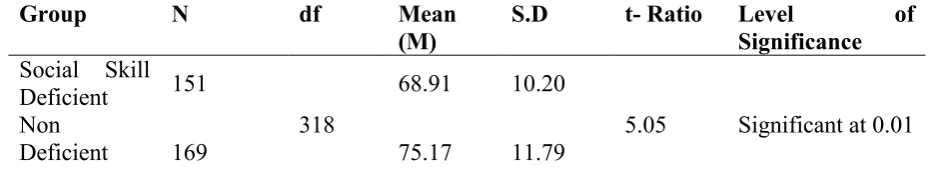
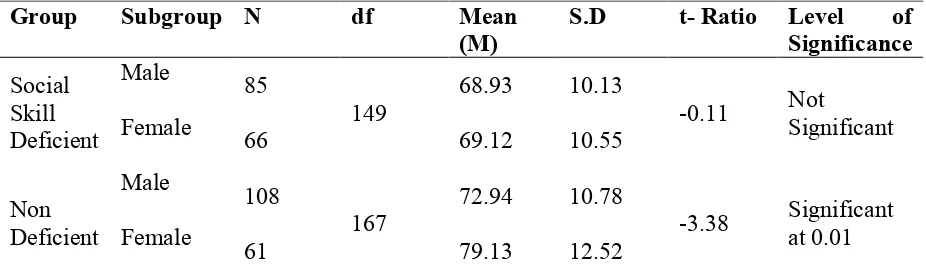
[image:4.595.64.529.434.528.2]The comparison between the academic achievement score of social skill deficient and non deficient school students is done in his section to see the dependence of social skills on the academic achievement of school students. The effect of gender (Male/Female) of students on the academic achievement of social skill deficient and non deficient school students is also studied. The results are presented in the Table 1 and 2.
Table 1: Significance of Difference in the Academic Achievement score of Non Deficient and Social Skill Deficient school students
Group N df Mean
(M)
S.D t- Ratio Level of Significance
Social Skill
Deficient 151
318
68.91 10.20
5.05 Significant at 0.01
Non
Deficient 169 75.17 11.79
It can be seen from Table 2 that Mean academic achievement scores of social skill deficient and non deficient students are 68.91 and 75.17 with standard deviations 10.20 and 11.79 respectively. The‘t’ value between two groups comes out to be 5.05. It is significant at 0.01 level of significance, leading to an inference that the social skills play very important role in deciding the academic achievement of school students. So null hypothesis H01, that “there is no difference between social skill deficient and non deficient school students on academic achievement” is rejected.
SEPT-OCT, 2015, VOL-I, ISSUE-III www.srjis.com Page 183 Table 2: Significance of Difference in the Academic Achievement score of Non Deficient
and Social Skill Deficient school students on the basis of gender
Group Subgroup N df Mean
(M)
S.D t- Ratio Level of Significance Social Skill Deficient Male 85
149 68.93 10.13 -0.11 Not
Significant
Female 66 69.12 10.55
Non Deficient
Male 108
167
72.94 10.78
-3.38 Significant at 0.01 Female
[image:5.595.67.530.123.260.2]61 79.13 12.52
Table 2 compares the effect of gender (Male/Female) on the academic achievement score of social skill deficient and non deficient school students. The Mean academic achievement scores of Social Skill Deficient male and female students are 68.93 and 69.12 with standard deviations 10.13 and 10.55 respectively. The ‘t’ value between male and female social skill deficient students comes out to be -0.11. It is not significant at 0.05 level of significance. It indicates that male and female groups of social skill deficient students did not differ significantly on academic achievement. So the null hypothesis (H02) that “there is
no difference in academic achievement of male and female students among the social
skill deficient group” is accepted.
It is clear from lower part of Table 2 that Mean academic achievement scores of Non Deficient male and female school students are 72.94 and 79.13 with standard deviations 10.78 and 12.52 respectively. The ‘t’ value between two groups comes out to be -3.38. It is significant at 0.01 level of significance. It shows that in case of non deficient school students, their gender (male/female) plays significant role on their academic achievement. The comparison of mean scores further reveals that mean academic achievement score of Non Deficient female students is higher than the Non deficient male students. It indicates that female non deficient school students perform better academically than Non deficient male students. So the null hypothesis (H02) that “there is no difference in academic achievement of male and female students among the non deficient group” is rejected.
FINDINGS OF THE STUDY
SEPT-OCT, 2015, VOL-I, ISSUE-III www.srjis.com Page 184 2. Male and female groups of social skill deficient students did not differ significantly on academic achievement.
3. The comparison of mean scores further reveals that mean academic achievement score of Non Deficient female students is higher than the Non deficient male students. It indicates that female non deficient school students perform better academically than Non deficient male students.
EDUCATIONAL IMPLICATIONS
The findings of the study can be used by parents, teachers and planners while planning about the education of children in following manner. Teachers can make use to these findings to assess the social skills of school students to plan some activities or training programs for students to improve their social skills.
REFERENCES
Bursuck, W. D., & Asher, S. R. (1986). The relationship between social competence and achievement in elementary school children. Journal of Clinical Psychology, 15, 41– 49.
Çelik N (2007). The effects of social skills training on social adjustment of elementary school students. Master dissertation. Dokuz Eylül University, _zmir, Turkey.
Coie, J. D., & Krehbiel, G. (1984). Effects of academic tutoring on the social status of low
achieving, socially rejected children. Child Development, 55, 1465‐1478.
Elliott, S. N., Gresham, F. M., Freeman, T., & McCloskey, G. (1988). Teacher and observer ratings of children’s social skills: Validation of the Social Skills Rating Scales.
Journal of Psychoeducational Assessment, 6, 152‐161.
Hay, D. F. (1994). Prosocial development. Journal of Child Psychology and Psychiatry, 35, 29-71.
Kagitcibasi C (1996). Human and humans. Istanbul: Evrim Yayinlari.
Kabasakal Z, Çelik N (2010). The effects of social skills’ training on elementary school students’ social adjustment. Elementary Education Online, 9(1): 203-212.
Mara Welsh, Ross D. Parke (2001). Linkage between childrens social and academic competance, Journal of School Psychology, Vol 39, No. 6, pp 463-481, 2001.
SEPT-OCT, 2015, VOL-I, ISSUE-III www.srjis.com Page 185