Structure, Agency and Intersubjectivity: Re-capturing the EMU
Policy Process in a Constructivist Realist Framework
Andreas Gofas
Department of Politics and International Studies University of Warwick, UK
Paper prepared for the 2ndworkshop of the European Political-economy Infrastructure Consortium, May 2002.
Abstract
After a period of neglect, if not hostility, toward ideational explanations, it is now considered a truism that the study of ideas should be incorporated into our analysis. Indeed, contemporary international and European studies scholarship is awash with talk of ‘ideas’. However, and despite the fact that this rise in interest indicates a state of good theoretical health, the debate seems to be evolving around polemics between ‘ontological terrorists’ and ‘methodological opportunists’.
Introduction
After a period of neglect, if not hostility, toward ideational explanations we are now faced with a burgeoning literature on the role of ideas. As Jacobsen (1995: 283) notes, it now seems obligatory for every work in international and European political economy to consider the ‘power of ideas’ hypothesis –even if only then to dismiss it. Indeed, even Moravcsik (2001: 185), the most materialist student of European integration, now concedes that ‘[s]urely few domains are more promising than the study of ideas in the process of European integration’.
At the same time, and despite the fact that this rise in interest indicates a state of good health for integration theory, the debate seems to be evolving around polemics between ‘ontological terrorists’ and ‘methodological opportunists’, with the former engaging exclusively in a re-conceptualisation of social reality, presumably under the assumption that our social ontologies can provide ready-make solutions to all of our questions, and the latter suggesting an eclectic pragmatism which, in its attempt to have the best of all worlds, slides via instrumentalism into a marriage of inconsistent premises1(Archer, 1995: 5).
This paper takes issue with the above theoretical morass, through a re-examination of the EMU policy-process. Its principal contention is twofold. First, that we cannot escape the morass of the current state in the examination of the role of ideas without recognising the connection between ontology, methodology and practical social theory and ensuring consistency between them (Archer, 1995). Second, that the EMU
1
policy-process should be re-captured as a socio-cultural cycle (Marcussen, 2000) that took off in the early 70s and unfolded in three phases –social structuring; social interaction and social elaboration (Archer, 1995)- until firmly institutionalised in the Maastricht Treaty.
The argument is developed in two main parts. After briefly outlining the utility, as well as the associated dangers, of meta-theoretical engagement, I review the inherent deficiencies of the rationalist-inspired reading of ideas, associated mainly with the neoliberal agenda. Then, I examine the constructivist challenge to this approach and find it, despite its multiple insights and clear advancement, wanting. I conclude the first part by outlining the main assumptions of a constructivist realist approach. In the second part, I move down the ladder of abstraction in order to illustrate the utility of this approach through a re-examination of the EMU policy-process.
PART I.
Is Meta-Theory the Problem or the Solution?
Despite the fact that the constructivist language of mutual constitution is, as will be argued later, rather inappropriate for capturing the stratified nature of the EMU policy process, nonetheless the argument owes significant debts to the constructivist turn. It is then only appropriate to begin with a brief point on the main accusation raised against this scholarship.
As Moravcsik (2001) claims in his critique of constructivism, published in a state of the art volume on constructivism in EU studies (Christiansen, et al, 2001):
‘[despite the deployment of a] panoply of arguments drawn from ontology, social theory, epistemology, and philosophy of science…(185), [yet] …constructivists…have contributed far less to our empirical and theoretical understanding of European integration than their meta-theoretical assertions might suggest (177). Perhaps, then, an opposite view is worth considering, namely that meta-theory is not the solution but the problem’ (185-6, emphasis original).
In this section I want to argue with and against Moravcsik. I will argue with Moravcsik that constructivism cannot remain unapologetically a mere antagonist of rationalist-inspired theories at the ontological level. Engaging exclusively in a re-conceptualisation of social reality runs the risk of descending into an ontological extremism of the ‘you’d better believe it’ type. If the promise of the constructivist turn is to be fulfilled, then it has to move down the ladder of abstraction to address and systematically examine issues like how to clearly define ideational variables, the need to examine the socio-political and economic context that lends power to a specific set of ideas instead of another during a particular historical setting, and how to analyse the role of the ideational entrepreneurs and diffusion mechanisms at work.
empirical testing’ (Moravcsik, 2001: 186), but rather pointing out the impossibility of adopting ‘the standpoint of a second-order observer of [ontology’s] first-order accounts. Such standpoint …, is simply not suited to assessing the correctness of first-order accounts. It allows one to unearth their origins and to see their effects, but it lacks the criteria for judging their validity’ (Schmidt, 2001: 137).
Essentially, then, the argument comes down to the simple point that meta-theory is neither the problem nor the solution, and that although an exclusive engagement with ontological standpoints is problematic, ontology always lies at the beginning of any enquiry. But ontological exertions, important as they are, do not suffice, as ‘[t]he practical analyst of society needs to know not only what social reality is, but also how to begin to explain it…[In that sense], methodology, broadly conceived of as an
explanatory programme, is the necessary link between social ontology and practical theory.’ (Archer, 1995: 5, emphasis original).
The Neoliberal Agenda and the New Ideational Orthodoxy.
One of the responses that the recent challenge to the prevailing rationalist orthodoxy has seen, was an ideational turn within the ‘mainstream’ of the neoliberal agenda. However, although this turn has done a great service in redirecting our attention to neglected ideational factors, it has at the same time done a considerable disservice to the development of a genuine ideational research programme (Gofas, 2001). In this section, I want to argue that this disservice is due to three main reasons –the retaining of the rationalist bias of keeping ideas and interests separated; the deployment of a
2
methodology that does exactly the same; and the focus on the individual, rather than structural, properties of ideas3.
The Goldstein-Keohane (1993) volume offers probably the most systematic and thoughtful statement of a rationalist inspired treatment of how ideas influence foreign policy. However, despite their stated aim to challenge rationalism (Ibid.: 6), their approach is firmly anchored to it. Suffice to quote their analytical departure point, where the ‘null hypothesis [is]: that variation in policy across countries, or over time, is entirely accounted for by changes in factors other than ideas’ (Ibid.: 6, emphasis original). In effect, ideas are brought into the analysis only when and if an interest-based explanation is insufficient, reducing them into a deus ex machina variable that either ‘mops up’ residual variance or deals with discomfort deficiencies of existing research programmes.
Considering the firm anchoring of this agenda to a rationalist framework, small wonder why the associated proposed methodology of counterfactual argumentation does nothing more than retaining the separation of ideas and interests. For instance, Goldstein (1993) utilised a deductive counterfactual method to determine the degree to which ideas rather than interests affected US trade policies historically. She begun by deducing the policies actors would pursue if they simply followed their exogenously given interests, as derived from structural imperatives. Then she compared actual policy outcomes against this deduced counterfactual and argued that the difference, if any, between the counterfactual prediction and real policy outcome was attributable to the degree to which ideas rather than interests were determinant.
rationalist-However, deducing the interests of actors from structural imperatives can be misleading, as the crucial question is why actors interpreted a structural imperative the way they did (Campbell, 2000). In Adler’s (1997: 332) words this line of thinking is:
‘…like looking at the contents of a room through a tiny window. For what is at stake here is actually the construction, by collective beliefs about [trade policies, of USA’s identity], and the explanation of the role of social actors,…in constructing these identities in the first place. The interesting question is whether and how [economic beliefs]…are becoming not only regulative injections designed to overcome the collective action problems associated with interdependent choice, but also constitutive, a direct reflection of the actors’ identity and self-understanding’.
The third and final problem with the neoliberal agenda is the focus on the individual, i.e., the ideas that people hold in their heads, rather than structural properties of ideas. In doing so, they omit the social context of ideas and neglect the fact that ideas exist as collective knowledge structures that are connected to, but are irreducible to, the actors who draw upon them.
The Constructivist Approach.
Against this background emerged an interest in constructivism which called into question both the positivist underpinnings of the mainstream in IR and IPE and the inherent deficiencies of the rationalist inspired reading of ideas. This is not the place to discuss this varied scholarship that should be understood as a new arena of contention, rather than a homogenous turn4. Nonetheless, and with regard to the previous discussion, most constructivists have long argued that we should eschew
thinking in the oppositional terms implied by the polarisation of ideas- versus interest-based approaches, as the question is how the two are related, rather than which of the two is more important. Secondly, constructivists have turned the focus from the individual to the structural properties of ideas; that is from subjectivity to intersubjectivity. As Adler (1997: 327) puts it: ‘intersubjective meanings are not simply the aggregation of the beliefs of individuals…Rather, they exist as collective knowledge…This knowledge persists beyond the lives of individual social actors, embedded in social routines and practices as they are reproduced by interpreters who participate in their production and working’.
However, despite the above insights that constitute a real advancement from the deficiencies of the neoliberal agenda, yet three problems preclude the constructivist approach from delivering its full potential. These are the inconsistency of the middle ground that constructivists claim to occupy; the analytically unworkable and conflationary conceptualisation of the relationship between structure and agency as mutually co-constituted; and a lack of focus on the stratified nature of knowledge structures.
The constructivist claim of occupying the middle ground finds its clearest expression in the work of Wendt (1999; see also Adler, 1997 and Checkel, 1997), who is constantly in the bridge-building business of rationalist and relativist theories of international relations, and clearly positions himself ontologically with the post-positivists and methodologically with the post-positivists. However, considering the fundamental differences of the two opposing poles that Wendt is trying to bridge, his
effort is becoming more of a rhetorical gesture to marriage inconsistent premises, rather than a synthesis.
Secondly, it must thus far have become obvious how important the relationship between structure and agency is for an ideational approach, considering the understanding of ideas as knowledge structures that are above the aggregate of individual beliefs. However, the constructivist (informed by Giddens) conceptualisation of structure and agency as mutually constitutive is analytically unworkable and leads to what Archer (1995, esp. ch.4) has called conflationary theorising.5 That is because the core notion of structure as the simultaneous medium and outcome of action precludes examination of their interplay (Ibid.).
The third and final reason that prohibits constructivism from delivering its full potential is the lack of focus on the stratified nature of knowledge structures. Ideas do develop structural properties as the constructivists argue, but these are usually of different qualities. As will later become clear, focus on the stratified nature of reality is imperative as different knowledge structures or discourses define different aspects of social reality.
Towards a Constructive Realist Approach.
A constructive realist approach is committed to a linking of ideas in a non-conflationary discussion of structure and agency. In that sense, it owes equal debts to
(2001) in the Christiansen et al (2001) volume on constructivism would suffice for the point and for revealing the differing degrees of constructedness that various constructivisms are willing to admit.
5Archer (1995) identifies three modes of conflationary theorising: upwards and downwards conflation,
constructivism and critical realism.6 The purpose of this section is to briefly outline the departure point and main assumptions behind such an approach.
Critical realism7, the principle of emergence and the central part of ideas in social reality are the ontological points of departure. According to Patomaki and Wight (2000: 223), one of the distinctive features of critical realism, as opposed to empirical realism (where reality is only what is perceived empirically) or linguistic realism (where reality is only what is spoken), is that ‘…the world is composed not only of events, states of affairs, experiences, impressions, and discourses, but also of underlying structures, powers, and tendencies that exist, whether or not detected or known through experience and/or discourse’. An important caveat is in order here. The argument (at least as I read it and in the way that I invoke it) does not make claims to a reality ‘out there’ in a more or less positivist notion, but stems from an anxiety with the anti-realist anthropocentricism that denies any status to structures by collapsing them into the actions of the actors who draw upon them.
The above point speaks directly to and points out the stratified nature of reality, which brings the issue of emergence. The principle of emergence can be boiled down to the simple point that what emerges out of the interaction of two or multiple units possesses properties that are irreducible to its constituent parts. This is important if we recall the previous discussion about the subjectivity of the neoliberal approach and the intersubjectivity of the constructivist. The principle of emergence tells us that
6
There is always a danger in allowing yourself to be inspired by such different sources as constructivism and critical realism, as there is an on-going and unsettled discussion (which has not though yet reached IR) regarding the compatibility of the two.
7 Not to be conflated with realism in political theory or IR. Actually, according to a critical realist
although knowledge structures emerge out of interaction of individual ideas, they nonetheless possess properties that are above and irreducible to these ideas.
The last point is that the issues of the material and the ideational and of structure and agency cannot be separated (Hay, 1999). That is simply for two reasons. Firstly, as already outlined, we have to pay attention to the structural properties of ideas, and in that sense conceptualise their relationship with the actors who draw upon them in a structure and agency problematic. Secondly, because ‘between international structures and human volition lies interpretation. Before choices… can me made, circumstances must be assessed and interests identified’ (Adler and Haas, 1992: 367). This interpretation, in turn, depends on prevailing discourses and knowledge structures (not just on the ideas that actors hold, as Adler and Haas have it). In effect, the material and the ideational has to be viewed ‘…as a whole. A whole that is necessary to investigate as an integral system with all its necessary interconnections, not as isolated fragments torn out of context’ (Patomaki and Wight, 2000: 235).
Finally, in studying the interplay between structure and agency, I follow Archer’s (1995) methodological approach of analytical dualism, which is based on two basic propositions:
i) that structure necessarily pre-dates the action(s) leading to its reproduction or transformation;
ii) that structural elaboration necessarily post-dates the action sequences which gave rise to it. (Ibid.: 15).
character of a cycle which involves three phases, 1) structural conditioning, 2) social interaction, and 3) social elaboration.
The purpose of the remaining is to illustrate the utility of these abstract remarks, by attempting to re-capture the EMU policy process as an ideational cycle that involved these three phases and where different, but interrelated, ideas were at work in each phase.
PART II.
Bringing Ideas Back In (Yet Once Again).
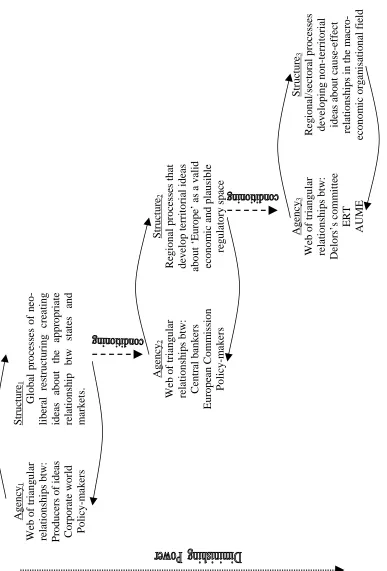
The main purpose of this part is to argue that the ideational content of EMU is more than the product of policy learning and institutionalised interaction between three mutually constituted actors –national policy makes, the EC and monetary experts- as the constructivist insight about idea diffusion would have it (Gofas, 2001). That is because the ideas that EMU amalgamates i)function at different levels, ii)create emergent structural properties of different qualities and iii) develop at different time-spans (Ibid.). The argument can be schematically presented in the following figure.
Insert figure 1 about here.
where the knowledge structures developed (through the interaction of the main agents involved at this level) are both enabling and constraining action at the lower levels. At the meso-level actors interpret reality on the basis of the knowledge structures at the macro. At the same time though, at this level (which represents the phase of social interaction) new (yet of course interrelated) knowledge structures emerge out of the interaction of the agents involved at this phase. Finally, the micro-level represents the final phase of the cycle, which although most restrained of all does still produce its own discourses.
We already showed the importance of analytical dualism, as knowledge structures at the macro-level pre-date action at the meso, and the final phase at the micro-level post-dates actions at the meso-level. But there is an additional reason for which the knowledge structures are presented at different levels, and this reason was to do with the principle of emergence. I argued that the ideas developed at each phase represent emergent properties of different qualities. By that I mean that the power of discourses diminishes as we move down the phases of the ideational cycle. In this respect, it is becoming clear that power in this analysis is the ability of actors at higher/previous phases of the cycle to create collective cognitive certainties on the basis of which actors at lower levels or later phases interpret the context at the higher level or previous phase.
dimension of the wider discourse of disciplinary neo-liberalism [,that seeks] to separate economic policies from broad political accountability in order to make governments more responsive to the discipline of market forces, and correspondingly less responsive to popular democratic forces and processes’ (Ibid.: 47). What is important to note about this discourse is that it is involved in a redefinition of principles of political action and accountability, and a redefinition of the ‘appropriate’ relationship between states and markets.
Second, at the meso-level territorial ideas about ‘Europe’ and globalisation as the EU’s external economic environment (neo-liberal restructuring at the macro-level) are the most important and help to construct a particular notion of ‘Europe’/the EU as a valid economic and plausible regulatory space (Rosamond, 1999). Indeed, as Rosamond (1999) argues, although ‘globalisation’ is not uncontested within European policy circles, and despite the fact that its usage as a signifier of the changing economic environment entered rather recently the European discourse, nevertheless ‘much Commission discourse from the late 1980s was heavily concerned with making a linkage between external economic conditions and the need to give meaning to the European level of action’ (Ibid.: 661).
Finally, at the micro level non-territorial ideas about cause-effect relationships in the macro-economic organisational field are at work. At the last phase of the cycle we see an institutionalisation of the abandonment of the notion that there is a trade-off between inflation and unemployment and, hence, an exploitable Phillips curve8. The
8As Radaelli (1999b: 83, nt.37) notes, it is indeed interesting to point out that ‘the Phillips curve stems
new belief was that inflation was a monetary phenomenon and that price stability was the foundation for growth. In other words, ‘sound’ policy was now understood as rigid budgetary policies and low inflation.
To sum up the argument so far, the ideational dimension of EMU is more than a mere amalgamation of different sets of ideas. For the purposes of the argument, we can consider the neo-liberal ideas of global restructuring and the territorial ideas about ‘Europe’ as the appropriate arena for the management of the region’s political economy and for the construction of a public sphere, as creating a first web of intersubjective meanings that defines the boundaries of the politically acceptable, while the non-territorial ideas about cause-effect relationships in the macro-economy create a second web of intersubjective meanings that defines the technically feasible9. The point that I am trying to make is not just that the ideational dimension of EMU is the outcome of the interaction, a mere amalgamation, between these two webs of intersubjective meanings. By creating the realm of the politically acceptable, the first web of intersubjective meanings limits the possibilities of action in Europe and, in effect, ‘selects’ the non-territorial ideas that will find their way to policy-making.
However, although ideas develop emergent structural properties that are irreducible to the aggregate of individual beliefs or to the actors who draw upon them, nonetheless ideas/knowledge-structures need individuals/actors. As this suggests, ‘an analysis which confines itself exclusively to discourses…is overtly structural, giving insufficient attention to the active and frequently creative role of agents in the
9 I borrow the distinction of the EMU policy process between political acceptability and technical
formulation of ideas which may become sedimented as discourses’ (Hay and Rosamond, 2000: 21). In effect, this inevitably demands an examination of the main actors involved at each phase.
Before doing so though a brief point on one more conclusion that can be drawn from the analysis so far. Social action and agency are social conditions, since we have to emphasise that ideas/discourses not only ‘tell us what we should do; they also nominate who are the key agents in any given social situation’ (Rosamond, 2001: 204). So, agents at the meso- and micro-level become important because there is a widespread intersubjective understanding that indeed they are important (Ibid: 205). Agents at the macro-level become important because of residual intersubjective understandings from previous ideational cycles. ‘Moreover these collective cognitive certainties contribute to the material importance of [these actors]. Onuf observes that structures –or ‘social arrangements’ as he prefers to dub them- are made concrete by actors through the manufacture of congruent institutions’(Ibid.: 205)10.
Who transfers the EMU ideas?
The main actors at the macro-level (or in the phase of structural conditioning) are hard to identify, for as Gill (2001: 48) says they ‘are not confined to haute finance…[and] are broad-based, and cut across social classes’. Nonetheless, we can say that a web of triangular relationships between producers of ideas, corporate America and Europe, and Washington and European policy-makers were at work in this initial phase of the EMU ideational cycle.
At the meso-level, we see again three main actors involved: the European Commission (EC), national-policy-makers, and central bankers. Let us examine their role in brief.
The European Commission and Delors.
As Radaelli (1999a: 768-9, emphasis in original). argues, we have to reject “the ‘anthropomorphic’ view of knowledge…[as] knowledge has less to do with specific actors than with the structure in which actors act.” Indeed, as an institutionalist
approach would point out the key issue is whether the actors who hold specific ideas are in position to transmit them through institutional channels into influential policy-making arenas. So, an investigation of the role of the Commission should begin with an examination of the structural conditions within which it and, especially its President, found themselves.
Pollack has concluded that one important determinant of supranational autonomy is uncertainty. Hence, ‘the influence of a supranational entrepreneur is greatest when member governments have imperfect information and are uncertain of their own policy preferences and when supranational institutions posses more information and clear preferences; in these circumstances, entrepreneurial institutions may provide focal points around which the uncertain preferences of the member governments can converge.’ (Pollack, 1997: 130).
sets of ideas.
10
In this respect, the EMU case provided a lot of fertile ground for an entrepreneurial role on behalf of the Commission because of the high uncertainty surrounding the project. Indeed, as McNamara notes, ‘there is little agreement within the economics profession on a ‘benchmark’ model for analysing the distributional effects of alternative monetary regimes’ (McNamara, 1998: 58, referring to Giovanini).
Having said that, we have to note that the ability of the Commission and Delors to influence the course of events was crucially circumscribed because of various reasons. First, besides the legal limitations on the EC because it has no competence on monetary issues and despite the fact that Delors tried to establish an informal cross-national network on EMU to provide him with the necessary intellectual support, ‘the Commission did not possess the depth of financial and monetary expertise comparable to that to be found in the national central banks and finance ministries’ (Dyson and Featherstone, 1999: 692). Hence, although the first part of Pollack’s hypothesis seems to be at work the second does not, as one could hardly argue that the Commission possessed more information on the EMU issue than the member states.
Second, although Delors ‘had a much wider conception of an EMU based on strong economic-policy co-ordination that incorporated ideas of structural adjustment as well as of fiscal policy’ (ibid.: 697), his ability to cognitively influence the project was constrained by the fact that the EMS had been transformed into a de facto Deutsche-mark zone and by the intellectual ascendancy of the German ideas (Dyson, 1994).
(1999: 695-706) call an informal ‘presidentialisation’ of power in the EC, the multicultural character of the Commission could not but undermine its cohesiveness.
However, having rejected the ‘anthropomorphic view of knowledge’, we should caution not to descend to the other extreme, that of an institutional/structural fatalism which ignores the fact that ‘the ability of elites to transport an idea into influential arenas may turn on their ability to package and frame it successfully in the first place’ (Campbell, 1998: 381).
The European Central Bankers.
Their role should not be restricted to their participation in the so-called Delors’ Committee and the drafting of the EMU blueprint (which after all is at a later phase in the EMU cycle). Rather their role as ideational entrepreneurs and constructors of (the narrower meso-level) economic reality was more important in the aftermath of the economic crisis of the early 1980s (Marcussen, 2000). Taking again both structure and agency into account they were able to promote the monetary orthodoxy of a deflationary zeal for the following reasons. As Marcussen (2000: 57-61; see also Dyson et al, 1998) argues, there were three decisive factors that influenced the power of central bankers: the liberalisation of financial markets, which although undermined their power in relation to markets it increased it in relation to their governments which were forced to rely increasingly on them; European monetary integration, which limited their room for manoeuvre but enmeshed them more closely to the policy-making process; and the development of a coherent transnational central bank culture. On the level of their agential ability to act as ideational entrepreneurs, their
power lied -to borrow from Haas’s (1992) definition of an epistemic community- on their recognised expertise and competence in the macro-economic field and their authoritative claim to policy-relevant knowledge within that field.
National Policy-Makers and the Franco-German Axis.
only in an attempt to neutralise potential opposition from them that would jeopardise the whole project, but also ‘because they already knew what they would get in turn from such a committee’ (Marcussen, 2000: 121). This implies that an ideational consensus around ‘sound’ money and finances had already been established before establishing the Delors’ Committee, which signifies the launching of the last phase in the EMU cycle.
Space limitations preclude us from examining the actors at the micro-level who, as indicated in the schema, are the Delors’ Committee (see for example Verdun, 1999, who argues in favour of analysing it in terms of an epistemic community at work); AUME (the Association for the Monetary Union of Europe; see for example Sherrington, 2000 who argues that AUME was an interest-group with think-tank capacities); and the European Roundtable of Industrialists (ERT; see the work of van Apeldoorn, 2001).
By Way of Conclusion.
paper are more forcefully explored and the mediating connections between these levels conceptualised and empirically demonstrated.
References.
Adler, E. (1997) “Seizing the Middle Ground: Constructivism in World Politics,” European Journal of International Relations, 3:3, 319-63.
Adler, E. and Haas, P. M. (1992) ‘Conclusion: epistemic communities, world order, and the creation of a reflective research program,’ International Organisation, 46:1, Special Issue, pp.367-90.
Archer, M. S. (1995) Realist Social Theory: The Morphogenetic Approach (Cambridge: Cambridge University Press).
Campbell, J. L. (1998) ‘Institutional Analysis and the Role of Ideas in Political Economy,’ Theory and Society, 27, pp.377-409.
Campbell, J. L. (2000) ‘Convincing the Sceptics: Six Questions for Ideational Analysis,’ Paper presented at the conference on ‘Ideational Institutionalism: Perspectives on European Politics,’ University of Birmingham.
Checkel, J. T. (2001) ‘Social Construction and European Integration,’ in Christiansen, T.; Jorgensen, K. E. and A. Wiener, eds.
Checkel, J. T. (1997) “International Norms and Domestic Politics: Bridging the Rationalist-Constructivist Divide,” European Journal of International Relations 3:4, 473-95.
Christiansen, T.; Jorgensen, K. E. and A. Wiener, eds. (2001) The Social Construction of Europe (London: Sage).
Diez, T. (2001) ‘Speaking ‘Europe’: The Politics of Integration Discourse,’ in Christiansen, T.; Jorgensen, K. E. and A. Wiener, eds.
Dyson, K. (1994) Elusive Union: The Process of Economic and Monetary Union in Europe (London: Routledge).
Dyson, K. and K. Featherstone (1999) The Road to Maastricht: Negotiating Economic and Monetary Union (Oxford: Oxford University Press).
.
Fligstein, N. and Mara-Drita, I. (1996). ‘How to Make a Market: Reflections on the Attempt to Create a Single Market in the European Union,’ American Journal of Sociology, 102:1, 1-33.
Gill, S. (2001) ‘Constitutionalising Capital: EMU and Disciplinary Neo-Liberalism,’ in A. Bieler and A. D. Morton, eds. Social Forces in the Making of the New Europe (New York: Palgrave).
Gofas, A. (2001) ‘Ideas and Interests in the Construction of EMU: Beyond the Rationalist Bias of the New Ideational Orthodoxy,’ CSGR Working Paper Series, No. 76/01.
Goldstein, J. (1993) Ideas, Interests and American Trade Policy (Ithaca: Cornell University Press).
Goldstein, J. and R. O. Keohane (1993) ‘Ideas and Foreign Policy: An Analytical Framework,’ in J. Goldstein and R. O. Keohane, eds. Ideas and Foreign Policy: Beliefs, Institutions and Political Change (Ithaca: Cornell University Press). Haas, P. M. (1992) ‘Introduction: epistemic communities and international policy
coordination,’ International Organisation, 46:1, Special Issue on epistemic communities, pp.1-35.
Hay, C. (1999) ‘What Place for Ideas in the Structure-Agency Debate? Globalisation as a ‘Process Without a Subject’,’ Paper presented at the annual conference of the British International Studies Association.
Hay, C. and B. Rosamond (2000) Globalisation, European Integration and the Discursive Construction of Economic Imperatives,’ IPSA XVIII World Congress of Political Science, Quebec City; forthcoming in Journal of European Public Policy.
Jabko, N. (1999) ‘In the name of the Market: how the European Commission paved the way for monetary union,’ Journal of European Public Policy, 6:3, pp.475-95. Jacobsen, J. K. (1995) ‘Much Ado About Ideas: The Cognitive Factor in Economic
Policy,’ World Politics, 47, pp.283-310.
Laffey, Mark and Jutta Weldes. (1997) ‘Beyond Belief: Ideas and Symbolic Technologies in the Study of International Relations,’ European Journal of International Relations 3:2, 193-237.
Marcussen, M. (2000). Ideas and Elites: The Social Construction of Economic and Monetary Union (Aalborg: Aalborg University Press).
.
Moravcsik, A. (2001) ‘Constructivism and European Integration: A Critique,’ in Christiansen, T.; Jorgensen, K. E. and A. Wiener, eds. (2001) The Social Construction of Europe (London: Sage).
Onuf, N. G. (1998) ‘Constructivism: A User’s Manual,’ in V. Kubalkova, N. Onuf and P. Kowert, eds. International Relations in a Constructed World (Armonk, N.Y.: M.E. Sharpe).
Patomaki, H. and C. Wight (2000) ‘After Postpositivism? The Promises of Critical Realism,’ International Studies Quarterly, 44, 213-37.
Pollack, M.A. (1997) ‘Delegation, agency, and agenda setting in the European Community,’ International Organisation, 51:1, pp.99-134.
Radaelli, C. M. (1999a) ‘The Public Policy of the European Union: whither Politics of Expertise?’ Journal of European Public Policy, 6:5, pp. 757-774.
Radaelli, C. M. (1999b) Technocracy in the European Union (London: Longman). Rosamond, B. (2001) ‘Constructing Clobalisation,’ in K. M. Fierke and K. E.
Jorgensen, eds. Constructing International Relations: the next generation (Armonk, N.Y.: M.E. Sharpe).
Rosamond, B. (1999) ‘Discourses of globalisation and the social construction of European identities,’ Journal of European Public Policy, 6:4 (special issue), pp.652-68.
Sandholtz, W. (1993) ‘Choosing union: monetary politics and Maastricht,’ International Organisation, 47:1, pp.1-39.
Schimdt, V. H. (2001) ‘Oversocialised Epistemology: A Critical Appraisal of Constructivism,’ Sociology, 35:1, 135-57.
Sherrington, P. (2000) ‘Shaping the Policy Agenda: Think Tank Activity in the European Union,’ Global Society, 14:2, 173-189.
Van Apeldoorn, B. (2001) ‘The struggle over European Order; Transnational Class agency in the Making of ‘Embedded Neo-Liberalism,’ in A. Bieler and A. D. Morton, eds. Social Forces in the Making of the New Europe (New York: Palgrave).
Verdun, A. (1999) ‘The role of the Delors Committee in the creation of EMU: an epistemic community?’ Journal of European Public Policy, 6:2, pp.308-328. Wendt, A. (1999) Social Theory of International Politics (Cambridge: Cambridge