RIT Scholar Works
Theses
Thesis/Dissertation Collections
2002
Mobile computing & law enforcement: An
Examination of its application in the field and its
consequences
Lanny Lockhart Jr
Follow this and additional works at:
http://scholarworks.rit.edu/theses
This Thesis is brought to you for free and open access by the Thesis/Dissertation Collections at RIT Scholar Works. It has been accepted for inclusion in Theses by an authorized administrator of RIT Scholar Works. For more information, please [email protected].
Recommended Citation
Examination of Its Application in the Field and Its
Consequences
By
Lanny Lockhart, Jr.
Thesis submitted in partial fulfillment of the requirements for the
degree of Master of Science in Information Technology
Rochester Institute of Technology
B. Thomas Golisano College
Of
Computing and Information Sciences
Thesis
Reproduction
Permission
Form
Rochester Institute of Technology
B. Thomas Golisano College
Of
Computing
and
Information Sciences
Mobile Computing & law Enforcement:
An
Examination of Its Application in the Field and
Its
Consequences
I. lanny
Lockhart, Jr., hereby grant permission to the
Wallace
Library of the
Rochester Institute of Technology to reproduce my thesis in whole or in part.
Any reproduction must not be for commercial use or profit.
Capstone Thesis Approval Form
Student Name:
Student Number:
Thesis Title:
Lanny Lockhart, Jr.
Mobile Computing
&
Law Enforcement:
An
Examination of Its
Application
in
the Field and Its Consequences
Thesis Committee:
Name
Prof. Steve Jacobs
Chair
Signature
Date
7
Dr. John Klofas
Committee Member
,"-P",-,ro=f,,-,.L=a="V",-,e=m=e.=..:M=c"""O"u=i=ll=er,--W"""-,-,,,i=lh='a=m=s'--
...:v/;_(_0~~
2-Committee Member
The
following
studyhas been
conductedinthepursuitofaMasters Degree ofScience inInformation
Technology.The functionalpurpose
ofthisstudywasto examinethree basicconcepts (officerefficiency, safety, and arrestrates)within
law
enforcementandtoattemptto
determine
if
aspecifictypeofinformationtechnology
(wirelessdata
computers)
has had
anypositive impactonthoseconcepts. Tothat end, the authorhas
reviewedthe
history
oftechnologyinlawenforcementand surveyed agroupofpatrolofficersinthe Wilmington Police Department. Difficultiesassociatedwithgathering
researchdatafrom lawenforcementagencies
has
also beennotedanddescribed. TheAnumberof people
have
contributed,directly
andindirectly,
to this project, andIthankallofthem.
Firstof all
is
thelate Dick
Lewis.He
set me onthispathoh somanyyears ago,andImiss
him dearly.
Specialthanks toDr. John Klofaswhopickedup Dick'smantleand
has been burdened
with me ever since. Hehasplacedmanyopportunities
before
me,andIamthankfulfor
eachofthem.
Steve
Jacobs is gratefullyacknowledgedfor
dutiesaccepted andgraciouslycarried out asthisproject
has
stumbledonmorethanone occasion.Arespectfulnod
is
givento the Criminal Justicefaculty
ofRITfor
providingme withtheacademictoolsneededto succeedin mychosenprofession. WithouttheireffortsIwould
not
be
whereIamtoday.Anothernod
is
presentedtoProf. Elizabeth L.Lawley
for
her Defenseinput
whichhasstrengthenedthisdocumentandthisresearcher.
Tothe
late
GeneRoddenberry
for
creatingauniversethatstartedmylove
affair withtechnology.
Mostof alltomy beloved
bride
Joy,
whoselove,
support,and goodhumor
weretheAPPROVAL
PAGEii
ABSTRACT
iii
ACKNOWLEDGEMENTS
ivDEDICATION
vTABLE
OFCONTENTS
viLIST
OF TABLES
viiiLIST
OFDIAGRAMS
ixINTRODUCTION 1
LITERATURE REVIEW 3
Historical Overview 4
INITIAL RESEARCH DESIGN 11
TECHNOLOGY ASSESSMENT 15
Cellular Digital Packet Data
(CDPD)
15Wilmington Police Department
&
Wireless DataTechnology
21METHODS
23
Population
23
Sampling
Method24
Survey
DesignandScale
24
Methods of
Statistical Analysis
25
RESULTS
26
Reliability
26
CONCLUSIONS
36
Findings
36Impact
ofResearch
37
Project
Weaknesses
38Discussion
39
Areas
ofFuture Research 43REFERENCES 46
APPENDTX A: The
Survey
Instrument 49APPENDIX B: The Revised
Survey
Instrument 58APPENDIX C: DAT File 66
APPENDIX D:
COMMAND
File 67APPENDLX E:
Codebook
721
Technology
Adoptionin
the PoliticalEra
5
2
Technology
Adoptionin
the ReformEra
6
3
Technology
Adoptionin
theCommunity
Era 104 Technological and Departmental Selection Criteria 12
5 Disadvantages of using CDPD 19
6
Benefits of using CDPD 207 Wilmington Police Department Hardware and
Operating
System Details.... 228
RELIABILITY Output for Quesl - Ques21 269
Race of Respondent 2710 Education of Respondent 28
11 QUES8 'MDT's ease of
operation...'
30
12 QUES21
'Overall,
the adoption ofMDT'shas
made you feelsafer...'
31
Introduction
The
United States
criminaljustice
system,particularlythatofthe1990s,
haseasily
been
one ofthemosttechnologically
advanced such systemsin
theworld.Examples include:
Police
helicopters
areusinginfrared
sensorsto track suspects;Patrolcarsare carryingvideo camerastomonitor
both
officersandsuspects, andtherecorded
imagery
is
being
usedtogood effectincourts acrossthecountry(Seaskate, Inc.,
p.60);
Officersnow wearthe
latest
body
armor andcarryanumberofdifferentless-than-lethalandlethalweapons;
Thetime-honoredcrime-fightingmethod of
fingerprinting
hasevolvedintohighly
effectiveAutomated Fingerprint Identification Systems(AFIS)
allowingpolice officers greater
flexibility
and speedinidentifying
suspects1;andDNA
testing
has
aidedin
countless cases wherelittle
otherphysical evidence wasavailable.
The
mostrecenthigh-techadditionfor
policeofficershas beenwireless notebookcomputers. These
devices
arenowbeing
installed
inpatrol cars acrosstheUnitedStates,
and officers areconnectingto criminal
justice databases
withouttheassistance ofdispatchers.
For manyyears,
fingerprinting
was asolitaryartrequiringa significant amount oftimeandexpertiseforpoliticians often citethemarvels of wireless
data
technology
to thecriminaljusticecommunity in
press ads and atmarketingdemonstrations
(CapitolConnections,
2000).Police
officials acrossthecountryoftenhearofincreasesin
officerefficiency, arrestrates,andsafetyasaresult oftheuse ofthis
technology,
but
fewfacts
arepresentedtosupporttheseclaims. Onthe surface,itwould make sensetoexpect an
increase in
anyofthese threeareasthroughtheadvent of moderncomputing
technology,
particularlyin
apaperwork-driven environment such as policework. Since
few
scientific studieshave
beenconductedtoexaminetheimpactof
information
technology
rolloutsin
thefield
oflaw
enforcement, itis
of vitalimportancetothecriminaljusticefield for
theactualefficiency
increases
tobedetermined.
Most,
if
notall,modernpoliceagencies arefacing
shrinking
budgets,
andcanill
affordtospend allottedtaxdollarsonflashy,
but
ineffective
technology. Policeofficialshave
tobewellinformed beforethey
decide
topurchase expensive computer systemsthatwill
be
more of ahindrancethanabenefit
andthatcannot
be
easilyreplaced.Tothat end, thisresearcher
has begun
investigating
thecurrent state of affairsin
the
field
oflawenforcementwithregardto theusageof mobilecomputingtechnology.Whereappropriate, the
technology
ofpreferencehas
beenexamined anddiscussed. Six
policedepartmentshave
been identified
and contactedfor
relevantinformation.
Theresultsofthosecontactattempts
have been
documented.One department in
particular,theWilmington Police
Department,
was quitewillingtobe
of assistance and allowedthis2
Theseresultsbearconsiderationinandofthemselvesdueto theconclusions
they
haveproduced regardingthecurrent attitude oflawenforcementadministrators andtheirtechnologychoices. Itis hoped that thisfirstinvestigationintothenewarenaoflawenforcementandInformationTechnology
willopendepartment. Those
surveyresultshave been
analyzed,and conclusions generatedfrom
thegathered
data. Though
specificto thatorganization andlimited in
scope, thedata
retrieved should also
be
of value as aninitial
examination oftheuse ofwirelessdatatechnology
in
thefield
by
patrolofficers, and when examinedfor its
relevanceto thegreaterlawenforcement community.
Literature
Review
Despitetheapparent ease of adoptioninferred fromtheopeningparagraph,most
oftheadvancements
in
policemethodologyandtechnology
in
thelast
centuryhave
neither
been
quickly,noreasilyadopted(Pursley, 1994,
p. 214).Institutional,
political,and sociological
dynamics
exist withinthelawenforcementcommunity, asinalmostanylargeadministrativesystem, that
hinder
theacceptance of'newideas.' Administratorsarehesitant
toinstitute
changesin
processes,politiciansare ever reluctanttorelease newfunds
tocertain publicagencies,and police officers work within a machoistic sub-culturethat
has its
own affect on change acceptance. Asaresult,changes withinthelawenforcementcommunitycomeslowlyand, generally,asa result of outward
influence,
themost notable of which
being
thecourtsystems(Pursley, 1994,
p. 214).Interestingly
enough, oncethoseforces,
eitherinternal or externalin
nature, areapplied, theresultantchanges
typically
occurinarapid,sweepingfashion,
over a shortperiod oftime. Thecyclethen repeats,thereluctancetoadoptnewmethods returns until
thenext wave ofexternalpressure
is
applied.Additionally,
themorethanseventeenthousandpolice departments intheUnited Statestend toadopt new
technology
in
wildlythe
formation
oftheLawEnforcement
Assistance Administration(LEAA)
andtheLawEnforcement Education Program
(LEEP),
butthateffort produced mixed results(Wrobleski
&
Hess, 1993,
p.48). Theeducational assistance component oftheLEEPenabled numerous officerstoadvance
in
theirown educations and was quite successfulinadvancingtheprofessionalism ofAmerican lawenforcement
(Brule,
1997). Atthesametime,
asdescribed
shortly, the technologicalimplementations fostered
by
theLEAA oftenfoundered.
Beforelooking
specificallyatlaptop
computers,it
willbe
beneficialtoreviewthebasic
history
oftechnology
transferin
American lawenforcementinordertobetter
understandtheprinciple .Historical Overview
The
history
of modernAmerican policing is broken upinto
threephases:thepoliticalera, thereformera,andthecommunityera(Wrobleski &
Hess, 1993,
pp.43-51).The
first
ofthese threeeras was a period oftimemarkedby
both
widespreadpolicecorruption and variedtechnological adoptions.
Covering
theyearsbetween 1 840and1930,
thepolitical era sawtherapidadoption of newequipmentandideas despite
corruptive
influences.
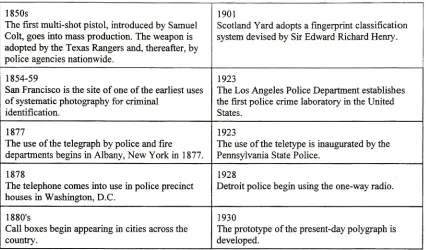
As Table 1demonstrates,
thevarioustechnologiesofthat timewereadoptedrelatively quickly (uponthe
discovery/creation
ofthetechnology)
by
differentpolice
departments.
Forexample,callboxesmade a rapidentryinto
thefield
oflawenforcement.
Created
anddeployedin Chicago
intheearly 1880s,
thecallbox
waslater hailedasahallmarkof police
innovation
by
Chief
FrancisO'Neill in
a1903
speechbefore
theInternational AssociationofChiefsofPolice
(Seaskate,
1998,
p.96).
Thethen
lawenforcement3. Inthe
Political
Era,
thisachievementwouldonlybe
eclipsedby
Sir
Francis
Galton's
introduction
offingerprinting
in 1892(Johnson, 1988,
p.253).1850s
The firstmulti-shotpistol,introduced
by
SamuelColt,
goesintomass production.Theweaponisadopted
by
theTexasRangersand,thereafter,by
policeagenciesnationwide.1901
Scotland Yardadopts afingerprintclassification
systemdevised
by
Sir Edward Richard Henry.1854-59
SanFrancisco is thesite of one oftheearliest uses
of systematicphotography forcriminal
identification.
1923
The Los Angeles Police Departmentestablishes
thefirstpolice crime
laboratory
in the United States.1877
Theuse ofthetelegraph
by
police andfire departments begins inAlbany,New York in 1877.1923
Theuse oftheteletypeisinaugurated
by
the PennsylvaniaStatePolice.1878
The telephonecomesintouseinpolice precinct
houses inWashington,D.C.
1928
Detroitpolicebegin using the one-wayradio.
1880's
Callboxes begin appearing incities acrossthe
country.
1930
[image:16.511.46.472.147.397.2]Theprototype ofthepresent-daypolygraphis developed.
Table 1:
Technology
Adoption in the Political Era (Derived from Seaskate's "PoliceTechnology
Timeline", 1998,pp.22 &
64)
The Reform
Era,
encompassingtheyearsbetween
1930and1980,
began
as aresponseto thepolitically-driven corruption oftheprior age and concluded attheend of
thecivil rights
discord
ofthe 1960sand 1970s(Wrobleski, 1993,
p.47). Thistimeframe
saw considerablechangesinthe
field
oftechnology
andtheworldatlarge.
Lawenforcement,
however,
onlysaw major changesin its
useoftechnology
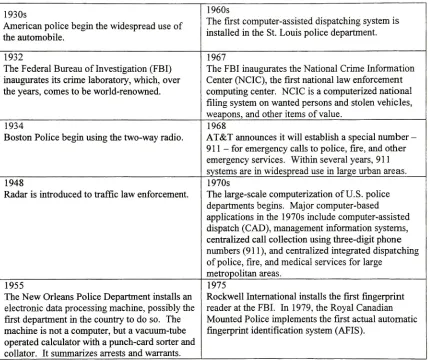
attheoppositeends ofthatfifty-yearperiod. Table 2
displays
some ofthoseadditionsbetween
1930and 1980. Police departments quicklywentto
two-way
radio systemsin
the1930s
and1940s
for both foot
andcar patrols.They
wereequallypromptin
incorporating
Priorto thispoint,officers on patrol were"ontheirown"
andhadtodealwitheventswithouttheabilityto
faded,
though,
by
theend ofthe1940s,
and most policedepartmentswould not altertheiroveralltechnicalofferings
for decades
tocome.1930s
Americanpolicebeginthewidespread use of theautomobile.
1960s
Thefirstcomputer-assisted
dispatching
systemis installed intheSt. Louispolicedepartment.1932
The Federal BureauofInvestigation
(FBI)
inaugurates itscrimelaboratory,
which,over theyears,comestobeworld-renowned.1967
TheFBIinauguratestheNational Crime Information CenterQMCIC),thefirstnationallawenforcement computingcenter. NCICisa computerized national
filing
system on wanted persons and stolenvehicles, weapons,and otheritemsof value.1934
Boston Policebeginusing thetwo-wayradio.
1968
AT&Tannouncesitwill establish a special number
-91 1
-for emergencycallstopolice,fire,and other emergencyservices. Withinseveralyears,911 systems areinwidespread usein largeurbanareas. 1948
Radaris introducedto trafficlawenforcement.
1970s
Thelarge-scalecomputerization ofU.S.police departmentsbegins. Majorcomputer-based applicationsinthe 1970s includecomputer-assisted dispatch(CAD),managementinformationsystems, centralized call collectionusingthree-digitphone numbers(911),and centralizedintegrated
dispatching
ofpolice,fire,
and medical servicesfor largemetropolitanareas.
1955
TheNew Orleans Police Departmentinstallsan electronicdataprocessingmachine,possiblythe first department inthecountrytodoso. The machineisnotacomputer, buta vacuum-tube operated calculator with a punch-card sorter and
collator. Itsummarizesarrests and warrants.
1975
Rockwell Internationalinstallsthefirst fingerprint readerattheFBI. In1979,theRoyal Canadian Mounted Policeimplementsthefirstactual automatic fingerprintidentificationsystem(AFIS).
Table2:
Technology
Adoption intheReform Era (Derived from Seaskate's "PoliceTechnology
Timeline", 1998,pp.22-23)
Itwasn'tuntilthecivil unrest ofthe 1960sthatsteps weretaken tomodernizethe
technology
usedin
lawenforcement. Theassassinations ofPresident
John F.Kennedy
andMartin Luther
King,
Jr.,
alongwiththeclass riotsragingacrosstheUnited
States,
broughtabouttherealizationthatAmerican
law
enforcementhad
somefundamental
[image:17.511.44.474.147.507.2]standards.
Coupled
withrisingcrimerates, theperformance oflaw
enforcementbecamea political
issue
inthe 1960s(Seaskate, 1998,
p. 2). President Lyndon B. Johnson"appointed
thePresident'sCommissiononLaw EnforcementandAdministrationofJusticetoexaminetheproblem"
(Seaskate, 1998,
p.2). Thatcommission'sfindings,
releasedin
1967,
indicated
thatmanypolicedepartments
couldhave
been usingtheverysame
technology
as much as30
yearsprior,butfor
variousreasons,had
notdoneso.Most
departments
were stillusing 1940stechnology,
likeradios, weapons,and out-datedoperatingprocedures,
in
thelate
1960's. Thepolitical and socialpressuresofthaterawouldforcethe
federal
governmenttoreact andresultedinthecreation oftheLawEnforcement
Assistance Administration(LEAA)
(Northrop, 1995,
p.259).Thatagency'sprimarygoal wastoprovide"grantstogovernmentagencies,
educational
institutions,
and private organizationstoimprove lawenforcement"(National
ArchivesandRecords
Administration,
2000). Especialattention wasgiventoincreasing
theoveralltechnical sophistication ofAmericanpolicedepartments. Fundswere made
availabletoagencies
for
theprocurement ofalltypesoftechnology:including
crimelabs,
computer
hardware,
and computer software(Seaskate, 1998,
p.34). InthisregardtheLEAAwasquite successful.
Countless
policedepartmentswereabletoacquire newequipment,particularlycomputer
hardware
& software,atlittle
or no costto theparentdepartment. As
Kraemer, King,
andNorthrop
note, the"LEAAcontributednearly$50
milliontostate andlocalgovernment criminal
justice
andlawenforcement agenciestofight
crime. Thisfunding
was overmatchedby
otherfederal
agencies such astheFederal
(Northrop,
etal,1995,
p.259).
Unfortunately,
as oftenhappens in
anyindustry
wherelarge infusions
of cashlead
totechnology
buying
sprees,most ofthisexpensiveequipment was eitherunder-utilized,orsimplysat
in
originalshippingcontainers. AsG.
Thomas
Steele
recalls,"Alotof computerswereboughtwithLEAAmoney.Many
werestillintheirpackingcrates,not even
installed,
whenI sawthem"(Seaskate, 1998,
p. 34).These
failings
were causedby
a combination offactors,
the twolargestbeing
lackoffunds for
adequatetraining
andafundamental lack
ofunderstandingastotheintracies
ofinformation
technology
deployments.
The formerremains anissue
today
andis just
asunforgivablenowas
it
wasthen(Seaskate, 1998,
p.4). Thelatter,
asperceivedby
theresearcher,wassimplyabyproductofthe"newness"ofinformation
technology
atthattime
in history.
Thisstateofaffairs continued well
into
the1980s,
atleastonthelocal level. Atthe
federal
level, however^
theFBIhad
been movingforward
withtheNational CrimeInformationCenter
(NCIC)
sincethelate 1960's.Embracing
technology
in
thefight
against crimehad
long
beena mottofor
theFBI,
andNCICwastobecome
thecrowningachievementofthat philosophy,atleastwithregardto
information
technology.By
1967,
NCICwasrecordingannual
transactions,
meaningrequestsfor data
by
dispatchers,
inthemillionsandhad
become
an unequivocal success(TheInvestigator,
2000). Thegrowing
success ofNCICwouldhaveanother,perhapsunexpected,
dramatic
affect on the use ofinformation
technology
in law
enforcement- locallaw
enforcementnowhad access,
though
limited,
toanation-widedatabase
of criminal records(also limited in
size andscope),andthoseopportunitieswouldfuelmore changes
in how
patrol officers operatedfairly
standard procedurefor
patrolofficers,uponpullingoverasuspectvehicle,toperform a routine
lookup
againstNCIC
records(Northrop
etal.,1995,
p.262). Throughthe
1970's
andinto
the1980's,
this taskwas accomplishedviaaradiodispatcheroperatinga remoteterminalat a centralized police
location.
Functionally,
theprocessinvolved
having
a patrol officeridentify
a suspectvehicleandnotetherelevantidentification information
ofthedriverand/orthevehicle. Theofficerwouldthenradioin
thisdata
to theaforementioneddispatcher.
Oftentheofficer's requestswouldhavetowait
in
a queue untilthedispatcherhad
availabletime toprocesshis
specific request.Thisprocess couldtakeuptoseveral minutes. Thecumulative
delays
madethisatediousprocessthat
begged for improvement.
The impactofthesystem's
inefficiencies
becomesmoretelling
astheCommunity
Eraofpolicingis
examined. WrobleskiandHess (1993)
describethis era,starting in1980,
asthat timewhen"many
policedepartmentsarebeginning
tobecome"customer-oriented""
(pp. 50-5 1). Police departments
became
morelike businessesin
thatthey
werefar
more concernedwiththeneeds ofcommunitymembers,referringto thegeneralpublicthat
they
served and notjustthecriminal elementusuallyassociated with policework, than
they
had
been inthepastandwerewillingtochangetomeetthoseneeds.Thisattitudebeganto
foster
anopen atmospherethatquicklyresultedinnew proceduresandtechnicalneeds
for
patrol officers. Evenascommunity policinggrewbeyond
merebuzzwordstatus andpolicedepartmentsacrosstheUnited States started
reshaping
their1980 1993
Police departments begin
implementing
"enhanced"911,
whichallowsdispatcherstosee ontheircomputerscreenstheaddressesandtelephonenumbersfromwhichthe91 1
emergencycalls originated.
Morethan90percentofU.S.policedepartments
servingapopulationof50,000or more areusing
computers.
Many
ofthemareusing themforsuchrelativelysophisticated applications as
criminalinvestigations, budgeting, dispatch,and
manpower allocation.
1990sDepartments in NewYork, Chicago,and
elsewhere
increasingly
use sophisticatedcomputer programstomapand analyze crime
patterns.
1996
The National
Academy
ofSciencesannouncesthatthereisnolonger anyreasontoquestionthe
[image:21.511.53.463.54.196.2]reliabilityofDNAevidence.
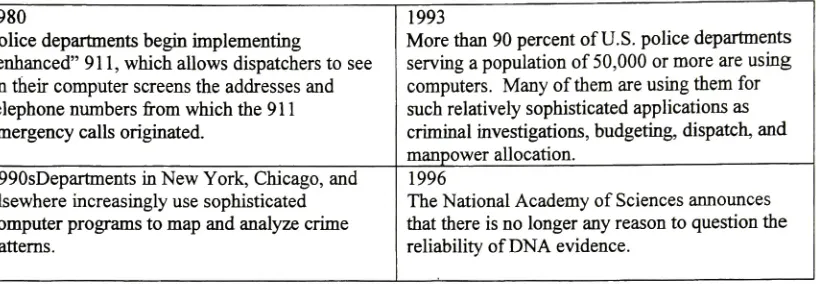
Table 3:
Technology
Adoptions in theCommunity
Era (Derivedfrom Seaskate's "PoliceTechnology
Timeline", 1998,pp.
23-24)
The
introduction
ofMobile Data Terminals(MDTs)
topatrol cars markedonesuchimprovement
in
thisarena. Those officersfortunateenoughtoworkinadepartmentthatembracedthis
technology
in
theearly1980s,
suchastheofficers intheSan AntonioPD,
werenow abletoaccessNCICrecordsdirectly
from
theirpatrolcars,bypassing
dispatchersandwaitingqueues
(SAPD,
2000). Thoughprimitiveby
today'stechnicalstandards, these
devices
gave equippedofficerstheabilitytoacquiretheinformationthattheyneeded more quickly. These devices
led
to theeventual adoption of notebookcomputers
in
the 1990s. Wireless datanetworks,like Cellular Digital Packet Data(CDPD)
andARDIS,
sprangup inthatdecade,
andcompetingprotocols wouldbattle
back
andforth in
thepolice market. Asprocessorspeedsincreased
and mobilecomputersbecamesmaller,notebook computersbecamea more common sight
in
policedepartments acrosstheUnited
States,
replacingtraditionalMDTs inpatrol cars. Aslaptops
becamemoreprevalent,vendorsand politicians alike would arguethatnotebookcomputers were
having
apositiveaffectonthefight
againstcrime,andthatofficers wereIsthis
true,
though?Northrop, Kraemer,
andKing's 1995 study,"Police Use ofComputers",
wouldtend toagree withthatgeneralization(p. 262). Tobe
moreaccurate,though,
thefocus
oftheirstudywas moretowardsthetraining
of officersin
theuse ofcomputers and
less
on perceptions ofefficiency, arrestrates, andsafetyasadirectuseofinformation
technology
by
officers on patrol. In thecourse oftheirresearch,they
did
notethatcertain statistical
increases in
arrestsand warrantsearcheshadoccurredin
theperiod
between 1976
and1988 as a result ofpatrol officerlookups. Theirresearch,however,
alsoincluded
dispatch-aidedinformation
gatheringanddid
notdistinguishbetween MDTand
dispatch
usage. Nordid it
distinguish betweenthe typesofMDTs(notebook-basedversustraditionalMDT). Inthe
following
study,itis
theprogressionfrom
MDTstonotebooksthatis ofthegreatestinterest. Theresearcher'shypothesisis
thatpatrolofficers, as a result ofusingwirelessdata
technology,
willperceive anincrease
inarrestrates,overallefficiency,and"safety".
Initial
Research Design
The
initial
design
ofthis studywastoattempttoanswerthesequestionsby
gatheringandanalyzingpertinentdata
from
selected policedepartments. Thatselectionprocesswasto
include
identifying
policedepartments usingspecifictechnologiesandhaving
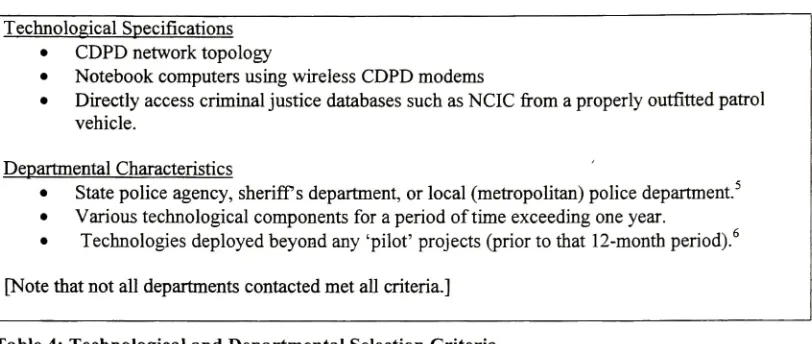
certaindepartmentalcharacteristics(see Table 4). Onceidentified,
thosedepartmentswould
be
contacteddirectly
witha requestfor
availabledata,
preferablyin
raw
format,
astoofficerefficiency,arrestrates,andsafetyreports.4
This data
wouldbe
broken
downinto
Pre-adoptionandPost-adoptioncategories. Thosecategories wouldthen
be statistically
analyzedfor
patternsandtrends. Appropriateconclusions wouldbe
drawn from
thatanalysis andbe
publishedaccordingly.Technological Specifications
CDPDnetworktopology
NotebookcomputersusingwirelessCDPDmodems
Directly
access criminaljustice databasessuch asNCICfromaproperlyoutfitted patrol vehicle.DepartmentalCharacteristics
Statepoliceagency,sheriffsdepartment,orlocal
(metropolitan)
policedepartment.5
Varioustechnologicalcomponentsfora period oftimeexceedingone year.
Technologiesdeployedbeyond any'pilot'
projects(priorto that12-monthperiod).6
[image:23.511.47.453.112.284.2][Notethatnot alldepartmentscontacted met allcriteria.]
Table 4: TechnologicalandDepartmentalSelection Criteria
Using
thefactors
from Table4,
various policedepartmentswereidentified aslikely
candidates and contactedfor
availabledata.
Thelist7is
asfollows:Astate policedepartment
Aregional sheriffsdepartment
Ametropolitan policedepartment
A
federally-sponsored
police departmentA federalagency'
suniformed police
department
Wilmington Police Department
(Delaware)
Thisportionoftheresearch effort produced resultsthatresulted
in difficulties
thatwerenotentirelyunexpected,
but
were nonetheless undesirable.5
Thenature ofthis study,withitscore examination ofpatrol-orientedlawenforcement,obviates
examiningfederalagencieslikethe DEAandFBI. 6
Like manyorganizations,policedepartmentsoften usesmallpilotprojectsto testnewtechnologies. 7
This
researcher'sfirst
candidate, theregional sheriffsdepartment, did,
atthedeputy-level,
express aninterestin
assistingwiththisstudyandwere quitehelpfulin
theinitial
stages oftheresearch.Unfortunately,
when eventsbegan
torequiretop-levelapproval
from
thatcounty's sheriff,allinteractions
withthatdepartmentceased, andfurther
contact attempts wereignored.
Thesecondcandidatedepartment,
a statepoliceforce,
was alsoinitially
veryopentodiscussions,
and afirst
meetingprovidedasubstantive amount of
information
abouttheuseof mobiletechnology
inthatagency. Attheconclusion ofthat meeting9,
however,
thisresearcherwasinformedthathe
would notbeabletoaccessanyrawdata
from
thatagency. Theirrepresentative expressedconcernthatotherrecentlyadopted programs mightadverselyaffecttheoutcome ofanyanalysis
of what
little data
thatthey
possessed,andsimilarly^ thatthey
didnotkeep
accuraterecordsofthenature requiredintheoriginalstudy design.
Follow-up
contactattempts,made whenthestudy
design
wasmodifiedtoits
currentform,
wentunanswered as well.Afterthefailurewiththatstate police
force,
thisresearcherpostedto theNationalInstituteofJustice's
technology
website,"JustNet",
(athttp://www.nlectc.org)
inpublicforums dedicatedtolawenforcement
technology,
knowntobe frequentedby
lawenforcement
officers.10
Atthesame
time,
anopportunitytomeet withtheprimarycommunication/technologyofficerintheWilmington Police
Department
arose and wastakenonDecember
20,
2001. This meetingwithMasterSergeant
John S. Martinproduced a considerable amount of
data
andaffirmedhis department's
willingnesstoassist
in
thisresearcheffort. Heprovided a number oftechnicaldetails
abouttheir8
Contactmethodsincludedphone calls/voicemail and emailmessages. 9
This meetingoccurred on 10 Oct00andlastedapproximately2.5 hours. 10
technicalconfigurations
(current
as ofthatdate),
including
dataonhow
andwhycertainpurchasing
decisions
were made.Additionally,
he
wentonto confirmthisresearcher'sexperiencethatmany
departments
are notproperly (ornotatall)tracking
certaindata
associated withtheirnewtechnologies.
Accordingly,
he
admittedthathis
departmentwould not abletoprovideanyraw
data
with regardto theoriginalstudy designconcept.He
did,
though,
expressthathis department
mightbe
willingtoundergoastudy surveyorientedtowardspatrol officers andtheiruseof mobiletechnology.
Uponconsultationwiththesiscommittee
faculty
members,a modifieddesign
approach was agreed upon. Fromthatpointon, the
design
model wastogenerateasurvey
instrument for
delivery
topatrol officers actively usingthetechnology
understudy. Additionaldecisionsmade
by
Committee Chair Stephen Jacobsweretoallowtheparticipatingpolice
departments
theopportunitytoreviewthefinished
thesispriortopublication andtoallowthem theoptionto
have
thedocument
'classified'.11A survey
instrumentspecificto theWilmington PDwasgenerated and providedforcommittee
review&advisement
in
January
2001. InFebruary
2001 itwas giventoWPDfor final
approval uponreview, andtheactual
delivery
tookplacein
March 2001. Thedelivery
processwillbeoutlinedlater inthisdocument.
Whilethisprocess was
being
undertaken, theoriginal state policeforce
wasapproacheda secondtime
for inclusion in
thissurveyprocess.Again,
email andvoicemailwere
left
unanswered.Simultaneously,
twoseparatefederal
policeforces
wereapproachedand given organization-specificsurvey
instruments for
examination, butdeclined
toparticipate. Contactattempts with athirduniformedfederal
policeagency11
were also
unsuccessful.12
By
June2001,
it
wasapparentthatotherdepartmentswere notwillingto
be
included
in
this study,atleast
not atthis stage, andthesiscompletionrequirements/timetables restrictedthisresearcher'sabilitytocontinuesearching
for
willingparticipants.
As
aresult,adecisionwas madetomoveforward
withtheavailabledata from
theWilmington Police Departmentandtobeginfinal
analysisoftheavailabledata.13
Technology
Assessment
Cellular Digital Packet
Data (CDPD)
Thoughother networktopologies
have
viedfor
thelaw enforcement/emergencyservicesmarket,mostnoticeably ARDISand
RAM/Mobitex,
Cellular Digital PacketData
(CDPD)
appearstohave
emerged astheprimarywirelessdatanetwork of choiceformostAmerican lawenforcement agencies. Acasual search oftheInternet
for
"police &CDPD"
will
literally
find
thousandsof referencestopolicedepartments convertingtoCDPDnetworks. Atthe time that thisstudywas initiated
in
1999,
thatnumber wasfar
less. DelawareadoptedCDPD
in
a statewideinitiative
asits
publicsafety datanetworkinl998(Wartell,2001,p.
1).CDPDwasdesignedtobean
industry
standardfor digital
data communications,developed
by
aconsortiumconsistingof six(out
ofseven) Regional BellOperating
Companies
(RBOCs), IBM,
andothertelecommunicationcompanies(Dayem,
1997,
p.47).
In
essence, the CDPDwireless network operates withintheconfines ofexistingcellular networksalongsideordinarycell phones. The
data
technology
functions
inside
12
Andthisdespite
having
a'friendly
ear'connectedtoeach ofthosedepartments. Asconcluded
later,
having
adirectcontactina policedepartmentcanoften openformerly
'sealed'doors. 13Theweaknessthatthispresentstoward theoverallstudyisreviewedinthe"ProjectWeakness" section
ofthat
infrastructure
throughthesame radiofrequencies
(WirelessForum, 1998,
[image:27.511.45.405.109.327.2]radiotec.html).
Diagram
1.0,
as seenbelow,
representsthebasic
concept:Figure 1: CDPD Basic Network Design (SochanandChen, tpdmobile.html)
Thewireless notebook representsthemobileworker,inthiscase a sheriffs
deputy,
andthewirelessdata
signalis
senttothenearest cellulartower. Atthetower,
thesignal
is
processedby
theMobile Data Base Station(MDBS)
andtransmittedviadigitallandline
to theMobile Data Intermediate Systems(MDIS)
(Dayem, 1997,
pp.97-100).Thiscomponent, simplyput, providesthe
functionality
upon whichthemobileusercommunicates withtherelevantend-userservices. Inthis example, thesheriffs
deputy
is
directly interacting
witha state-runserverthatprocessNCICchecks.Naturally
theprocess
is far
more complexthandescribed
here,
butthislevel
ofcomplexityis
sufficientfor
thepurposesofthis study.Withtheongoinggrowthofthecellular
infrastructure in North
America,
coveragefor
CDPD continuestoexpandrapidly.Installing
aCDPD-based
wireless network would(Wireless
Forum, 1998,
netreuse.html).Otherwise,
thephysical infrastructureofthenetwork
is
not changed.Estimated
cellular usageis
around55million usersin
theUnitedStates,
andthataddsuptoalot
of cellulartowers(Parker, 1998,
p. 106). That existingphysical
infrastructure
allows cash-strapped policedepartments
tomakethemostoftheircapital
funds
whilegaining
a capable wirelessdata
networkthatmeetstheirgeographicrequirements.
Froma softwareperspective,
CDPD is
similartoRAM/Mobitexin its
design.CDPD
is
adigitaltechnology
thatrelies ondatapackets sentin
shortbursts.
CDPD usesforward
errorcorrectiontominimizedata
transmissionsand re-transmissions(WirelessForum, 1998,
mobiledn.html). Asthepackets aresent,they
are encodedwitherrorcorrection
bits
thatallowthereceivingequipmenttousesophisticateddecoding
algorithmstorecoverlost datawithoutasking for freshtransmissions(Wireless
Forum,
1998,
fec.html).
Thisprocess ofdata
recoveryatthehandheld
unitlevel greatly increasestheefficiencyofthenetworkwhilesimultaneously minimizingthecosts of use
by
decreasing
thepackets sent. Anotherexample oftheefficiencyoftheCDPDnetworkisthatmultiple units can usethesame radio channel. This
is
accomplishedinthesamefashion
aslocalareaEthernetnetworks:whenadevicedoesn't
needto"speak",
it is
silent. If
it
has somethingto"say"(transmitafile
ormessage,for
example), then themobileunitwillaccordinglytransmit
its data.
In
fact,
CDPDuses an open specificationthatallowsit
tointerface
withtheInternet Protocolstandardsothatapplications and mobile units
have
thegreatestversatilitywithother network protocols
(Dayem, 1997,
p.99).
Specifically, by
for
theuse ofthemost commonInternetProtocols;
such asSimple Mail TransferProtocol, Telnet,
File Transfer
Protocol,
andHypertext Transfer Protocol. Thismeansthatthemobile units
in
thefield
are abletousethesameoperatingsystemsthatcanbe
found in
offices and at policedepartments.
Having
thesameoperating systems onbothmobile andstationaryunits can cutdownon
training
costs andminimizeuserdifficultiesinthe
field.
Similarly,
astheoperatingsystems evolve onthedesktops,
themobileunitsrunning CDPDcan
be
easilyupgradedto theneweroperatingsystems with aminimumofsoftware changes. Suchunitscanalso accesstheInternetwithouttheadditionof custom
software applications: softwarethatusuallycomeswitha
hefty
pricetag.Ofcourse,usingmobile computers withInternetcapabilities requiresthatpolice
departments
make architecturaldecisionswiththeirdata
networkstoprecludeofficersfrom
indulging
inunacceptablebehaviors(surfing
inappropriatewebsites,playingnetwork computergames,readingpersonalemail, etc). The Wilmington Police
Departmentisan exampleof anagencythathastakensuchsteps. Master Sergeant
Martindescribed his
department's
procedures toreducethese unacceptablebehaviors,
whichinclude removingmedia
bays
(floppy
drives
andCD-ROM
drives)
from field
units.
Table 5: Disadvantagesofusing CDPD
Speed
Providesrawdatarate atthespeed of19.2kbps.
May
notbesufficientfortransmissionofdigital images (inatimely
fashion)
Coverage
One
area ofcontentionin
theadvancement ofCDPD has beenin
thearena ofinformation
security. CDPDdoes
use abuilt-in securitysystemdesignthatinvolvesthreecomponents:Airlinkencryption, authentication,andauthorization
(Dayem, 1997,
p.100).
However,
components withinthatdesignhave
beencriticizeddueto thepossibilityof exploitationattacks againsttheencryption schemeusedintheprotocol. Yair
Frankel,
a noted researcher
in
thefield
ofcryptography, and associates areamongthecriticsofCDPD's
securitymodel.They
have
oftenbeen
citedwith regardto thefaultsofCDPDdata
security,particularlytheopportunityfor
"maninthemiddle"
attacks. Theirwork,
Security
Issues inaCDPD WirelessNetwork,
describesthisfaultin
detailandtheirrecommended replacement protocol
(Frankel,
etal, 1995). Inparticular, theirconcernis
withtheDiffie-Hellman
key
exchangebetweentheMobile EndUserandtheMobileServing
Function.Thecounter-argumentto thisconcernis described
here,
in
thewordsof someCDPD's
founders:Thespecificationteamrecognizedthatsuchauthenticationcredentialshave a
finite lifetime.
If
a mobileunit's authentication credentialswerestatic overtime,thesecretcouldbecopied andusedtomimicthevalidunit. Topreventthis, the
CDPDspecificationteamdefinedtheabilityforthe CDPDnetworktoeither
periodicallyor attheserviceprovider's
discretion,
update a mobile unit'sauthenticationcredentials. Inthis way, anyparticular authentication credential
only
has
valueduring
theperiodoftimedeemed
usefulby
thenetwork operator.Taylor
et al.(1996)
were well aware oftheintended
usesoftheirprotocolandattemptedtoprovide a
functional
'real
world'solutionto the taskof wirelessdata
communications.14
To
their credit,CDPD has
stoodthe testoftimeandis
widelyutilizedacross
North
America,
withoutanysignificant acknowledged penetrations ofthoseexistingnetworks.
Speed
Providesrawdatarate atthespeed of1 9.2kbps Connectionlessandinstantnetwork access
Protocols
Open-standardnetworkbasedonInternet Protocol
(IP)
andOSI Connectionless Network Protocol(CLNP)
Compatiblewithexisting TCP/IPandUDP/TPapplications
Standards-based designallowsforcompetitivebids insoftware andhardwarepurchases,
therebyreducingsome costsinacquisitions(and/or upgrades)
Reliability
andSecurity
Userauthentication
Lesschance ofdataerror(comparedtovoicetransmissions)
Air-linkencryptiontopreventeavesdropping
Availability
Uses existingcellular networks
ProvideswirelessInternetaccess
Cost Effectiveness
Transmitsdata insmall packets
Fully digital,
lowerrorrates,higherspeed(19.2Kbps)
Lowercostthan analogwireless connections
Connection-basedsystem
Table6:Benefitsofusing CDPD
14
Naturally
both issuescanbeexaminedforgreatertechnicaldetail,
but thisexaminationisat asufficient technicallevelforthepurposesofthisstudy. Readersinterested inadeeperanalysis ofeitherissueare [image:31.511.47.461.198.525.2]Wilmington Police Department
& Wireless DataTechnology
Lawenforcement
has
certainlydemonstrated its
willingnesstoadoptthisnetworktopology
over other offerings. TheState
ofDelawareandits
variouspolicedepartmentshave been
among the many Americanlaw
enforcement agenciesin
thelast decadetomigratetowardswireless
data
communications. The Wilmington Police Department(WPD),
one ofDelaware's
43law
enforcementagencies,has
been using CDPD-enablednotebook computers sinceapproximatelymid-1999
(Martin,
2000).15WPD isauthorizedto
field 289
swornofficers,but
presently only has 280officersontheforce. Theforce
has
56marked carsin
useddaily.16 Of that280,
roughly 160 aredesignated
asPatrolOfficerand performthe
duties
associated withthatstatus. Theseofficerspatrola metropolitan area ofapproximately 73,000residents. Atthesametime,
Wilmingtonis
also
known
asthe"corporatecapital oftheworld". As aresult,downtown Wilmingtonis
ahubof
business
activitieswithalargenumberofdaily
commuterscoming inand out of thecityenvirons.Through the benefitof stategrants,WPDwas ableto purchase,
install,
andoperatePanasonic Toughbooks. Theorganization
is
capable offielding
80
mobileunits,but is
onlyfielding
48activeunitsat present. The intendedgoalis
tohave
75 active units,withfive
availableas 'hotstandbys'(formaintenance purposes). The
department
usesacombinationof models andoperatingsystems,as
detailed in
Table8.
Theirintention
is
to solidifytooneoperatingsystem astimeand resources allow. Theindividualunits are
'assigned'
to specificpatrolunits(asopposedto
assigning
themto15
Notethat the
following
detailsare accurate as of20December2000,
thedateoftheinitial interviewwithMaster Sgt. JohnS.Martin. Some detailsmayhavechanged
during
thewritingofthisstudy.16
Certaindetailsabouttheoperations andinfrastructureoftheWilmingtonPDwereconsideredtoo 'sensitive'
individual
officers),but
are nothardwired
tothepatrol units.A
docking
station allowsfor relatively easy swapping
offaulty
units.During
thecourse oftheinterviewwithMaster
Sergeant
Martin,
thisresearcher's attentionwasdirected
towardsone such unitin
his
officeawaiting
repairs. Hedid
not,however,
have
details regardingoveralloperational performance oftheunits
from
a maintenanceperspective.17
Lastly,
theInput/Outputcomponents
(floppy
andCD-ROMdrives)
of each unithave
beenremovedtoprevent unauthorized
tampering
by
officers. Thedepartment
preferstoblockaccesstosites
like
AOL andMSN,
andremovingtheI/Ohardwarefrom
theunitshelps
tolimit
suchactivity (but
does
notcompletelyeliminateit).
Table 7 Wilmington Police Department Hardwareand
Operating
System DetailsModel (40ofeach)
Operating
System CDPD ModemCF-27 233MHz Windows 95B Spyder
(internal)
CF-27 300MHz Windows 98 Sierra SB300
(internal)
Theactual CDPDnetworkaccess
is
providedby
BellAtlantic,
paidfor
throughDelawarestate contracts. This CDPD network coverstheentiretyof
Delaware,
withtheexpectedareas ofpoor/non-existentconnectivity. The department didconsider
purchasinga separateradio-based
infrastructure,
but
theanticipated cost of such adedicatedsystemwastooexpensive. WPDhas
its
ownInternet Protocol(IP)
Addressblock,
also providedby
Bell Atlantic. The specificsastoallotment of addressestoindividual
devices
were notprovided, forobvious reasons.17
Thatissue isaddressedinthesurveysection ofthisdocument. 18
Forthosereaders without anInformation
Security background,
maintainingstrongcontrol of one's networkdesign isa goodsteptowardkeeping
thatnetwork moresecure. Itisalwaysbesttoallowonly'trusted'
The
department
usesfour
software applications as a matter of course. E-mailhas
astraightforwardpurpose, and
is
provided atthestatelevel. Delawarestatelaw
requiresthatall
law
enforcementreportsbe
of a standardformat.
A3270
emulatorallowsfor
accessto the
Delaware Criminal Justice
Information System (DELJIS). Thethirdapplication used
by
WPD is
theEnhanced PoliceComplaint
system(EPC),
astate-runcentral
database
criticaltotheDelaware Real-Time CrimeReporting
System
(RTCR)
(Wartell, 2001,
p. 3).This
application allows officerstocompleteanyreport,short ofaccident reports.
The
final
application,known
simplyastheEnforcersoftware,is for
accessing National
Crime
Information Center(NCIC)
databases.
Thisdirectaccesstostate and
federal databases
is,
asdiscussedpreviously,anintegral
driving
factor
behindprovidingpatrol officerswithwirelessdatacommunications. Hasthis access,
though,
had
anydiscernable
impactontheWilmingtonpatrol officer? Havethey
seenanyincreases inefficiency, arrestrates, ortheirown'safety' while onpatrol as a result of
usingthis technology? The Wilmington Police Department'spatrolofficers
have been
given asurvey
designed
touncovertheanswerstothosequestions. Itis
thisresearcher'shypothesisthatinallthreecasestherespondingofficers wouldhaveseen
increases in
their efficiency,arrestrates,and
level
ofsafetyas aresultofusingthiswirelessdatatechnology.
Methods
Population
The
population examinedconsisted ofWilmingtonPolice Department
policeofficers. The onlyrequirements
for
membersoftheforce
werethatthey
be
on activepatrol officer. Itwas
hoped
thatby following
thesamplingmethodlisted
belowthattheserequirementswould
be
properlymet.Sampling
Method
The sampling
method used withtheWPDwas non-random andconsistedoftwoseparate
deliveries.
Thefirst
delivery
wasto theSecond
Shiftpatrol group,andthesecondto theThird
Shift
patrol group. Bothdeliveries
tookplaceinthesame24-hourperiodand
in
thesamefashion.
Inbothcircumstances, thesurveytoolwaspresentedtotheoncomingpatrol shift
during
theirpre-shiftbriefing,
and completedsurveyforms
were gathered priorto theend ofthosebriefings.19This samplingmethodyielded32
completed surveys.
Survey
Design and ScaleAnextensive search of prior related efforts was performedtoprovidethisstudy
withanapplicable scale
from
anypreviousstudy. Thatsearchwasconductedfromand atvarious
locations,
including
RIT's electronicdatabases (viatheWallace MemorialLibrary'sonline
interface).
Additionally,
keyword
searches oftheWorldWide
Web,
usingphrases
like law
enforcement,CDPD,
police, results, etc, were carried outwithfew
results of anacademic
nature.20
Nearly
allofthematerial generatedas a result ofthesesearcheswas of a popular orbusinessnature. The fewexceptions,thoughnot
directly
applicableto this survey
design,
arelistedin
thecitationsection ofthisdocument.
Asaresult, theresearcherwas
forced
tobuild
questionsbasedon prior undergraduate workanddirectexperienceinthe
field
ofInformationTechnology.19
Thepatrolshifts werethosemade available
by
Wilmington PD administration,hencethenon-randomsamplingmethod. Theother shift was not available. 20
Notethat thesesearches alsoincludedavarietyofBooleanexpressionstominimize straight-linelogic
The design
ofthesurvey
instrument
was straightforward andgeneralin
form.Of
the thirty-onequestions
in
the surveytool,
sixweredemographic innature. Thosequestionscontained referencesto therespondent'ssex, race, education, and age. The
othertwo
demographic
questions, RANKandlength
ofSERVICEas aPatrolOfficer,
wereadded. Withtheexception ofAGEand
RANK,
thequestions werepreparedfor
analysis as
interval-level
data.
RANKwas modifiedduring
thedata
analysisphaseandbecame
interval-level
data.21AGEwas modified viathe
RECODE
commandfound in
SPSS.
Twenty-one
oftheremainingquestions were gathered as ordinaldataand providetheprimary
focal
pointsfor
thedata
tobe
acquired. The remainingfour
questionswerebroad in design
andwereincluded
toallowtherespondentstomake general statementsaboutthe
technology
in
theirdepartment.Methods ofStatistical Analysis
Thetypes of statistical analysis available
for
usein
thisstudywereaffectedby
thenature ofthesurvey
instrument,
andeachtestwaschosen with an eyeto themaximumbenefit
possiblefrom its
use. Statistical analysiswasconductedusingSPSS,
versions10.1 and 1
1.22
Asseen
in
theCommand File (AppendixD),
thefirst
statistical tool tobe
run againstthe QUES1throughQUES21 variableswastheRELIABILITYcommand.
Thistest
is
usedto test theinternal validityoftheassociatedvariables. Allofthevariables werethentested
for
frequency-related informationviatheFREQUENCIES
command. Somevariables weretestedonly
for
mode,whileothers weretestedfor
allmeasurementsof
frequency,
including
mean, median, etc. Thefinal
statistical analysis21"Patrolman"
becamea"1","Corporal"becamea"2",and soon,asthesurvey datawasmanuallyplaced intotheDAT file.
22
performedagainsttheacquired
data
wasthecrosstabulationofcertain variablesin
specificsequences.
The SPSS
commandusedfor
thispurpose wasCROSSTABS. Eachofthese tests
included
optionsfor
chisq and counts.Results
Reliability
Asnotedpreviously,the
first
statisticaltestperformed wasforreliability. TheQUES1 through
QUES21
variableshave
areliability ALPHAof.7715-thecloserto 1.0that thereliability ALPHA
is,
themore reliablethedata isconsideredtobe.
Inthiscase,with a score of.7715,thedatagathered can
be
consideredfairly
reliableforthepurposesofthis study,consideringthesample size. Table 8
displays
theoutputfromtheRELIABILITY
command.Table 8: RELIABILITY Output for Quest- Ques21
RELIABILITY ANALYSIS - SCALE
(ALL)
Reliability
CoefficientsNofCases= 27.0 NofItems==21
Alpha =
.7715
FrequenciesVariables
The second series of analyses
involved
thefollowing
variables:SEX, SERVICE,
RACE, RANK,
andEDUC. Thesevariables,becauseoftheirnominallevel
ofmeasurement,couldonly
be
testedfor
mode. Asaresult, this testonlygives a measureofthemostcommonly occurringvalue
in
each variable. ForSEX,
thebreakdown
consisted ofthreefemaleofficers andtwenty-ninemale officers.
SERVICE
provided ain
patrolduty.
Similarly,
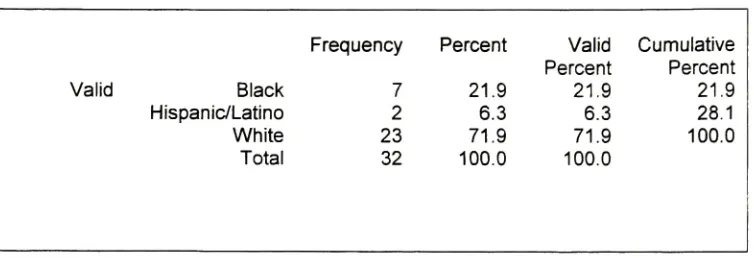
the RACEvariablehad
afairly
uniformspread ofraces, as seenin Table 9.
Frequency
Percent Valid PercentCumulative
Percent
Valid Black 7 21.9 21.9 21.9
Hispanic/Latino 2 6.3 6.3 28.1
White 23 71.9 71.9 100.0
Total 32 100.0 100.0
Table9: RaceofRespondent
RANK
displayed
another expectedreturnof25Patrolmen,
6Corporals,
and 1MasterSergeant.23
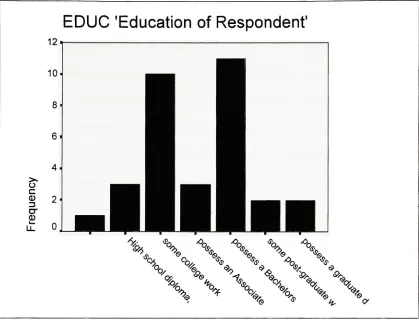
Of
thesefive
variables,EDUCprovedthemostinteresting
in its
results.
According
to thedata
acquired,roughly 56.4percent ofrespondentshadeitheran
Associates, Bachelors,
orMasters degree (orsome combinationthereof),
and another31.3percent
indicated
thatthey
had
somelevel
of college work. Asdescribed
previouslyin
thisdocument,
theeducationallevel oflawenforcement officershad beena concernin
the 1960-
1980s.
Thisappearstobeless
of anissue
now,atleast for the Wilmington
Police Department.
Follow-up
studies shouldbe
abletomoreaccuratelyanswerthisissue.
23
Aminorflaw inthesurvey instrumentsurfacedhere. 'Patrolman'
[image:38.511.44.421.119.248.2]Table10EducationofRespondent
The remainingvariables,QUES1 through
QUES21,
were also processedforfrequency
statistical results. Thesevariableswere,ofcourse, themain questionsin
thesurvey
instrument,
anditwas expectedthat thedatagleanedfrom
thesequestions wouldeither confirm or
deny
thisresearcher'shypothesis. Thequestions werebroken down
into
thebasiccategories of comfortlevel
(withregardtohome,
work,and mobilecomputeruse),
hours
of useperweek,MDToperationalaspects, softwaretype(ECP,
DELJIS,
andEnforcer- theirimpact
with regardto the threeresearch
issues),
andthree [image:39.511.44.463.72.392.2]arrestrates,andsafety).24
Theresults ofthatanalysis were
in
manyrespects quitesurprising.
Those
questions andtheirresults are notedbelow.
QUES5
reads asfollows:
"Pleaseindicate how
comfortableoruncomfortableyouare withthemobile computerthatyour
department is
currentlyusing". 93.8percent oftherespondents
indicate
thattheyare comfortable or somewhat comfortablewiththetechnology.
This
resultis
somewhatsurprising,evenforsuch asmallsample size,asit is
generallyaccepted withintheInformation
Technology
field
thatmostusers areuncomfortable, tosome
degree,
withthedaily
operation of suchtechnology. Atthe sametime,
therelatively youngages ofthepatrol officersmay beinfluencing
thisquestion'sresults. Theamount oftimespent each weekusingthemobilecomputermayalso
be
affecting thatset ofresponses,as seen
by
therepliestoQUES6. Seventeenofthe32respondents
indicated
thatthey
usedthemobile computersbetween
two to tenhours aweek,and 13respondents repliedthat
they
usedthedevices formorethan tenhours
aweek. Thepatrolofficers also seemedtofeelthat themobilecomputerswere
fairly
easyto operate,as seen
in
Table 11.Similarly,
93.7percentoftheofficersfound
thatthetechnology
was eithereasytoadaptto ornotdifficulttoadaptto (QUES9). Theofficerswere,
though,
somewhatdividedastothe reliabilityofthemobilecomputers;34.4percent answeredthat theunits were notreliable (QUES7).
24
The survey instrument erroneouslyreferencesDELJISasDCJIS. Saidinstrument,initsentirety,is
containedinAppendix A.
25
Frequency
Percent ValidCumulative Percent PercentValidSTRONGLY 1 3.1 3.1 3.1
DISAGREE
DISAGREE 2 6.3 6.3 9.4
AGREE 25 78.1 78.1 87.5
STRONGLY 4 12.5 12.5 100.0
AGREE
[image:41.511.40.474.60.213.2]Total 32 100.0 100.0
Table 11:QUES8 'MDT'sease ofoperation...'
Survey
questionsQUES10
throughQUES18 focused
onthe threedifferent
typesof software utilized
by
Wilmington
PatrolOfficers,
andthedata
gatheredfrom
thosequestions
is
asfollows:
83.8%of respondents agreed orstronglyagreedthattheEnhanced Police
Complaint
software madethemmoreefficient(QUES10),
while87.1%saidthesameregardingtheDCJIS
(DELJIS)
software(QUES16). Theseas comparedtothe62.6%who respondedthattheEnforcersoftware
had
allowedthem tobe
moreefficient(QUES13).26
71.4%of respondents either
disagreed
orstronglydisagreed
withthestatementthat theEPCsoftwarehad
increased
theirarrestrates(QUES1 1). ThisresultcloselyparalleledthatofQUES
14;
71.4%had
thatsamefeeling
abouttheEnforcersoftware. The only
difference
wasin
intensity
ofdisagreement. Thedifferenceswere
less
obviousfor
theDCJIS(DELJIS)
software. Forthisquestion,only 5 1.6%
disagreed
orstronglydisagreed
astoarrest rateincreases
while48.
4%
agreedthatusingthissoftwarehad
increasedtheirarrest rates.26
With
regardtoanincrease
in
'safety'as a result ofusingthis
technology,
theresponses
for both EPC
(QUES12)
andEnforcer(QUES15)
wereroughlythesame;
approximately
70%disagreed
orstrongly disagreed. Aswiththeprevioussection,theresults
for DCJIS
(DELJIS)
were muchcloser;54.8% disagreedorstrongly disagreed
while45.2%
of respondents(thirty-one
ofthirty-twoofficers)agreed orstronglyagreedthat thissoftware madethem'feelsafer'
while on
duty
(QUES18).
Frequency
Percent Valid Percent Cumulative Percent Valid STRONGLYDISAGREE
1 3.1 3.4 3.4
DISAGREE 17 53.1 58.6 62.1
AGREE 9 28.1 31.0 93.1
STRONGLY 2 6.3 6.9 100.0
AGREE
Total 29 90.6 100.0
Missing
System 3 9.4 [image:42.511.42.480.253.424.2]Total 32 100.0
Table 12: QUES21
'Overall,
theadoption ofMDT's hasmade youfeelsafer...'Whenasked
for
overallimpressionsofthemobiletechnology
in
use intheirdepartment
(aspresentedin
QUES20andQUES21),
theofficers'responses were
somewhatdivided. Whenpresentedwiththe statement,
"Overall,
theadoptionofthemobilecomputersinyourdepartment
has
increasedyourarrestrate",
18
officersdisagreedwhilethe remaining twelve
did
agree. Whenthesame general questionwasasked aboutsafety, theresponseswere even more
divided,
asTable 12shows.There
waslittle
division amongrespondents withthe statement, "Overalltheadoptionofthemobilejob
".
Only
one oftwenty-nineresponding
patrol officersdid
notfeel
moreefficient.The
significanceofthisstatement willbe
addressedlaterin
thisdocument.The
complete set offrequency
analyses results arein
Appendix F.Crosstabs
The
thirdandfinal
set of statistical analysesinvolved
performingcrosstabulationof variables.
Specifically,
thevariablesRACE, RANK, AGE, EDUC, SERVICE,
andSEXweretested
individually
againstthevariables ofQUES1 - QUES21.Additionally,
crosstabulation
testing
was performed on an adhoc
basisasinteresting
and/orunexpected results occurred.
Overall,
thebreakdown
oftheindependentvariablesagainstthe
dependent
variables provided variousrevelations,particularlywhencomparedagainsttheresults
from
thefrequency
analysis asdescribedpreviously. Thefollowing
items from
thecrosstabulationanalysis areworthyof comment.Unfortunately
thesamplesetonlycontainsthreefemale
officers,and one ofthosethreeofficersdidnotanswerthemajoritythedependentvariablequestions(QUES10
through
QUES21)
ofprimaryinterest,
sothedata
gleanedfrom
thevariable SEXis
toolimited for
anypractical usewithinthisstudy.The RACEvariable
has
abreakdownof sevenBlackofficers, twoHispanicofficers, andtwenty-threeWhiteofficers. Anexaminationofthisvariable against
QUES1 throughQUES6shows no significantdifferences betweenthe
different
racialtypesexceptthattheBlackofficersgenerallyseem morecomfortablewiththe
technology. Thesameexaminationagainst
QUES7
throughQUES9reveals a similargeneralresult,withtheexceptionof
QUES8,
"the mobiledata
terminal(MDT)
is easyto27
operate...
"
in
which all sevenBlack
respondents agreedthattheunitswereeasytooperate.
For
thesurvey
questionsQUES10
-QUES18,
theresponses providedtendedtobe
moreevenly
distributed
withinthe BlackrespondentsthanwithintheWhiterespondents.
When
presented withthequestion of overallefficiency,asin
QUES19,
theraces answered as seen
in
Table 13.DISAGREEAGREE STRONGLY Total AGREE
Black Count 1 4 2 7
%within RACE 'RaceofRespondent' 14.3% 57.1% 28.6% 100.0% %withinQUES19
'Overall,
the 100.0% 17.4% 33.3% 23.3%adoptionofMDT's hasmadeyou
more
efficient...'
%ofTotal 3.3% 13.3% 6.7% 23.3%
Hispanic Count 1 1
/Latino
%within RACE 'RaceofRespondent' 100.0% 100.0%
%within QUES19
'Overall,
the 4.3% 3.3%adoption ofMDT's hasmade you
moreefficient...'
%ofTotal 3.3% 3.3%
White Count 18 4 22
%within RACE 'RaceofRespondent' 81.8% 18.2% 100.0% %withinQUES19'Overall,the 78.3% 66.7% 73.3% adoptionofMDT's hasmadeyou
more
efficient...'
%ofTotal 60.0% 13.3% 73.3%
Count 1 23 6 30
%within RACE 'RaceofRespondent' 3.3% 76.7% 20.0% 100.0% %within QUES19
'Overall,
the 100.0% 100.0% 100.0% 100.0% adoptionofMDT'shasmadeyoumore
effici