..
4 November 1983
English Edition
European Communities
EUROPEAN PARLIAMENT
Working Documents
1983-1984
)
'
DOCUMENT 1-976/83
Report
drawn up on behalf of the Committee on Energy, Research and Technology
on the proposals from the Commission of the European Communities to the Council (Doc. 1-600/83 - COMC83) 350 final> for:
I. a decision adopting a multiannual research and
development programme of the European Economic Community in the field of basic technological reseafch
•
II. a decision adopting a mult+annual research and
development programme of the European Economic Community in the field of the applications of ne technologies Rapporteur: Mr C. MARKOPOULOS
By letter of 12 July 1983, the President of the Council of the European Communities requested the European Parliament to deliver an opinion on the proposals from the Commission to the Council for a decision adopting a multiannual research and development programme of the European Economic
Community in the field of basic technological research and a decision adopting a multiannual research and development programme of the European Economic Community in the field of the applications of new technologies.
On 12 September 1983, the President of the European Parliament referred these proposals for decisions to the Committee on Energy, Research and Technology as the committee responsible and to the Committee on Budgets and the Committee on Economic and Monetary Affairs for opinions.
On 21 June 1983, the Committee on Energy, Research and Technology appointed Mr MARKOPOULOS rapporteur.
The committee considered the Commission proposals and the draft report at its meetings of 11 July, 30 September and 2 November 1983.
At the Last meeting, the committee decided by 14 votes to 1 with 1 abstention to recommend that Parliament should adopt the Commission's proposals without amendment.
The committee then adopted the motion for a resolution as a whole and the explanatory statement by 14 votes to 1 with 1 abstention.
The following took part in the vote: Mrs Walz, chairman; Mr Gallagher, Mr Seligman, vice-chairmen; Mr Markopoulos, rapporteur; Mr Adam, Mr Fuchs, Mr Kellett-Bowman (deputizing for Mr Normanton>, Mr Linkohr, Mr Moreland, Mr Pedini, Mr Petersen, Mr Purvis, Mr Rinsche, Mr Salzer, Mr Veronesi and Mrs Viehoff (deputizing for Mrs Lizin).
The opinion of the Committee on Budgets will be published separately. The opinion of the Committee on Economic and Monetary Affairs is attached to this report.
The report was tabled on 2 November 1983.
WP0463E OR.El
C 0 N T E N T S
A. MOTION FOR A RESOLUTION ••••••••••••••••••••••••••••••••••••••• 5
B. EXPLANATORY STATEMENT ••••••••••••••••••••••••••••••••••••••••• 9
I.
II.
III.
WP0463E OR.El
INTRODUCTION •••••••••••••••••••••••••••••••••••••••••••• 9
CRITICISM OF THE COMMISSION DOCUMENT
.
... .
19CONCLUSION
.
... .
23ANNEX I
...
24ANNEX II •••••••••••••••••••••••••••••••••••••••••••••••• 35
Opinion of the Committee on Economic and Monetary Affairs
A
The Committee on Energy, Research and Technology hereby submits to the European Parliament the following motion for a resolution together with the explanatory statement:
MOTION FOR A RESOLUTION
closing the procedure for consultation of the European Parliament on the proposals from the Commission of the European Communities to the Council for I. a decision adopting a multiannual research and development programme of the European Economic Community in the field of basic technological research and II. a decision adopting a multiannual research and development programme of the European Economic Community in the field of the applications of new technologies.
The European Parliament,
-having regard to the proposals from the Commission to the Council (COM(83) 350 final) (1),
-having been consulted by the Council (Doc. 1-600/83),
- having regard to the proposal from the Commission to the Council: European scientific and technical strategy framework programme (COM(83> 382 final), - having regard to the report by the Committee on Energy, Research and
Technology and the opinions of the Committee on Budgets and the Committee on Economic and Monetary Affairs (Doc. 1-976/83),
- having regard to the result of the votes on the Commission proposals,
<1> OJ No. C 230 of 27 August 1983, pp. 3 and 6
WP0463E OR.El
A. whereas the technological challenges of the present day are becoming ever more intense and international commercial rivalry is daily growing fiercer, B. believing that the only answer to industry's continually increasing need
for greater competitivity is to $ecure a high level of technological research and continually to strengthen its efforts to produce direct results, so that the application of the results of it will lead to improvements in productivity and the production of qualitatively better products,
c.
viewing collaboration between the various research bodies and advance coordination of any mass Community research effort as a basic prerequisite for the success of any technological research programme,o.
believing that if there is to be all-round progress and development in European industry the greatest possible number of industries and research institutions involved in a particular branch of technology must beencouraged to take part in research at Community level, and access to the results of such research must be freely available to all the relevant Community industries, particularly the small and medium-sized ones and those situated in its least industrially developed regions,
E. believing that the aim of intensifying industrial and technological
research must, among other things, be to improve the quality of life of the working citizen of the European Community by developing the prerequisites of better social living and working conditions and ensuring the necessary standards of safety and protection, both for the worker and for the
environment in which he lives and works,
1. Approves the implementation of a multiannual (1984-1987) programme of basic technological research and the application of new technologies for
Community industry, with the aim of:
(a) strengthening the competitiveness of European industry through qualitative and quantitative improvements in production and the development of new, advanced forms of products reflecting market requirements and demand, and
WP0463E OR.El
(b) developing European industry, a fundamental factor in the progress and prosperity of the 10 Community Member States, on a rational and
balanced basis;
2. To attain these objectives, calls on the Commission to ensure, in collaboration with the relevant research organizations in the Community Member States, that the greatest possible number of industries and research establishments is involved, so that the widest possible spread of
potential, knowledge and expertise is put to use;
3. Since what is aimed at is an overall rise in the Community's industrial level, calls on the Commission to take particular care to ensure that the research programmes involve not just the large industries which are already active in the research field but also the largest possible number of small and medium-sized undertakings situated both in the centre and on the periphery of the Community;
4. Calls on the Commission to make a specific selection of technological sectors for research activity, after systematically investigating the international scientific front and the consumer demands and needs of the peoples of the Community and the world market, and to be particularly flexible in planning the programmes, adding new sectors for research or adjusting the existing ones in the light of the scientific communications which it receives;
5. Calls on the Commission to apply rules governing the selection of research institutions and interested industries for inclusion in the above planning, assessing, in a spirit of responsibility, the likely return from and
usefulness of the work to be done and, in particular, applying strictly meritocratic scientific criteria, as well as, where required, specific criteria relating to the requirements of regional development and the need to make productive use of local potential;
6. Calls on the Commission tu establish a central processing system for research information and findings which are not sensitive from the commercial viewpoint in order, in cooperation with the relevant state
advisory agencies, to facilitate the coordination, guidance and supervision of the vario11~ resear~h activiti~s b~inQ
Yndortlktn
by th~induitrit§,
WP0463E OR.El
universities and institutions to be involved in the technological research sectors selected, so as to avoid duplication and pointless work which will waste time, money and human effort;
7. Calls on the Commission to monitor and assess the research work at reasonable Intervals and take responsibility for making sure that it proceeds smoothly and without obstruction;
8. Calls for interested industries, regardless of whether they are involved in the programme, to be assured of unrestricted access to the centralized processing system for findings so that information is immediately
disseminated and consequently the results of the research work can be applied as swiftly as possible at every stage of the programme;
9. Calls on the Commission to make a specific selection of the industrial sectors to which the new production and processing methods which will
~rise from the development of the new information and automation systems and the new advanced forms of machine processing will first be applied,
10. Expects the Commission to make a close study of the likely social repercussions of applying the research results in practice and, in particular, of developing those industrial sectors in which the new automated production methods will be introduced;
11. Also expects the Commission to study with all possible care the impact of applying this research programme and its results (a) on energy consumption and (b) from the energy and environmental viewpoint, and to take all
necessary steps to ensure that it is applied in conjunction with a more rational use of energy and with industrial operating regulations entirely compatible with modern requirements relating both to the safety and
protection of working people and to the protection of end-consumers and the environment;
12. Instructs its President to forward to the Council and Commission the
proposal~ from the Commission as voted by Parliament and the corresponding resolution as Parliament's opinion.
WP0463E OR.El
EXPLANATORY
STATEMENT INTRODUCTIONIt is a well-known fact that the survival of an economic entity and its further development depend fundamentally on its industrial level and
commercial competitiveness. As just such an economic entity, the European Economic Community is obliged constantly to pay special attention to these two factors which, as is well known, need to be continually readjusted and
dynamically redeveloped, because of the constant increases in consumer
requirements and the inevitable competition with other economic and industrial centres.
The dynamic redevelopment of the industrial factor, however, depends on the constant development of technology and the possibility of applying the results of this directly, with the aim both of improving productivity and of producing new, qualitatively improved forms of products which cost less to adapt immediately to the demands of modern consumer society. It is therefore clear that an important, if not the most important, component of such success is proper, rationally planned and effective scientific research, as well as coordination of the processes to be gone through from the completed research
~tage to completion of the necessary technological transformations to turn the fruits of research into an industrial end·product ready for consumption.
So it is more than essential to persuade industries to focus their efforts on the research work which will enable them to look to the future with
optimism; for this purpose, the Community must clearly make material and human resources available, and, in particular, invest considerable sums of money. Above and beyond that, there is a clear need for detailed and
systematic supervision of the direction research must move in to avoid wasting time and money on sectors which either will not produce the desired
competitiveness or which there is already no point in taking on, given the considerable pioneering work already done by other rival centres.
In recent years, however, interest seems to have centred on the following sectors:
WP 0463E
Or El
<a> the search for suitable raw materials or the development of new ones for industrial applications, and the production of new improved products in sectors where consumption is particularly vulnerable;
(b) the search for ways of producing better-quality products with Longer service lives and greater reliability, and compatible with environmental requirements;
<c> the search for new paths to the overall development of industry in the Community's Less developed Member States, without overriding the demand for immediate further development of already developed industry, so that the two branches are not in confrontation with one another but, by
complementing each other, contribute to the overall development of the Community.
Other reasons, too, such as the balance of trade relationships between the Community and its main industrial rivals, especially Japan, which has greatly deteriorated in the Last decade, and the fact that approximately one-quarter of the active population in the industrialized countries are employed in
industry'or in production, with consequences for the very nature and existence ot jobs, mdke it essential that there should be specific planning aimed at contributing, through the development of European industry, to a general improvement in social conditions in the EEC countries. One might, however, reasonably ask which industries and, correspondingly, which technological sectors are especially important for the development of Community Member States, so that they can get assistance from it. The answer is by no means an easy one, since, owing to the fairly broad spectrum of industrial
production, the considerable number of industrial materials and products and the interdependence of the various fields of industrial research, it is difficult to pick out one sector at the expense of another.
Consequently, there is an urgent need, first of all, to examine the criteria on which the areas for research will be selected, having identified those areas of the industr; 1. spectrum which are particularly sensitive with
regard to future Community dev~lopment and require Community aid to make European industry competitive in key sectors of production, not just for its commercial advanc~ment ~er se but particularly to create new and better social conditions for the centre and the periphery of its ten Member States.
WP 0463E
Or El
A. P\esent-day problems facing the development of industrial research in the Community
The motive force behind industrial research is the requirements which daily appear and which are either genuine, i.e. they spring from the need for
improved industrial goods to satisfy our demands, or the creations of a constantly mounting and often, for the industries themselves, disastrous commercial and industrial rivalry at all levels, which in its turn provokes a mania for over-consumption which distorts society. These requirements, then, real or artificial, are the stimulus which prompts industrial research to seek and find new methods and materials, and, chiefly, to make constant improve-ments in production processes and finished products.
The rodd to achieving these aims, of course, is not an easy one. On the
contrary, it requires vast sums of money and human resources, as well as labour and, above all, time, which cannot, however, be made freely available, given the present-day forms of international trade rivalry. The problems facing Community industry, especially industrial research, today are basically of two types, aside from the pu~ely historical and/or conjunctural reasons which have caused it to lose its position at the head of the technological
revolution ot recent decades. These are:
(a) problems arising from reasons outside its control and more to do with obtaining supplies of raw materials;
(b) problems arising from the nature and structure of European industry itself and from the very conduct of technological research (methods and resources which it does or does not use>.
With regard to the first type of problems, it is a generally known fact that the,European Commu •• ity countries are poor in raw materials both for energy purposes and for industrial materials.
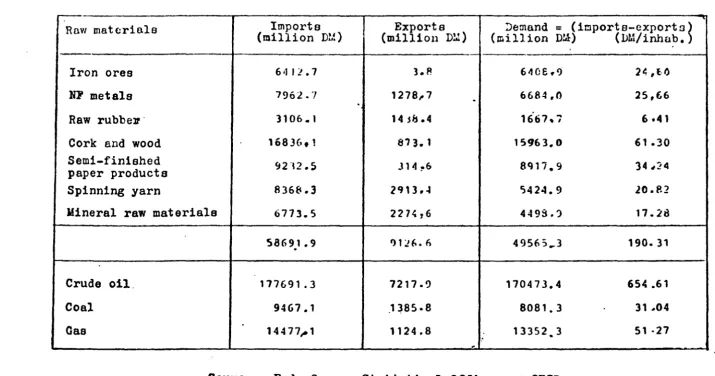
A simple glance at the table below clearly shows Community demand for certain key raw materials for industry. In 1980, for example, the Community had to spend 290 ECU per inhabitant on raw materials for energy, whereas it spent approximately 76 ECU per inhabitant on important industrial raw
materials.
WP 0463E
Or El
...
N
.,
m
.
o-... 00 ... -t. -'• :J
.
Table 1:
Commu~itydemand for key raw materials (1990)
Raw materials
Imports
(million
m.n
(million
Exports
D!.l)(million
~emand=
D~) (i~ports-cxports~(DM/inhab.
Iron ores
6•11!. 7 3.R 640£~9 24,tllN1'
metals
7962.7 1278,7.
6684.0 25,~6.
Raw rubbe:Jr·
3106.1 l4j&.4 16.67. 7 6 ·41Cork
endwood
168)(,,1 873.1 1596 3. 0 61.30Semi-finished
92"\2.5 J 14 ~6 aq11.9 )4 #24paper products
Spinning yarn
8368.3 2CJ13.-I 5424. 9 lO.P.2Mineral raw materials
6773.5 22H ,6 449S.~ 17.2d58691.9
.
1)1;!6.6 4956=)_3 190.31Crude
oil.
177691.3 7217.9 170473.4 654 .61Coal
9467.1 .1~85-8 8081.3 31 .. 04Gas
14477,.1 1124.8 13352.3 51 -27.•
,
Rav uterial bauxite lead chromi.te iron cad:zlium cobalt copper
Table 2 shows the geographical distribution of certain important raw materials and the relevant qres.
Situation: December 1981
Table 2: Reeervea of, key raw material• (eource: BCR) Share of the
3 chief supplier countriea (%)
53.6 98.0 59.2 47.8 49.5 45.0
Reaional diatributioo (%)
GUinea (27.8), Australia (19.7)
Brazil (10.7), Jamaica (8.5), India (6.0)
USA (26.8), Australia (14.0), CAnada (12.8)
USSR (10.8), South Africa (3.3)
South Africa (64.1), Zimbabwe (28.2),
USSR (5.6), Finland (0.8%), India (0.2)
USSR (30.1), Brazil (17.5), Canada (11.6)
Australia (11.4), India (6.0)
Canada (17.6), USA (16.2), Australia (14.0)
USSR (7.4), Ireland (5.1)
CUba (21.8), Indonesia (15.4), Zaire (12.3)
Philippines (11.6), New Caledonia (10.5) Chile (19.4), U~A (18.3), USSR (7.3)
Zambia (6.7), Canada (6.4)
Life of
reserves in yo!a.rs
253 4J 364 184 36 112 70
:nanganese ore 89.5 South Africa (44.5), USSR (37.1),
Australia (7.9), Gabon (5.0), Brazil (2.2) 69 1110 1 ybde null
nickel silver tantalum titaniferoue iron (i ltDenite) titanium ore
( r~.; tile)
vanadium tungsten ZlDC tin 76.6 48.8 .54.6 74.3 56.1 71.1 9.5.6 70.6 55.6 43.7
USA (43.6), Chile (25.8), USSR (7.2)
Canada (6.2), Panama (2.4)
New Caledonia (18.8), Cuba {17.8),
Canada (12.2), USSR (11.0) Indonesia (10.7)
USSR (21.6), USA (20.4), Australia (12.7)
Mexico (11.5), Canada (9.7)
Zaire (56.4), Nigeria (11.0), Thailand (6.9)
USSR (6.9), Hal~ysia (5.5)
Canada (24.7), Norway (18.7), India (12.7)
USSR (12.2), South Africa {8.2)
Australia (33.7), India (24.9),
Sierra Leone (12.5), USSR (8.3), USA (6.9)
South Africa (48.9), USSR (45.6),
Australia (1.1), Chil~ (0.8), PR China (0.8)
PR China (52.7), Canada (9.5), USSR (8.4)
USA (4.9), North Korea r~.4)
Canada (25.7), USA (19.9), Australia (10.0)
USSR (8.3), Japan (3.7)
Indonesia {16.0), PR China {15.4)
Thailand {12.4), Kalayeia (12.4), USSR (10.3)
13
-ss
110 22 66 135 65 469 49 39 41In the table above, which lists the five leading countries in which the various materials are to be found, what stands out is the frequency with which foreign countries a long way from Europe figure in it. The Lack of raw
mat@riols both for energy and for industry 1n th! EEC countries is abundantly
clear, a tact which in the end is undoubtedly the most thorny problem which the Community has to solve. Considering, then, the problem of obtaining supplies of raw materials in itself, in conjunction with the fact that the price of raw materials is constantly fluctuating and that the deposits
themselves will not last for ever, it can easily be appreciated how enormously important technological research is, at least as regards finding substitutes for some of the already existing raw materials, for the economic state of the Community's Member States.
Going on to the second type of problems, those relating to the nature of European industry itself, a great many reasons for backwardness could be pointed to, chief among them undoubtedly being those arising from the
plurality of nations within the Community and the intra-Community rivalry that this, so far with good reason, engenders. Although the explanation for this doubtless predates the constitution of the Community in its present form, there i-s no good reason for it today, when the Community itself seems unaware of a range of conditions which, if met, would enable it to grow stronger and take its place as a unified whole at the head of the international industrial community. We cannot, of course, overlook well-intentioned intra-Community competition as a factor for progress and as one of the driving forces behind European technological evolution, but if the obstacles set out below were removed, European industry might be more efficient. They are:
<a> the lack of cooperation between industries involved in producing the same product and carrying out similar research programmes, or in which the sectors in which research is being done are beinq duplicated and complemented elsewhere. This tendency tohoard technological data, besides increasing internal, at the expense of external, competitive-ness, leads to duplication of effort and pointless waste of resources, effort and materials, particularly at a time when the influence which scientific disciplines and technological applications have on one another has become immense, and when the need for a •critical mass• if research is to be effective requires not only that specialized scientific disciplines should cooperate with one another but that there should be a sum-total of experience which only industry can provide;
WP 0463E
Or El
{b) inadequate guidance and information from industries to the scientific institutions and universities collaborating and/or financed by them, as to their needs. Thus, we frequently see pieces of research being done which for the most part cannot be put to practical use by industry, although they were done for that purpose, or industry itself not being able to capitalizt on Laboratory achievemtnts, and Laboratories themselves having difficulty adapting to the present-day requirements both of consumer demand and of commercial rivalry itself, and remaining attached to the doctrine of research for its own sake, whiih, despite its attractions from a human and a scientific viewpoint, contributes nothing to profitability and to the aim of producing an upswing in industrial advance;
(c) the fact that scientific achievements with technological applications cannot be fully exploited, and that they cannot be guarded and kept inside the Community, with the result that they drain to third countries in
competition with the Community;
{d) similarly, the fact that full use cannot be made of the Community's
scientific and technical human potential who, when they fail to find work or appropriate conditions in their own countries, leave and give their services mainly by working for countries in competition; this happens to
'
a variable degree between the various Member States of the Community. The less developed member countries lose a great deal more of their scientific potential as the people involved become expatriates both from their native countries and from Europe, to the detriment of both;
(e) the Community's inability and, often, refusal to give effective help to development programmes in its less industrially developed Member States, which are on the periphery of the Community; this not only affects industry but extends to cover the whole length and breadth of development sectors. Yet industry is a key branch in the economic viability of a state <and not •)nly that>, and the less developed Member States would see such help not jus\ ~s free aid given to them but as an assurance and a guarantee that they can be involved, on an equal footing, in all the Community's development efforts. This last consideration definitely works both ways, because through regional development the Community moves nearer to becoming a single homogeneous area and, in the struggle under way, is able to mobilize all the forces at its command to its own
advantage;
WP 0463E Or El
<t> to crown all the probl!ms mentioned above, there is the lack of a central coordinating agency which would direct and coordinate all the various projects, make sure that the possibilities and prospects open to all the Community Member States were capitalized on in a rational way, and be the expression of a just and balanced Community development policy in all branches of industry, something of which the centrally run resea~ch
systems in the USA and Japan are certainly not deprived, thanks to the homogeneity of those countries.
To conclude, it must be understood that only as a totality, as a single cooperating whole, as a jointly acting and coherent force will the
Community succeed in making progress and be able to confront and overcome the fierce competition forced on it by the countries which are its main trade rivals. We will eventually have to stop talking about particular large industrial units in the Community and replace that concept with that of a single large Community industry.
B. Efforts to secure an upturn in industrial and technological research Clearly, when the causes of a deficiency have been identified, the deficiency will be overcome when, and only when, the causes identified have been removed. Thus, although it is obviously not possible for Europe
suddenly to fill with rich deposits of mineral raw materials, it is feasible to remove the obstacles identified in analysing the problems of the second type. It is therefore superfluous to make an exhaustive analysis of the obstacles to be removed; it will suffice simply to enumerate them in the
order in which thtY hav! already been mentioned, as follows:
<a> developing cooperation among industries involved in producing the same product to put an end to the duplication of similar research programmes and convert this into a constructive exchange of skills;
(b) rationalized and sysLematic guidance from industries to scientific institutions relevant to dnd associated with them as to the problems to which a solution is required;
(c) findings from scientific investigations to be put to immediate use by
industries;
WP 0463E Or El
(d) maximizing the use made of the ten Community Member States' scientific and technical potential;
<e>
effective back-up for the development programmes of the Community's less industrially developed Member States so that they can make an appreciable contribution to the Community's overall development efforts;(f) finally, setting up a central coordinating agency, relying on the most advanced data processing techniques, which can receive and store research results and also inform and coordinate industrial research work from the centre to the outlying regions.
It is equally clear, however, that efforts to develop industrial and technological research so that it contributes as soon as possible to starting an upturn in the Community's industrial competitiveness can be made straight away. Certainty, action is obviously preferable to inaction, and, even if
the best component of all those activities which would, with absolute certainty and without the least shadow of doubt, lead to the immediate
effectiveness of industrial research cannot be found straight away, moves can be made to launch a series of research activities which will certainly create the conditions for an upward turn in European technology. What must,
however, be taken particularly into account is that special attention must be given to ensuring that there is the greatest possible degree of approximation in the suitability of projects selected.
For this purpose, a whole series of criteria must be borne in mind, some of which are set out below:
<a>
research in most of the technological sectors selected should be of interest to many branches of industry and the economy and be of direct concern to industries in most Community Member States.(b) Research subjects shut~Ld not relate directly to only one industrial product or technological process, as this would enable one or more
industries to become more competitive at the expense of certain others in the Community.
WP 0463E
Or El
<c> Wherever a decision has been taken to carry out research in a particular industrial sector, all parties expressing a wish to be actively involved should at the same time be provided with the widest possible favourable conditions, so that every industry involved can follow its own line.of research, emulating (but not in rivalry with) its partners.
(d) R~se~rch results should be capable of being used in the widest possible range of applications so that there are also benefits to other sectors not connected with the particular area under research.
(e) The selection of the industrial sectors requiring research should be made on the basis of a detailed study of the needs of European industry, both as regards the actual technical problems which it faces and which require solutions, and from the point of view of widening the market, internal and external, the cost-benefit relationship and, generally speaking, factors relating to selling the particular product.
<f> Since all the industrial research sectors selected cannot in the end be of interest to all the Community's Member States, and since the industries in all ten Member States do not have the same momentum, the same ability to carry out research programmes or the same scope for absorbing the results, care should be taken to ensure that interested industries can gain access to any findings while research is in progress and capitilize on results, so as to promote the most balanced possible development of European industry.
(g) In view, too, of the very acute social problems now faced by every country under the sun, industrialized or otherwise, problems associated with
unemployment and working conditions and which are partly due, too, to present-day technological developments, account should also be taken of the social cost, whether positive or negative, of applying research results in practice, so that, side by side with countervailing Community measures, any negacive repercussions from applying the sought-after innovations will be ba 1nced out.
<h> There is, finally, one more criterion which is also linked to another very acute problem of the present day, the physical protection of man and the environment.
WP 0463E Or El
Today, when even the simplest action can turn against man himself and the space which surrounds him, when even the conventional, most widely used forms
ot energy have proved to be a threat to the environment, and when the
accumulation of industrial waste is having the effect of altering the face of the planet with the disast!rl which it causes, it is essential that any action intended to improve industrial products must also be designed to protect man as final consumer and the place in which he lives and works.
No industrial product can be said to be completely safe, but correctly oriented research on these lines is a way to reduce such risks to a minimum or even remove them.
Criticism of the Commission document
Th~ aim of the Commission's industrial research programme is quite clear and has been repeatedly stated: it is to enhance the competitiveness of European industry in comparison with its main trade rivals by making qualit-atively better products available or importing new, improved ones reflecting the needs of market demand and creating better cost-benefit relationships.
In drawing up its document, however, the Commission has clearly had in mind, and given greater weight to, the large industrial units in the
industrially developed "ember States of the Community.
This is obvious both from the whole range of industries and research
establishments which the Commission approached through independent researchers <Britain, Germany> in putting together its document, and from the answers which it received and the sectors which it selected and which, in its view, merit research at Community level. Nevertheless, judging from the practice
so far, it is not certain that the majority of industries and research establishments will be able to take part in, and derive any advantage from, this research programme in the sectors which were selected and which are of interest to them, or wh~ther a few large firms, most of them manufacturing firms, will take up and ex~.1it the sums on offer. If this happens, we do not see how the competitiveness of the Community as an industrial whole will be improved; it will more likely be a case of assisting large companies which already hold a significant share of the market, both European and
international, in increasing their influence, authority, prestige
WP 0463E Or El
and control over a Larger section of that market. If, of course, the aim of such a thing were solely to improve the position of Community industry in relation to its rivals, it would be acceptable up to a point; however, we consider that aid of this kind will place great industrial giants in a more advantageous position and widen the gap between them and other small
industrial units involved in producing similar products and which, owing to their size, are not in a position to compete with them by having sums
available tor research which would improve their products, introduce new methods to increase their production and generally better their position on the European and world markets. It is true that the Commission is trying to avoid this kind of thing by making sure there is collaboration between those interested in being involved in the programme, by giving priority, that is, to collaboration between more than two industries and research establishments in different Member States. The final selection of those to take part, however, will be made by the Commission's subcommittees, i.e. by the Commission itself, and there is no mention anywhere of the process of correlation which ought to take place among those to be involved in a particular programme in which all
likely combinations are possible, including, of course, those which envisage participation by two or three large industrial units.
The likelihood of this is strengthened by the fact that an essential pre-condition tor involvement in the programme is the submission of a draft research programme in one or more of the sectors proposed, which it is the Commission's task to approve or reject, objectively and in accordance with its weight and importance.
One does, however, wonder who can put forward the best and fullest, as well as innovative, research projects, the big industrial firms with a long tradition of research, projects and experience, or the smaller ones which, because of their size and resources, are confined as a rule to following in the wake of the ac~ievements and discoveries of the larger scientific
laboratories, which are mostly funded by or belong to the large industries which are also the first to 'XPloit them. The matter is not, of course, treated exhaustively here, and it relates both to the actual structure of each Member State's economy and industrial policy and to the actual relations between Community Member States, as well as to the actual structure of Community research.
WP 0463E
Or El
we are Led, however, to these considerations by the fact, or the
suspicion, that the proposals the Commission is now making are the thoughts and proposals of the Community's Large industrial circles themselves. We would, of course, see nothing reprehensible in that if there could be a
uu~rant~~
of
tht broadtst poastbl~ 1nvolvtm~nt in the programm@of
the widestpossible cross-section of Community industry - regardless of size - the free and unrestricted flow within the Community of the knowledge and techniques acquired, and thus the avoidance of a closed circle of research by a limited number of industrial circles and the hoarding of knowledge, which, as we have said, would widen the gap between large and small-sized industries of the same kind and ultimately lead to the collapse of the small and medium-sized under-takings to the advantage of the large ones, which would in the end be to the detriment of the Community from both an industrial and, chiefly, a social point of view.
On the other hand, of course, no one is claiming that the same level of research, with the same results, is done by a scientific l~boratory with enormous experience in a particular field belonging to a large industrial unit, and a small laboratory belonging to some small firm on the periphery of the Community; but, insofar as the programme is being carried out with
Community money, that is, with money which comes from the citizens of all ten Member States of the Community, there should be global involvement in,
contribution to and benefit from the Community programme in question, a system of equal treatment in acquiring scientific knowledge and technological data and equivalent development directed mainly towards the small and medium-sized
industries which form the backbone of European industry, not only from the point of view of what they contribute to it but from the viewpoint of their
Large number and thus of the jobs which they provide.
It is not, in other words, a question of simply giving hand-outs to a
group of industrial units of a certain size which would otherwise not be able to produce a return, but of the urgent need to support the future development of such industries, which ft~ will otherwise see withering beneath the weight of a form of Community rivalry which the Community itself will be supporting to the advantage of the large industrial units. The positive feature, of course, of the Commission's report is the allusion to the •small and medium-sized undertakings• which the Commission rightly considers to be the most basic productive element in European industry.
WP 0463E
Or El
Unfortunately, however, there is no mention anywhere of any guarantees that they will be involved in the programme; that is to say, although it is very properly stated that preference will be given to proposals for collabor-ation by more than one Member State, no mention is made of the size of the undertakings which will be involved, or even of some ratio of size among the industrial units to be involved in the various research projects (perhaps the only exception being in the field of mathematical models and the introduction of computers for design or production>.
On the contrary, the proposal states that high priority will be given when it comes to exploiting research results to industries which have already been involved in the common research programme. In fact it goes as far as saying that merely visiting the experimental sites will require approval from those involved. Here, however, it needs to be repeated that this is not a case of research being done by a self-financing industry or research at national level for which the capital comes out of the national budget. On the contrary, it is a question of a common endeavour to improve Community industry by creating better, more competitive products, and if the results of this endeavour are not capitalized on by all the likely interested users, they will remain in the hands of the select few of European industry, with the effect of strengthening its monopoly character and quite plainly reducing the small companies to ruin.
Such a notion, however, is very close to the idea of making a collective effort to increase competitiveness in relation to the Community's main
industrial rivals, the USA and Japan - the only endeavour which can hope to bear fruit; it is, rather, a case of trying to enhance the competitiveness of
a few European industrial giants at the expense of other related European industries in the first instance, and then in relation to the Community's economic rivals.
And if, ot course, the aforesaid represent real dangers and threats to the small and medium-sized undertakings in the industrially developed Member
States of the Community, 'Je can easily imagine what the results of a one-sided policy of aiding the industr ~~s in the outlying regions of the Community would be. These are small and medium-sized industries for the most part, but the definition of them is not the same as for their equivalent in the industrially developed Member States, as they are not as big nor do they have the same
resources; their productivity and product quality are not as high, but on the other hand they are not aiming at the same markets.
WP 0463E Or El
rhe consequences will be th@ same, though multiplied in accordance with the differences between national industrial levels. The impact of such a
situation on the actual national economies of such countries will be much greater and a basic consequence will be a widening of the gap between the industrially developed "•mber Statts of the Community and the weaker ones, with extremely serious consequences for the continued existence of the Community itself.
CONCLUSION
Although the Commission's practice hitherto and our own experience have
accustomed us, with regard to these specific technological research
programmes, to the idea of a one-sided orientation by the Commission in favour of the strong, more advanced industries, which are, of course, to be found in the technologically and industrially developed part of the Community, we would like to hope that the remarks made above represent purely hypothetical fears, and they are made solely as a necessary reminder in order to prevent the wrong path being followed. Thus, in our desire not to retard any moves toward progress in European industrial research, we consider this particular programme of technological research for industry to be a praiseworthy endeavour.
We believe and hope that this programme, which comes within the framework programme tor a European scientific and technical strategy and represents the first and most important sphere of action in it, will contribute to the
further industrial development of Europe.
Finally, as regards the fields of industrial research, the selection of them shows that detailed research has been done by the Commission into the
needs of European industry, and they seem to cover an important part of the areas of industrial activity which call for technological advance, without this implying that others could not also have been selected.
WP 0463E
Or El
ANNEX I
On the basis of results from research done in the Member States of the European Community and comparative studies into research work in the USA and Japan, the following basic technological research fields have been selected:
I. Quality and operating safety of industrial materials, researching and recording deterioration processes.
II. Innovative technologies of industrial product components.
III.Measurements and new methods of testing materials and industrial products. IV. Computer-aided design and production and construction of mathematical
\
modes.
VI. Science and technology of membranes and problems in electrochemistry. VII.Catalysis and particle technology.
I. ~u.!l!tr.!n~ E.P.!r.!tJ.ni _!a!_e!)'_o!_ j_n£tu!t!.i!l_m_!t! . .rials_a,!ld_P!.O~u.£_t!,,
!.e!e.!.r.£.h!n.i
!"!!
!.e!o!.d.ini E_e!e!.i.5~.r.!t.io.!l E_r~C,!S!.e.!.Studies carried out in the Community states have shown that the quality, reliability, safety and service performance of industrial materials and products are an important factor in the competitiveness of such products. Consequently, a knowledge and study of the conditions necessary to secure the highest degree of these properties, and of the processes of wear, are
essential factors in the proper functioning of any industrial unit. Owing to
its importance, this field is a fundamental prerequisite of technological research. The most important processes into which such research must be done
are:
WP 0463E
Or El
1. Corrosion
Materials corrosion is one of the most commonly encountered problems
affecting the quality and performance of industrial products. The results of detailed research have shown that annual losses to an industrialized state from corrosion amount to 2-4% of gross national product, which for the Community repr!stnts approximately 3,500 million ECU per annum.
2. Wear
Wear affects every moving part of a machine and is the major factor influencing the performance, safety and reliability of any machine system. All wear-inducing mechanisms involve some form of rubbing process, in such a way that rubbing and wear cause considerable waste of materials and energy.
As with corrosion, extensive studies of wear have been carried out; in fact a special branch of science known as tribology has been developed, uealing with tht
science or technology of interacting lurfaces in relative
motion. Calculations based on the same studies show that 2% of the gross national product of tht industrialized countries is lost through wear, which for the Community represents some 1,700-3,500 million ECU per annum.In all sectors of technology, machine components, machine systems and
-·--·
industrial installations are under a complex of 'cyclical pressures' which may be in the form of alternating mechanical and thermal pressures. Thus, values computed by experimentally establishing materials endurance under static
loading frequently do not hold true in practice.
In other words, components or machine systems may suffer damage when subjected to pressures below their nominal stress levels, owing to a process known as fatigue.
The great importance of fatigue for the service life of mechanical products is clear from the fact it is responsible for 95% of all fracture damage. None of the research done on various occasions by universities and
research institutions has so far succeeded in laying the groundwork for a
WP.0463E Or El
consistent theory, owing to the complexity of the processes of materials wear; the apparent multiplicity of fatigue-inducing factors and the enormous range of structure and composition to be investigated in materials prone to such fatigue.
4. Fracture mechanics
Fracture mechanics is a relatively new field of research into the reliability and safety of the component parts of a technical product. It deals with research into cracks which may appear and into the conditions under which they may propagate and lead to fracture. An important factor in this study is the calculation of allowable.crack size.
As distinct from the view that excludes the possibility of any damage during the service life of a component, fracture mechanics is based on the
realistic premise that the avoidance of all damage during any specified service life is practically impossible.
With the aid of fracture mechanics it is possible to make safety evaluations of components in major areas of engineering, from the motor vehicle and aircraft industries to energy installations.
Another factor which affects the quality of industrial materials and products is their resistance to biological damage. We can distinguish here between two types of biological deterioration process:
damage caused by organisms (bacteria) or insects, e.g. micro-biological metal corrosion (industrial fluid or fuel tanks), microbial decomposition of plastic components, bacterial destruction of cement, etc., damage arising from medical implantation in vivo or interaction between
implant and human body.
It is very important for medical applications of this type that the
materials used should be biocompatible. Examples given are artificial limbs, artificial arteries, heart valves, etc.
WP 0463E
Or El
The results of research at Community level have shown that the
tephnolog.jes of the components of various products deserve special consider-ation on account of their importance for the quality and proper use of such end-products. New data from surface and joining technologies, the use of high-intensity lasers in materials manufacture, and innovative techniques such as powder metallurgy have a lot to offer both to the quality and reliability of industrial products and in the way of savings and a more rational use of materials and energy. These innovative technologies are:
Intfrest in surface technology has grown recently for the following reasons:
the need to create 'functional' technical surfaces, i.e. surfaces with a certain degree of desired properties, by manipulating cheaper basic raw materials as appropriate;
the need for more rational use of raw materials, lower production cost and reduced energy consumption, while satisfying environmental requirements; the need to prolong the service life of components and protect them against deterioration processes.
Engine~ring surfacP. phenomena are therefore of increasing interest in various branches of industry and directly affect the performance, quality and
reliability of industrial products.
Here there is enormous interest, among manufacturing industries for the most part, in extended im~ ovement of joining technology as regards the commercial viability of products produced, which is closely linked to their safety and reliability.
It seems, though, that greater attention must be paid to traditional joining techniques such as glue bonding, which is widely used even today -as regards the actual joining process, -as welL dS various problems associated
with materials, design and the whole field of materials testing.
WP 0463E Or El
Going beyond traditional joining techniques, electron beam welding is a technique with significant advantages deriving from the simpler and more efficient processes used <the weld is completed in a single pass, no filler materials are used, workpiece distortion is low and energy requirements are
Vf'ry small>.
Joining techniques are used for large-sized products in conventional
machinery and industrial plant, the motor vehicle industries, shipbuilding and aircraft manufacture, conventional and nuclear generators and the production of alternative sources of ~nergy, as well as for products on a microscopic scale, as in precision engineering and the microelectronics industry.
Lasers, aside from their other possible scientific or medical
applications, are an extremely important industrial tooL. Even so, extensive use of them has not been greatly developed nor are the applications open to them sufficiently correct.
Such applications of lasers in materials manufacture, which must be researched, are as follows:
WP 0463E Or El
This is an application basically of concern to the electronics
industry, which uses such materials on a microscopic scale. The use of lasers facilitates the cutting of such materials.
Laser cutting is chiefly applied to low-thickness laminates of less than 6 mm, and is very effective with most metals and alloys except for copper and alll"'inium. The advantages of laser cutting are that no tools are used and handling is easy. There are important
applications in making masters and producing pieces in complicated shapes.
This is a very important field of application, chiefly used for small-diameter apertures of less than 1 mm. Materials otherwise difficult to drill from that point of view can be drilled, and the aperture depth/diameter ratio can be fairly large (of the order of 20 or 30>.
Lasers, more specifically
co
2
lasers, have proved to be a useful welding tool which can be adapted for industrial production. The most important advantages are the rapid speed of execution, the ability of the source to be used for different purposes (automatic switching from cutting to welding), and a combination of three important features: speed, accuracy and minimal remaining errors. 5. Thermal treatmentWP 0463E
Or EL
---This is applied to small surfaces and in areas where other methods have proved ineffective (conventional methods have proved to be cheaper>. Laser treatment keeps materials distortion down and consequently obviates the need for extra working.
Besides the above-mentioned research fields relating to the applications of power lasers and the effects they have on actual
mat~rials, rtsearch must also be done into problems relating to the actual operating safety of the beams and user protection.
A laser device is no more dangerous than any other conventional machine, but it is worth pointing to two specific dangers: - those associated with the high operating tension,
-those associatec: ~oo~ith the beam (reflection, ray diffusion). These risks can be significantly reduced, however, by a series of rules providing, for example, for thorough familiarity with the apparatus, safety systems and correct training of handlers.
This is the technique of producing components out of materials in powder form, and is applied where other manufacturing techniques such as mixing, cutting, casting and forming can only be applied with
great technical difficulty and at high cost. It consists of powdering the material and recompressing it in a particular shape.
It is a technique of the future whose success lies in the fact that it produces homogeneous grain structures from which components with better operating properties can be manufactured, as well as giving savings on energy and materials. This technique is expected to make the relevant European industry highly competitive with the USA and Japan.
An important requirement tor the success of any basic technological research aimed at improving industrial products is the carrying-out of accurate measurements and the application of testing methods whereby the criteria and procedures for evaluating materials, particularly new ones, for which demand is constantly growing, can be identified. The methods into which systematic research needs to be done
as
to their adequacy and suit-ability fall into the following groups:<a> Service testing methods (deterioration process measurement>
In-service testing comprises measurements of corrosion, wear, fracture, crack tormation and the incidence of biological damage. Three types of testing can be distinguished:
WP 0463E
Or El
methods and techniques for detecting damage at the earliest possible stage, entailing fairly sensitive measurements;
methods and techniqu~s applied when component measurement and service testing cannot be carried out directly in actual operating
conditions, in which case additional research is needed into ways of transferring testing techniques to operating conditions;
methods and techniques applied when wear to components or materials is the result of complex phenomena, where a systematic study needs to be made with a view to classifying and describing the operative
factors to be taken into account in designing, executing and evaluating the testing procedure.
(b) Non-destructive testing methods
These testing methods, which avoid causing any wear to the materials under examination, are comparable to medical diagnostic procedures in that
exactly the same principle applies: the earlier the defect is diagnosed, th• e.asier it is to intervene and rectify it. The chief methods of this type include X-ray or gamma-ray bombardment, the use of ultrasonic sound, acoustic emission analysis and thermal flow techniques. These
ultramodern and effective techniques offer the best possible guarantee of the quality of the products produced.
(c) Computeraided testing methods
-Important factors in testing and reviewing components are measurement reliability, robotization and the Limitation of the subjective
intervention factor in order to reduce error, in other words
systematization of measuring and testing methods and the recording and proper evaluation of information. In the present day this can only be achitved with the aid of a computer.
The importance of this field derives from the fact that the USA and Japan have stepped up their efforts and greatly surpassed European producers in questions of materials testing, since most European industries, owing to their size <SMU>, cannot afford to finance this type of development. (d) Methods of determining operating conditions under operating conditions
A fundamental crit~:ion in the evaluation of the quality and reliability of industrial products is the determination of their service life, i.e. the length of time that the product will meet the requirements for which
it was manufactured.
A
decisive factor in the service Life of a material is the whole complex of stresses and pressures acting on it while it is in service and arising mainly from composite conditions such as static andWP 0463E Or El
dynamic loading, temperature, parallel machine operation, environmental influences, etc. A knowledge of such stresses and pressures under operating conditions is essential for the rational use of raw materials and actual component manufacture.
Efforts to improve industrial products, increase and automate production and save energy and raw materials by avoiding error include the introduction and use of computers in design and production.
There would be no point in listing the technological sectors in which there are computer applications, as they cover practically the whole spectrum of production, particularly by the manufacturing industries (from the aircraft and shipbuilding industries and the electronics industry to motor vehicle and other machine construction). There would also be no point in detailing the progress made in this sphere in Japan and the USA. Simply as an
illustration, in a field already discussed, the use of lasers, almost ~ll
applications require a computer for the execution stage. It is clearly already considered essential to develop appropriate new mathematically modelled programmes <software> for the design and production of industrial products. This will mainly help the Community's small and medium-sized undertakings which, owing to their size, cannot afford to finance such programmes.
v.
New materialsBesides work to improve product quality and limit imperfections and defects in the whole manufacturing process, fresh efforts are needed to manufacture new materials so as to widen the opportunities open to European industry to develop new forms of useful products with improved properties and at lower cost.
A study of existing trends has shown that important work has been under-taken in this field in the USA and Japan, whereas Europe is lagging behind, despite the needs that exist. Research in this field needs to cover the following areas:
WP 0463E Or El
Polymers are increasingly gaining ground in technological development, for many reasons, such as their suitability for and ability to replace other materials and their wide range of chemical, physical and mechanical qualities. The European plastics industry today has to face double competition, on the one hand from the USA, where the plastics industry is among the largest and is growing at the fastest rate, and on the other from various East European and oil-producing countries which produce quality products at low prices. Nevertheless, certain changes in the international use of plastics are under way as regards national standards, testing procedures and safety requirements, which is one more reason for research and development in the Community plastics industry.
Composites is the terms used to describe materials consisting of two or more single materials closely bonded together and forming a composite material with combined properties.
Composites pursue one basic aim: to improve specifications compared with the use ot single-component materials, e.g. resistance to corrosion and wear, thermomechanical endurance, heat- and sound-insulating properties, reduction in specific gravity to save energy, etc. Examples of
composites are fibre-reinforced materials, surface-coated materials and Laminates, and they are found in all categories: metal, plastic, cement, glass and ceramics.
Composites with specific electrical, magnetic and opto-electronic
properties are of particular interest both in the production of electronic parts and for special applications in electrical installations in
electronics and opto-electronics. A significant feature here is that research of this tyne could help small and medium-sized undertakings or undertakings of parti~~tar interest to certain Community Member States.
This field comprises techniques for the physical separation of Liquid and gaseous mixtures, but the technology required is fairly complicated, so that Large-scale action and coordinated work effort are warranted.
WP 0463E - 33 - PE 86.678/ tin./Ann.1