lssN 0378-3693
Bulletln
OF
THE
EUROPEAN
COMMUNITIES
Commission
No
4
1985
Volume
1B
The Bulletin of the European Communities reports on the activities of the Commission and the other Community institutions.
lt
is edited by theSecretariat-General of the Commission (rue de la Loi 200, B-1049
Brus-sels) and published eleven times a year (one issue covers July and
August) in the official Community languages, Spanish and Portuguese.
Reproduction is authorized provided the source is acknowledged.
The following reference system is used: the first digit indicates the part
number, the second digit the chapter number and the subsequent digit or digits the point number. Citations should therefore read as follows: Bull. EC 1 -1985, point 1 .1.3 or 2.2.36.
Supplements to the Bulletin are published in a separate series at irregular intervals. They contain official Commission material (e.g. communications to the Council, programmes, reports and proposals).
Bulletin
OF THE
EUROPEAN
COMMUNITIES
ECSC_EEC_EAEC
Commission of the European Communities
Secretariat-General
Brussels
No4
1985
Volume 18
Sent to press in July 1985
\
\
\
co
nte
nts
PART
ONE
PEXfIi*',,
1.
Advanced manufacturing equipment in the Community2.
Progress towardsa
common transport policy-
maritimetransport
3.
Community aid schemefor
non-documentary cinema andtelevision co- productions 10
PART
TWO
fi,"I1'JII"?,,
1.
Building the Comqunity-
Economic and monetary policy-
lnternal market and industrial affairs-
lndustrial innovation and the information market-
Customs union-
Competition-
Financial institutions and taxation-
Employment, education and social policy-
Culture-
Regional policy-
Environment and consumers-
Agriculture-
Fisheries-
Transport-
Nuclear safety-
Research and development14
14 15 18 19 20 25 27
30 30 30
32 35 37 37
38
:
2. Enlargement and external relations
-
countriesEnlargement and bilateral relations with applicant-
Commercial policy-
Relations with industrialized countries-
Relations with other countries and regionso
Mediterranean countrieso
Countries of the Gulf and the Arabian peninsulao
Asiao
Latin America-
Development-
lnternational organizations and conferencesFinancing Community activities Political and institutional matters
-
Political cooperation-
European policy and relations between the institutions-
lnstitutionso
Parliamentand organs of the Communitieso
Councilo
Commissiono
Court of Justiceo
Economic and Social Committeeo
European lnvestment Bank42
42 43 45 47 47 47 47 47 48 52
55
59
59
61 61 61
67 68 68 77 80
3. 4.
PART
TH
REE
DocUMENTATtoN
1.
ECU2.
Additional references in the OfficialJournal3.
lnfringement procedures84
85
Supplements
1985
1185
The thrustof
Commission policy: Statementby
JacquesDelors, President of the Commission, to the European Parlia-ment and extracts from his reply to the ensuing debate
2185
Consumer redress3/85
Cross-border mergers of public limited companies-
Proposalfor a tenth Directive
4rc5
Programme of the Commission for 19b5'5/85
Progress towards a common transport policy-Maritimetrans-port
'6/85
Advanced manufacturing equipmentin
the
Community-Commission communication
PART
@[\[
E
SPECIAL
FEATURES
\
\
Bulletin information
service
Readers can obtain information on developments since this issue went
to
press (dateof
adoption of instruments by the Council, of opinior-rs given by Parliament or the Economic
and^ Social Commirree,
of
publicationirt
tht
Officiat
Journal, etc.)by
telephoning the 'document services of the Information Offices at the following numbers:
London
2228122Belfast
240708Cardiff
371631Edinburgh
225 2058Dublin
712244M.
Clairet Mme Mescarello Mme TeirlinckReferences in text and footnotes
References to other parts of the same issue of the Bulletin are given in parentheses in text, thus
(+
point 2.1.53).References to other issues of the Bulletin, to a Bulletin Supplement, to an Official Journal
etc. are given in footnotes.
Standardized abbreviations ,or the dosignation ol certain mon€tary units in the diflorsnt languages of the Community:
ECU = European currency unit
BFR
:
Belgische frank / Franc bolgeDKR
:
Dansk kroneDM =
DEutsche MarkDR :
Greek drachmaFF :
Franc frangaisHFL = Nededandse gulden (Hollandse florijn)
IRL
:
lrish pound / puntLFR
:
Franc luxembourgeoisLIT
= Lira ilalianaUKL
=
Pound sterling1
.
Advanced manufacturing
equipement
in
the
Community
Commission commu
nication
1.1.1.
On 22
March
the
Commissiontransmitted
to
the
Council
a
communi-cation
on
advanced manufacturing equip-ment in the Community.lThis
paper
follows
on
from the
Com-mission's statementon
the
machine-toolsindustry2
and
takes
into
account
the experience gained-in
implementing theEsprit
programme.3It
containsa
further statement, together with a detailed analysisof
the situation andoutlook
in
this
field,and has
beenwritten
in
responseto
arequest made by the Ministers
for
Industryat
their informal
meetingin
Parison
18May 7984.
The
general approach proposedby
the Commission highlights the prime import-anceof
standardizationin
this area, withthe emphasis on better exploitation
of
theCommunity's technological potential and more effective
public
funding.The
Com-mission also stresses the need to implement the 'partnership programmes' it proposed in January 1984 in its communication entitled 'Technological changeand
socialadjust-ment'4
andto
promote dialogue between the two sides of industry.Standardization
1.1.2.
The first priority is to launchactivi-ties in the field of standardization as quickly
as possible, using as
a
basis the followingoperational plan:
(i)
representativesof
the firms concerned must meet informally at Community level;(ii)
the firms must draw up a work plan,indicating the various successive levels at
which European standardization
will
haveto
be developed, taking accountof
inter-national activites (e.g. the ISO's 'OpenSys-tems Interconnection') ;
(iii)
whenthis work
is at a
sufficiently advanced stage and the objectives have beenBull. EC 4-1985
clearly defined,
the
Commission and the Member Stateswill
have to initiate a second phase establishing working procedures and methodswhich
will
makeit
possible to achievethe
expected resultsof
any
such standardizationactivity, i.e. the
adoptionof
genuine European standardsto
beapplied at national level.
Exploitation of European technological potential
1.1.3.
Given the forceful strategies being adopted by the big US and Japanese groups in the electrical engineering, electronics and data-processing industrieswith
a view
tocontrolling all aspects of the factory of the
future, now that information technologies have become so much more important,
gre-ater cooperation between Member States
seems highly desirable. This would help to
mobilize the far from inconsiderable advan-tages held by Community firms, above all
their domination
of
the mechanical engin-eering industry. As things stand, one of the critical factors for success in the automationfield is a
thorough understandingof
the processes that haveto
be automated. This is borne out, in particular, by the fact thatof
all
the
flexible manufacturing systemsintroduced over the past
two
years, most have been installed by machine-tools manu-facturers.The prime objective of cooperation should, therefore, be
to
bring togetherall
theelec-tronics, data-processing and electrical and mechanical engineering
skills and
know-ledge availablein
the Community. Lastly,the
Commissionand the
Member Statesshould investigate ways and means of estab-lishing greater contact and more extensive exchanges
of
information between firms, institutions and research centres engaged in1
Suppement 6/85-Bull. EC; COM (85) 112 final.2
Bul[. EC 2-1983, poinr2,l.26.3
OJ L 57,9.3.1984l' Bull. EC 2-1984, point 1.3.7. et seq.Advanced manufacturing equipement
R6cD
in
connectionwith
industrial auto-mation.Structural and financial aspects
1.1.4.
During the lasttwo or
three yearsthere has
beena
rapid
increasein
theamount
of
public
aid
made available in Europe for automation.Vhile
this has hel-pedto
accelerate the installation and useof advanced equipment in the Community,
national compartmentalization has
appar-ently
prevented Europeanfunding
frombeing
fully
effective despite
the
large amounts involved.Nor
must the danger ofdistortion
of
competitionpotentially
in-herent in this type of aid be overlooked.The
Commission andthe
Member Statesmust therefore undertake
a
joint
studyof
the effectiveness of different types of public backing and investigate the best means
of
exploiting
the
European dimension, withregard not only to firms but also to govern-ments.
Human resources
1.L.5.
The
introduction
of
advanced equipment is likely to cause a considerable reduction in employment levels in industry,particularly
manufacturing
industry.
It
would, however, be wrong to conclude that industrial automation necessarily'results in large-scale unemployment: the productionof
advanced equipment itselfwill, in
fact, create a number of jobs. Nevertheless, most new jobs are likely to emerge as part of the expansionary effect of the benefits broughtby this
equipmentto
the
economyas
awhole, particularly to the services sector. In order to ensure that the workers affected
by these developments can be redeployed, there
will
haveto
be far-reaching changesas regards skills and the sectoral
-
and,most probably, geographical
-
distribution of employment.The transformation
of
skills atall
levels isundoubtedly one of the greatest challenges
to
emerge
from the
introduction
of
advanced equipment.
If
it
isto
succeed,it
will
call
for
an
enormous education and training effort throughout the Community. The'partnership programmes' proposed bythe
Commissionin
1984 canplay
a
very valuablepart from
the
point
of
view of
stimulation to this effect. They
will
involve the promotion and setting-upof joint
pro-grammesto
be
conductedby
industry, advanced technical training institutes and research institutions.The Commission also stresses the need to promote dialogue between the two sides
of
industry at European level.
lnformation on developments in industrial automation
1.1.6.
The Commission proposesto
give independent institutes in the Member States2.
Progress
towards
a
common transport
po!
icy-mariti
me
transport
Commission
communication
1.2.1.
On 19 March the Commission sentthe Council a communication on maritime transport
in
the Community together witha
seriesof
specific proposals.I
Followingon
from the
communicationson
inland transport2
andon
civil
aviation,3this
isthe
third
in
a set producedin
response to Parliament'scall,
in
1982,for
a
global approach to the common transport policy. a This latest communication sets out thefun-damental objectives
for
developing andimproving maritime transport services in
the
Communityand
providesa
coherent overall frameworkfor
a Community ship-ping policy. The Commission takes the viewihai
-a
multilateral
Community shippingpolicy
is
still
in
the
best interestof
theCommunity shipping industry, despite the decline
in
the Con-rmunity fleet as a result of the worldwide recession (at a time when the world fleet was growing vigorously), anerosion of the Community fleet's compara-tive advantages and growing protectionism throughout the rest
of
the world. First the communication recapitulates the measurestaken by the Community
in
the past, thenit proceeds to pinpoint the challenges facing
a
competitive, liberalized industry and to propose new responsesto
them,until
suchiime as a common approach for negotiating
more satisfactory solutions and equitable terms
with
non-Community countries canbe agreed.
A coherent overall framework
for a Community policy
1.2.2.
Not
only
does
the
Comtttissiott communication provide a consistent ovcrall framework for a Community policy but alsoit
setsout
the guiding principlesfor
anyfurther Community action on shipping, as
follows:
Bull. EC 4-1985
'(i)
The predominant issues affecting shippingare those concerning trade with third countries.
Because of this, any actions on matters internal to
the Community should take fully into account
their effect on the international competitive
pos-ition of Community shipping.
(ii)
The Community should seek, whereregulat-ory action is necessary, and in particular where
the competitive position of Comunity shipping is
affectedf wide iniernational agreement rather than
take unilateral Community action. This is
necess-ary in order not to ieopardize the impottant
cross-trading interests of the Communiry fleet and_ its need to compete in an international market. Thus
the Community should stimulate and support the
work of the International Maritime Organization
(lMO) and the International Labour Organization
(lLO) and support the position of the maritime
countries in the OECD. This means in effect
stimu-lating the implementation of international
conven-tions, supplementing them where appropriate and
formulating policies in the more general context
of wider shipping policy discussions and
nego-tiations.
(iii)
The Community should concentrate most of its efforts on those problems which can be moreeffectively resolved at Community level because
this could lead to the adoption of measures that
could be applied by the Community as a whole,
including, if necessary, appropriate countervailing
measures against unfair practices.
(iv)
The Community should ensure that commonpolicy action on shipping matters uis-d-uis third
iountries for the preservation of Community
inter-ests is matched by equality of treatment of
Com-munity shipowners by the Member States'
(v)
The Community should continue to Pursuea non-protectionist shipping policy based on the
principle of free and fair competition- in world ihippihg, in the interest of Community shipowners
and the users
of
shipping services, taking intoaccount the interests of the Community's trading partners, including the developing countries. The
Community should,
in
particular, considerwhether, and
if
so how, the current work in theGATT and in the OECD on trade in services might
be used to pursue this obiective.
I
Supplement 5/85-Bull. EC; COM(85) 90 final.2
0J c 154, 13.6.1984; Bull. EC 2-1983, point 2.1.128.3
0J c 182,9.7.1984; Bull. EC 2-1984, point 2.1.149.Towards a common shipping policy
(vi)
The Community should seekto
supporrinternational efforts to maintain and improve the standards of maritime safety.
(vii)
The Community should seek to improve thecommercial competitiveness of Community
ship-ping and thus contribure ro such objectives of the
Treaty as economic development and the
improve-ment o-!employmenr opportunities for Community
ship officers and seamen'.
1.2.3. The
Commissionthen
outlines anumber
of
specific issues which the Com-munity must solve in order to maintain the broadly free and open regime enshrined inthe OECD Code
of
Liberalizationof
Cur-rent
Invisible Operations,on
which
the Members States have been basing theirship-ping policies,
In
particularit
stresses rhat the Member States mustthink
our acom-mon
Communityposition
on the
threat posed by cargo reservationin
non-member countries and on aspects of the Communitypolicy likely
to
affect
relations between Member States (e.g. the freedom to provideservices, State aid and social legislation).
Specific measures
1.2.4.
As a first step, the Commission pro-poses a package of new measures regaided as essentialin
orderto
promote theCom-munity's
maritime
trade
and
transport interests, including:(i)
a
Regulation empoweringthe
Com-munity
to
take action against cargoreser-vation practices;
(ii)
a Regulation ro ensure that theMem-ber States
grant
all
shipownersthe
sameconditions
of
accessto
the market, and aDecision providing for greater consultation
on
relations betweenthe
Member Statesand other countriesl
(iii)
a Directive to rule out discrimination between shipping lines from different Mem-ber States;(iv)
a
Regulationlaying
down
detailed rulesfor
the application of Article 85(3)of
the Treaty
(the ruleson
comperition) to maritime transport;(v)
a
Regulation empoweringthe
Com-missionto
take action against unfairprac-tices on the world market wherever they are
likely
to
harm the inreresrsof
Community shipping lines.Finally,
the
Commission
has
also announced thatit will
continueto
support the international consultation proceduiis to deal with the unacceptable praitices encour-agedby
the
open registry('flag
of
con-venience') system-
substandard vesselsand
poor
crew conditions beingjust
twoexamples.
In
addition, the
Commission intendsto
play an active role on maritime safety andpollution
conrrol.And
ir
pre-viously sent the Council a proposal designedto
eliminate distortions
of
competition between ports stemming from differinces inthe
national legislation governing hinter-land traffic.l
3.
Community
aid scheme
for
non
-documentary
cinema
and
television
co-
productions
1.3.1.
On
23April
the Commission sentto the Council a proposal
for
a Regulation on a Community aid scheme fornon-docu-mentary cinema
and
television
co-pro-ductions.l
The main aim of this proposal, which is to
be examined at the next Council meeting
of
Ministers
for
Cultural Affairs on 28 May, isto
tackle the problemof
supplying non-documentary materialto
the
audio-visual media, primarily by encouraging thedevel-opmenf
of
the
Europeanfilm
and
pro-giamme industry. The industry is currently facing strong competition from productions originating in non-member countries and isliable to be still further beleaguered
follow-ing the
introduction and spreadof
cable and satellite broadcasting.Under
the
Commission proposal, co-pro-ductions involving at least three producersfrom
different Community countrieswill
qualify for Community aid.To
take accountof
the different needsof
cinema and television co-productions-andthe
differentrisks
involved-the aid
will
take two different forms: advances on
earn-ings
with
interestin
the
caseof
co-pro-ductions intended primarily for the cinema;
and interest-free loans
in
the caseof
co-productions for television, the cost of whichwill
be amortized since they are assuredof
a screening.Although the cost to the Community of the proposed scheme has
not yet
beendeter-mined,
it
shouldbe
possibleto
support about 40 co-productions a year.The
Commission proposalwill
operateinitially on a trial basis and may be extended
if
successful.It
comes at a time when, withdemand rising steeply and likely to continue
to
do so, the numberof
European cinemaand television co-productions
is
dropping sharply asa
resultof
structural weaknessand market fragmentation.
When so many traditional industries are in decline, cinema and television programme production offers exceptional potential for
economic development and employment.
t
OJ C 125,22.5.1985; COM(85) 174 frnil.PART
TW@
ACTIVITIES
1.
Building the
Community
Economic
and monetary policy
European Monetary System
Strengthening the EMS
2.1.1.
At
their
informal
meeting
in Palermoon
14 and 15April
the Member States' Ministersfor
Economic Affairs and Finance endorsed the agreement reached bythe
Committeeof
Governorsof
Central Banks to improve the monetary qualitiesof
the ECU issued by the European Monetary Cooperation Fund (EMCF). The improve-ments involve:
(i)
a higher rateof
intereston
the ECU, which henceforthwill
be based on the most representative money marke-t r-atesof
the component currencies instead of on the dis-count rates;(ii)
the introductionof
machinery whichwill
enableEMS central
banks
which require intervention currencies to mobilize, temporarily, from their partner banks, ECUassets against foreign currency;
(iii)
the openingof
ECU flowsto
'third-country holders; once the Regulation
of
18December 1978 relating
to
the powersof
the
EMCFt
has
been amendedto
this effect, EMS central bankswill
be able to transfer ECU issued by the EMCF tothird-country central banks and
to
international monetary institutions;(iv)
the introductionof
an exemption to the ECU's acceptabilitylimit;
acceptability is increasedto
100% where,in
the contextof
operationsto
settlea
very
short-term financing operation, a debtor central bank pays ECU to a creditor central bank whose ECU holdings are smaller than the volume of ECUit
has been allocated by the EMCF.Community
borrowings
2.1.2.
On 30April
the Council adopted,2without change, the Commission's proposal for a Regulation concerning the Community
loan mechanism designed to support Mem-ber States' payments balances.3
Six-monthly report
2.1.3.
In
accordancewith
the Decisionof
19
April
1983 empoweringit
to
contract loans underthe New
Community Instru-ment (NCI III), a the Commission transmit-tedto
the Council andto
Parliament on 9April
its thirds
six-monthly report on the rate of utilization ofNCI
tranches (June to December 1984).6The
report shows thatat 31 December 1984 4 200 million ECU had
been lent; 700
million
of
this
was excep-tional aid for the regions in Greece and Italy affectedby
the
earthquakesin
1980 and 1981.Of
the total lent, 54% went to Italy,15%
to
France, 8o/oto
Denmark,8%
to Ireland, To/o to the United Kingdom andTohto
Greece. The proportionof
loansto
the productive sectors (in particular small and medium-sized enterprises) rosefurther
in the period June to December 1984,continu-ing
a
trend already notedin
the previous report.s
In the case of ordinaryNCI
oper-ations, the degree of utilization is as follows:(i) NCI I and NCI
II
are practicallyexhaus-ted;
(ii)
loans signed underNCI
III
total1
538 million ECU;
if
projects
already declared eligibleby the
Commission areadded,
the figure
is
approximately 2 500million
ECU.As
regards exceptional aid, decisions on eligibility taken so far aresuf-ficient
to
absorbthe
remaining resourcesavailable for operations in Italy, the bulk
of
which
is
financedby
theNCI;
operationsin
Greece have been completed,with
theNCI providing 100% of the financing.
Economic
Policy Committee
2.1.4. The
EconomicPolicy
Committeeheld
its
153rd meetingon
25April in
itsI
oJ L 379, 30.12.1978; Bull. EC 12-1978, point 2.1.1.2
oJ L 118, 1.5.1985.3
oJ c 167,27.6.1984 Bull. EC 5-1984, point 2.1.3.{
OJ L 112,28.4.1983; Bull. EC 4-1983, point 2.1.8.5
Second report: Bull. EC7/8-1984, point 2.1.6.lnternal market and industrial affairs
'budgets' composition.
It
examined the implementationof
budgetsin
1984, budget prospectsfor
1985 and medium-termpros-pects.
lnterna!
market
and industrial
affairs
Strengthening
the internal
market
Easing of controls and formalities applicable to nationals
of
the Member States when crossing intra-Community borders
2.1.5.
In
April
Parliament delivered its opinionI
on
the
proposalfor
a
Council Directive, presented by the Commission in December 7984,2 on the easing of controlsand formalities applicable
to
nationals ofthe
Member Stateswhen
crossing intra-Community borders.Parliament endorses the proposal, subject
to
certain amendments.It
regardsit
as thefirst
stagein
thetotal
removalof
controls and calls on the Commission, even before the proposal is adopted, to compile a listof
the
obstacles standingin
the way
of
full
passport union and lay
it
before Parliament by the endof
1985.2.1.5.
The Economic and SocialCommit-tee also gave an opinion on this proposal at its
April
session(+
point 2.4.32).Standardization
2.1.7.
The Economic and SocialCommit-tee gave
an
opinion
at
its April
session(--+ point 2.4.33) on the Commission com-munication setting
out
a new approach totechnical harmonization
and
standards transmitted to the Council in January.3 Removal of technical andadministrative barriers to trade lndustrial products
2.1.8.
At
its April
session the Economic and Social Committee delivered an opinionBull. EC 4-1985
(+
point
2.4.34)on
the
proposalfor
aDirective concerning
roll-over
protectionstructures incorporating
two
pillars
and mountedin
front
of
the
driver's seat on narrow-tracked wheeled agricultural or for-estry tractors.4Foodstuffs
2.1.9.
As requiredby
the CouncilDirec-tive
of
15 July 1980 on the approximationof
the lawsof
the Member States relating to the exploitation and marketing of natural mineral waters,5 the Commission has pub-lished 6 a first list of mineral waters recog-nizedbv
the United Kinedom anda
suo-plemeni to thelistT
of th"ose recognized 6y France.Smal !
business-Business
Cooperation
Centr+D
istri butive
trades
Distributive trades
2.1.10.
The Working
Partyon
External Trade of the Committee on Commerce andDistribution
meton
19April.
It
devotedpart
of
its discussionsto
the futureof
theMFA.
It
felt
that,
as the situationin
thetextile
sector had improved, there was aneed for gradual liberalization of trade and
that
the
newMFA
should beof
shorterduration than the preceding arrangements and constitute a transition agreement. The 'Working Party also felt that the South-east
Asian
countries,Japan
and the
United States should be urgedto
reduce protec-tionism.1
oJ c 1z2,zo.s.t9gs.,
oJ C 47,79.2.7985;Bull. EC t2-l984,point 2.1.9.3
Bull. EC 1-1985, point 1.3.1 er seq.4
Bull. EC 11-1984, point 2.1.10.5
OJ L 229,30.8.1980;Bull. EC718-1980, point 2.1.15.6
oJ c 110,4.5.1985.7
oJ c 218, 18.8.1984.lnternal market and industrial affairs
lndustry
Steel
Market situation Crude steel production
2.1.11. The
initial
statisticsshow
that crude steel production in April was runningat 10 198 000 tonnes-higher than in
April
1984 (9 703 000 tonnes) but lower than the
figure for March (10 874 000 tonnes). After
a
sluggishstart
becauseof
the
winter weather, production had increased sharplyin March, nearly equalling the March 1984
figure (10 910 000 tonnes).
The trend
in
production by Member Statein
the
first
quarterof
1985is
shown inTable 1.
Table
I
-
Crude steel production by Mernber State in the first quarterof
1985'ffiO tonws March 1985 Fcbruary 1985 March 1984 Fcbruary 1984
Germany France
Italy
Netherlands Belgium Luxembourg
United Kingdom
Ireland Denmark Greece
Total
3 589 1 7Si 2 t42
494 995 371
I 476
2t
JJ
3
t9t
I 562 1 982 4s6 814 305
I
20217
39 76
3 527 1 722
2240
456 996 383 7 426 18 57
85
3 302
I
596I
999417
941 350
1 348
13 52 79
t0 874 9 645 10 910 t0 097
Overall, there was
a
dropof
1.3o/oin
the
on-year
percentage changeby
Memberfirst
quarterof
1985 comparedwith
the
State, showing relatively large differencessame period in 1984. Table 2 gives the
year-
between one country and another.Table 2
-
Percentage change 1985 by Member State in crude steel production betuteen 1984'and1985/1984 B L D F I UK NL
DK GR
IRL
March
lst quarter
-
0.1-
6.2-
3.1-
5.1+ 1.8
+2.6
+ 1.8
-
3.5-4.4
-
1.9+3.5
-
5.9+ 8.3
+11.6
-
19.4-
10.7+ 0.4
[image:18.461.24.436.582.661.2]lnternal market and industrial affairs
Forward programme
2.1.12.
Having
receivedthe
Council's assent anda
favourable opinionfrom
the ECSC Consultative CommitteeI
the Com-mission adopted at the second reading theforward programme for steel for the second
quarter
of
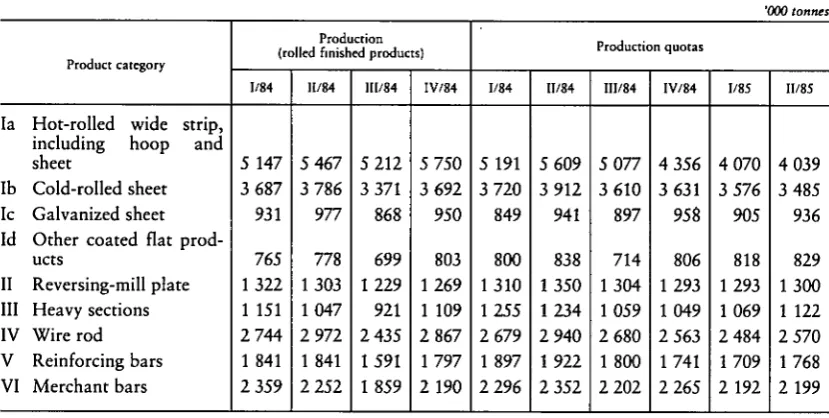
1985.2Table 3 shows the trend in production and quotas
for
1984 and the theoretical quotaswithout supplements
or
other adjustmentsfor the fourth quarter
of
1984 and the first two quartersof
1985.Table 3
-
Trend in production and quotasfor
1984 and the beginningof
1985'frO tonnes
Product catcgory
Production
(rolled frnished products) Production quotas
lt84 l/84 ilt/84 lv/84 t/84 ilt84 lil/84 lvt84 l/85 M5
Ia
Hot-rolled wide strip,including
hoop
and sheetIb
Cold-rolled sheetIc
Galvanized sheetId
Other coated flatprod-ucts
II
Reversing-millplateIII
Heavy sectionsIV
Wire rodV
Reinforcing barsVI
Merchant bars5 147
3 687 931
755
I 322
I
1512744
1 841
2 359
5 467 3 786
977
n8
I 303tM7
2 972
1 841
2252
5 212 3 371
858 599 I 229 921 2 435 1 591 1 859
5 750 3 692 9s0
803
I
269I
1092 867
1 797
2 190
5 191 3 720 849 800 1 310
I 255 2 579
|
8972 296
5 609
3 912 941
838
1 350
I
234 2 940I
9222 352 5 077 3 510
897
714
I 304
I 059
2 680 1 800
2202
4 3s6
3 631 9s8
805
I
293tM9
2 563
I 741
2265 4 070 3 576 90s
818 t 293 1 069
z 484 1 709
2 192 4 039 3 485 936 829
r 300 1 122
2 570
1 768
2 199
Crisis measures
Price policy
2.1.13.
On
I
April,
having received the Council's assent and the views of the ECSC Consultative Committee,the
Commissionamended
3
its
Decisionof
1.4 March 7978(527/7\/ECSC)
prohibiting
alignment on offers of iron and steel products originating in certain non-member countries.4 Thislat-est amendment is subject to certain internal measures
still in
forcein
1985 andto
theconclusion
of
arrangementswith
the countries in question.Production quotas
four points the rates for the establishment of production quotas
for
productsin
catego-ries Ia and Ib, and by two and three points respectively thosefor
the establishmentof
the parts
of
the production quotas which may be delivered in the common market forcategories Ic and III. The increases in quotas
for the latter two categories are mainly due
to
the growthof
the marketin
the United Kingdom.I nf ormati o
n
tech n o I ogya n d telecomm u n icatio ns
2.1.15. As part
of
its
overall policy
to coordinate and accelerate work on thedefi-2.1.14.
On 30 April
the
Commissiondecided
s
to modify the ratesof
abatementto
be appliedin
calculating the quotas forthe second quarter of 1985 and to reduce by
Bull. EC 3-1984, point 2.4.30.
OJ C 98, 18.4.1985; Bull. EC 3-1985, point 2.1.17.
oJ L 95, 2.4.r98s.
oJ L73, ts.3.1978.
oJ L 118, 1.5.1985.
[image:19.460.30.445.185.394.2]lndustrial innovation and the information market
nition and implementation of international
information technology standards
in Europe,the
Commission madea
call for
proposals in April concirning the provision
of information technology conformity test-ing services I
Funding is available under the extension
of
Part
I
of
the multiannual data-processing programme 2 to assist centres in setting upharmonized
reference-testing
servicesthroughout the Community,
in
accordance with official international information tech-nology standards.Particular reference
is
madeto
ISO-OSI-related issues. The closing date for the sub-mission of proposals is 24 June.Adva n ced ma n ufa ctu ri ng equipment
2.1.16.
On
22 March the
Commissiontransmitted
to
the
Council
a
communi-cation
on
advanced manufacturing equip-mentin
the Community (--+point
1.1.1 etseq.).
lndustrial innovation
and
the information
market
Transnational measures to promote innovation
European Association
for
the Transfer of Technology,lnnouation and lndustrial Information
2.1.17.
Commission representativesjects. The main outcome of the meeting was the setting up
four
TII
working parties onthe
transferof
technologyby
communi-cation, grantingof
licences, promotionof
innovation, and information.
Seminar on a European strategy
for
technical fairs2.1.18.
The seminar on a European strat-egyfor
technicalfairs
heldby
the
Com-mission in Luxembourg on 19 and 30April
was attended by about 40 representatives
of
the main European fairs.Under the plan
for
the transnational devel-opment of the supporting infrastructure forinnovation and technology transfer adopted by the Council at the end
of
19834techno-logical fairs are regarded as tools
to
pro-mote innovation and technology transfer. The aim of the Luxembourg seminar was tocollect recommendations
for
Commission activitiesto
enhance the impactof
techno-logical fairs
at
Europeanlevel
through transnational collaboration.The conclusions were that
it
would beuse-ful: to
ensurewider
disseminationof
the proceedingsof
seminars associated withtechnological
fairs
by
having themtrans-lated
into
different languages;to
issue adirectory of fairs in Europe so as to improve
coordination
of
these events;to
issue anewsletter
with
information on technologi-cal fairs; to have standardized terminologies in the different sectors; to introduce special reduced ticketsfor
foreign exhibitors; to organize well-planned group visits; and to includein
the programmeof
technologicalfairs
the
presentationof
similar
fairs abroad.Utilization of research results
2.1.19.
ThS
European
Atomic
EnergyCommunity,
representedby
the
Com-t
oJ c 90,12.4.1985.2
oJ L 308,n.11.1984.3
Bull. EC 5-1984, point 2.1.31.4
oJ L 3s3, 15.12.1983.attended the annual plenary asiembly of the European Association
for
the Transferof
Technology,
Innovation
and
IndustrialInformation (TII), set up in May 1984 with
pro-Customs union
mission,
obtained
the
following
three patentsin
April:
'PhotovoltaicSchottky-barrier elements'
in
the
United Kingdom,'Annular dosimetry and relevant analytical device' in Luxembourg and'Testing method
for
brazedjoints
in
metallic articles and metallic articles tested thereby' in Ireland. Euratom currently holds 540 valid patentsfor some 220 inventions.
2.1.20.
Underthe
schemefor
the
com-' munication of scientific and technicalinfor-mation designed
to
disseminate rhe resultsof
Community research,more
than
480titles,
including 259
EUR
series publi-cations, have been publishedin
the
firstquarter alone
of
this year. The series now contains some 9 800 reports, papers and conference proceedings, some of them avail-able in several languages.Summaries
of
publications on Community research were incorporatedin
the Euroab-stracts database (EABS) and shownin
themonthly
publications Euroabstracts,Sec-tion
l:
Euratomand
EEC research and Euroabstracts, SectionII:
ECSC research.EABS
now
containsmore than
35 000entries accessible directly through ECHO (European Community Host Organization) and Euronet-Diane.
Customs union
Simplification of
customs
formalities
2.1.21.
In April the Council authorized the Commissionto
participatein
the
nego-tiations on an amendment to the 7972 Cus-toms Convention on Containers.This Convention deals
with
the temporaryimportation
of
containers
and
theirapproval
for
transportof
customs-sealed goods. It is a vital instrument of Communityand international commercial policy. The accession of the Community as such would greatly facilitate the operation
of
theCon-vention, as most
of
the
mattersit
dealsBull. EC 4-1985
with
fall
within
the sphereof
Community competence. Hitherto the Commission hasonly attended the Convention's meetings as
an observer.
2.1.22.
On 22April
the Council acceptedon behalf
of
the Comunity the recommen-dation of the Customs Cooperation Council and the resolution of the Inland Transport Committeeof
the Economic Commissionfor Europe concerning the establishment
of
links between customs systems. 1
Genera! legislation
Reliefs from customs duty
2.1.23. Partly
responseto
Parliament'swishes 2 the Commission amended
3
on 25April its
proposal
for
a
Regulation in respectof
the
tariff
treatment applicableto
goods containedin
travellers' personal luggageor
sentin
small consignments to private individuals. aThe
Commissionnow
proposesthat
the ceilings be raisedto
100 ECUfor
travellers aged 15 years or over and 50 ECU for those under 15 years of age. The flat-rate charge ceiling would be raised to 200 ECU.Customs debt
2.1.24.
On 19 April
Parliament endorsed,5 subject to ceitain amendments, the Commission'sproposal for a Regulation on customs debt.52.1.25.
The
Economic and Social Com-mittee gaveits
opinionin April
(-+
point 2.4.35) on the proposal for a CouncilRegu-lation
on
the entryin
the
accounts and termsof
paymentof
the
amountsof
theI
OJ L 112,8.4.1985; Bull. EC 7/8-1984, point 2.1.42.2
oJ c 72,18.3.198s.3
oJ c l3t, 30.5.1985; coM(85) 169 final.1
oJ c 324,5.72.7984; Bull. EC 11-1984, point 2.1.35.5
oJ c t22,zo.s.l98.s.6
oJ c 261,29.9.1984;Bull. EC 9-1984,poi1r2.1.24.Competition
import
or
export duties resultingfrom
acustom debt I
Repayment or remission
of duties
2.1.25.
The
Economic and Social Com-mittee gave its opinion(+
point 2.4.35) onthe
proposed amendment2
of
the
Regu-lation
of
2July
1979 on the repayment or remission of import or export duties.r
Customs procedures
with
economic impact
Temporary importation2.1.27.
On 25April
the Commission sent the Council a proposal4 f.or a Regulationto
amend the Regulationof
21 December 7982on
temporaryimportation
arrange-ments.5Numerous difficulties having been encoun-tered
in
connectionwith
the new arrange-ments, the Commission considers that this Regulation's date of implementation shouldbe put back to 1 January 1986.
Common Customs
Tariff
Nomenclature
2.1.28.
On
19 March the
Commission adopteda
Regulationfor
the
purposeof
ensuring uniform application
of
the CCT nomenclature classifying goods under sub-heading 17.04 D 1.6The Committee on Common Customs
Tar-iff Nomenclature adopted a number of
tariff
measures-in
the form
of
classification slips, explanatory notesor
agreements onthe classification
of
goods-involving
thefollowing subheadings: 50.04 B
IV
b) 2 aa),b) 2 ee), d) 2 dd); 50.05
A
II
b) 3; 61.01 BIV
b);
67.02 BII
d)
2; 6t.02 BII
e)4
cc);73.71.
A
1);73.40 B;84.07 B; 84.10 BII
a);85.13 B;85.21 A
lll;87.02 A;87.728.7
Economic
tariff
matters
Tariff
quotas2.1.29.
The
Council adoptedin
April
aRegulation opening, allocating and provid-ing for the administration of a Community
tariff
quota for new potatoes falling within CCT subheading 07.01A
II
b) originatingin Cyprus (1985).8
Value
for
customs purposes
2.1.30.
On 23April
the Council adopted a Regulation e amending the Regulationof
28 May
1980on
the
valuationof
goodsfor
customs purposes,lo giving effecton
aunilateral
and
provisional basis
to
adecision taken under the
GATT
implemen-tation agreement. The Regulation provides that the value for customs purposes of
car-rier media bearing software
will
notgener-ally
includethe
costor
valueof
data or instructions carried on the media.The Commission sets great store by having exact statistical data and
will
be presenting proposalsfor
amendements-from 1Jan-uary
1985-to
the Common CustomsTariff
and the Nomenclature of Goods forExter-nal Trade Statistics (Nimexe)
with
a view to obtaining more accurate statistics for the products in question.Competition
Fourteenth Report on Competition Policy
2.1.31.
In April the Commission published its Fourteenth Report on CompetitionPol-1
OJ C 47,73.2.7985; Bull. EC 12-1984, point 2.1.40.2
oJ c 22,24.7.7985; Bull. EC 12-1984,point2.7.42.3
oJ L 17s,127.t979.1
oJ c 117, 11.5.1985; coM(8s) t73 final.5
oJ L 376,31.1,2.1982.6
oJ L78,21.3.198s.7
oJ c 99, 19.4.1985.6
oJ I- il8, 1.5.198s.e
OJ L 112,25.4.1985; Bull. EC 2-1985, poinr 2.1.33.Competition
icy in conjunction with the Eighteenth
Gen-eral Report on the Actiuities
of
the Euro-pean Communities.l As in previous years,the report outlines developments
in
Com-munity competition policy during the past
year;
it
also takes stockof
policy
trends since 1981.The Commission was particularly vigilant
during the past year
in
ensuringthat
the competition rules laid down by the Treaties are enforced in such a way as to further the establishment of the conditions of a genuine internal market, which can operate properly only if manufacturers, distributors and pro-viders of services arein
a position to com-petewith
one another on thesamHr
at least comparable-terms. Giventhe
con-tinuing
adverse economicsituation,
the Commission attached greater importance tocoordinating
its
competitionpolicy
withother Community policies intended to
pro-mote industrial change and
to
encourage industryto
take up the technological chal-lenges posedin
this final
quarterof
the twentieth century.The three aims
of competition policy
2.1.32. In the period from 1981 to 1984,
compe-tition policy was conducted in the shadow of econ-omic problems manifested notably in rising
unem-ployment and the contraction of declining indus-tries. The Commission's aim in this situation was
to bring the weight of competition policy behind
the other policies designEd to promote structural
adjustment in the Community. To do so, the Com-mission had to make its competition policy more consistent, more universal and more in touch with
economic realities.
Greater consistency
2.1,33, Greater consistency was sought both
within the ambit of competition policy itself and
in relation to other Community policies. The quest
for internal consistency is seen in the mobilization of different branches of competition policy to pro-mote structural change. Two examples can illus-trate this approach. In relation to research,
devel-opment and innovation, the Commission was
involved simultaneously
in
preparinga
blockexemption regulation
for
agreementson
joint Bull. EC 4-1985research and development work and establishing
a clear framework for government aid for research
and development activities. Both actions were
aimed at creating a more favourable climate for
projects that raise the technological level and
inno-vative capacity of Community industry, without
removing the stimulus of competition. The second
example concerns the steel industry. Here the
Commission simultaneously administered a
mar-ket regime and an aids code to allow the industry to
carry out an orderly reduction of excess production
capacity and regain profitability and competitive-ness. In both examples, care was taken to make
the application of competition policy consistent
with other Community policies, such as the Esprit programme
in
the caseof
applied research oninformation technology and the schemes to assist
retraining of labour and diversification of industry
in steel areas. Consistency with policies aimed at
creating
a
more integrated internal Communitymarket was also a constant concern of the
Com-mission. In this context, it has ceaselessly waged
war on arrangements or practices seeking to
pre-vent parallel imports and on cartels which divide
up the Community market among the participants.
More comprehensive coverage
2.1.34.
In
its movesto
make the coverage ofcompetition policy more comprehensive, the
Com-mission extended
its
actioninto
areas whichinitially had not been given priority but which have
begun
to
require attention as economic changeincreases their impact on competition. Anti-trust
enforcement was thus taken into the services
sec-tor, particularly banking, insurance and transport,
The Commission also provided itself with the
means of enforcing the competition rules better in relation to publicly owned enterprises by adopting
in June 1980, and since applying, a directive on
the transparency
of
financial relations betweenMember States and public undertakings.
Another development
of
competition policy inresponse
to
the
tendencyof
Member Statestowards interventionism was a statement by the
Commission setting out how Articles 92 and 93
apply to State shareholdings in firms.
Efforts to extend the coverage of the competition
rules are also seen in the more stringent scrutiny
of
regional aid schemesin
the most developed parts of the Community. The Commission's actionmostly concerned the central regions, where it
constantly pressed
for a
reductionin
the areaI Available from the Office for Official Publications of the European Communities, L-1985 Luxembourg. See also: coM(85) 103.
Competition
coverage and intensity of aid. Finally, also in the State aids field, the Commission decided in future to examine significant cases of multiple awards of aid for different purposes, which previously had escaped specific scrutiny.
Increased relevance
to economic realities
2.1
.35.
The drive for consistency andcomprehen-siveness only assumes its full significance, however,
when seen in relation to the simultaneous efforts
to make competition policy more in touch with
economic realities.
A prominent feature of the past four years' work
has been the effort to increase the credibility of
competition policy by simplifying and speeding up
the decision-making procedures. In the anti-trust
field, this was reflected
in
the adoptionof
an unprecedented number of block exemption regu-lations, in the introduction of a streamlined 'oppo-sition' procedure in some of these regulations, and in the wider use of administrative 'comfort' letters. These procedural changes were accompanied by measures to increase the safeguards for the rightsof the defence in anti-trust proceedings: a Hearing
Officer was appointed to supervise oral hearings, representatives of firms were given greater access
to the Commission's files and the rules for
on-the-spot investigations were clarified. In the field of
State aids, internal procedures were changed to
speed up the processing of minor cases from now on. Indeed, a major thrust of policy generally was
to concentrate resources on the cases having the greatest potential impact on competition.
Efforts to increase relevance to economic realities and needs were also seen in the work on improving
the transparency of competition policy. Notices and definitions on the criteria to be met in order,
for example, to come within the terms of a block
exemption were published. These not only increase
legal certainty with regard to existing conduct;
they also serve as a guide to the kind of future conduct, for example on cooperation or
govern-ment aid, that is compatible with the common
market. In this way competition policy was able
to play a greater preventive role, instead of being
limited to the simple approval or prohibition of
both restrictive practices and State aids.
Finally, the desire
to
make competition policymore relevant led the Commission to pay grearer
attention to the operational aspect of its decision.
An example was its going over to the practice
of ordering governments to recover, or otherwise reverse the effects of, illegally paid aid. Similarly,
in its fining practice the Commission took more
and more account of the economic environment and impact of the infringements in question.
Continuation of these policies in 1984
2.1.35. The Commission's work
in
1984 was acontinuation of the general policies it had followed
over the last four years.
Thus, 1984 saw the adoption of no fewer than
four block exemption regulations. Two of them, relating to research and development and,
respect-ively, patent licensing agreements, were prompted by the desire to facilitate, consistent with the need
to maintain competition, the cooperation
necess-ary for the spread of new technologies and inno-vation. Another concerned distribution and servi-cing agreements in the motor vehicle sector, where there tends to be more competition between
differ-ent makes (interbrand) than within a given
manu-facturer's network (intrabrand). The fourth
regu-lation replaces an earlier one on specialization agreements and increases the scope for such
coop-eration up to a certain market share limit.
Among the 20 decisions under Articles 85 and 86
EEC and the eight under Articles 55 and 55 ECSC made in 1984, special mention must be made of a number involving classic horizontal anti-trust infringements relating to price fixing and
market-sharing
in
the woodpulp, zinc, flat glass,alu-minium and hydrogen peroxide sectors. 1984 also saw the first decisions on restrictive agreements in the banking and insurance sectors. However, the
Commission's activity cannot be gauged entirely
from the number of formal decisions. In the IBM
case, which is one of the largest the
Directorate-General for Competition has ever handled, the
Commission decided
to
suspend the Article 86proceedings in view of the changes IBM agreed
to make to its business practices in the common market.
In the field of State aids, the Commission worked
on determining general policy issues as well as
taking decisions in specific cases. Developments in
the first category included action to exrend the
existing control machinery
to
shareholdings infirms by governments, following a study of this practice under Article 92EEC, and to multiple aid awards. The year also saw the first cases in which the Commission ordered the recovery of illegally
paid aid. As regards the second category, the
spec-ific decisions that were prepared or adopted helped
clarify the limits within which aid can be held to
be in the Community interest or not to distort
competition to an extent contrary to the
Competition
Apart from the special case of the steel industry,
where aid is to be discontinued at the end of 1985
under the steel aids code, the highest incidence of
decisions requiring Member States
to
alter aidproposals was found in the textile and clothing industry, where the markets had slightly improved,
and in the man-made fibres industry, which is still
suffering from overcapacity. The Commission also reaffirmed its opposition to schemes for supporting
exports to other Member States, instances of which
were planned by Denmark, France and Greece ...
Some headway, but ground still uncovered
2.1.37. The record of competition policy since 1981 and of the steps taken during the final year
of the Thorn Commission shows considerable
pro-gress, despite the difficult economic circumstances.
However, progress was not uniform on all fronts
and on some, the necessary development was slowed down by various obstacles.
In certain policy areas the Commission's efforts
have so far frankly been a failure. This is the
case with the proposed merger control regulation, where the Commission's perseverance has still not brought any results, T2years and several revisions
later. In air transport, too the lack of progress
towards a liberalization of the market is a clear setback for competition policy of which consumers are keenly aware.
In other cases, p.actical difficulties of
implemen-tation continue to mar the effectiveness even of
well-established policies like that on State aids.
The Commission has difficulry in ensuring that
all
notifiable aid schemes planned are actuallynotified, especially where decentralized
govern-ment agencies are involved, ,.. while the
infor-mation the Commission has so far elicited under
the directive
on
the transparencyof
financialrelations between Member States and public
undertakings has also regularly failed to match up
to exPectations.
New priorities
2.1.38. These considerations and the experience gained over the last few years indicate that in the
future, the application of competition policy must advance in a number of directions at once. The objective. pursued.
by
safeguarding undistortedcompetition remains structural adiustment and increased competitiveness of the Community
econ-omy. The means for reaching this end must be
determined on the basis of a number of priorities: Bull. EC 4-1985
(i)
The remaining gaps in the coverage of anti-trust policy must be filled, continuing the trend setby the Commission's greater attention to service industries.
(ii)
The Commission's policy on agreements and practices worthy of exemption under Article 85(3), especially where they promote economic or techni-cal progress, must be made clearer, particularly by means of notices.(iii)
Decisions on State aids and in anti-trust casesmust systematically have regard to an economic
analysis of competitive conditions on the relevant
markets-within the Community and if necessary
worldwide.
(iv)
Competition policy must also be made more effective through close cooperation with the Mem-ber States, be it through the application ofCom-munity law by national courts or in the application of the State aid rules, Article 93(2) and (3).
(v)
Finally, competition policy must be developedin
conjunction with other Community policiesregarding the creation of a unified market, the
approximation of laws (with particular reference
to Article 101 EEC) and the implementation of
other fundamental principles of the Treaty.
Restrictive practices, mergers
and
dominant
position:
specific
casesPermissible forms
of cooperation
Extension of authorization
for
Groupement Europien du Manganise2.1.39.
On 24 April
the
Commission extended, underArticle
65(2)of
the ECSCTreaty,
its
authorizationfor
the
Groupe-ment Europ6en du Mangandse (GEM), con-trolled by Sofrem (Pechiney Group), Soci6t6Nouvelle des Aci6ries de Pompey (Sacilor
Group)
and
Eurominas,granted
on
2October 1974 and extended
for
the
firsttime on 20 December 1979.r
GEM's main object
is
the distributionof
high-carbon ferro-manganese produced by
the Portuguese
firm
Eurominas,in
which Sofrem and Pompey have a maiority share-holding. Its sales have represented onaver-I
oJ L 119,3.5.1985.Competition
age l.9o/o
of
annual Communityconsump-tion
of
high-carbon ferro-manganese, wellbelow
the
estimateon
which
the
initialauthorization
decisionwas
based. TheCommunity high-carbon ferro-manganese
industry
is
sufferingfrom
overproduction dueto
reductionsin
both steel production and the specific consumptionof
high-car-bon
ferro-manganeseper
tonne
of
steelproduced and
to
the
replacementof
thisproduct
by
other alloys,
suchas
silico-manganeseand
refined
ferro-manganese (EEC products) following the introduction of continuous casting. In this situation there oughtto
be a cutin
thefirm's
production capacity and hencea
restructuringof
the industry.The
Commission accordingly deemedit
appropriateto
renew the authorization for no more thantwo
years, so asto
be ableto
assess the effectson
the
agreement inquestion
of
any changein
the structureof
the
industry.In
addition,the firms
con-cerned are requiredto
inform the
Com-missionforthwith
of
any amendments toor
updatingof
the agreement, notably asregards their shareholding and voting rights in GEM and Eurominas and the ownership of their own shares.
Subject to these conditions and safeguards, the Commission adopted a Decision
extend-ing the
authorizationit
had
granted to GEM.Distribution
Restrictions of compet ition
in the spectacle trade
2.1.40.
At
the
Commission's request, OptischeVerke
G.
Rodenstock, Munich,a
leading supplierof
spectacle lenses and frames,and Metzler
International OptikGmbH,
Muhlacker,a
major
supplierof
spectacle frames, have brought their
distri-bution
agreementinto
line
with
the EECTreaty competition rules by
lifting
certain resale restrictions which they had imposed on their German dealers.Rodenstock's standard distribution
agree-ment required
that
its
products be resoldonly
to
final
consumers, which prevented dealers from selling Rodenstock lenses and framesto
dealersin
other Member States.The firm has now left it open to its German dealers
to
supplyany
dealerin
anotherMember State.
The
Commission
hasreserved
the
right
to
decide whether theamended
distribution
arrangements-which
still
prohibit
cross-sales betweenapproved German
dealers-are liable
to have an appreciable effect on trade between Member States, particularlyin
the lightof
the analogous national distribution systems
prevailing throughout the trade.
Metzler's standard distribution agreement imposed the same restrictions
on
German dealers,who
were likewise barred from cross-frontier selling; the firm has alsowith-drawn this restriction.
The Commission's action
in
these cases ispart of a broader drive to eliminate restric-tions
of
competitionin
the spectacle tradethat
are
incompatiblewith
Communitylaw.l
The Commission is empowered
to
impose fines for direct or indirect interference withintra-Community trade. It has informed the opticians' and manufacturers' associations
in the Member States of the content of the press release issued in this connection.2
State aids
Industry aids
Synthetic fibres
Germany
2.1.41.
Having initiated the Article 93(2)procedure
3
and received the commentsof
interested parties, the Commission decided on 2
April
that the German Government'sI Bull. EC 1-1985, point 2.1.9.
2 IP(85) 112.
Financial institutions and taxations
proposal to grant assistance to a polyamide
filament
and
carpet
yarn
producer
in Neumiinster could not be regarded ascom-patible
with
the common market. Takingthe view
that
the aid would
affect trade between Member Statesto
an extentcon-trary
to
the common interest,it
requested the Federal Republic of Germany to refrain from implementing its proposal.The planned investment actually concerned only'routine plant modernization and could
not
be
describedas
restructuring. There were accordingly no grounds for the Com-missionto
exempt the proposed assistancefrom the rules laid down by the aids code
for
the synthetic fibres and yarns industry, extended in July 1983, 1 which specifies that such assistance is not to be granted.Sbipbuilding
Germany
2.1.42.
On 2
April the
Commission decidedto
raiseno
objectionto
a
schemeof
assistancefor
the shipbuilding industrynotified by the German Government on 15
February.
The
scheme, preparedby
the Governmentof
Bavaria, introduces a pro-gramme of aid for shipyards from 1 October1983 to 31 December 1985. The programme
has been allocated
DM
3 million
andwill
mean subsidies of 5olo (up to 31 December
1984) and 4% (in 1985) of the contract price
for
orders obtainedby
Bavarian yards upto 31 December 1985. Part of the subsidies could be recovered from any operating
pro-fits
madeby
the yards between 1989 and 7991.By its
termsand
criteria,the
pro-gramme represents an extension to Bavariaof measures authorized by the Commission
for
the coastalLiinder of
Bremen,Ham-burg,.Lower
Saxonyand
Schleswig-Hol-steln.'
The
Commission hastaken note
of
theefforts
undertakenby
recepient yards in regard to restructuring, bearing in mind theparticular features
of
the
Bavarian yardsind
the
push towards diversification and rationalization of their production capacity.Bull. EC 4-1985
The aid in question is aimed more
particu-larly in this case at curtailing the economic risks which could imperil these endeavours.
Steel
2.1.43.
On
19
April the
Commission amended, 3 with the issent of the Council, aits
Decisionof 7
August 1981 establishing Communitv rules for aids to the steelindus-try.5
Aids granted to the steel industry may henceforth be considered compatible withthe orderly functioning of the common
mar-ket
provided,
inter
alia, that they
areapproved
not
later than
1
August
1985(instead
of
1 July 1983). Aids for continued operation must not leadto
payments after 31 December 1985 (instead of 31 December1,984), while aids for research and develop-ment must be notified not later than 31 May 1985 (instead of 30 September 1982).
Financial institutions
and