Nephrol Dial Transplant (2015) 0: 1–10 doi: 10.1093/ndt/gfv209
NDT Perspectives
How to routinely collect data on patient-reported
outcome and experience measures in renal registries
in Europe: an expert consensus meeting
Kate Breckenridge
1, Hillary L. Bekker
2, Elizabeth Gibbons
3, Sabine N. van der Veer
4,5, Denise Abbott
6,
Serge Briançon
7, Ron Cullen
1, Liliana Garneata
8, Kitty J. Jager
9, Kjersti Lønning
10, Wendy Metcalfe
11,12,
Rachael L. Morton
13,14, Fliss E.M. Murtagh
15, Karl Prutz
16,17, Susan Robertson
18, Ivan Rychlik
19,
Steffan Schon
16,20, Linda Sharp
21, Elodie Speyer
22,23, Francesca Tentori
24and Fergus J. Caskey
1,251UK Renal Registry, Southmead Hospital, Bristol, UK,2Leeds Institute of Health Sciences, School of Medicine, University of Leeds, Leeds, UK, 3Health Services Research Unit, Nuffield Department of Population Health, University of Oxford, Oxford, UK,4European Renal Best Practice, Methods Support Team, University Hospital Ghent, Ghent, Belgium,5Health eResearch Centre, Farr Institute for Health Informatics Research, University of Manchester, Manchester, UK,6The National Kidney Federation, Shireoaks, Worksop, UK,7CHU de Nancy, Epidémiologie et évaluation cliniques, Inserm CIC 1433, Nancy, France,8‘Dr Carol Davila’Teaching Hospital of Nephrology, Bucharest, Romania,9European Renal Association–European Dialysis and Transplant Association Registry, Department of Medical Informatics, Academic Medical Center, University of Amsterdam, Amsterdam, The Netherlands,10Section of Nephrology, Department of Organ Transplantation, Oslo University Hospital Rikshospitalet, Oslo, Norway,11Renal Unit, Royal Infirmary of Edinburgh, Edinburgh, UK,12The Scottish Renal Registry, Glasgow, UK,13School of Public Health, The University of Sydney, Sydney, Australia,14Health Economics Research Centre, Nuffield Department of Population Health, University of Oxford, Headington, UK,15Department of Palliative Care, Policy & Rehabilitation, King’s College London, Cicely Saunders Institute, London, UK,16Swedish Renal Registry, Jönköping, Sweden,17Department of Internal Medicine, Hospital of Helsingborg, Helsingborg, Sweden, 18Dumfries and Galloway Royal Infirmary, Dumfries, UK,192nd Department of Medicine, 3rd Faculty of Medicine, Charles University, Prague, Czech Republic,20Diaverum Renal Services Group, Lund, Sweden,21National Cancer Registry Ireland, Cork, Ireland,22CHU Nancy, Pôle QSP2, Epidémiologie et Evaluation Cliniques, Nancy, France,23Université de Lorraine, Université Paris Descartes, Nancy, France,24Arbor Research Collaborative for Health, Ann Arbor, MI, USA and25School of Social and Community Medicine, University of Bristol, Bristol, UK
Correspondence and offprint requests to: Fergus J. Caskey; E-mail: [email protected]
A B S T R AC T
Despite the potential for patient-reported outcome measures (PROMs) and experience measures (PREMs) to enhance under-standing of patient experiences and outcomes they have not, to date, been widely incorporated into renal registry datasets. This report summarizes the main points learned from an ERA-EDTA QUEST-funded consensus meeting on how to routinely collect PROMs and PREMs in renal registries in Europe. In preparation
for the meeting, we surveyed all European renal registries to es-tablish current or planned efforts to collect PROMs/PREMs. A systematic review of the literature was performed. Publications reporting barriers and/or facilitators to PROMs/PREMs collec-tion by registries were identified and a narrative synthesis under-taken. A group of renal registry representatives, PROMs/PREMs experts and patient representatives then met to (i) share any ex-perience renal registries in Europe have in this area; (ii) establish how patient-reported data might be collected by understanding how registries currently collect routine data and how patient-re-ported data is collected in other settings; (iii) harmonize the fu-ture collection of patient-reported data by renal registries in © The Author 2015. Published by Oxford University Press on behalf of
ERA-EDTA. This is an Open Access article distributed under the terms of the Creative Commons Attribution Non-Commercial License (http://creativecommons.org/
NDT Advance Access published May 16, 2015
at University of Leeds on May 18, 2015
http://ndt.oxfordjournals.org/
Europe by agreeing upon preferred instruments and (iv) to iden-tify the barriers to routine collection of patient-reported data in renal registries in Europe. In total, 23 of the 45 European renal registries responded to the survey. Two reported experience in collecting PROMs and three stated that they were actively explor-ing ways to do so. The systematic review identified 157 potential-ly relevant articles of which 9 met the inclusion criteria and were analysed for barriers and facilitators to routine PROM/PREM collection. Thirteen themes were identified and mapped to a three-stage framework around establishing the need, setting up and maintaining the routine collection of PROMs/PREMs. At the consensus meeting some PROMs instruments were agreed for routine renal registry collection (the generic SF-12, the dis-ease-specific KDQOL™-36 and EQ-5D-5L to be able to derive quality-adjusted life years), but further work was felt to be needed before recommending PREMs. Routinely collecting PROMs and PREMs in renal registries is important if we are to better under-stand what matters to patients but it is likely to be challenging; close international collaboration will be beneficial.
Keywords: patient-reported measures, quality indicators, registry
INTRODUCTIO N
Established renal failure is a chronic disease with significant as-sociated morbidity. Although it affects a small proportion of the general population (0.06–0.12% in countries across Europe in 2012) (Table A.4.3 in [1]), the quality of life of those affected is markedly lower than for those with most other chronic con-ditions and cancers [2]. Standard dialysis provides the equiva-lent of only 10% of kidney function so many patients are chronically tired, depressed and suffer pain; and many of these symptoms go unrecognized [3].
The success of treatments for renal failure has been historic-ally assessed using measures considered important by doctors, such as phosphate level or urea clearance. Although instru-ments measuring the patient’s perspective have been available for decades, their incorporation into routine clinical practice has until recently been slow. A number of patient-reported measures exist:
• Patient-reported outcome measures (PROMs) include any metric assessing health, illness or health care benefits from the patient’s perspective; in general they take the form of a questionnaire and more specifically a quality of life or symp-tom questionnaire. In routine clinical practice, PROMs have the potential to highlight relevant symptoms and changes in symptoms, promote patient engagement in their treatment [4] and improve patient outcomes [5]. Summarizing PROM results across individual patients, for example at the level of treatments or hospitals, they could be used to inform a pa-tient’s choice of treatment or assess quality of care across different hospitals [6,7]. The importance of PROMs as end points in clinical trials is also increasingly being recognized [8].
• Patient-reported experience measures (PREMs) capture in-formation about the healthcare experience as perceived by
the patient. They can refer to a variety of issues, ranging from cleanliness of facilities to information provision, and from timeliness of transport to family members0access to health professionals [9]. In routine clinical practice, PREMs can be used to improve quality in clinical services [10].
• Measures reflecting aspects of patient involvement in their health care, including patient activation [11] and informed and shared decision-making [12].
Dialysis and transplantation are in the almost unique pos-ition of having an existing infrastructure of regional, national and international registries for collecting and reporting infor-mation on all patients receiving treatment. Quality of care, as measured against nationally and internationally agreed stan-dards, can be publicly reported and compared between centres and between countries. These instruments were usually devel-oped for measurement at the patient level, however, and caution will need to be exercised when comparing differences between centres or countries until more is known about their perform-ance at these levels. To be able to report symptom burden and quality of life-adjusted survival alongside laboratory measures such as haemoglobin, calcium, phosphate and dialysis dose would be a major step forward in reporting what is important to patients. While some components of quality of life have been shown to be modifiable (e.g. the physical component summary score of the SF-36 in the Frequent Haemodialysis Network Short Daily Trial [13]), others reflect the broader social con-struct in which the patient functions which so could prove to be beyond the influence of the health care provider.
Part of this infrastructure is the ERA-EDTA Registry, which collects data on renal replacement therapy (RRT) via the national and regional renal registries in Europe: individual patient data is available from 31 national and regional registries in 17 countries and aggregated data from a further 14 national registries [1]. The data items collected vary by country but can include demograph-ics, primary renal disease, RRT treatment history, date and cause of death, comorbidities, details of physical examination (e.g. weight, blood pressure), laboratory measurements (e.g. haemo-globin, albumin) and details of certain therapies given. At pre-sent, none of the national and regional registries report patient-reported outcome/experience measures to the ERA-EDTA Registry, but it is not certain what data are collected locally. This paper reports the results of a survey to capture exist-ing experiences of European renal registries in PROM and PREM collection and a literature review of the facilitators and barriers to registries routinely collecting PROMs and PREMs. It then presents the discussions and conclusions of an international con-sensus meeting, funded by the QUEST initiative of the ERA-EDTA, aimed at promoting and harmonizing the routine collection of patient-reported data by European renal registries.
S U RV E Y O F E U RO P E A N R E N A L R E G I S T R I E S
Prior to the consensus meeting, the organizers contacted all 45 European renal registries (using the ERA-EDTA Registry email contact list) asking for responses to the following questions:
ND
T
P
ERSPECTIVES at University of Leeds on May 18, 2015
http://ndt.oxfordjournals.org/
(i) Does your registry currently collect any quality of life or patient satisfaction/experience measures?
(ii) If so, what measures do you use and how are these data collected?
(iii) If not, have you tried to collect these measures in the past and/or do you have plans to collect these measures in the future?
The survey did not ask about patient involvement question-naires, patient activation or shared decision making, as these had not been included in the original application for funding. Responses were received from 23 out of 45 registries. Only two registries (Austria and France) reported experience in the collec-tion of PROMs/PREMs and a further three registries reported that they were actively exploring this possibility (Norway, Romania and Sweden). From these responses, there was no obvious consensus on the instruments or methods to use in the collection of PROMs and PREMs, although some barriers to the process were identified. These included low response rates, legal constraints and the burden on staff and patients.
L I T E R AT U R E R E V I E W A N D N A R R AT I V E S Y N TH E S IS
A systematic review of the literature was conducted with the primary aim of identifying facilitators and barriers to the rou-tine collection of patient-reported measures by chronic disease registries. Medline and EMBASE databases were searched from 1981 to 2013 to identify papers reporting on the routine collec-tion of patient-reported outcome, experience or quality of life data by chronic disease registries, including both renal and non-renal registries. Full details of the search terms are avail-able in the Supplementary data. Abstracts of papers identified in the search were reviewed and full text versions obtained of those which appeared potentially relevant. Two reviewers (K.B. and F.C.) independently screened the full-text papers for relevancy, and—from the relevant papers—systematically identified any recurring themes across studies.
The search yielded 762 hits, of which 157 papers were deemed to be potentially relevant at the title and abstract screening stage
based on pre-defined criteria; 9 papers were finally selected [14–22] and included in the narrative synthesis conducted according to guidelines provided by Popayet al.[23].
All nine of the selected papers were read by two independent researchers (K.B. and F.C.) and the two most relevant papers used to conduct a preliminary synthesis [20,21]. Relationships between the data were then explored using all nine studies to develop a broad conceptual model in order to provide an appro-priate framework for further exploration of relationships in the data (Figure1). This framework comprised three stages: estab-lishing the need for, setting-up and maintaining routine PROM/PREM data collection. In total, 13 themes were
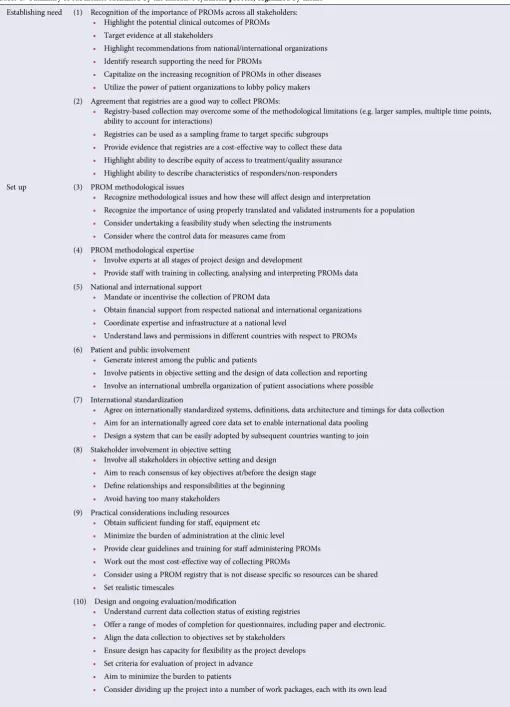
identi-fied and agreed by two independent researchers (K.B. and F.C.) across the three stages of the conceptual model, each compris-ing a number of subthemes (Table1). For each theme that re-sulted from the thematic analysis, we identified facilitators and barriers to implementation as reported in the selected papers, which we then translated into a series of recommendations (listed in Table1).
Establishing the needfor PROM/PREM data in registries was largely broken down into two main themes: recogniz-ing the importance of PROMs and agreerecogniz-ing that, with all the other data they collect, registries provide a good back-drop for the collection of patient-reported data.
Several of the themes and subthemes were identified as important insetting upPROM/PREM collection by regis-tries. Methodological issues associated with PROMs were identified, and recommendations developed based on the need for PROMs expertise, national and international support, stakeholder involvement (including patient and public involvement) and international standardization. As well as these themes, some specific issues relating to resources and practical aspects were identified.
More exclusive tomaintaininga PROM/PREM programme were themes related to ensuring useful, high-impact output and the process of maintaining trust in the data. Several themes crossed the‘set-up’and‘maintenance’parts of the model, including subthemes under design and evaluation, and technological/information governance.
F I G U R E 1 : Framework for narrative synthesis.
ND
T
P
ERSPECTIVES
at University of Leeds on May 18, 2015
http://ndt.oxfordjournals.org/
Table 1. Summary of subthemes identified by the narrative synthesis process, organized by theme
Establishing need (1) Recognition of the importance of PROMs across all stakeholders: • Highlight the potential clinical outcomes of PROMs • Target evidence at all stakeholders
• Highlight recommendations from national/international organizations • Identify research supporting the need for PROMs
• Capitalize on the increasing recognition of PROMs in other diseases • Utilize the power of patient organizations to lobby policy makers (2) Agreement that registries are a good way to collect PROMs:
• Registry-based collection may overcome some of the methodological limitations (e.g. larger samples, multiple time points, ability to account for interactions)
• Registries can be used as a sampling frame to target specific subgroups • Provide evidence that registries are a cost-effective way to collect these data • Highlight ability to describe equity of access to treatment/quality assurance • Highlight ability to describe characteristics of responders/non-responders Set up (3) PROM methodological issues
• Recognize methodological issues and how these will affect design and interpretation
• Recognize the importance of using properly translated and validated instruments for a population • Consider undertaking a feasibility study when selecting the instruments
• Consider where the control data for measures came from (4) PROM methodological expertise
• Involve experts at all stages of project design and development
• Provide staff with training in collecting, analysing and interpreting PROMs data (5) National and international support
• Mandate or incentivise the collection of PROM data
• Obtainfinancial support from respected national and international organizations • Coordinate expertise and infrastructure at a national level
• Understand laws and permissions in different countries with respect to PROMs (6) Patient and public involvement
• Generate interest among the public and patients
• Involve patients in objective setting and the design of data collection and reporting • Involve an international umbrella organization of patient associations where possible (7) International standardization
• Agree on internationally standardized systems, definitions, data architecture and timings for data collection • Aim for an internationally agreed core data set to enable international data pooling
• Design a system that can be easily adopted by subsequent countries wanting to join (8) Stakeholder involvement in objective setting
• Involve all stakeholders in objective setting and design
• Aim to reach consensus of key objectives at/before the design stage • Define relationships and responsibilities at the beginning • Avoid having too many stakeholders
(9) Practical considerations including resources • Obtain sufficient funding for staff, equipment etc • Minimize the burden of administration at the clinic level
• Provide clear guidelines and training for staff administering PROMs • Work out the most cost-effective way of collecting PROMs
• Consider using a PROM registry that is not disease specific so resources can be shared • Set realistic timescales
(10) Design and ongoing evaluation/modification
• Understand current data collection status of existing registries
• Offer a range of modes of completion for questionnaires, including paper and electronic. • Align the data collection to objectives set by stakeholders
• Ensure design has capacity forflexibility as the project develops • Set criteria for evaluation of project in advance
• Aim to minimize the burden to patients
• Consider dividing up the project into a number of work packages, each with its own lead
ND
T
P
ERSPECTIVES at University of Leeds on May 18, 2015
http://ndt.oxfordjournals.org/
A number of these themes, such as the need for stakeholder involvement, PROMs expertise and international standardiza-tion, were used when planning the consensus meeting. The re-sults of the review were also presented to the delegates during the preparatory session of the consensus meeting.
CON S E N S U S ME E T I N G
In June 2014, experts from across Europe participated in a con-sensus meeting in Bristol, UK. Invited to the meeting were par-ticipants representing all European renal registries with an interest in collecting PROMs and PREMs routinely; experts on PROMs, PREMs and shared decision making; a representa-tive from the National Cancer Registry Ireland with experience in routine PROMs collection among cancer patients, and; patient and carer representatives from a large UK kidney patient charity the National Kidney Federation. The objectives of this meeting were to (i) share any experience renal registries in Eur-ope already have in this area; (ii) establish how patient-reported data might be collected by understanding how registries cur-rently collect routine data and how patient-reported data is col-lected in other settings; (iii) harmonize the future collection of patient-reported data by renal registries in Europe by agreeing upon preferred instruments and (iv) identify the barriers to routine collection of patient-reported data in renal registries in Europe.
The opening sessions of the meeting comprised the presen-tation of the results of the narrative synthesis followed by a
series of presentations aimed at addressing thefirst two objec-tives. Representatives from four of thefive renal registries with PROMs/PREMs experience (France [24], Norway, Romania and Sweden) and the National Cancer Registry Ireland shared their experience of PROMs/PREMs data collection. The direct-or of the ERA-EDTA Registry then described the current state of routine data collection in renal registries in Europe; this was followed by presentations from three experts in PROMs, PREMs and shared decision making. Summaries of the three methodological presentations follow.
E X P E R T R E POR T S
Patient-reported outcome measures—Elizabeth Gibbons, patient-reported outcome measurement group,
University of Oxford, UK
PROMs capture patients’perceptions of their health and quality of life, and vary according to factors such as method of completion (e.g. paper-based or electronic) and content (ranging from general items to more disease-specific symptoms). PROMs are useful for research purposes, clinical monitoring and more recent applications include service improvement and na-tional benchmarking (e.g. the Nana-tional PROMs programme in England for elective procedures). In addition to this established programme, several PROMs pilots are in progress in the UK, looking at long-term conditions (LTCs) in primary care, de-pression in secondary care, cardiac revascularization and skin cancer.
Maintenance (11) Technological and information governance issues
• Ensure lack of familiarity with technology does not limit participation • Ensure technology has the capacity forflexibility over time
• Consider issues of data security and information governance
• Establish and address the legal and ethical constraints of the country/state • Develop a coordinated IT infrastructure
• Consider availability of technology across different participating countries • Maintain database so that patient information is up to date
• Obtain legal advice on the data sharing agreements that may be necessary • Get the technology working before rolling it out-slow technology can be a barrier (12) Useful high-impact output
• Maintain interest by maximizing published output in a range of formats • Target different stakeholder group with outcomes of PROMs work • Present patient-level data in a readily understandable format • Highlight the direct benefit to patients from participation
• Use ongoing nature of data to ensure frequent analysis and dissemination • Data should aim to help improve patient care
• Make data as freely available as possible within the constraints of confidentiality (13) Maintaining trust/faith in the data
• Ensure methodological rigour to maintain trust
• Be aware of the sensitivity of centres to publication of data that reflects poorly on their performance
• Ensure objectives and evaluation are transparent and set by stakeholders and not any group for example with a vested interest • Be aware that PROMs viewed more positively if presented as a care management tool
• Report characteristics of responders and non-responders ND
T
P
ERSPECTIVES
at University of Leeds on May 18, 2015
http://ndt.oxfordjournals.org/
Several challenges have been identified through such pilot studies including poor response rates and concerns about benchmarking and performance management. However
bene-fits include the value of individual patient monitoring, plus the potential for service improvement.
Selection of a PROM should be informed by a systematic re-view of the literature reporting psychometric properties and consideration of the practicalities of data collection. In 2009 the PROM group, University of Oxford, was commissioned by the Department of Health in England to review PROMs for chronic kidney disease and established renal failure [25]. Re-commendations based on the strength of evidence included the SF-36 [26], EQ-5D-5L [27] and KDQOL™-36 [28] measures. When selecting a PROM, consideration needs to be given to the purpose of measurement and practicalities of data collec-tion. Complexity of scoring may outweigh the benefits of preci-sion whereas short verpreci-sions of instruments with narrow focus and simple indices may not provide breadth of information. Data linkage and clinical information systems can support col-lection and feedback of the data but may be complex to develop and maintain.
Patient-reported experience measures—Dr Sabine van der Veer, Amsterdam Medical Center, the Netherlands Patient experience has long since been acknowledged as an important dimension of quality of care [29]. Whereaspatient satisfactionis the perceived discrepancy between the expected and experienced quality of care, the construct ofpatient experi-enceattempts to exclude the former element from the equation [30]. However, when translating these two constructs into ac-tual measurement instruments, the distinction between them often becomes less clear.
During the consensus meeting, eight instruments were dis-cussed that were either available in English or on which an
English publication was available in PubMed [31–38]. Most in-cluded items on a broad spectrum of care delivery aspects [31,
32,35,36,38]; others focussed on capturing experiences with specific aspects like education, or with treatment in general [32,33,36]. The number of items varied widely between instru-ments, ranging from eleven in the Renal Treatment Satisfaction Questionnaire [33] to over 60 in the Scottish Renal Patient Experience Survey [36]. Only two instruments were applicable to any type of RRT [33,37], while others were designed for one [32,34] or more dialysis modalities [31,35,36,38].
Almost all instruments were developed with input from pa-tients: for example, focus groups or interviews which identified relevant aspects of care [31–33,35,38] or cognitive testing of a preliminary version of the instrument [32, 33, 38]. In most cases, developers evaluated the instruments’internal consist-ency [33–35,38,39]. Some also assessed construct validity by exploring the correlation between patient experience as mea-sured by the instrument and global assessments of satisfaction [34,38], clinical performance [31] or health-related quality of life [34]. Outside a development context, wide scale use has only been reported for the CHOICE and the CAHPS questionnaire [40,41].
Shared decision-making—Dr Hilary Bekker, University of Leeds, UK
Measures used to assess shared decision making are predom-inantly self-report questionnaires designed to evaluate a decision support intervention’s effectiveness [12,42–45] and/or screen for decisional outcomes within usual care [46–51]. The substantial number of measures available reflects the complexity of these in-terventions in terms of their impact on different people within the process of delivering care and components needed to en-hance people’s active reasoning and engagement with others [52] (Figure2).
F I G U R E 2 :A framework representing informed, evidence-based and shared decisions with people and their healthcare roles.
ND
T
P
ERSPECTIVES at University of Leeds on May 18, 2015
http://ndt.oxfordjournals.org/
Decision support intervention types include:
• Patient Decision Aids [12, 45] enabling people to make informed decisions( point 1, Figure2) between options by consideration of accurate information about all options and their consequences without bias, evaluation of this information with their values and making a decision on trade-offs between evaluations [12,53,54]. There are several patient-reported informed decision outcome measures [37,
38, 46–50, 55–59]. Alternatively, proxy outcomes may be used to assess an aid’s impact by capturing people’s knowledge, risk perception, values, involvement, activation, usefulness intervention, value-choice consistency and/or decision quality [12,45,60–62].
• Professional Decision Support [63] enabling professionals to makeevidence-based choices( point 2, Figure2) by using the best evidence available, in consultation with the patient, to de-cide upon the option which best suits that patient [64].
• Shared Decision-Making Support [65–68] within patient-professional consultations enabling theprocess of choosing healthcare collaboratively( point 3, Figure2) by exchanging information, preferences and values about treatments, expli-cit reasoning about choices and agreeing a choice and im-plementation plan. Some measures assess patient-reported shared decision making outcomes [48,69,70]. Proxy out-comes assess an aid’s impact on the professional (e.g. pro-vided option information, elicited values, awareness of patient experience, etc.), [71–73] the patient (e.g. asked questions, provided values, awareness of professional view-point, etc.) [61,62,74–76] and/or the concordance between patient-professional factors (e.g. SDM-Q-9; decisional
con-flict) [77–79].
When informed [56,57,59] and shared [60] decision out-comes are used in renal services, findings suggest that they are useful service-quality indicators [49,50,77,80]. However, they may respond differently from application in other con-texts, as they are not designed for decisions taking place across multiple consultations, health professionals and services, with delayed implementation and chronically ill, elderly and/or often frail patients [80].
R E AC H I N G A CO N S E N S U S
The second part of the meeting addressed the objective of har-monizing the routine collection of patient-reported data by renal registries in Europe by agreeing on preferred instruments and discussing some of the practicalities of this process. Atten-dees were divided into four groups and asked to discuss which of the PROM/PREM instruments on a list should be employed, how often they should be administered and in what format. Due to time constraints and as they had not been included in the ori-ginal application for funding it was decided to exclude the measurement of Shared Decision Making from the consensus discussions. Groups were chaired by four of the attendees, who later reported back to the whole meeting. Discussions
were also audio-recorded. Participants were also asked to vote on which PROMs/PREMs they thought would be most appro-priate based on the evidence outlined throughout the course of the meeting.
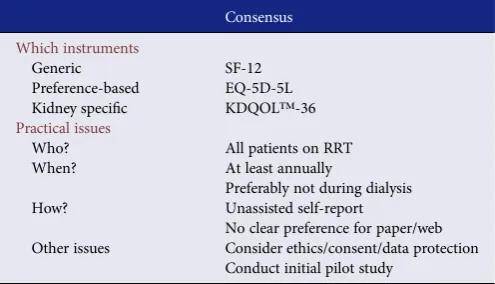
(i) PROM instruments. The overwhelming consensus was that any PROMs measurement programme should aim to support improvements in the quality of care for pa-tients. In terms of the measures adopted, there was agree-ment that the programme should aim to include both generic and disease-specific measures if possible, whilst minimizing the overall length of questionnaires administered. Of all the instruments discussed, the KDQOL™-36 seemed to be preferred by delegates as it offers both generic and disease-specific outcomes. Of the generic instruments, the SF-12 [81] was the most pre-ferred. The importance of capturing patient symptoms was recognized, especially if a generic health-related quality of life instrument was being used, but no pre-ferred symptom burden instrument was agreed on. There was not complete agreement on whether a preference-based measure should be included, but con-sensus suggested that it would be useful to have a meas-ure that would allow health economic evaluations provided that the length was not prohibitive. The EQ-5D-5L was the preferred instrument for this purpose but it was recognized that SF-6D [82], which could also provide the utility data necessary for calculating quality adjusted life years in health economic evaluations, could be derived from longer SF instruments (Table2) [82,83].
(ii) PREM instruments. Delegates were much less familiar with the various PREM instruments available. Therefore, although the strengths and weaknesses of the various in-struments had been presented to them earlier in the meeting, there was a broad consensus that more work was needed to recommend specific PREMs for broader use.
[image:7.612.310.558.590.732.2](iii) Patient groups to be covered. There was a clear consensus that the aim should be to include all patients on RRT in any PROMs/PREMs programme, and that data should be collected on at least an annual basis. The possibility
Table 2. Summary of recommendations from consensus discussions for routine renal registry PROM collection
Consensus
Which instruments
Generic SF-12
Preference-based EQ-5D-5L Kidney specific KDQOL™-36
Practical issues
Who? All patients on RRT
When? At least annually
Preferably not during dialysis How? Unassisted self-report
No clear preference for paper/web Other issues Consider ethics/consent/data protection
Conduct initial pilot study
ND
T
P
ERSPECTIVES
at University of Leeds on May 18, 2015
http://ndt.oxfordjournals.org/
of extending coverage to pre-dialysis patients in the fu-ture, when these patients are captured by registries, was discussed. The importance of making patients aware of how the data were being used was emphasized if high re-sponse rates were to be achieved from a broad range of patients. Several issues relating to the timing of data col-lection were discussed, and the general view was that al-though it may be useful to collect data at specific time points (e.g. in relation to commencement of RRT), this may not be feasible. As regards timings, the patient rep-resentative suggested that patients may not wish to com-plete PROMs/PREMs questionnaires whilst attending for dialysis and PROM experts raised concerns that re-sponses given while on dialysis may be sensitive to the current dialysis experience rather than‘usual’ health-related quality of life. No clear preference for paper or web-based reporting emerged, but the group felt that data should be collected via unassisted self-reporting. Other issues that featured prominently in discussions were the need to consider the legal, data protection and consent constraints of participating countries, and the possibility of a pilot study to assess feasibility.
There are limitations to this report. There is a scarcity of ro-bust data on measuring and reporting PROMs and PREMs in kidney patients. Further, as mentioned above, the instruments available were generally developed for measurement at the in-dividual patient level, rather than the centre or national level. In some ways these limitations reflect the attempt to reach consen-sus across European renal registries before instruments and processes become established.
S UM M A RY
From the survey of European renal registry representatives and discussions with those attending the meeting there seems to be a widespread acceptance of the need to extend renal registry data collection to capture patient-reported outcomes and ex-perience. It is recognized that this represents a considerable challenge for renal registries and services if all the potential ben-efits from the information gathered—such as focussing consul-tations on what matters to patients, having real-life information on quality of life for decision-making, incorporating patient measures into the quality assurance of renal units, research and improving services—are to be realized. Establishing a dia-logue between registries around PROMs/PREMs and agreeing on some preferred measures at this stage will hopefully enable the sharing of expertize and experience and stimulate the col-lection, and facilitate the collection and comparison of patients’ outcomes and experiences across Europe in the future.
S U P P L E M E N TA RY D ATA
Supplementary data are available online at http://ndt.oxford journals.org.
AC KN OW L E DG E ME NT
This work was funded by the ERA-EDTA Quest initiative.
CO N F L I C T O F I N T E R E S T S TATE M E N T
None declared.
R E F E R E N C E S
1. ERA-EDTA Registry. ERA-EDTA Registry 2014 Annual Report. Amsterdam: Department of Medical Informatics, Academic Medical Centre, 2014
2. Mittal SK, Ahern L, Flaster Eet al. Self-assessed physical and mental func-tion of haemodialysis patients. Nephrol Dial Transplant 2001; 16: 1387–1394
3. Murtagh FE, Addington-Hall J, Higginson IJ. The prevalence of symptoms in end-stage renal disease: a systematic review. Adv Chronic Kidney Dis 2007; 14: 82–99
4. Greenhalgh J. The applications of PROs in clinical practice: what are they, do they work, and why? Qual Life Res 2009; 18: 115–123
5. Etkind SN, Daveson BA, Kwok Wet al. Capture, transfer, and feedback of patient-centered outcomes data in palliative care populations: does it make a difference? a systematic review. J Pain Symptom Manage 2015; 49: 611–624
6. Appleby J. Patient reported outcome measures: how are we feeling today? BMJ 2012; 344: d8191
7. Black N. Patient reported outcome measures could help transform health-care. BMJ 2013; 346: f167
8. Calvert M, Blazeby J, Altman DGet al. Reporting of patient-reported out-comes in randomized trials: the CONSORT PRO extension. JAMA 2013; 309: 814–822
9. Crow R, Gage H, Hampson Set al. The measurement of satisfaction with healthcare: implications for practice from a systematic review of the litera-ture. Health Technol Assess 2002; 6: 1–244
10. Haugum M, Danielsen K, Iversen HHet al. The use of data from national and other large-scale user experience surveys in local quality work: a sys-tematic review. Int J Qual Health Care 2014; 26: 592–605
11. Hibbard JH, Stockard J, Mahoney ERet al. Development of the Patient Activation Measure (PAM): conceptualizing and measuring activation in patients and consumers. Health Ser Res 2004; 39(4 Pt 1): 1005–1026 12. Bekker H, Thornton JG, Airey CMet al. Informed Decision Making: an
An-notated Bibliography and Systematic Review. Basingstoke, UK: Health Technology Assessment Number 3: NHS R&D, 1999
13. Group FHNT, Chertow GM, Levin NWet al. In-center hemodialysis six times per week versus three times per week. New Engl J Med 2010; 363: 2287–2300
14. Daly BJ, Douglas SL, Foley Het al. Psychosocial registry for persons with cancer: a method of facilitating quality of life and symptom research. Psy-chooncology 2007; 16: 358–364
15. Pugliatti M, Eskic D, Mikolcic Tet al. Assess, compare and enhance the sta-tus of Persons with Multiple Sclerosis (MS) in Europe: a European Register for MS. Acta Neurol Scand 2012; 195: 24–30
16. Ghatnekar O, Eriksson M, Glader EL. Mapping health outcome measures from a stroke registry to EQ-5D weights. Health Qual Life Outcomes 2013; 11: 34
17. Norlin JM, Steen CK, Persson Uet al. Analysis of three outcome measures in moderate to severe psoriasis: a registry-based study of 2450 patients. Br J Dermatol 2012; 166: 797–802
18. Paulsen A, Pedersen AB, Overgaard Set al. Feasibility of 4 patient-reported outcome measures in a registry setting. Acta Orthop 2012; 83: 321–327 19. van de Poll-Franse LV, Horevoorts N, van Eenbergen Met al. The Patient
Reported Outcomes Following Initial treatment and Long term Evaluation of Survivorship registry: scope, rationale and design of an infrastructure for
ND
T
P
ERSPECTIVES at University of Leeds on May 18, 2015
http://ndt.oxfordjournals.org/
the study of physical and psychosocial outcomes in cancer survivorship co-horts. Eur J Cancer 2011; 47: 2188–2194
20. Thong MS, Mols F, Stein KDet al. Population-based cancer registries for quality-of-life research: a work-in-progress resource for survivorship stud-ies? Cancer 2013; 119(Suppl 11): 2109–2123
21. Kennedy L, Craig AM. Global registries for measuring pharmacoeconomic and quality-of-life outcomes: focus on design and data collection, analysis and interpretation. Review 128 refs. PharmacoEconomics 2004; 22: 551–568 22. Boyce MB, Browne JP, Greenhalgh J. The experiences of professionals with using information from patient-reported outcome measures to improve the quality of healthcare: a systematic review of qualitative research. BMJ Qual Saf 2014; 23: 508–518
23. Popay J, Roberts H, Sowden Aet al. Guidance on the Conduct of Narrative Synthesis in Systematic Reviews. A Product from the ESRC Methods Pro-gramme. Lancaster: Lancaster University, 2006
24. Gentile S, Beauger D, Speyer Eet al. Factors associated with health-related quality of life in renal transplant recipients: results of a national survey in France. Health Qual Life Outcomes 2013; 11: 88
25. Gibbons E, Fitzpatrick R. A Structured Review of Patient-Reported Out-come Measures for People with Chronic Kidney Disease. Oxford: Depart-ment of Public Health, University of Oxford, 2009
26. The Short Form-36 version 2 Health Survey.https://www.optum.com/ optum-outcomes/what-we-do/health-surveys/sf-36v2-health-survey.html
(3 May 2015, date last accessed)
27. The EQ-5D-5L. http://www.euroqol.org/eq-5d-products/eq-5d-5l.html
(3 May 2015, date last accessed)
28. The Kidney Disease Quality of Life-36.http://www.rand.org/content/dam/ rand/www/external/health/surveys_tools/kdqol/kdqol36.pdf(3 May 2015, date last accessed)
29. Donabedian A. Evaluating the quality of medical care. Milbank Mem Fund Q 1966; 44(Suppl): 166–206
30. Sitzia J, Wood N. Patient satisfaction: a review of issues and concepts. Soc Sci Med 1997; 45: 1829–1843
31. Rubin HR, Jenckes MW, Fink NEet al. Patient’s view of dialysis care: de-velopment of a taxonomy and rating of importance of different aspects of care. CHOICE study. Choices for Healthy Outcomes in Caring for ESRD. Am J Kidney Dis 1997; 30: 793–801
32. US Agency for Healthcare Research and Quality (AHRQ) Centers for Medicare & Medicaid Services (CMS). CAHPS In-Center Hemodialysis Survey English version. Available from. https://www.cahps.ahrq.gov/ surveys-guidance/ich/, 2006 (3 May 2015, date last accessed)
33. Barendse SM, Speight J, Bradley C. The Renal Treatment Satisfaction Ques-tionnaire (RTSQ): a measure of satisfaction with treatment for chronic kid-ney failure. Am J Kidkid-ney Dis 2005; 45: 572–579
34. Kirchgessner J, Perera-Chang M, Klinkner Get al. Satisfaction with care in peritoneal dialysis patients. Kidney Int 2006; 70: 1325–1331
35. Wasserfallen J-B, Moinat M, Halabi Get al. Satisfaction of patients on chronic haemodialysis and peritoneal dialysis. Swiss Med Wkly 2006; 136: 210–217
36. NHS Quality Improvement Scotland. Scottish Renal Patient Experience Survey. Dialysis report. Your service—your views, 2010
37. Fadem SZ, Walker DR, Abbott Get al. Satisfaction with renal replacement therapy and education: the American Association of Kidney Patients sur-vey. Clin J Am Soc Nephrol 2011; 6: 605–612
38. Van der Veer SN, Jager KJ, Visserman Eet al. Development and validation of the consumer quality index instrument to measure the experience and prior-ity of chronic dialysis patients. Nephrol Dial Transplant 2012; 27: 3284–3291 39. Wood R, Paoli CJ, Hays RDet al. Evaluation of the consumer assessment of healthcare providers and systems in-center hemodialysis survey. Clin J Am Soc Nephrol 2014; 9: 1099–1108
40. Palmer SC, de Berardis G, Craig JCet al. Patient satisfaction with in-centre haemodialysis care: an international survey. BMJ Open 2014; 4: e005020 41. Paddison CM, Elliott MN, Haviland AMet al. Experiences of care among
Medicare beneficiaries with ESRD: Medicare Consumer Assessment of Healthcare Providers and Systems (CAHPS) survey results. Am J Kidney Dis 2013; 61: 440–449
42. Sepucha KR, Borkhoff CM, Lally Jet al. Establishing the effectiveness of pa-tient decision aids: key constructs and measurement instruments. BMC Med Inform Decis Mak 2013; 13(Suppl 2): S12
43. Scholl I, Koelewijn-van Loon M, Sepucha Ket al. Measurement of shared decision making—a review of instruments. Zeitschrift fur Evidenz, Fortbil-dung und Qualitat im Gesundheitswesen 2011; 105: 313–324
44. Patel D, on behalf of The Evidence Centre. Helping People Share Decision Making. Helping People Share Decision Making, 2012
45. Stacey D, Bennett CL, Barry MJet al. Decision aids for people facing health treatment or screening decisions, 2011
46. Legare F, Kearing S, Clay Ket al. Are you SURE?: assessing patient decisional conflict with a 4-item screening test. Can Fam Physician 2010; 56: e308–e314 47. Ferron Parayre A, Labrecque M, Rousseau Met al. Validation of SURE, a four-item clinical checklist for detecting decisional conflict in patients. Med Decis Making 2014; 34: 54–62
48. Bekker HL, Nye A, Walker Eet al. SHARED: Patient Experience of Shared Decision Making Measure. 2012.https://www.gem-measures.org/public/ MeasureDetail.aspx?mid=1517&cat=2(3 May 2015, date last accessed) 49. Nye A, on behalf of the NHS Advancing Quality Alliance. Your Health,
Your Decision. A report from the creating a receptive culture shared deci-sion making project. Right Care, NHS, 2013. http://arma.uk.net/wp-content/uploads/2013/05/Your-Health-Your-Decision-Evaluation-Report. pdf(3 May 2015, date last accessed)
50. Durand M-A, Bekker HL, Casula Aet al. Measuring Shared Decision-Making in Chronic Kidney Care. Service Evaluation Report. The UK Renal Registry in collaboration with the NHS Institute, 2013
51. King E, Taylor J, Williams Ret al. The MAGIC Programme: Evaluation. An Independent Evaluation of the MAGIC (Making Good Decisions in Collab-oration) Improvement Programme. London, UK: The Health Foundation, 2013
52. Craig P, Dieppe P, Macintyre Set al. Developing and evaluating complex interventions: the new Medical Research Council guidance. BMJ 2008; 337: a1655
53. Bekker HL. The loss of reason in patient decision aid research: do checklists damage the quality of informed choice interventions? Patient Educ Couns 2010; 78: 357–364
54. Bekker HL, Winterbottom AE, Butow Pet al. Do personal stories make pa-tient decision aids more effective? A critical review of theory and evidence. BMC Med Inform Decis Mak 2013; 13(Suppl 2): S9
55. Brehaut JC, O’Connor AM, Wood TJet al. Validation of a decision regret scale. Med Decis Making 2003; 23: 281–292
56. O’Connor AM. Validation of a Decisional Conflict Scale. Med Decis Mak-ing 2010; 15: 25–30
57. Graham I, O’Connor AM. Preparation for Decision Making Scale—User manual, 2010
58. Holmes-Rovner M, Kroll J, Schmitt Net al. Patient satisfaction with health care decisions: the satisfaction with decision scale. Med Decis Making 1996; 16: 58–64
59. O’Connor AM. User Manual—Stage of Decision Making, 2003.http:// decisionaid.ohri.ca/docs/develop/User_Manuals/UM_Stage_Decision_ making.pdf(3 May 2015, date last accessed)
60. Bekker HL, Legare F, Stacey Det al. Is anxiety a suitable measure of decision aid effectiveness: a systematic review? Patient Educ Couns 2003; 50: 255–262 61. Mavis B, Holmes Rovner M, Jorgenson Set al. Patient participation in clin-ical encounters: a systematic review to identify self-report measures. Health Expect 2014; doi: 10.1111/hex.12186. [Epub ahead of print]
62. Sepucha KR, Scholl I. Measuring shared decision making: a review of con-structs, measures, and opportunities for cardiovascular care. Circ Cardio-vasc Qual Outcomes 2014; 7: 620–626
63. Hunink M, Glasziou P, Siegel Jet al. Decision Making in Health and Medi-cine: Integrating Evidence and Values. Cambridge, UK: Cambridge Univer-sity Press, 2001
64. Gray JAM. Evidence-based Healthcare: How to Make Health Policy and Management Decisions. London, UK: London; 1997
65. Charles C, Gafni A, Whelan T. Shared decision-making in the medical en-counter: what does it mean? (or it takes at least two to tango). Soc Sc Med 1997; 44: 681–692
66. Coulter A. Partnerships with patients: the pros and cons of shared clinical decision-making. J Health Serv Res Policy 1997; 2: 112–121
67. Stacey D, Legare F, Pouliot Set al. Shared decision making models to inform an interprofessional perspective on decision making: a theory analysis. Pa-tient Educ Couns 2010; 80: 164–172
ND
T
P
ERSPECTIVES
at University of Leeds on May 18, 2015
http://ndt.oxfordjournals.org/
68. Makoul G, Clayman ML. An integrative model of shared decision making in medical encounters. Patient Educ Couns 2006; 60: 301–312
69. Lerman CE, Brody DS, Caputo GCet al. Patients’perceived involvement in care scale: relationship to attitudes about illness and medical care. J Gen In-tern Med 1990; 5: 29–33
70. Clayman ML, Makoul G, Harper MMet al. Development of a shared deci-sion making coding system for analysis of patient-healthcare provider en-counters. Patient Educ Couns 2012; 88: 367–372
71. Elwyn G, Barr PJ, Grande SWet al. Developing CollaboRATE: a fast and frugal patient-reported measure of shared decision making in clinical en-counters. Patient Educ Couns 2013; 93: 102–107
72. Elwyn G, Hutchings H, Edwards Aet al. The OPTION scale: measuring the extent that clinicians involve patients in decision-making tasks. Health Ex-pect 2005; 8: 34–42
73. Kriston L, Scholl I, Holzel Let al. The 9-item Shared Decision Making Questionnaire (SDM-Q-9). Development and psychometric properties in a primary care sample. Patient Educ Couns 2010; 80: 94–99
74. De Silva D, on behalf of The Evidence Centre. Helping Measure Person-Centred Care. London, UK: The Health Foundation, 2014
75. Graham C, MacCormick S. Overarching questions for patient sur-veys: development report for the Care Quality Commission (CQC). National Patient Survey Co-ordination Centre. Picker Institute Eur-ope, 2012
76. Hibbard J, Gilburt H. Supporting People to Manage Their Health: An Introduction to Patient Activation. London, UK: The Kings Fund, 2014 77. Fish M, Coyne E, Ferraro A. The utility of the decisional conflict tool in a pre-dialysis clinical (Abstract). In: British Renal Conference. Manchester, 2013 78. Kasper J, Heesen C, Kopke Set al. Patients’and observers’perceptions of
involvement differ. Validation study on inter-relating measures for shared decision making. PloS one 2011; 6: e26255
79. Legare F, Leblanc A, Robitaille Het al. The decisional conflict scale: moving from the individual to the dyad level. Zeitschrift fur Evidenz, Fortbildung und Qualitat im Gesundheitswesen 2012; 106: 247–252
80. Winterbottom AE, Gavaruzzi T, Mooney Aet al. Patient Acceptability of the Yorkshire Dialysis Decision Aid (YoDDA) disseminated within predialysis services: a non-randomised controlled study. 2014; (submitted for publication) 81. The Short Form-12 version 2 Health Survey.https://www.optum.com/ optum-outcomes/what-we-do/health-surveys/sf-12v2-health-survey.html
(3 May 2015, date last accessed)
82. Brazier J, Roberts J, Deverill M. The estimation of a preference-based meas-ure of health from the SF-36. J Health Econ 2002; 21: 271–292
83. Brazier JE, Roberts J. The estimation of a preference-based measure of health from the SF-12. Med Care 2004; 42: 851–859
Received for publication: 31.1.2015; Accepted in revised form: 13.4.2015
ND
T
P
ERSPECTIVES at University of Leeds on May 18, 2015
http://ndt.oxfordjournals.org/