Forms: Minimally Unsatisfiable Sub-clause-sets
and the Lean Kernel
Oliver Kullmann1,, Inˆes Lynce2,, and Jo˜ao Marques-Silva3
1
Computer Science Department University of Wales Swansea
Swansea, SA2 8PP, UK [email protected] http://cs-svr1.swan.ac.uk/
~
csoliver 2Departamento de Engenharia Inform´aticaInstituto Superior T´ecnico / INESC-ID Universidade T´ecnica de Lisboa
[email protected] http://sat.inesc-id.pt/
~
ines 3School of Electronics and Computer ScienceUniversity of Southampton Highfield, Southampton SO17 1BJ, UK
[email protected] http://www.ecs.soton.ac.uk/
~
jpmsAbstract. Finding out that a SAT problem instance F is unsatisfiable is not enough for applications, where good reasons are needed for ex-plaining the inconsistency (so that for example the inconsistency may be repaired). Previous attempts of finding such good reasons focused on finding some minimally unsatisfiable sub-clause-set F’ of F, which in general suffers from the non-uniqueness of F’ (and thus it will only find some reason, albeit there might be others).
In our work, we develop a fuller approach, enabling a more fine-grained analysis of necessity and redundancy of clauses, supported by meaningful semantical and proof-theoretical characterisations. We combine known techniques for searching and enumerating minimally unsatisfiable sub-clause-sets with (full) autarky search. To illustrate our techniques, we give a detailed analysis of well-known industrial problem instances.
1
Introduction
Explaining the causes of unsatisfiability of Boolean formulas is a key requirement in a number of practical applications. A paradigmatic example is SAT-based model checking, where analysis of unsatisfiability is an essential step ([7,22]) for ensuring completeness of bounded model checking ([3]). Additional examples
Supported by grant EPSRC GR/S58393/01.
Supported by FCT under research project POSC/EIA/61852/2004.
A. Biere and C.P. Gomes (Eds.): SAT 2006, LNCS 4121, pp. 22–35, 2006. c
include fixing wire routing in FPGAs ([24]), and repairing inconsistent knowledge from a knowledge base ([21]).
Existing work on finding the causes of unsatisfiability can be broadly organ-ised into two main categories. The first category includes work on obtaining a
reasonable unsatisfiable sub-formula, with no guarantees with respect to the size of the sub-formula ([5,11,28,4]). The second category includes work that pro-vides someguarantees on the computed sub-formulas ([10,20,23]). Most existing work has focused on computing one minimally unsatisfiable sub-formula or all minimally unsatisfiable sub-formulas. Thus also relevant here is the literature on minimally unsatisfiable clause-sets, for example the characterisation of min-imally unsatisfiable clause-sets of small deficiency ([1,9,6,12]), where [12] might be of special interest here since it provides an algorithm (based on matroids) searching for “simple” minimally unsatisfiable sub-clause-sets.
In this paper now we seek to obtain a more differentiated picture of the (po-tentially many and complicated) causes of unsatisfiability by a characterisation of (single) clauses based on their contribution to the causes of unsatisfiabil-ity. The following subsection gives on overview on the this categorisation of clauses.
From necessary to unusable clauses. The problem is to find some “core” in an unsatisfiable clause-setF: Previous attempts were (typically) looking for some minimally unsatisfiable sub-clause-set F ⊆ F, that is, selecting some element F ∈ MU(F) from the set of all minimally unsatisfiable sub-clause-sets of F. The problem here is that MU(F) in general has many elements, and thus it is hard to give meaning to this process. So let us examine the role the elements of F play for the unsatisfiability ofF.
At the base level we havenecessary clauses, which are clauses whose removal rendersF satisfiable. These clauses can also be characterised by the condition that they must be used in every resolution refutation of F, and the set of all necessary clauses is MU(F) (the intersection of all minimally unsatisfiable sub-clause-sets). DeterminingMU(F) is not too expensive (assuming the SAT decision forF and sub-clause-sets is relatively easy), and every “core analysis” ofF should determine these clauses as the core parts ofF. It isMU(F) itself unsatisfiable if and only ifF has exactly one minimally unsatisfiable sub-clause-set (that is,|MU(F)|= 1 holds), and in this case our job is finished. However, in many situations we do not have a unique minimally unsatisfiable core, but
unsatisfiability ofF, however not in a unique sense (other clauses may play this role as well).
MU(F) is the set of all clauses inF which can be forced to be used in every resolution refutation by removing some other clauses. Now at the third and weak-est level of our categorisation of “core clauses” we consider all usable clauses, that is, all clauses which can be used insomeresolution refutation (without dead ends); the set of all usable clauses ofFis Na(F) (see below for an explanation for
this notation). Clauses which are usable but not potentially necessary are called
only usable; these clauses are superfluous from the semantical point of view (if Cis only usable inF, andF⊆F is unsatisfiable, then alsoF\ {C}is unsatis-fiable), however their use may considerably shorten resolution refutations ofF, as can be seen by choosingF as a pigeonhole formula extended by appropriate clauses introduced by Extended Resolution: Those new clauses are only usable, but without them pigeonhole formulas require exponential resolution refutations, while with them resolution refutations become polynomial.
Dual to these three categories of “necessity” we have the corresponding de-grees of “redundancy”, where a SAT solver might aim at removing redundant clauses to make its life easier; however this also can backfire (by making the problem harder for the solver and harder even for non-deterministic proof pro-cedures). The weakest notion is given byunnecessary clauses; the set of all unnec-essary clauses isF\MU(F). Removing such a clause still leaves the clause-set unsatisfiable, but in general we cannot remove two unnecessary clauses simulta-neously (after removal of some clauses other clauses might become necessary).
At the next (stronger) level we havenever necessary clauses, that is, clauses which are not potentially necessary; the set of all never necessary clauses is F\MU(F). Here now we can remove several never necessary clauses at the same time, and still we are guaranteed to maintain unsatisfiability; however it might be that after removal of never necessary clauses the resolution complexity is (much) higher than before.
For necessary clauses we have a “proof-theoretical” characterisation, namely that they must be used in any resolution refutation, and an equivalent “se-mantical” characterisation, namely that removal of them renders the clause-set satisfiable. Now for unnecessary clauses we also have a semantical criterion, namely a clause is never necessary iff it is contained in every maximal satisfiable sub-clause-set.
Finally the strongest notion of redundancy is given byunusable clauses; the set of unusable clauses isF\Na(F). These clauses can always be removed
with-out any harm (that is, at least for a non-deterministic resolution-based SAT algorithm). As shown in [16], a clause C ∈ F is unusable if and only if there exists anautarky for F satisfyingC. This enables a non-trivial computation of Na(F) (as discussed in Section 4), which is among the categorisation algorithms
Organisation of the paper. The paper is organised as follows. The next section introduces the notations used throughout the paper. Section 3 develops the proposed clause categorisation for unsatisfiable clause sets. A discussion on the computation of the lean kernel is included in Section 4. Section 5 presents results for the well-known Daimler-Chrysler’s [27] problem instances. Finally, Section 6 concludes the paper and outlines future research work.
2
Preliminaries
Clause-sets and autarkies. We are using a standard environment for (boolean) clause-sets, partial assignments and autarkies; see [16,17] for further details and background. Clauses are complement-free (i.e., non-tautological) sets of literals, clause-sets are sets of clauses. The application of a partial assignmentϕto a clause-setFis denoted byϕ∗F. An autarky for a clause-setF is a partial assignmentϕ such that every clauseC∈Ftouched byϕ(i.e., var(ϕ)∩var(C)=∅) is satisfied byϕ.1 Applying autarkies is a satisfiability-equivalent reduction, and repeating
the process until no further autarkies are found yields the (uniquely determined)
lean kernel Na(F)⊆F.
Hypergraphs. A hypergraph here is a pairG= (V, E), whereV is a (finite) set of vertices andE⊆P(V) is a set of subsets. Let(G):= (V(G),{V(G)\E:E∈ E(G)}) be the complement hypergraph of G. Obviously we have((G)) =G. A transversal of G is a subsetT ⊆V(G) such that for all E ∈E(G) we have T ∩E = ∅; the hypergraph with vertex set V and hyperedge set the set of all minimal transversals of G is denoted by Tr(G); we have the well-known fundamental fact (see for example [2]) Tr(Tr(G)) = min(G), where min(G) is the hypergraph with vertex setV(G) and hyperedges all inclusion minimal elements of G(the dual operator is max(G)). An independent set of G is a subset I ⊆ V(G) such thatV(G)\Iis a transversal of G; in other words, the independent sets of G are the subsets I ⊆ V(G) such that no hyperedge E ∈ E(G) with E ⊆ I exists. Let Ind(G) denote the hypergraph with vertex set G and as hyperedges all maximal independent sets ofG. By definition we have Ind(G) =
(Tr(G)).
Sub-clause-sets. For a clause-set F letUSAT(F)be the hypergraph with vertex set F and hyperedges the set of all unsatisfiable sub-clause-sets of F, and letMU(F):= min(USAT(F)). Thus MU(F) has as hyperedges all min-imally unsatisfiable sub-clause-sets of F, and MU(F) = ∅ ⇔F ∈ SAT. And letSAT(F)be the hypergraph with vertex setF and hyperedges the set of all satisfiable sub-clause-sets ofF, andMS(F):= max(SAT(F)). Thus MS(F) has as hyperedges all maximal satisfiable sub-clause-sets of F, andF ∈MS(F) ⇔ F ∈ SAT; we always have MS(F)=∅. Finally letCMU(F):=(MU(F)) and
1
CMS(F):=(MS(F)). In [20] the observation of Bailey and Stuckey has been used that for every clause-setF we have
MU(F) = Tr(CMS(F)). (1)
This can be shown as follows: By definition we have MS(F) = Ind(MU(F)), whence MS(F) = (Tr(MU(F))), and thus (MS(F)) = Tr(MU(F)); applying Tr to both sides we get Tr((MS(F))) = Tr(CMS(F)) = MU(F).
3
Classification
LetF ∈ USAT be an unsatisfiable clause-set for this section. When we speak of a resolution refutation “using” a clauseCthen we mean the refutation usesCas an axiom (and we consider here only resolution refutations without “dead ends”; since we are not interested in resolutioncomplexityhere this can be accomplished most easily by only consideringtree resolution refutations).
3.1 Necessary Clauses
The highest degree of necessity is given by “necessary clauses”, where a clause C ∈ F is called necessary if every resolution refutation of F must use C. By completeness of resolution, a clauseC is necessary iff there exists a partial assignment ϕ satisfying F \ {C}. So we can compute all necessary clauses by running through all clauses and checking whether removal renders the clause-set satisfiable. The set of all necessary clauses of F is MU(F). Clause-sets with F =MU(F), that is, clause-sets where every clause is necessary, are exactly the minimally unsatisfiable clause-sets. So the complexity of computing MU(F) is closely related to deciding whether a clause-setF is minimally unsatisfiable, which is aDP-complete decision problem (see [25]). The corresponding (weakest) notion of redundancy is that of clauses which areunnecessary, which are clauses C∈F such thatF\ {C} still is unsatisfiable, or, equivalently, clauses for which resolution refutations ofF exist not using this clause.
3.2 Potentially Necessary Clauses
minimally unsatisfiable, thenV∗F is the union of minimally unsatisfiable clause-sets, has been shown in [26]. For the converse direction consider the characteristic case of two minimally unsatisfiable clause-setsF1, F2. Choose a new variable v
and letF :={C∪ {v}:C∈F1} ∪ {C∪ {v}:C∈F2}; obviouslyF is minimally
unsatisfiable and{v} ∗F =F1∪F2.
So given (unsatisfiable) F with F = MU(F), we have a (characteristic) representationF =V ∗F0for some minimally unsatisfiableF0; it is conceivable
but not known to the authors whether such a representation might be useful (considering “good” F0). The complexity of deciding whether for a clause-set
F we haveF =MU(F) is not known to the authors; by definition the prob-lem is in PSPACE, and it seems to be a very hard probprob-lem. See below for the computation ofMU(F).
Clauses which are potentially necessary, but which are not necessary (i.e., the clauses inMU(F)\MU(F)), are called only potentially necessary. By Lemma 4.3 in [12] we haveMU(F) =F\MS(F), i.e., a clause is potentially necessary iff there exists a maximally satisfiable sub-clause-set not containing this clause, or, in other words, a clause is not potentially necessary iff the clause is in every maximally satisfiable sub-clause-set. Thus for computingMU(F) we see two possibilities:
1. Enumerating MU(F) and computingMU(F).
2. Enumerating MS(F) and computingMU(F) =F\MS(F) (this is more efficient than using (1), since for applying (1) we must store all elements of MS(F), and furthermore it is quite possible that while MS(F) is a small set, MU(F) is a big set).
The corresponding (medium) degree of redundancy is given by clauses which are never necessary (not potentially necessary), that is, clauses which can not be forced into resolution refutations by removing some other clauses, or equivalently, clauses which are contained in every maximally satisfiable sub-clause-set. A clause which is never necessary is also unnecessary. Blocked clauses (see [14]), and, more generally, clauses eliminated by repeated elimination of blocked clauses, are never necessary; an interesting examples for such clauses are clauses introduced by extended resolution (see [15]).
3.3 Usable Clauses
The weakest degree of necessity if given by “usable clauses”, where C ∈ F is called usable if there exists some tree resolution refutation of F using C. Obviously every potentially necessary clause is a usable clause. By Theorem 3.16 in [16] the set of usable clauses is exactly the lean kernel Na(F). The set
ofF with Na(F) =F, which are calledlean clause-sets (every clause is usable)
refutation, which are exactly the clauses for which an autarky ϕ for F exists satisfying C. An unusable clause is never necessary. Clauses which are never necessary but are which are usable are called only usable, and are given for example by clauses (successfully) introduced by Extended Resolution: They are never necessary as discussed before, but they are usable (since we assumed the introduction to be “successful”), and actually these clauses can exponentially speed up the resolution refutation as shown in [8].
[image:7.513.84.349.299.410.2]3.4 Discussion
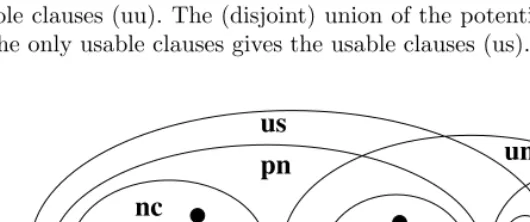
Figure 1 relates the concepts introduced above. Consider a formula with 9 clauses (represented with bullets). These clauses can be partitioned into nec-essary clauses (nc) and unnecnec-essary clauses (un). The unnecnec-essary clauses can be partitioned into only potentially necessary clauses (opn) and never necessary clauses (nn). The (disjoint) union of the only potentially necessary clauses with the necessary clauses gives the potentially necessary clauses (pn). In addition, the never necessary clauses can be partitioned into only usable clauses (ou) and unusable clauses (uu). The (disjoint) union of the potentially necessary clauses with the only usable clauses gives the usable clauses (us).
nc
pn
opn
un
ou
nn
uu
us
Fig. 1.Clause classification: an example
3.5 Finding the Cause
Given is an unsatisfiable clause-setF, which is partitioned into F = Fs∪
·
Fu,whereFscome from “system axioms”, whileFucomes from a specific “user
re-quirements”. The unsatisfiability ofFmeans that the user requirements together with the system axioms are inconsistent, and the task now is to find “the cause” of this problem.
First if Fu is already unsatisfiable, then the user made a “silly mistake”,
while ifFs already is unsatisfiable, then the whole system is corrupted. So we
assume that Fu as well as Fs is satisfiable. The natural first step now is to
considerMU(F). The best case is thatMU(F) is already unsatisfiable (i.e., F has a unique minimally unsatisfiable sub-clause-set). Now Fu∩
are the critical user requirements, which together with the system properties Fs∩
MU(F) yield the (unique) contradiction. So assume that MU(F) is satisfiable in the sequel.
ThatFs∩
MU(F)=∅ is the case typically does not reveal much; it can be a very basic requirement which when dropped (or when “some piece is broken out of it”) renders the whole system meaningless (if for example numbers would be used, then we could have “if addition wouldn’t be addition, then there would be no problem”). However ifFu∩
MU(F)=∅ holds, then this could contain valuable information: These clauses could also code some very basic part of the user requirement, where without these requirements the whole user requirement breaks down, and then (again) we do not know much more than before; if however at least some clauses code some very specific requirement, then perhaps with their identification already the whole problem might have been solved.
In general the consideration ofMU(F) is not enough to find “the cause” of the unsatisfiability ofF. Finding some F ∈ MU(F) definitely yields some information: F will contain some system clauses and some user clauses which together are inconsistent, however this inconsistency might not be the only in-consistency. Also ifF \F is satisfiable (which is guaranteed if MU(F)=∅) we do not gain much, again because some very fundamental pieces might now be missing. So what really is of central importance here isMU(F). The clauses Fu∩
MU(F) are exactly all (pieces) of user requirements which can cause trouble, while the clausesFs∩
MU(F) are exactly all pieces of basic require-ments needed (under certain circumstances) to complete the contraction. The clauses inF\MU(F), the unnecessary clauses, might be helpful to see some contradiction with less effort, but they are never really needed.
So what now is the role of Na(F) (the lean kernel, or, in other words, the set
of usable clauses) here?! To identify the causes of inconsistency the clauses in Na(F)\
MU(F) (the only usable clauses) are not needed. One role of Na(F)
is as a stepping stone for the computation ofMU(F), since the computation of Na(F) is easier than the computation of
MU(F), and removing the “fat” helps to get faster to the potentially necessary clauses. Another, quite different role now is, that the setF\Na(F) of unusable clauses are the clauses satisfied by
a maximal autarkyϕ; and thisϕcan be considered as the largest “conservative model”, which doesn’t remove any possibilities to satisfy further clauses.
Satisfying any clause from Na(F) necessarily implies that some other clause
4
Computing the Lean Kernel
In Section 6 of [13] the following procedure for the computation of a “maximal autarky” ϕfor F (that is, an autarky ϕ forF with ϕ∗F = Na(F)) has been
described, using a SAT solverAwhich for a satisfying inputF returns a satis-fying assignmentϕ with var(ϕ)⊆var(F), while for an unsatisfiable input F a setV ⊆var(F) of variables is returned which is the set of variables used in some (tree) resolution refutation ofF:
1. ApplyA(F); ifF is satisfiable then returnϕ. 2. Otherwise letF :=F[V], and go to Step 1.
Here F[V] is defined as (V ∗F)\ {⊥}, where V ∗F denotes the operation of removing all literals x from F with var(x) ∈ V, while ⊥ is the empty clause. So the above procedure can be outlined as follows: Apply the given SAT solver Ato F. If we obtain a satisfying assignment, thenϕis a maximal autarky for the original input (and applying it we obtain the lean kernel). Otherwise we obtain a setV of variable used in a resolution refutation ofF; cross out all these variables fromF, remove the (necessarily obtained) empty clause, and repeat the process.
Correctness follows immediately with Theorem 3.16 in [16] together with Lemma 3.5 in [16]. More specifically, Lemma 3.5 in [16] guarantees that if by iterated reduction F → F[V] for arbitrary sets V of variables at the end we obtain some satisfiable F∗ then any satisfying assignment ϕ for F∗ with var(ϕ)⊆var(F∗) is an autarky forF (thus the above process returns only au-tarkies). For the other direction (the non-trivial part) Theorem 3.16 guarantees that by using such V coming from resolution refutations we don’t loose any autarky.
The computation of V by a SAT solver can be done following directly the correspondence between tree resolution refutations and semantic trees (for a de-tailed treatment see [18]). Since the set of used variables needs to be maintained only on the active path, the space required by this algorithm is (only) quadratic in the input size; the only implementation of this algorithm we are aware of is
inOKsolver(as participated in the SAT 2002 competition), providing an
imple-mentation of “intelligent backtracking” without learning; see [19] for a detailed investigation.
By heuristical reasoning, a procedure computing some unsatisfiable F ⊆ Na(F) for unsatisfiableF has been given in [28], also based on computing
reso-lution refutations. Compared to the autarky approach,F is some set of usable clauses, while Na(F) is the set ofall usable clauses. Furthermore Na(F) comes
with an autarky (a satisfying assignment for all the other clauses, not touching Na(F)), and the computation of Na(F) can be done quite space-efficient (as
5
Experimental Results
The main goal of this section is to analyse a set of problem instances with respect to the concepts described above. To achieve this goal, we have selected 38 problem instances from the DC family ([27])2. These instances are obtained
from the validation and verification of automotive product configuration data and encode different consistency properties of the configuration data base which is used to configure Daimler Chrysler’s Mercedes car lines. For example, some instances refer to the stability of the order completion process (SZ), while others refer to the order independence of the completion process (RZ) or to superfluous parts (UT). We have chosen these instances because they are well known for having small minimal unsatisfiable cores and usually more than one minimal unsatisfiable core [20]. Hence, they provide an interesting testbed for the new concepts introduced in the paper.
The size of DC problem instances analysed in this paper ranges from 1659 to 1909 variables and 4496 to 8686 clauses. However, and as mentioned in [20], these formulas have a few repeated clauses and also repeated literals in clauses. Also, there are some variable codes that are not used. Consequently, we have performed a preprocessing step to eliminate the repeated clauses and literals, as well as non-used variables. In the resulting formulas the number of variables ranges from 1513 to 1805 and the number of clauses ranges from 4013 to 7562.
Table 1 gives the number of variables, the number of clauses and the average clause size for each of the 38 problem instances from the DC family. Table 1 also gives the number of minimal unsatisfiable sub-clause-sets (#MU) contained in each formula, the number of maximal satisfiable sub-clause-sets (#MS) (recall (1)), the percentage of necessary clauses (nc) and the percentage of the number of clauses in the smallest (min) and largest (max) minimal unsatisfiable sub-clause-set. Furthermore Table 1 shows the percentages of only potentially necessary clauses (opn) and the percentage of only potentially necessary clauses (pn), as well as the percentage of only usable clauses (ou) and the percentage of usable clauses (us). Then redundant clauses are considered: the percentage of unusable clauses (un), the percentage of never necessary clauses (nn) and the percentage of unnecessary clauses (un). Recall that uu stands for the clauses which can be satisfied by some autarky; in the final column we give the percentage of the uu-clauses which can be covered by (iterated) elimination of pure literals alone.3
These results have been obtained using a tool provided by the authors of [20], and also a Perl script for computing the lean kernel that iteratively invokes a SAT solver ([28]) which identifies variables used in a resolution refutation. From this table some conclusions can be drawn. As one would expect in general to be the case, as the number of mus’s increases, the relative number of necessary clauses decreases. Regarding the number of mus’s we see of lot of variation:
2
Available from http://www-sr.informatik.uni-tuebingen.de/
˜
sinz/DC/.3 Since all instances contain necessary clauses, the maximum (size) maximal
Although half of the problem instances have only a few mus’s, there are also many problems with many mus’s. In addition, there seems to be no relation between the number of mus’s and the number of mss’s.
Looking at the levels of necessity, we may observe the following. For all in-stances the percentage of clauses in the smallest mus is quite small (in most cases less than 1%) and the largest mus is usually not much larger than the smallest one. The number of potentially necessary clauses is typically somewhat bigger than the size of the largest mus, but for all instances the set of potentially necessary clauses is still fairly small. The percentage of usable clauses is typically substantially larger, but only for theUT-family more than half of all clauses are usable. Looking at the levels of redundancy, we see that in many cases autarky reduction to a large part boils down to elimination of pure literals. In most cases most never necessary clauses are already unusable, with the notable exceptions of the UT- and (to a somewhat lesser degree) the SZ-family, while almost all unnecessary clauses are already never necessary.
6
Conclusions
This paper proposes a categorisation of clauses in unsatisfiable instances of SAT, with the objective of developing new insights into the structure of unsatisfiable formulas. The paper also addresses which sets of clauses are relevant when deal-ing with unsatisfiable instances of SAT. Finally, the paper evaluates the proposed categorisation of clauses in well-known unsatisfiable problem instances, obtained from industrial test cases [27].
We see the following main directions for future research:
– Regarding the industrial test cases considered, we were mainly interested in them as proof of concept, and likely there are many more interesting relations hidden in the data (especially when combining them with special insights into the structure of these formulas).
– In Subsection 3.5 we outlined a general approach for finding causes of un-satisfiability in a scenario motivated by [27]; it would now be interesting to see how helpful these considerations are in practice.
– Obviously there are many non-trivial problems regarding the complexity of the algorithms involved. A main problem here, which according to our knowl-edge has not been tackled until now, is the complexity of the computation ofMU(F).
– For the computation of the lean kernel in this paper we considered an al-gorithm exploiting the “duality” between resolution proofs and autarkies. It would be interesting to compare this approach with a direct approach (directly searching for autarkies).
References
1. Ron Aharoni and Nathan Linial. Minimal non-two-colorable hypergraphs and minimal unsatisfiable formulas. Journal of Combinatorial Theory, A 43:196–204, 1986.
2. Claude Berge. Hypergraphs: Combinatorics of Finite Sets, volume 45 of North-Holland Mathematical Library. North Holland, Amsterdam, 1989. ISBN 0 444 87489 5; QA166.23.B4813 1989.
3. Armin Biere, Alessandro Cimatti, Edmund M. Clarke, Ofer Strichman, and Y. Zhu.Highly Dependable Software, volume 58 ofAdvances in Computers, chapter Bounded model checking. Elsevier, 2003. ISBN 0-12-012158-1.
4. Renato Bruni. On exact selection of minimally unsatisfiable subformulae. Annals for Mathematics and Artificial Intelligence, 43:35–50, 2005.
5. Renato Bruni and Antonio Sassano. Restoring satisfiability or maintaining un-satisfiability by finding small unsatisfiable subformulae. InLICS Workshop SAT 2001, volume 9 ofENDM.
6. Hans Kleine B¨uning. On subclasses of minimal unsatisfiable formulas. Discrete Applied Mathematics, 107:83–98, 2000.
7. P. Chauhan, E. Clarke, J. Kukula, S. Sapra, H. Veith, and D. Wang. Automated abstraction refinement for model checking large state spaces using SAT based con-flict analysis. InInternational Conference on Formal Methods in Computer-Aided Design, 2002.
8. Stephen A. Cook. A short proof of the pigeonhole principle using extended reso-lution. SIGACT News, pages 28–32, October-December 1976.
9. Gennady Davydov, Inna Davydova, and Hans Kleine B¨uning. An efficient algo-rithm for the minimal unsatisfiability problem for a subclass of CNF. Annals of Mathematics and Artificial Intelligence, 23:229–245, 1998.
10. M. G. de la Banda, P. J. Stuckey, and J. Wazny. Finding all minimal unsatisfiable sub-sets. In International Conference on Principles and Practice of Declarative Programming, 2003.
11. E. Goldberg and Y. Novikov. Verification of proofs of unsatisfiability for CNF formulas. In Design, Automation and Test in Europe Conference, pages 10886– 10891, March 2003.
12. Oliver Kullmann. An application of matroid theory to the SAT problem. In Fifteenth Annual IEEE Conference on Computational Complexity (2003), pages 116–124.
13. Oliver Kullmann. On the use of autarkies for satisfiability decision. In LICS Workshop SAT 2001, volume 9 ofENDM.
14. Oliver Kullmann. New methods for 3-SAT decision and worst-case analysis. The-oretical Computer Science, 223(1-2):1–72, July 1999.
15. Oliver Kullmann. On a generalization of extended resolution. Discrete Applied Mathematics, 96-97(1-3):149–176, 1999.
16. Oliver Kullmann. Investigations on autark assignments. Discrete Applied Mathe-matics, 107:99–137, 2000.
17. Oliver Kullmann. Lean clause-sets: Generalizations of minimally unsatisfiable clause-sets. Discrete Applied Mathematics, 130:209–249, 2003.
19. Oliver Kullmann. Modelling the behaviour of a DLL SAT solver on random for-mulas. In preparation, 2006.
20. Mark H. Liffiton and Karem A. Sakallah. On finding all minimally unsatisfiable subformulas. In Theory and Applications of Satisfiability Testing (SAT 2005), pages 173–186.
21. B. Mazure, L. Sais, and E. Gr´egoire. Boosting complete techniques thanks to local search methods. Annals of Mathematics and Artificial Intelligence, 22(3-4):319– 331, 1998.
22. K. L. McMillan. Interpolation and SAT-based model checking. InInternational Conference on Computer-Aided Verification, 2003.
23. M. N. Mneimneh, I. Lynce, Z. S. Andraus, K. A. Sakallah, and J. P. Marques-Silva. A branch and bound algorithm for extracting smallest minimal unsatisfiable formulas. InTheory and Applications of Satisfiability Testing (SAT 2005), pages 467–474.
24. G.-J. Nam, K. A. Sakallah, and R. A. Rutenbar. Satisfiability-based layout re-visited: Detailed routing of complex FPGAs via search-based boolean SAT. In International Symposium on Field-Programmable Gate Arrays, February 1999. 25. Christos H. Papadimitriou and M. Yannakakis. The complexity of facets (and some
facets of complexity).Journal on Computer and System Sciences, 28:244–259, 1984. 26. Ma Shaohan and Liang Dongmin. A polynomial-time algorithm for reducing the number of variables in MAX SAT problem.Science in China (Series E), 40(3):301– 311, June 1997.
27. Carsten Sinz, Andreas Kaiser, and Wolfgang K¨uchlin. Formal methods for the validation of automotive product configuration data. Artificial Intelligence for Engineering Design, Analysis and Manufacturing, 17(1):75–97, January 2003. 28. Lintao Zhang and Sharad Malik. Extracting small unsatisfiable cores from