ENGAGING DISTANCE AND
ON-CAMPUS STUDENTS IN PROBLEM
BASED LEARNING
L.M. Brodie* and M. Porter
Faculty of Engineering and Surveying,University of Southern Queensland, Toowoomba, Queensland, Australia
Abstract
The University of Southern Queensland in Australia offers multiple entry pathways to a suite of integrated programs delivered to oncampus and distance education students. The programs cover 2 to 5 years in 9 majors.
A specially designed strand of four integrated courses using Problem Based Learning (PBL) was incorporated into programs and replaced some traditionally taught (lecture) content-based courses. The first offer of the new foundation course took place in 2002. It has since been recognised through a number of national and international awards.
For the initial offer, delivering a PBL course to distance engineering students working in virtual teams, had never been done before in the world. It is currently delivered to approximately 400 students annually. Student feedback indicates that the course successfully inculcates attributes such as teamwork, communication, and to solve technical problems. All these attributes have been identified as being desirable by professional and industry bodies around the world.
Keywords: Problem Based Learning, distance education, graduate attributes
*
1. Introduction
The University of Southern Queensland (USQ) is a regional university located in the city of Toowoomba approximately 130km west of Brisbane, the capital of the state of Queensland., Australia. The university incorporates five faculties – Engineering and Surveying, Arts, Education, Business and Science. Total enrolment exceeds 25,000 students (University of Southern Queensland 2007).
The University has an international reputation for providing distance education with approximately 77% of the student body studying via distance education. The university also offers online education and the traditional face to face (on-campus) courses and programs.
USQ offers many alternate entry paths to a broad range of people who would not normally have the opportunity for tertiary education. This has lead to a very diverse student population. In Australia, student demographics have changed dramatically in the last decade. Nationwide, 41 percent of university students are the traditional school leavers while 37 percent of students have attendance patterns other than internal full time modes (Department of Education Science and Training (DEST) 2002, 2004). This contrasts with USQ where less than 30 percent of students enter university directly from school and only 24 percent are internal full time students (USQ 2005).
The Faculty of Engineering and Surveying (FoES) has no departmental subdivisions and offers 9 majors (agricultural, civil, computing/software, environmental, electrical/electronic, mechanical, mechatronic, surveying/spatial science, GIS). Staff have discipline specific knowledge and teach in their discipline areas at higher levels of the course, but the foundational years are taught by all staff, often in multidisciplinary teams.
The Faculty has approximately 2,500 students with 76 percent studying via distance education. These students are located across Australia and the world. The diverse background of students in the Faculty includes people with trade backgrounds, other tertiary qualifications and many mature age students. This means that a high proportion of students lack the traditionally expected background of maths and physics as a prerequisite entry. At the same time some students with previous qualifications have exceeded the minimum entrance expectations. With all courses offered by distance education, many of our students are already working in the engineering and surveying disciplines. This student population brings a pool of prior knowledge, skills and experience as well as cultural and age differences. In the past, this student diversity has been seen as a disadvantage, but the Faculty review suggested that the diversity represented an untapped potential.
Figure 1 shows the long term average age distribution of commencing students in engineering degree programs. While about 80% of on-campus students are under age 24 at commencement, the external students are statistically much more widely distributed. A total of 70% of external students are aged between 20 and 34 at commencement. As would be expected, the background of these students reflects the spread in age with many bringing experiences from a diverse range of jobs to their studies.
[INSERT Figure 1 here]
constraints have led to the development of a large number of common courses for all programs and majors in foundational years, particularly in first year.
[INSERT Table 1 here]
In 2000, the Faculty prepared for a re-accreditation by embarking on a major review and restructure of its programs. Engineers Australia, the professional accreditation body, required the inclusion of new graduate attributes, such as teamwork (in multidisciplinary teams), problem solving and the development of life long learning patterns. This resulted in major changes to the programs (Dowling 2001).
2. Program Requirements
Engineering educators are becoming increasingly focused on graduate attributes. This focus is driven by the needs of employers for immediately productive professionals and of professional registration bodies for globally comparable graduates. In Australia the national accreditation body (Engineers Australia) has focused heavily on the development of graduate attributes required in engineering professions in addition discipline specific technical knowledge. They now nominate a range of attributes and require universities to demonstrate how these attributes are incorporated into the curriculum. This focus on graduate attributes is also supported by other accreditation bodies around the world (IEAUST 1999; ABET 2003; Engineering Council UK (EC UK) 2003). In short, the main focus of higher education now is on outcomes and not the process.
University policy in Australia at the national level is also concentrating on generic attributes of graduates for quality control reasons. Universities now explicitly list their required graduate attributes including teamwork, communication skills and problem solving (MUni 2004; USyd 2006; MelbUni 2007; USQ 2007). Students and employers both appear to support this change. A recent survey of Australian engineering graduates rated “contributing positively to team-based projects” as the most important work skill to be acquired, while ‘technical knowledge’ rated only 29 out of 38 nominated success factors. Thoben and Schwesig (2002) expand these attributes, listing working globally in a multicultural environment; working in interdisciplinary, multi-skill teams; sharing of work tasks on a global and around the clock basis; working with digital communication tools; and working in a virtual environment as requirements of engineers and a responsibility of engineering educators. Meeting these requirements presents a major challenge especially given the current economic climate in higher education and the resistance to educational cultural change in the conservative world of engineering academics.
In this paper we describe how the nature of the challenge was defined by review and then implemented in a revised curriculum as part of the re-accreditation process.
In 2000 the Faculty prepared for their regular re-accreditation process by examining the curriculum to establish how well graduate attributes and the traditional discipline-specific knowledge were delivered to students. A comprehensive review by the Faculty of its courses, curriculum and quality control was able to establish the need for new courses to meet a range of teamwork, communication and life-long learning requirements.
have a better understanding of the breadth and depth of the engineering professions and staff professional development in educational strategies and theories.
Spender and Stewart (2002) proposed that if educational organisations are to survive, they must move from a didactic to a more student-centred approach to learning. This call has been reinforced by current Australian government policies with incentives for universities to improve teaching and leaning within their organisation. Staff promotion pathways are increasingly dualistic, with greater emphasis now being placed on the quantification of ‘teaching performance’ in ways that mirror the traditional measures of research performance. The concept of a “good teacher” is being more clearly articulated in university circles. Helping staff to move from the didactic teacher, the ‘sage on the stage’ to the facilitator, the ‘guide on the side’ is now an integral part of staff development in the Faculty (Brodie et al. 2006).
3. Implementation Strategy
The Faculty concluded in 2000 that the recent requirements for engineering graduates could be met through the introduction of Problem Based Learning (PBL) courses. It found that the didactic teaching of a number of foundational courses was not meeting the needs of our students. The courses could not challenge the better students while helping those who lacked prior subject knowledge. Consultations with industry employers, past graduates and academic specialists indicated that these courses contained little if any knowledge that was essential for a professional engineer. As a result the Faculty substantially changed the content and teaching methodology of one eighth of the 4 year degree program.
Four content based courses which were traditionally taught by lectures and tutorials were removed and replaced by a strand of four new courses to be delivered using PBL. The final year research project was retained as a capstone course for our 4 year programs. The new courses were designed to cumulatively develop key attributes. They were summarized as:
• an ability to be flexible, to adapt to changing circumstances and to master new techniques;
• an understanding of, and ability to apply, knowledge of engineering fundamentals and basic science including computing and mathematics;
• an ability to gather and utilize information from the range of sources relevant to their field, and an ability to be discriminating in the way it is used;
• an ability to apply problem solving techniques. This encompasses:
o problem identification, formulation and solution; o a capacity for analysis, evaluation and synthesis; o innovation and creativity;
o an ability to utilize a systems approach to design and operational performance.
The course had secondary objectives of introducing students to engineering at an early stage of the program and inspiring them to continue with their studies. The habit and skills of life-long learning were also an objective of the strand.
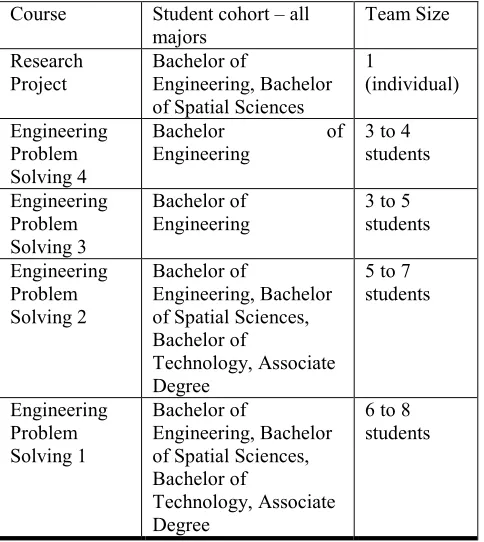
As students progress through their program, the problem complexity and technical difficulty of each problem solving course increases as does the need for student independence and application of research. Teamwork skills are developed in the early courses where the teams themselves provide peer support to the students. Many students find it a reassuring that they have significant knowledge and skills from their life experience which help the overall task of the team. This is particularly true of the mature age distance students. The appreciation of their skills of their peers and the friendships formed through working together are common outcomes of these courses. As student confidence in their ability to learn and research skills grow, the team support is reduced until the student is ready to demonstrate professional level engineering work in his or her final year research project.
[INSERT Table 2 here]
The first problem solving course focuses on ‘setting the scene’. It introduces students to PBL and has a greater emphasis on teamwork, conflict resolution, problem solving skills, application and sharing of prior knowledge, self learning and reflection, communication skills (both individually and as a team), task allocation and finding and applying appropriate resources.
Students are allocated to a team of the appropriate size, as indicated by Table 2 and assigned an academic staff member who acts as team facilitator. Resources provided for the teams in these courses include a course web page and a course resource book.
The course web page documents the team technical problems. Specific resources are provided to help address the technical problem or improve the team operation. The web page includes a Frequently Asked Question (FAQ) section, tips and hints from the examiner and extra resources particular to each problem.
The course resource book contains general information on all aspects of the course from setting up email accounts and maintaining a computer file structure through to technical information for each of the problems. However, the technical information is taken not from traditional engineering or technical texts, but other sources so that students are forced to understand it in the context of their own problem before they can apply it.
Communication is facilitated through a commercial Learning Management System (WebCt). This provides email, discussion boards and chat facilities for each team and facilities for electronic submission of final project reports, weekly team reports and individual portfolios. It is also used to gain student feedback through electronic surveys (Brodie 2006; Gibbings & Brodie in press).
In line with a problem solving strategy students are also encouraged to seek resources from outside the course e.g. work colleagues, team members etc and apply this information to the problems.
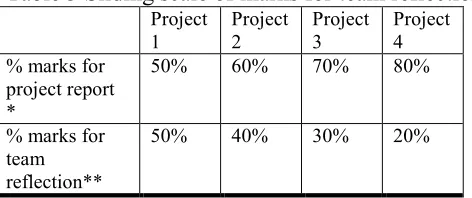
[INSERT table 3 here]
4. Achievements and Challenges
The strand of PBL based engineering courses was introduced since 2001. The foundational course was, to our knowledge, the first offering of an engineering PBL course to distance students working in virtual teams and communicating solely by electronic means, such as discussion boards, email and chat sessions.
References in the literature on team work organized for distance education students are limited and all depend on some on face-to face meetings at specified times during the course (Bygholm et al. 1998; Whittington & Sclater 1998; Brandon & Hollingshead 1999; Helbo et al. 2001; Jensen et al. 2003). The cohort of students at USQ studies entirely at a distance and there is little or no possibility of face-to-face meetings during the semester. USQ has the fourth largest international education program in the Australian higher education sector, and is the largest off-shore distance education international education program - recruiting from around 50 countries. Its success and support of distance education students has attracted large numbers of students not only from remote locations, but allows students who for work, family or personal reasons cannot be present on campus during normal hours. Team based work was implemented with these students in mind. Course delivery for the on-campus cohort was then a comparatively simple exercise as a variation on the external offering.
The work of the staff in the PBL strand has been recognised with several national and international awards. The strand has won the USQ award for the Design and Delivery of Teaching Materials for two successive courses and the Australasian Association of Engineering Education award for excellence for Curriculum Team Project. The delivery team for the foundation course were finalists in the prestigious Australian Awards for University Teaching (AAUT) in 2005 and won a Carrick Citation for Innovation in Teaching in 2006. These awards have recognised the innovative nature of the courses, particularly for distance students, the development of resources for staff and students and the corresponding staff professional development.
Faculty staff are routinely rotated through the PBL courses and must attend annual staff training sessions on delivering courses in this new engineering educational paradigm. This has resulted in nearly 50% of the Faculty academic staff being exposed to cooperative learning techniques (Brodie et al. 2006). It has significantly contributed to changing the culture of teaching within the Faculty and even within the University. Staff responsible for training and implementation of the PBL course have given university wide seminars and workshops on the techniques and strategies employed in the courses.
The development of the PBL strand within an engineering course offered to students at a distance from the campus was a novel, even world-first process. A longitudinal study was developed to document the student’s reception of these courses and their progress in acquiring the required attributes. The survey is ongoing, but results to date indicate that a large portion of the student cohort agrees that their learning, retention of knowledge and appreciation of problem solving and prior knowledge has increased through these courses. Key findings to 2005 include:
• 54% of students thought that the PBL courses had increased their ability to learn, with only 14% unsure of this effect.
• 52% of respondents either agreed or strongly agreed that their confidence in their ability to independently learn new concepts was increased, 22% were undecided.
• 70% of respondents either agreed or strongly agreed with the proposition that the course had enhanced problem solving skills and made effective use of prior knowledge. Only 15% were unsure of the effect.
• 83% of respondents thought that the courses had enhanced their appreciation of the prior knowledge and skills of their fellow team members. Only 7% had no opinion on this issue and 10% disagreed.
The student portfolios have qualitatively affirmed the results of this survey. Students tend to dislike the extra work required for the course and the need to depend on others in a team situation. Many do however realise how teamwork is now an essential part of the engineering profession and comment on how their skills in this area have been improved. Those with more experience in the university system are also likely to state that their learning experience has been significantly deeper through this course then it has in other traditionally taught courses.
5. Conclusions
The move to PBL was a huge undertaking by the Faculty of Engineering and Surveying at the University of Southern Queensland. It represented a significant cultural change for both students and staff, which has not been made without difficulty. Initially both parties found the change difficult but as challenges were overcome, many of the inherent benefits of PBL became more apparent.
Now a large portion of the student cohort agrees that their learning, retention of knowledge and appreciation of problem solving and prior knowledge has increased. A longitudinal study of the students is continuing with each offer of the course to document changing student attitudes, their perceptions of their learning progress and confidence in their ability to learn.
It would seem that the strand of Problem based learning engineering courses is achieving its objectives of inculcating teamwork, communication, and life long learning attributes while enabling our students to acquire specific technical knowledge as required for specific projects.
References
1. ABET 2003, Engineering Evaluation Criteria, 2006 <http://www.abet.org/criteria.html>.
3. Brodie, L. in press, 'Reflective Writing By Distance Education Students In An Engineering Problem Based Learning Course', Australasian Journal of Engineering Education.
4. Brodie, L., Aravinthan, T., Worden, J. & Porter, M. 2006, 'Re-skilling Staff for
Teaching in a Team Context.' EE 2006 International Conference on Innovation, Good Practice and Research in Engineering Education,,Liverpool, England, pp. 226-231. 5. Brodie, L.M. 2006, 'Problem Based Learning In The Online Environment –
Successfully Using Student Diversity and e-Education.' Internet Research 7.0: Internet Convergences,,Hilton Hotel, Brisbane, Qld, Australia,
<http://conferences.aoir.org/viewabstract.php?id=586&cf=5 >.
6. Brodie, L.M. & Porter, M.A. 2001, 'Delivering Problem Based Learning courses to engineers in on-campus and distance education modes', 3rd Asia Pacific Conference on Problem Based Learning.,Yeppoon, QLD.
7. Brodie, L.M. & Wood, D.J. 2004, 'Student Portfolios in an Engineering Problem Based Learning Course. ' Effective Teaching And Learning Conference, ,Griffith University, Brisbane, Australia. .
8. Bygholm, A., Hejlesen, O. & Nøhr, C. 1998, 'Problem oriented Project work in a distance education program in health informatics', MIDINFO 98,IOS Press, Amsterdam.
9. Department of Education Science and Training (DEST) 2002, 'Students 2001: Selected Higher Education Statistics', in Department of Education, Science and Training, Canberra.
10.Department of Education Science and Training (DEST) 2004, Our Universities: Backing Australia’s Future - Striving for Quality: Learning, Teaching and Scholarship, Department of Education, Science and Training, viewed 24/8/04 <http://www/backingaustraliasfuture.gov.au/publications>.
11.Dowling, D.G. 2001, 'Shifting the Paradigm for a New Era in Engineering and Surveying Education', SEFI Annual Conference,,Copenhagen, Denmark. 12.Engineering Council UK (EC UK) 2003, Regulating the Profession,
<http://www.engc.org.uk/documents/CEng_IEng_Standard.pdf>.
13.Gibbings, P.D. & Brodie, L.M. in press, 'Team-Based Learning Communities in Virtual Space', International Journal of Engineering Education.
14.Helbo, J., Knudsen, M., Jensen, L.P., Borch, O. & Rokkjær, O. 2001, 'Group Organized Project Work in Distance Education', ITHET 2001 Conference, Kumamoto.
15.IEAUST 1999, 'Manual for the Accreditation of Professional Engineering'. 16.Jensen, L.P., Helbo, J., Knudsen, M. & Rokkjær, O. 2003, 'Project-Organized
Problem-Based Learning in Distance Education', The International Journal of Engineering Education, vol. 19, no. 5,pp. 696-700.
17.MelbUni 2007, 'Attributes of the Melbourne graduate '.
18.MUni 2004, The nine attributes of a Murdoch graduate and the subattributes, viewed 10/10/07 <http://www.tlc.murdoch.edu.au/gradatt/attributes.html>.
19.Porter, M.A. & Brodie, L.M. 2001, 'Challenging tradition: Incorporating PBL in Engineering courses at USQ,' 3rd Asia Pacific Conference on Problem Based Learning,,Yeppoon, QLD.
20.Spender, D. & Stewart, F. 2002, Embracing e-learning in Australian schools, Commonwealth Bank, 2007
21.Thoben, K. & Schwesig, M. 2002, 'Meeting Globally Changing Industry Needs In Engineering Education', ASEE/SEFI/TUB Colloquium,,American Society for Engineering Education, Berlin, Germany,
<http://www.asee.org/conferences/international/papers/upload/Global-Education-in-Manufacturing.pdf>.
22.University of Southern Queensland 2007, Overview of USQ, viewed 8/7/07 <http://www.usq.edu.au/aboutusq/overview/default.htm >.
23.USQ 2005, Institutional Performance 2001-2005, viewed 6/5/06 2006 <http://www.usq.edu.au/resources/2005arpart5.pdf >.
24.USQ 2007, The Qualities of a USQ Graduate viewed 10/10/07 2007. 25.USyd 2006, Graduate Attributes Project, viewed 10/10/07
<http://www.itl.usyd.edu.au/graduateattributes/>.
26.Whittington, C.D. & Sclater, N. 1998, 'Building and Testing a Virtual University',
0% 10% 20% 30% 40% 50% 60%
18 - 24 yrs 25 - 29 yrs 30 - 39 yrs 40 - 49 yrs >50 yrs Distance students
[image:10.595.76.299.75.203.2]Oncampus students
Table 1 Undergraduate Programs in Engineering and Surveying
Field of Study
Five Year Programs
Four Year Programs
Three Year Programs
Two Year Programs
Agricultural Engineering ü ü
Building & Construction Management ü
Civil Engineering ü ü ü ü
Computer Systems Engineering ü ü ü ü
Electrical & Electronic Engineering ü ü ü ü
Environmental Engineering ü ü ü ü
Geographic Information Systems ü ü
Instrumentation & Control Engineering ü
Mechanical Engineering ü ü ü ü
Mechatronic Engineering ü ü
Software Engineering ü ü
Table 2 PBL Strand of Courses
Course Student cohort – all majors
Team Size
Research Project
Bachelor of
Engineering, Bachelor of Spatial Sciences
1
(individual)
Engineering Problem Solving 4
Bachelor of
Engineering
3 to 4 students
Engineering Problem Solving 3
Bachelor of Engineering
3 to 5 students
Engineering Problem Solving 2
Bachelor of
Engineering, Bachelor of Spatial Sciences, Bachelor of
Technology, Associate Degree
5 to 7 students
Engineering Problem Solving 1
Bachelor of
Engineering, Bachelor of Spatial Sciences, Bachelor of
Technology, Associate Degree
Table 3 Sliding scale of marks for team reflection
Project 1
Project 2
Project 3
Project 4 % marks for
project report *
50% 60% 70% 80%
% marks for team reflection**
50% 40% 30% 20%