DEMOGRAPHIC RESEARCH
VOLUME 35, ARTICLE 8, PAGES 201
−
228
PUBLISHED 29 JULY 2016
http://www.demographic-research.org/Volumes/Vol35/8/ DOI: 10.4054/DemRes.2016.35.8
Research Article
Migrant children and migrants’ children:
Nativity differences in school enrollment in
Mexico and the United States
Jennifer E. Glick
Scott T. Yabiku
©2016 Jennifer E. Glick & Scott T. Yabiku.
This open-access work is published under the terms of the Creative Commons Attribution NonCommercial License 2.0 Germany, which permits use, reproduction & distribution in any medium for non-commercial purposes, provided the original author(s) and source are given credit.
2 Migration and schooling in the United States 203
3 Return migration and schooling in Mexico 204
4 Life course, schooling, and migration 206
5 Hypotheses 207
6 Data and methods 208
7 Results 210
8 Discussion 221
Migrant children and migrants’ children: Nativity differences in
school enrollment in Mexico and the United States
Jennifer E. Glick1
Scott T. Yabiku2
Abstract
BACKGROUND
The growing prevalence of migrant children in diverse contexts requires a re-consideration of the intergenerational consequences of migration. To understand how migration and duration of residence are associated with children’s schooling, we need more comparative work that can point to the similarities and differences in outcomes for children across contexts.
OBJECTIVE
This paper addresses the importance of nativity and duration of residence for children’s school enrollment on both sides of a binational migration system: The United States and Mexico. The analyses are designed to determine whether duration of residence has a similar association with school enrollment across these different settings.
METHODS
The analyses are based on nationally representative household data from the 2010 Mexican Census and the 2006‒2010 American Community Survey. Logistic regression models compare school enrollment patterns of Mexican and U.S.-born children of Mexican origin in the United States and those of Mexican and U.S.-born children in Mexico. Interactions for nativity/duration of residence and age are also included. RESULTS
The results demonstrate that, adjusting for household resources and household-level migration experience, Mexican-born children in the United States and U.S.-born children in Mexico, particularly those who arrived recently, lag behind in school enrollment. These differences are most pronounced at older ages.
1 Population Research Institute and Department of Sociology and Criminology, The Pennsylvania State University, University Park PA, 16801, U.S.A. E-Mail: [email protected].
CONCLUSIONS
The comparisons across migration contexts point to greater school attrition and non-enrollment among older, recent migrant youth, regardless of the context. The interactions suggest that recent migration is associated with lower schooling for youth who engage in migration at older ages in both the United States and Mexico.
1. Introduction
As migration increases around the world, interest in the role of migration for children’s health and well-being continues to grow. Most needed are comparative studies that give greater insight into how children’s outcomes vary across diverse migration contexts. Despite long-term flows of migration such as those between the United States and Mexico, there is limited understanding of the variations in outcomes among children who migrate (Donato and Duncan 2011). This dearth of knowledge about the fate of migrant children is particularly notable for one of the fastest growing groups of children: U.S.-born children living in Mexico. By 2010, foreign-born residents in Mexico accounted for approximately 1% of the population, which represents a tripling of the size of the foreign-born population over 20 years. Over half of the foreign-born residents in Mexico in 2010 were children under age 15 (INEGI 2012). Research on this subgroup is timely, given the multiple factors in the United States that led to an increase in this population: the recession, the increasingly hostile immigration laws passed at the state level, and a rise in family members’ deportations. These children occupy a unique niche in the transnational realm because they are migrants themselves and yet, more often than not, are living with family members who are familiar with what is essentially the children’s country of settlement. This turns the more traditional intergenerational pattern of migration and the attendant expectations for incorporation upside down (Rendall and Torr 2008; Zúñiga and Hamann 2009).
families, those families with continued connections and communications across national boundaries (Levitt 2001). Nor do we have strong theories of incorporation that might lead to a clear prediction of migrant children’s schooling or educational progress in the case of return migration to parents’ origin communities. Thus there is limited guidance for predicting how duration of residence in these settings of return migration might be associated with children’s schooling.
This paper considers the role of nativity and duration of residence on children’s school enrollment in two different migration contexts: Mexico, which has seen an increase in return migration and a new influx of foreign-born children, and the United States, which receives many foreign-born children and where studies of these children’s educational experience are more plentiful. The analyses address whether there is a consistent role of nativity and duration of residence in these different receiving contexts. Foreign-born children may face similar constraints to school enrollment, particularly among recently arrived youth, regardless of the country under study. In both settings, families and youth may face difficulties navigating school enrollment procedures, lowering school enrollment for the most recently arrived (Medina 2012; Lukes 2013). But among immigrants in the United States there is considerable variation in educational outcomes by age and age at arrival, as well as a significant age pattern to school enrollment in general. In this case, nativity differentials in school enrollment in Mexico and the United States are likely to diverge according to children’s age. This paper takes advantage of national-level data for each context and considers the importance of migration, duration/age at arrival, and age when looking at school enrollment.
2. Migration and schooling in the United States
improvements over time and across generations consistent with this framework (White and Glick 2009).
Studies of Mexican-origin youth in the United States demonstrate that educational progress and attainment has been negatively impacted by structural barriers such as unauthorized status of parents, segregation into low-resourced communities and schools, and the difficulty immigrant parents may have navigating these institutions (Bean et al. 2011; Crosnoe 2006; Telles and Ortiz 2009). Parents’ unauthorized status is particularly disadvantageous to the structural incorporation of Mexican-origin youth (Bean et al. 2014). In such a setting, U.S.-born children with unauthorized parents face challenges despite their United States citizenship. Yet, even in the presence of these barriers, within the Mexican-origin population in the United States there is greater educational attainment among the second and higher generations than among the Mexican-born (White and Glick 2009; Zsembik and Llanes 1996).
Some of the variation in schooling is also associated with the timing of migration in the life course and the availability of alternatives to schooling. Some studies point to better educational outcomes among youth who come to the United States at younger ages (White and Glick 2009). Among immigrants to the United States from Mexico, approximately one-third of those who arrived before age 12 failed to earn a high school diploma as compared to two-thirds of those who arrived between ages 12 and 18 (Baum and Flores 2011). One reason for these differences is that many Mexican immigrants who arrive in the United States as adolescents do not enroll in school in the United States at all (Oropesa and Landale 2009). Older children have alternatives to schooling in the form of the labor market, either formal or informal, and this competes with schooling. This implies a differential selection process for migration among older youth than among younger children and different incorporation patterns following migration.
3. Return migration and schooling in Mexico
(2008) find that even though second-generation Mexican American children have lower school enrollment than other children in the United States, their rates of school enrollment still outpaces their counterparts in Mexico (Rendall and Torr 2008). Mandatory schooling in Mexico now extends to secondary education, suggesting that the majority of children under age 15 or so can be expected to be enrolled in school (Creighton and Park 2010). But the availability of secondary schooling is less universal across Mexico than in the United States, leading to considerable variation in school enrollment at older ages and in rural areas (Vargas and Camacho 2015).
Overall, the body of research focusing on schooling outcomes among children who return to their parents’ countries of origin is somewhat smaller than research focusing on children migrating with parents to a new context. It is unlikely that the patterns associated with nativity or duration of residence observed among children of immigrants to the United States will also be observed among the children of returning migrants. Therefore we may not be able to rely on the assimilation frameworks and the underlying assumption that succeeding generations have better knowledge of the destination context. In the case of children of migrants who return to their parents’ country of origin, it is more likely that parents know more than their children about this destination’s language, customs, and schooling system. Thus, typical assimilation frameworks may not hold (Zúñiga and Hamann 2009).
Although U.S.-born children returning to Mexico with their parents are not experiencing the strife of war and forced migration like refugee children, nor are most of the returning Mexican parents highly advantaged professionals like the parents of the kikokushijo, they may still face difficulties entering Mexican schools. Enrolling children in Mexican schools involves a lengthy bureaucratic process and families may find the process cumbersome (Medina 2012). Thus, we might expect some delay in school enrollment among recently arrived U.S.-born children in Mexico. But even if returning Mexican families face barriers to school enrollment, should we expect the same association in Mexico between duration of residence and school enrollment as observed in the United States, such that all U.S.-born children of Mexican origin lag behind their Mexican-born peers? On the one hand, the pattern may look similar if U.S.-born children face difficulties adapting to schools in Mexico, perhaps leading to higher levels of attrition from school than their Mexican-born peers (Zúñiga and Hamann 2009). On the other hand, U.S.-born children moving to Mexico may be more motivated to enroll and stay in school because they aspire to return to the United States and find employment, which their birthright citizenship gives them the legal right to do. In this case, U.S.-born children and their parents in Mexico may envision these children’s futures as connected to the job market and employment patterns available in both Mexico and the United States. The knowledge of the returns that schooling provides in the United States labor market could therefore boost U.S.-born children’s enrollment relative to Mexican-born peers, even if there is some delay immediately upon entrance to Mexico.
4. Life course, schooling, and migration
In both the United States and Mexico, schooling has established life course patterns regarding school enrollment and attainment. In both contexts, children typically enroll around age 5 or 6. In the United States, public schooling is widely available through grade 12 and school attendance is compulsory until age 16‒18, depending on the state of residence (NCES 2013). As noted earlier, Mexico has also moved to make secondary education compulsory, with varying levels of school availability across the country. These overall patterns set the context for schooling in each country, but how the migration or return migration experience affects an immigrant child’s enrollment in relation to native-born children is likely to depend on the timing of migration in the child’s life course.
influence school enrollment. But among older children, age at arrival in the destination country may be more important. Those who arrived at younger ages and have lived in their new context the longest have had time to overcome bureaucratic barriers to school enrollment and will have experienced the new school system earlier in their schooling careers, perhaps increasing motivation to remain in school (Zúñiga and Hamann 2009). But older and more recently arrived youth will have less experience in the new school system and may be less motivated to enter and/or remain in school in their new context (Vargas and Comancho 2015). Further, from age 15 or so, viable alternatives to schooling ‒ in the form of the labor market ‒ become possible, creating competing choices for these youths.
5. Hypotheses
Based on previous research, we rely on nationally representative data to test hypotheses about school enrollment among U.S.-born children living in Mexico compared with Mexican-born children in Mexico and in the United States. Duration of residence (i.e., more or less than five years in the country of settlement) is also used to account for variation with increased experience. Interactions with age and nativity/duration of residence also help evaluate whether these differences are more pronounced at older ages. The analyses predict school enrollment among children aged 5–17 in households throughout Mexico and the United States. Furthermore, school enrollment is likely to decline around age 15 for all children in Mexico because this is the age at which compulsory education is completed in Mexico (Rendall and Torr 2008). Thus, the hypotheses account for a different age pattern of enrollment by nativity in Mexico than in the United States, where school attrition (or non-enrollment) is expected to be more prevalent among the Mexican-born at older ages.
H1: In the United States a classic assimilation pattern is likely to be observed, in which U.S.-Born children have the highest enrollment, followed by “Foreign-born” children in the United States for 5 years or more, and then “Foreign-born” children in the United States for less than 5 years.
H2a: In Mexico, U.S.-born children will have higher school enrollment than their Mexican-born peers.
H3: In both countries, differences in school enrollment across nativity/duration of residence groups will be most pronounced at oldest ages when competing alternatives to schoolingin the form ofemploymentbecome available.
6. Data and methods
The data are drawn from the 2010 Mexican Census and the 2006‒2010 five-year American Community Survey data (ACS). Both datasets were accessed through the Integrated Public Use Microdata Series (IPUMS) (Minnesota Population Center 2014; Ruggles et al. 2010). The samples consist of children aged 5‒17, in order to observe differences in entry and exit from school enrollment. For the United States the sample is further restricted to individuals of Mexican descent or ancestry. This includes anyone who identifies as Mexican on the Hispanic ethnicity question, was born in Mexico, or identifies Mexican as their first ancestry3. The advantages of relying on these data sources include a sufficiently large sample size across nativity and age groups and the comparability of many variables. The dependent variable of interest is school enrollment for all household members between the ages of 5 and 17. The vast majority of children aged 5‒17 are currently enrolled in school in Mexico (88.2%), with even higher enrollment across these ages in the United States (96.2%). But there are significant decreases in enrollment observed at later ages in both countries. To predict child school enrollment, logistic regression models are conducted in STATA, which allows for appropriate consideration of the clustering of children within households and reliance on appropriate weights for both the ACS and Mexican Census samples.4
The key predictor variable is based on country of residence and country of birth (Mexico or the United States). Children born in other countries are not included in the analyses. We compare the school enrollment of three groups of children in each country. For the United States, we compare school enrollment among children born in Mexico who arrived in the United States within the previous 5 years (Mexican born, <5 years in U.S.), children born in Mexico who arrived in the United States more than 5 years ago (Mexican born, >5 years in U.S.), and children of Mexican ancestry/ethnicity born in the United States (U.S.-born). Unfortunately, the measure of year of arrival in
3 There is likely some coverage error for the Mexican-origin population in the American Community Survey, particularly for the children of Mexican-born mothers (Van Hook et al. 2014). But the coverage error appears to have declined in the 2000s. There is also a small chance that some children are counted in both datasets. This would occur only if children we observe from the 2006‒2010 ACS surveys migrated to Mexico in time to be counted in the 2010 Mexican Census.
the United States available in the ACS may not accurately represent duration of residence for adults who make multiple entries to the United States (Redstone and Massey 2004). It is likely a more accurate measure of residence duration in the case of children, but we may be underestimating exposure to the United States. This will be particularly true for children who live in proximity to the border and move back and forth. This is one reason we include border residence as a control variable, as described below.
In the Mexican data, the question we use to establish duration of residence refers to location of residence five years ago. This allows us to create comparison groups in Mexico: children born in the United States who have lived in Mexico for less than 5 years (U.S.-born <5 years in Mexico), children born in the United States who have lived in Mexico for five years or more (U.S.-born >5 years in Mexico), and children born in Mexico (Mexican-born). We do not make an attempt to pool the datasets with these somewhat different measures but rather look to comparisons across groups of children within each context.
The other predictor variables reflect individual measures associated with school enrollment and family and household resources. Age is an important predictor, which indicates variations in entry to school, variations in school attrition, and age-graded opportunities that are alternatives to schooling. Age is used as a continuous measure and age squared is included to account for the non-linearity of age and school enrollment. To assess whether nativity/duration of residence groups diverge in enrollment at older ages, the final models include an interaction term with nativity/duration of residence and age.
the case of single parents. Parental education is not available for children who are not coresident with at least one parent. When neither parent is present, the education of the householder is used. Parental education is measured as less than high school (reference group) and more than high school. The least comparable measure for both data sources is household income. For the United States, the analyses include a dummy variable indicating the household is below the federal poverty line. For Mexico, we rely on an index of household assets for Mexico (i.e., whether the home has a solid roof, floor, running water, a refrigerator, a washing machine, a computer, or a car. Principal Components Analysis (PCA) reveals these items all load consistently on one factor (eigenvalue = 3.0).
It is also important to consider the proximity to the migration experience within the household. Research on children in origin communities has found important variations in children’s schooling, health, and development according to whether the household has migrant family members (Creighton, Park, and Teruel 2009; Dontato and Duncan 2011; Kandel and Kao 2000; Nobles 2011). In receiving contexts, living in a household with recent arrivals is also associated with differences in children’s schooling and development (Baum and Flores 2011; Crosnoe 2006; Jackson, Pebley, and Goldman 2010). Here the analyses include a variable indicating whether there has been any recent migration experience in the household. In the United States, this measure reflects those households in which a household member has moved to the United States within the previous five years. In Mexico, this measure reflects those households in which a household member has left to live abroad within the previous five years.
Finally, we include a measure for whether the household is located in the border region, because the experience of recent migration and schooling is quite different there than in the rest of the country, in both countries under consideration (Vargas Valle 2012). In the United States, this includes households located in Arizona, California, New Mexico, and Texas. In Mexico, this refers to households located in Baja California, Coahuila, Chihuahua, Nuevo León, Sonora, and Tamaulipas.
7. Results
appear small in the aggregate, the age patterns of school enrollment suggests greater diversity within and across groups when we consider recently arrived migrant youth. Figure 1 demonstrates the age pattern of school enrollment across groups of youth in the United States and Mexico, respectively. There is greater divergence in school enrollment among youth at the youngest and oldest ages in both countries. School enrollment increases with age and levels off around age 7. Among 7-year-olds, for example, nearly all U.S.-born children of Mexican origin in the United States and in Mexico are enrolled in school (98.5% for U.S.-born, 96% for Mexican-born in the United States for 5 years or more, and 95% among Mexican-born children in the United States for less than 5 years). This nearly universal level of school enrollment by age 7 is also apparent in Mexico, but highest enrollment is found among U.S.-born youth in Mexico for more than 5 years (97%). There is increasing divergence in school enrollment by nativity and duration of residence at older ages. In the United States, school enrollment remains high and does not diverge much until after age 14. Among 16-year-olds, for example, well over 90% of Mexican-origin U.S.-born youth are enrolled in school compared to approximately 70% of Mexican-born 16-year-olds who arrived within the previous 5 years. We note that this latter group represents 16-year-olds who migrated to the United States during their early adolescence (age 12 and above). In Mexico, there is also increasing divergence by nativity and duration of residence with age. Here the highest school enrollment is observed among the U.S.-born who have lived in Mexico for more than 5 years (70% of 16-year-olds enrolled), with lower levels of enrollment among recent arrivals in Mexico and the Mexican-born (60% of 16 year olds enrolled). Again, age minus duration of residence also represents age at arrival, so that the U.S.-born 16-year-olds who have resided in Mexico for more than 5 years presumably entered Mexico prior to adolescence.
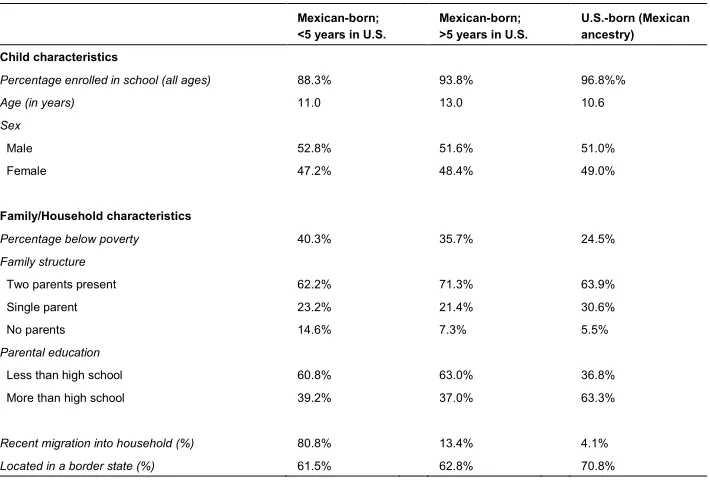
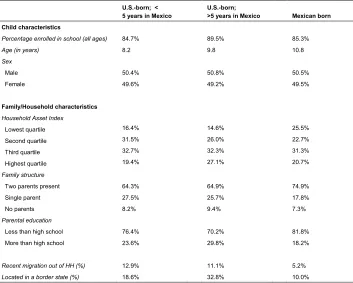
States. In Mexico, there is less variation in child characteristics by nativity. On average, immigrant children (i.e., U.S.-born) live in households with more resources and have parents with higher education than Mexican-born children – a pattern that is the opposite of the United States. Similar to the United States, however, immigrant children in Mexico are more likely to live in a household that has sent recent migrants abroad. There is less concentration in states along the border, with a higher percentage of U.S.-born children in Mexico for more than 5 years living in these states than those with more recent arrival in Mexico or Mexican-born.
Table 1a: Descriptive statistics by child’s nativity, United States
Mexican-born;
<5 years in U.S. Mexican-born; >5 years in U.S. U.S.-born (Mexican ancestry) Child characteristics
Percentage enrolled in school (all ages) 88.3% 93.8% 96.8%%
Age (in years) 11.0 13.0 10.6
Sex
Male 52.8% 51.6% 51.0%
Female 47.2% 48.4% 49.0%
Family/Household characteristics
Percentage below poverty 40.3% 35.7% 24.5%
Family structure
Two parents present 62.2% 71.3% 63.9%
Single parent 23.2% 21.4% 30.6%
No parents 14.6% 7.3% 5.5%
Parental education
Less than high school 60.8% 63.0% 36.8% More than high school 39.2% 37.0% 63.3%
Recent migration into household (%) 80.8% 13.4% 4.1%
Located in a border state (%) 61.5% 62.8% 70.8%
Table 1b: Descriptive statistics by child’s nativity, Mexico
U.S.-born; <
5 years in Mexico U.S.-born; >5 years in Mexico Mexican born Child characteristics
Percentage enrolled in school (all ages) 84.7% 89.5% 85.3%
Age (in years) 8.2 9.8 10.8
Sex
Male 50.4% 50.8% 50.5%
Female 49.6% 49.2% 49.5%
Family/Household characteristics
Household Asset Index
Lowest quartile 16.4% 14.6% 25.5%
Second quartile 31.5% 26.0% 22.7%
Third quartile 32.7% 32.3% 31.3%
Highest quartile 19.4% 27.1% 20.7%
Family structure
Two parents present 64.3% 64.9% 74.9%
Single parent 27.5% 25.7% 17.8%
No parents 8.2% 9.4% 7.3%
Parental education
Less than high school 76.4% 70.2% 81.8% More than high school 23.6% 29.8% 18.2%
Recent migration out of HH (%) 12.9% 11.1% 5.2%
Located in a border state (%) 18.6% 32.8% 10.0%
Figure 1: Observed school enrollment by age and nativity, United States and Mexico
0.5 0.6 0.7 0.8 0.9 1
5 6 7 8 9 10 11 12 13 14 15 16 17
United States
US born, US
Mexican born < 5 years in US Mexican born > 5 years in US
0.5 0.6 0.7 0.8 0.9 1
5 6 7 8 9 10 11 12 13 14 15 16 17
Mexico
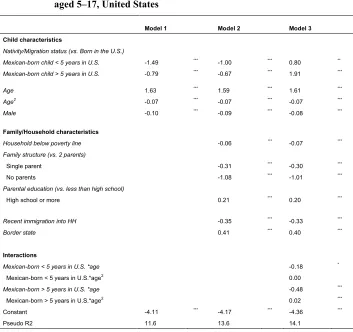
The descriptive results suggest that Mexican immigrant children in the United States are disadvantaged relative to their U.S.-born counterparts in terms of family resources, while U.S.-born children in Mexico have more resources than their Mexican-born counterparts. These factors may reduce the variations in school enrollment observed in Figure 1. Logistic regression models predicting school enrollment are estimated separately for children in the United States (Table 2a) and Mexico (Table 2b). First, Model 1 demonstrates that Mexican-born children in the United States have lower levels of school enrollment than their U.S.-born peers, even when adjusting for age and gender. Children in the United States for less than five years have the lowest levels of school enrollment even when adjusting for their older age profile. Model 2 also demonstrates the importance of family and household characteristics. Children living in households below the poverty line, without both parents present and with parents who have the lowest level of education, are less likely to be enrolled in school. Living in a household with recent immigrants is also associated with lower probability of school enrollment. Living in a border state is associated with a higher probability of school enrollment among Mexican-origin children in the United States when compared to Mexican-origin children living elsewhere in the country. Overall, these family and household characteristics reduce the size of the ‘immigrant child’ effects. The biggest reduction is for Mexican-born children with less than 5 years’ duration in the United States, which highlights the large role of family and household factors in explaining recently arrived children’s lower schooling levels. But even after considering these factors, all Mexican-born children are still less likely to be enrolled in school than their U.S.-born peers, and this is especially the case for those who arrived in the United States within the last five years.
Table 2a: Logistic regression models predicting school enrollment, children aged 5‒17, United States
Model 1 Model 2 Model 3
Child characteristics
Nativity/Migration status (vs. Born in the U.S.)
Mexican-born child < 5 years in U.S. -1.49 *** -1.00 *** 0.80 **
Mexican-born child > 5 years in U.S. -0.79 *** -0.67 *** 1.91 ***
Age 1.63 *** 1.59 *** 1.61 ***
Age2 -0.07 *** -0.07 *** -0.07 ***
Male -0.10 *** -0.09 *** -0.08 ***
Family/Household characteristics
Household below poverty line -0.06 *** -0.07 ***
Family structure (vs. 2 parents)
Single parent -0.31 *** -0.30 ***
No parents -1.08 *** -1.01 ***
Parental education (vs. less than high school)
High school or more 0.21 *** 0.20 ***
Recent immigration into HH -0.35 *** -0.33 ***
Border state 0.41 *** 0.40 ***
Interactions
Mexican-born < 5 years in U.S. *age -0.18 *
Mexican-born < 5 years in U.S.*age2 0.00
Mexican-born > 5 years in U.S. *age -0.48 ***
Mexican-born > 5 years in U.S.*age2 0.02 ***
Constant -4.11 *** -4.17 *** -4.36 ***
Pseudo R2 11.6 13.6 14.1
Some of these differences likely reflect the importance of age at arrival in the United States. The lower school enrollment among Mexican-born teens is consistent with the observation that some recent immigrant youth never enroll in school in the United States in the first place (Oropesa and Landale 2009). Likewise, the results are consistent with the expectation that those who have lived in the United States for longer periods of time, and therefore entered at younger ages, evidence higher school enrollment and have higher English language proficiency and academic achievement (Stevens 2014; Stiefel, Schwartz, and Conger 2010; White and Glick 2009). The more gradual decline in enrollment for Mexican-born children with more than 5 years’ duration in the United States is consistent with an assimilation process in which longer duration in the receiving country allows children to follow schooling patterns that are more similar to normative expectations for native-born children.
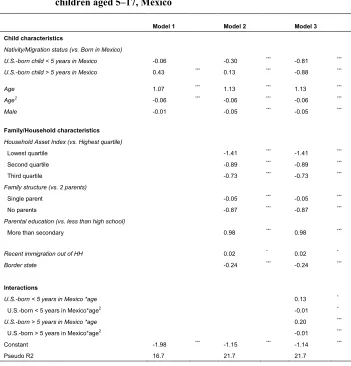
The models predicting school enrollment in Mexico are presented in Table 2b. Model 1 suggests there is little variation in the school enrollment of U.S.-born children who arrived very recently in Mexico when compared to their Mexican-born peers, unlike the pattern observed for duration of residence and school enrollment in the United States. However, children born in the United States who have lived in Mexico for five years or more are more likely to be enrolled in school than their Mexican-born peers.
Table 2b: Logistic regression models predicting school enrollment, children aged 5‒17, Mexico
Model 1 Model 2 Model 3
Child characteristics
Nativity/Migration status (vs. Born in Mexico)
U.S.-born child < 5 years in Mexico -0.06 -0.30 *** -0.81 ***
U.S.-born child > 5 years in Mexico 0.43 *** 0.13 *** -0.88 ***
Age 1.07 *** 1.13 *** 1.13 ***
Age2 -0.06 *** -0.06 *** -0.06 ***
Male -0.01 -0.05 *** -0.05 ***
Family/Household characteristics
Household Asset Index (vs. Highest quartile)
Lowest quartile -1.41 *** -1.41 ***
Second quartile -0.89 *** -0.89 ***
Third quartile -0.73 *** -0.73 ***
Family structure (vs. 2 parents)
Single parent -0.05 *** -0.05 ***
No parents -0.87 *** -0.87 ***
Parental education (vs. less than high school)
More than secondary 0.98 *** 0.98 ***
Recent immigration out of HH 0.02 * 0.02 *
Border state -0.24 *** -0.24 ***
Interactions
U.S.-born < 5 years in Mexico *age 0.13 *
U.S.-born < 5 years in Mexico*age2 -0.01 *
U.S.-born > 5 years in Mexico *age 0.20 ***
U.S.-born > 5 years in Mexico*age2 -0.01 ***
Constant -1.98 *** -1.15 *** -1.14 ***
Pseudo R2 16.7 21.7 21.7
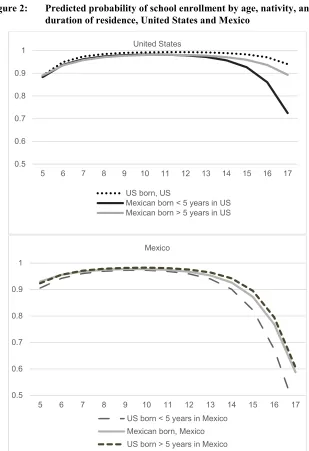
Model 3 includes a multiplicative interaction between nativity and child age to examine whether differences in the enrollment of U.S.- and Mexican-born children varied by age. Child age significantly moderates nativity differences in enrollment in the case of Mexico. As with the models for the United States, the interaction terms suggest greater divergence in school enrollment among older children.
To make these interactions easier to interpret, Figure 2 presents predicted school enrollment by age for immigrant and native youth of Mexican origin in the United States and Mexico. In the United States there is little divergence in school enrollment until adolescence, when U.S.-born youth are most likely to be in school, longer resident Mexican-born youth are somewhat less likely to be in school, and those most recently arrived are least likely to be enrolled. The lower school enrollment is particularly notable among older youth who have lived in the United States for less than five years, who would have entered the United States at older ages than their age peers that have longer duration of residence in the United States.
Figure 2: Predicted probability of school enrollment by age, nativity, and duration of residence, United States and Mexico
0.5 0.6 0.7 0.8 0.9 1
5 6 7 8 9 10 11 12 13 14 15 16 17
United States
US born, US
Mexican born < 5 years in US Mexican born > 5 years in US
0.5 0.6 0.7 0.8 0.9 1
5 6 7 8 9 10 11 12 13 14 15 16 17
Mexico
8. Discussion
Although there is great interest in the importance of migration for children’s well-being, there is no one theoretical framework that addresses potential impacts of migration on children across settings and for different types of migration. The assimilation framework has been widely applied to studies of immigrant and higher-generation youth in receiving contexts, but there is no clear analogous theoretical framework to guide expectations for outcomes among children who move to their parents’ origin communities. These children, many of whom move with returning migrant parents, may face barriers to schooling that are similar to those faced by immigrant youth in the United States, such as limited familiarity with the instructional language or institutional expectations of schools in their new communities (Zúñiga and Hamann 2009). Yet U.S.-born children in the parents’ origin country may also have an advantage, shared by higher-generation children, if they benefit from their parents’ institutional knowledge - knowledge that is not anticipated by the assimilation framework.
To understand the dynamics of nativity and duration of residence in children’s schooling, the analyses here compare the experiences of Mexican-origin children in the United States and U.S.-born Mexican-origin children in Mexico. The results indicate that recent migration ‒ which we conceptualized as duration in the receiving country of less than 5 years ‒ is associated with lower school enrollment when compared to native-born children in either context. This suggests that migration itself induces a lag in school entrance or discourages school enrollment entirely, particularly among older youth. However, this disadvantage is not shared by youth who migrated more than five years ago in either context.
families from the United States to Mexico have a greater commitment to schooling than non-migrants and that greater duration of residence in Mexico allows families to overcome enrollment barriers. Further, these U.S.-born youth may be motivated to higher educational attainment if they anticipate moving back to the United States. Regardless, the pattern of school enrollment by nativity observed in Mexico is more reminiscent of the higher educational attainment of some children of immigrants in the United States when compared to their native-born peers, a phenomenon most often observed among some Asian-origin youth, than it is of the pattern predicted by a simple assimilation framework (White and Glick 2009).
The analogy to Asian-origin youth in the United States is particularly appropriate when considering the second explanation of the differences we observe in Mexico. It seems likely that school enrollment variation is partially due to the differential selection of return migrants to Mexico (Feliciano 2005). There is considerable variation in the temporal pattern of return migration (Rendall, Brownell, and Kups 2011; Van Hook and Zhang 2011). The most recently returned families in our data will have moved at a time of worsening economic conditions and increased scrutiny of the unauthorized population in the United States between 2006 and 2010. These families may differ from those who made the decision to return to Mexico earlier. Further, the observation that older U.S.-born youth with longer residence in Mexico are more likely to be in school than their recently arrived peers could reflect differential selection of the returning youth themselves (Dustmann 2003). Adolescents may be less likely to return with their families than younger children. This will particularly impact the results for school enrollment if families find alternatives to migration to Mexico for those children who excel in school, but bring along children or adolescents with less attachment to their schooling in the United States. The need to unravel these selection dynamics means we also need more comparative and longitudinal data, so researchers can consider pre-migration and pre-return conditions of families and gain better understanding of these dynamics in children’s outcomes (Glick 2010).
U.S.-born counterparts in households that have not received migrants in the last five years. The results for living in a household that has recently sent migrants to the United States are different in the models for Mexico. We found that recent migration out of the household in Mexico is positively associated with children’s enrollment. Mixed results have been attained in prior work looking at the role of migration in schooling in Mexico. In the case of Mexican households that send migrants to the United States there may be less school engagement among children who view migration as an alternative strategy to education (Kandel and Kao 2000), but there may also be greater access to resources that can facilitate continued school enrollment.
References
Alba, R. and Nee, V. (2003). Remaking the American Mainstream: Assimilation and contemporary immigration. Cambridge: Harvard University Press. doi:10.4159/9780674020115.
Baum, S. and Flores, S.M. (2011). Higher education and children in immigrant families. Future of Children 21(1): 171‒193. doi:10.1353/foc.2011.0000.
Bean, F.D., Bachmeier, J.D., Brown, S.K., Van Hook, J., and Leach, M.A. (2014). Unauthorized Mexican migration and the socioeconomic integration of Mexican Americans. In: Logan, J. (ed.). Diversity and Disparities: America enters a new century. New York: Russell Sage Foundation.
Bean, F.D., Leach, M., Brown, S.K., Bachmeier, J.D., and Hipp, J. (2011). The educational legacy of unauthorized migration: Comparisons across U.S. immigrant groups in how parents’ status affects their offspring. International Migration Review 45(2): 348‒385. doi:10.1111/j.1747-7379.2011.00851.x. Cornish, F., Peltzer, K., and MacLachlan, M. (1999). Returning strangers: The children
of Malawian refugees come ‘home’? Journal of Refugee Studies 12(3): 264‒283. doi:10.1093/jrs/12.3.264.
Creighton, M. and Park, H. (2010). Closing the gender gap: Six decades of reform in Mexican education. Comparative Education Review 54(4): 513‒537. doi:10.1086/653702.
Creighton, M., Park, H., and Teruel, G. (2009). The role of migration and single motherhood in upper secondary education in Mexico. Journal of Marriage and Family 71(5): 1325‒1339. doi:10.1111/j.1741-3737.2009.00671.x.
Crosnoe, R. (2006). Mexican roots, American schools: Helping Mexican immigrant children succeed. Stanford: Stanford University Press.
Donato, K.M. and Duncan, E.M. (2011). Migration, social networks and child health in Mexican families. Journal of Marriage and Family 73(4): 713‒728. doi:10.1111/j.1741-3737.2011.00841.x.
Dreby, J. (2010). Divided by Borders: Mexican migrants and their children. Berkeley: University of California Press.
Enloe, W. and Lewin, P. (1987). Issues of integration abroad and readjustment to Japan of Japanese returnees. International Journal of Intercultural Relations 11(3): 223‒248. doi:10.1016/0147-1767(87)90002-2.
Feliciano, C. (2005). Educational selectivity in US immigration: How do immigrants compare to those left behind? Demography 42(1): 131‒152. doi:10.1353/ dem.2005.0001.
Feliciano, C. (2008). Gendered selectivity ‒ US Mexican immigrants and Mexican nonmigrants, 1960‒2000. Latin American Research Review 43(1): 139‒160. doi:10.1353/lar.2008.0009.
Fry, R. (2009). Politics of education for Japanese returnee children: Articles. Compare 39(3): 367‒383. doi:10.1080/03057920701712908.
Glick, J.E. (2010). Connecting complex processes: A decade of research on immigrant families. Journal of Marriage and Family 72(3): 498‒515. doi:10.1111/j.1741-3737.2010.00715.x.
Hagan, J., Eschbach, K., and Rodriguez, N. (2008). US deportation policy, family separation, and circular migration. International Migration Review 42(1): 64‒88. doi:10.1111/j.1747-7379.2007.00114.x.
Hatfield, M.E. (2010). Children moving ‘home’? Everyday experiences of return migration in highly skilled households. Childhood 17(2): 243‒257. doi:10.1177/0907568210365747.
Instituto Nacional de Estadísticas y Geografía (2012). Mujeres y hombres en México 2011 / Instituto Nacional de Estadística y Geografía, Instituto Nacional de las Mujeres. -- México : INEGI, 2012.
Jackson, M.I., Pebley, A.R., and Goldman, N. (2010). Schooling location and economic, occupational and cognitive success among immigrants and their children: The case of Los Angeles. Social Science Research 39(3): 432‒443. doi:10.1016/j.ssresearch.2009.11.001.
Kandel, W. and Kao, G. (2000). Shifting orientations: How US labor migration affects children’s aspirations in Mexican migrant communities. Social Science Quarterly 81: 16‒32.
Levitt, P. (2001). The Transnational Villagers. Berkeley: The University of California Press.
Liu, L. (2012). Return migration and selective citizenship: A study of returning Chinese professional migrants from the United States. Journal of Asian American Studies 15(1): 35‒68. doi:10.1353/jaas.2012.0007.
Lukes, M. (2013). Pushouts, shutouts and holdouts: Educational experiences of Latino immigrant young adults in New York City. Urban Education 20: 1‒29.
Medina, D. (2012). Return migration: Undocumented “American” children in Mexico. Paper presented at the annual meeting of the American Sociological Association, Denver, Co.
Minnesota Population Center (2014). Integrated Public Use Microdata Series, International: Version 6.3 [Machine-readable database]. Minneapolis: University of Minnesota.
National Center for Education Statistics (2013). School Attendance Age Limits, Education Commission of the States, 2013. Washington, DC: US Department of Education, Institute for Education Statistics.
Nobles, J. (2011). Parenting from abroad: Migration, nonresident father involvement, and children’s education in Mexico. Journal of Marriage and the Family 73(4): 729‒746. doi:10.1111/j.1741-3737.2011.00842.x.
Onoda, M. (2007). La Educación Básica de los ninos migrantes y la legislación pertinente “studio contrastado internactional”. Thesis prepared for Universidad Autóma del Estado de Hidalgo. Pachuca de Soto Hidalgo, November 2007. Oropesa, R.S. and Landale, N.S. (2009). Why do immigrant youths who never enroll in
US schools matter? School enrollment among Mexicans and non-Hispanic whites. Sociology of Education 82(3): 240‒266. doi:10.1177/0038040709082 00303.
Redstone, I. and Massey, D.S. (2004). Coming to stay: An analysis of the U.S. Census question on immigrants’ year of arrival. Demography 41(4): 721‒738. doi:10.1353/dem.2004.0035.
Rendall, M.S. and Torr, B.M. (2008). Emigration and schooling among second-generation Mexican-American children. International Migration Review 42(3): 729‒738. doi:10.1111/j.1747-7379.2008.00144.x.
Ruggles, S.J., Alexander, T., Genadek, K., Goeken, R., Schroeder, M.B., and Sobek, M. (2010). Integrated Public Use Microdata Series: Version 5.0 [Machine-readable database]. Minneapolis: University of Minnesota, 2010.
Secretaria de Gobernacion (2015). Acuerdo numero 07/06/15. Diario Oficial de la Federacion. http://dof.gob.mx/nota_detalle.php?codigo=5396631&fecha=15/06/ 2015. [accessed 4/25/2016].
Stevens, G. (2014). Trajectories of English acquisition among foreign-born Spanish-language children in the United States. International Migration Review 49(4): 981‒1000. doi:10.1111/imre.12119.
Stiefel, L., Schwartz, A.E., and Conger, D. (2010). Age at entry and the high school performance of immigrant youth. Journal of Urban Economics 67(3): 303‒314. doi:10.1016/j.jue.2009.10.001.
Telles, E.E. and Ortiz, V. (2009). Generations of Exclusion: Mexican Americans, Assimilation and Race. New York: Russell Sage Foundation.
Van Hook, J. and Zhang, W. (2011). Who stays? Who goes? Selective emigration among the foreign-born. Population Research and Policy Review 30(1): 1‒24. doi:10.1007/s11113-010-9183-0.
Van Hook, J., Bean, F.D., Bachmeier, J.D., and Tucker, C. (2014). Recent trends in coverage of the Mexican-born population of the United States: Results from applying multiple methods across time. Demography 51(2): 699‒726. doi:10.1007/s13524-014-0280-2.
Vargas Valle, E.D. and Camacho Rojas, E. (2015). ¿Cambiarse de escuela?: nasistencia y rezago escolar de los niños de migración reciente de Estados Unidos a México. Norteamerica 10(2): 157‒186. doi:10.20999/nam.2015.b006.
Vargas Valle, E.D. (2012). Transborder links and formal education of the urban youth population on the northern border. Frontera Norte 47(1): 35‒61.
Yoshida, T., Matsumoto, D., Akiyama, T., Moriyoshi, N., Furuiye, A., Ishii, C., and Franklin, B. (2002). The Japanese returnee experience: Factors that affect reentry. International Journal of Intercultural Relations 26(4): 429‒445. doi:10.1016/S0147-1767(02)00015-9.
Zhou, M. (1997). Segmented assimilation: Issues, controversies, and recent research on the new second generation. International Migration Review 31(4): 975‒1008. doi:10.2307/2547421.