Workflow-based e-Learning Platform
Jianming Yong
Department of information Systems
Faculty of Business
University of Southern Queensland
Toowoomba QLD 4350
AUSTRALIA
Abstract
E-learning has become one of most important means for the future education, especially for universities. This paper is based our e-learning teaching experience which comes from one of the leading e-learning university, the University of Southern Queensland. We use the workflow mechanism to analyse the learning system. The whole e-learning system is divided into four sub-workflow systems, teaching workflow, leaning workflow, admin sub-workflow and infrastructure sub-sub-workflow. Through a coherent analyse of co-relationship of main activities in four sub-workflow systems, some activities are identified as the key elements for the e-learning system. By enhancing these key elements, the performance of all the learning workflow gets a significant improvement and e-learning students get better grades than on-campus and traditional distance students. The workflow-based e-learning system can effectively reach the expected achievement of e-learning.
1.
Introduction
E-learning has become one of most concerned paths for people to acquire their expected knowledge. More and more universities have been invested a huge amount of resources to implement their e-learning platform or environment. Many developed countries have reserved a big proportion of education funding to support their e-learning strategies to enhance the education exports. Under these circumstances, more and more researchers and industrial developers are much interested in e-learning research and development. It is very important to design an efficient e-learning platform for teaching, learning, research, and administration. This paper proposes a new method to design an efficient e-learning platform by combining an e-learning environment with the workflow mechanism. Based on our teaching and implementation
experience, we find this new method is more efficient and helpful than other methods and it enhances the efficiency of e-learning from the perspective of teaching, learning and administration. This paper is organised as follows: In Section 2, e-learning and environment is discussed; In Section 3, relevant workflow technologies are introduced; In Section 4, some designing methods of e-learning and their modellings are described for four separated sub-workflow systems; In Section 5, a new method of a combination of e-learning design and workflow is proposed for overall e-learning system; In Section 6, a practical case is demonstrated to prove the new design; In section 7, a throughout evaluation of the new method is presented to prove the efficiency and applicability of the new design of e-learning; In Section 8, conclusions are drawn for this paper.
2.
E-learning and environment
students/learners, admin personnel and technical experts in an e-learning environment.
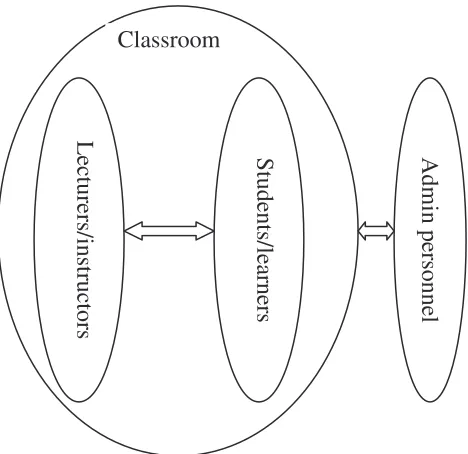
In Figure 1, lecturers/instructors go to the physical classrooms to delivery teaching contents to students and accept the students’ questions during the teaching time. Students/learners also go to the classroom to attend the lectures or tutorials and at the same time ask questions if they feel puzzled. The admin personnel usually give reasonable support to the classrooms both for students/learners and for lecturers/instructors, such as student enrolment, assessment items received and dispatch, etc.
In Figure 2, the lecturers/instructors access a server computer to upload teaching materials, including lecture slides, tutorial questions and answers etc, according to pre-set teaching schedule instead of going to a physical classroom by a fixed time period. It is very flexible for the lecturers/instructors to upload the teaching contents upon their convenience. The students/learners also access that server computer to get the teaching contents and involve online discussion board with their instructors and peers upon their own convenience. For the admin personnel, they need to act on administration roles of online matters via the online environment. In the e-learning environment, the technical experts give the technical support by building an effective platform and a user-friendly running
[image:2.595.51.285.280.507.2]environment. The technical experts should supply their support to the lecturers/instructors, students/learners, administration personnel. Thus it is very important for the technical experts to design a better e-learning platform and environment so that the whole e-learning process can be smoothly conducted and implemented. Some design rules/methods are introduced as follows. ASP model [2] classifies an e-learning environment as the following tasks: application development, hosting, network access, marketing, customer support, user support, hardware delivery, and software delivery. To link these tasks, the following roles are defined as: customer, user, solution partner, software partner, infrastructure partner, network service partner, support partner, marketing partner, hardware vendor, and software vendor. MDA model [3] discusses how to use existing middleware and component platforms, like CORBA, DCOM, Java RMI, CCM, EJB, .NET, etc. Learner-centred model [1, 4] emphases on that the e-learning environment design should more focus on the learners/students who are the main body of e-learning. Context-based model [5, 6, 7] focuses on how to deliver better contents to students/learners via e-learning design and how to facilitate the learning process, including learning needs analysis, curriculum design, curriculum delivery
Figure 1 relationship between participants of
traditional classrooms
L
ec
tu
re
rs/
in
str
uc
to
rs
Stu
de
nts
/le
arn
ers
Classroom
A
dm
in
p
ers
on
ne
l
[image:2.595.308.536.415.695.2]Figure 2 Relationship between
participants of e-learning environment
L
ec
tu
re
rs/
in
str
uc
to
rs
Stu
de
nts
/le
arn
ers
A
dm
in
p
ers
on
ne
l
Online
platform
and curriculum evaluation. This design places the lecturers/instructors as the main body, because only lecturers/instructors can have the knowledge and authority to upload the contents.
These models are effective in certain aspects, such as ASP and MDA models that focus on technical platform design, which usually neglects the users’ roles, context-based and learner-centred models more focus on either the students/learners or the lecturers/instructors. Actually an effective e-learning design has to consider all roles of students/learners, lecturers/learners, admin personnel and technical experts. Because the learning process is very dynamic, the design of e-learning environment has to be adjusted according to any changes from all participants during the procedure of e-learning. In order to challenge the dynamic e-learning, an effective e-learning design methodology has to be found to support this requirement. In the latter sections, a workflow-based e-learning design method is proposed to meet this dynamic requirement for e-learning.
3.
Workflow process
Workflow [8-16] has been used in big organisations to control their business processes and work re-engineering. According to Workflow Management Coalition (WfMC), workflow focuses on handing business processes. It is concerned with the automation of procedures where information and tasks are passed between participants according to a defined set of rules to achieve, or contribute to, an overall business goal. It is often associated with business process re-engineering, which is concerned with the assessment, modeling, definition and subsequent operational implementation of the core business process of an organization (or other business entity). In order to implement an effective workflow system, WfMC have published its reference model of the workflow system. In April, 2000, Object Management Group ( OMG ) also published its workflow management facility specification in order to use its CORBA and relevant technologies to implement workflow systems. For the e-learning environment, workflow mechanism can be used to plan and design the process of all aspects of e-learning. There is a teaching workflow for the lecturers/instructors. There is a learning workflow for the students/learners. There is an admin workflow for the admin personnel. There is an infrastructure workflow for technical experts/technicians to support a user-friendly environment for all participants. All these four sub-workflows interact to each other to form an overall e-learning workflow system to facilitate all the processes and actions of e-learning. The following section will show the details of four sub-workflow systems and an overall view of e-learning system.
4.
Design methods and modelling
sub-workflow systems
It is a very convenient way to describe an e-learning system based on its functions respectively. We define four main functions for e-learning systems based on four participants, lecturers /instructors, students/learners, admin personnel, and technical experts/technicians. In this case the e-learning system is sub-classified as teaching workflow system, learning workflow system, admin workflow system, and infrastructure workflow system.
4.1
Teaching workflow system (T)
In this e-learning environment, the main teaching activities include teaching plan (T1), material preparation (T2), material delivery (T3), assessment (T4), student involvement (T5), and student learning service and support (T6). The teaching workflow is demonstrated in Figure 3.
4.2
learning workflow system (L)
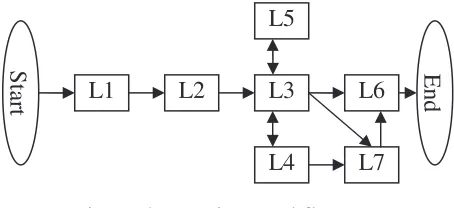
In the e-learning environment, the main learning activities are study plan (L1), acceptance of materials (L2), self-learning (L3), assignments (L4), discussion (L5), evaluation (L6), and examination (L7). The learning workflow is shown in Figure 4.
Sta
rt
L1
L2
L3
E
nd
L4
L5
[image:3.595.309.536.356.445.2]L6
Figure 4 Learning workflow
L7
Sta
rt
T1
T2
T3
E
nd
T4
T5
[image:3.595.308.535.600.704.2]T6
4.3
Admin workflow system (A)
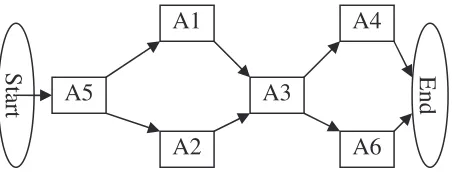
In the e-learning environment, the main learning actives are teaching support (A1), learning support (A2), assessment result publication and notification (A3), student record management (A4), enrolment and withdraw management (A5), and other administration functions (A6). The admin workflow is shown in Figure 5.
4.4
infrastructure workflow system (I)
In this e-learning environment, the main activities of technical experts include e-learning platform plan and design (I1), initial installation of e-learning system (I2), supporting tools for teaching, learning and administration (I3) , system maintenance and upgrade (I4), user training (I5), daily technical support to all users (I6). The infrastructure workflow is described in Figure 6.
5.
Overall e-learning workflow
In the previous sections, four separate sub-workflow systems are discussed in details. Now we need to know how these sub-workflow systems to work together so that an effective overall workflow for e-learning can be formed.
It is important to identify a proper order for four sub-workflow systems to form an overall sub-workflow of e-learning. In order to decide the sequence of four sub-workflow systems, we must have a method to decide which sub-system should be run firstly and which one is the follow-up. Suppose four sub-workflow systems (T, L, A, I) can work well separately. In order to organise them into an overall workflow, the inter-relationship has to be identified. All possible co-relationships are T&L, T&A, T&I, L&A, L&I, and A&I. These co-relationships will be addressed in details as the follows.
T & L relationship
In the e-learning environment, T and L relationship is very important. A proper relationship between T and L will present an ideal e-learning atmosphere. In order to easily present these co-relationships, the following definitions need to be given.
Definition 1: If and only if there is an activity, A, then an activity, B, will definitely occur. We denote this relationship as A B.
Definition 2: if and only if there is an activity, A, then an activity, B, will either occur or not. We denote this relationship as A†B.
Definition 3: if and only if there is an activity, A, then an activity, B, will never occur. We denote this relationship as A B.
Definition 4: if and only if there is an activity, A, then an activity, B, will definitely occur and also after B occurs, A will need an re-occurrence to react to B. We denote this relationship as A B.
Based these definitions, the main activities of T & L relationship can be represented as the follows.
T1 L1 T2 L1 T3 L2 T3 L3 T4 L4 T4 L7 T4 L5 T5 L5 T6 L5 T6 L4 T6 L7 L6 T1 T6†L3
From these relationships, we find that T6 and L5 are most frequent activities to have transactions for teaching and learning sub-workflow systems.
Sta
rt
I1
I2
I3
E
nd
I5
[image:4.595.51.277.210.301.2]I4
Figure 6 Infrastructure workflow
I6
Sta
rt
E
nd
A6
A5
A2
A3
A1
A4
[image:4.595.49.280.484.594.2]T & A relationship
The relationships between teaching sub-workflow system and administration sub-workflow system are as the follows.
T4 A1 T4†A4 T4 A3 A5 T4 T4†A4
From these relationships, we find that T4, assessment component in teaching sub-workflow system, has most frequent transactions with the administration sub-workflow system.
T & I relationship
The relationships between teaching sub-workflow system and infrastructure sub-workflow system are as the follows.
I3†T1 I3†T2 I3 T4 I3 T5 I3 T6 I4†T3 I4†T4 I4†T5 I4†T6 I6 T3 I6 T5 I6 T6
From these relationships, I3 in the infrastructure sub-workflow system has a significant impact on the teaching sub-workflow system.
L & A relationship
The relationships between learning sub-workflow system and administration sub-workflow system are as the follows.
L4 A2 L4 A3 L4 A4 L6 A6 L7 A2 L7 A3 L7 A4 A5 L1
From these relationships, L4 and L7 need more involvement of the administration sub-workflow system.
L & I relationship
The relationships between learning sub-workflow system and infrastructure sub-workflow system are as the follows.
I3 L2
I3 L4 I3 L5 I3 L5 I3 L6 I3†L7 I4†L2 I4†L3 I4†L5 I4†L6 I6 L2 I6 L3
From these relationships, I3 in the infrastructure sub-workflow system has a significant impact on the learning sub-workflow system.
A & I relationship
The relationships between administration sub-workflow system and infrastructure sub-workflow system are as the follows.
I3 A1 I3 A2 I3 A3 I3 A4 I3 A5 I3 A6 I4†A1 I4†A2 I4†A3 I4†A4 I4†A5 I4†A6 I6 A1 I6 A2 I6 A3 I6 A4 I6 A5 I6 A6
From these relationships, I3 and I6 in the infrastructure sub-workflow system have a significant impact on the administration sub-workflow system.
From previous analyse, T4, T6, L4, L5, L7, I3, and I6 are relatively more important than other activities for e-learning system. In other words, if a design can improve the performance of T4, T6, L4, L5, L7, I3, and I6, the whole e-learning system will have a better performance.
6.
Practical case show
university in the world, we can easily use our two e-learning platforms to test the results. The University of Southern Queensland is using its Blackboard system for Web-based on-line students and its WebCT system for traditional distance and on-campus students. When we are delivering our courses, we are quite concerned with building T4, T6, L4, L5 and L7, which the infrastructure sub-workflow support effective tools, I3 and I6, via the useful feedback of other three sub-workflow systems. The details about how to enhance these key activities need more space. Due to the limit of length, this paper cannot discuss in details.
7.
Feedback from students and
instructors
We have been conducting our courses through e-learning platform, traditional distance and on campus for many years. Before, we paid more attention to these key activities, students had less satisfactory to e-learning platform. The final grade for on-campus, traditional distance, and online students is very similar. The Group of e-learning students has a similar mean score for their course. After we have focused more on these key activities construction, we find that the students are actively involved in the course learning through the e-learning platform. The average score for e-e-learning students is much higher than those who are not involved in e-learning process.
8.
Conclusions
This paper illustrates how workflow-based e-learning system works for teaching, learning, administration and system development. In the e-learning environment, four basic sub-workflow systems work together to present dynamic e-learning activities. Through a detailed analysis of the co-relationship of four sub-workflow systems, some key activities, T4, T6, L4, L5, L7, I3, and I6, are identified for e-learning. Through the enhancement of these key activities in each sub-workflow system, the overall e-learning workflow gets a better performance. The evaluation of this improvement is significant by students’ feedback and average score for the course. It is obvious that workflow-based e-learning system can provide a better strategy and understanding for teaching, learning, administration and system development. We believe that e-learning will become one of most important means for the future education, especially for the universities.
[1] N. Iahad, G. A. Dafoulas, E. Kalaizakis, and L. A. Macaulay, Evaluation of online assessment: The role of feedback in learner-centered e-learning, The 37th Hawaii International Conference on System Science, IEEE, 2004.
[2] W. G. Bleek, I. Jackewitz, Providing an E-learning platform in a university context-balancing the organisational frame for application service providing, The 37th Hawaii International Conference on System Science, IEEE, 2004.
[3] H. Wang, D. Zhang, MDA-based development of E-learning system, The 27th Annual International Computer Software and Applications Conference, IEEE, 2003
[4] C. Allison, A. Bain, B. Ling, R. Nicoll, MMS: A user-centric portal for e-learning, The 14th International Workshop on Database and Expert Systems Applications, IEEE, 2003
[5] T. Nabeth, A. A. Angehrn, R. Balakrishnan, Integrating “Context” in e-learning system design, The IEEE International Conference on Advanced Learning Technologies, IEEE, 2004. [6] P. Mylonas, P. Tzouveli, S. Kollias, Towards a personalized scheme for teachers, The IEEE International Conference on Advanced Learning Technologies, IEEE, 2004.
[7] R. Anane, S. Crowther, J. Beadle, G. Theodoropoulos, e-Learning content provision, The 15th International Workshop on Database and Expert Systems Applications, IEEE, 2004
[8] C.Bussler, Enterprise-wide workflow management. IEEE Concurrency, 1999. 7(3): p. 32-43.
[9] P. Hartmann, R. Studt, and T. Wewers. A framework for classifying interorganizational workflow-controlled business processes focusing on quality management. in the 34th Hawaii International Conference on System Sciences. 2001. Maui, Hawaii, USA: IEEE, pages:7050(1-9)
[10] D. Hollingsworth, The workflow reference model. 1995, WfMC-TC-1003, Version 1.1.
[11] M.H. Kang, J.S. Park, and J.N. Froscher. Access control mechanisms for inter-organizational workflow. in the sixth ACM symposium on Access control models and technologies. 2001. Chantilly, Virginia, United States: ACM Press New York, NY, USA.
[12] M.S. Olivier, R.P.v.d. Riet, and E. Gudes. Specifying application-level security in workflow systems. in 9th International Workshop on Database and Expert Systems Applications (DEXA'98). 1998. Vienna, Austria: IEEE, pages:346-351.
[13] M. Weske, et al. A reference model for workflow application development process. in WACC'99. 1999. San Francisco, CA, USA: ACM, pages:1-10.
[14] P. Xu, and B. Ramesh. Supporting workflow management systems with traceability. in the 35th Hawaii International Conference on System Science. 2002. Big Island, Hawaii, USA: IEEE Computer society, pages:91c(1-10)
[15] Y. Yang, Enabling cost-effective light-weight disconnected workflow for Web-based teamwork support. Journal of Applied Systems Studies, 2002. 3(2): p. 435-453.