
Stereochemical effects on intervalence charge transfer
309
0
0
Full text
(2) ii. DECLARATION. I declare that this thesis is my own work and has not been submitted in any form for another degree or diploma at any university or other institution of tertiary education. Information derived from the published or unpublished work of others has been acknowledged in the text and a list of references is provided.. Deanna M. D’Alessandro September 2005.
(3) iii. STATEMENT OF ACCESS. I, the undersigned, author of this work, understand that James Cook University will make this thesis available for use within the University Library and via the Australian Digital Theses network, for use elsewhere. I understand that, as an unpublished work, a thesis has significant protection under the Copyright Act and all users consulting this thesis will be required to sign the following statement:. "In consulting this thesis I agree not to copy or closely paraphrase it in whole or in part without the written consent of the author, and to make proper public written acknowledgment for any assistance which I have obtained from it.". Beyond this, I do not wish to place any restriction on access to this thesis.. Deanna M. D’Alessandro September 2005.
(4) iv. STATEMENT OF CONTRIBUTION OF OTHERS. The work reported in this thesis was conducted under the supervision of Prof. Richard Keene, using the facilities in the Department of Chemistry at James Cook University. Collaborations with Prof. Joe Hupp (Centre for Nanofabrication and Materials Science, Northwestern University, U.S.A.), Prof. Peter Steel (University of Canterbury, N.Z.), and Dr Jeff Reimers (University of Sydney) have been instrumental in providing intellectual and experimental support for this work. Electroabsorption (Stark effect) measurements were conducted by the candidate under the skilful guidance of Dr Peter Dinolfo and Dr Keith Walters during a three-month research visit to Prof. Hupp’s laboratory. Prof. Steel supplied a number of novel bridging ligands which have been employed in this work. The preliminary Density Functional Theory calculations reported in Chapter 2 were conducted by the candidate under Dr Reimers’ expert guidance. The collection and analysis of X-ray crystal structure data were performed by Dr Murray Davies (JCU) and A/Prof. Peter Junk (JCU and Monash University) in the Advanced Analytical Centre at JCU. Preliminary infrared spectroelectrochemical measurements were performed by the candidate in the laboratory of Dr Stephen Best (University of Melbourne). Dr Graham Heath (Research School of Chemistry, The Australian National University) provided custom-made spectroelectrochemical equipment. A number of complexes and ligands employed in the work were kindly supplied by other collaborators, and their contributions have been fully acknowledged where appropriate in the text. This work was funded by an Australian Research Council (ARC-DP) grant to Prof. Keene. Travel to the laboratories of Dr Reimers and Dr Best was undertaken with the support of the ARC, and travel to Prof. Hupp’s laboratory was jointly funded by a JCU Doctoral Research Scheme grant (to the candidate) and grant No. DE-FG02-8713808 from the Basic Energy Sciences Program, Office of Science, U.S. Department of Energy to Prof. Hupp. Financial support for the candidate was obtained from an Australian Postgraduate Award, and funding during the compilation and writing of this thesis was obtained from a JCU Ph.D. Completion Scholarship.. Deanna M. D’Alessandro September 2005.
(5) v. ACKNOWLEDGMENTS. “While the difficult takes time, the impossible just takes a little longer.” Art E. Berg The finalisation of this thesis would not have been possible without contributions from a large number of people who have provided both scientific and personal support during my Ph.D. I am sincerely grateful to my supervisor Prof. Richard Keene for his patience, understanding and for the generosity of his time and knowledge. I am indebted to Richard for instilling in me his passion for chemistry, and for allowing me the freedom to pursue a field of research that has challenged me both intellectually and experimentally. The scientific, professional and personal experiences which I have gained will remain with me far beyond my time at JCU. I am also grateful to Richard for facilitating interactions with our talented collaborators which has broadened the dimensions of this work. To Richard’s family − Cheryl, Nicola, Martin and Andrew − thank you for your kindness and hospitality, and for the many memorable evenings of Keene cuisine that I have been fortunate to have enjoyed over the years. Special thanks must also go to Nicola for dealing with my bottomless pile of references! To all the members of the Keene group both past and present – Dr Brad Patterson for passing on his experimental expertise and Dr Joy Morgan, Jayden Smith, Dr Laurie Kelso, Dr Rob Gauci, Fiona Foley, Amy Topley, Caitriona Spillane and Dean Richards – thank you for providing a pleasant lab environment. My sincere thanks also go to the academic, technical and administrative staff in the JCU Chemistry Department for their advice and expertise. I am particularly grateful to Dr Murray Davies and A/Prof. Peter Junk for their patience with the collection of crystallographic data, Dr Ken Adam for his advice on computational aspects of the work, and Dr Bruce Bowden for his assistance with NMR spectroscopy. In addition, thank you to A/Prof. Michael Ridd, A/Prof. George Meehan, Dr Brian McCool and Prof. David Yellowlees – the encouragement, support and understanding you have all provided throughout my time at JCU is very much appreciated. I am also grateful for the interactions with many fellow students within the department (especially Ronelle, Dave, Ces, Dianne and Madhavi), which have contributed to a warm and constructive working environment. My appreciation also goes to the technical and secretarial staff for their assistance and kindness over the years – thank you Sonia Dalla Pozza, Dr Sherryl Robertson, Dr Steve Gheller, Maree Hines, Sharryn Gleeson, Max Shaw, Dave Soper, John Sweet, Dr Moira McCann and Debbie Saunders. I am grateful to our collaborators both within Australia and abroad who have provided intellectual insights and experimental skills which have enabled the depth of this project to evolve. I thank Prof. Peter Steel (University of Canterbury, N.Z.) and all the members of the Steel group (Dr Chris Sumby, Dr Jon Slater and Dr Chris Richardson) for designing and synthesising some of the novel.
(6) vi bridging ligands used in this work. My sincere thanks to Prof. Joe Hupp (Northwestern University, USA) for inspiring some of the preliminary experiments and for many helpful discussions on theoretical aspects during the early stages of the project. My appreciation also to the members of the Hupp group for their hospitality during my visit to Northwestern, and for introducing me to the essentials of American lifestyle (especially the Chicago-style pizza!). I am especially grateful to Dr Peter Dinolfo and Dr Keith Walters for their time and assistance with the collection and analysis of the electroabsorption data, and to Dr Jerry Sando for his advice on spectral simulation techniques. My appreciation goes to Dr Jeff Reimers and Prof. Noel Hush (University of Sydney) for many helpful and insightful discussions, and for their continued interest in this research. In particular, I thank Dr Reimers for his expert guidance on computational aspects, and for challenging me to think more deeply about theoretical issues which have been paramount to the methods employed for the spectral analyses. I am very grateful to both Dr Reimers and Prof. Hush for giving me the opportunity to present some aspects of this work at a recent symposium to honour the 80th Birthday of Prof. Hush and his seminal contributions to the field of electron transfer research. My thanks to the members of the Reimers group, and to Jeff’s family for their hospitality during my visits. I am thankful to Dr Stephen Best (University of Melbourne) for providing access to his FT-IR instrument for some last-minute experiments, and to Dr Graham Heath (Resarch School of Chemistry, Australian National University) for his assistance with the UV/Vis/NIR instrumentation. I also acknowledge and thank Prof. Tom Meyer for a helpful discussion on the interpretation of some aspects of this work during the final stages of the writing of this thesis. On a personal note, I am indebted to all my family and friends who have shared (and at times, endured!) this Ph.D. with me. I am eternally grateful to my parents for their never-ending love, motivation and understanding − thank you for always encouraging me to “have a go”, and for instilling in me persistence and perseverance, without which this work would not have come to fruition. Thanks also for helping me to see the lighter side of “dielectric salvation effects in pilyporidyl complexes” whilst I was emersed in Chapter 2! A special thank you also to Craig, who has helped me to put things into perspective on numerous occasions – thank you for your friendship, kindness and frequent computerrelated advice. I am deeply grateful to you all for your faith and conviction in my abilities, and your resolution in seeing the finalisation of this thesis..
(7) vii. ABSTRACT This thesis reports the first observation of stereochemical effects on intervalence charge transfer (IVCT) in di- and trinuclear mixed-valence complexes. The differential IVCT characteristics of the diastereoisomers of polypyridyl complexes of ruthenium and osmium offer a new and intimate probe of the fundamental factors that govern the extent of electronic delocalisation and the barrier to electron transfer. These findings challenge prior assertions that the inherent stereochemical identity of such complexes would have no influence on the intramolecular electron transfer properties of polymetallic assemblies. Chapter 1 addresses these issues within the context of the existing theoretical and experimental framework for IVCT. Solvatochromism studies on the meso and rac diastereoisomers of [{Ru(bpy)2}2(µ-bpm)]5+ {bpy = 2,2'-bipyridine; bpm = 2,2'-bipyrimidine} reported in Chapter 2, reveal striking differences between their IVCT characteristics due to stereochemically-directed specific solvent interactions. Such effects are inconsistent with dielectric continuum theories of solvation which are typically used to assess the contribution of the Franck-Condon outer-sphere reorganisational energy to the electron transfer barrier. Solvent proportion experiments demonstrate that the magnitude of the specific interaction is enhanced for the rac relative to the meso form, as the dimensionality of the “clefts” between the planes of the terminal polypyridyl ligands are ideally disposed to accommodate discrete solvent molecules. Subtle and systematic variations in the size and shape of the clefts through bridging ligand modification and the judicious positioning of alkyl substituents on the terminal ligands reveal that the magnitudes of the effects are dependent on the different cavity dimensions, and the number, size, orientation and location of solvent dipoles within the clefts. Chapter 3 discusses stereochemically-directed solvent and anion interactions in systems of the type [{M(bpy)2}2(µ-BL)]5+ {M = Ru, Os} where BL denotes an extensive series of N-heterocyclic di- and tri-bidentate polypyridyl bridging ligands. NIR region electroabsorption (Stark effect) measurements of the mixed-valence complexes reveal small dipole moment changes for the IVCT transitions. In all cases, the effective charge transfer distances are negligible compared with the geometrical metal-metal separations, in support of a moderately- to strongly-delocalised assignment for the systems. This contrasts previous assertions in the literature which favoured a localised (“Class II”) classification for complexes of the genre. IVCT solvatochromism and thermochromism studies on the mixed-valence species reveal that a subtle increase in the extent of inter-metal coupling with bridging ligand modification reduces the reorganisational barrier to electron transfer and leads to a transition between the localised (“Class II”) and localised-to-delocalised (“Class II-III”) regimes. The importance of the bridging ligand in mediating the IVCT process necessitates a three-state theoretical analysis for the IVCT line-shape which explicitly includes the symmetric vibration mode..
(8) viii The comproportionation constants (Kc) which are typically used to assess the degree of metalmetal coupling are markedly dependent on the electrolyte anion and the stereochemical identity of the complex. This emphasises the need for standard conditions for data from which analyses based on the magnitude of Kc are made, and the danger of over-interpretation of the values. The differential anion interactions between the diastereoisomers are also manifested in their IVCT characteristics and represent a redox asymmetry contribution to the electron transfer barrier. The magnitude of the differences between the IVCT characteristics of the diastereoisomeric forms of the same complex are more pronounced in the presence of inherent structural distortions in the bridging ligands, which are evident in their solid-state X-ray crystal structures. Such distortions decrease the extent of delocalisation through their redox asymmetry contribution to the electron transfer barrier. The interconfigurational (IC) transitions in the fully-oxidised forms of the dinuclear osmium complexes indicate that stereochemical effects modulate the energy levels of the metal-based dπ orbitals themselves, which are split by spin-orbit coupling and ligand field asymmetry. Chapter 4 extends the IVCT probe to stereochemically-pure trinuclear assemblies through a systematic investigation of the influence of the oxidation state, nuclearity and overall geometry of the systems on their intramolecular electron transfer processes. The IVCT properties of the dinuclear complexes [{Ru(bpy)2}(µ-HAT){M(bpy)2}]5+ {M = Ru, Os} and [{Ru(bpy)2}2(µ-ppz)]5+ are contrasted with their trinuclear analogues, which are “cluster-type” [{Ru(bpy)2}2{M(bpy2)}(µ-HAT)]n+ or “chainlike” [{Ru(bpy)2}2{Ru(bpy)(µ-ppz)2}]n+ {n = 7, 8; M = Ru, Os; BL = HAT (1,4,5,8,9,12hexaazatriphenylene) and ppz (4,7-phenanthrolino-5,6:5',6'-pyrazine)}. While the diastereoisomers of the dinuclear complexes possess similar electrochemical and IVCT characteristics, the trinuclear “clustertype” system bridged by HAT exhibits significantly greater electronic coupling than the “chain-like” assembly based on ppz. The IVCT transitions in the singly-oxidised (+7) and doubly-oxidised (+8) trinuclear mixed-valence species are markedly different to those in their dinuclear analogues due to appreciable second-order interactions which depend on the overall geometry and oxidation state of the assemblies. The observation of stereochemical effects on IVCT illustrates the subtle interplay of factors that govern the localised-to-delocalised transition, and addresses the limited experimental data which exist to probe the microscopic factors that facilitate this transition. The recognition of such effects on intramolecular electron transfer processes has significant implications for the elucidation of spatial influences on electron migration in biological systems such as metalloenzymes in nature. Ultimately, stereochemical modifications may be exploited in materials science applications to “fine-tune” the physical properties of novel molecular devices such as artificial photosynthetic systems for solar energy harvesting..
(9) ix. TABLE OF CONTENTS Declaration …………………………………………………………………………………………………ii Statement of Access ………………………………………………………………………………….…....iii Statement of Contribution of Others ………………………………………………………………………iv Acknowledgements ………………………………………………………………………………………...v Abstract …………………………………………………………………………………………….……..vii Table of Contents ……………………………………………………...…………………………………..ix. CHAPTER 1 INTRODUCTION. 1. 1.1 Background and Scope …………………………………..……...……………………………..…..... 2 1.2 IVCT in Dinuclear Mixed-Valence Complexes …...………………………………………………... 4 1.2.1 Two-State Classical and Semi-Classical Theories of IVCT ………………………....………. 4 1.2.2 The Reorganisational Energy ………………………………………………………….….….. 7 1.3 The Analysis of IVCT Transitions According to Two-State Classical and Semi-Classical Models… 8 1.3.1 The Extent of Electronic Coupling …………………………...……………………....……….8 1.3.2 Predictions for the IVCT Band-shape ……………………………………….….…....……... 10 1.3.3 Classifying Mixed-Valence Systems between the Class II and Class III Regimes …..…….. 12 1.4 Theoretical Models for the Localised-to-Delocalised Transition in IVCT ……..…………...……... 13 1.4.1 Three- and Four-State Classical Models …...………………...……………………...…...…. 13 1.4.2 Vibronic Coupling Models: the “PKS Model” ……………....……………………...…….... 15 1.4.3 Molecular Orbital Models: the “Ondrechen Model” ………………………………...…....... 16 1.4.4 Computational Approaches and Quantum Mechanical Methods …….……………...……... 18 1.4.5 Towards a “Unifying Theory” for IVCT ……………………………..……………...…....... 18 1.5 The Fundamental Factors Governing the Localised-to-Delocalised Transition …..…………...…... 19 1.5.1 Dynamic Considerations and the “Class II-III” Classification .……...……………...…….... 19 1.5.2 Experimental Studies of Mixed-Valence Systems in the Class II-III Regime ……………… 20 1.5.3 Probing the Factors which Govern the Localised-to-Delocalised Transition ………….…… 23 1.6 IVCT in Stereoisomeric Mixed-Valence Complexes ………..……...………….………….………. 31 1.6.1 Stereochemical Considerations ……………………………………………………...……... 31 1.6.2 Solutions to the “Stereochemical Problem” ………………………………………………… 33 1.6.3 Stereochemical Effects on Intramolecular Electron Transfer ………………………….….... 34 1.7 Scope and Objectives of the Present Study .……........................…………………….………......... 35 1.8 Overview of the Thesis ………..………………………..……...…………………………………... 37 1.9 Publications ……………………………………………..……...…………………………….......... 38 1.10 References ………………..……...…………………………………………………………………. 41.
(10) x. CHAPTER 2 DIASTEREOISOMERS AS PROBES FOR SOLVENT REORGANISATIONAL EFFECTS IN IVCT. 46. 2.1 Introduction …………………………...…………………..……...………………………………….. 47 2.1.1. Scope and Objectives of the Present Study …………………..…………………....……....... 51. 2.2 Experimental …………………………………..…....…………………………………………...…... 55 2.2.1. Materials …………………………………………...……………………………....……..….55. 2.2.2. Instrumentation and Physical Methods ……………………………………….………...…... 55. 2.2.3. Synthetic Procedures ……………………………………………………….…………...….. 59. 2.2.4. X-ray Crystallography …………………………………………..………….…………...…...64. 2.3 Results and Discussion ………………………………………………………………..……......……. 66 2.3.1. Diastereoisomer Synthesis, Separation and Structural Characterisation …………........…… 66. 2.3.2. Electrochemistry …………………………………………………………….…......…..…… 71. 2.3.3. Electronic Spectroscopy and Spectroelectrochemistry ……………….……….…......…....... 73. 2.3.4. IVCT Solvatochromism …………………………………………………….…......……....... 79. 2.4 Conclusions and Future Prospects …..……………………………………………………...…….…. 96 2.5 References …………………………………..……………………………………………...……..…. 98. CHAPTER 3 DIASTEREOISOMERS AS PROBES FOR THE LOCALISED-TO-DELOCALISED TRANSITION IN IVCT. 101. 3.1 Introduction …………………………...…………………..……...……………………………........ 102 3.1.1. The Localised-to-Delocalised Transition in IVCT .…………….…………………....……. 103. 3.1.2. Scope and Objectives of the Present Study ……………………..………………....……….105. 3.2 Experimental …………………………………..…....…………………………………………...…. 110 3.2.1. Materials ………………………………………...………………………………....……… 110. 3.2.2. Instrumentation and Physical Methods …………………………………………….….…... 111. 3.2.3. Synthetic Procedures ……………………………………………………….………….…... 114. 3.2.4. X-ray Crystallography ………………………………………..…………….………….….. 128. 3.3 Results and Discussion ………………………………………………………………...……...…….130 3.3.1. Diastereoisomer Synthesis, Separation and Structural Characterisation …………......…… 130. 3.3.2. Diastereoisomers of Ruthenium Complexes Incorporating a Series of Angular Bridging Ligands ……………………………………...…………………….…......……… 135. 3.3.3. Two Examples of Complete Delocalisation ………………………..……….…......……… 150. 3.3.4. Differential Redox Asymmetry Contributions in the Diastereoisomers of Unsymmetrical Mixed-Valence Complexes ……………………………………....……… 152. 3.3.5. Dinuclear Osmium Complexes as Probes for Spin-Orbit Coupling Contributions ……...... 158. 3.3.6. The Effective Electron Transfer Distance: Stark Absorption Spectroscopy ……................. 169.
(11) xi 3.3.7. Diastereoisomers as Probes for Redox Asymmetry Contributions: Ion-Pairing and IVCT Thermochromism ………………………………………...………. 174. 3.3.8. Diastereoisomers as Probes for Solvent Reorganisational Contributions ………………….180. 3.4 Conclusions and Future Prospects ………..………………………………………………...……….187 3.5 References ………………………………..………………………………………………...………. 192. CHAPTER 4 EXTENDING THE IVCT PROBE TO TRINUCLEAR POLYMETALLIC ASSEMBLIES. 196. 4.1 Introduction ………………………………..…....…………………………………………….......... 197 4.1.1. IVCT in Trinuclear Complexes ……………………………………………………....…….197. 4.1.2. Trinuclear Polymetallic Assemblies: Molecular Architectures and Applications …...……. 199. 4.1.3. Stereochemical Ambiguities in Higher Nuclearity Polymetallic Assemblies …....……...…200. 4.1.4. Scope and Objectives of the Present Study ……………………………………......……….201. 4.2 Experimental ………………………………..…....……………………………………………........ 204 4.2.1. Materials ……………………………………………………....……………………………204. 4.2.2. Instrumentation and Physical Methods …...……………………………………………….. 204. 4.2.3. Synthesis of Mono-, Di- and Trinuclear Complexes ……………………......…………….. 204. 4.3 Results and Discussion ………………………………………………………………...……........... 211 4.3.1. Homo-nuclear Ruthenium Complexes based on the Bridging Ligand HAT …...…………. 211. 4.3.2. Homo- and Hetero-nuclear Osmium Complexes based on HAT …....……...……………...222. 4.3.3. Mono-, Di- and Trinuclear Assemblies based on the Bridging Ligand ppz……....……….. 236. 4.4 Conclusions and Future Prospects …..……………………………………………………...……… 250 4.5 References ………………………………..………………………………………………...………. 254. EPILOGUE. 258. References ……………………………….…………..……...…………………………………… 262. APPENDICES. 263. Appendix A …………………………….…………..……...………………………………………264 Appendix B …………………………………………..……...…………………….…………........ 267 Appendix C ……………………………….…………..……...…………………………………… 295. CD ACCOMPANIMENT X-ray Crystallography Data and Publications.
(12) 1. CHAPTER 1.
(13) 2. Chapter 1 Chapter 1. INTRODUCTION 1.1. Background and Scope Electron transfer is ubiquitous in chemical, physical and biological systems. The phenomenon is. fundamental in natural processes such as photosynthesis and in materials science applications such as light-activated devices and non-linear optical materials. The importance of electron transfer underlies the extensive multidisciplinary research efforts which have led to the discovery of mixed-valence complexes, a class of transition metal-based compounds which contain ions of the same element in different formal oxidation states. The significance of the mixed-valence phenomenon was elucidated in the early twentieth century with the realisation that the valences are in rapid oscillation between the metal centres (rather than being uniquely fixed, one to each ion),1, 2 giving rise to the absorption of light in the visible region of the electromagnetic spectrum. The first synthetic mixed-valence compound, “Prussian Blue”, FeIIFeIII(CN)6.xH2O3, 4 has been prized industrially for centuries as an ink and dye-stuff. This infinite three-dimensional cubic array of alternate FeII and FeIII centres linked by bridging cyanide (CN-) groups* exhibits an intense blue colouration which cannot be attributed to a combination of the individual absorption spectra of the constituent ions.2 The mixed-valence nature of the species gives rise to an intervalence charge transfer† (IVCT) transition between the metal centres which corresponds to the absorption of light in the visible region of the spectrum. The mixed-valence phenomenon has also been invoked to explain the extraordinary colours displayed by many transition-metal containing gemstones including sapphire and aquamarine, which incorporate Mn and Mn+1 centres (e.g. M = FeII, TiIII).1, 2, 6, 7 The spectral, electrical and magnetic properties of naturally-occurring and synthetic mixed-valence compounds are related to the additive properties of their constituent metal ions, and to cooperative effects which originate from electronic coupling between the metal centres across a bridging ligand. This interplay of effects endows the systems with profoundly new properties which are not indicative of their constituent metal ions. The reaction centres in bacterial, algal and plant systems constitute elaborate examples of biological mixed-valence systems. In the natural photosynthetic process, the primary electron donor is the “special-pair”, P − a membrane-bound protein comprising two bacteriochlorophyll molecules. Photoexcitation of the reaction centre gives rise to a long-lived charge-separated state via a series of rapid electron transfer relay processes between the excited dimer P* and neighbouring pigments. The resultant special-pair radical cation P+ is a mixed-valence species.8 While several fundamental features have been elucidated regarding the kinetics, energetics and structural aspects of the electron transfer reactions in * †. The three-dimensional X-ray crystal structure contains cyanide C-bonded to FeII and N-bonded to FeIII.5 The alternate terminology metal-to-metal charge transfer (MMCT) is also commonly employed..
(14) 3. Chapter 1 photosynthetic reaction centres, several questions remain unclear.9 Of pivotal importance is the elucidation of the factors that govern the efficiency of the primary charge separation process. These include the relative orientations and distances between the chromophores, protein residues and solvent molecules, and the degree of charge delocalisation. In addition, the understanding of the inherent stereochemical complexities has, to date, been limited.10, 11 In photobiological systems, there is no ambiguity in the geometry of the natural assembly, as the building blocks are chiral amino acids or phosphate sugars which are organised in definitive orientations by an enzymic matrix. The elegance and efficiency of the charge separation function in photosynthetic organisms has provided the inspiration for the design and synthesis of many ingenious model systems.12, 13 These include covalently-linked porphyrin arrays,14-19 chromophore-quencher assemblies utilising transition. metal complexes13, 20, 21 and polymetallic ligand-bridged assemblies.22-24 Polypyridyl complexes of the d6 metals ruthenium(II) and osmium(II) have been extensively employed as the basis for such assemblies due to their unique combination of photochemical, photophysical and redox properties, including the stability of their ground and excited states and their chemical inertness in a variety of oxidation states.25 Dinuclear mixed-valence complexes of ruthenium and osmium provide ideal model systems for elucidating the fundamental factors that govern inter-molecular electron transfer reactions in natural and artificial systems. In the late 1960’s, Allen and Hush1 and Robin and Day2 published seminal reviews of mixed-valence materials. Hush26 subsequently provided a theoretical model linking the physical properties of dinuclear mixed-valence complexes (i.e. the parameters of their IVCT absorption bands) to the activation barriers for electron transfer from Marcus theory.26, 27 Of particular significance was the prediction of a relationship between the energy of the intervalence transition (νmax) and several factors which govern the activation barrier: νmax = hν = λi + λo + ∆E0 + ∆E'. (1.1). The Franck-Condon factors, λi and λo, correspond to the reorganisational energies within the inner- and outer-sphere (respectively), the redox asymmetry, ∆E0, is the thermodynamic energy difference between the two metal-based chromophores, and ∆E' reflects any additional energy contributions due to spin-orbit coupling and ligand field asymmetry. To date, these factors have been probed by varying the “global” features of dinuclear complexes such as the identity and coordination environments of their constituent metal centres, or through the introduction of redox asymmetry. The reorganisational energy contributions are typically assessed by varying the macroscopic features of the external environment such as the solvent, anions and temperature. The present study represents the first investigation of IVCT in stereochemically-pure di- and trinuclear polypyridyl complexes of ruthenium and osmium, and addresses the limited experimental data available to probe the influence of the inherent stereochemical complexities in polymetallic assemblies on their physical properties.10, 11 The subtle and systematic variations in the geometries of the stereoisomers provide a new experimental probe for the factors which govern the barriers to electron transfer at the.
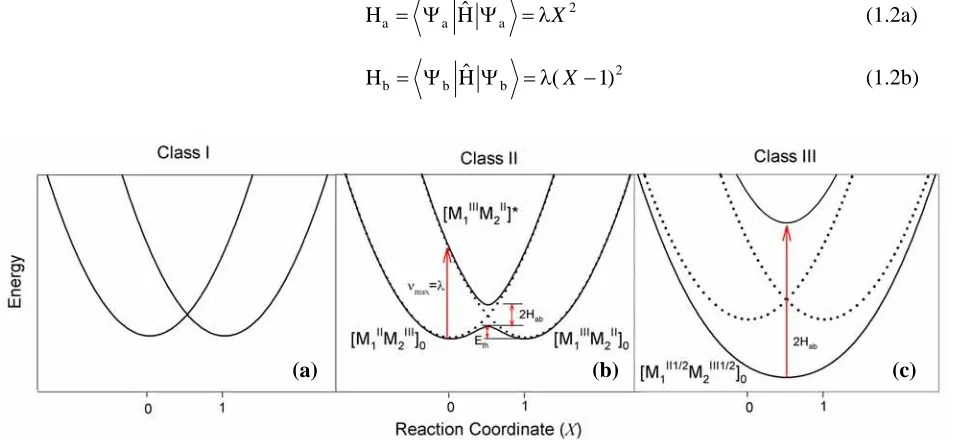
(15) 4. Chapter 1 molecular level. The extension of the IVCT probe to trinuclear systems provides the link between the understanding of dinuclear mixed-valence complexes, and higher nuclearity metallosupramolecular. systems. This has important implications for the elucidation of spatial influences on electron migration in natural processes such as photosynthesis, and for exploiting stereochemical effects in artificial materials capable of performing useful light- and redox-induced functions.. 1.2. IVCT in Dinuclear Mixed-Valence Complexes. 1.2.1. Two-State Classical and Semi-classical Theories of IVCT The IVCT transition in dinuclear mixed-valence species may be examined by considering a. complex of the type [{M1(L)n}(µ-BL){M2(L)n}]4+ {where M1 and M2 represent the metal centres; L and BL represent the terminal and bridging ligands respectively}, hereafter abbreviated [M1IIM2II], where both metal centres are in the +2 oxidation state. The oxidation of one metal centre gives rise to the mixedvalence species [M1IIM2III], where the overall +5 charge corresponds to [M1IIM2III] in a fully localised description and [M1II1/2 M2II1/2] in a fully delocalised description.26, 27 A symmetrical dinuclear complex is typically described by the parabolic potential energy surfaces depicted in Figure 1.1 where the dimensionless reaction coordinate (X) represents an anti-symmetric combination of the metal-ligand and solvent stretching vibrations.28 The dotted curves correspond to the wavefunctions Ψa and Ψb for the valence-localised “electronic isomers” [M1IIM2III]0 and [M1IIM2III]0, respectively, where the odd electron is completely localised on either metal centre. These “diabatic” states are centred at Xmin = 0 and 1 on the reaction coordinate and are assumed to be harmonic with identical force constants. Their energies are given by Ha and Hb in equations 1.2(a) and (b), where Ĥ is the effective two-state Hamiltonian operator and λ is the reorganisational energy.. (a). ˆ Ψ = λX 2 Ha = Ψ a H a. (1.2a). ˆ Ψ = λ( X − 1) 2 Hb = Ψ b H b. (1.2b). (b). (c). Figure 1.1 Potential energy curves for electron transfer in ligand-bridged dinuclear complexes with (a) negligible, (b) weak (Hab = λ/4) and (c) strong (Hab = 3λ/4) electronic coupling. The dotted and solid curves represent the diabatic and adiabatic states, respectively..
(16) 5. Chapter 1 At the intersection of the diabatic surfaces (X = 0.5), the mixing between the wavefunctions removes the degeneracy and gives rise to two new “adiabatic” surfaces, depicted by the solid curves in Figure 1.1. The energies of the lower and upper adiabatic states, E- and E+ (respectively), are given by equation 1.3,28, 29 and the splitting between the surfaces at X = 0.5 defines the electronic coupling parameter, Hab = ⟨Ψa|Ĥ|Ψb⟩.. E± =. [λ(2 X 2 − 2 X + 1)] {[λ (2 X − 1)]2 + 4H ab 2 }1/ 2 − 2 2. (1.3). The optically-induced vertical transition between the adiabatic states is the IVCT transition (equation 1.4), which corresponds to the formation of the vibrationally excited state of the ion, [M1IIIM2II]*. Since this process proceeds faster than nuclear motion (in accordance with the FranckCondon Principle), [M1IIIM2II]* contains [M1III]* in a coordination environment appropriate for [M1II]0, and [M2II]* in a coordination environment appropriate for [M2III]0. hν → [M IIIM II]* [M1IIM2III]0 ⎯⎯⎯ 1 2. (1.4). The degree of electronic coupling between M1 and M2, and the resultant splitting between the adiabatic surfaces dictates the “class” of a mixed-valence system. When M1 and M2 are far apart or when their interaction is symmetry or spin forbidden, the electronic coupling is negligible (Hab = 0) and IVCT transitions are not possible. This situation is illustrated in Figure 1.1(a) and corresponds to Class I in the Robin and Day classification scheme.2 Class II systems are characterised by weak to moderate electronic coupling between M1 and M2, and exhibit IVCT bands due to the vertical transition between the adiabatic states at Xmin {Figure 1.1(b)}. As Hab increases, the greater vertical splitting between the adiabatic surfaces is compensated for by the reactant and product minima moving closer together such that the energy of the transition (νmax) is equal to λ within the Class II regime (equation 1.5).28, 30, 31 While λ is a property of the diabatic states and corresponds to the transfer of unit charge, the adiabatic reorganisational energy, λ', corresponds to the “actual” charge transferred, as expressed in equation 1.6.28, 30, 31 λ' is reduced relative to λ by delocalisation, and vanishes when λ = 2Hab. νmax = λ = λ' + 4Hab2/λ λ'. = λ(1 – 4Hab2/λ2). (1.5) (1.6). In addition to the optically-activated IVCT process, electron transfer can occur by thermal activation and surface crossing on the ground state adiabatic surface in Figure 1.1(b). The energies of the thermal and optical processes are directly related,26, 27 and the energetic barrier for thermal electron transfer,28, 30, 31 Eth, is given by equation 1.7. Eth. = λ/4 – Hab + Hab2/λ. (1.7).
(17) 6. Chapter 1. IVCT measurements on dinuclear complexes provide a sensitive and powerful probe to elucidate aspects of intramolecular electron transfer processes. The parameters of the absorption band – specifically, their energy (νmax), intensity (εmax) and bandwidth at half-height (∆ν1/2) – may be quantitatively related to the factors which influence the barrier to intramolecular electron transfer according to the classical theory developed by Hush.26, 27 Within the Class II regime, the IVCT bands are typically weak (εmax ≤ 5000 M-1cm-1), solvent dependent, and exhibit large bandwidths (∆ν1/2 ≥ 2000 cm-1). In the two-state limit, the predicted bandwidth,26, 27 ∆ν1/2º, is given by equation 1.8, where R is the gas constant, T is the temperature (in K), and the term 16RTln2 takes a value of 2310 cm-1 at 298 K. ∆ν1/2º = [16RTln2(λ)]1/2. = [16RTln2(νmax − ∆E0 − ∆E')]1/2. (1.8). For Gaussian-shaped IVCT bands, Hab is given by equation 1.9,26, 27 where rab is the distance between the two diabatic states. A more rigorous quantum mechanical formulation is given by equation 1.10,32, 33 where |µ12| is the adiabatic transition dipole moment and e is the unit electronic charge. This form of the equation for Hab has the advantage that no implicit assumption is made regarding the shape of the IVCT band, as |µ12| may be calculated from the integrated intensity of the absorption band.33 H ab =. 2.06 × 10⁻² (ν max ε max ∆ν1/ 2 )1/ 2 rab. (1.9). H ab =. | µ12 | ν max erab. (1.10). According to the Robin and Day classification scheme,2 the abovementioned classes of mixedvalence systems are distinguished by the relative magnitudes of λ and 2Hab. For weakly-coupled Class II systems, 2Hab « λ. When M1 and M2 are strongly electronically coupled (2Hab » λ), the thermal barrier to intramolecular electron transfer vanishes and the ground state adiabatic surface exhibits a single minimum at Xmin = 0.5 {Figure 1.1(c)}. In these delocalised Class III systems, both metal centres posses a partial oxidation state of +2.5 and the IVCT transitions* occur within the molecular orbital manifolds of the systems. The transitions are typically intense (εmax ≥ 5000 M-1cm-1), solvent independent and exhibit narrow bandwidths (∆ν1/2 ≤ 2000 cm-1). The energies of the IVCT bands provide a direct measure of Hab according to equation 1.11.26, 27 νmax = 2Hab. *. (1.11). The terms “IVCT transition” and “mixed-valence” are retained although the transitions do not involve net charge transfer and the systems are more accurately defined as “average valence”. 34.
(18) 7. Chapter 1. 1.2.2. The Reorganisational Energy The reorganisational energy, λ, is partitioned into two independent contributions corresponding to. the inner- (λi) and outer-sphere (λo) reorganisational energies (equation 1.12).26, 27 λi represents the energy required for reorganisation of the metal-ligand and intra-ligand bond lengths and angles, and λo is the energy required for reorganisation of the surrounding solvent medium. Classical expressions for λi are formulated in terms of the equilibrium bond length changes and force constants of the reactants and products according to equation 1.13,26, 27 where dn and fn denote the metal-ligand bond lengths and the force constants, respectively, for the metal centres in oxidation states (+n) of +2 or +3. λ = λi + λo λi =. (1.12). n(2 f2 f3 )(d2 − d3 ) f2 + f3. (1.13). The classical model is appropriate for low frequency modes which are coupled to the electron transfer, such as vibrations in polar solvents. However, the model is inadequate for systems which exhibit nuclear tunnelling through the activation barrier due to high frequency internal modes*35-37 which require explicit treatment through a quantum mechanical approach. λi may be determined from equation 1.14, where νi and ∆ i are the vibrational frequency and the dimensionless normal coordinate displacement, respectively, for each vibrational mode coupled to the electronic transition. These mode-specific contributions may be evaluated experimentally by resonance Raman spectroscopy.38, 39. λi =. 1 2. ∑∆ ν 2 i. i. (1.14). i. The λo contribution is generally treated as a one-dimensional classical mode due to the low frequencies of coupled solvent vibrations.26, 27, 40, 41 According to the spherical cavity dielectric continuum model given in equation 1.15, the solvent is modelled as a structureless dielectric continuum and has no specific interactions with itself or with the redox sites.42 The two metal centres of a symmetrical dinuclear complex are assumed to be centrally located in two non-interpenetrating spheres (d » 2a) embedded in the dielectric. The parameters a and d define the molecular radii and distance between the donor and acceptor, and Ds and Dop are the static and optical dielectric constants of the solvent, respectively. 1 ⎞ ⎛ 1 1 ⎞⎛ 1 λo = e2 ⎜ − ⎟ ⎜ − ⎟ ⎝ a d ⎠ ⎜⎝ Dop Ds ⎟⎠. (1.15). In accordance with equations 1.1, 1.5 and 1.15, νmax should vary linearly with the solvent dielectric function (1/Dop-1/Ds), with slope e2(1/a-1/d) and intercept λi + ∆E'. The validity of the *. For low frequency modes, ħω « kBT, where kBT ~200 cm-1 at room temperature and ħω ~ 1-10cm-1 for polar solvents. For highfrequency modes, ħω » kBT. ħ, ω and kB denote Planck’s constant, the vibrational frequency and Boltzmann’s constant, respectively..
(19) Chapter 1. 8. dielectric continuum model is typically assessed experimentally through IVCT solvatochromism measurements.2, 26, 27, 34, 37, 43-45 The sensitivity of IVCT bands to solvent variation is often employed as a criterion for the class of a mixed-valence species: a solvent dependence signals valence localisation (Class II), while a solvent independence signals delocalisation (Class III).34, 43, 46. 1.3. The Analysis of IVCT Transitions According to Two-State Classical and Semi-classical Models. 1.3.1. The Extent of Electronic Coupling. 1.3.1.1 Spectral Methods. The classification of mixed-valence complexes as localised (Class II) or delocalised (Class III) is dependent on the extent of delocalisation which is governed by the competition between λ and Hab: λ exceeds 2Hab in valence localised systems, whereas λ is less than 2Hab in the delocalised case. The determination of the class of a mixed-valence system based on this criterion is often complicated by the inability to accurately determine Hab from equations 1.9 and 1.10. While rab is typically equated with the through-space geometrical distance between the metal centres, the effective charge transfer distance is decreased relative to the geometric distance as electronic coupling across the bridge increases and these equations provide a lower limit only for Hab.37 Electroabsorption (Stark effect) measurements on the IVCT bands of dinuclear mixed-valence complexes have revealed that the actual (adiabatic) chargetransfer distances are often significantly less than the geometric metal-metal distances.47-51 This issue is addressed further in §1.5.3.2. In addition to electronic delocalisation effects, band-shape analyses are frequently complicated by the presence of multiple overlapping IVCT and interconfigurational (IC) transitions. These arise from the effects of low symmetry and spin-orbit coupling in transition metal complexes of Ru and Os.37, 52-54 Importantly, only the lowest energy IVCT transition corresponds to the thermal electron transfer pathway and can be used to assess the extent of delocalisation in the ground state.37 Since the multiple IVCT transitions are generally unresolved, the Hab values obtained by assuming a single IVCT band provides an upper limit only to the ground state Hab value. This issue is the subject of §1.5.3.5. While the Hush model26, 27 is the preferred method of analysis for IVCT bands, alternate spectral methods for extracting the electronic coupling parameter have been sought which do not rely primarily on the characteristics of the bands. The “CNS” approach28, 32 introduced by Creutz, Newton and Sutin is based upon a superexchange formalism (§1.5.3.1), in which the metal-metal coupling is facilitated by mixing with a metal-to-bridging ligand charge transfer (MLCT) and/or bridging ligand-to-metal charge transfer (LMCT) state. For a dinuclear system M1-BL-M2, the electronic coupling parameter (denoted by H M M instead of Hab) may be calculated from equation 1.16(a). 1. 2.
(20) 9. Chapter 1. HM M = 1. 2. H M L H M L H LM H LM + ∆ELM 2∆EML 1. 2. 1. (1.16a). 2. 1 1⎛ 1 1 ⎞ = ⎜ − ⎟ ∆EML 2 ⎝ ∆EMLCT ∆EMLCT − ∆EIVCT ⎠. (1.16b). Here, H M L is the M1-BL coupling for the M1II site (determined from the characteristics of the MLCT 1. band by an expression analogous to equation 1.9), H M L is the corresponding quantity for an M2II site at 2. the M2III geometry, and ∆EM L is the effective M1-BL energy gap. The latter is determined from equation 1. 1.16(b), where ∆EMLCT and ∆EIVCT are the energies of the MLCT and IVCT transitions, respectively. The quantities denoted by the subscripts LM1 and LM2 are the corresponding values for the LMCT transition. Typically, the superexchange coupling of the metal centres is dominated by either an electron or hole transfer superexchange mechanism, and equation 1.16(a) is reduced to the first or second term only. The equations are further simplified by assuming that the quantities denoted by the subscripts M1L and LM1 are equivalent to those denoted by M2L and LM2, respectively, which is reasonable given the small differences in geometry between the two redox sites.55 Indeed, for weakly-coupled systems such as [{RuII(NH3)5}(µ-4,4'-bpy){RuIII(NH3)5}]5+, the value of the electronic coupling parameter obtained from equation 1.9 (Hab = 900 cm-1) is in satisfactory agreement with the value calculated from equations 1.16(a) and (b) {i.e. H M M = 800 cm-1, where H M L = H M L = 4.4 × 103 cm-1 and ∆EM L = 12.7 × 10³ 1. 2. 1. 2. 1. cm-1}.28, 32 For a number of Class II systems, the magnitudes of the electronic coupling parameters calculated from the Hush and CNS methods, were in close agreement.56-58 The validity of the CNS method has been questioned due to the need for empirical parameterisation and assumptions regarding the charge transfer distance, a single orbital interaction directed along the M1-BL-M2 axis, and the treatment of a single MLCT or LMCT excited state only.32, 56, 57 1.3.1.2 Electrochemical Methods and the Comproportionation Equilibrium. The comproportionation constant, Kc, and the free energy of comproportionation, ∆Gcº, can be deduced from electrochemical measurements, and provide alternate measures for determining the degree of electronic delocalisation.43, 59-61 In the absence of electronic coupling, the two metal centres in a symmetrical dinuclear complex undergo oxidation at approximately the same potential; however, any electronic interaction between the centres leads to the existence of discrete oxidation waves.43-45 In the potential domain between these two processes the complex is in the mixed-valence state, [M1IIM2III] (designated [2,3] to indicate the respective formal oxidation states of the two metal centres). The Kc values for the comproportionation equilibrium express the stability of the [2,3] species relative to the fully-reduced, [2,2], and fully-oxidised, [3,3], forms: [2,2] + [3,3]. 2[2,3]. where, K c =. [2,3]2 [2, 2][3,3]. (1.17).
(21) 10. Chapter 1. Kc can be measured spectrally59, 60 or electrochemically from the separation between the two redox potentials for the successive oxidation processes (∆Eox) according to equation 1.18(a), where F/RT takes the value 38.92 V-1 at 298 K (F is the Faraday constant).*43, 61 Large values of Kc and ∆Eox are essential requirements for the isolation of a complex in its mixed-valence state. Kc. = exp(∆EoxF/RT). ∆Gc° = -RTlnKc = -∆EoxF. (1.18a) (1.18b). Four factors contribute to the magnitude of ∆Gc° {equation 1.18(b)}: a statistical contribution (½RTln¼); an electrostatic factor (∆Ge°) arising from the repulsion of the two similarly charged metal centres linked by the bridging ligand; a synergistic factor (∆Gs°) due to metal-ligand backbonding interactions; and a resonance stabilisation factor (∆Gr°) due to electronic delocalisation.43, 59-62 For localised mixed-valence systems, the first three contributions can be readily estimated.43-45, 61 ∆Gr° is the only component that represents the “actual” metal-metal coupling, and is related to Hab by equation 1.19†: -∆Gr° = 2Hab2/λ = 2Hab2/νmax. (1.19). The comparison of ∆Eox and Kc values determined from electrochemical data have been widely used for the assessment of the extent of coupling in mixed-valence complexes.43-45, 63 However, the comparison between the electronic coupling parameters derived from the semi-classical Hush model,26, 27 the CNS model,28, 32 and the electrochemical treatment, are frequently in poor agreement.57, 58 Previous reports have emphasised the need for caution in the interpretation of electrochemical data, due to the significant dependence of redox potentials on the identity of the solvent and anions in the electrolyte medium.56 Spectral measurements of the IVCT transitions provide a more accurate and systematic probe of the degree of electronic coupling.26, 27. 1.3.2. Predictions for the IVCT Band-shape The transition between the localised and delocalised regimes is driven by an increase in Hab. The. predicted effect of increasing delocalisation on the IVCT band-shape for a symmetrical dinuclear mixedvalence complex is illustrated in Figure 1.2.31 The band is calculated by assuming a Boltzmann distribution over the energies on the ground state adiabatic surface.26, 27 For 2Hab « λ, this produces a Gaussian-shaped contour that is symmetrical about νmax, with a bandwidth of ∆ν1/2° {Figures 1.2(a) and (b)}. As Hab increases, the Gaussian shape is retained, but is truncated on the low energy side below 2Hab, i.e. the minimum difference between the ground and excited states at X = 0.5, as shown in Figure 1.2(c).57, 64. *. Due to comproportionation of the mixed-valence species, the proportion of the complex in the mixed-valence form (at equilibrium) is Kc1/2/(2+Kc1/2). This must be accounted for in measurements of the intensities of the IVCT bands.56 † Equation 1.19 relates to localised systems. In the delocalised case, -∆Gr° = 2(Hab - λ/4) = νmax - λ/2.28.
(22) Chapter 1. 11. Figure 1.2 Potential energy surfaces and band-shape predictions from the two-state classical model.31 Plots of the energy vs. reaction coordinate (top panel) and the relative reduced absorption spectra ε/ν vs. ν* (lower panel) for a symmetrical mixed-valence system with increasing 2Hab/λ (λ = 8000 cm-1). The values of 2Hab/λ (Hab, in cm-1) are (a) 0.02 (80), (b) 0.2 (800), (c) 0.75 (3000), and (d) 1.25 (5000).. The “band cut-off effect” is manifested by IVCT bands which are Gaussian on the high energy side and skewed on the low energy side. The physically-unrealistic nature of the sharp spectral cut-off is attributed to the neglect of quantum effects and solvent broadening of the individual vibronic components which “round-off” the abrupt cut-off. As indicated in Figure 1.2, the effect does not become significant until Hab exceeds λ/4, and ∆ν1/2 is equivalent to ∆ν1/2º for 2Hab < λ - [4RTln2]1/2.31 Beyond this regime, ∆ν1/2 decreases relative to ∆ν1/2º with increasing Hab and the IVCT bands increase in intensity until 2Hab = λ at the transition between Classes II and III. At this point, the band retains intensity in the higher energy. half only. The Hab values determined from equation 1.9 are increasingly underestimated as the system approaches the Class II-III borderline, and this underestimation reaches 50% when 2Hab = λ.57 For 2Hab > νmax, only the high energy side remains and the asymmetrically-shaped band shifts to higher energy, increases in intensity, and narrows due to the greater curvature at the E+ minimum {Figure 1.2(d)}.31, 57 An IVCT band which exhibits a cut-off effect should become increasingly symmetrical as the temperature is decreased.37 The explicit consideration of this effect is required for the accurate analysis of the IVCT bands of moderately- to strongly-coupled systems. Brunschwig, Creutz and Sutin have proposed relationships between the IVCT energies and bandwidths which enable the calculation of “corrected” values for Hab through the introduction of an “error function”.31 The treatment of symmetrical mixed-valence systems31 has subsequently been extended to unsymmetrical systems66 in which the Gaussian-shaped band is centred at λ + ∆E0 and exhibits a cut-off at 2Hab. *. Wavelength-dependent charge transfer intensities scale with the inverse of the absolute absorption energy (ν-1),26, 65 and the energy maximum of the “reduced” absorption spectrum (i.e. ε/ν vs ν) is identified with the vertical separation between the lower and upper surfaces and is the quantity most appropriately employed in the analysis of IVCT bands..
(23) 12. Chapter 1. 1.3.3. Classifying Mixed-Valence Systems between the Class II and Class III Regimes The cut-off effect has been observed in the spectra of both organic and transition metal-centred. mixed-valence species, and has been utilised as a diagnostic marker for systems which lie close to the transition between the localised (Class II) and delocalised (Class III) regimes.31, 34, 37, 43, 57, 64 While the majority of reports have considered the relative magnitudes of 2Hab and λ as the criterion for defining the position of a mixed-valence system between the two regimes, Nelsen57 and Brunschwig, Creutz and Sutin31 have recently proposed alternate criteria. Nelsen57 considered the disappearance of the electron transfer barrier as an indication of the transition from Class II to the Class II-III borderline. By factoring the semi-classical expression for Eth in equation 1.7, the parameter F was defined as the fraction of the electron transfer barrier remaining after the inclusion of electronic coupling (equation 1.20). The magnitude of F varies between 1 (in the limit of complete localisation) and 0 (at the Class II-III borderline). Eth = F(νmax/4). where, F = (1 – 2H/νmax)2. (1.20). The magnitudes of F determined on the basis of electronic coupling values from the Hush model26, 27 (with H = Hab) and CNS model28, 32 (with H = H M M ) were compared57 for the series of 1,41. 2. dicyanamidobenzene complexes58, 67-71 including [{Ru(NH3)5}2(µ-BL)]3+, trans,trans[{Ru(NH3)4(py)}2(µ-BL)]3+ and mer,mer-[Ru(NH3)3(bpy)}2(µ-BL)]3+ {where BL represents the dianions dicyd2- (1,4-dicyanamidobenzene), Me2dicyd2- (1,4-dicyanamido-2,5-dimethylbenzene) and Cl4dicyd2(2,3,5,6-tetrachloro-1,4-dicyanamidobenzene)}. F decreased with progressively stronger electronic coupling as BL was varied through the series Cl4dicyd2-, dicyd2- and Me2dicyd2-. While the values of FHush and FCNS were comparable in the absence of significant IVCT band cut-off effects, the CNS method. provided more reasonable estimates of the degree of coupling near the Class II to III borderline.57 The Hab values determined from the Hush model (equation 1.9) were increasingly underestimated as the borderline was approached, due to cut-off effects and discrepancies between the effective charge transfer distance and the geometrical metal-metal distance. While the magnitude of F provides a suitable means to assess the relative degree of electronic coupling within a series of closely-related complexes in the localised regime,57 the criterion is inappropriate for strongly-coupled systems which exhibit highly asymmetric IVCT bands. The latter typically require at least a three-state analysis. As an alternative classification scheme, Brunschwig, Creutz and Sutin31 introduced a criterion based upon the experimental and predicted IVCT bandwidths,26, 27 according to equation 1.21. The magnitude of the Γ parameter distinguishes the class of a mixed-valence system: 0 < Γ < 0.1 for weaklycoupled Class II systems, 0.1 < Γ < 0.5 for moderately-coupled Class II systems, Γ ≈ 0.5 at the transition between Classes II and III, and Γ > 0.5 for Class III systems. Γ = 1 – (∆ν1/2)/(∆ν1/2°). (1.21).
(24) 13. Chapter 1. The classification of a number of mixed-valence systems based on the magnitudes of Γ were shown to be in favourable agreement with the results from prior experimental studies.31 For [{Ru(NH3)5}2(µ-4,4'-bpy)]5+ {4,4'-bpy = 4,4'-bipyridine}, for example, the Γ value of -0.1 was consistent with a Class II assignment, as established previously from the broad, Gaussian-shaped and solvent dependent IVCT band.60 A delocalised assignment was favoured for the Creutz-Taube ion, [{Ru(NH3)5}2(µ-pyz)]5+ {pyz = pyrazine}, on the basis of the Γ value of 0.63 for the narrow (∆ν1/2 = 1480 cm-1) asymmetrically-shaped IVCT band at 6320 cm-1 (in DCl/D2O).72, 73 This classification was consistent with the findings from an extensive series of physical techniques of varying timescales34, 37, 43, 74 including IR,75, 76 single crystal EPR,77 Stark effect78, 79 and Raman spectroscopy.80 While the Γ bandwidth criterion provides a reasonable qualitative measure for the classification of mixed-valence systems between the localised and delocalised limits, band-shape analyses are frequently complicated by a number of factors. These include multiple overlapping IVCT and IC transitions,37, 52-54 differences in the extent of electronic delocalisation between the ground and mixedvalence excited states, contributions from vibronic progressions, and multiple nuclear and solvent vibrations which are coupled to the electron transfer.37. 1.4. Theoretical Models for the Localised-to-Delocalised Transition in IVCT. 1.4.1 Three- and Four-State Classical Models Classical models26, 27 are the preferred method of analysis for IVCT transitions due to the facility of their application and their overlap with the Marcus theory of electron transfer.40, 41 However, the classical two-state approximation is based upon the Born-Oppenheimer approximation and is strictly valid in the strongly localised and delocalised limits.26, 27 In real systems, the inclusion of additional electronic states is often necessary to account for the role of the bridging ligand in mediating the superexchange coupling between the metal-based sites. The three-state model proposed by Brunschwig, Creutz and Sutin31 provides an extension to the two-state classical model by explicitly including a third electronic state formed by charge transfer to or from the bridging ligand. The influence of this additional state depends upon its energy (Hc in equation 1.22) relative to the other two diabatic states {Ha and Hb in equations 1.2(a) and (b)}. ∆Eac represents the energy difference between the minima of the potential energy surfaces for states ‘a’ or ‘b’ and the bridge state ‘c’. Hc = λ(X – 0.5)2 + ∆Eac. (1.22). The salient features of the three-state model are considered here for a symmetrical mixed-valence system, where the mediating state lies above the intersection of the reactant and product diabatic states at X = 0.5.31 The adiabatic surfaces are obtained solving a 3 × 3 Hamiltonian analytically or numerically.. The electron transfer process involves superexchange coupling of the three states, where states ‘a’ and ‘b’ couple to state ‘c’ through the electronic coupling parameter Hac (= Hbc), and the direct Hab coupling is.
(25) Chapter 1. 14. zero. The diabatic and adiabatic potential energy surfaces, and the corresponding absorption spectra for a series of Hac coupling strengths are illustrated in Figure 1.3, * where λ and ∆Εac are 8000 and 16000 cm-1, respectively.. Figure 1.3 Potential energy surfaces and band-shape predictions from the three-state classical model.31, 66 Plots of the energy vs. reaction coordinate for the three-state one-mode model (top panel) and overlay of the reduced absorption spectra ε/ν vs. ν† (lower panel) for a symmetric mixed-valence system with increasing values of Hac (λ = 8000 cm-1, ∆Eac = 16000 cm-1) for the one- (---) and two-mode (―) cases. The values of Hac in cm-1 are (a) 800, (b) 2400, (c) 7000, and (d) 9000. The class II-III transition occurs at Hac = 8000 cm-1.. The major difference between the two- and three-state models is the allowance in the latter for a second absorption (generally MLCT) at higher energy than the IVCT. As Hac (= Hbc) increases in the Class II regime {Figures 1.3(a) and (b)}, the intensity of the IVCT transition increases. The MLCT intensity initially increases before reaching a maximum and decreasing to the Class II-III borderline, at which point the band vanishes {Figure 1.3(c)}. νmax is initially equal to λ in the Class II limit, but decreases as the Class II-III borderline is approached. This contrasts the two-state model where νmax = λ throughout the Class II regime until the Class II-III borderline is reached. For the three-state case, νmax increases as does Hac in the Class III regime {Figure 1.3(d)}. The inclusion of a fourth electronic state is required to qualitatively reproduce the experimental observation of MLCT transitions for Class III complexes.31 * The numerical codes used for the construction of the potential energy surfaces and resulting spectra based on the three- and four-state models of Brunschwig, Creutz and Sutin31 were kindly provided by Dr Gerald Sando.66 The routines were implemented within Mathcad 2001 Professional using internal algorithms for matrix diagonalisation. † Wavelength-dependent charge transfer intensities scale with the inverse of the absolute absorption energy (ν-1),26, 65 and the energy maximum of the “reduced” absorption spectrum (i.e. ε/ν vs ν) is identified with the vertical upper-/lower-surface energy separation and is the quantity most appropriately employed in the analysis of IVCT bands..
(26) 15. Chapter 1. Within a three-state two-mode approach,31 the addition of a second vibrational mode representing a symmetrical combination of stretches results in a smooth spectral cut-off. Figure 1.3 depicts the potential energy surfaces and corresponding absorption spectra. The energies of the diabatic states are expressed in equation 1.23 where X1 and X2 represent the anti-symmetric and symmetric reaction coordinates, respectively. In the Class II regime, the addition of the symmetric vibration mode has a modest effect only on νmax and ∆ν1/2 {Figures 1.3(a) and (b)}. In Class III, the IVCT band is broadened and the spectral cut-off is smoothed out relative to the one-mode two- and three-state models {Figure 1.3(d)}. Ha = λX12 + λX22 Hb = λ(X1 – 1)2 + λX22 Hc = λ(X1 – 0.5)2 + λ(X2 – 0.5)2 + Eac. (1.23). The central role of the symmetric vibration mode for moderately- to strongly-coupled mixedvalence systems was first discussed by Hush,74 and arises from the symmetrical nature of the electronic redistribution that occurs on charge excitation. The IVCT transition originates from a state in which the electron is predominantly localised on a metal site, to one on the bridge. The latter is displaced from the metal-localised state along the totally symmetric vibration coordinate, and the vertical IVCT excitation occurs from the ground state surface to a region on the upper surface that is higher up, and steeper. The addition of the symmetric mode results in a broadening in the IVCT and MLCT bands with increasing delocalisation.. 1.4.2. Vibronic Coupling Models: the “PKS Model” Quantum mechanical treatments account for the integral role of vibronic coupling which becomes. increasingly important as the degree of electronic coupling increases due to the dynamic interaction between the vibrational and electronic motions (i.e. the breakdown in the Born-Oppenheimer approximation). The “PKS model” proposed by Piepho, Krausz and Schatz.81 was originally formulated as a two-state, one-dimensional model along an anti-symmetric vibrational coordinate, q.82, 83 The vibronic energy levels are determined using wavefunctions which allow for the dependence on both the nuclear and electronic coordinates, and the IVCT manifold is calculated as a superposition of the transitions between these levels. The model was the first to investigate the full IVCT absorption profile by iteratively fitting the band to three parameters: the electronic and vibronic coupling parameters (ε and. λ, respectively) and the wavenumber of the totally symmetric metal-ligand stretching vibration (ν ). The energies of the surfaces, E1,2(PKS), and the expressions for the PKS parameters are given by equations 1.24(a) and (b), where c is the speed of light, f is the metal-ligand force constant and µ is the reduced metal-ligand mass.43 The localised limit occurs when ε ≈ 0 and E2-E1 ≈ 2λq, and the delocalised limit when λ ≈ 0 and E2-E1 ≈ 2ε..
Figure
![Table 3.3 Electrochemical data (in mV relative to the Fc+/Fc0 couple) and comproportionation constantsa (Kc) for [{Ru(bpy)2}2(µ-BL)]4+ in 0.1 M [(n-C4H9)4N]PF6/CH3CN.b](https://thumb-us.123doks.com/thumbv2/123dok_us/215230.56462/150.595.120.491.102.333/table-electrochemical-data-relative-couple-comproportionation-constantsa-cn.webp)
![Figure 3.8 UV/Vis/NIR[( spectra of the reduced absorption spectra {(ε/ν) vs. ν} of (a) meso-[{Ru(bpy)2}2(µ-dpb)]n+, (b) meso-[{Ru(bpy)2}2(µ-dpb')]n+ and (c) meso-[{Ru(bpy)2}2(µ-dpq')]n+ {n = 4 (―), 5 (―), 6 (―)} in 0.1 M n-C4H9)4N]PF6/CH3CN at -35](https://thumb-us.123doks.com/thumbv2/123dok_us/215230.56462/154.595.142.460.304.713/figure-vis-nir-spectra-reduced-absorption-spectra-meso.webp)
![Figure 3.12 (a) Spectral progression for the oxidation reaction [([{Ru(bpy)meso-[{Ru(bpy)2}2(µ-dpo)]4+ → meso-2}2(µ-dpo)]5+ in 0.1 M [(n-C4H9)4N]PF6/CH3CN at -35ºC](https://thumb-us.123doks.com/thumbv2/123dok_us/215230.56462/161.595.92.527.348.553/figure-spectral-progression-oxidation-reaction-bpy-meso-meso.webp)
+7
![Figure 3.13 (a) Overlay of the IVCT bands for mesothe meso- (solid lines) and rac-[{Ru(bpy)2}(µ-BL){Ru(pp)2}]5+ (dashed lines) {BL = dpb, dpb'} in 0.1 M [(n-C4H9)4N]PF6/CH3CN at -35°C](https://thumb-us.123doks.com/thumbv2/123dok_us/215230.56462/164.595.78.535.239.493/figure-overlay-ivct-bands-mesothe-solid-lines-dashed.webp)

![Figure 3.16 state (show the best fits of the bands obtained by Gaussian deconvolution of the spectra.{BL = dpb, dpb', dpq(a) Differential mid-IR spectra (CH3CN) for meso-[{Os(bpy)2}2(µ-BL)]5+ {BL = dpb, dpb'} obtained by chemical oxidation with NOPF6, an](https://thumb-us.123doks.com/thumbv2/123dok_us/215230.56462/173.595.110.516.66.647/figure-obtained-gaussian-deconvolution-differential-obtained-chemical-oxidation.webp)
![Table 3.14 Summary of the mid-IR and NIR spectral data for meso- and rac-[{Os(bpy)2}2(µ-BL)]5+ in [(n-C4H9)4N]PF6/CH3CN at -35°C.a,b The mid-IR spectral data is indicated in bold type](https://thumb-us.123doks.com/thumbv2/123dok_us/215230.56462/174.595.166.447.102.427/table-summary-spectral-spectral-data-indicated-bold-type.webp)
![Table 3.15 Summary of the energies of the IC transitions obtained by Gaussian deconvolution for [{Os(bpy)2}2(µ-BL)]6+ complexes.a,b](https://thumb-us.123doks.com/thumbv2/123dok_us/215230.56462/177.595.204.403.463.609/table-summary-energies-transitions-obtained-gaussian-deconvolution-complexes.webp)
Related documents
This model posits four types of health beliefs that affect an individual’s health behavior, in this case, the decision to seek mental health services: perceived
Political Parties approved by CNE to stand in at least some constituencies PLD – Partido de Liberdade e Desenvolvimento – Party of Freedom and Development ECOLOGISTA – MT –
• Taxpayers subject to the provisions of Title II of the Income Tax Law (ITL) which have declared taxable income of $644,599,005 or more in the immediately preceding tax
It is the (education that will empower biology graduates for the application of biology knowledge and skills acquired in solving the problem of unemployment for oneself and others
Comments This can be a real eye-opener to learn what team members believe are requirements to succeed on your team. Teams often incorporate things into their “perfect team
Specifically, we tested whether emotional responses would be less positive, and more negative, toward wearers of any Muslim veil compared with those wearing no veil (Hypothesis 1);
The government co ll ect s revenue f rom taxes on capital and labour income and value-added taxes on fina l demand , production taxes on intermediate inputs, and...
3This result is explained by the fact that under Bertrand competition foreign investment in R&D has a negative (indirect) strategic effect on foreign firms'
