Representing the one left over: a social semiotic perspective of
students’ use of screen casting
Carol Murphy1 and Nigel Calder2 1
University of Waikato, Tauranga, New Zealand; [email protected]
2
University of Waikato, Tauranga, New Zealand; [email protected]
This paper examines the potential of using screen casting with an iPad to enhance learning in mathematics. Data are presented from two seven-year-old students as they use the Explain Everything app to solve a division with remainder problem (DWR). A social semiotic perspective was used to interpret students’ use of multiple modes as they represented the mathematical ideas within the context of the problem. We consider how a social semiotic perspective has the potential to draw attention to the students’ interests and emerging expressions in representing mathematical relationships. We further consider how the use of representations in the app might relate to student learning.
Keywords: Mobile technologies, multimodality, primary mathematics, representations, social semiotics.
Introduction
Several decades ago Kaput (1987) predicted that the opportunities afforded by new digital technologies would mean “students of the near future … will be choosing how to represent given relationships” (p.21), and that students’ choice in building and interpreting their own representations would be seen as important as the calculations themselves. With the recent introduction of mobile devices into mathematics classrooms, student choice in creating, selecting, and using representations has continued to widen and such new media has been seen to have the potential to “augment and enhance” student learning (Clark & Luckin, 2013, p. 2). In this paper we present data from part of a larger project that examined teacher and student use of iPad apps in primary mathematics classrooms in New Zealand. In particular, we focus on Explain Everything, a screen casting app, with two students (aged seven years old) as they represented their solutions to a problem involving division with remainder (DWR).
Screen casting involves the use of a digital white board screen which the user can write or draw on. The user can also add images and text. The digital board can then be recorded to capture the images, static or dynamic, along with a vocalisation of the user’s thoughts. As such, in mathematics, students can create and present their solutions in real time and in a multi-modal format using text and images along with voice recording. Such apps are generally used as a tool for students to show their explanations in solving problems (Soto, 2015) as they have the appeal of exposing the students’ thinking.
modes, including writing, drawings, downloaded images, mathematical symbols, spoken and written language, so there is the potential for choosing, creating and interpreting different representations for a given relationship (as predicted by Kaput). Furthermore, the use of the screen interface on iPads means that the students can manipulate representations by touch and hand actions (Sinclair & de Freitas, 2014). If the students are choosing to build and create their own representations along with hand actions, can such use go beyond the reporting of solution strategies? We also query whether screen casting, as an example of new media, has the potential to augment and enhance learning.
Theoretical framework: Social semiotics and multimodality
In order to understand the potential for learning with this new media we require a way of understanding how representations are selected and used by students in creating their screen casts. Whilst previous representational theories in mathematics education have been based on an epistemological view of learning as a constructive activity (e.g. Janvier, 1987), further theorising on representations in mathematics has focused on semiotics as intrinsic to mathematical thinking (Duval, 2008; Ernest, 2006). Ernest proposed that a study of mathematics teaching and learning from a semiotic perspective follows sociocultural Vygotskian theories in studying the appropriation of cultural signs and the underlying meaning structures that embody the relationships between signs.
In mathematics, signs are related to mathematical relationships and can only be understood as part of a complex system; there is a “pull towards abstraction” (Ernest, 2006, p.71). If mathematical signs become isolated as purely structural systems they lose meaning. A fundamental view of semiotics refers to representations, as sign production in a broader sense, standing for something else in order to make meaning. Ernest referred to such sign production as “primarily an agentic act” that “often has a creative aspect” (p.69). The students’ use of representations in a screen cast may indicate this agentic, creative act, where the sign relates to a form which “strongly suggests the meaning [we] want to communicate.” (Kress, 2010, p. 64). Rather than using a sign that pulls to abstraction, the student may choose a representation that indicates what he or she sees as critical in regard to their ‘bit of the world’ and the mathematical relationship in the context of a problem. As such, we can determine the interest and agency of the sign-maker, and what they attended to, in order to make meaning.
Furthermore, direct interaction with the screen of an iPad allows students not just to choose representations but to manipulate them through hand actions. The screen cast app also enables students to record verbal explanations. As such, the use of the app allows for students to be agentic in creating signs across a multiplicity of modes. In this paper we consider how a multimodal social semiotic theoretical perspective (Jewitt, 2013) can inform the interpretation of students’ choices and dynamic use of symbols, and images along with their use of language. Social semiotics has been used as a theoretical tool to explain phenomena by revealing things which might not be evident otherwise (Jewitt & Oyama, 2001). In this paper, the intention is to examine the students’ choices of representations, how they manipulate them, and to consider what they see as critical between their world and the mathematical relationship in the context of the problem.
In following a social semiotic theoretical perspective, the intention was to interpret the students’ syntactic positioning of images as a source for representational meaning as well as temporal components (Jewitt & Omaya, 2001). That is, how the students placed images on the screen. For example, how the centrality of their placements and connections of objects showed some elements as held together, in contrast to more marginal or disconnected elements. In addition, the intention was to interpret the students’ narrative and hand actions as syntactical temporal components. For example how the students’ verbal explanations related to how they moved images or drew on the screen.
The study
Two seven-year-old students’ use of the Explain Everything app are presented in this paper. These data come from a larger research project investigating how iPads apps were used in primary mathematics classrooms. The project involved researcher observation and the collection of video data over one year with three teachers experienced in using iPads in their mathematics classrooms. Further data was collected through student and teacher interview to investigate their views of using the apps. The research team met with the three teachers throughout the year for collaborative analysis and critical reflection of classroom practice and student learning. The use of screen casting apps such as Explain Everything featured several times in the teachers’ classrooms and in comments made by students and teachers as they were seen as beneficial for reporting solution strategies.
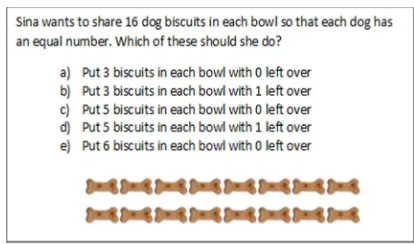
Figure 1: The division with remainder problem
Students worked individually on the problem with the intention to create a screen cast of their solution process for the teacher for her assessment. As they worked in the classroom, six students were selected at random by the researchers to explain more fully their solution strategies in relation to the representations on the screen cast they were developing. As Ambrose and Soto (2016) suggested, the completed screen casts of students may not “capture all the intricacies of students’ explanations” (p.282). As the research team was interested in gaining as much insight as possible, the researchers asked the students to elaborate on their thinking in representing their solutions in the screen cast. These elaborated explanations were videoed to show the iPad screen and students’ hand actions, and to capture the students’ explanations and responses to the researchers’ questions. In this short paper data from two of the students are presented. These two students are presented here because they showed contrasting approaches in relation to their mathematical solution using partitive and quotitive models (Roche & Clarke, 2009).
Student 1: Fred
Fred downloaded images of dog bowls and biscuits from the internet and positioned five dog biscuits onto each bowl, see Figure 2.
Figure 2: Fred’s screen with his solution (a sketch is also provided as the iPad screen is not clear)
[image:4.595.108.504.510.625.2]Researcher: Did you try any other questions using the bowls? Did you try (a) with the bowls?
Fred: No, I basically knew it was (d) from the start because there were three bowls and you have sixteen biscuits and you have to have one left over. Fred chose to use realistic images. The dog biscuits were piled onto the dog bowls in a realistic fashion. Fred had also given different names to the dogs. Fred wrote the numeral five above each dog bowl as if in a ‘bubble,’ and placed the left over biscuit in the top right hand corner of the screen. As Fred said, the dog bowls were “full and fair” and the remaining biscuit was for “nobody.” When talking to the researcher Fred used dynamic recordings and hand actions in circling the five numerals and the one biscuit left over in the top right hand corner.
Student 2: Jan
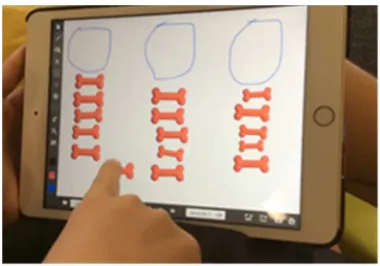
Jan had drawn three circles at the top of the screen. She downloaded images of dog biscuits from the internet and grouped them at the bottom of the screen. Then Jan moved each biscuit one by one to line up underneath each circle (see Figure 3).
Jan: I’m doing five and then I’ve got one left over. (Jan moved the left over biscuit around the screen with her finger.)
Researcher: Why do you think that is?
[image:5.595.215.405.461.594.2]Jan: Ummm, I don’t know. (Jan scanned back to the screen with the original problem and the options). Because (a) and (b) are not going to be right, but I haven’t tried six (referred to the last option). So if I put six…
Figure 3: Jan’s screen with her solution
Jan placed six biscuits under two bowls but then moved one biscuit from the middle line to the line of four to make five in two of the lines. She then counted the third line as six and moved the sixth biscuit away. Jan then moved the left over biscuit around the screen (Figure 3).
Researcher: What could you do with the spare one? What would you do if they were your dogs?
Jan: (Jan used her finger to draw two lines on the left over biscuit) I’d have three halves. One for that one, one for that one, and one for that one (Jan indicated with her finger to the three lines of biscuits).
Jan used realistic images of the dog biscuits but drew circles for the bowls, and placed the dog biscuits in a vertical line underneath each bowl. Jan did not use any numerals, but she referred to the numbers in her oral explanation. Jan seemed in a quandary about the one left over, to the extent that she tried six biscuits, only to find she needed to redistribute them. Jan also moved the left over biscuit around the screen. She then marked the biscuit into three “halves” in order to share the remainder, pointing to each line as she did so. Whilst she used the term ‘halves’ incorrectly she was attempting to further divide the left over biscuit between the three dogs.
Discussion
In relation to the students’ use of models of division, Fred used repeated addition to explain his solution; “five and five and five is fifteen with one more it’s sixteen.” Fred’s solution demonstrated a quotitive model, in that he focused on the quotient as the size of the subset from one of the solutions in the options (i.e. five in each bowl). Jan, on the other hand, used a partitive strategy to share out the dog biscuits. Jan focused on the divisor as the number of objects in each subset, how many in the three dog bowls, and so she shared out each of the dog biscuits by counting. Jan then moved to the use of rational numbers by including fractions in further dividing the left over biscuit, although maybe she was influenced by the reviewers’ question. It is noted that neither of the students wrote their solution using mathematical symbols formally, such as 16 ÷ 3 = 5 remainder 1, and this may have been due to the way the problem was set where the options were stated verbally.
In relation to the use of representations, Fred used realistic images and features, along with the mathematical symbols. Fred’s ‘bubbles’ over the dog bowls with the number five suggested a close connection between the number symbol and the quantity of dog biscuits in each bowl. Furthermore, he centralized the dog bowls, piled the dog biscuits onto the bowls and then positioned the left over dog biscuit in the corner of the screen, stating it was for nobody. Interpreting the positioning of the representations from a spatial syntax perspective, it could be said that Fred marginalized the left over dog biscuit both in positioning it on the screen and in verbally stating it was for no one and so indicating his own perspective of the remainder in the context of this problem. Interpreting the temporal syntax, Fred’s hand actions in circling each of the five numerals and the left over biscuit, along with his explanation, suggested an emphasis on key features, and mirrored a formal recording of the solution.
the bowls. Interpreting the temporal syntax, Jan’s movement of the biscuit around the screen suggested a dynamic visual ‘doodle’ as she thought about the remainder. Her uncertainty in where to position the dog biscuit was reflected in her comment “Ummm I don’t know.” Unlike Fred she did not seem satisfied that the left over biscuit should be for no one. In the end, Jan solved this problem in a realistic context that made sense to her, and used hand actions in drawing lines to show how the biscuit could be cut into three pieces.
In interpreting the students’ use of representations in creating the screen cast, the intention was to see further into the students’ placing of different semiotic modes (symbols, images and drawings) alongside temporal narrative and dynamic movements. As the students chose to use mathematical symbols and ‘made up’ the signs, they were being critical in relating the mathematics with their ‘bit of the world’, in order to make meaning. Fred already knew the solution and selected realistic representations to show this solution, tying the key mathematical signs, the chosen images and the quotient closely together. The remainder was redundant and hence placed marginally representing his understanding of the relationships in regard to his bit of the world. Jan chose a less real life representation of the problem but appeared to explore the solution with these representations. Her exploration then led her to the use of fractions in relation to sharing as her bit of the world.
Concluding remarks
The interpretation of the students’ use of representations in relation to spatial and temporal syntax may provide further insight into what students attended to in order to make meaning of the mathematical relationships. In this regard, this paper has, arguably, presented an illustration of Kaput’s prediction that students will choose to build and interpret their own representations, and that their choice of representations will be seen as important as the calculation. However, how these choices relate to or augment learning is less clear.
It has been possible to consider how Jan was ‘settling’ an understanding of the mathematical ideas in solving a problem, maybe by virtual ‘doodling’ with the remainder. Her use of the representations was agentic and indicative of how she related to the problem, but they also appeared to change her understanding of the mathematical relationships in the problem. For Fred the representations were used to explain thinking that was already formed. He knew the solution. It is not clear that the use of these representations, whilst agentic and indicative of his bit of the world within the context of the problem, changed his understanding of the mathematical relationships. Although, they may have helped him explain or report his thinking.
The intention of this paper was to consider whether screen casting, as a way of agentic sign making across multiple modes, has the potential for students’ representations to make meaning and hence augment learning. Only two examples are presented here, and whilst a social semiotic approach may shed light on what the students attended to, the use of the screen casting app as new media to augment learning needs further investigation.
References
Clark, W., & Luckin, R. (2013). iPads in the classroom: What the research says. London, UK: London Knowledge Lab, Institute of Education.
Duval, R. (2008). Eight problems for a semiotic approach in mathematics. In L. Radford, G. Schubring, & F. Seeger (Eds.), Semiotics in mathematics education: Epistemology, history, classroom, and culture (pp. 39-62). Rotterdam, The Netherlands: Sense Publishers.
Ernest, P. (2006). A semiotic perspective of mathematical activity: The case of number.
Educational Studies in Mathematics, 61, 67-101
Janvier, C. (1987). Translation process in mathematics education. In C. Janvier (Ed.),
Problems of representation in the teaching and learning of mathematics (pp. 27-32). Hillsday, N.J: Lawrence Erlbaum Associates.
Jewitt, C. (2013). Multimodal methods for researching digital technologies. In S. Price, C. Jewitt, & B. Brown (Eds.), The SAGE handbook of digital technology research (pp. 250-265). London, UK.: SAGE Publications.
Jewitt, C., & Oyama, R. (2001). Visual meaning: a social semiotic approach. In T. van Leeuwen & C. Jewitt (Eds.), Handbook of visual analysis. London, UK.: Sage Publications Ltd.
Kaput, J. (1987). Representation systems and mathematics. In C. Janvier (Ed.), Problems of representation in the teaching and learning of mathematics (pp. 19-26). Hillsday, N.J.: Lawrence Erlbaum Associates.
Kress, G. (2010). Multimodality: A social semiotic approach to contemporary communication. Abingdon, UK: Routledge.
Roche, A. & Clarke, D. (2009). Making sense of partitive and quotitive division: A snapshot of teachers’ pedagogical knowledge. In R. Hunter, B. Bicknell, & T. Burgess (Eds.),
Crossing divides: Proceedings of the 32nd annual conference of the Mathematics Education Research Group of Australasia (Vol. 2). Palmerston North, NZ: MERGA. Sinclair, N., & de Freitas, E. (2014). The haptic nature of gesture: Rethinking gesture with
new mutitouch digital technologies. Gesture, 14(3), 351-374.
Soto, M. (2015). Elementary Students' Mathematical Explanations and Attention to Audience With Screencasts. Journal of Research on Technology in Education, 47(4), 242-258. Soto, M. & Ambrose, R. (2016). Screencasts: Formative assessment for mathematical