I
Effect of the 5-HTTLPR Genotype on Memory Performance in Older Adults
Abbie-Rose Imlach (B. Psych)
A report submitted as a partial requirement for the degree of Bachelor of Psychology with honours at the University of Tasmania, 2015.
I declare that this report is my own original work and that contributions of others have been duly acknowledged.
II
Acknowledgements
Firstly I would like to thank my supervisors Kim Felmingham and James Vickers for allowing me to undertake and complete this project. Your guidance and
encouragement has been invaluable throughout this year.
To my psych peers, who I have made everlasting friends with, you have made the year so much more bearable and dare I say it, enjoyable! To Isabel and Caitlin, I would not have got through the long days at Uni and stressful times without you both. You have been the best study buddies anyone could ask for.
I would also like to thank the Wiking lab group, who were always willing to help me out when ever I had questions. Barbora, my psych friend at Menzies, I thank you for helping me go “Above and Beyond”. Also I would like to thank Graeme McCormack for giving up his time to help me in the lab and being patient with me while I learnt such foreign methods.
III
Table of Contents
Abstract ... 1
Introduction ... 2
Serotonin and the Brain ... 2
Serotonin and Memory ... 3
Acute Tryptophan Depletion and Memory ... 4
The Impact of Ageing on Serotonin and Memory ... 6
Sex Differences in Serotonin Levels ... 6
The Serotonin Transporter (5-HTT)... 7
5-HTTLPR Effect on Hippocampal Architecture ... 8
Empirical Evidence: 5-HTTLPR and Memory ... 9
Episodic Memory ... 10
Working Memory ... 11
Selective Effect of the 5-HTTLPR Genotype ... 12
Serotonin Effects in a Stressed System ... 14
Effect of the 5-HTTLPR Genotype in Females ... 15
Effect of 5-HTTLPR in Older Age ... 15
Aims and Hypothesis ... 16
Method ... 17
Participants ... 17
Materials ... 18
Demographic Measures ... 18
IV
Visual Working Memory ... 19
Verbal Episodic Memory ... 19
Visual Episodic Memory... 20
Procedure... 20
Neuropsychological Testing ... 20
Genotyping ... 21
Gel Electrophoresis ... 23
Design and Data Analysis ... 24
Results ... 26
Assumptions ... 26
Demographic Results and Allele Frequency Distribution ... 27
Moderation Analyses ... 30
Episodic Memory Performance... ……...30
RAVLT Test Performance ... …….30
RCFT Test Performance ... …….33
Working Memory Performance ... ….34
LNS Test Performance ... ….34
SWM Test Performance ... ….35
Discussion ... 36
The Moderating Effect of 5-HTTLPR and Sex on the Relationship Between Age and Memory ... 37
The Specificity of The Moderating Effect on Verbal Episodic Memory... 39
Females With The Short Allele Should Have Greater Memory Impairments With Ageing ... 40
V
Individual Differences in Neural Compensation... 42
The Effect of Oestrogen ... 43
Limitations ... 44
Implications ... 46
Conclusion ... 47
References ... 49
VI List of Tables
Pages Table 1. Summary of Findings: Effect of 5-HTTLPR Genotype on
Memory Performance... 13
Table 2. The Tasmanian Healthy Brain Project Test Battery ... 22
Table 3. Number of Outliers Deleted for Each Outcome Measure and the Remaining Sample Size ... 27
Table 4. Difference Between 5-HTTLPR Genotypes on Possible Covariates ... 29
Table 5. 5-HTTLPR Genotype Frequency Distribution ... 29
Table 6. Prediction of RAVLT Immediate Recall Score from Age, Sex and 5-HTT Genotype ... 31
Table 7. Prediction of RAVLT Delayed Recall Score from Age, Sex and 5-HTT Genotype ... 32
Table 8. Prediction of RCFT Recall Score from Age, Sex and 5-HTT Genotype ... 34
Table 9. Prediction of LNS Test Score from Age, Sex and 5-HTT Genotype ... 35
Table 10. Prediction of SWM Score from Age, Sex and 5-HTT Genotype ... 36
Table A1. Summary of ATD Effects on Memory Performance ... 61
VII List of Figures
Figure 1. Projections of serotonergic neurons in the central nervous system ... 3 Figure 2. Depiction of 5-HTT action at the synapse, regulating amount
of 5-HT in the synaptic cleft ... 7 Figure 3. Depiction of the short and long alleles of the serotonin transporter gene that result from a polymorphism in the promoter region of SLC6A4 ... 8 Figure 4. Gel electrophoresis of 26 participant samples and a NTC, the
marker is the first ladder on the left used to indicate bp length of DNA
fragments ... 24 Figure 5. Simple moderation as a conceptual diagram ... 25 Figure 6. Predicted moderation of sex and 5-HTTLPR genotype on the
relationship between age and memory performance ... 25 Figure 7. RAVLT total immediate recall scores across age for female
VIII
Effect of the 5-HTTLPR Genotype on Memory Performance in Older Adults
Abbie-Rose Imlach
Abstract
The s allele, of the 5-HTTLPR genotype has been associated with a negative effect on memory function, however very few studies have examined the impact of this gene polymorphism in older age. This is important given the functional impact of memory decline in ageing, and given that serotonin declines with age. The present study examined the effect of the 5-HTTLPR genotype (s/s and s/l versus l/l
Serotonin (5-Hydroxytryptamine; 5-HT) is a key neurotransmitter in the CNS and it’s impact on neurocognition is well established (Seyedabadi, Fakhfouri,
Ramezani, Mehr, & Rahimian, 2014). There is evidence for a relationship between 5-HT and memory performance, however very few studies have examined the role of serotonin on memory decline in ageing. This is important to investigate, as ageing is associated with a reduction in levels of circulating serotonin as well as a decline in memory functions (Rodriguez, Noristani, & Verkhratsky, 2012). Memory
impairments in ageing can lead to significant functional deficits and are a major contributor to lowered quality of life for ageing individuals (Millan-Calenti et al., 2012). While memory impairments have been associated with dysfunctions of the serotonin system (Mendelsohn, Riedel, & Sambeth, 2009), the relationship between markers of 5-HT function such as the serotonin transporter (5-HTT), have had limited investigation in conjunction with ageing. Functional polymorphisms of the 5-HTT gene are associated with differential transcription efficiency of 5-5-HTT (Lesch et al., 1996). Therefore these polymorphisms provide a promising marker for
examining the impact of serotonin regulation on rates of memory decline across age. To further explore the impact of serotonin on memory in the ageing brain, the aim of the current study was to examine the effect of functional polymorphisms of the 5-HTT gene on episodic and working memory performance in older adults.
Serotonin and the brain
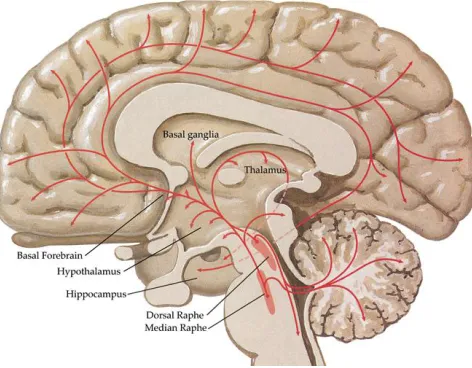
cortical and subcortical brain regions, innervating many brain areas including those involved in memory, such as the pre-frontal cortex and hippocampus (Mattson, Maudsley, & Martin, 2004; Struder & Weicker, 2001: Refer to Figure 1).
Synthesis of 5-HT depends on the availability of its amino acid precursor, L-tryptophan which is derive from diet and converted to 5-HT after crossing the blood brain barrier (Vergne & Nemeroff, 2006). The activity of serotonin in the brain is determined by the serotonin transporter and several different 5-HT receptors (5-HT1
-5-HT7) (Hannon & Hoyer, 2008).
[image:11.595.186.422.316.500.2]
Figure 1. Projections of serotonergic neurons in the central nervous system from the raphe nucleus to multiple cortical regions including the hippocampus and pre-frontal cortex, involved in memory performance.
Serotonin and Memory
information and it’s retrieval (Lezak, Howieson, Bigler, Tranel, 2012). Memory can be broadly classified as either short-term (working memory) or long-term memory. WM employs different neural processes to LTM and allows information to be briefly stored and manipulated via temporary potentiation of neural circuits (Sreenivasan, Curtis, & D'Esposito, 2014).
Long-term memory, on the other hand, can be divided into declarative and procedural types (Barros, Tufik, & Andersen, 2015). Episodic memory is a division of declarative memory and involves the conscious recollection of facts and events, involving three phases (encoding, consolidation, retrieval: Pacheco et al., 2009). Episodic memory is associated with activation of the hippocampus and is dependent on hippocampal connections with parahippocampal regions and the neocortex (Bearden et al., 2012; Tulving & Markowitsch, 1998)
While it is established that 5-HT is associated with neurocognition, of all monoamines, serotonin’s role in memory is thought to be the least understood (Pacheco et al., 2012). Increasing evidence for the direct participation of 5-HT in memory comes from experimental manipulations of tryptophan availability (Meneses & Liy-Salmeron, 2012).
Acute Tyrptophan Depletion and Memory
Increasing the availability of L-tryptophan, which is associated with
Porter et al., 2005, Merens et al., 2008). The key findings from ATD studies reveal an impairing effect on verbal episodic memory but not verbal WM or visual WM (For a summary table of relevant ATD studies, see Appendix A)
While there is support for the negative effects of reduced serotonin on episodic memory, some studies have also revealed no effect (Hayward, Goodwin, Cowen, & Harmer, 2005; Hughes et al., 2003). This could be due to the use of small sample sizes leading to underpowering of studies, or may be due to the bulk of studies examining healthy younger adults. As older adults have reduced levels of serotonin compared to younger adults (Rodriguez et al., 2012), the effects of ATD for younger adults may differ to those for older adults. Furthermore, inconsistent findings could be accounted for by the different dosages of ATD used between studies as it has been found that high versus low dosages of ATD have differential effects on cognitive function (Merens et al. 2011).
documented that the detrimental effects of ATD on verbal memory functions are more apparent in females than males (Sambeth et al., 2007).
The Impact of Ageing on Serotonin and Memory
The most affected domains of cognition that decline with age are memory and attention (Gilsky, 2007). Areas of the brain responsible for these functions, such as the pre-frontal cortex and the hippocampus, have a rich supply of 5-HT neuron activity (Meneses & Liy-Salmeron, 2012). These areas experience reduced serotonin secretion across age resulting in a general decline in levels of circulating serotonin (Rodriguez et al.). In conjunction with decreased serotonin levels across age, WM and episodic memory performance both decrease with age (Mendelsohn et al., 2009). Therefore, the potential association between markers of serotonin function and memory may be more evident in ageing-individuals.
Sex differences in Serotonin Levels
In addition to a decrease in circulating levels of 5-HT across age, females compared to males have approximately 50 percent lower levels of circulating serotonin in the central nervous system (Nishizawa et al., 1997). Therefore females may be more prone to neurocognitive deficits that may occur from a dysfunction in the 5-HT system. This is somewhat supported by the higher prevalence for mood and anxiety disorders, associated with dysfunction of the serotonin system, seen in
The Serotonin Transporter
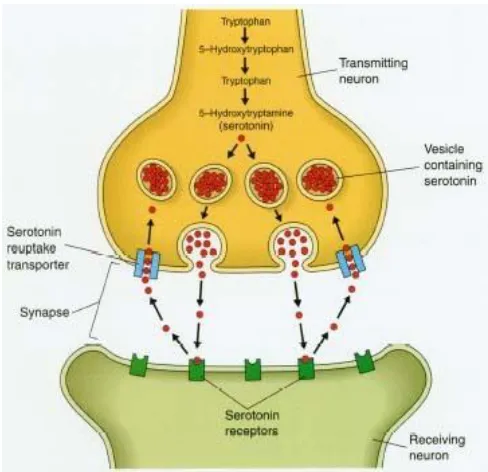
A key regulator of 5-HT function is the 5-HTT, a membrane bound protein that is responsible for the re-uptake of 5-HT from the synaptic cleft back into the presynaptic neuron (Lesch, Wolozin, Murphy, & Reiderer, 1993: see Figure 2). Its function determines the duration and intensity of the serotonin signal at the synapse. 5-HTT’s are distributed in brain areas associated with memory function with the highest levels found in the raphe nuclei and subcortical structures, followed by the hippocampus and the prefrontal cortex (Madsen et al., 2011; Murphy, Lerner, Rudnick, & Lesch, 2004).
[image:15.595.176.420.319.555.2]
Figure 2. Depiction of 5-HTT action at the synapse, regulating amount of 5-HT in the synaptic cleft.
reduced transcription of the 5-HTT gene resulting in a 40 per cent reduction in density of 5-HTT sites and binding of 5-HT to receptors in comparison to the long allele (Greenberg et al., 1999). The reduced 5-HTT sites in s allele carriers results in a two-fold decrease in 5-HT uptake at the synapse and therefore less modulation of 5-HT (Lesch et al., 1996).
While reduced re-uptake results in greater synaptic 5-HT, it is suggested that, over time, this results in lower 5-HT signaling at the post synaptic neuron, which could be due to neuronal changes such as lower receptor sensitivity (Williams et al., 2003). As this transporter is the key regulator of serotonin function, the
[image:16.595.147.518.431.591.2]polymorphism variants of the HTTLPR gene that code for the transcription of 5-HTT may be a promising marker for detecting accelerated memory decline across age.
Figure 3. Depiction of the short and long alleles of the serotonin transporter gene that result from a polymorphism in the promoter region of SLC6A4
5-HTTLPR Effect on Hippocampus Architecture
with changes in the brain’s architecture (Price et al., 2013). Associations between, 5-HTTLPR genotype and neurodegeneration in the hippocampus, as well as other brain areas, have been demonstrated through SLC6A4 knockout mice (Dannlowski et al., 2014; Olivier et al., 2008). More specifically, s allele carriers have been associated with reduced grey matter in the hippocampus (Olivier et al., 2008) and areas of the prefrontal cortex (Frodl et al., 2008; Pezawas et al., 2005), compared to individuals homozygous for the long genotype. Based on these findings, lower memory
performance associated with the s allele compared to the l-homozygous genotype might be expected.
In a healthy adult sample, Price et al. (2013) also associated the s allele with smaller hippocampal volume, however for males the association was only present for those who had experienced significant childhood adversity. Erker et al. (2011) revealed that individuals with depression and the s/s genotype had smaller
hippocampal volumes than depressed individuals with the l/l genotype. On the basis of these findings, it could be argued that the association between the s allele and lower grey matter volume is moderated by stress on the serotonergic system, for example, traumatic events or depression, which have both been found to impact on the serotonin system (Dannlowski et al., 2014; Firk & Markus, 2007; Frodl et al., 2015; Pezawas et al., 2005).
Empirical Evidence: 5-HTTLPR and Memory
dysfunction, whilst others report the opposite or no association. One possible source of this inconsistency in findings is that many studies have small sample sizes
(n<100) and are thus underpowered for examining genotype effects. However, even in studies with larger sample sizes, a further potential source of inconsistency is that the 5-HTTLPR genotype may have a specific effect on particular types of memory.
Episodic memory
O’Hara et al. (2007), examined the interaction of the 5-HTTLPR genotype, cumulative life stress and cortisol levels on cognitive performance of 154 older adults (60-100 years of age). In their study, an association between the 5-HTTLPR genotype and lower delayed recall scores on verbal episodic memory was found, with s allele carriers showing worse memory performance compared to
l-homozygous individuals. The s allele has also been associated with poorer visual episodic memory performance compared to l-homozygous genotypes (Price et al., 2013).
Working memory
Contrary to the s allele being identified as a risk allele for lower episodic memory performance, there are some findings that suggest the s allele of the 5-HTTLPR genotype is associated with better WM performance. For example, Enge et al. (2011) demonstrated both males and females (18-33 years old) homozygous for the s genotype had better WM performance on an n-back task than individuals with the s/l or l/l genotypes. Anderson, Bell and Awh (2010) observed similar results, whereby carriers of the short allele (s/s and s/l genotype) were associated with better visual WM performance as measured by a visual change detection task.
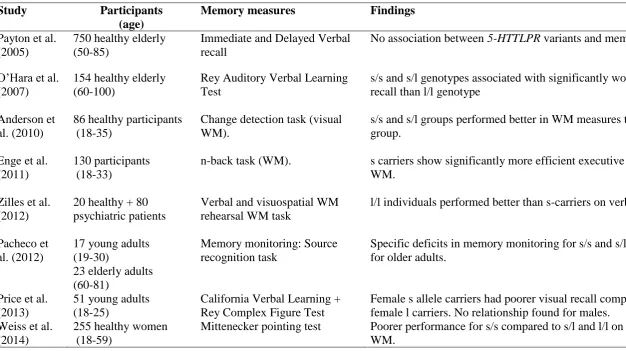
Contrary to the beneficial effects reported for the s allele and WM, updating and monitoring of WM was found to be worse for the s/s genotype compared to the s/l and l/l genotype in healthy women (Weiss et al., 2014) suggesting there may be sex specific effects of 5-HTTLPR genotype and WM. Furthermore, there are some reports of null findings for associations between WM and the 5-HTT genotypes (Payton et al., 2005; Reneman et al., 2006). As outlined in the literature review summarised in Table 1, the effects of the 5-HTTLPR genotype variants on episodic memory and WM are inconsistent. Possible explanations for these inconsistencies are low power, due to small sample sizes, variable age ranges used and not
Selective Effect of the 5-HTTLPR Genotype
In addition to the inconsistent findings of the 5-HTTLPR polymorphism variants and WM, there is some evidence for 5-HT having a selectively modulating effect on verbal memory functions (Helmbold et al., 2013; Price et al., 2013; Zilles et al., 2012). In conjunction with the neuroanatomical separation of Verbal and spatial WM components, Zilles et al., (2012) provide evidence that the 5-HTTLPR genotype has a selective effect on functions of verbal WM. In their study,
Table 1
Summary of Findings: Effect of 5-HTTLPR Genotype on Memory Performance
Study Participants
(age)
Memory measures Findings
Payton et al. (2005)
750 healthy elderly (50-85)
Immediate and Delayed Verbal recall
No association between 5-HTTLPR variants and memory scores.
O’Hara et al. (2007)
154 healthy elderly (60-100)
Rey Auditory Verbal Learning Test
s/s and s/l genotypes associated with significantly worse delayed recall than l/l genotype
Anderson et al. (2010)
86 healthy participants (18-35)
Change detection task (visual WM).
s/s and s/l groups performed better in WM measures than l/l group.
Enge et al. (2011)
130 participants (18-33)
n-back task (WM). s carriers show significantly more efficient executive control of WM.
Zilles et al. (2012)
20 healthy + 80 psychiatric patients
Verbal and visuospatial WM rehearsal WM task
l/l individuals performed better than s-carriers on verbal WM
Pacheco et al. (2012)
17 young adults (19-30)
23 elderly adults (60-81)
Memory monitoring: Source recognition task
Specific deficits in memory monitoring for s/s and s/l genotypes for older adults.
Price et al. (2013)
51 young adults (18-25)
California Verbal Learning + Rey Complex Figure Test
Female s allele carriers had poorer visual recall compared to female l carriers. No relationship found for males.
Weiss et al. (2014)
255 healthy women (18-59)
Serotonin effect in a stressed system
The majority of genetic effects on neural function are polygenetic and may have only small impacts on behavioural phenotypes (Franks, 2014; Plomin & McGuffin, 2003). In this regard, it is difficult to establish a direct relationship between a specific genotype and a behavioural trait. However, examination of the serotonin system under stress is proposed to give greater insight into the relationship between a candidate gene and a behavioural trait such as memory. The importance of the gene X environment interaction in examining the effect of the 5-HTTLPR
genotype has been demonstrated in many published reports, whereby the s allele of the 5-HTTLPR genotype has been suggested to predispose individuals to developing major depression following significant life adversity (Daniele et al., 2011; Juhasz, 2015). For example, increased diagnosis of depression and anxiety (Stein, Schork, & Gelernter, 2008) has been found for s allele carriers compared to l/l genotypes in adolescents (Eley et al., 2004) and adults (Kendler, Kuhn, Vittum, Prescott, & Riley, 2005) when faced with stressful life events, which also challenge brain serotonin levels (Firk & Markus 2007).
When investigating 5-HTTLPR genotype effects on verbal memory under ATD conditions, Roiser, Muller, Clark, and Sahakian (2007), found s-carriers had poorer verbal recall when under ATD conditions compared to control participants. Furthermore there was no effect between control and ATD conditions for l/l
ageing brain, as ageing is associated with significant reductions in serotonin. A second way is to examine the impact of serotonin on memory in females.
Effect of 5-HTTLPR genotype in females
Differences in the rate of 5-HT metabolism between males and females have been suggested to result in sex moderating the effect of 5-HTTLPR on indicators of 5-HT function including memory (Helmbold et al., 2013; Price et al., 2013). As highlighted previously, females have approximately 50 percent lower levels of circulating 5-HT than males (Nishizawa et al., 1997). Brummett et al., (2008) found that the effect of the 5-HTTLPR genotype on depression was moderated by sex in addition to stressful life events. More specifically the l allele was associated with higher levels of depression for males when accompanied with a high stressor, whereas for females the s allele was associated with increased depressive symptoms in conjunction with a stressor. Therefore, it might be predicted that a greater negative effect of the s allele on memory will be observed in females.
Effect of serotonin in older age
the short allele may decrease older adults ability to adapt to changes in serotonin function (O'Hara et al., 2007), this could result in behavioural symptoms, such as memory impairments. Therefore, as serotonin is related to memory function, the s allele of the 5-HTTLPR genotype may be associated with memory impairments more so than the long allele in older adults.
In summary, there is increasing evidence that dysfunctions in the serotonin system affect memory functioning, particularly verbal memory. As the 5-HTT is a key regulator of serotonin function, the 5-HTTLPR genotype variants are a
promising marker to investigate for differential effects on memory function. There are inconsistencies in the literature on the differential effects of the 5-HTTLPR genotypes on episodic and WM, which may be the result of small effect sizes, underpowered studies, not examining sex specificity, and a focus on healthy young controls. As there are clear effects of this genotype on hippocampal volume and clinical disorders when accompanied by environmental stressors, it is predicted that the inclusion of internal stressors on the serotonin system such as age and sex, which are associated with a decreased level of 5-HT, may reveal a differential effect of the 5-HTTLPR genotype on memory function if there is one.
Aim and hypotheses
The aim of the current study was to better clarify the possible role of 5-HTTLPR genotype variants on memory in an elderly population. As there is a general decrease in serotonin across age, it was predicted that in an elderly population the additional stress on the serotonin system would increase the likelihood of detecting effects of 5-HTTLPR genotype on memory function.
it was predicted that s carriers (s/s and s/l genotypes) would be associated with a stronger negative relationship between age and memory performance as compared to the l/l genotype.
2) In accordance with the findings that altered 5-HT levels in the CNS most robustly affect verbal memory it was hypothesised that the proposed
differential effects between s carriers and l-homozygous individuals would be more pronounced for verbal memory as determined by a stronger negative relationship between age and scores on Letter Number Sequencing test and the Rey Auditory Verbal Learning test compared to visual memory, shown by scores on the Spatial Working Memory test and the Rey Complex Figure Test.
3) Furthermore, it was hypothesised, based on the gender differences in serotonin turnover rate, that gender would moderate the effect of the 5-HTTLPR genotype on age and memory performance. More specifically, as females have lower levels of serotonin in the CNS, it was predicted that females who carry the s allele would have a greater decline in memory performance with age compared to l-homozygous females and males with either genotype.
Methods Participants
cognitive reserve, age-related cognitive decline and dementia (Summers et al.,
2013). As part of the enrollment process participants were excluded for the following to avoid conditions that may be associated with cognitive impairment: dementia, multiple sclerosis, prior head injury, epilepsy, cerebrovascular complications such as stroke, aneurysm, poorly controlled diabetes, poorly controlled hypertension or hypotension, other neurological disorders, chronic obstructive pulmonary disease, heart disease, blindness or deafness and current psychological diagnosis.
Materials
Demographic measures
To ensure approximate match of genotype groups, information on age, intelligence and previous years of education was collected as these factors have been found to affect performance on the memory tests utilized in the current study (Lezak, 2012; Schoenberg et al., 2006).
The Wechsler Test of Adult Reading (WTAR), a measure of full scale IQ (Strauss et al., 2006) was collected and compared across genotype groups to determine if premorbid intellectual capacity would affect results. The WTAR has established reliability and validity (Green et al., 2008).
Verbal working memory
The Letter-Number-Sequencing (LNS) Test, a subtest of the WAIS-IV (Wechsler, 2008), was used to assess verbal working memory capacity (Lezak, 2012; Strauss, 2006). This task required participants to mentally rearrange a series of random letters and numbers that were presented to them verbally and then repeat the letters back in alphabetical order and the numbers in order from lowest to highest. The dependent variable (DV) was recorded as the overall number of sequences correctly recalled. The LNS test has excellent reliability and validity (Lezak, 2012; Strauss, 2006)
Visual working memory
The Spatial Working Memory (SWM) subtest of the (CANTAB; Cambridge Cognition Ltd., 2004) assesses visual working memory. Participants were required to search through randomly arrayed boxes and locate coloured tokens within the boxes in order to fill a column on the side of the display. The number of boxes presented is successively increased to alter task difficulty. Total errors in choosing the same box more than once were recorded to comprise the DV. The SWM test has established reliability and validity for older adults (Robbins et al., 1994)
Verbal episodic memory
Interference list: An interference list (list B) comprising 15 words was presented after the 5 trials of list A had been presented.
Delayed recall: Following the recall of list B the initial 15 words from list A were presented again to participants. The total number of words correctly recalled was recorded as a measure of delayed recall and used as a second DV for verbal episodic memory. The RAVLT has established validity for healthy older adults (Strauss, 2006).
Visual episodic memory
The Rey Complex Figure Test (RCFT; Rey, 1941), was used to examine visual episodic memory (Strauss et al., 2006). Participants were required to first copy a complex geometric design on a separate piece of paper. The original design and the copy of the design were then removed from the participants view. After 5 minutes participants were required to re-draw the complex design again from memory. Participants were not informed this would happen to avoid them engaging in retention strategies. Scoring was based on the accurate placement and reproduction of 18 specific elements of the complex design, with higher scores indicating greater performance
.
Procedure
Neuropsychological testing
each participant by a trained examiner following standard THBP protocol.
Participants underwent baseline testing and follow up testing every two years after baseline (Summers et al., 2013). Due to sample size limitations, only baseline cross-sectional data is presented in the current study. Participants provided saliva samples via Oragene DNA self-collection kits (Genotek, ON, Canada, 2012) that were posted with instructions, information and consent forms (Appendix C). Some participant’s attended the medical science precinct in person to have their saliva samples collected after providing informed consent.
Genotyping
Once participants provided saliva samples and their consent the DNA was extracted, purified and then genotyped for tri-allelic variants of the 5-HTTLPR (s/s, s/l and l/l). All samples were genotyped in duplicate to ensure accuracy. The 5-HTTLPR was identified following a protocol developed by Taylor et al. (2006). The Polymerase Chain Reaction (PCR) mixture contained the forward primer (stpr5, 5'-GGC GTT GCC GCT CTG AAT GC) and reverse primer (stpr3, 5'-GAG GGA CTG AGC TGG ACA ACC AC) which yielded 484-bp (short) and 527-bp (long)
Table 2
The Tasmanian Healthy Brain Project Test Battery (Summers et al., 2013)
COGNITIVE RESERVE Premorbid cognitive reserve
WTAR (Wechsler Test of Adult Reading) LEQ (Lifetime Experience Questionnaire) Current cognitive reserve
WAIS-III-SF1 (WAIS-III, short-form)
WRAT4-PMV (Wide Range Achievement Test 4th edition, Progress Monitoring Version)
COGNITIVE/NEUROPSYCHOLOGICAL Global
DRS-2 (Mattis Dementia Rating Scale, 2nd edition) Memory
PAL (Paired Associates Learning Test, CANTAB) RAVLT (Rey Auditory Verbal Learning Test) LM (Logical Memory Test, WMS-III)
RCFT (Rey Complex Figure Test) Working memory
SSP (Spatial Span test, CANTAB) DSP (Digit Span test, WAIS-III)
SWM (Spatial Working Memory test, CANTAB) LNS (Letter–Number Sequencing test, WAIS-III) Language
VOC (Vocabulary test, WAIS-III)
COM (Comprehension test, WAIS-III) BNT (Boston Naming Test) Executive function
COWAT (Controlled Oral Word Association Test) RVP (Rapid Visual Processing test, CANTAB) MTS (Match to Sample Visual Search test, CANTAB)
SRT (Simple Reaction Time test, CANTAB)
CRT (5-Choice Reaction Time test, CANTAB)
STROOP (24-item Victoria version Stroop Colour-Word Test) TMT (Trail Making Test)
PSYCHOSOCIAL
HADS (Hospital Anxiety and Depression Scale) PWI (Personal Wellbeing Index)
LSNS-18 (Lubben Social Network Scale)
CONFOUNDS
Medical health status questionnaire
Gel electrophoresis
Following DNA amplification, the PCR products were run on 2% agarose gel in 1xTAE to visualize the product. The 2% agarose was made using 4g of agarose power and 200ml of 1xTAE. The agarose solution was heated for five minutes in a standard microwave. Gel electrophoresis was run in lots of 30 samples, 75ml of the agarose molten solution was combined with 4μl of Sybr-safe stain. The mix was then poured into a gel casting chamber with a 30 well gel comb to create wells for each sample to be loaded into. Once the gel set, it was placed into a bio-rad gel tank and covered with 1XTAE buffer solution before removing the comb. Five μl of a 100bp marker called DNA HyperLadder V was loaded into the first well, each of the remaining wells were loaded with 9μl of the PCR mixture containing the DNA samples. The gel was then run at 140V for 40 minutes, this allows the samples to migrate through the gel with shorter fragments moving faster than longer fragments and therefore moving further down the gel. Once electrophoresis was complete it was placed on the Image Station that exposes the gel to UV light and using
[image:31.595.114.530.597.709.2]Carestream Molecular Imaging Software the image was captured. Comparing each band to the marker the 5-HTTLPR allele length was determined. A base pair (bp) length of 484 indicated a long allele, 572 indicated a short allele and a band with both bp lengths indicated a heterozygote (see Figure 4).
Design and Data Analysis
The effect of the 5-HTTLPR genotype and sex on the relationship between age and memory performance was examined using a moderated moderation cross-sectional design (Hayes, 2013). The independent effects of the 5-HTTLPR genotype, sex and age on memory function were examined as well as the interaction between these independent variables via moderation analysis. The dependent variables comprised of verbal and visual measures of both working memory and episodic memory were examined in separate moderation analyses. The homozygous s/s and heterozygous s/l genotypes were combined to represent carriers of the short allele and compared against the homozygous l/l genotype. This bi-allelic combination is common throughout the literature as the s allele has a dominant action (Lesch et al., 1996). The bi-allelic approach was also adopted to enhance sample size and
statistical power. The two groups were dummy coded (1= s/s and s/l, 2=l/l).
Prior to examining the data for moderation effects, analyses were conducted to determine if there were differences between the two genotype groups that could be considered confounds. Examination of differences between groups for years of education, intelligence and HADS depression score were examined using one-way analysis of variance (ANOVAs). A chi-square goodness of fit test was also used to compare observed genotype frequencies with the expected genotype frequencies for an Australian population to determine if the sample was statistically significantly different from the Hardy-Weinberg equilibrium. Raw scores for the tests of episodic and working memory measures were used for all analyses as examining the effect of age on these scores, made z-scores unnecessary.
analyses for each outcome variable. Alpha levels were set at p <.05 for all analyses. R2 and ∆R2 was used as a measure of effect size as other effect size measures could
not be computed due to use of categorical predictors (Cohen, 1988). Moderated moderation analysis examines simple moderation (see Figure 5) and the effect of another moderator on the simple moderation (see Figure 6). In simple moderation the moderating variable (M) affects the direction or the strength of the relationship between X and Y (Field, 2013). Identifying a moderator helps to establish the circumstances for which the effect of X on Y is present versus absent, large versus small or positive versus negative (Hayes, 2013).
For all moderated moderation analyses conducted, 5-HTTLPR genotype was the moderator (M) on the relationship between age (X) and memory outcome measures (Y). The moderator of the moderation was sex (W) for all analyses.
[image:33.595.195.402.416.511.2]
Figure 5. Simple moderation as a conceptual diagram (Hayes, 2013)
[image:33.595.177.426.572.684.2]
Results Assumptions
Prior to regression analysis all variables were examined for the necessary assumptions. Normal probability plots were conducted to examine the assumptions of linearity and homoscedasticity. Scatterplots showed random and even distribution of residuals indicating the assumptions were met. The assumption of normality was examined with frequency distribution histograms and residual scatterplots, indicating normal distributions for all variables. However as suggested by Tabachnick and Fidell (2007) the large sample size and use of moderated regression analyses make this data robust to violations of the normality assumption.
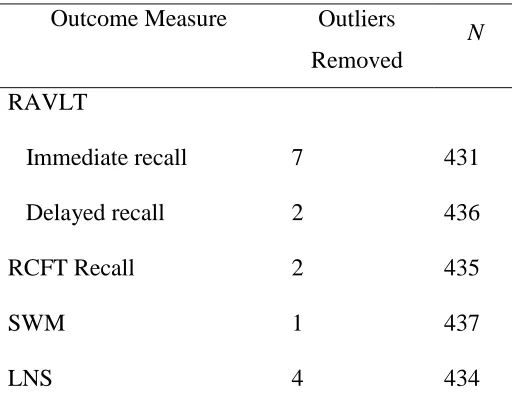
Mahalanobis, Cooks distance and tests of Leverage were employed to detect multivariate outliers in the data set. Using a criterion of p< .001, cut off scores were: 16.27 for Mahalanobis distance, Cooks distance (>.009) and Leverage (>.018). Data that met the cut off for two of these tests were considered to be influential and were therefore removed from the data set (Tachnick & Fidell, 2007: see Table 3).
Table 3
Number of outliers deleted for each outcome measure and the remaining sample size Outcome Measure Outliers
Removed
N
RAVLT
Immediate recall Delayed recall
7 2
431 436
RCFT Recall 2 435
SWM 1 437
LNS 4 434
Note. RAVLT= Rey Auditory Verbal Learning Test, RCFT= Rey Complex Figure Test, SWM= Spatial Working Memory, LNS = Letter Number Sequencing, N = number of participant’s.
Demographic results and allele frequency distribution
One-Way ANOVA’s were used to test for differences between genotype groups on demographic variables to identify any variables that needed to be
controlled for in the moderation analyses. Results revealed no significant differences between the two genotype groups on age, sex, intelligence or years of education. There was also no significant difference between the genotype groups on HADS depression and anxiety scale, prior education or WTAR estimated pre-morbid intelligence. Therefore these variables were not controlled for in any moderation analyses (see Table 4).
Table 4
Difference Between 5-HTTLPR Genotypes on Possible Covariates S/S and S/L
(n = 331)
L/L
(n = 107) P
M(SD) M(SD)
Age 60.25
(6.71) 60.65 (6.90) .59 Sex Female Male 67.67% 32.33% 69.16% 30.84% .78 HADS depression scale 2.45 (2.23) 2.32 (2.18) .60 HADS anxiety scale
5.29(3.04) 5.23(2.91) .85
Education (years)
14.08(2.69) 13.51(2.72) .06 WTAR
estimated FSIQ
112.18(5.86) 112.85(5.10) .29
Note: HADS = Hospital Anxiety and depression scale, WTAR = Wechsler Test of Adult Reading, FSIQ =Full Scale Intelligence Quotient.
Table 5
5-HTTLPR Genotype Frequency Distribution
Genotype Observed n % Expected n %
s/s 111 25.2 113.03 25.81
s/l 220 50.2 218.94 49.99
[image:36.595.114.526.610.725.2]Moderation Analyses
Moderated moderation analyses were conducted using PROCESS for each outcome variable (RAVLT -immediate and delayed recall, RCFT, SWM test, LNS test). Age, Sex and 5-HTTLPR genotype were included as predictors in all
moderation analyses.
Episodic memory performance
RAVLT Test Performance
PROCESS was used to fit linear regression models to test the impact of the 5-HTT genotype, age and sex on verbal episodic memory performance as measured by RAVLT. The RAVLT provided two measures of verbal episodic memory performance (immediate recall and delayed recall). For both RAVLT outcome measures, age, gender and 5-HTT genotype were entered as predictors and significant models were produced: total immediate recall (F(7,423)=13.77, p<.001,
R2=.18), delayed recall (F(7,428)=5.88, p<.001, R2=.10).
No significant independent association of 5-HTT genotype on any RAVLT score was found (p>.05). Age and sex had a significant negative association with both episodic outcome measures at p<.001. The independent contribution of each variable in the overall model for episodic memory outcome variables is summarised in Table 6 and Table 7.
No two-way interaction terms were significant, however the three-way interaction (5-HTT genotype x age x sex) significantly contributed to the overall model for total immediate recall score, ∆R2 = .011, p =.0161
1Applying Bonferroni adjusted p-values for multiple comparisons, reduced the significance
of the three way interaction for immediate recall scores, to trendlevel, however this adjustment is not
commonly used in moderated regression analyses (Myers, 2010) and due to the exploratory nature of
the current study, the conservative Bonferroni adjustment wasnot warranted to reduce the probability
Table 6
Prediction of RAVLT Immediate Recall Scores From Age, Sex and 5-HTT genotype Episodic
memory
Predictor B SE T P
95% C.I Lower Upper RAVLT total immediate recall Age 5-HTT Sex
Age x 5-HTT Age x Sex 5-HTT x Sex Age x 5-HTT x sex
Table 7
Prediction of RAVLT delayed recall score from age, sex and 5-HTT gene Episodic
memory
Predictor B SE t P
95% C.I Lower Upper RAVLT delayed recall Age 5-HTT Sex
Age x 5-HTT Age x Sex 5-HTT x Sex Age x 5-HTT x sex
-.08 .35 -1.23 .01 -.06 -.29 .16 .02 .29 .28 .04 .04 .66 .09 -4.08 1.20 -4.34 .25 -1.38 -.45 1.79 <.001 .231 <.001 .802 .169 .654 .074 -.12 -.22 -1.79 -.07 -.15 -1.59 -.02 -.04 .91 -.67 .09 .03 1.00 .34
Figure 7. RAVLT total immediate recall scores across age for female 5-HTT genotype groups and male 5-HTT genotype groups.
Figure 7 indicates that females performance on RAVLT total immediate recall test declines across age for both 5-HTTLPR genotypes, however the figure also indicates that the decline in performance is steeper for females homozygous for the long allele compared to female carriers of the short allele. Figure 7 indicates greater decline in immediate recall score for males with the short 5-HTTLPR genotype compared to males with the long genotype.
RCFT test performance
The overall model for the RCFT recall was significant (F(7,427)=7.82, p<.001,
R2=.12). There was no significant main effect of the 5-HTT genotype, however there was a significant main effect of sex (B= 2.07, p<.001) and age (B= -.27, p<.001) on RCFT performance, whereby age was associated with a significant decline in RCFT
46 48 50 52 54 56 58 60
-1 0 1
recall performance. There were no significant two or three way interactions between sex, age and 5HTT genotype on recall for the RCFT (see Table 8).
Table 8
Prediction of RCFT Recall Score From Age, Sex and 5-HTT Genotype Visual
episodic
memory Predictor B SE T P
95% C.I Lower Upper RCFT 5 minute recall Age 5-HTT Sex
Age x 5-HTT Age x Sex 5-HTT x Sex Age x 5-HTT x sex
-.27 .14 2.07 -.10 .06 -1.54 .014 .04 .63 .58 .10 .08 1.28 .19 -6.64 .22 3.59 -1.10 .79 -1.20 .08 <.001 .824 <.001 .273 .428 .229 .939 -.35 -1.09 .94 -.29 -.10 -4.06 -.36 -.19 1.37 3.21 .08 .22 .98 .38
Working Memory Performance
LNS test performance
For LNS test score the overall model was significant (F(7,426)=5.34, p<.001,
R2=.08). There was no significant main effect of the 5-HTT genotype or sex found
for LNS performance however there was a significant main effect of age (B= -.09, p<.001), whereby LNS test performance declined with age. There were no
Table 9
Prediction of LNS Test Score From Age, Sex and 5-HTT Genotype Working
memory
Predictor B SE t p
95% C.I Lower Upper
LNS Age
5-HTT Sex
Age x 5-HTT Age x Sex 5-HTT x Sex Age x 5-HTT x sex
-.09 -.03 .02 -.03 -.02 -.16 .10 .02 .26 .25 .04 .04 .57 .08 -5.56 -.11 .08 -.63 -.62 -.29 1.31 <.001 .913 .933 .532 .536 .774 .191 -.13 -.50 -.47 -.09 -.09 -1.28 -.05 -.06 .45 .51 .05 .05 .95 .26
SWM test performance
The overall model for SWM test performance was significant (F(7,429)=8.21,
Table 10
Prediction of SWM Score From Age, Sex and 5-HTT Genotype Working
memory
Predictor B SE T P
95% C.I Lower Upper
SWM Age
5-HTT Sex
Age x 5-HTT Age x Sex 5-HTT x Sex Age x 5-HTT x sex
.75 .60 -4.3 .32 .52 -4.55 .53 .14 1.96 1.89 .28 .29 4.11 .58 5.46 .31 -2.28 1.13 -1.84 -1.11 .91 <.001 .760 .023 .260 .067 .269 .361 .48 -3.25 -8.02 -.23 -.04 -12.64 -.61 1.01 4.45 -.60 .86 1.08 3.53 1.67 Discussion
genotype would moderate the relationship between age and memory performance was supported for one measure of verbal episodic memory, the direction of the findings for females was not in accordance with the hypothesis that s carriers would demonstrate the greatest decline in memory performance across age. Instead, females with the
l-homozygous genotype demonstrated a greater decline in verbal immediate recall as compared to female s carriers. In contrast, male carriers of the short allele had greater decline in immediate recall performance compared to males homozygous for the long allele. These findings suggest there may be sex specific factors that interact with 5-HTTLPR.
The Moderating Effect of 5-HTTLPR and Sex on the Relationship Between Age and Memory
The results of the current study indicate that the 5-HTTLPR genotype and sex moderate the relationship between age and memory, confirming the initial
These latter null findings are inconsistent with O’Hara et al. (2007), who found the s allele to be associated with lower delayed recall compared to the l/l genotype in elderly. However the null findings are consistent with Payton et al. (2005) who also found no significant overall effect of the 5-HTTLPR genotype on baseline memory performance for older adults. Payton et al. examined the 5-HTTLPR genotype in 758 elderly Caucasian adults with a similar age range to the current study (50-85years). Participant’s memory was assessed using unstandardized measures.
The sample that Payton et al., (2005) used differed from the current sample, as they did not exclude participants with clinical depression therefore examining a broader spectrum of the population. Furthermore, unlike the current study, Payton and colleagues did not consider sex differences in genotype effects on cognitive decline. Whilst the current findings are consistent with Payton et al. as no overall effect of 5-HTTLPR on memory in the elderly was found, the current findings diverge when including sex as a moderator, something Payton et al. did not do. While no significant association was found for the 5-HTTLPR genotype on baseline memory measures, Payton et al., did find another polymorphism of the SLC6A4 gene that codes for the serotonin transporter (VNTR2 polymorphism) to be associated with cognitive decline. This VNTR2 polymorphism however was not associated with significant differential impairment at baseline levels of memory or other cognitive performance. No effect sizes were reported and means were not available for computation of effect size.
predictors. The small effect size found in the current study is not uncommon, as highlighted previously, it is unlikely that a single genotype would have a large effect on a behavioural trait (Franks, 2014; Plomin & McGuffin, 2003). Studies that have found moderate effect sizes for the 5-HTTLPR genotype on memory performance (Price et al., 2013; Weiss et al., 2014; Zilles et al., 2012) have had small sample sizes and a consequence of underpowered studies is inflated effect size (Grissom, 2012). Even in conjunction with stressors on the serotonin system, the current study has shown that genetic effects on a behavioural trait may still be small. Despite small amounts of variance explained, single genotype studies are still relevant in providing insights into what genotypes may be relevant for inclusion in polygenetic
interactions that account for larger variations in neurocognitive traits(Ward et al., 2014).
The Specificity of the Moderating Effect on Verbal Episodic Memory The second hypothesis that s-carriers would be associated with a stronger decline in verbal memory compared to visual memory was partially supported, as the only significant three-way interaction found in the current study was for a verbal episodic memory test. There were no significant moderation effects found for tests of visual memory; SWM test and RCFT. However this hypothesis was not fully
supported as there was no significant moderation effect of sex and the 5-HTTLPR genotype on the relationship between age and other measures of verbal memory such as RAVLT delayed recall scores or the LNS test scores.
uptake by 5-HTT results in impaired verbal memory performance (Laws & Kokkalis, 2007; Wright, Strong, Gilbart, Shollenbarger, & Lisdahl, 2015). These findings converge with findings of Zilles et al. (2012), who found a differential effect of the 5-HTTLPR genotype on verbal WM performance, not visual memory performance. However Zilles et al. findings differed to the current study as they did not examine episodic memory. Both studies provide evidence for a selective
influence of the serotonin genotype on predicting verbal memory performance however.
The inconsistent findings between the current study and Zilles et al., (2012) for verbal working memory, may be due to the different tests of memory function used and the different age range of participants across studies. Differing levels of complexity between different measures may result in variable levels of
neurotransmitter involvement, therefore impacting on the comparison between study results (Miranda, 2007). Furthermore Zilles et al. used a mixed sample of healthy participants, bipolar, schizophrenia and obsessive-compulsive participants. Some of their participants were medicated and this was not controlled for, therefore limiting the ability to generalise and compare to the current study that used a more
homogenous healthy sample. The current study used a much larger sample size than Zilles et al. and therefore the current findings are suggested to give greater insight into the relationship between 5-HTTLPR genotype and memory.
Females With the Short Allele Should Have Greater Memory Impairments With Ageing
memory, the specific direction of effects evident from the simple slopes analysis were not consistent with the prediction. Instead it was found that females
homozygous for the long genotype had the greatest decline in verbal episodic memory performance, with a beta value of .47 compared to a beta value of .27 for females with the s allele (see Figure 7). This finding is inconsistent with Price et al., (2013), who associated the s allele with worse performance for females not males.
Males, however, showed the expected effect, whereby the short allele was associated with significant decline in immediate recall performance opposed to the long homozygous genotype. Overall this group showed the greatest decline in immediate recall across age (beta = .54). The smallest gradient was found for male non-s carriers, which is consistent with the overall hypothesis.
The findings for males are consistent with Roiser (2007) who found the s allele to be associated with deficits in verbal memory functions when individuals have reduced levels of serotonin. However, the findings for females in the current study do not support the findings of Roiser et al. or O’Hara et al, (2007). Despite this, the immediate recall scores for females below the mean sample age of 60.35 years, is consistent with the literature, as scores were lower than l-homozygous females (refer to figure 7).
Potential floor and ceiling effects
Investigation of the difference between the two genotypes at lower age groups of the sample (below mean sample age of 60.35 years), revealed younger female s-carriers had lower immediate recall performance. Alternatively, males with the long homozygous genotype were associated with lower immediate recall
The initial low scores for males with the l/l genotype could mean there is less capacity for decline. It could also be argued that the l/l genotype for females was associated with a stronger decline in immediate verbal recall across age because these individuals have more room for decline due to the higher performance at lower ages.
Individual differences in neural compensation
Individual differences in the ability for neural compensation could confound the interpretation of differences between the 5-HTTLPR genotype (Stern, 2012). Regions of the prefrontal cortex that show functional variations across age have been shown to have compensatory mechanisms whereby alternative neural structures are used to counteract performance declines (Cabeza, Anderson, Locantore, &
McIntosh, 2002). These findings relate to the concept of cognitive reserve, however, they could also be used to explain why the current study did not detect a differential effect of the 5-HTTLPR genotype on all verbal memory outcome measures across age (i.e verbal working memory and verbal delayed recall) as other studies have (O'Hara et al., 2007).
The effect of oestrogen
The unexpected association between the l/l genotype and greater decline in immediate recall across age for females may be interpreted in relation to the effect of oestrogen on the serotonin system. Oestrogen has been found to act on a variety of receptors, including serotonin receptors (Barth et al., 2015). As the current study examined a healthy elderly cohort with a minimum age of 49 years, the vast majority of females in the sample would have been post menopausal and therefore have relatively stable, low levels of oestrogen compared to younger females (Barth, Villringer, & Sacher, 2015). The majority of previous research that has associated the s allele with increased risk for depression in the face of stressful life events (Brummett et al., 2008; Eley et al., 2004), and worse memory performance (Price et al., 2013; Weiss et al., 2014) in females have examined younger premenopausal cohorts.
Limitations
Potential limitations of the present study need to be considered. The cross sectional nature of the current study limits the ability to assess developmental moderations of sex, age and 5-HTTLPR genotype on memory performance. Using a cross-sectional design makes it difficult to determine whether changes in RAVLT immediate recall score across males and females with different 5-HTTLPR genotypes predicts developmental progression or instead is the result of cohort differences between participants at each age group. Future studies that investigate a cohort longitudinally would be beneficial for tracking the supposed effects of memory decline associated with the 5-HTTLPR status across sex.
In the current study the 5-HTTLPR genotype was investigated as bi-allelic (s-carriers versus l/l genotype) as opposed to investigating the tri-allelic genotype (s/s versus s/l versus l/l) to ensure sufficient statistical power. However this basic split may have reduced sensitivity to the effects of serotonin, even using the tri-allelic genotype may be considered insufficiently sensitive for investigating a single behavioural trait (Plomin & McGuffin, 2003). There are now more nuanced ways of investigating polymorphisms of the SLC6A4 gene that codes for the serotonin transporter, yet these require much larger sample sizes for adequate power than was available in the current study. It has been identified that another functional
polymorphism, Variable Number of Tandem Repeats (termed STin2 VNTR), which has two common variants (10 and 12 16/17bp repeats), acts variably as a
future research should consider the 5-HTTLPR and the VNTR2 genotype in the same study.
It is important to consider the ethnic homogeneity that comprised the sample of this study. The current study was largely Caucasian and while it is beneficial to study genotype effects in homozygous samples due to differences in genotype frequencies across ethnic groups, results of the current study should not be generalised to other ethnic groups (Goldman et al., 2010).
In addition to considering the samples ethnicity, some bias in the recruitment of participants for this study may be a potential issue as it is highly likely that a study like the THBP would attract highly motivated individuals who have had previous exposure to University or completed year 12. This potential selection bias would likely impact on generalisation of the findings to other demographic groups. Furthermore, the current sample was selected to be psychologically healthy and individuals with depressed or anxious mood were excluded from the study. Thus, future research needs to examine this question in a more representative sample, including measures of depression, current life stress and previous trauma, as they enhance challenges to the serotonergic system with possible neurocognitive consequences.
effects of the 5-HTTLPR genotype on memory as the majority of studies use sample sizes less than 300. The current study did have a larger sample size than majority of the previous literature around the 5-HTTLPR genotype.
Most studies do not report the effect sizes of the 5-HTTLPR genotype on memory in their studies, therefore it is difficult to get an estimate of the effect outside of the underpowered nature of studies. However as highlighted, most single genotype studies only account for relatively small amounts of variance. This was also an issue of the current study, as the additional variance in immediate recall performance that was accounted for by the interaction of age, sex and 5-HTTLPR genotype was only 1.1 per cent.
There are currently no meta-analyses looking at the combined effects of the 5-HTTLPR genotype on memory or other forms of cognition, therefore it is
suggested that this field would benefit from future meta-analyses combining the inconsistent literature as this would increase power to give a clearer picture on whether the 5-HTTLPR genotype does differentially effect memory decline (Munafo & Flint, 2004). While meta-analyses should not replace a well-designed powerful study, such knowledge is needed in order to determine if the functional
polymorphism of the SLC6A4 gene is a likely candidate for inclusion in more promising studies that investigate polygenetic effects on cognitive performance and cognitive decline.
Implications
on one memory outcome measure and therefore it cannot be concluded that the 5-HTTLPR genotype is a marker for predicting rates of memory decline across age. Although other studies have demonstrated this genotype accounts for some variance in memory performance in older adults (O'Hara et al., 2007; Pacheco et al., 2012), due to the small effect size found in the current study and the higher power obtained, it is suggested that future research should focus not on the independent contribution of the 5-HTTLPR genotype, but rather look at it in conjunction with other genes associated with memory. For example, genes such as APOE e4 and BDNF have been shown to interact and predict memory performance in older (Ward et al., 2014) and younger (Richter-Schmidinger et al., 2011) adults. The THBP is a longitudinal study and provides the opportunity for investigation of the polymorphic effect the 5-HTTLPR genotype, APOE and BDNF genotypes on memory function over time and within individuals. The current findings contribute to the field by highlighting potential sex differences in genotype effects. Therefore a clear implication for future studies trying to identify genetic makers of cognitive function and decline across age should control for sex.
Conclusion
The aim of the current study was to examine whether 5-HTTLPR genotype differentially affected the relationship between age and memory performance and determine if this is moderated by sex. It was hypothesised that s allele carriers (s/s and s/l genotype) would be associated with greater decline in memory performance across age compared to individuals with the l-homozygous genotype. It was also hypothesised that the differential effect would be greater for verbal memory
References
Barros, L. A., Tufik, S., & Andersen, M. L. (2015). The role of progesterone in memory: an overview of three decades. Neuroscience and Biobehavioral Reviews, 49, 193-204. doi: 10.1016/j.neubiorev.2014.11.015
Barth, C., Villringer, A., & Sacher, J. (2015). Sex hormones affect neurotransmitters and shape the adult female brain during hormonal transition periods.
Frontiers in Neuroscience, 9, 37. doi: 10.3389/fnins.2015.00037
Bearden, C. E., Karlsgodt, K. H., Bachman, P., van Erp, T. G., Winkler, A. M., & Glahn, D. C. (2012). Genetic architecture of declarative memory:
implications for complex illnesses. Neuroscientist, 18(5), 516-532. doi: 10.1177/1073858411415113
Bertram, L., & Tanzi, R. E. (2004). Alzheimer's disease: one disorder, too many genes? Human Molecular Genetics, 13 Spec No 1, R135-141. doi: 10.1093/hmg/ddh077
Bjelland, I., Dahl, A. A., Haug, T. T., & Neckelmann, D. (2002). The validity of the Hospital Anxiety and Depression Scale. An updated literature review. Journal of Psychosomatic Research, 52(2), 69-77.
Brummett, B. H., Boyle, S. H., Siegler, I. C., Kuhn, C. M., Ashley-Koch, A.,
Cabeza, R., Anderson, N. D., Locantore, J. K., & McIntosh, A. R. (2002). Aging gracefully: compensatory brain activity in high-performing older adults. Neuroimage, 17(3), 1394-1402.
Cohen, J. E. (1988). Statistical Power Analysis for the Behavioral Sciences: Hillsdale, NJ: Lawrence Erlbaum Associates, Inc.
Daniele, A., Divella, R., Paradiso, A., Mattioli, V., Romito, F., Giotta, F., . . . Quaranta, M. (2011). Serotonin transporter polymorphism in major
depressive disorder (MDD), psychiatric disorders, and in MDD in response to stressful life events: causes and treatment with antidepressant. In Vivo, 25(6), 895-901.
Dannlowski, U., Kugel, H., Redlich, R., Halik, A., Schneider, I., Opel, N., . . . Hohoff, C. (2014). Serotonin transporter gene methylation is associated with hippocampal gray matter volume. Human Brain Mapping, 35(11), 5356-5367. doi: 10.1002/hbm.22555
Eley, T. C., Sugden, K., Corsico, A., Gregory, A. M., Sham, P., McGuffin, P., . . . Craig, I. W. (2004). Gene-environment interaction analysis of serotonin system markers with adolescent depression. Molecular Psychiatry, 9(10), 908-915. doi: 10.1038/sj.mp.4001546
Field, A. (2013). Discovering statistics using IBM SPSS Statistics (4th ed.). London: SAGE publications Ltd.
Firk, C., & Markus, C. R. (2007). Review: Serotonin by stress interaction: a
susceptibility factor for the development of depression? J Psychopharmacol, 21(5), 538-544. doi: 10.1177/0269881106075588
Frontiers in Aging Neuroscience, 6, 270. doi:
http://doi.org/10.3389/fnagi.2014.00270
Frodl, T., Koutsouleris, N., Bottlender, R., Born, C., Jager, M., Morgenthaler, M., . . . Meisenzahl, E. M. (2008). Reduced gray matter brain volumes are
associated with variants of the serotonin transporter gene in major depression. Molecular Psychiatry, 13(12), 1093-1101. doi:
10.1038/mp.2008.62
Frodl, T., Szyf, M., Carballedo, A., Ly, V., Dymov, S., Vaisheva, F., . . . Booij, L. (2015). DNA methylation of the serotonin transporter gene (SLC6A4) is associated with brain function involved in processing emotional stimuli. Journal of Psychiatry and Neuroscience, 40(5), 296-305.
Goldman, N., Glei, D. A., Lin, Y. H., & Weinstein, M. (2010). The serotonin transporter polymorphism (5-HTTLPR): allelic variation and links with depressive symptoms. Depression and Anxiety, 27(3), 260-269. doi: 10.1002/da.20660
Green, R. E., Melo, B., Christensen, B., Ngo, L. A., Monette, G., & Bradbury, C. (2008). Measuring premorbid IQ in traumatic brain injury: an examination of the validity of the Wechsler Test of Adult Reading (WTAR). Journal of Clinical and Experimental Neuropsychology, 30(2), 163-172. doi: 10.1080/13803390701300524
Grissom, R. J., & Kim, J. J. . (2012). Effect Sizes for Research: Univariate and Multivariate Applications, Second Edition (2nd ed.). New York: Routledge, 2014.
Hannon, J., & Hoyer, D. (2008). Molecular biology of 5-HT receptors. Behavioural Brain Research, 195(1), 198-213. doi: 10.1016/j.bbr.2008.03.020
Harrison, B. J., Olver, J. S., Norman, T. R., Burrows, G. D., Wesnes, K. A., & Nathan, P. J. (2004). Selective effects of acute serotonin and catecholamine depletion on memory in healthy women. J Psychopharmacol, 18(1), 32-40. doi: 10.1177/0269881104040225
Hayward, G., Goodwin, G. M., Cowen, P. J., & Harmer, C. J. (2005). Low-dose tryptophan depletion in recovered depressed patients induces changes in cognitive processing without depressive symptoms. Biological Psychiatry, 57(5), 517-524. doi: 10.1016/j.biopsych.2004.11.016
Helmbold, K., Bubenzer, S., Dahmen, B., Eisert, A., Gaber, T. J., Habel, U., . . . Zepf, F. D. (2013). Influence of acute tryptophan depletion on verbal declarative episodic memory in young adult females. Amino Acids, 45(5), 1207-1219. doi: 10.1007/s00726-013-1582-1
Hughes, J. H., Gallagher, P., Stewart, M. E., Matthews, D., Kelly, T. P., & Young, A. H. (2003). The effects of acute tryptophan depletion on
neuropsychological function. J Psychopharmacol, 17(3), 300-309.
Jacobs, B. L., & Azmitia, E. C. (1992). Structure and function of the brain serotonin system. Physiological Reviews, 72(1), 165-229.
European Population: The Role of Age, Symptom Profile, Type and Intensity of Life Stressors. PloS One, 10(3).
Kendler, K. S., Kuhn, J. W., Vittum, J., Prescott, C. A., & Riley, B. (2005). The interaction of stressful life events and a serotonin transporter polymorphism in the prediction of episodes of major depression: a replication. Archives of General Psychiatry, 62(5), 529-535. doi: 10.1001/archpsyc.62.5.529 Kessler, R. C., Berglund, P., Demler, O., Jin, R., Merikangas, K. R., & Walters, E.
E. (2005). Lifetime prevalence and age-of-onset distributions of DSM-IV disorders in the National Comorbidity Survey Replication. Archives of General Psychiatry, 62(6), 593-602. doi: 10.1001/archpsyc.62.6.593
Laws, K. R., & Kokkalis, J. (2007). Ecstasy (MDMA) and memory function: a meta-analytic update. Hum Psychopharmacol, 22(6), 381-388. doi:
10.1002/hup.857
Lesch, K. P., Bengel, D., Heils, A., Sabol, S. Z., Greenberg, B. D., Petri, S., . . . Murphy, D. L. (1996). Association of anxiety-related traits with a
polymorphism in the serotonin transporter gene regulatory region. Science, 274(5292), 1527-1531.
Lesch, K. P., Wolozin, B. L., Murphy, D. L., & Reiderer, P. (1993). Primary structure of the human platelet serotonin uptake site: identity with the brain serotonin transporter. Journal of Neurochemistry, 60(6), 2319-2322. Lezak, M. D., Howieson, D. B., Bigler, E. D. and Tranel, D. (Ed.). (2012).
Neuropsychological Assessment (Vol. 2nd Edn.). Oxford: Oxford University Press.
susceptibility factor for late onset Alzheimer's disease. Neuroreport, 8(3), 683-686.
Luciana, M., Burgund, E. D., Berman, M., & Hanson, K. L. (2001). Effects of tryptophan loading on verbal, spatial and affective working memory functions in healthy adults. J Psychopharmacol, 15(4), 219-230.
Lucki, I. (1998). The spectrum of behaviors influenced by serotonin. Biological Psychiatry, 44(3), 151-162.
Mace, J., Porter, R., O'Brien, J., & Gallagher, P. (2008). Cognitive effects of acute tryptophan depletion in the healthy elderly. Acta Neuropsychiatrica. Officieel Wetenschappelijk Orgaan van Het IGBP (Interdisciplinair Genootschap voor Biologische Psychiatrie), 20(2), 78-86. doi:
10.1111/j.1601-5215.2008.00272.x
Mace, J. L., Porter, R. J., Dalrymple-Alford, J. C., Wesnes, K. A., & Anderson, T. J. (2011). The effects of acute tryptophan depletion on neuropsychological function, mood and movement in the healthy elderly. J Psychopharmacol, 25(10), 1337-1343. doi: 10.1177/0269881110389094
Madsen, K., Erritzoe, D., Mortensen, E. L., Gade, A., Madsen, J., Baare, W., . . . Hasselbalch, S. G. (2011). Cognitive function is related to fronto-striatal serotonin transporter levels--a brain PET study in young healthy subjects. Psychopharmacology, 213(2-3), 573-581. doi: 10.1007/s00213-010-1926-4 McClintock, S. M., Husain, M. M., Greer, T. L., & Cullum, C. M. (2010).