27
PERCEPTIONS OF ENTREPRENEURSHIP IN A UNIVERSITY
AGRIBUSINESS PROGRAM: DEVELOPING A SCALE
Joey E. Mehlhorn
University of Tennessee at Martin, 254 Brehm Hall, TN 38238, USA
Email: [email protected]
Morgan Miles
Charles Sturt University, Australia
Laurie Bonney
University of Tasmania, Australia
Rachna Tewari
University of Tennessee at Martin, U.S.A.
Abstract
This paper develops a scale to measure student perceptions of entrepreneurship in an agribusiness undergraduate program. The study builds on Morris, Webb, Fu and Singhal (2013) and Kriewall and Mekemson (2010) conceptualization of entrepreneurial competencies to develop a brief nine-item scale for agribusiness students. It contributes to the integration of entrepreneurship into the agribusiness curriculum by first explaining the challenges that may be best addressed through building competencies in innovation and entrepreneurship in undergraduate agribusiness education. In this scale development study, undergraduate agribusiness students from a U.S. Land Grant University considered oral communication, motivation and the ability to recognize opportunities to be the most significant capabilities for entrepreneurship.
Keywords: Agribusiness, Entrepreneurship competencies, Undergraduates, Education, Scale
JEL Codes: A22, Q13, Q16, I21, I23
1. Introduction
“We’re looking at having to grow as much food in the next forty years (to feed more than 9 billion in 2050) as we have since agriculture began 10,000 years ago. It is the greatest challenge that humanity has ever faced, and we have to do it without destroying the water, the oceans, the soils, that we all depend on,” Bourne (2015).
28
due to transformative technologies (Bentham 2014). These competing demands for water and energy that food production requires will only escalate as global population increases and consumption patterns shift towards more animal protein in the diet. Innovation and entrepreneurship have become imperatives for businesses to revitalize and renew their ability to compete (Covin & Miles 1999; Miles et al. 2016).
Agribusiness is now a large global market system encompassing several subsectors. These subsectors include input supply, food processing, crop production, government assistance and regulation, equipment and implement manufacturing and sales, and agri-marketing. As agriculture continues to become more technical and profit centered, the need for creative, innovative and entrepreneurial professionals is critical (Sonka, 1989). However, as Mehlhorn, Bonney, Fraser, and Miles’s (2015) survey of deans and directors of university undergraduate programs in Australia, New Zealand, and the United States revealed entrepreneurship has not been well integrated into the agribusiness curriculum. The present study contributes to address this gap by first explaining the challenges that may be best addressed through building competencies in innovation and entrepreneurship in undergraduate agribusiness education and then offering a parsimonious scale to measure student perceptions of entrepreneurial competencies in a university undergraduate agriculture program (see Melhorn, Bonney, Fraser, & Miles, 2015).
Entrepreneurship is the pursuit of opportunities to gain an advantage (Stevenson & Gumpert 1985). Entrepreneurship involves the recognition or creation of an opportunity, the ability to assess the opportunity, and the ability to exploit the opportunity (Shane & Venkataraman, 2000). An effective university program in agribusiness needs to develop management skills, but must also build the entrepreneurial competencies of opportunity recognition and exploitation among their graduates as indicated in the findings of a recent survey of Agriculture deans and program directors in Australia, New Zealand, and the United States where over 85 percent of the respondents believed that innovation and entrepreneurship was vital to the future of agriculture, agribusinesses and university level agricultural education in their respective nations (Mehlhorn, Bonney, Fraser, and Miles 2015). Similar to Mitchelmore and Rowley’s (2010) four category framework of entrepreneurial competencies as augmented by work by Sanchez (2013) and Volery et al. (2013), this study distinguishes between entrepreneurial competencies which relate to the discovery or creation, assessment and exploitation of venture opportunities and managerial competencies which are required for an on-going organization to remain viable and include competencies which relate to strategic decision marketing, human relations, financial management and marketing.
The objective of this study is to assess the perceptions of agribusiness students on entrepreneurship and agriculture and to develop a short evaluation scale to benchmark students’ perceptions of entrepreneurship in a university’s agribusiness program. This scale allows agribusiness faculty to evaluate student understanding of entrepreneurship in the agribusiness profession better, as well as provide insights for integrating entrepreneurship into existing courses and programs. The paper proceeds as follows. First, the relevant literature is briefly reviewed, then the study’s objectives are discussed, followed by a discussion of the data and methods, results, and conclusions.
2. Literature Review
29
changing due to pressures from a rapidly increasing population and changing technologies (Bourne, 2015). Therefore, the agribusiness curriculum must change as well.
Agribusiness encompasses so much more than just business economics. It has grown into a global technologically advanced sector in which old curriculums are simply not adequate. For example, Sonka’s (1989) seminal work suggests that the agribusiness sector has five distinctive characteristics. The first distinguishing factor is the unique cultural and political aspects of food security. The government plays a major role in agribusiness implementing policies and overseeing international trade. Educating students on the governmental role in agribusiness allows students to be aware of how policies can affect each subsector. The next characteristic is the uncertainty within the industry. Uncertainty thrives in the agribusiness sector, and therefore graduates must be able to manage and leverage risk. Third are the alternative goals of political intervention. Fourth is the technology development initiatives arising within the field. The curriculum must advance technologically and build the entrepreneurial capabilities in graduates necessary to commercialize useful agricultural innovations as diverse as remote sensing unmanned aircraft (drones), biotech innovations, or genetically improved livestock. The last characteristic is the dynamic nature of competition within agribusiness. Competition drives the market forward, and without competition, the market would come to a halt. These five characteristics provide opportunities for students with entrepreneurial capabilities in agribusiness to gain an advantage in the job market.
Smit (2004) states that entrepreneurship is viewed as one of the most critical skills needed in production agriculture. This is also noted by McElwee (2006) in an extensive literature review on farmer’s entrepreneurial capacity. McElwee notes that there is a need for entrepreneurship in agriculture, but it is being limited due to the regulatory and complex nature of agriculture. McElwee (2006) suggests that the complexity of the agriculture industry is precisely why educators should seek to foster entrepreneurial education in our curriculums. The ability to innovate and recognize opportunity is needed to feed the growing world. Noel and Qenani (2013) finding in a survey of agribusiness employers such as food processors, Ag suppliers, and Ag marketers that university graduates need entrepreneurial competencies such as creativity and team building to deal with the challenges facing agriculture. To achieve the change, agribusiness programs should educate students on how to recognize, assess and exploit opportunities, manage risks, manage adversity, and be proactively goal oriented all while maintaining ethics. Mehlhorn, Bonney, Fraser and Miles’ (2015) findings support this where approximately 70 percent of agribusiness programs responding had at least one class offered on agricultural entrepreneurship, and 50 percent have classes on ethics and stakeholder management. An interesting recent study on the earning ability of agribusiness graduates suggests that a broader more innovative curriculum (e.g. an ag-entrepreneurship course) would financially benefit agricultural graduates (Artz, Kimle, & Orazem, 2014).
3. Data and Methods
30
4. ResultsOver two hundred students in agribusiness participated in the study (N=215), which represented the approximate population of agribusiness students at the University. Table 1 summarizes the rank order of and means of the capabilities that students perceived to be the most important for entrepreneurship. It was found that students considered oral communication, motivation and the ability to recognize opportunities to be the most important capabilities for entrepreneurship.
Table 1. Rank Order and Means of Student Perceptions’ of Competencies Critical to Entrepreneurship in Agribusiness
COMPETENCIES Mean
Std. Deviation Oral Communication Skills 4.66 .530 Drive And Motivation 4.65 .515 Opportunity Recognition Is Important 4.62 .523 Problem Solving Skills 4.54 .562 Leadership Skills 4.49 .571
Selling Skills 4.47 .610
General Business Knowledge 4.46 .561 Written Communication Skills 4.45 .601
Creativity 4.45 .569
The Ability To Manage Adversity 4.35 .560
Reading 4.33 .691
Ethics And Integrity 4.33 .705 The Willingness To Accept Risks 4.32 .664 Ability To Work With Others 4.31 .724
Optimism 4.28 .670
Agriculture Needs Entrepreneurship 4.20 .652 The Ability To Tolerate Risk 4.15 .682 The Agriculture Industry Rewards Risk 4.07 .673
Technical Skills 3.86 .806
Entrepreneurs Are The People Who Start Businesses 3.78 .824 Entrepreneurship Is Teachable 3.52 .842 Soft Skills Are Important 3.35 .767 Anyone Has The Ability To Be An Entrepreneur 3.35 1.141
31
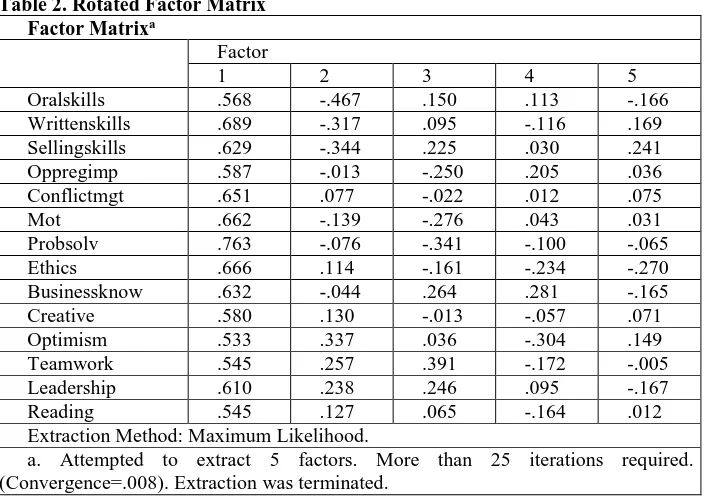
Table 2. Rotated Factor MatrixFactor Matrixa
Factor
1 2 3 4 5
Oralskills .568 -.467 .150 .113 -.166 Writtenskills .689 -.317 .095 -.116 .169 Sellingskills .629 -.344 .225 .030 .241 Oppregimp .587 -.013 -.250 .205 .036 Conflictmgt .651 .077 -.022 .012 .075 Mot .662 -.139 -.276 .043 .031 Probsolv .763 -.076 -.341 -.100 -.065 Ethics .666 .114 -.161 -.234 -.270 Businessknow .632 -.044 .264 .281 -.165 Creative .580 .130 -.013 -.057 .071 Optimism .533 .337 .036 -.304 .149 Teamwork .545 .257 .391 -.172 -.005 Leadership .610 .238 .246 .095 -.167 Reading .545 .127 .065 -.164 .012 Extraction Method: Maximum Likelihood.
a. Attempted to extract 5 factors. More than 25 iterations required. (Convergence=.008). Extraction was terminated.
Nine items emerged from the factor analysis that purports to capture the students’ perceptions of important entrepreneurial capabilities for agribusiness. These include the ability to: (1) accept risk; (2) solve problems; (3) act ethically; (4) be creative; (5) remain optimistic; (6) recognize opportunities; (7) manage adversity; (8) maintain motivation and drive; and (9) read well. Interestingly, the nine items that undergraduates perceived to be entrepreneurial competencies did not fully capture Morris, et al.’s (2013) inventory of thirteen entrepreneurial competencies; with five factors in the present study matching Morris et al.’s (2013) framework including the ability to: (1) accept and leverage risks; (2) recognize and exploit opportunities; (3) be creative; (4) overcome adversity; and (5) remain motivated and be resilient.
Litzenberg and French (1989) and Howard, Litzenberg, Schneider, and Fairnie (1990) developed the Agribusiness Management Aptitude and Skill Survey (AMASS) that describes the business and managerial competencies needed for successful agribusiness that matched the present study’s competencies that pertain to: (1) conflict management and interpersonal communication; (2) critical thinking and problem solving; and (3) managerial and technical knowledge. Neither Litzenberg nor French’s (1989) AMASS nor do Morris et al.’s (2013) entrepreneurial competencies address ethics as a fundamental agribusiness competency.
A Cronbach’s Alpha of .838 was exhibited, which exceeds the minimal score of .70 for scale development (Nounally, 1978). The mean score of the sample for the nine-item scale is 40 with a standard deviation of 3.6 out of a total of possible score of 45. This suggests that students with a score of 40 and above have an adequate understanding of what entrepreneurship means in an agribusiness context.
5. Conclusion
32
skills, and communication skills; the most progressive agribusiness programs are also beginning to build entrepreneurial capabilities in agribusiness students. However, in today’s environment, it is not adequate to just be a good manager. Agribusiness needs entrepreneurs that can recognize opportunities, be creative, and take risks as well as the more traditional skills such as leadership, teamwork, communication, and decision-making. Agribusiness is constantly changing and the agribusiness curriculum must change to supply well-equipped students for their future ahead, and this means including the entrepreneurial capabilities of opportunity recognition, assessment, and exploitation into the current agribusiness curriculum. Training tomorrow’s agribusiness leaders to be more innovative and entrepreneurial as they seek to develop solutions to the ever-increasing global population, is critical.
This exploratory study has developed a preliminary scale to measure student perceptions of entrepreneurship in agribusiness programs and intends to provide guidance in shaping and developing ag-entrepreneurship curriculums. This study contributes to building entrepreneurial competencies in undergraduate agribusiness education by providing a short metric that educators can administer and use in developing and managing their university’s agribusiness curriculum.
Successful managers start with a strong educational foundation that is shaped by dedicated faculty and staff. Faculty and staff mold students into desirable employees that firms want to hire. Firms want students that are hardworking, ethical, self-motivated team workers, and have the ability to think ahead and push the market in a positive direction. This study highlights ethics as a necessary, but largely neglected, competency needed in agribusiness. Discussions on ethics can be complex in agribusiness due to the nature of the industry, which brings together natural resource and human needs on issues such as food security and the use of GMOs just to give two examples. The need to develop ethical and sustainable solutions to food and resource issues will continue as natural resources availability changes.
Like Litzenberg and Schneier’s (1987) and Howard, Litzenberg, Schneider, and Fairnie’s (1990) AGRIMASS surveys in the U.S. and Australia of the needs of agribusiness employers that did much to shape the existing agribusiness curriculum to better reflect an emphasis on management, marketing, accounting and finance; the authors hope that this exploratory study illuminates the importance of ethical opportunity recognition and exploitation using creative and innovative processes, strategies, business models and products.
The authors acknowledge the many limitations of the study, including its limited sample size from one university only. The agribusiness program utilized in the study is typical of the majority of agribusiness programs delivered in the U.S. with respect to curriculum, however, the authors hope that this exploratory study will stimulate additional research in ag-entrepreneurship and ag-entrepreneurship education and help build ag-ag-entrepreneurship capabilities in the agribusiness curriculum by offering agribusiness program directors a simple tool to benchmark students’ perceptions of entrepreneurship in their program, and then use their own findings to shape their program to reflect both student and industry needs.
References
Artz, G. M., Kimle, K. L., & Orazem, P. F. (2014). Does the Jack of all trades hold the winning hand? Comparing the role of specialized versus general skills in the returns to an agricultural degree. American Journal of Agricultural Economics, 96(1), 193-212. Bourne, J.K. (2015). As Global Population Grows, Is The Earth Reaching The 'End Of Plenty?
33
Covin, J.G. & Miles, M.P. (1999). Corporate entrepreneurship and the pursuit of competitive advantage. Entrepreneurship Theory and Practice, 23(3), 47-63.
Howard, W., Litzenberg, K., Schneider, V. & Fairnie, I. (1990). Characteristics required for success in management of agribusiness firms: An international perspective. Agribusiness, 6(2), 133-142.
Kriewall, T. J., & Mekemson, K. (2010). Instilling the entrepreneurial mindset into engineering undergraduates. The Journal of Engineering Entrepreneurship, 1(1), 5-19. Litzenberg, K.K. & French, C.E. (1989). An overview of agribusiness education in Australia:
Developing tomorrow's agribusiness leaders. Agribusiness, 5(3), 207-211.
Litzenberg, K.K & Schneier, V. (1987). Competencies and Qualities of Agricultural Economics Graduates Sought by Agribusiness. American Journal of Agricultural Economics, 69, 1031-1036.
McElwee, G. (2006). Farmers as entrepreneurs: developing competitive skills. Journal of Developmental Entrepreneurship, 11(3), 187-206.
Mehlhorn, J.E., Bonney, L., Fraser, N., & Miles, M.P. (2015). Benchmarking Entrepreneurship Education in the U.S. Australia, and New Zealand University Agriculture Programs. Journal of Developmental Entrepreneurship, DOI: 10.1142/S108494671550017X
Miles, M. P., Lewis, G. K., Hall-Phillips, A., Morrish, S. C., Gilmore, A., & Kasouf, C., (2016). The influence of entrepreneurial marketing processes and entrepreneurial self-efficacy on community vulnerability, risk and resilience, Journal of Strategic Marketing. 24(1), 34-46.
Mitchelmore, S. & Rowley, J. (2010). Entrepreneurial competencies: a literature review and development agenda. International Journal of Entrepreneurial Behavior & Research, 16(2): 92 – 111.
Morris, M. H., Webb, J. W., Fu, J., & Singhal, S. (2013). A Competency‐Based Perspective on Entrepreneurship Education: Conceptual and Empirical Insights. Journal of Small Business Management, 51(3), 352-369.
Noel, J. & Qenani, E. (2013). New Age, New Learners, New Skills: What Skills Do Agribusiness Graduates need to Succeed in the Knowledge Economy? International Food and Agribusiness Management Review, 16(3), 17-36.
Nunnally, J.C. (1978). Psychometric Theory. 2nd ed. New York: McGraw-Hill.
Sánchez, J. C. (2013). The Impact of an Entrepreneurship Education Program on Entrepreneurial Competencies and Intention. Journal of Small Business Management, 51, 447–465.
Shane, S. & Venkataraman, S. (2000). The promise of entrepreneurship as a field of research. Academy of Management Review,25(1), 217-226.
Sonka, S. (1989). Future Priorities in Agribusiness Education: A US Perspective. Agribusiness, 5, 269-279.
Smit, A. (2004). Changing external conditions require high levels of entrepreneurship in agriculture. Acta Horticulturae, 655, Proceedings of the 15th International Symposium on
Horticultural Economics and Management, W. Bokelman. Berlin, Germany.
Stevenson, H., & Gumpert, D. (1985). The heart of entrepreneurship. Harvard Business Review, 63(2), 85-94.