This is a repository copy of
The effect of group mobility on the efficacy of routing in next
generation mobile networks
.
White Rose Research Online URL for this paper:
http://eprints.whiterose.ac.uk/116421/
Version: Accepted Version
Proceedings Paper:
Lagkas, T.D. orcid.org/0000-0002-0749-9794, Lamproudi, A. and Sarigiannidis, P. (2016)
The effect of group mobility on the efficacy of routing in next generation mobile networks.
In: 2016 23rd International Conference on Telecommunications (ICT). 2016 23rd
International Conference on Telecommunications (ICT), 16/05/2016 - 18/05/2016,
Thessaloniki, Greece. Institute of Electrical and Electronics Engineers . ISBN
9781509019908
https://doi.org/10.1109/ICT.2016.7500424
© 2016 IEEE. Personal use of this material is permitted. Permission from IEEE must be
obtained for all other uses, in any current or future media, including reprinting/republishing
this material for advertising or promotional purposes, creating new collective works, for
resale or redistribution to servers or lists, or reuse of any copyrighted component of this
work in other works.
[email protected] https://eprints.whiterose.ac.uk/ Reuse
Unless indicated otherwise, fulltext items are protected by copyright with all rights reserved. The copyright exception in section 29 of the Copyright, Designs and Patents Act 1988 allows the making of a single copy solely for the purpose of non-commercial research or private study within the limits of fair dealing. The publisher or other rights-holder may allow further reproduction and re-use of this version - refer to the White Rose Research Online record for this item. Where records identify the publisher as the copyright holder, users can verify any specific terms of use on the publisher’s website.
Takedown
If you consider content in White Rose Research Online to be in breach of UK law, please notify us by
The Effect of Group Mobility on the Efficacy of
Routing in Next Generation Mobile Networks
Thomas D. Lagkas
Computer Science Department The University of Sheffield International Faculty, CITY College
Thessaloniki, Greece [email protected]
Argyro Lamproudi
Department of Signals and Systems Chalmers University of Technology
Gothenburg, Sweden [email protected]
Panagiotis Sarigiannidis
Department of Informatics and Telecommunications Engineering University of Western Macedonia
Kozani, Greece [email protected]
Abstract—A key challenge in next generation mobile networks is ensuring effective routing that efficiently adapts to the special characteristics of the various mobility schemes. The purpose of this paper is to study and illustrate how group mobility affects the network performance of a wireless ad hoc network depending on the type of movement, in a space with or without obstacles. In the scope of this paper, we created a simulator of a MANET that uses AODV routing protocol, while the entities of the network move according to the chosen group mobility model. Despite the fact that the routing protocol supports mobility in general, the results greatly vary depending on the specific mobility scenario. The strong connection between mobility properties and network performance is revealed.
Keywords— AODV; next generation networks, MANETs, group mobility, mobile routing, WMNs
I. INTRODUCTION
Data networks today are evolving to support people who are on the move. Not only have they required immediate access to data, but also the ability to remotely control home and business devices in order to save money and personal time. The use of wireless sensor networks as well as network convergence brought solutions to housekeeping and business monitoring, by enabling users to control heat, security and many other aspects while being on holidays or even on the move to work. This is the vision of mobility where people can take their connection to the network along with them on the road.
But the desire to be always connected and communicate at any place, anytime with anyone brings in the need for an always available network that can be configured, managed and maintained at anytime, anyplace. The configuration, maintenance and optimization of such a network is really complex and time consuming for a man. This problem is solved with the realization of next-generation networks, which realize cognitive techniques of self-configuration, self-maintenance, self-healing and self-optimization [1]. They are able to auto-configure and integrate newly added nodes, optimize the appropriate parameters to change network behavior in case of mobility or even adjust them in order to reduce the impact of a link failure.
The effect of mobility in a wireless ad hoc network is determinant to the network configuration, maintenance, and performance. Nodes movement causes frequent link failures between neighbors and sudden topological changes that lead to more dynamic and unreliable links. In this manner, the network becomes harder to configure and maintain [2]. Coping with the routing impairments caused by mobility constitutes a very active research field, with different approaches regarding node localization. However, reliably localizing nodes in different environments remains a big challenge, particularly for indoor scenarios where advanced signal processing techniques are proposed in an effort to address the operational problems imposed [3]. In any case, the routing protocol is required to be able to effectively function under mobility conditions and ensure reliable data forwarding, especially for critical applications of infrastructureless networking.
In order to examine the ways mobility affects network stability and performance, we used models that imitate nodes moving in groups, in an environment with or without obstacles. In each case, we simulated mobility and evaluated network performance in a MATLAB simulator we implemented for that reason. A reactive routing protocol was employed to limit overhead, and the models of Column Mobility, and Behavioral Mobility were realized.
In the following section, we discuss background issues, focusing on state-of-the-art routing protocols for MANETs (Mobile Ad hoc NETworks), the operation of the modelled protocol AODV (Ad hoc On-Demand Distance Vector), and the details of the employed group mobility models. Section III presents aspects of the followed methodology, focusing on the developed simulator characteristics as well as the considered network metrics. The obtained results are shown and discussed in Section IV. Lastly, the fifth section concludes the paper.
II. BACKGROUND A. MANET Routing Protocols
The routing protocols applied in ad hoc networks are capable to control changes in the topology and avoid as many data losses as possible. There are three kinds of routing protocols for
wireless ad hoc networks: proactive, reactive, and hybrid routing protocols that combine the former two. The “proactive” feature refers to the creation of preventive routes in advance or in regular intervals. On the other hand, the preventive protocols update the involved routing tables on demand, each time a node wants to communicate with another one.
The routing protocol that is implemented in our simulator for the purposes of this study is AODV (Ad hoc On-demand Distance Vector) [4] [5]. It constitutes one of the most known, efficient, and promising protocols for multi-hop MANETs. AODV is a typical reactive protocol that offers unicast, multicast and broadcast communication in an ad-hoc network. It should be mentioned that we only considered the case of unicast communications in an effort to develop simulation scenarios that can lead to explicit conclusions in the context of a comparative study. The major feature that attributes the on-demand role of the protocol is that the routing algorithm enables the exchange of information about available links, neighbors’ status etc., only when particular nodes want to communicate with each other. The basic functions the routing algorithm implements are neighbor discovery, route discovery, route establishment, and error detection.
To begin with, neighbor discovery depends on the layer-2 protocol’s reliability. If the IEEE 802.11 standard is adopted, nodes “hear” their neighbors via message transmissions and automatically detect link failures [6]. When this type of overhearing is not effective, nodes exchange periodically broadcasted “hello” messages to discover their neighbors. After the neighbor discovery is completed, nodes are ready to initiate route discovery. The routing protocol uses two types of messages for route discovery and establishment, RREQ (Route Request) and RREP (Route Reply). If there is a no route entry in the source node, it broadcasts a RREQ message requiring a path towards the destination. Every node that receives a RREQ creates an inverse route entry towards the source node in its routing table. At the same time, all nodes that received the RREQ message, broadcast it to their neighbors except the source. This process continues until the node that receives the RREQ is the destination node. When the destination node receives the RREQ, creates an inverse route entry towards the source node. Then, it generates a RREP message to reply to the source node, and uses the inverse route entry towards the source node to forward the message. All nodes that receive the RREP message create a route entry towards the destination. Then they forward it to the node that the inverse route entry indicates. When the source node receives the RREP, it creates accordingly a route entry towards the destination. From that point on, the source is ready to communicate with the destination node.
In case data packets are forwarded to nodes with no valid route entry towards the source or the destination, the routing protocol uses a mechanism to prevent packet loss. To be more precise, the node that does not have any valid route entry to forward data sends to the previous one a RRER (Route Error) message. This is a type of failure control message that informs the previous nodes not to forward any data over the invalid path. The node that received the RRER message checks if the node that sent it is considered as next hop in any of its route entries. If that’s the case, the respective route entries are noted as invalid
and they are deleted. This process continues until RRER reaches the source or the destination node.
B. Group Mobility Models
In this study we investigate the effect of group mobility on the routing performance of a multi-hop ad hoc network. All nodes belonging in the same group move as a whole, towards the same destination and with the same features. Moreover, it is examined how the physical environment of the network affects nodes movement and consequently network performance.
The two models that are considered here are the Behavioral Group Mobility and Column Mobility. The former is inspired from models initially developed by biological physicists and researchers in artificial intelligence. Such models are defined by rules that govern mobility of given physical or biological phenomena, where interactions are known to have great impact on mobility. In this study, the rules we implemented express movement as a result of attractive and repulsive forces [7]. For example, the movement of a node towards a destination is considered to be a result of an attractive force applied by the destination to the node. Accordingly, if a node is about to collide with another, a repulsive force is applied in order to avoid collision. In case of a multiple collision, a total force is calculated in order to avoid all collisions. After the calculation of the total force, total acceleration is calculated for all nodes belonging in the same mobility group, as follows:
(1)
where is a normalizing scalar of dimension 1/sec, v0 is the set
speed, and vi(t) is node’s current velocity. According to the rule
of wall avoidance (simulation space borders), the acceleration vector is given by:
(2)
where is 1/sec2. In case of an obstructed simulation
environment, obstacles are modeled as disks and nodes steer around them. Acceleration is then defined in such a way that allows the node to move around the obstacle with the minimum deviation in its direction. Lastly, in order to avoid a mutual collision, nodes move to the opposite direction of each other. When they reach a distance of one meter, they apply a repulsive force to their colliding neighbor in order to move to the opposite direction. Behavioral Group Mobility could be used to model various scenarios, such as tourists moving in group and using personal devices to communicate with each other.
Column Mobility is a model that represents the movement of a group of nodes that move in line towards the same direction. The nodes are positioned in line and actually move around their initial position. Every node has a reference point. A reference point is calculated as shown below:
where is the reference point of node i, is the current position of node i and rnd is the distance between the current position of the node and the reference point of the node. This parameter is same and constant for all nodes. In order for the nodes to move, the model uses an advance vector to change the position of the reference point of each node. The advance vector is calculated randomly in a desirable range of vectors. The range is selected according to the desirable speed that we want the nodes to move. Thus in every position update, a new reference point is calculated as follows:
(4)
where is the reference point of the previous position update and is the selected advance vector. After the position update of the reference point of each node, the new position of each node is calculated by the equation:
(5)
where is a random vector also chosen between a desirable range of vectors. Column Mobility model is capable to represent the movement of vehicles moving in line towards a destination in the highway or in a city road.
III. SIMULATION SETUP
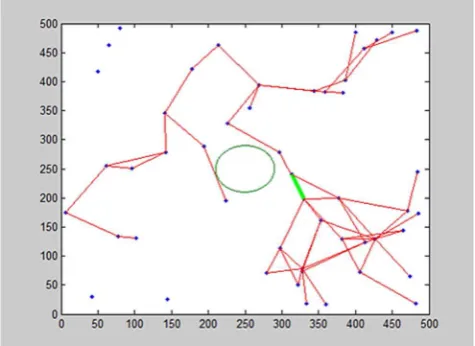
For the purpose of examining the impact of group mobility on routing performance in MANETs, we have extended a MATLAB network simulator that we initially developed and used in [8]. The simulations are event-driven, capable of modeling the AODV routing tasks as well as node mobility. Our main objective is to reveal the effect of group mobility my comparing two movement patterns: Behavioral Group Mobility and Column Mobility. A snapshot of the Column Mobility based network as presented by the simulator is provided in Fig. 1, where nodes can be seen in-line forming several groups.
In more detail, each network forms a connectivity graph. Each moving node of the network communicates with its neighboring nodes that are in communication range, creating active connections between the nodes. The total number of active connections of a node in the connectivity graph is denoted by node degree [9]. In our simulations, the node degree is practically the total number of neighboring nodes of a node. During the simulation in certain amount of time each node updates its position according to the mobility model that is applied. For each position update, the node degree is calculated all over again and at the end of the simulation we take into consideration the average node degree of all the position updates. We focus on the variation of the mean node degree and the factors that affect it, namely relevant position of nodes, velocity of nodes, and Number of nodes. Furthermore, we examine the following network metrics which are representative of the routing performance: throughput (average rate of successful message delivery over the network during the simulation time) and lost data packets (total number of packets that have been lost due to link failures – broken paths).
In order to have a complete view of network performance
under realistic conditions where obstacles may be present, we also considered mobility in an obstructed environment. The models applied for this purpose are Individual Behavioral Mobility and Behavioral Group Mobility. In that manner, we are able to reveal the impact of obstacle avoidance, as well as to compare group against individual mobility. The basic features that both models include are: Mutual avoidance, Obstacle avoidance, and Wall avoidance. The main difference of these models is that the former uses Eq. (1) to set the acceleration of each node individually, whereas the latter uses the same equation to calculate the acceleration of all the nodes in the same group. The specific simulation environment includes in the center an obstacle of a circular shape, with variable radius and signal loss, which affects the communication range of each entity. The considered network consists of fifty nodes, moving either individually or as groups, with maximum communication range of one hundred meters, default speed 1m/sec, and simulation space of size 250000 m2. In more specific, the
[image:4.595.314.552.56.237.2]percentage of signal loss depends on the obstacle’s material. In case of an obstacle interjecting two neighboring nodes, the communication range of both nodes decreases according to the chosen percentage of signal loss. The environment that has been chosen for this simulation is a representative application of a military operation environment, where soldiers move through a
Fig. 1. Simulation modeling of Column Mobility
[image:4.595.314.552.523.696.2]field with a natural obstacle, like a hill, as shown in Fig. 2. In both Individual and Group Behavioral Mobility with obstacles, we are also interested in the way the relevant position of nodes is affected by the size of the obstacles. We implemented an environment with one obstacle in the center of the simulation space. Thus the only nodes that were affected by the movement were those who moved through the center of the simulation space.
IV. SIMULATION RESULTS
In this section, we present the results of the simulation different MANET scenarios, where we first evaluate the effect of group mobility and then the impact of movement in an environment with obstacles.
Regarding the nature of the mobility models, it is evident that Column Mobility arranges nodes in a more structured way, allowing more connections between them comparing to Behavioral Group Mobility. The variation of mean node degree is presented in Fig. 3. As it is clearly shown, nodes in Column Mobility exhibit higher values of node degree. It is notable that as the number of groups increases, the node degree in the Behavioral Group Mobility scenario decreases, which constitutes evidence of the fact that when there are more groups, the relevant distance between nodes increases, resulting in less connection links. When more groups exist, more nodes move towards different directions, thus, they get sooner apart.
The effect of node speed is presented in Fig. 4, where it is shown that node degree decreases while speed increases, despite the fact that nodes belonging in the same group have the same direction. The distance of nodes which belong to the same group remains quite stable, but for nodes in different groups, their distance increases causing link disconnections. It is noted that the modeling of Column Mobility does not include a speed parameter. Instead, it uses an advance vector parameter, which is actually the measure of reposition vector (dx) of each node in a position update. Each node is repositioned according to the calculated advance vector. Thus, speed is calculated using the formula , where dt is the time elapsed between two position updates.
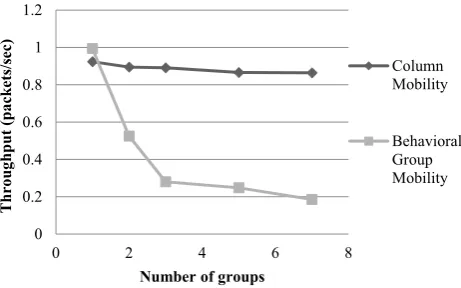
Throughput is affected by network load, node velocity, and node degree. Taking into consideration the results depicted in Fig. 5, the conclusion that throughput is indirectly affected by the number of mobility groups is drawn, since more and smaller groups lead to lower mean node degree.
[image:5.595.49.278.387.515.2]Regarding obstructed mobility, as illustrated in Fig. 2, we examine the impact of obstacles on network connectivity, while contrasting group with individual movement for the Behavioral Mobility model. As shown in Fig. 6, the mean node degree is only slightly affected by the obstacle size, since just the nodes that move close to the center of the simulation space are obstructed by the obstacle and move around it. Moreover, as it was expected, the mean node degree for Behavioral Group Mobility is higher than for Individual Behavioral Mobility,
Fig. 5. Throughput vs Number of groups for two Group Mobility Models 0 0.2 0.4 0.6 0.8 1 1.2
0 2 4 6 8
Th rou gh p u t (p ac k ets /s ec )
Number of groups
Column Mobility
[image:5.595.318.549.388.532.2]Behavioral Group Mobility
Fig. 3. Mean node degree vs Number of groups for two Group Mobility Models 0 2 4 6 8 10 12 14 16
0 2 4 6 8
M ean n od e d egr ee
Number of groups
Column Mobility
[image:5.595.316.552.564.698.2]Behavioral Group Mobility
Fig. 6. Mean node degree vs Obstacle Radius for Obstructed Mobility 0 0.5 1 1.5 2 2.5 3 3.5 4 4.5
0 20 40 60
M ean n od e d egr ee
Obstacle radius (m)
[image:5.595.52.278.564.697.2]Behavioral Group Mobility with obstacles Individual Behavioral Mobility with obstacles
Fig. 4. Mean node degree vs Node speed for two Group Mobility Models 0 2 4 6 8 10 12 14 16
0 10 20 30
M ean n od e d egr ee
Node speed (m/sec)
Column Mobility
because of the group formation. However, an obstacle of large size causes groups to break apart while avoiding it, resulting in a movement behavior similar to individual mobility. Neighboring nodes that move around the obstacle in opposite sides exhibited higher probability of losing connectivity in case of obstacle radius greater than 30 meters. In that case, the diameter of the obstacle was 60 meters and the nodes had to avoid it by increasing the distance between them by 70 meters. Considering that the percentage of signal loss caused by the obstacle was up to 25%, the communication range of the nodes decreased to 75 meters, approaching the communication threshold. Taking into consideration that a node, not only avoids obstacles, but also supports mutual avoidance of nodes, the distance between neighboring nodes in some cases may be elongated significantly. On the other hand, for radius less than 30 meters, the size of the obstacle doesn’t affect that much the relevant position of the nodes. In the contrary, nodes that move either in the same side of the obstacle or being diametrically opposed, didn’t lose connectivity.
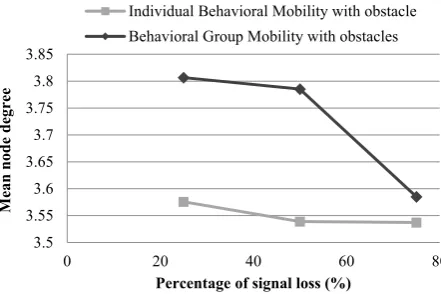
Fig. 7 shows that by increasing the percentage of signal loss caused by the obstacle, the mean node degree is consequently decreased for both Individual and Group Mobility. However, this reduction is not significant, since the obstacle only affects connections between nodes moving in opposite sides. Moreover, it should be noted that an indirect effect of the circular obstacle in the center of the simulation space is the fact that nodes concentrate around it, increasing in that manner the network density, hence, moderating the reduction of node degree.
V. CONCLUSION
This work investigated the impact of group mobility and obstructed mobility on routing and especially on the network connectivity of MANETs. By implementing different mobility models in a simulator developed for that cause, it is revealed how node movement affects network topology and how the routing protocol responds. Specifically, Column Mobility and Behavioral Group Mobility were simulated to examine and compared. Each mobility model, depending on the movement that it induces to the network nodes, alternates the nodes relevant position accordingly. Sudden changes in network topology result in link failures and loss of neighbors. In that case, existing routing entries become invalid, so the routing protocol removes them to prevent data loss. The simulated routing protocol was
the well-known and promising AODV protocol, which is considered one of the best candidates for MANETs.
In general, it has been shown that Behavioral mobility generates less coherent topologies than Column mobility, allowing the creation of limited links and unstable routes. In such conditions, AODV causes frequent deletion of available data paths and as a result the overall throughput drops. As far as obstructed mobility is concerned, obstacle size and positioning affect network connectivity in two ways; on one hand node connections are affected due to the presence of the obstacle in the line of sight, whereas on the other hand the impact on the dynamic topology is also notable, since nodes adjust their movement due to obstructions. In that manner, the concentration of nodes around the obstacle mitigates the negative effects due to the caused signal degradation.
Conclusively, routing in emerging mobile networks remains challenging; even specialized routing protocols developed for dynamic mobility fail to ensure reliable networking. The effectiveness of routing operations heavily depends on the specific application, which is characterized by different movement features that cause topological changes. In that sense, protocols that are able to adapt their functions to the mobility model that is identified for the particular scenario could prove an efficient approach for enhancing network reliability and performance. In the future, we intend to study such adaptive routing techniques and develop data forwarding solutions that self-optimize for different mobility conditions.
REFERENCES
[1] S. Misra, I. Woungang, and S.C. Misra, “Configuring, Self-Organizing, and Self-Healing Schemes in Mobilie Ad Hoc Network,” in Guide to Wireless Ad Hoc Networks, Springer, 2009.
[2] E. Natalizio and V. Loscri, “COntroled mobility in mobile sensor networks: advantages, issues and challenges,” Springer Telecommunication Systems, vol. 52, no. 4, pp. 2411-2418, 2013. [3] C. Lacatus, D. Akopian and M. Shadaram, "Reduced complexity
crosscorrelation interference mitigation in GPS-enabled collaborative ad-hoc wireless networks - Theory," Computers & Electrical Engineering, vol. 38, no. 3, pp. 603-615, 2012.
[4] C. Perkins, E. Belding-Royer and S. Das, "Ad hoc On-Demand Distance Vector (AODV) Routing," IETF RFC 3561, 2003.
[5] R.H. Jhaveri and N.M. Patel, “Mobile Ad-hoc Networking with AODV: A Review,” International Journal of Next-Generation Computing, vol. 6, no.3, pp. 165–191, 2015.
[6] V. Lalitha and R.S. Rajesh, “AODV_RR: A Maximum Transmission Range Based Ad-Hoc on-Demand Distance Vector Routing in MANET,” Springer Wireless Personal Communications, vol. 78, 491-506. [7] F. Legendre, V. Borrel, M. Dias de Amorim and S. Fdida, "Reconsidering
Microscopic Mobility Modeling for Self-Organizing Networks," Network, vol. 20, no. 6, pp. 4-12, 2006.
[8] T. D. Lagkas, A. Lamproudi, P. Sarigiannidis, and C. Skianis, “The impact of mobility patterns on the efficiency of data forwarding in MANETs,” in 2015 IEEE International Conference on Communications (ICC), pp. 6037-6042, London, U.K., 2015.
[image:6.595.49.270.551.698.2][9] V. Lenders, J. Wagner, S. Heimlicher, M. May and B. Platner, “An empirical Study of the Impact of Mobility on Link Failures in an 802.11 Ad Hoc Network,” Wireless Communications, vol. 15, no. 6, pp. 16-21, 2008.
Fig. 7. Mean node degree vs signal loss % for Obstructed Mobility 3.5
3.55 3.6 3.65 3.7 3.75 3.8 3.85
0 20 40 60 80
M
ean
n
od
e
d
egr
ee
Percentage of signal loss (%)
Individual Behavioral Mobility with obstacle