This is a repository copy of
Privateer : software for the conformational validation of
carbohydrate structures
.
White Rose Research Online URL for this paper:
http://eprints.whiterose.ac.uk/95794/
Version: Accepted Version
Article:
Agirre, Jon orcid.org/0000-0002-1086-0253, Iglesias-Fernández, Javier, Rovira, Carme et
al. (3 more authors) (2015) Privateer : software for the conformational validation of
carbohydrate structures. Nature structural & molecular biology. pp. 833-834. ISSN
1545-9985
https://doi.org/10.1038/nsmb.3115
[email protected] https://eprints.whiterose.ac.uk/ Reuse
Items deposited in White Rose Research Online are protected by copyright, with all rights reserved unless indicated otherwise. They may be downloaded and/or printed for private study, or other acts as permitted by national copyright laws. The publisher or other rights holders may allow further reproduction and re-use of the full text version. This is indicated by the licence information on the White Rose Research Online record for the item.
Takedown
If you consider content in White Rose Research Online to be in breach of UK law, please notify us by
NATURE STRUCTURAL & MOLECULAR BIOLOGY
| CORRESPONDENCEPrivateer: software for the conformational
validation of carbohydrate structures
Jon Agirre
1,
Javier IglesiasFernández
2,
Carme Rovira
2,3,
Gideon J
Davies
1,
Keith S Wilson
1&
Kevin D Cowtan
11 York Structural Biology Laboratory, Department of Chemistry, The University of York,
England.
2 Departament de Química Orgànica and Institut de Química Teòrica i Computacional
(IQTCUB), Universitat de Barcelona, Barcelona, Spain.
3 Institució Catalana de Recerca i Estudis Avançats (ICREA), Barcelona, Spain.
email: [email protected] or [email protected]
Nature Structural & Molecular Biology
22, 833–834 (2015) doi:10.1038/nsmb.3115 Published online 04 November 2015
Carbohydrates, including O and Nglycans attached to protein and lipid structures, are increasingly important in cellular biology. Crystallographic refinement of sugars is, however,
very poorly performed with thousands of incorrect structures polluting the PDB1,2. While
nomenclature validation became possible in the past decade with the introduction of tools
such as pdbcare3, inappropriate refinement protocols at resolutions lower than 1.6 Å can
still force the correct sugar into a most improbable ring conformation, let alone distort one
with chemical errors1. Higherenergy conformations are very infrequent in nature even out
of the question in Nglycans and should always be backed by clear electron density, and otherwise treated as outliers.
We have developed the Privateer software package for the detection and prevention of conformational anomalies in cyclic carbohydrate structures. The software identifies incorrect regio and stereochemistry and unlikely conformations, produces a visual checklist for rapid correction of the errors in real space, and ensures that conformational preferences are accounted for during subsequent rebuilding and refinement, achieved as follows.
Privateer holds a manually curated database of supported monosaccharides based on the
PDB Chemical Component Dictionary, whose entries contain coordinates for an
energyminimized conformer that the PDB calculates upon new depositions using Corina (Molecular Networks) or Omega (OpenEye). For each of these supported sugars, the
database holds the conformation as determined by the CremerPople algorithm4, as well as
stereochemical and geometric information, to be used as reference upon validation with the
during ab initio metadynamics simulations of the conformational freeenergy landscape of
cyclohexane5.
A real space correlation coefficient against omit mFoDFc electron density is reported as a qualityoffit indicator. Biasminimized map coefficients are exported automatically and can be subsequently used to assess identification of the sugars.
Privateer is able to feed results into Coot6 through its Python or Scheme scripting interface,
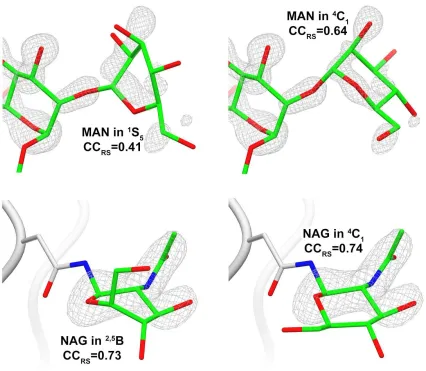
loading model and maps automatically and flagging issues up visually. Most of the conformational outliers detected at higher resolutions (< 1.6Å) are typically wrongly modelled from the start and may require rebuilding (Fig. 1, top panel). At lower resolutions, higherenergy conformations may appear as a consequence of underparameterized refinement, in spite of starting from a correct input model. These can be corrected during both real and reciprocal space refinement (Fig. 1, bottom panel) provided that enough restraints are introduced to balance the parametertoobservation ratio. A common way of introducing conformational preferences is by using harmonic torsion restraints, but these are
equally satisfied by multiple conformations, e.g. a chair and a boat. To enforce a single
conformation, Privateer produces CIF library files that contain monoperiodic torsion restraints on the ring bonds, computed directly from the minimalenergy conformer. These
files, generated using the CCP4 Storage, Retrieval and Search framework for small
molecule data (CCP4SRS), are compatible with all major refinement packages. In addition,
torsion restraints can be turned on for the distorted sugars in Refmac57 using the keyword
file generated by Privateer, making its integration into rerefinement pipelines such as
PDB_REDO8 straightforward. It is just such examples that emphasize the problems of
modelling sugars where the density is poor. In both cases, the published structures have high energy conformations which are not justified by the density, while is clearly more appropriate to use the expected minimal energy conformation.
Privateer is distributed by CCP49. A graphical user interface will be available in the upcoming
CCP4 7.0 release, fully automating the validation, correction and rerefinement process, and providing access to interactive HTML5/Javascript graphical reports. This publication should be considered the primary citation for Privateer.
Acknowledgments
This work was supported by the Biotechnology and Biological Sciences Research Council grant BB/K008153/1. The authors thank Eugene Krissinel (CCP4, UK) for valuable assistance in using CCP4SRS, and to the Barcelona Supercomputing Center (BSC).Competing financial interests
References
1 Agirre, J., et al. Nat Chem Biol 11(5), 303 (2015).
2 Lütteke, T. et al. Carbohydr. Res. 339, 10151020 (2004).
3 Lütteke, T. & von der Lieth, C.W. BMC bioinformatics. 5, 69 (2004).
4 Cremer, D. & Pople, J.A. J. Am. Chem. Soc. 97, 1354–1358 (1975).
5 IglesiasFernandez, J., et al. Chemical Science 6(2), 11671177 (2015).
6 Emsley, P. et al. Acta Cryst. D66 (4), 486501 (2010).
7 Murshudov, G.N. et al. Acta Cryst. D67(4), 355367 (2011).
8 Joosten, R.P. et al. Bioinformatics 27, 3392–3398 (2011).
9 Winn, M.D. et al. Acta Cryst. D67(4), 235–242 (2011).
10Brunger, A.T. Nature Protocols 2, 27282733 (2007).
Figure 1
Figure 1. Nglycan Dpyranosides in higherenergy conformations as deposited in the PDB (left) and their corrected counterparts (right). Grey mesh: omit mFoDFc density contoured at 4 . Top panel: MAN 616 (chain A) from PDB 3QVP. 3d7d, 1.1 Åresolution
data. This sugar was distorted to a 1S
5 conformation by the refinement software (CNS10)
after being modeled with a linkage instead of the expected one, and therefore required
rebuilding before it could be refined to the minimalenergy conformation (4C
1). Bottom panel:
NAG 1757 (chain A) from PDB 3D7D, refined with Refmac5 to the 2,5B conformation in
partial density. Since this conformation minimizes deviations from ideal bond lengths, angles and harmonic torsions, the model could not be corrected by restraining those parameters. Application of the monoperiodic torsion set in Refmac5 produced by Privateer produced the
expected minimal energy conformation (4C