White Rose Research Online URL for this paper:
http://eprints.whiterose.ac.uk/1040/
Article:
Linde, K., Hondras, M., Vickers, A. et al. (2 more authors) (2001) Systematic reviews of
complementary therapies – an annotated bibliography. Part 3: Homeopathy. BMC
Complementary and Alternative Medicine. ISSN 1472-6882
https://doi.org/10.1186/1472-6882-1-4
[email protected] https://eprints.whiterose.ac.uk/
Reuse
Items deposited in White Rose Research Online are protected by copyright, with all rights reserved unless indicated otherwise. They may be downloaded and/or printed for private study, or other acts as permitted by national copyright laws. The publisher or other rights holders may allow further reproduction and re-use of the full text version. This is indicated by the licence information on the White Rose Research Online record for the item.
Takedown
If you consider content in White Rose Research Online to be in breach of UK law, please notify us by
BMC Complementary and Alternative
Medi-cine (2001) 1:4
Research article
Systematic reviews of complementary therapies – an annotated
bibliography. Part 3: Homeopathy
Klaus Linde*
1,2
, Maria Hondras
3
, Andrew Vickers
4
, Gerben ter Riet
5,6
and
Dieter Melchart
1
Address: 1Centre for Complementary Medicine Research, Department of Internal Medicine II, Technische Universität, München, Kaiserstr. 9,
80801 München, Germany, 2Institute for Social Medicine & Epidemiology, Charité Hospital, Humboldt University, Berlin, Germany,
3Consortial Center for Chiropractic Research, Davenport, Iowa, USA, 4Royal London Homoeopathic Hospital, London, UK, 5NHS Centre for
Reviews & Dissemination, University of York, UK and 6Department of Epidemiology, Maastricht University, The Netherlands
E-mail: Klaus Linde* - [email protected]; Maria Hondras - [email protected];
Andrew Vickers - [email protected]; Gerben ter Riet - [email protected]; Dieter Melchart - [email protected]
*Corresponding author
Abstract
Background: Complementary therapies are widespread but controversial. We aim to provide a comprehensive collection and a summary of systematic reviews of clinical trials in three major complementary therapies (acupuncture, herbal medicine, homeopathy). This article is dealing with homeopathy. Potentially relevant reviews were searched through the register of the Cochrane Complementary Medicine Field, the Cochrane Library, Medline, and bibliographies of articles and books. To be included articles had to review prospective clinical trials of homeopathy; had to describe review methods explicitly; had to be published; and had to focus on treatment effects. Information on conditions, interventions, methods, results and conclusions was extracted using a pretested form and summarized descriptively.
Results: Eighteen out of 22 potentially relevant reviews preselected in the screening process met the inclusion criteria. Six reviews addressed the question whether homeopathy is effective across conditions and interventions. The majority of available trials seem to report positive results but the evidence is not convincing. For isopathic nosodes for allergic conditions, oscillococcinum for influenza-like syndromes and galphimia for pollinosis the evidence is promising while in other areas reviewed the results are equivocal.
Interpretation: Reviews on homeopathy often address general questions. While the evidence is promising for some topics the findings of the available reviews are unlikely to end the controversy on this therapy.
Introduction
In this third part of our series on systematic reviews in complementary therapies we report our findings on ho-meopathy. Homeopathy is one of the most widespread
forms of complementary medicine worldwide. According to a recent survey 3.4% of Americans have used homeop-athy in the past 12 months [1]. It is even more wide-spread in some European countries [2], some countries
Published: 20 July 2001
BMC Complementary and Alternative Medicine 2001, 1:4
Received: 22 March 2001 Accepted: 20 July 2001
This article is available from: http://www.biomedcentral.com/1472-6882/1/4
in South America, India or Pakistan [3]. This widespread use is in strong contrast with the position held by many in scientific medicine that homeopathy has no effect be-yond placebo [4].
The basic principle of homeopathy is the principle of similars: A patient with a specific pattern of symptoms is best treated by a remedy which causes the same or a very similar pattern in healthy subjects. Homoeopathic reme-dies are often prescribed in high dilutions some of which are unlikely to contain any molecules of the originally di-luted agents. In consequence, homoeopathic remedies – at least when applied in high dilutions – cannot act by pharmacological means. Theories for a potential mecha-nism of action, therefore, postulate the storage of infor-mation in the dilution process by physical means [5].
Methods
A detailed description of the methods used in this review of reviews is given in the first part of this series [6]. As a specific intervention-related inclusion criterion we re-quired that reports reviewed prospective (not necessarily controlled) clinical trials of homoeopathic medicines in humans.
Results
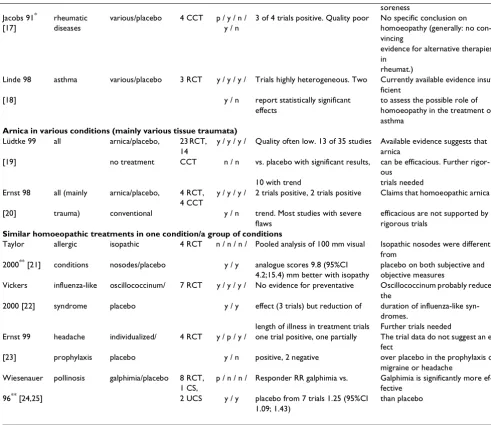
From a total of 22 potentially relevant reviews identified in the literature screening, 18 reviews published in 19 pa-pers met the inclusion criteria [7–25] (see table 1). Four papers were excluded as they were only subgroup or methodological analyses of previously published papers [26–29].
Three quantitative meta-analyses addressed the general question whether homeopathy is different from placebo by pooling highly heterogeneous study samples [7–9]. Study samples and meta-analytic methods differed con-siderably (total number of trials covered 97). While two reviews reported significant effects of homeopathy [7,8] a third found no effect over placebo in the main analysis [9]. Several years before the publication of these studies a meta-analytic approach had already been tried in a the-sis [10]. However, this review is mainly dealing with the problems encountered when trying to pool the data and cannot be interpreted meaningfully with respect to the effectiveness of homeopathy. Two older reviews included both placebo-controlled trials and comparisons with standard treatment [11,12] (total number of trials cov-ered 107). Results were classified in a vote count as posi-tive and negaposi-tive. The majority of the studies had reported positive results. The conclusions were positive with reservations in one review and ambiguous in the other.
Two reviews focused on individualized homeopathy but were not restricted in terms of conditions investigated. A review of comparisons of individualized homoeopathic and conventional treatment found that only few trials of low quality exist [13]. The other review included mainly placebo-controlled trials [14]. Overall, the results sug-gested that individualized homeopathy is superior to pla-cebo but when the analysis was limited to studies of better quality the difference was no longer significant.
Four reviews focused on a single condition or a group of conditions but included a variety of homoeopathic treat-ments [15–18]. Positive results have been reported for the treatment of postoperative ilues and asthma but de-finitive conclusions are not possible.
Arnica is the most often investigated homoeopathic rem-edy. Typically it is used in conditions involving tissue trauma. Two reviews with slightly different inclusion cri-teria have been published [19,20] (total number of trials covered 37). While the results of the available trials seem to be contradictory the more comprehensive of the two reviews had slightly more favorable conclusions.
Table 1: Systematic reviews of clinical trials of homoeopathy
Features
Author Year Indication Homoeopathy/ Studies 1 / 2 / 3 / Results Conclusion
Control 4 / 5
All homoeopathy in all conditions
Cucherat all all/placebo 17 RCT y / y / y / Combined p value for an effect There is some evidence that
2000 [7] n /y over placebo p = 0.000036, for homoeopathy is more than
place-bo.
best trials only p = 0.08 Studies of high quality more likely to be
negative
Linde 97 [8] all all/placebo 89 RCT y / y / y / OR of all trials over placebo 2.45 Results not compatbile with the y /y (95%CI 2.05; 2.93), in better trials hypothesis that all homeo-pathy is
1.66 (1.33; 2.08) placebo. No firm evidence for any single condition
Walach 97 all all/placebo, 41 RCT y / p / y / Random effect size g = 0.259 The effects of homoeopathy are not
[9] conventional y / y (95%CI -0.319; 0.837), fixed different from placebo on a statis-tical
effects 0.295 (0.223; 0.366) level Lutz 93 [10] all all/placebo, 21
RCT/ CCT
? / n / y / Results of available studies No clear conclusions drawn.
conventional y / p contradictory (Comment: thesis mainly
discuss-ing
problems of meta-analysis)
Kleijnen 91 all all/placebo, 107
CCT
y / p / y / 81 trials reported positive results. Available evidence positive but not
[11] conventional y / n Most trials low quality but many sufficient to draw definitive conclu-sions
exceptions
Hill 90 [12] all all/placebo, 40 RCT n / p / y / The authors of half of the studies The results do not provide accept-able
conventional y / n concluded that homoeopathy was evidence that homoeopathy treat-ments
effective, further 7 promising are effective Individualized homoeopathy in all conditions
Ernst 99 all individualized/ 3 RCT, 3 CCT
y / p / n / All trials were burdened with The relative efficacy of individual-ized
[13] conventional y / n serious methodological flaws. homoeopathy compared to
Results non-uniform conventional treatments is not known
Linde 98 all individualized/ 32 RCT y / y / y / Responder RR vs. placebo 1.62 Available evidence suggests effects [14] placebo, convent. y / y (95%CI 1.17; 2.23), in better over placebo. Evidence not
con-vincing
quality trials 1.12 (0.87; 1.44) due to shortcomings and inconsistencies Various homoeopathic treatments in a single condition/area
Barnes 97 postoperative various/placebo 4 RCT, 2 CCT
y / y / y / Time to first flatus in homoeopathy Available evidence positive but several
[15] ileus y / y significantly shorter. Best trial caveats preclude definitive
conclu-sions negative
Ernst 98 delayed- various/placebo 8 dou- ble-blind
y / y / y / Most trials with severe flaws. The Published evidence does not sup-port
[16] onset muscle trials (3 y / n 3 RCT showed no significant the hypothesis that homoeopathic
soreness
explicit-ly RCT)
Discussion
Systematic reviews on homeopathy address, more often than in other areas of complementary medicine, general questions such as "is it more than placebo?" or "is it ef-fective?" This is probably due to the fact that any effect of homeopathy over placebo is considered scientifically im-plausible. In consequence, the discussion does not pri-marily focus on specific clinical problems but on whether there is a real effect at all. While many overviews report that the majority of trial results are positive conclusions of reviewers are contradictory.
With few exceptions such as arnica for trauma or individ-ualized homeopathy for headache, the reviews (and probably the primary research) do not cover conditions and treatment approaches which are relevant in homoe-opathic practice. Self-medication with Oscillococcinum
for influenza-like syndromes is popular in several coun-tries but cannot be considered representative practice.
We want to emphasize again that it was not our primary objective to assess the effectiveness of homeopathy and the other therapies included in our series but to provide
soreness
Jacobs 91* rheumatic various/placebo 4 CCT p / y / n / 3 of 4 trials positive. Quality poor No specific conclusion on
[17] diseases y / n homoeopathy (generally: no
con-vincing
evidence for alternative therapies in
rheumat.)
Linde 98 asthma various/placebo 3 RCT y / y / y / Trials highly heterogeneous. Two Currently available evidence insuf-ficient
[18] y / n report statistically significant to assess the possible role of
effects homoeopathy in the treatment of
asthma Arnica in various conditions (mainly various tissue traumata)
Lüdtke 99 all arnica/placebo, 23 RCT, 14
y / y / y / Quality often low. 13 of 35 studies Available evidence suggests that arnica
[19] no treatment CCT n / n vs. placebo with significant results, can be efficacious. Further rigor-ous
10 with trend trials needed
Ernst 98 all (mainly arnica/placebo, 4 RCT, 4 CCT
y / y / y / 2 trials positive, 2 trials positive Claims that homoeopathic arnica is
[20] trauma) conventional y / n trend. Most studies with severe efficacious are not supported by
flaws rigorous trials
Similar homoeopathic treatments in one condition/a group of conditions
Taylor allergic isopathic 4 RCT n / n / n / Pooled analysis of 100 mm visual Isopathic nosodes were different from
2000** [21] conditions nosodes/placebo y / y analogue scores 9.8 (95%CI placebo on both subjective and 4.2;15.4) mm better with isopathy objective measures
Vickers influenza-like oscillococcinum/ 7 RCT y / y / y / No evidence for preventative Oscillococcinum probably reduces the
2000 [22] syndrome placebo y / y effect (3 trials) but reduction of duration of influenza-like syn-dromes.
length of illness in treatment trials Further trials needed
Ernst 99 headache individualized/ 4 RCT y / p / y / one trial positive, one partially The trial data do not suggest an ef-fect
[23] prophylaxis placebo y / n positive, 2 negative over placebo in the prophylaxis of
migraine or headache Wiesenauer pollinosis galphimia/placebo 8 RCT,
1 CS,
p / n / n / Responder RR galphimia vs. Galphimia is significantly more ef-fective
96** [24,25] 2 UCS y / y placebo from 7 trials 1.25 (95%CI than placebo
1.09; 1.43)
*Disease-focused review on a variety of complementary medicine interventions including homoeopathy; **Meta-analytic overviews of researchers of
[image:5.612.56.548.98.524.2]their own trials on the topic Features: 1 = comprehensive search, 2 = explicit inclusion criteria, 3 = formal quality assessment, 4 = summary of results for each included study, 5 = meta-analysis; y = yes, p = partly, n = no, - = not applicable, ? = unclear RCT = randomized controlled trials, CCT = non-randomized controlled trials, CS = cohort study, UCS = uncontrolled study; OR = odds ratio, RR = rate ratio
an annotated bibliography of the available systematic re-views. This provides an overall picture of the evidence but for an in-depth review readers must go back to the original reviews.
In conclusion, the available systematic reviews on home-opathy provide little guidance for patients and doctors. They rather reflect the ongoing fundamental controversy on this therapy and strengthen the perception that, on one side, positive evidence from clinical trials will not convince skeptics, and that on the other side negative re-sults from trials not representing actual practice will not have any impact on homoeopaths.
Competing interest
KL, AV, GtR and DM have been involved in some of the reviews analyzed. These were extracted and assessed by other members of the team.
Acknowledgements
KL's work was partly funded by the NIAMS grant 5 U24-AR-43346-02 and by the Carl and Veronica Carstens Foundation, Essen, Germany. We would like to thank Brian Berman for his support, his help to get funding and his patience in awaiting the completion of our work.
References
1. Eisenberg DM, Davis RB, Ettner SL, et al: Trends in alternative medicine use in the United States, 1990-1997. Results of fol-low-up national survey JAMA 1998, 280:1569-1575
2. Fisher P, Ward A: Complementary medicine in Europe BMJ
1994, 309:101-111
3. Malik IA, Khan NA, Khan W: Use of unconventional methods of therapy by cancer patients in Pakistan Eur J Epidemiol 2000, 16:155-160
4. Vandenbroucke JP: Homoeopathy trials going nowhere Lancet
1997, 350:824
5. Schulte J: Effects of potentization in aqueous solutions Br Hom J 1999, 88:155-160
6. Linde K, Vickers A, Hondras M, et al: Systematic reviews of com-plementary therapies – an annotated bibliography Part 1: acu-puncture. BMC Complementary and Alternative Medicine 2001, 1:3 7. Cucherat M, Haugh MC, Gooch M, Boissel JP: Evidence of clinical
efficacy of homeopathy. A meta-analysis of clinical trials Eur J Clin Pharmacol 2000, 56:27-33
8. Linde K, Clausius N, Ramirez G, et al: Are the clinical effects of homeopathy placebo effects? A meta-analysis of randomised placebo-controlled trials Lancet 1997, 350:834-843
9. Walach H: Unspezifische Therapie-Effekte. Das Beispiel Homöopathie PhD thesis, Psychologisches Institut, Albert-Ludwigs-Uni-versität Freiburg, 1997
10. Lutz C: Quantitative Meta-Analyse empirischer Ergebnisse der Homöopathieforschung Diplomarbeit, Psychologisches Institut, Albert-Ludwigs-Universität Freiburg, 1993
11. Kleijnen J, Knipschild P, ter Riet G: Clinical trials of homoeopathy
BMJ 1991, 302:316-323
12. Hill C, Doyon F: Review of randomized trials of homoeopathy
Rev Epidém et Santé Publ 1990, 38:139-147
13. Ernst E: Classical homoeopathy versus conventional treat-ments: a systematic review Perfusion 1999, 12:13-15
14. Linde K, Melchart D: Randomized controlled trials of individu-alized homeopathy: a state-of-the art review J Alt Complement Ther 1998, 4:371-388
15. Barnes J, Resch KL, Ernst E: Homoeopathy for post-operative il-eus: a meta-analysis J Clin Gastroenerol 1997, 25:628-633 16. Ernst E, Barnes J: Are homoeopathic remedies effective for
de-layed-onset muscle soreness? A systematic review of place-bo-controlled trials Perfusion 1998, 11:4-8
17. Jacobs JWG, Rasker JJ, van Riel PLCM, Gribnau FWJ, van de Putte LBA: Alternatieve behandelingswijzen by reumatische aan-doeningen; een literatuuronderzoek Ned Tijdschr Geneeskd
1991, 135:317-322
18. Linde K, Jobst K: Homoeopathy for asthma (Cochrane Review)
In: The Cochrane Library, Issue 4, 1998. Oxford: Update Software.
19. Lüdtke R, Wilkens J: Klinische Wirksamkeitsstudien zu Arnica in homöopathischen Zubereitungen In: Karl und Veronica Carstens-Stiftung, Jahrbuch Band 5 (1998). Edited by Albrecht H, Frühwald M. Essen: KVC Verlag 199997-112
20. Ernst E, Pittler MH: Efficacy of homoeopathic Arnica. A sys-tematic review of placebo-controlled clinical trials Arch Surg
1998, 133:1187-1190
21. Taylor MA, Reilly D, Llewellyn-Jones RH, McSharry C, Aitchison TC: Randomised controlled trials of homoeopathy versus place-bo in periennial allergic rhinitis with overview of four trial se-ries BMJ 2000, 321:471-476
22. Vickers AJ, Smith C: Homoeopathic Oscillococcinum for pre-venting influenza and influenza-like syndromes (Cochrane Review) In: The Cochrane Library, Issue 1, 2000. Oxford: Update Soft-ware.
23. Ernst E: Homeopathic prophylaxis of headaches and mi-graine? A systematic review J Pain Symptom Manag 1999, 18:353-357
24. Wiesenauer M, Lüdtke R: A meta-analysis of the homeopathic treatment of pollinosis with Galphimia glauca Forsch Komple-mentärmed 1996, 3:230-236
25. Lüdtke R, Wiesenauer M: Eine Metaanalyse der homöopa-thischen Behandlung der Pollinosis mit Galphimia glauca
Wien Klin Wochenschr 1997, 147:323-327
26. Ernst E, Resch KL: Clinical trials of homoeopathy: a re-analysis of a published review Forsch Komplementärmed 1996, 3:85-90 27. Ernst E: Are highly dilute homoeopathic remedies placebos?
Perfusion 1998, 11:291-292
28. Jonas WB, Linde K: Homeopathy and rheumatic disease Rheum Dis Clin North America 2000, 26:117-123
29. Linde K, Scholz M, Ramirez G, Clausius N, Melchart D, Jonas WB: Im-pact of study quality on outcome in placebo-controlled trials of homeopathy J Clin Epidemiol 1999, 52:631-636
Pre-publication history
The pre-publication history for this paper can be ac-cessed here:
http://www.biomedcentral.com/content/backmatter/ 1472-6882-1-4-b1.pdf
Publish with BioMed Central and every
scientist can read your work free of charge
"BioMedcentral will be the most significant development for disseminating the results of biomedical research in our lifetime."
Paul Nurse, Director-General, Imperial Cancer Research Fund
Publish with BMCand your research papers will be:
available free of charge to the entire biomedical community
peer reviewed and published immediately upon acceptance
cited in PubMed and archived on PubMed Central
yours - you keep the copyright
[email protected] Submit your manuscript here:
http://www.biomedcentral.com/manuscript/