Insider Attack and
Cyber Security
Advances in Information Security
Sushil Jajodia
Consulting EditorCenter for Secure Information Systems George Mason University
Fairfax, VA 22030-4444 email: [email protected]
The goals of the Springer International Series on ADVANCES IN INFORMATION SECURITY are, one, to establish the state of the art of, and set the course for future research in information security and, two, to serve as a central reference source for advanced and timely topics in information security research and development. The scope of this series includes all aspects of computer and network security and related areas such as fault tolerance and software assurance.
ADVANCES IN INFORMATION SECURITY aims to publish thorough and cohesive overviews of specific topics in information security, as well as works that are larger in scope or that contain more detailed background information than can be accommodated in shorter survey articles. The series also serves as a forum for topics that may not have reached a level of maturity to warrant a comprehensive textbook treatment.
Researchers, as well as developers, are encouraged to contact Professor Sushil Jajodia with ideas for books under this series.
Additional titles in the series:
INTRUSION DETECTION SYSTEMS edited by Robert Di Pietro and Luigi V. Mancini; ISBN: 978-0-387-77265-3
VULNERABILITY ANALYSIS AND DEFENSE FOR THE INTERNET edited by
Abhishek Singh; ISBN: 978-0-387-74389-9
BOTNET DETECTION: Countering the Largest Security Threat edited by Wenke Lee, Cliff Wang and David Dagon; ISBN: 978-0-387-68766-7
PRIVACY-RESPECTING INTRUSION DETECTION by Ulrich Flegel; ISBN: 978-0-387-68254-9
SYNCHRONIZING INTERNET PROTOCOL SECURITY (SIPSec) by Charles A.
Shoniregun; ISBN: 978-0-387-32724-2
SECURE DATA MANAGEMENT IN DECENTRALIZED SYSTEMS edited by Ting Yu
and Sushil Jajodia; ISBN: 978-0-387-27694-6
NETWORK SECURITY POLICIES AND PROCEDURES by Douglas W. Frye; ISBN:
0-387-30937-3
DATA WAREHOUSING AND DATA MINING TECHNIQUES FOR CYBER SECURITY
by Anoop Singhal; ISBN: 978-0-387-26409-7
SECURE LOCALIZATION AND TIME SYNCHRONIZATION FOR WIRELESS SENSOR AND AD HOC NETWORKS edited by Radha Poovendran, Cliff Wang, and Sumit Roy; ISBN: 0-387-32721-5
PRESERVING PRIVACY IN ON-LINE ANALYTICAL PROCESSING (OLAP) by Lingyu
Wang, Sushil Jajodia and Duminda Wijesekera; ISBN: 978-0-387-46273-8
SECURITY FOR WIRELESS SENSOR NETWORKS by Donggang Liu and Peng Ning;
ISBN: 978-0-387-32723-5
MALWARE DETECTION editedby Somesh Jha, Cliff Wang, Mihai Christodorescu, Dawn Song, and Douglas Maughan; ISBN: 978-0-387-32720-4
Additional information about this series can be obtained from http://www.springer.com
Insider Attack and
Cyber Security
Beyond the Hacker
by
Salvatore J. Stolfo
Steven M. Bellovin
Shlomo Hershkop
Angelos D. Keromytis
Columbia University, USA
and
Sara Sinclair
Sean W. Smith
Dartmouth College, USA
Salvatore J. Stolfo Steven M. Bellovin Angelos D. Keromytis Shlomo Hershkop
Columbia University
Department of Computer Science 1214 Amsterdam Avenue MC 0401 New York, NY 10027-7003 USA
Sean W. Smith Sara Sinclair
Department of Computer Science Dartmouth College
6211 Sudikoff Laboratory Hanover, NH 03755-3510 USA
Series Editor:
Sushil Jajodia
George Mason University
Center for Secure Information Systems 4400 University Drive
Fairfax VA 22030-4444, USA [email protected]
Library of Congress Control Number: 2008921346
ISBN-13: 978-0-387-77321-6 e-ISBN-13: 978-0-387-77322-3
Advances in Information Security series: Volume 39
Printed on acid-free paper.
The “Big Picture” of Insider IT Sabotage Across U.S. Critical Infrastructures by Andrew P. Moore, Dawn M. Cappelli, and Randall F. Trzeciak, Copyright 2007 Carnegie Mellon University is printed with special permission from the Software Engineering Institute.
CARNEGIE MELLON UNIVERSITY AND SOFTWARE ENGINEERING INSTITUTE MATERIAL IS FURNISHED ON AN "AS-IS" BASIS. CARNEGIE MELLON UNIVERSITY MAKES NO WARRANTIES OF ANY KIND, EITHER EXPRESSED OR IMPLIED, AS TO ANY MATTER INCLUDING, BUT NOT LIMITED TO, WARRANTY OF FITNESS FOR PURPOSE OR MERCHANTABILITY, EXCLUSIVITY, OR RESULTS OBTAINED FROM USE OF THE MATERIAL. CARNEGIE MELLON UNIVERSITY DOES NOT MAKE ANY WARRANTY OF ANY KIND WITH RESPECT TO FREEDOM FROM PATENT, TRADEMARK, OR
COPYRIGHT INFRINGEMENT.
© 2008 Springer Science+Business Media, LLC.
All rights reserved. This work may not be translated or copied in whole or in part without the written permission of the publisher (Springer Science+Business Media, LLC, 233 Spring Street, New York, NY 10013, USA), except for brief excerpts in connection with reviews or scholarly analysis. Use in connection with any form of information storage and retrieval, electronic adaptation, computer software, or by similar or dissimilar methodology now known or hereafter developed is forbidden. The use in this publication of trade names, trademarks, service marks and similar terms, even if they are not identified as such, is not to be taken as an expression of opinion as to whether or not they are subject to proprietary rights.
Printed on acid-free paper
9 8 7 6 5 4 3 2 1
On behalf of the Organizing Committee, I am pleased to present to you the proceedings of the first Workshop on Insider Attack and Cyber Security held in Washington DC in June 2007. This book serves to educate all interested parties in academia, government and industry and that helps set an agenda for an ongoing research initiative to solve one of the most vexing problems encountered in securing our critical IT infrastructure, the insider threat. In some sense, the insider problem is the ultimate security problem. Insider threats, awareness and dealing with nefarious human activities in a manner that respects individual liberties, and privacy policies of organizations, while providing the best protection of critical resources and services that may be subjected to insider attack, is a very hard problem requiring a substantial ef-fort by a large research community. We hope this book helps establish a community of researchers focused on addressing the insider problem.
The book contains a number of invited papers authored by attendees of the workshop. We believe the material that has been selected is of wide in-terest to the security research community. Papers have been invited that help define the nature and scope of the insider attack problem. Several papers provide an overview of technical solutions that have been proposed and dis-cuss how they fail to solve the problem in its entirety. An essential theme of the workshop was to educate researchers as to the true nature of the problem in real-world settings. Papers are provided that describe the nature and scope of the insider problem as viewed by the financial industry. The book con-cludes with technical and legal challenges facing researchers who study and propose solutions to mitigate insider attacks.
We wish to thank Cliff Wang of the Army Research Office, Daniel Schutzer of the Financial Services Technology Consortium and Eric Goetz of the Institute for Information Infrastructure Protection for supporting our effort and sponsoring the Workshop, and Shari Pfleeger of Rand Corpora-tion for providing the venue for our meeting and assistance in organizing the Workshop. We also thank the reviewers who served anonymously to vet the technical papers included here. Finally, we are especially grateful to Shlomo Hershkop and Sara Sinclair for their remarkable effort to organize and for-mat the individual papers to produce a final cohesive manuscript.
The Insider Attack Problem Nature and Scope... 1
1 Introduction ... 1
2 Types of Attack ... 1
2.1 Misuse of Access... 1
2.2 Defense Bypass ... 2
2.3 Access Control Failure ... 2
3 Defend or Detect... 3
4 The Role of Process... 4
5 Conclusion ... 4
Reflections on the Insider Threat... 5
1 Introduction ... 5
2 Who Is an Insider? ... 6
2.1 Motive ... 6
2.2 Effect ... 7
2.3 Defining the Insider Threat... 8
2.4 Context ... 8
3 Insider Threat Issues ... 9
3.1 Data ... 9
3.2 Psychology ... 10
3.3 Monitoring and Privacy... 12
3.4 Detecting Insider Attacks ... 13
3.5 Technology... 13
4 Conclusions ... 14
Acknowledgments ... 15
The “Big Picture” of Insider IT Sabotage Across U.S. Critical 17 1 Introduction ... 19
2 General Observations About Insider IT Sabotage ... 20
3 Model of the Insider IT Sabotage Problem... 24
3.1 Insider Expectation Escalation ... 25
3.2 Escalation of Disgruntlement ... 26
3.3 Attack Setup and Concealment... 27
3.4 The Trust Trap... 28
4 Possible Leverage Points for Addressing the Problem ... 29
4.1 Early Mitigation Through Expectation Setting... 29
4.2 Handling Disgruntlement Through Positive Intervention... 30
4.3 Targeted Monitoring... 31
4.4 Eliminating Unknown Access Paths... 32
4.5 Measures Upon Demotion or Termination ... 34
5.1 The Instructional Case ...36
6 Conclusion ...39
6.1 Value of Modeling for Insight ...40
6.2 Related CERT Research ...41
Acknowledgments ...43
Appendix A: System Dynamics Background ...45
Appendix B: The Insider IT Sabotage Training Case...48
1 Introduction...48
1.1 Background...48
1.2 The Final Weeks...50
Appendix C: Model of the Insider IT Sabotage Problem...52
Appendix D: Insider Sabotage Mitigating Measures ...52
Data Theft: A Prototypical Insider Threat...53
1 Introduction...53
1.1 Data Theft...53
1.2 Data Leakage ...54
1.3 Risk...54
1.4 Recommendations ...55
2 Status Quo...55
2.1 History ...55
2.2 Risks & Controls ...55
3 Recommendations...61
3.1 Technical Controls...61
3.2 Administrative Controls...64
3.3 Areas for Further Research...66
4 Conclusions...67
Acknowledgments ...67
A Survey of Insider Attack Detection Research ...69
1 Introduction...69
2 Insider Attacks ...72
3 Detecting Insider Attacks...73
3.1 Host-based User Profiling...73
3.2 Network-Based Sensors...81
3.3 Integrated Approaches...82
3.4 Summary...83
4 Future Research Directions...85
5 Conclusion ...87
Naive Bayes as a Masquerade Detector: Addressing a Chronic Failure ...91
1 Introduction...91
2 Related Work ...92
3 Background on Naive Bayes...94
5 Experiment With Synthetic Data ... 95
5.1 Variable Selection ... 95
5.2 Synthetic Data ... 97
5.3 Experiment Control ... 99
5.4 Procedure... 99
5.5 Results and Analysis... 100
6 Naive Bayes Mathematical Formulation ... 101
6.1 Calculating the Anomaly Score... 101
6.2 Manipulating the Anomaly Score... 103
6.3 Effect of NBSCs ... 105
7 Exploiting NBSCs to Cloak Attacks... 106
8 Naive Bayes Fortification ... 107
8.1 The Fortified Detector ... 107
8.2 Evaluation Methodology ... 108
8.3 Evaluation Results and Analysis ... 109
9 Discussion... 110
10 Conclusion ... 111
Towards a Virtualization-enabled Framework for Information 1. Introduction ... 114
2. Threat Model and Requirements... 114
3. Background... 116
3.1. Models of Policy Enforcement ... 116
3.2. Hardware Virtualization ... 117
4. System Architecture... 117
4.1. Platform Architecture ... 118
4.2. Network Architecture ... 119
5. Implementation... 120
5.1. Virtualization-enabled Information Tracing... 121
6. Analysis ... 124
6.1. Performance Discussion ... 125
6.2. Threat Mitigation... 126
7. Related Work... 126
8. Conclusion ... 129
Acknowledgments ... 129
Reconfigurable Tamper-resistant Hardware Support Against Insider Threats: The Trusted ILLIAC Approach ... 133
1 Introduction ... 133
2 Software-based Transparent Runtime Randomization ... 135
3 Tamper-resistant Key-store Support for Threshold Cryptography ... 137
3.1 Crypto-engine Architecture ... 138
3.2 Security Analysis... 139
4 Information Flow Signature Checking for Data Integrity... 140
4.1 Threat Model ...141
4.2 Approach ...141
4.3 Implementation...143
5 System Architecture Including the Trusted Computing Engine ...144
5.1 Protecting Against Insider Attack With User-level Privileges: Runtime Guarantees ...146
5.2 Protecting Against Insider Attack with Administrative Privileges: Initialization and Runtime Guarantees ...147
6 Conclusions and Future Directions...149
Surviving Insider Attacks: A Call for System Experiments ...153
1 Introduction...153
2 Principles for Survivability ...155
2.1 Avoidance of a Single Point of Failure...156
2.2 Independence of Failure Modes and Attack Vulnerabilities...157
2.3 Fast Recovery from Failure and Attack...158
2.4 Attack Deterrence ...159
2.5 Least Privilege Authorization ...160
3 Cost Factors ...161
4 Conclusion: A Call for Research and Development Experiments ...161
Preventative Directions For Insider Threat Mitigation Via Access Control ...165
1 Introduction...165
2 Definitions and Threat Model...168
2.1 The Insider...168
2.2 Types of Insiders ...169
2.3 Damage of Insider Attacks ...169
2.4 Threat Model ...170
3 Background and Primitives...171
3.1 Authentication and Authorization...171
3.2 Access Control Principles...172
3.3 MAC, DAC, and Intermediate Schemes...172
3.4 Users and Groups...173
3.5 Roles and Role Engineering ...174
3.6 Public Key Cryptography ...174
4 Requirements ...175
4.1 Functionality...175
4.2 Usability and Cost ...176
4.3 Scale and Complexity...178
4.4 Domain Considerations ...179
5 Tools ...181
5.1 Passwords: Knowledge-Based Authentication ...181
5.2 Biometrics: Physiology-Based Authentication ...182
5.3 Tokens: Possession-Based Authentication ...183
5.5 Distributed Authentication and Identity Management... 185
5.6 Distributed Authorization ... 186
6 Ongoing Challenges... 188
6.1 A Snapshot of a Motion Picture ... 189
6.2 Privilege Issuance and Review ... 189
6.3 Auditing and Visualization... 190
6.4 Role Drift and Escalation ... 190
6.5 Expressiveness and Need to Know... 191
6.6 Incentives... 191
7 Conclusions ... 191
Acknowledgments ... 192
Taking Stock and Looking Forward – An Outsider’s Perspective on the Insider Threat... 195
1 Introduction ... 196
2 What Is An “Insider Threat”? ... 198
3 How Does The Research Community Get Better Data?... 201
3.1 Changing the Incentives that Organizations Face... 205
3.2 Integrating Technical Solutions with Social Science 3.3 Creating a Response and Recovery System for Insider Threats .. 211
4 Conclusion ... 213
Research Challenges for Fighting Insider Threat in the Financial Services Industry... 215
1 Introduction ... 215
2 Employee Screening And Selection ... 216
3 Access Controls ... 217
4 Monitoring And Detection... 218
Hard Problems and Research Challenges Concluding Remarks ... 219
Index ... 223
Steven M. Bellovin
Computer Science Department, Columbia University
1
Introduction
Hackers, especially "terrorist hackers" or "cyberwar hackers" get lots of press. They do indeed pose a serious problem. However, the threat they pose pales be-fore that posed by those closest to us: the insiders.
The cyberthreat posed by insiders isn’t new. Donn Parker’s seminal 1978 book Crime by Computer estimated that 95% of computer attacks were committed by authorized users of the system. Admittedly, this was in the pre-Internet era, when very few non-insiders had any access at all; still, the underlying issue – that em-ployees are not always trustable – remains. To be sure, this has always been true – thieving or otherwise corrupt workers have undoubtedly existed since commerce itself – but the power of computers (and our inability to secure them in the best of circumstances) makes the problem far worse today.
In June 2007, a workshop (sponsored by Cliff Wang of the Army Research Of-fice) on the insider threat was held. Approximately 35 invitees attended, including security researchers, vendors, practitioners, and representatives of organizations that perceive a serious insider threat. The goal was to develop a research commu-nity on the insider threat. Of necessity, our first steps were to understand the scope of the problem, to develop a common vocabulary, and to start sketching a research agenda. This volume consists of papers contributed by some of those at-tendees.
2
Types of Attack
Fundamentally, there are three different types of attack: misuse of access, defense bypass, and access control failure. Each must be approached differently.
2.1
Misuse of Access
wrong reason. In a university, for example, professors have the right to submit grade change requests after the semester is over. Typically, this is done to correct clerical errors or to deal with other unusual situations. The same action, if done in response to a bribe, would constitute insider misbehavior.
It is not possible to prevent or detect misuse by purely technical means, except in special situations. Generally speaking, the most that can be done is monitoring for unusual patterns or quantities of requests. Detailed logging can be useful if the person falls under suspicion for other reasons.
In some environments, such as the intelligence community, external data can be combined with technical analyses to detect abuse. For example, financial records, spending patterns, etc., can be examined to detect inappropriate sources of income. (Such data can also be missed. The CIA never noticed that Aldrich Ames drove a car that cost more than his annual salary.)
2.2
Defense Bypass
Insiders generally have a major inherent advantage over outsiders: they’re already past some defense layers. For example, many companies rely on firewalls as part of their cybersecurity. More or less by definition, insiders are on the inside of the firewall; they are thus not blocked by it. Similarly, insiders generally have some sort of login access to an organization’s computer systems; this permits local at-tacks, rather than only attacks against network services.
Again, it is hard to conceive of purely technical defenses. Insiders, by defini-tion, are inside; they thus have more opportunities to commit mischief. Detection mechanisms can work well; in particular, they can look for either anomalous be-havior or actual attacks on nominally-protected systems.
2.3
Access Control Failure
By contrast, access control failures represent a technical problem. Either an ac-cess control mechanism is buggy or the system has been configured improperly. Either way, the preferred solution is to correct the problem.
3
Defend or Detect
There are two fundamentally different approaches to dealing with insider attacks: defend against them, or detect them after the fact. While defense is generally preferable, it isn't clear that it is always feasible. Only one of the possible attack types – access control failures – can be defended against in any strong sense.
It is tempting to say that the same is true for all attacks, by insiders or outsiders. Examination of the attack taxonomy shows that this assertion is false. By defini-tion, insiders have more access; this is the essence of their status, their responsi-bilities – and their ability to launch attacks.
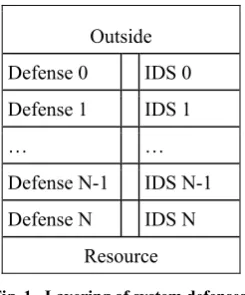
Another way to look at it is to consider system defenses schematically. As-sume, as is generally the case, that the resource is protected by defense in depth. That is, there are N (more or less) independent defense layers. Further assume that each such layer consists of a combination of technical measures and an intrusion detection system tailored for that layer. The system then looks like this:
Outside Defense 0 IDS 0 Defense 1 IDS 1
… …
Defense N-1 IDS N-1 Defense N IDS N
[image:14.439.159.282.257.405.2]Resource
Fig. 1. Layering of system defenses.
An outsider must penetrate all N layers. Insiders, though, have fewer layers to penetrate. Their task is thus strictly easier than that of an outside attacker. This is, of course, the definition of our second class of attack. Second, authorized users, whether behaving properly or not, of necessity have access rights that let them penetrate all N layers.
4
The Role of Process
In some circumstances, a combination of procedural and technical mechanisms can be employed as an additional mechanism to prevent or detect misuse of access attacks. Specifically, the ability to perform certain actions can be limited so that no one person can do them alone. Alternatively, manual audit checks can detect certain kinds of abuse after the fact.
Both of these ideas are rooted in old manual processes. Large checks have long required two signatures, certain cash register operations can only be done by su-pervisors, ordinary accounting audits can detect fraud, etc. The same can be done in computer systems: certain transactions can be blocked until requested by two different individuals.
Note that this does not contradict our assertion that there are no technical de-fenses against misuse of access attacks. If two person control is employed, a sin-gle individual does not have certain access rights. Furthermore, protection is pro-vided by a combination of policy and technical defenses.
5
Conclusion
Defending against insider attacks is and will remain challenging. For the most part, traditional computer security defenses will not suffice. It will take a combi-nation of things – technical defenses, intrusion detection systems, process, and more – to provide meaningful protection.
The remaining papers in the introductory section includes a detailed accounting of the workshop discussions provided by Charles Pfleeger and an industry per-spective of the problem provided by Michael McCormick. The second section contains a number of invited technical papers (by Malek Ben Salem, Shlomo Hershkop, and Sal Stofo; Roy Maxion; Ravi Sahita; Ravishankar Iyer; Virgil Gli-gor; and Sara Sinclair) describing the state of the art in insider attack detection, in-cluding a proposal for hardware support for preventing insider attack and an over-view of the state-of-the-art in masquerade attack detection, with a sobering over-view of the limits of anomaly detection techniques if poorly designed. The book con-cludes with a perspective on the legal and ethical issues (by Jeffrey Hunker; Daniel Schutzer; Angelos Keromytis) raised by technical approaches to detecting insider attack, as well as contributions that set an agenda for future research.
Charles P. Pfleeger
Pfleeger Consulting Group
Abstract This paper reports on a workshop in June 2007 on the topic of the in-sider threat. Attendees represented academia and research institutions, consulting firms, industry—especially the financial services sector, and government. Most participants were from the United States. Conventional wisdom asserts that insid-ers account for roughly a third of the computer security loss. Unfortunately, there is currently no way to validate or refute that assertion, because data on the insider threat problem is meager at best. Part of the reason so little data exists on the in-sider threat problem is that the concepts of inin-sider and inin-sider threat are not con-sistently defined. Consequently, it is hard to compare even the few pieces of in-sider threat data that do exist. Monitoring is a means of addressing the inin-sider threat, although it is more successful to verify a case of suspected insider attack than it is to identify insider attacks. Monitoring has (negative) implications for personal privacy. However, companies generally have wide leeway to monitor the activity of their employees. Psychological profiling of potential insider attackers is appealing but may be hard to accomplish. More productive may be using psy-chological tools to promote positive behavior on the part of employees.
1
Introduction
In June 2007the U.S. Army Research Office, the Financial Services Technology Consortium (FSTC) and the Institute for Information Infrastructure Protection (I3P) sponsored a workshop on insider attack and cyber security. The two-day event featured participants from academia, research institutions, consulting firms, industry, and the government. The security researchers, practitioners and vendors in who attended shared insights and frustrations.
2
Who Is an Insider?
Who is an insider?
This question seems straightforward and easy to answer. But as with other fundamental terms in computer security (such as integrity, availability, or even se-curity) the definition of insider is not well established. There are several possible uses of the term.
An insider can be:
• an employee, student, or other “member” of a host institution that op-erates a computer system to which the insider has legitimate access • an associate, contractor, business partner, supplier, computer
mainte-nance technician, guest, or someone else who has a formal or informal business relationship with the institution
• anyone authorized to perform certain activities, for example a bank’s customer who uses the bank’s system to access his or her account • anyone properly identified and authenticated to the system including,
perhaps, someone masquerading as a legitimate insider, or someone to whom an insider has given access (for example by sharing a pass-word)
• someone duped or coerced by an outsider to perform actions on the outsider’s behalf
• a former insider, now using previously conferred access credentials not revoked when the insider status ended or using access credentials secretly created while an insider to give access later
This rather broad range of interpretations of the term insider is by no means ex-haustive. But it does point out the potential for confusion both inside and outside the computer security profession.
2.1
Motive
The motives for an insider attack are similarly diverse. In fact, the term “attack” may be overly harsh for certain types of insider actions:
• making an unintentional mistake
• trying to accomplish needed tasks—for example, in a case in which the system does not support a particular action or the insider is blocked from accessing certain data, the insider may try workarounds to accomplish the same thing
• trying innocently to do something beyond the authorized limit, with-out knowing the action is unauthorized
• checking the system for weaknesses, vulnerabilities or errors, with the intention of reporting problems
• testing the limits of authorization; checking the system for weak-nesses, vulnerabilities or errors, without the intention of reporting problems
• browsing, killing time by viewing data
• expressing boredom, revenge or disgruntlement
• perceiving a challenge: treating the system as a game to outwit • acting with the intention of causing harm, for reasons such as fame,
greed, capability, divided loyalty or delusion
We obviously react differently to these different motivations, sympathizing with the employee who wants to get work done in spite of the system, but deplor-ing agents with malicious intent. Unintentional errors are usually seen as unfortu-nate but inevitable, and malicious behavior is usually seen as something heinous that should be prevented. But the area between these two ends is grey.
Unfortunately for research purposes different people include different ones of these cases in the definition of insider behavior. A given action may be classified as an insider attack in one study but not in another, which complicates assessing the severity and frequency of insider “attacks.” Because different projects use dif-ferent definitions, comparing results or statistics between projects can be difficult for analysts and misleading to the public.
As one participant pointed out during the workshop, two interesting cases arise: when bad things happen even though system privileges are not exceeded, and when good things happen even though system privileges are exceeded. We might initially say we want to prevent the former, but blocking acceptable behavior risks limiting a system’s usability. We also tend to excuse the latter if the good domi-nates. These two cases show how difficult it is to separate acceptable insider be-havior from unacceptable. With a murky policy definition, enforcement becomes problematic.
2.2
Effect
Another way to analyze the insider threat is to look at the effect insiders’ actions have had. Here are some impacts of insider attacks:
• making available data or computer services to people who would oth-erwise not have had them—either because the people were not author-ized or because the system failed to deliver as expected or intended • receiving data for which the user was not authorized because such data
• obtaining data or services for fraudulent purposes
The first impact here would sometimes be considered positive, and the last is usually negative. The middle impact can be mixed, depending on what use the user made of the data. The impact of a insider can thus range from positive to negative.
2.3
Defining the Insider Threat
Two major points stand out: First, we need standard definitions of insiders and in-sider behavior so studies and discussions can compare like entities. These defini-tions need to be used not just in the computer security research community but also by commercial security professionals (such as chief security officers and other management) and the press. (Convincing the press to use these terms pre-cisely may be challenging.)
Second, we need to recognize that, unlike the “outsider” threat, insider behavior with the potential to do harm ranges from human nature (unintentional errors) through positive intentions (getting the job done in spite of an uncooperative sys-tem) and finally to all kinds of malice. Threat is the common term in computer security for an action with the potential to cause harm. But because the word “threat” has a negative connotation, some people would understandably not ordi-narily use it to describe unintentional or non-malicious behavior. We must be es-pecially careful when using the term “insider threat” to be sure our meaning is not misconstrued and insiders are not offended.
2.4
Context
Distinguishing acceptable from unacceptable insider behavior is difficult in part because of context. A disclosure may be acceptable only to certain people, at a certain time, in a certain location, in the presence (or absence) of certain other people, if certain other conditions obtain, for one time, and only if the recipient has not already obtained certain other data. Although such complex access control rules can be modeled and implemented, these rules go well beyond the subject– object–mode paradigm traditionally used for access control. These complex rules reflect the factors employed daily in personal data sharing decisions (between people, not involving computers), computer scientists do not even know the full set of parameters on which access control decisions are based outside of com-puters; thus it is premature to expect their implementation in most computing sys-tems.
and human overrides that can exercise judgment (such as dealing with the lost or forgotten badge or allowing emergency access by medical personnel). Acceptable behavior can be similarly rigidly determined by a system. But the working of some organizations is highly nuanced and sensitive data are communicated under subjective access control regimes.
These rich, context-based human access control decisions pose a problem for insiders: To share computerized data in those ways may require going outside or around the system, that is, violating system access controls. This is one of many examples in which insiders need to go outside or around the system’s controls in order to accomplish needed goals.
3
Insider Threat Issues
Research on insider threats has several limitations. First, there is only meager data on inappropriate insider activity. Second, it would be very useful to probe the minds of insiders to determine what makes an insider good or bad. In part because of limited data, and in part because of limitations of current psychology, success in this avenue may be narrow. Third, the way to determine what insiders are doing is to monitor them, but monitoring of users or employees has privacy implications. Finally, technology is important in many areas of computer security, but the sider threat may be one for which the uses of current technology are somewhat in-complete.
3.1
Data
Research on the insider threat is hampered by the definitional problems described above. An even more serious limitation is the scarcity of data.
As a community we assert certain points, but in the realm of insider threat and insider behavior some of our assertions are hunches. Repeated enough times, hunches become accepted as fact.
Obtaining accurate data on the insider threat is difficult for several reasons, in-cluding
• imprecise definitions (as previously discussed)
• unclear policy of what constitutes welcomed or allowable insider be-havior versus what constitutes bebe-havior to be discouraged or prohib-ited
• massive amounts of data: assuming that the number of acceptable sider actions is far larger than the number of potentially negative in-sider threat actions, large amounts of uninteresting data will have to be filtered out
• reticence to share: because of laws, image, morale, and other factors, some organizations who collect data on insider activity are unwilling to share data with other organizations
• privacy concerns that limit data collection and sharing
The absence of good data limits researchers’ ability to analyze, hypothesize and validate. One researcher went so far as to say that researchers need data to address problems; if organizations are not serious enough to supply researchers data, they (the organizations) aren’t treating their problem as serious.
One source of data are police and court records. Cases are usually in the public record and details of the crime are reasonably complete. However, these records present a biased view of insider threat. First, police are involved only in crimes. As described earlier, insider behavior can sometimes be positive, so the police will not be involved. Even when the behavior is negative in some cases the companies will let the insider off with a warning or at most a dismissal. And some kinds of insider malicious activity are not criminal offenses. Second, some companies choose not to prosecute even in the case of a crime, fearing the negative publicity. Furthermore, faced with many crimes, district attorneys sometimes put computer crime cases low on their priority list, especially cases in which the loss is intangi-ble and not huge, because of the complexity of prosecuting the case and the con-sequently low probability of winning. Finally, crime statistics typically cover only a single country (or other jurisdiction, such as a city or district), meaning that in-sider attacks against multinational companies may be hard to track. For all these reasons, criminal data must be viewed in context.
3.2
Psychology
Some participants wanted a psychological profile of an insider who was likely to offend (and preferably before the offense). More than one person wanted to know how to identify potential insider attackers (before they attack, and ideally before they are hired).
For years the criminal justice system has unsuccessfully sought the profile of the criminal. Criminologists are not even close to identifying criminals reliably in advance. It seems as if criminals are varied in their motivation and psychological makeup. We may be able to identify some very antisocial personalities, but other criminals elude advance detection. The possibility of false positives hampers these efforts. If we have been unable to identify serious criminal intent or behav-ior, why should we expect to be able to identify insider threats?
Complicating psychological identification is that we send mixed signals to in-siders. We praise creative individuals, ones who are adept at making a recalcitrant system work. Initiative, industriousness, and problem solving are positive traits on employee reviews. So we should not be surprised when an insider users these traits to be more productive.
We do not know if insiders expand their threat activity, first for nonmalicious purposes and then gradually to more malicious ends. Consequently we do not know if our rewarding unorthodox system use actually starts insiders on a path to malicious behavior. The situation is probably far more nuanced than this descrip-tion.
Psychological screening would be ideal before an employee is hired. The typi-cal job interview lasts no more than one day, and it involves both trying to get a sense of whether to hire the potential employee and at the same time convincing the employee to accept a job if offered. An intense psychological evaluation rig-orous enough to identify potential inside attackers might be off-putting to non-attackers who should be hired. And time spent evaluating the candidate psycho-logically reduces the time to assess whether the person would be an asset to the organization. So, even if a psychological exam were available, its use might be counterproductive.
Prospects do not look good for developing psychological profiles. We have too little data (too few cases) with which to work, we do not have a good understand-ing of the norms of acceptable behavior, we are not sure where is the boundary be-tween acceptable and unacceptable behavior, and we must be able to address many different motivations for unacceptable behavior. Perhaps when we understand general human behavior better we will be able to develop useful profiles.
The other major use for psychology is positive: developing ways of reinforcing good behavior. Some participants wanted to understand how to use psychology to keep insiders acting in positive ways. The prospects seem more promising for this use of psychology than for profiling.
technique is largely effective, meaning that it serves it desired purpose on a sig-nificant enough proportion of people, it is deemed successful. We can afford to use several motivational techniques that work for different people.
3.3
Monitoring and Privacy
Privacy concerns significantly limit data collection and psychological modeling. Again, the definition of insider becomes important.
When the insider is an employee, privacy rights are subordinated to business rights. The courts have consistently upheld the right of a company to monitor em-ployees’ behavior, as long as there is a reasonable business purpose for the moni-toring and the monimoni-toring does not violate basic human and civil rights. Thus, companies can generally capture and analyze an employee’s email and other communications that use company equipment, log all files and other resources an employee accesses, and retain copies of programs and data an employee creates under the company’s auspices. A company is far more free in tracking its em-ployees’ system activities than would be law enforcement, for whom probable cause and a search warrant are needed.
But not all insiders are employees. Some definitions of insider include people such as account holders who access their bank accounts, patients who use an elec-tronic system to communicate with medical professionals or view or manage their medical records, students at universities, customers who use online shopping tems, and similar users. Each of these users has certain authorized access to a sys-tem. Privacy for some classes of users is covered by laws, such as HIPAA for pa-tients in the United States or the European Privacy Directive for many accesses by Europeans. In other cases, the privacy regulations allow monitoring, data collec-tion and retencollec-tion, and even data sharing if it is documented in a privacy policy (and sometimes even if not). In these cases, then, privacy rights vary.
Regardless of whether the company has the right to monitor its users’ actions, some companies choose not to monitor because of possible negative public opin-ion.
Another type of insider is the business partner, consortium member, subcon-tractor, or the like. In these cases, privacy rights are even weaker than for the category of users. The contract between partners may spell out rights to track be-havior, although not all such relationships are covered by a contract.
3.4
Detecting Insider Attacks
Insider attacks are difficult to detect, either by human or technical means. One workshop participant observed that most insider attacks are detected only because of some reason to suspect: the insider may have talked (bragged) about the act, for example. In other kinds of crime police investigators sometimes profit from a perpetrator who does something to draw suspicion.
An insider attack recognition tool would be useful to flag attacks or suspicious behavior in time to limit severity. Clearly most insider activity is not malicious; otherwise organizations’ computer systems would be constantly broken. Thus, the volume of nonmalicious insider activity far outweighs that of malicious activity. Such volume of data is hard to analyze.
A similar example is an intrusion detection system protecting a system from malicious network access: Most network traffic is benign. Intrusion detection technology is improving all the time. However, intrusion detection systems are best at finding specific examples of inappropriate access, either because the access fits a pattern of known malicious activity or because the access touches specific sensitive resources in unusual ways. The hardest attack for an intrusion detection system to recognize is one composed of pieces spread across a long period of time. For those attacks the intrusion detection system has to collect and correlate pieces of data over time, which implies a long window of data comparison.
Inside attackers presumably will perform both normal and malicious acts, which complicates the search for anomalous activity beyond that performed by an intrusion detection system.
One important question raised, then, about monitoring to identify inappropriate behavior is whether the monitoring is effective. Intrusion detection techniques may be of some value. But because there is so little published research on insider attacks, it is impossible to tell whether monitoring helps. Monitoring is useful to confirm a suspected case of insider attack. There is controversy as to whether monitoring serves as a deterrent; that is, if insiders know their activity is being monitored are they less likely to engage in inappropriate activity? The answer to that is unknown, although one workshop participant noted that monitoring is not effective to deter retail theft by employees. Another participant said that detection of a data leak is unlikely unless there is some trigger that makes the leak promi-nent.
3.5
Technology
What technology is available to detect, deter, or prevent insider attacks?
defense. With insider attacks, drawing the protection line is more difficult be-cause the attacker and the sensitive resources are on the same side of the line.
Intrusion detection systems may be of some value in detecting insider attacks. As previously discussed, these systems need to analyze a large amount of data, correlate pieces of data potentially spread over a long period of time, and distin-guish malicious from nonmalicious intent. These three factors exceed the current demands on intrusion detection systems.
Operating systems, access controls and audit logs offer little support for con-trolling insider threats, because the insider is acting within limits of authorized be-havior, just doing inappropriate things with that allowed access.
But more to the point, technological approaches may be wrong for dealing with the insider threat. The basic element of the insider threat is human: a perpetrator has abused a position of trust. The insider is part of the organization and has some loyalty to it. Capitalizing on the human aspect includes determining what kinds of people are likely to abuse trust or creating an environment in which people would not want to abuse.
4
Conclusions
Little is known about the insider threat. Even computer security professionals use different definitions for insider, and so it is not surprising that the general comput-ing field, as well as the general public, can offer little insight into the problem of insider attacks. Add to this organizational reticence to be embarrassed in public and it is not surprising that there is little valid measurement and reporting on in-sider attacks or the inin-sider threat.
Several significant points evolved at the insider threat workshop:
• The term insider must be clearly defined. That definition must be communicated to security professionals, computer professionals out-side of security, management, and the general public.
• The term insider attack must be clearly defined. That definition must be communicated to security professionals, computer professionals outside of security, management, and the general public.
• Data from reliable measurement of insider activity—malicious and not—must be gathered and shared within the security research com-munity.
• Cooperation with industry is necessary: Industry has the insider attack cases, but security researchers have the tools and inclination to ana-lyze the data. Each side needs the other.
• Psychology may be more effective at finding positive controls: condi-tions that make it less likely that an insider will want to harm the or-ganization.
• Technical controls to prevent, detect, or deter malicious insider behav-ior will be difficult to develop. The insider exploits legitimate access. Limiting such access may have a negative effect on nonmalicious em-ployees’ productivity.
Acknowledgments
I would like to thank the conference organizers for inviting me to attend this workshop and to write this overview paper for the proceedings.
U.S. Critical Infrastructures
Andrew P. Moore, Dawn M. Cappelli, Randall F. Trzeciak
CERT®1, Software Engineering Institute and CyLab at Carnegie Mellon University
Abstract A study conducted by the U.S. Secret Service and the Carnegie Mellon University Software Engineering Institute CERT Program analyzed 150 insider cyber crimes across U.S. critical infrastructure sectors. Follow-up work by CERT involved detailed group modeling and analysis of 54 cases of insider IT sabotage out of the 150 total cases. Insider IT sabotage includes incidents in which the in-sider’s primary goal was to sabotage some aspect of the organization or direct spe-cific harm toward an individual. This paper describes seven general observations about insider IT sabotage based on our empirical data and study findings. We de-scribe a System Dynamics model of the insider IT sabotage problem that elabo-rates complex interactions in the domain and unintended consequences of organ-izational policies, practices, technology, and culture on insider behavior. We de-scribe the structure of an education and awareness workshop on insider IT sabo-tage that incorporates the previously mentioned artifacts as well as an interactive instructional case.
1 CERT and CERT Coordination Center are registered in the U.S. Patent and Trademark Office
The “Big Picture” of Insider IT Sabotage Across U.S. Critical Infrastructures by Andrew P. Moore, Dawn M. Cappelli, and Randall F. Trzeciak, Copyright 2007 Carnegie Mellon University is printed with special permission from the Software Engineering Institute.
1
Introduction
Insiders, by virtue of legitimate access to their organizations’ information, sys-tems, and networks, pose a significant risk to employers. Employees experiencing financial problems have found it easy to use the systems they use at work every-day to commit fraud. Other employees, motivated by financial problems, greed, revenge, or the wish to impress a new employer, have stolen confidential data, proprietary information, or intellectual property from their employers. Lastly, technical employees have used their technical ability to sabotage their employers’ systems or networks in revenge for negative work-related events.
In January 2002, the Carnegie Mellon University Software Engineering Insti-tute’s CERT Program (CERT) and the United States Secret Service (USSS) Na-tional Threat Assessment Center (NTAC) started a joint project, the Insider Threat Study.2 The study combined NTAC’s expertise in behavioral psychology with CERT’s technical security expertise to provide in-depth analysis of approximately 150 insider incidents that occurred in critical infrastructure sectors in the U.S. be-tween 1996 and 2002. Analysis included perusal of case documentation and inter-views of personnel involved in the incident.
Two reports have been published to date as part of the Insider Threat Study. One analyzed malicious insider incidents in the banking and finance sector (Ran-dazzo 2004). The other analyzed insider attacks across all critical infrastructure sectors where the insider’s intent was to harm the organization, an individual, or the organization’s data, information system, or network [5]. Two additional re-ports will be published in the future: one pertaining to the information technology and telecommunications sector, and the other geared to the government sector.
The Insider Threat Study provided the first comprehensive analysis of the in-sider threat problem. CERT’s technical security expertise was augmented with expertise from several experts in the areas of psychology, sociology, insider threat, espionage, cyber crime, and specific domains like the financial industry. The re-sults of the study show that to detect insider threats as early as possible or to pre-vent them altogether, members of management, IT, human resources, security of-ficers, and others in the organization must understand the psychological, organiza-tional, and technical aspects of the problem, as well as how to coordinate their ac-tions over time.
The CERT project team felt that it was important to further utilize the wealth of empirical data from the Insider Threat Study to next concentrate on conveying the "big picture" of the insider threat problem - the complex interactions, relative de-gree of risk, and unintended consequences of policies, practices, technology, in-sider psychological issues, and organizational culture over time. Thus, the
2 The Insider Threat Study was funded by the USSS, as well as the Department of Homeland
MERIT project was initiated3. MERIT stands for the Management and Education
of the Risk of Insider Threat. As part of MERIT, we are developing a series of models and associated tools that can be used to better communicate the risks of the insider threat.
This paper focuses on insider IT sabotage across the U.S. critical infrastructure sectors: insider incidents in which the insider’s primary goal was to sabotage some aspect of the organization (e.g., business operations; information or data files; the system or network; organizational reputation) or to harm an individual. Section 2 describes key concepts for understanding the domain in the context of seven gen-eral observations about insider IT sabotage based on our empirical work. Section 3 presents the System Dynamics model of the insider IT sabotage problem, bring-ing into sharper focus the concepts previously described, with an emphasis on their dynamic interrelationship. Section 4 identifies leverage points for the possi-ble mitigation of the insider IT sabotage propossi-blem. Section 5 illustrates the struc-ture of a workshop about insider IT sabotage that incorporates the previously men-tioned artifacts. Section 6 concludes with an assessment of the value of our mod-elling efforts and a summary of our ongoing and future work in the area. Addi-tionally,appendices describe details of the System Dynamics approach we use, an instructional case used in our insider threat workshop, and an overview of the complete insider IT sabotage model.
2
General Observations About Insider IT Sabotage
The cases of insider IT sabotage were among the more technically sophisticated attacks examined in the Insider Threat Study and resulted in substantial harm to people and organizations. Forty-nine cases were studied, as described in [5]. Eighty-six percent of the insiders held technical positions. Ninety percent of them were granted system administrator or privileged system access when hired by the organization. In those cases, 81 percent of the organizations that were attacked experienced a negative financial impact as a result of insider activities. The losses ranged from a low of five hundred dollars to a high of “tens of millions of dol-lars.” Seventy-five percent of the organizations experienced some impact on their business operations. Twenty-eight percent of the organizations experienced a negative impact to their reputations.
The Insider Threat Study focused on analysis of individual components of in-sider incidents, such as characteristics of the inin-sider, technical details, planning and communication before the incident, detection and identification of the insider, and consequences of the attack. The purpose of the MERIT models is to analyze the cases in a different way. Rather than focusing on individual details of the
cases, MERIT attempts to identify common patterns in the evolution of the cases over time. Although 49 insider IT sabotage cases were examined for the Insider Threat Study, not all of the case files contained enough information for this model-ing effort. In the end, 30 IT sabotage cases were selected for use in this project based on availability of pertinent information.
In performing the “big picture” analysis of insider IT sabotage, we identified seven general observations about the cases. We then validated those observations against the empirical data from the Insider Threat Study. We have used the com-parative case study methodology [12], in our research. The findings from case study comparisons cannot be generalized with any degree of confidence to a larger universe of cases of the same class or category. What this method can provide, however, is an understanding of the contextual factors that surround and influence the event. We briefly describe each of those observations below, along with the percentage of cases that supports the observation. Band, et.al. [2] describes these observations in more detail, including their relevance to the problem of espionage.
Observation 1:Most insiders had personal predispositions that contributed to their risk of committing IT sabotage.
Personal predisposition: a characteristic historically linked to a propensity to exhibit malicious insider behavior.
Personal predispositions explain why some insiders carry out malicious acts, while coworkers that are exposed to the same conditions do not act maliciously. Personal predispositions can be recognized by certain types of observable charac-teristics [2]:
• Serious mental health disorders – Sample observables from cases in-clude alcohol and drug addiction, panic attacks, physical spouse abuse, and seizure disorders.
• Social skills and decision-making – Sample observables from cases include bullying and intimidation of coworkers, serious personality conflicts, unprofessional behavior, personal hygiene problems, and in-ability to conform to rules.
• A history of rule violations – Sample observables from cases include arrests, hacking, security violations, harassment complaints, and mis-use of travel, time, and expenses.
Observation 2: Most insiders who committed IT sabotage were disgruntled due to unmet expectations.
Unmet expectation: An unsatisfied assumption by an individual that an organization action or event will (or will not) happen, or a condition will (or will not) exist.
All of the insiders in the MERIT cases who committed IT sabotage had unmet expectations. In the Insider Threat Study IT sabotage cases, 57 percent of the in-siders were perceived as being disgruntled. Eighty-four percent were motivated by revenge, and 92 percent of all of the insiders attacked following a negative work-related event such as termination, dispute with a current or former employer, demotion, or transfer.
Unmet expectations observed in cases include insufficient salary/bonus, lack of promotion, restriction of online actions, limitations on use of company resources, violations of privacy, diminished authority/responsibilities, unfair work require-ments, and poor coworker relations.
Observation 3: In most cases stressful events, including organizational sanctions, contributed to the likelihood of insider IT sabotage.
Stressful events: those events that cause concerning behaviors in individuals predisposed to malicious acts.
Ninety seven percent of the insiders in the MERIT cases who committed IT sabotage experienced one or more stressful events, including sanctions and other negative work-related events, prior to their attack. The majority of insiders who committed IT sabotage in the Insider Threat Study cases attacked after termination or suspension from duties.
Stressful events observed in cases include poor performance evaluations, rep-rimands for unacceptable behavior, suspension for excessive absenteeism, demo-tion due to poor performance, restricted responsibilities and Internet access, dis-agreements about salary or bonuses, lack of severance package, new supervisor hired, divorce, and death in family.
Observation 4:Behavioral precursors were often observable in insider IT sabotage cases but ignored by the organization.
Behavioral precursor: an individual action, event, or condition that involves personal or interpersonal behaviors and that precedes and is associated with malicious insider activity.
ac-counts, mood swings, poor performance, absence or tardiness, sexual harassment, deception about qualifications, violations of dress code, and poor hygiene. Many behavioral precursors were direct violations of explicit organizational policies and rules.
Observation 5: In many cases organizations failed to detect technical precursors. Technical precursor: an individual action, event, or condition that involves computer or electronic media and that precedes and is associated with malicious insider activity.
Eighty seven percent of the insiders in the MERIT cases of insider IT sabotage performed technical precursors prior to the attack that were undetected by the or-ganization.
Technical precursors observed in cases include downloading and using hacker tools, failure to create backups, failure to document systems or software, unauthor-ized access of customers’ or coworkers’ systems, sharing passwords, demanding passwords from coworkers, system access after termination, inappropriate Internet access at work, and the setup and use of backdoor accounts.
Observation 6: Insiders created or used access paths unknown to management to set up their attack and conceal their identity or actions. The majority of insiders attacked after termination.
Access path: a sequence of one or more access points that lead to a critical system.
Seventy five percent of the insiders in the MERIT cases who committed IT sabotage created unknown access paths. In the Insider Threat Study IT sabotage cases, 59 percent of the insiders were former employees, 57 percent did not have authorized system access at the time of the attack, and 64 percent used remote ac-cess.
Many insiders in the cases analyzed used privileged system access to take tech-nical steps to set up the attack before termination. For example, insiders created backdoor accounts,4 installed and ran password crackers,5 installed remote
net-work administration tools, installed modem access to organization systems, and took advantage of ineffective security controls in termination processes. Many of these steps created or allowed the use of access paths unknown to the organiza-tion.
Observation 7: Lack of physical and electronic access controls facilitated IT sabotage.
4 A backdoor account is an unauthorized account created for gaining access to a system or
net-work known only to the person who created it.
Electronicaccess controls: the rules and mechanisms that control electronic access to information systems
Physicalaccess controls: the rules and mechanisms that control physical access to premises
Ninety three percent of the insiders in the MERIT IT sabotage cases exploited insufficient access controls. Access control vulnerabilities observed in cases in-clude coworker’s computers unattended while logged in, ability to create accounts unknown to organization, ability to release code into the production system with-out checking or knowledge of organization, an imbalance between physical and electronic access controls, and insufficient disabling of access at termination.
3
Model of the Insider IT Sabotage Problem
The Insider Threat Study investigated cases of actual insider attack. It therefore brought to light how the problem of malicious insider retribution arises and esca-lates within the organizational context. This section describes the key elements of the insider IT sabotage problem that we saw in a majority of cases. The patterns embodied by the model were not seen in all cases but in a sufficient number of cases to raise concern. In the next section we will describe the measures that an organization can take to prevent, detect, and respond to malicious insider actions based on our extended group’s experience on the psychology of insiders as well as the managerial and technical aspects of organizational and information security. In the course of our study, we learned much more about what organizations should
not do than what they should. Further research is needed to understand the effec-tiveness of various countermeasures for the insider threat problem.
3.1
Insider Expectation Escalation
Employee disgruntlement was a recurring factor in the insider IT sabotage cases, predominately due to some unmet expectation by the insider. For example:
1. The insider expected certain technical freedoms in his6 use of the or-ganization’s computer and network systems, such as storing personal files, but was reprimanded by management for exercising those free-doms.
2. The insider expected to have control over the organization’s computer and network system, but that control was revoked or never initially granted.
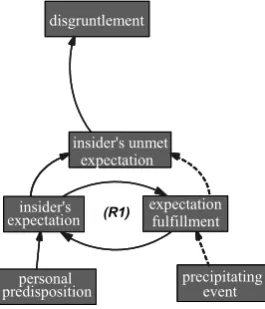
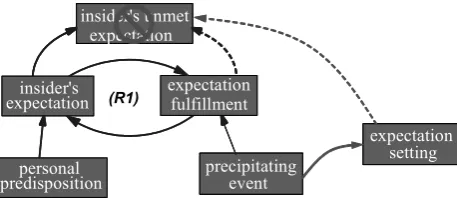
3. The insider expected a certain financial reward for his work, but bo-nuses were lower than expected due to the company financial status. Fig. 1 represents the escalation of expectation that often leads to insider dis-gruntlement. As shown in the lower left side of the figure, the insider’s personal predisposition could lead to heightened expectation. This predisposition differs from one person to the next, and influences the rate that expectations rise and fall.
The rise of expectations is influenced heavily by the expectation fulfillment. Policies and management controls are needed to keep employee expectations in check. As illustrated in reinforcing loop (R1), with lax management controls the insider’s expectation grows commensurate with the expectation fulfillment. As expectation grows and is fulfilled, expectation grows even more.
disgruntlement disgruntlement
insider's unmet expectation
precipitating event insider's unmet
expectation insider's unmet
expectation
precipitating event precipitating
event insider's
expectation
personal predisposition
insider's expectation
personal predisposition
expectation fulfillment expectation fulfillment
[image:35.439.153.286.358.513.2](R1)
Fig. 1: Expectation Escalation
Lax management that permits continually increasing employee expectation can result in major problems later, especially if the insider is so predisposed. The trig-ger for those major problems, which we call the precipitating event, tends to be anything that removes or restricts the freedom or recognition to which the insider has become accustomed. For instance, the hiring of a new supervisor who sud-denly enforces the organization’s acceptable use policy can cause extreme dis-gruntlement in the employees. Other precipitating events include the insider being passed up for a promotion, sanctions by management, or termination of the in-sider.
3.2
Escalation of Disgruntlement
Often the first sign of disgruntlement is the onset of behavioral precursors, ob-servable aspects of the insider’s social (non-technical) behavior inside or outside the workplace that might be deemed inappropriate or disruptive in some way. Some examples of behavioral precursors in the MERIT cases were conflicts with coworkers; a sudden pattern of missing work, arriving late, or leaving early; or a sudden decline in job performance.
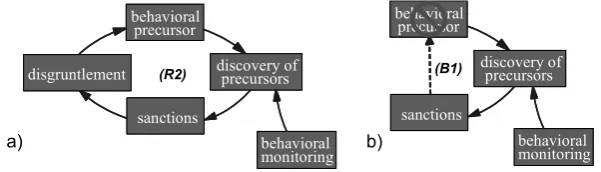
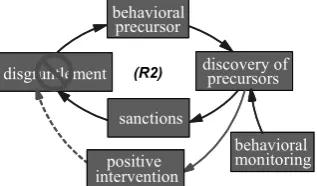
As shown in Fig. 2a, the degree of disgruntlement influences the insider’s exhi-bition of behavioral precursors, which can be discovered provided that the organi-zation has sufficient behavioral monitoring in place. An organization’s punitive response to inappropriate behaviors in the form of sanctions can be technical, such as restricting system privileges or right to access the organization’s systems from home, or non-technical, such as demotion or formal reprimand. The intended ef-fect of sanctions, as shown in the balancing loop B1 of Fig. 2b, is to prevent addi-tional behavioral precursors. Feedback loop R2, however, shows that sanctions can have unintended consequences such as escalation of disgruntlement. Whether sanctions curb behavioral precursor activity or spur the insider to greater disgrun-tlement and disruption depends largely on the personal predispositions of the in-sider.
behavioral precursor behavioral
precursor
disgruntlement
disgruntlement discovery ofdiscovery ofprecursorsprecursors
sanctions sanctions
behavioral precursor behavioral
precursor
discovery of precursors discovery of
precursors
sanctions sanctions
a) behavioral b)
monitoring behavioral monitoring
(B1) (R2)
behavioral monitoring behavioral monitoring
[image:36.439.71.372.461.547.2]3.3
Attack Setup and Concealment
Given an insider with personal predispositions, unmet expectations can lead to in-creasing disgruntlement which, if left unchecked, can spur not just behavioral pre-cursors but technical disruptions and attacks on the organization’s computer and network systems. Prior to the actual attack, there are typically technical precur-sors - actions by the insider to either set up the attack (for example, installing ma-licious software programs) or to put in place mechanisms to facilitate a future at-tack (for example, creation of backdoor accounts - secret, unauthorized accounts to be used later for the attack). These technical precursors could serve as an indi-cator of a pending attack if detected by the organization.
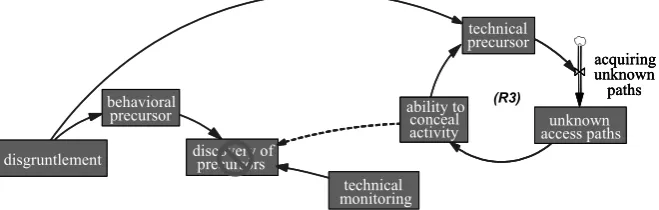
Fig. 3 depicts the influence that insider disgruntlement can have on the occur-rence of technical precursors that could indicate a pending attack. Some of these actions also contribute to the damage potential of the attack. Examples include sabotage of backups and decreases in the redundancy of critical services or soft-ware. As shown in loop R3, insiders may also acquire access paths unknown to the organization. This increases the insider’s ability to conceal their activity mak-ing it more difficult for the organization to discover the precursors. The feedback loop is reinforcing since the ability to hide their actions may embolden the risk-averse insider to continue, or even increase, their efforts to attack.
behavioral precursor behavioral precursor technical precursor technical precursor discovery of precursors discovery of precursors ability to conceal activity ability to conceal activity ability to conceal
[image:37.439.55.385.315.420.2]activity access pathsunknown acquiring unknown paths unknown access paths acquiring unknown paths acquiring unknown paths disgruntlement disgruntlement (R3) technical monitoringtechnical monitoring
Fig. 3: Technical Precursors due to Disgruntlement