Adaptive Resource Relocation in
Virtualized Heterogeneous Clusters
A thesis submitted for the degree of Doctor of Philosophy
of
The Australian National University
another person except where otherwise indicated.
This thesis is dedicated to the loving memory of my father, who taught me to believe in myself and have a positive attitute towards life.
Acknowledgements
I would like to express appreciation for Dr. Peter Strazdins for his guidance and advise during my doctoral research for the past three and a half years. As my supervisor, he guided me to remain in focus towards achieving the goal. His observations and comments helped me to broaden the knowledge in the research area and beyond. He also was instrumental in establishing the overall direction of the research and steer me towards the goals and milestones of my research work.
I would like to thank my advisors Dr. Alistair Rendell and Dr. Eric McCreath for their useful comments, suggestions and encouragement throughout my re-search work. They extended all the possible support during my rere-search work, which was not only at the academic level but also at the personal level.
My special gratitude for Computer Systems Research Group at the department of computer science, ANU. These ‘geeks’ have a great tradition of supporting each other in every possible way. Their constant support, discussions and useful suggestions acted as catalysts to my research output. I would like to especially thank Mr. Ahmed El Zein from the ANU supercomputer facility for helping me in setting up the compute farm.
Appreciation for Alexander Technology and Platform Computing for donating the hardware, especially Mr. Richard Alexander for his vision that enabled this research work.
My very special thanks to National University of Sciences and Technology (NUST), Pakistan for providing me a scholarship for the first three years of my candidature at the Australian National University.
I sincerely thank Department of Computer Science, ANU for providing me tuition fee and living allowance scholarship for the rest of my candidature. This enabled me to remain in focus to the research and not to worry about financial constraints. Especially Dr. Peter Christian, who in his capacity as Associate Dean (Higher Degree Research) always extended his full support. I would take this opportunity to thank all the administration and technical staff at the department of computer science. During the three and a half years of research, I never faced any administration issue.
Abstract
Cluster computing has recently gone through an evolution from single processor systems to multicore/multi-socket systems. This has resulted in lowering the cost/performance ratio of the compute machines. Compute farms that host these machines tend to become heterogeneous over time due to incremental extensions, hardware upgrades and/or nodes being purchased for users with particular needs. This heterogeneity is not surprising given the wide range of processor, memory and network technologies that become available and the relatively small price difference between these various options. Different CPU architectures, memory capacities, communication and I/O interfaces of the participating compute nodes present many challenges to job scheduling and often result in under or over utilization of the compute resources. In general, it is not feasible for the application programmers to specifically optimize their programs for such a set of differing compute nodes, due to the difficulty and time-intensiveness of such a task.
The trend of heterogeneous compute farms has coincided with resurgence in the virtualization technology. Virtualization technology is receiving widespread adoption, mainly due to the benefits of server consolidation and isolation, load balancing, security and fault tolerance. Virtualization has also generated consid-erable interest in the High Performance Computing (HPC) community, due to the resulting high availability, fault tolerance, cluster partitioning and accommodation of conflicting user requirements. However, the HPC community is still wary of the potential overheads associated with virtualization, as it results in slower network communications and disk I/O, which need to be addressed.
The live migration feature, available to most virtualization technologies, can be leveraged to improve the throughput of a heterogeneous compute farm (HC) used for HPC applications. For this we mitigated the slow network communication in Xen; an open source virtual machine monitor. We present a detailed analysis of the communication framework of Xen and propose communication configurations that give 50% improvement over the conventional Xen network configuration. From a detailed study of the migration facility in Xen, we propose an improvement in the live migration facility specifically targeting HPC applications. This optimization gives around 50% improvement over the default migration facility of Xen.
high performance scientific applications.
Contents
Acknowledgements v
Abstract vii
I Introduction 1
1 Introduction 3
1.1 Motivation . . . 3
1.2 Research Objectives . . . 6
1.3 Research Goals . . . 6
1.4 Methodology . . . 7
1.5 Contributions . . . 8
1.6 Thesis Outline . . . 10
II Background 13 2 Heterogeneous Cluster Scheduling 15 2.1 Heterogeneous Clusters . . . 15
2.2 Programming Issues in Heterogeneous Clusters . . . 16
2.3 Approaches to Parallel Application Scheduling in an HC . . . 17
2.3.1 Performance Modeling and Estimation . . . 17
2.3.2 Heterogeneity-aware Schedulers . . . 19
2.3.3 Heterogeneity-aware Applications . . . 22
2.4 Approaches to Job scheduling . . . 24
2.4.1 Batch Processing . . . 24
2.4.2 Gang Scheduling . . . 26
2.5 Scheduling Solutions . . . 27
2.5.1 Maui Scheduler . . . 28
2.5.2 The N1 Grid Engine . . . 29
2.6 Chapter Summary . . . 29
3 Virtualization in Cluster Computing 31 3.1 Overview of Virtualization . . . 31
3.2 Challenges in x86 Virtualization . . . 33
3.3 Xen Architecture . . . 35
3.3.4 Management Software . . . 37
3.4 Xen’s Bridged Network Architecture . . . 37
3.5 Live Migration Basics . . . 38
3.6 Use of Virtualization in HPC . . . 40
3.6.1 Use of HPC and Xen in Cloud Computing . . . 43
3.7 Chapter Summary . . . 44
III Infrastructure Improvement 47 4 Communication Infrastructure Improvement 49 4.1 Related Work . . . 49
4.1.1 Intra-domain Communication Improvement . . . 50
4.2 Network Configurations . . . 51
4.3 MPI Implementation Differences . . . 54
4.4 Results . . . 54
4.4.1 Experimental Setup . . . 55
4.4.2 Application Level Benchmarks . . . 55
4.4.3 Inter-domain Communication . . . 56
4.4.4 Intra-domain Communication . . . 59
4.4.5 Inter-Intra Node Communication Mix . . . 62
4.5 Discussion and Summary . . . 67
5 Live Migration Improvement 69 5.1 Related Work . . . 69
5.2 Experimental Platform . . . 71
5.3 Xen Migration Statistics . . . 72
5.4 Optimization of the Live Migration Routine . . . 74
5.4.1 Comparison of Migration Techniques . . . 75
5.4.2 Migration on 1×n Cluster Configurations . . . 75
5.4.3 Migration on 2×n Cluster Configurations . . . 79
5.5 Summary . . . 81
IV Design, Implementation and Evaluation 83 6 Design and Implementation of a Resource Relocation Framework 85 6.1 Motivation . . . 85
6.2 Related Work . . . 86
6.3.1 Assumptions . . . 88
6.3.2 Computational Model . . . 88
6.3.3 Communication Characterization of Parallel Programs . . . . 89
6.3.4 Memory Utilization . . . 92
6.3.5 Predicted Execution Time . . . 92
6.3.6 Migration Prediction . . . 93
6.3.7 Migration Decisions . . . 95
6.4 Framework Implementation . . . 97
6.4.1 Virtualization-aware Scheduler . . . 101
6.5 ARRIVE-F Accuracy and Overheads . . . 102
6.5.1 Experimental Setup . . . 102
6.5.2 Applications . . . 102
6.5.3 Comparison of Predicted and Actual Execution Times . . . 103
6.5.4 Framework Overheads . . . 108
6.6 Chapter Summary . . . 109
7 Evaluation of ARRIVE-F 111 7.1 Live Migration Experiments . . . 111
7.1.1 Computation Requirement Migration . . . 112
7.1.2 Computational Requirement Migration 2 . . . 114
7.1.3 Communication Requirement Migration . . . 115
7.1.4 Migration due to Insufficient Memory . . . 116
7.2 Compute Farm Throughput . . . 116
7.2.1 Experiment Number 1 . . . 119
7.2.2 Experiment Number 2 . . . 123
7.2.3 Experiment Number 3 . . . 125
7.3 Sensitivity Analysis . . . 127
7.3.1 Different values ofτ . . . 128
7.3.2 Migration Reevaluation . . . 128
7.3.3 Migration Threshold . . . 129
7.3.4 Migrationβ . . . 130
7.4 Discussion on ARRIVE-F Migration Decisions . . . 130
7.5 Chapter Summary . . . 136
8 Conclusions and Future Work 137 8.1 Infrastructure Improvement . . . 137
8.2 ARRIVE-Framework . . . 139
A Appendix A: Lublin-Feitelson Job Streams for the Experiments 149
A.1 Introduction . . . 150
A.2 Job Data - Experiment 1 . . . 150
A.3 Job Data - Experiment Number 2 . . . 157
A.4 Job Data - Experiment Number 3 . . . 162
B Comparison of Various Intra-domain Communication Mechanisms.167 B.1 Introduction . . . 168
B.1.1 Latency Results . . . 169
B.1.2 Bandwidth Results . . . 170
C Appendix C: The Database Schema 175 D Appendix D: ARRIVE-F Statistics and Screenshots 177 D.1 Lines of Code . . . 178
D.2 Dependencies . . . 178
D.3 ARRIVE-F Screenshot . . . 178
List of Figures
1.1 ARRIVE-F: Adaptive Resource Relocation In Virtualized
Environ-ments framework block diagram. . . 9
3.1 Privilege rings in the x86 architecture [courtesy [21]. . . 34
3.2 Xen environment block diagram [courtesy [33]]. . . 35
3.3 Xen bridge architecture. . . 38
3.4 Stages in default Xen migration [courtesy: [46]]. . . 39
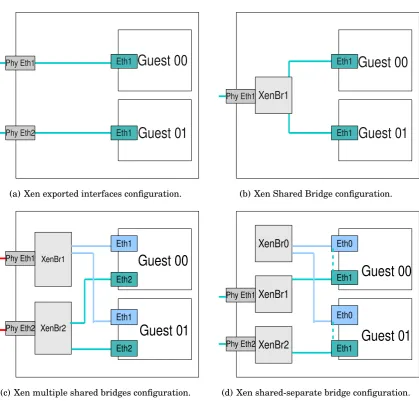
4.1 Various network configurations available to Xen VMs. . . 52
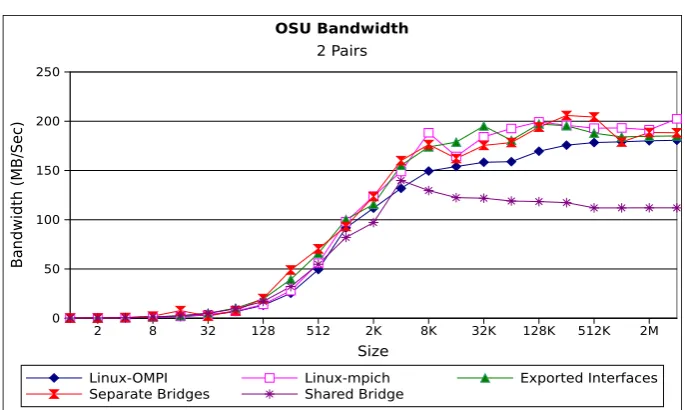
4.2 OSU 2 pair bandwidth benchmark . . . 60
4.3 OSU 3 pair bandwidth benchmark . . . 60
4.4 OSU 4 pair bandwidth benchmark . . . 61
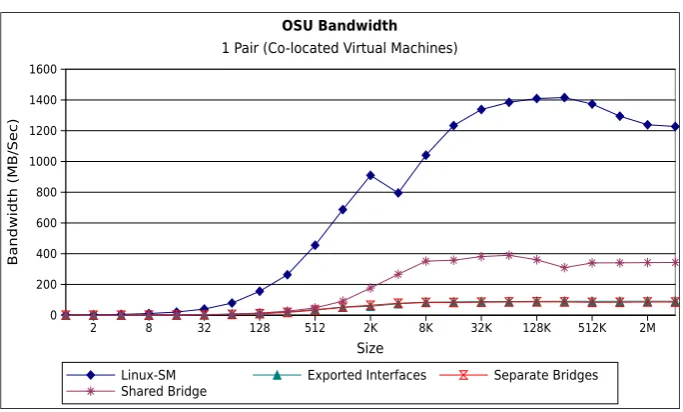
4.5 OSU bandwidth benchmark (1-pair, co-located VMs) . . . 61
4.6 OSU bandwidth benchmark (2-pair, co-located VMs) . . . 62
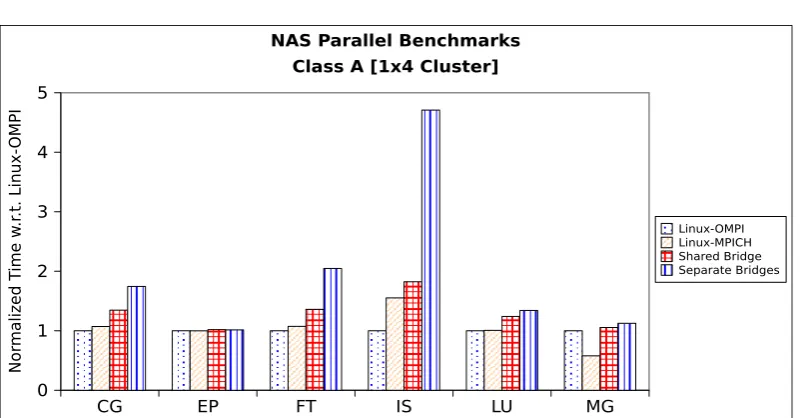
4.7 NAS parallel benchmarks on a 1×4 cluster. . . 63
4.8 NAS parallel benchmarks on a 2×4 cluster . . . 63
4.9 NAS parallel benchmarks, Class A on a 8×1 cluster configuration . . 65
4.10 NAS parallel benchmarks, Class A on a 8×2 cluster . . . 66
5.1 Different Cluster Configurations. . . 71
5.2 Migration of a single VM from a VMM in a 1×4 configuration . . . 73
5.3 Migration of a 131072 Page VM on a 1×n cluster conf. . . 76
5.4 Effects of different migration routines on a migrating node and its ‘source’ VMM during the execution of FT.B.4 benchmark. . . 77
5.5 Effects of different migration routines on a migrating node and its ‘source’ VMM during the execution of CG.B.4 benchmark. . . 79
5.6 Migration of two VMs from a single VMM on a 2×4 cluster configu-ration. . . 80
5.7 Migration of two VMs (131072 Pages each) on a 2×4 cluster configu-ration. . . 80
6.1 Pictorial view of hetrogeneous compute farm. . . 86
6.2 Migration decision scenario 1 - Migration of equal nodes. . . 96
6.3 Migration decision scenario 2 - Migration to free nodes. . . 96
6.4 Migration decision scenario 3 - Migration with the free nodes. . . 97
6.5 Migration decision scenario 4 - Migration with multiple jobs. . . 97
6.8 Overheads of the profiling framework and daemons. . . 108
7.1 Gantt chart of the first 2000 seconds of experiment number 1 . . . . 124 7.2 ARRIVE-F not migrating a 2 process job to make way for 8 process job.133 7.3 Serial vs parallel migration of two jobs spanning multiple VMMs . . 134 7.4 Impact of parallel migration . . . 135 7.5 Serial vs parallel migration of multiple jobs spanning multiple
VMMs . . . 135
B.1 Latency results of various intra-domain communication mechanisms in Xen. . . 170 B.2 Bandwidth of various Xen intra-domain communication mechanisms. 173 B.3 Bidirectional bandwidth of various Xen intra-domain communication
mechanisms. . . 173
C.1 Extended entity-relationship diagram of the ARRIVE-F database. . . 176
List of Tables
4.1 Summary of latency benchmark (µSec) at 1 byte . . . 57
4.2 Summary of latency benchmark (MB/Sec) at 4 MB . . . 58
4.3 Avg. bandwidth benchmark (MB/Sec) for message size≥4K . . . 58
4.4 Avg. bi-bandwidth benchmark (MB/Sec) for message size≥4K . . . . 59
4.5 Avg. bandwidth benchmark (MB/Sec) for message size≥4K . . . 62
5.1 Avg. migration statistics of an idle virtual machine. . . 72
5.2 Average statistics of migrating a 512 MB (131072 Page) VM on a 1×4 cluster configuration. . . 73
5.3 Optimized migration statistics of a 131072 Page VM on a 1×4 cluster configuration. . . 75
6.1 Heterogeneous compute farm . . . 102
6.2 Computational model accuracy (predicted vs actual) . . . 104
6.3 Penalty in CPU cycles . . . 105
6.4 Calculation of time estimate (seconds) based on computation model τ = 50 seconds . . . 105
6.5 Communication model accuracy (predicted vs actual) . . . 106
6.6 Communication calculations forτ = 50 seconds . . . 107
7.1 Computational requirement migration . . . 112
7.2 Calculation of time estimate based on computation model τ = 50 seconds . . . 113
7.3 Computational requirement migration . . . 114
7.4 Calculation of time estimate based on computation model τ = 50 seconds . . . 115
7.5 Communication requirement migration . . . 116
7.6 Memory requirement migration . . . 116
7.7 Base-run vs migration run . . . 120
7.8 Job allocation in base run . . . 120
7.9 Experiment 1: Job migration 1 . . . 120
7.10 Experiment 1: Job migration 2 . . . 121
7.11 Experiment 1: Job Migration 3 . . . 122
7.12 Experiment 2: Base-run vs migration run . . . 123
7.13 Experiment 2: Job migration 1 . . . 125
7.14 Experiment 3: Base-run vs migration run . . . 126
7.15 Experiment 3: Job migration 1 . . . 126
7.19 Effect of different pooling intervalsτ . . . 128
7.20 Effect of the migration threshold . . . 129
7.21 Migrationβ . . . 130
7.22 ARRIVE-F not migrating a 2 process job... [Job Queue] . . . 132
A.1 Experiment 1: List of jobs . . . 156
A.2 Experiment 2: List of jobs . . . 161
A.3 Experiment 3: List of jobs . . . 166
B.1 Comparison of intra-domain communication latencyµseconds . . . . 169
B.2 Comparison of intra-domain communication bandwidth . . . 171
B.3 Comparison of intra-domain bidirectional bandwidth . . . 172
Part
I
Chapter
1
Introduction
This chapter gives an overview of the thesis. It presents the inspiration for addressing the scheduling and resource allocation issues faced by the high per-formance computing (HPC) community working with the heterogeneous compute farms. It summarizes the main components of our proposed heterogeneous cluster scheduling algorithm and presents the primary contributions of our research. The chapter ends with a discussion on the organization of this dissertation.
1.1
Motivation
Compute farms, whether for research department clusters, enterprise grids, data centers or supercomputing facilities, tend to become heterogeneous over time. This is due to incremental extension over a period of time and/or nodes being purchased for users with particular needs. This heterogeneity is not surprising given the wide range of different processor, memory and network technologies that become available [49, 71] and the relatively small price difference between these various options. The small price difference between the various options often causes the administrators to purchase the latest hardware rather than purchasing the older models in order to keep the system homogeneous. After a few upgrade cycles, the compute farm becomes a heterogeneous compute farm (HC), constituting of a federation of homogeneous sub-clusters.
linked via an expensive high performance network (e.g. infiniband compared to the gigabit ethernet), it is possible for a parallel application that does little inter-node communication to end up running on the compute nodes with high performance network, while another application that would greatly benefit from a faster network is left to run on the nodes with slower network interconnects.
Application programming also poses a significant challenge to programmers in heterogeneous clusters compared to homogeneous systems. An efficient parallel application for a homogeneous distributed memory multiprocessor system tries to evenly distribute computations over the available processors [49]. If processors run at different speeds, the faster processors will complete their part of the computation and wait for the slower processors at points of synchronization and data transfer; a case we call ‘under utilization’ of the compute node. Therefore, the total time of computations will be determined by the time elapsed on the slowest processor [49].
The issue of effective mapping (scheduling) of parallel applications onto such heterogeneous systems is therefore of great interest to researchers. Two distinct solutions have evolved over time to address this issue, which involve either adapting the scheduling decision according to needs of the application [66, 25, 37] or adapting the application according to the heterogeneous compute farm (HC)[49, 71, 85] . In both cases, the allocation of nodes to a parallel job in an HC requires some sort of performance modeling techniques. In performance modeling, an application is profiled to gain an understanding of its performance characteristics. These characteristics are then encapsulated into a set of formulas [30]. The performance models are then evaluated on the different compute nodes and sub-networks to determine the expected speedups (or slowdowns) on various hardware architectures/nodes.
Fine grained performance modeling is capable of reasonably accurate predic-tion but the associated cost of profiling can be very high in terms of the wall-clock time of the job [71, 85]. Due to these costs, these techniques must be applied to applications in an ‘offline’ mode. The application or some of its iterations are profiled on a set of hardware and scheduling decisions are based on the resultant profile metrics. In the case of a workload change, the application behavior changes and the application needs to be profiled again. Hence, off-line performance modeling is not a scalable or practical solution.
1.1 Motivation
potential benefits of virtualization include server isolation, load balancing, fault tolerance, flexibility, security and power saving. The virtualization technology also consist of a feature of migration; where a running instance of a guest operating system (called a VM) is moved from one physical machine to another without considerable downtime. The migration of virtual machines (VMs) in a virtualized environment can play a pivotal role in load balancing, fault tolerance and server upgrades. It enables data center administrators to upgrade the hardware, or to move the operating system to other hardware when hardware failure is expected. A number of virtualization products called Virtual Machine Monitors (VMM, also called hypervisors) are now available for various operating systems. Among them VMware [19] , Xen [11, 33], Microsoft’s HyperV [14] and Oracle’s Virtualbox [17]. The mainstream Linux kernel also includes Kernel based Virtual Machine (KVM) from the kernel version 2.6.20.
Virtualization is also gaining a lot of interest in the HPC community mainly because of its ability to address the issue of balancing conflicting user require-ments. In cluster computing, the biggest issue faced by the administrators is different requirements of their user base. Some users may want a 64-bit Linux OS for their parallel applications, while others might require a 32-bit build of Linux customized to their application or even Microsoft Windows. Similarly, few applications have a hard requirement of a certain version of a library. With the ‘bare-metal’ OS this is not possible without physically partitioning a compute infrastructure. However, virtualization, makes the co-existence of various OS builds possible. The virtualized clusters can be setup on the fly to the specific needs of the user, without affecting the requirements of other users.
1.2
Research Objectives
Virtualization has generated considerable interest in High Performance Comput-ing (HPC) community mainly for the reasons for high availability, fault tolerance, cluster partitioning and balancing out conflicting user requirements [53, 107].
We believe that by using operating system virtualization the issue of hetero-geneity in cluster and grid computing can be addressed quite effectively.
Apart from balancing out the conflicting user requirements in cluster comput-ing, the concept of live migration of operating systems can be utilized to maximize the throughput of the compute farm and the turnaround times of the submitted jobs. This can be achieved by developing a run-time job estimation and remapping service, which can suggest the speedups or the slowdowns in the job progression and recommend a new mapping (sub cluster) to which jobs can be migrated for better turnaround times and/or average response times.
1.3
Research Goals
Based on the research objectives, where we want to utilize the operating system migration feature of the hypervisors to improve the throughput of a heterogeneous compute farm, the research goals of this PhD were divided into two categories, and are discussed as under:
1. Mitigate the costs of virtualization in an HPC environment:
The perceived cost of virtualization is not acceptable to the HPC community, where the performance is critical. In order to facilitate virtualization, the VMMs introduce an additional software layer, and thus an overhead. In this research, we propose improvements to the known performance bottlenecks introduced by virtualization. We will analyze the virtualization infrastruc-ture in detail with the perspective of HPC and propose improvements that lead to a better virtualization environment.
(a) Improve Xen’s communication.
1.4 Methodology
(b) Identify the migration overheads and determine if migration of virtual machines is a viable option for an improved throughput of an HC.
• Determine the total penalty in terms of communication and compu-tation, in case we migrate the job from one cluster to another cluster.
• Identify the bottlenecks and if possible, propose improvements to Xen’s migration routine.
2. Determine how to use virtualization to better utilize an HC.
In the second part of thesis, we plan to implement a complete resource relocation (remapping) solution that can estimate the performance of a parallel application and propose better hardware to increase the throughput of an HC.
(a) Develop a performance characterization methodology and evaluate whether it can make accurate performance predictions.
• Need to predict the application performance on certain hardware without actually running on the said hardware.
• To determine the accurate wall-clock time of a parallel application is not essential to this research. We will only evaluate the relative performance of an application compared to hardware on which it is currently executing.
• Based on the wall-clock time estimation, determine if migrating an application to another hardware will improve the application performance.
(b) Evaluate how our proposed scheduling framework performs with appli-cations that expose the heterogeneity in a compute farm.
1.4
Methodology
To achieve the research goals set out in Section 1.3, a virtualization aware job scheduling and remapping framework was implemented from the ground up. This is because, at the time of research, there was no virtualization and heterogeneity aware job scheduler.
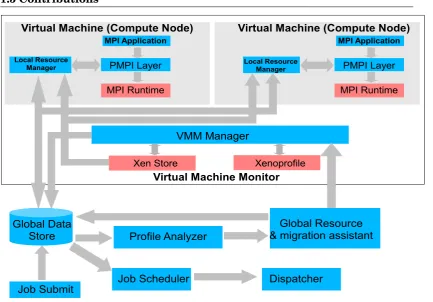
A diagram of the high-level architecture and components of the scheduling and resource remapping framework is given in Figure 1.1.
proceess (and hence a node). This also enables us to schedule single process jobs efficiently. It may also be noted that at the start of the research only dual core CPUs were available and sacrificing a CPU was not an option. The virtual machine monitors and the virtual machines (also called compute nodes in the thesis) are controlled by respective daemons, called the virtual machine
monitor daemon (VMMD) and the local resource manager daemon (LRM). The
VMMD is enables our framework to control the hardware profiles and the creation and migration of the compute nodes. VMMD utilizes Xenoprofile [79] to obtain hardware performance counter data. The LRM is responsible to communicate the compute node’s availability to the scheduler and provide job specific data (communication, CPU and memory utilization) to the global data store. The LRM uses the programmer’s interface of the MPI (PMPI) to obtain the communication data of each process.
The scheduler and dispatcher are responsible for dispatching the jobs to the
available nodes. The profile analyzer gathers the hardware and communication related characteristics of the running jobs through the global data store. The engine then performs an online analysis and propose the most optimal hardware mapping for each job. The jobs are migrated to the proposed hardware only if the overall throughput of the compute farm is improved.
The implementation details of the framework are provided in Chapter 6. We have named our framework as ARRIVE-F which stands for Adaptive Resource
Relocation In Virtualized Environments - Framework.
1.5
Contributions
To support the thesis that heterogeneous clusters can significantly benefit from virtualization technology, we have made several novel contributions. It may be noted that our implementation and findings are also applicable to cloud computing. Such findings are discussed throughout the thesis in relevant chapters.
1. The thesis identifies the use of operating system virtualization to address the issue of heterogeneity. For this we have developed a virtualization-aware resource manager and a multi-cluster scheduler which is able to dispatch and monitor jobs in the virtualized environments.
1.5 Contributions
Virtual Machine (Compute Node)
Virtual Machine Monitor
MPI Application
PMPI Layer
MPI Runtime
Local Resource Manager
Global Data Store
Job Submit Job Scheduler Profile Analyzer
VMM Manager
Xenoprofile
Dispatcher
Virtual Machine (Compute Node)
Global Resource & migration assistant
MPI Application
PMPI Layer
MPI Runtime
Local Resource Manager
[image:25.595.117.551.71.373.2]Xen Store
Figure 1.1: ARRIVE-F: Adaptive Resource Relocation In Virtualized Environments framework block diagram.
European Conference on Computer Systems, Proceedings of the 3rd ACM Workshop on System-level Virtualization for High Performance Computing [28] .
Muhammad Atif. and Peter Strazdins. ‘An evaluation of multiple
communi-cation interfaces for virtualized SMP clusters’. In Proceedings of the 3rd ACM
Workshop on System-Level Virtualization For High Performance Computing (Nuremburg, Germany, March 31 - 31, 2009). HPCVirt ’09.
3. We have optimized the live migration facility of Xen hypervisor. We imple-mented a small modification to the Xen hypervisor, which reduced the live migration times of virtual machines running the HPC jobs by upto 50%. A detailed analysis of migration overheads was also carried out in this research. The work [29] was presented at the 6th IFIP International Conference on Network and Parallel Computing (NPC 2009).
Muhammad Atif, Peter Strazdins, ‘Optimizing Live Migration of Virtual
Machines in SMP Clusters for HPC Applications’ NPC, pp.51-58, Sixth IFIP
International Conference on Network and Parallel Computing, 2009
profiling of the parallel applications and predict the execution time of each application on all the distinct hardware platforms available to the HC. Based upon the predicted execution times, we are able to relocate the compute jobs to the best suited hardware platforms such that the overall throughput of the compute farm is increased.
The problem of estimating the execution times and process migration has been addressed in the past. However, as we show in Chapter 2, the previous work on performance estimation is based on either the linear CPU frequency models or requires the off-line profiling or require source code modification or their combinations.
Our framework is different from all of the previous implementations in a number of ways:
• It does not require source code changes or recompilation of the parallel application, i.e. it gives binary compatibility.
• The applications are profiled and analyzed during the runtime; unlike similar implementations, there is no need to run the application in the profile mode.
• The execution time estimates are based on real hardware metrics like floating point operations and L2 size whereas similar models are based only on the CPU frequency.
• We are able to dynamically relocate an application to the best suited sub-cluster, using the live migration feature of the VMM, a feature missing in any job scheduling and estimation framework.
To our knowledge there is no prior research that consolidates the said benefits into a single framework.
5. We detail the design and implementation of the framework for Adaptive Resource Relocation In Virtualized Environments (ARRIVE-F), along with the experimental results. For the given compute farm, the framework has an overhead of 3% and an accuracy of around 80%. We are able to improve the throughput of an HC by up to 25% in certain cases.
The research work detailing the design and implementation of our resource relocation framework is submitted and under a review.
1.6
Thesis Outline
1.6 Thesis Outline
Part II discusses the background and related work. It is further divided into two chapters, Chapter 2 presents the state of the art of scheduling algorithms in cluster computing. Chapter 3 details the use of virtualization technology in cluster computing.
Part III discusses and details infrastructure improvement of Xen hypervisor that was necessary to conduct this research. It contains two chapters, Chapter 4 presents a detailed analysis of utilizing multiple communication interfaces in virtualized environment (namely Xen). We also suggest possible improvements which result in upto 50% improvement of bandwidth and latency over the default Xen network topology. Chapter 5 discusses the cost of live migration in detail. We present a small modification to the Xen hypervisor which resulted in approximately a 50% improvement in the live migration times of compute nodes in virtualized HPC environments.
Part
II
Chapter
2
Heterogeneous Cluster
Scheduling
Clusters of commodity processors - seen as a cheap alternative to homogeneous distributed memory systems are built and extended over time. This results in considerable heterogeneity in the compute farm due to the presence of different CPU architectures (clock speeds and instruction sets), memory capacities and communication interfaces. [49, 71].
This chapter discusses issues related to job scheduling in a heterogeneous compute environment.
2.1
Heterogeneous Clusters
A heterogeneous cluster is defined by Dongarra et. al [49] as a dedicated com-puter system designed mainly for high performance parallel computing, which is obtained from the classical homogeneous cluster architecture by relaxing one of its three key properties and leading to the situation where:
• Processors in the cluster may not be identical.
• The communication network may have a heterogeneous structure, e.g. machines interconnected with interconnects with different bandwidth and latencies.
• The cluster may be a multi-user computer system (but still dedicated to high performance parallel computing).
extreme case Intel x86 vs Oracle SPARC processors. If a parallel application is optimized for a specific hardware, the application may not work under a different hardware, i.e. the application does not remain binary compatible across different hardware platforms. For example, GCC optimization -O2 is compatible across various x86 platforms (e.g. AMD and Intel) but in the case GCC optimization of
-march amdfam10 -O3 is applied to AMD K10 family, the application becomes
binary compatible with AMD K8 and K10 family only. This means, in the case of an HC, the least common denominator level optimization can be applied. Even in the case of the same architecture, different CPU models introduce heterogeneity. For example, AMD Opteron-275 vs AMD Opteron-248 belong to same family (AMD-K8) but the presence of SSE-3 instruction set in Opteron-275 gives it a huge performance benefit over Opteron-248. Running different operating systems or the same operating systems with difference runtime libraries also introduces considerable heterogeneity and impact the application performance .
Similarly, the communication network of two compute notes can have different bandwidth and latency. An extreme of such a case is presence of infiniband, gigabit and fast ethernet networks. The multi-user case is rare for a dedicated HPC system, and is not discussed in this thesis.
Apart from these situations, machines having different memory capacities and additional on-board processors like graphical processing units (GPU) also add to the heterogeneity in a compute farm.
2.2
Programming Issues in Heterogeneous Clusters
2.3 Approaches to Parallel Application Scheduling in an HC
2.3
Approaches to Parallel Application Scheduling in
an HC
The issue of effective mapping (scheduling) of parallel applications onto heteroge-neous systems is of great interest to researchers. The research in the area can be divided into two distinct methodologies:
1. Heterogeneity-aware workload/application, where the application is made aware of the fact that it is running on a heterogeneous cluster and the workload balancing is done by the application programmer.
2. Heterogeneity-aware cluster scheduler, where the job scheduler is aware of heterogeneous nature of the cluster and tries to map the applications accordingly.
Both of these techniques require performance modeling which is described below.
2.3.1 Performance Modeling and Estimation
The goal of performance modeling is to gain an understanding of a computer sys-tems performance on various applications, by means of measurement and analysis, and then to encapsulate these characteristics in a compact formula. The resulting model can be used to gain greater understanding of the performance phenomena involved and to project performance to other system/application combinations [30].
The performance profile of a given system/application combination depends on numerous factors [30], including: (1) system size; (2) system architecture; (3) processor speed; (4) multi-level cache latency and bandwidth; (5) interprocessor network latency and bandwidth; (6) system software efficiency; (7) type of applica-tion; (8) algorithms used; (9) programming language used; (10) problem size; (11) amount of I/O; and others.
A comprehensive model must incorporate most, if not all, of the above factors. Fine grained performance modeling is capable of reasonably accurate predictions but the associated cost of profiling can be very high in terms of the wall-clock time of the job [30, 71, 85, 74].
application needs to be profiled again. A few have tried an online approach to performance modeling which is discussed in Section 2.3.2.
There is a significant amount of work related to performance modeling. This section gives brief summary of some of the most cited and popular performance models.
The most popular performance model is LogP by Culler et al. [48]. LogP was developed as realistic model for parallel algorithm design, in which critical performance issues could be addressed without reliance on the machine details. The performance of a system is characterized in terms of four parameters; three describing the time to perform an individual point-to-point message event and the last describing the computing capability, as follows.
• Latency (L) - an upper bound on the time to transmit a message from its source to destination.
• Overhead (o)- the time period during which the processor is engaged in sending or receiving a message.
• Gap (g) - the minimum time interval between consecutive message transmis-sions or consecutive message receptions at a processor. The reciprocal of the gap gives the effective bandwidth in messages per unit time.
• Processor (P)- the number of processors.
In addition, LogP assumes that the network has a finite capacity. The finite capacity of the network can be reached if a processor is sending messages at a rate faster than the destination processor can receive. If a processor attempts to send a message that would exceed the finite capacity of the network, the processor stalls until the message can be sent without exceeding the finite capacity limit.
2.3 Approaches to Parallel Application Scheduling in an HC
LogP only deals with the short messages and does not adequately model the machines that support long message sizes [24]. As communication is modeled by point-to-point messages of some fixed short size, the model has an implicit fifth parameter: the message sizew. Alexandrov et al. proposed an extension to LogP model called LogGP to address the issue. Here, G is defined as gap per byte for the long messages. Under the LogP model, sending a k byte message from one processor to another requires sendingdk/wemessages, wherew is the underlying message size of the machine. This would takeo+d(k−1)/we×max[g,o]+L+ocycles. In contrast, sending everything as a single large message takeso+ (k−1)G+L+o cycles under the LogGP model,
The model however, only concentrates on the communication aspects and the total number of processors. It does not take in to account the processor architecture and memory subsystems.
2.3.2 Heterogeneity-aware Schedulers
A number of ‘static’ heterogeneous cluster scheduling solutions have been proposed which try to map the application processes on the available compute nodes to improve the application runtime. The basic problem such algorithms try to solve is given by Sabin et. al [92] as
‘‘Given a number of heterogeneous sites, with a homogeneous cluster of
proces-sors at each site, and a stream of parallel jobs submitted to a metascheduler, find an effective schedule for the jobs so that the average turnaround time of jobs is
optimized.”
The general problem of optimally mapping parallel programs or tasks to machines in a heterogeneous compute farm has been shown to be NP-complete [66], and hence requires heuristics. Braun et al. [37] have presented a detailed comparison of a number of heuristics proposed earlier [25, 57, 66].
be-gins, and the objective is the minimization of make-span, i.e. the time to finish all tasks.
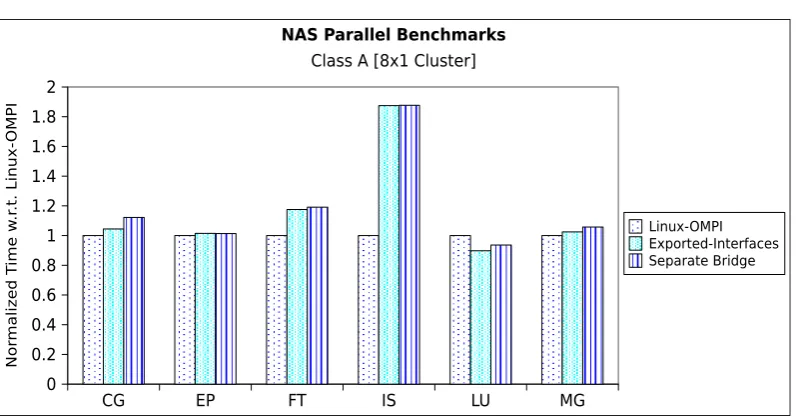
Sabin et.al implemented a Multiple Requests (MR) scheme, where jobs were processed in the arrival order. i.e. the list of jobs was not known to the scheduler in advance. The heterogeneous compute farm was divided into a number of distinct homogeneous clusters (called sites). Each job is sent to theKleast loaded sites by the meta-scheduler. Each of theseKsites schedules the job locally. The scheduling scheme at the sites was easy backfilling [83], using First Come First Serve (FCFS) queue priority. When a job is able to start at any of the sites, the site informs the meta-scheduler, which in turn contacts the K −1 other local schedulers to cancel that redundant request from their respective queues. This operation must be atomic to ensure that the job is only executed at one site. By placing each job in multiple queues, the expectation is that more jobs will be available in all local queues, thereby increasing the number of jobs that could fit into a backfill window. Furthermore, more “holes” were created in the schedule due toK−1reservations being removed when a job starts running, enhancing backfill opportunities for the queued jobs. Three benchmarks, namely LU, IS and MG from the NAS parallel benchmark [16] suite were utilized to test the system.
The above research and all the heuristics proposed in previous literature [37, 25, 57, 66] have a hard requirement of the estimated execution times of the application on all the possible distinct compute nodes (processors). This either requires complete execution of the application on all the possible compute nodes before scheduling or ‘offline’ performance estimation to predict the runtime of the applications. Even a minor change in the working set (data) will render the job time estimates incorrect and will break the system. All the subsequent work in the area is static in nature and dynamic load balancing of the HC is missing in these frameworks.
2.3 Approaches to Parallel Application Scheduling in an HC
process iwhich has the maximum time penalties in terms of communication and computation.
Sm=max|ni=1(Ri+Ci) (2.1)
where Sm is the maximum estimated run-time of the application. Ri and Ci
are the contributions from computation and communication to the process time. The process belonging to the application yielding the maximum time defines the estimated time taken by the application (bottleneck case) and is denoted by Im.
The termRi is calculated as
Ri = (Xi+Oi).
SpeedProfilej
Speedj .
1
ACP U j
(2.2)
whereXiis the accumulated time the process was executing in its own code andOi
is the time processiwas executing MPI library code, i.e. the overhead. SpeedProfile j
is the processing speed of the node used in profiling and Speedj is the speed of the node j executing process i. ACP U denotes the percentage CPU availability
therefore, 1/ACPU denotes the slowdown or speedup due to timesharing. The
communication time contribution (i.e. Ci) can be calculated as summing the
contribution of each message that processisends or receives. LetSsi, be the set of
processes that send messages to processiandSRithe set of processes that receive
messages from processi. For every processi, the program profile gives an analysis of how many messages and of what size were received by that process from the other processes of the program. The messages of each sender process to processi define a set of same-size message groupsmgsi; similarly, the messages received by
process i define the setmgRi. Each group of these sets has a message countmc, and
a message sizems.Lcis the current latency of the every message . The theoretical
communication time θiM for process i for mapping M is obtained by addition of total messages of some (same) size in message group multiplied by latency of each message of the same type.
θMi = X k∈SSi
X
j∈mgsk
mcj.Lc(k, i, msj) + X
k∈SRi X
j∈mgRk
mcj.Lc(k, i, msj) (2.3)
The profiling is done in isolation. Therefore, under typical execution envi-ronment there is no guarantee that the program will have the same latencies or overheads when executed in an uncontrolled environment. Therefore the profiled time is multiplied by a correction factorλ.
The factorλiis calculated as ratio of time the processiwas blocked (i.e. Biand
Ci =θMi .λi (2.4)
The model profiles the MPI using XMPI tool, which is part of the LAM/MPI [5] distribution. Although a non-standard MPI feature, LAM/MPI provides statements that can be used to mark the beginning and end of an execution phase in the application code. The system was evaluated with the NAS parallel benchmarks [16] and the HPL benchmark [68]. The prediction accuracy of the CEBS is around 94%. The CBES-supported scheduler makes the scheduling decisions (static placement) based on the profiles gathered earlier through the performance model. The whole framework achieved speedups higher than 10% for several scientific applications (NPB and HPL).
The framework has a number of drawbacks. The overheads of running the CBES can be prohibitive for short-lived programs which, in certain cases, exceeded the program wall-clock time. CBES is based on a linear CPU frequency model and requires an ‘offline’ profiling of the parallel job before the system can predict the performance. CEBS also requires manual changes to the source code to mark the execution phase in the application, which is specific to LAM/MPI implementation and is not MPI-2 compliant. Hence, applications running under CEBS are not binary compatible with MPI-2 compliant implementations.
2.3.3 Heterogeneity-aware Applications
One approach proposed by several researchers [49, 70, 34] to address the com-putation and communication imbalance of the nodes in an HC is to adapt the parallel application according to the heterogeneity of the compute farm. Here, the parallel application is required to distribute computations unevenly to account for the varied speed and architecture of processors [49]. The load balancing of such systems require a considerable effort from the programmers perspective [85] and the solutions are not generic in nature. In the case of workload change, modifications in the source code are required, which is difficult and time consuming. To load balance an application, the programmer is required to determine the application characteristics and performance modeling is required.
2.3 Approaches to Parallel Application Scheduling in an HC
assumption which is incorrect for the HC environments. For example, AMD family 10 microprocessors are able to perform twice as many floating point operations compared to AMD family 8 processors at the same CPU frequency.
Charm++ [70] is a machine independent parallel programming system. Pro-grams written using this system run unchanged on MIMD machines with or without a shared memory. It provides high-level mechanisms and strategies to facilitate the task of developing even highly complex parallel applications. Charm++ programs are written in C++ with a few library calls and an interface description language for publishing Charm++ objects. Charm++ supports dynamic load balancing using object migration for irregular and dynamic applications, as well as deal with external factors that cause load imbalance. To support MPI, Charm++ has its own layer known as AMPI (Adaptive MPI). However, it requires developers to rewrite MPI applications using Charm++ language specifications. AMPI is not MPI-2 complaint and requires the application developer to add support for dynamic load balancing in the application. This requires the developer to profile the application and tailor the application to a specific compute farm topology.
Prophet [104] is another attempt to schedule parallel applications on the het-erogeneous compute clusters, with alimitedprogramming effort. Prophet exploits the structure of the application and the information about the system resources to produce reduced completion time for applications. Prophet requires a programmer to to implement callback methods into the application source. These callbacks are a set of functions that detail application’s communication and computation characteristics e.g. average size of messages in bytes, the communication topology, architecture specific execution cost per instruction for the CPU (usec/instruction), number of iterations (if applicable) etc. Prophet these utilizes these callback methods to obtain applications’ communication and computation characteristics at runtime. Prophet then explores a set of candidate processor configurations to apply to the application in order to minimize completion time. However, getting architecture specific information of an application requires an off-line profiling of the application. The implementation of callbacks in the application source require the application to be specifically ported to Prophet, which is time consuming and makes the application specific to Prophet’s architecture.
has to be ported to AppLeS with the heavy modifications to the original source. Developing a performance model for each application is a time consuming task and not a feasible option.
EasyGrid [36, 35, 93] middleware is a distributed Application Management System (AMS) embedded into MPI applications to facilitate their efficient execu-tion in computaexecu-tional grids. The EasyGrid AMS is automatically embedded into an MPI parallel application without modification to the user’s original code at compile time. This makes MPI applications capable of adapting their execution according to the changes in the grid environment. The AMS monitors the execution of applica-tion processes and the grid environment to provide the appropriate informaapplica-tion to the scheduler. EasyGrid employs a hybrid scheduling approach to enable efficient scheduling of the MPI application. The system creates a LogP architecture model by collecting information (processor speed and average load, latency, overhead and bandwidth) for each of the online grid resource. The processes are initially scheduled using static scheduling heuristics such as Min-Min algorithm discussed in previous section. The dynamic scheduling subsystem runs concurrently with the application and makes its decisions based on the information provided by AMS monitors. However, the dynamic scheduler only reschedules the processes which are yet to be created. Thus dynamic scheduling is limited to a small set of MPI applications that utilize dynamic process creation. EasyGrid also supports dynamic process load balancing by dividing a process into a number of smaller process. The EasyGrid middleware does not support migration of processes citing higher cost of migration.
2.4
Approaches to Job scheduling
A job scheduler is a software application that is in charge of dispatching jobs
(parallel or otherwise) in a compute farm as the compute nodes become available. There are many ways to schedule parallel jobs and their constituent threads but only a few a practiced or studied [54]. In this section we present two basic approaches to job scheduling in parallel/distributed computers, namely ‘batch processing’ and ‘gang scheduling’ [54]
2.4.1 Batch Processing
The term batch processing in computer science traditionally conforms to seamless execution of jobs which belong to a queue.
2.4 Approaches to Job scheduling
Come First Serve (FCFS) [75] where jobs are dispatched in order of their arrival time. Each job must specify the number of processors it requires and is placed in a FIFO queue. When sufficient resources (processors) are available for the job at the head of the FIFO queue, the job is dispatched. If the required number of processors is not met, the scheduler waits until sufficient resources become available. The FCFS has a major throughput disadvantage as it cannot dispatch out-of-order
jobs. For example, consider a job jP=16 at the head of the queue requiring 16
processors, and currently only 8 processors are available. The estimated time for the availability of 8 more processors to dispatch the jobJP=16 is say 5 mins. The
scheduler can dispatch some other job down in the queue that has an estimated runtime of less than 5 mins, which will dramatically reduce the average waiting time of the compute jobs. However, FCFS does not take advantage of thiswindow
of opportunity.
The backfilling algorithm [77, 83] tries to optimize the CPU utilization by assigning the idle CPUs to the out-of-order jobs fulfilling the estimated time criteria. To avoid the situations where FCFS order is violated or starvation occurs, the jobs that need to wait are typically givenreservationof some future time. The backfilled jobs may not violate the reservation time and must finish before the time of reservation (called shadow time) of the resources. A backfilling algorithm in which the small jobs are moved forward to utilize the idle resources is called Extensible Argonne Scheduling sYstem (EASY). In EASY, only the first job in the queue is given reservation of the time. EASY backfilling is done based upon FCFS order and the first job that can be scheduled is launched.
2.4.2 Gang Scheduling
The main alternative to batch scheduling is co-operative scheduling, which is based upon time-sharing. This domain contains scheduling algorithms like gang schedul-ing [54], where jobs are preempted and rescheduled as a unit. Gang schedulschedul-ing (also referred as ‘explicit coscheduling’) is a mixed scheduling scheme based upon time-sharing and space-sharing concepts and is used to schedule processes that frequently communicate [62, 105]. Some of the popular implementations are SMART [56] and SCore-D [62].
The requirement of gang scheduling that all of the job’s processes must run together as a gang causes CPU fragmentation . To deal with fragmentation, ‘Paired gang scheduling’ [105] was proposed in which a balanced mix of I/O intensive and CPU intensive jobs is submitted. Once the CPU is busy waiting for I/O for one process, other processes can be scheduled. The biggest disadvantage of gang scheduling is the global synchronization overhead. The context switching time across the network also results in some performance degradation. However the cache pollution overhead is more significant as compared to the context switching overhead [98]. Early implementations of gang scheduling had no limit to the multiprogramming level (MPL) and therefore, under high load situations, the jobs suffered from paging and delays. The simplest approach to deal with this memory pressure is to put a cap on MPL [56, 82]. Popular alternates similar to gang scheduling are communication driven coscheduling methods e.g. Dynamic coscheduling (DCS) [95], Implicit coscheduling (ICS) [26], Spin block (SB) [94] , Co-ordinated coscheduling (CC) [23], Buffered-coscheduling (BCS) [89].
All of these scheduling methods rely on either the arrival of a message, or waiting for a message to determine which process is to be scheduled [45]. DCS makes use of incoming messages to schedule a process, as there is a high probability that the corresponding sender process is also scheduled at the same time. This ensures that both the send and receiver processes are coscheduled. If the communication is done using sockets on Unix facilities and applications are coarse-grained, coscheduling can be achieved implicitly as Unix processes that perform I/O automatically get higher priority [40]. Implicit coscheduling makes use of the same concept. To avoid having communicating process de-scheduled while waiting for a message, implicit coscheduling makes use of spin-blocking i.e. a process spins for a specified amount of time and if message does not arrive it blocks and relinquishes control of the CPU. ICS is quite efficient in tightly coupled programming where communication events are synchronous. In MPI programming, where the reply of each send is not necessary ICS can be slow.
optimiza-2.5 Scheduling Solutions
tion. Co-ordinated coscheduling (CC) [23] makes use of both send and receiver side optimizations. In CC the sender process spins for a pre-determined amount of time after sending the message and waits for an acknowledgment that the message was sent by the NIC of the sender process host node (note it does not wait for the response from the receiver side). If the message was sent, the algorithm optimistically hopes that the receiver node will coschedule the corresponding process and response will arrive soon. If the message was not sent (by the NIC) after a pre-determined spin, then the process blocks (inferring that the NIC is overloaded with previous messages) and gives the CPU to other process. This methodology ensures fast progression of parallel applications in time-shared environment. On the receiver side, a table containing information of message arrival for each process is maintained. After pre-determined duration (2-3 ms), the scheduler gets the list of pending messages for each process and makes the decision about what process should be invoked based upon number of messages waiting for a process. The downside of the coscheduling is that its implementation requires modifications in device drivers, firmware, OS kernel and parallel programming libraries etc. This is not only time consuming in implementation but is also difficult to maintain as upgrades are not easy. The comparison of batch, gang and coscheduling shows that coscheduling and gang scheduling outperform the batch processing. Similarly CC and gang scheduling (SCore) perform almost alike.
2.5
Scheduling Solutions
Scheduling algorithms are only part of broader resource management service [69, 43]. The resource management service enables the scheduler to make efficient scheduling decisions. Casavant and Kuhl [42] have outlined two major classes of resource management service in distributed/parallel computing: static and dynamic. The static algorithms are offline the algorithms which schedule the jobs based on the information made available at the compile time. The dynamic algorithms, are the algorithms that take the current system state as input to scheduling policy and are often categorized asonline algorithms. The algorithms required for grid/cluster computing shall be highly dynamic in nature, as jobs can be submitted at any time and new resources can become available at any time [55]. Apart from being ‘online’ the resource manager shall be fault tolerent, scalable, provide execution time estimation and interoperable with other schedulers (in case of grid computing) [67].
1. Global Scheduler (GP): The grid infrastructure has one meta scheduler.
2. Local Scheduler (LS): The system is based upon local schedulers for each cluster which contains both single and multi-cluster jobs. Local scheduling policies are further divided in four sub categories (a) LS-OR, where queues are enabled in a fixed order starting with same queue. (b) LS-RD, where queues are enabled in fixed order starting with randomly chosen queue. (c) LS-RO, the queues are enabled in the order in which the processors in the corresponding clusters are released by the departing job. (d) LS-DO, the queues are enabled in the same order in which they were disabled.
3. Global Priority (GP), where the local queues are only enabled if there is no job in the global queue.
4. Local Priority (LP), where local queues have priority and global queue is enabled only when there is at least one local queue empty. LP is further divided in three sub categories (a) LP-LF, where local queues are first enabled and then the global queue. (b) LP-GF, where global queue is enabled before the local queue (c) LP-RD, local or global queues are enabled with equal probability. Simulations were carried out using synthetic workload as well as original traces.
It was concluded by Bucur and Epema that amongst the local schedulers, LS-DO is the best performer and LS-OR performs worst. Overall LP-GF is the best performer. It may be noted that the simulations were conducted for different types of workloads and there is no single clear winner between LP and LS. The simulations were conducted assuming all processes were non-preemptive and once a process is assigned a mapping it cannot be changed.
Krallmann et. al have discussed various design issues and algorithms for parallel computers [75]. They observe that most of the scheduling algorithms are required to be tailored according to an organization’s needs. Amongst the popular algorithms they list FCFS and Backfilling. SMART can also be used but it is originally an off-line algorithm which assumes that all the jobs are ready to be executed from ‘0’ time.
2.5.1 Maui Scheduler
2.6 Chapter Summary
of the resources to a certain job / user / group. By default Maui uses easy backfill to schedule jobs across the nodes. Like any scheduler, Maui requires a resource manager on each compute node that keeps the Maui informed about the availability and various statistics (like memory utilization, CPU load etc) of the node. Maui comes with Torque, which is an open source resource manager.
2.5.2 The N1 Grid Engine
Another popular job scheduler is Oracle N1 Grid Engine [43] (formally Sun N1 Grid Engine). Like the Maui scheduler, the N1 Grid Engine also makes use of backfill scheduling and priority scheduling.
2.6
Chapter Summary
Chapter
3
Virtualization in Cluster
Computing
Virtualization technology is receiving widespread adoption mainly due to the potential benefits of server consolidation and isolation, flexibility, security and fault tolerance. It has also generated interest in the high performance computing (HPC) community, mainly for the reasons for high availability, fault tolerance, cluster partitioning and balancing out conflicting user requirements.
Virtualization allows a cluster to run different operating system images which allow both legacy codes and new functionality to co-exist. One can easily create a virtualized cluster on the fly in the case a user requires an application-specific and customized operating system. Similarly, hardware maintenance and upgrades are possible without disrupting the services to users/customers. If a hardware failure is detected (e.g. a network card or a RAM bank failure), the hosted virtualized operating systems can be seamlessly migrated to the healthy hardware. This keeps the downtime of a HPC compute farm to a minimum, which is often a critical requirement.
This chapter discusses the architecture and use of virtualization technology in HPC environments.
3.1
Overview of Virtualization
partitioning as a way to fully leverage the investment. Virtualization was effec-tively abandoned during the 1980s when client-server applications and inexpensive x86 servers and desktops led to distributed computing. The broad adoption of MS Windows and the emergence of Linux as server operating systems in the 1990s established x86 servers as the industry standard. The growth in x86 server and desktop deployments led to new IT infrastructure and operational challenges. These challenges include [3]:
• Low Infrastructure Utilization. Typical x86 server deployments achieve an average utilization of only 10% to 15% of total capacity, according to International Data Corporation (IDC), a market research firm. However, organizations typically run one application per server to avoid the risk of vulnerabilities in one application affecting the availability of another application on the same server.
• Increasing Physical Infrastructure Costs. The operational costs to support growing physical infrastructure have steadily increased. Most computing infrastructure must remain operational at all times, resulting in power consumption, cooling and facilities costs that do not vary with utilization levels.
• Increasing IT Management Costs. As computing environments become more complex, the level of specialized education and experience required for infrastructure management personnel and the associated costs of such personnel have increased. Organizations spend disproportionate time and resources on manual tasks associated with server maintenance, and thus require more personnel to complete these tasks.
• Insufficient Failover and Disaster Protection. Organizations are increasingly affected by the downtime of critical server applications and inaccessibility of critical end user desktops. The threat of security attacks, natural disasters, health pandemics and terrorism has elevated the importance of business continuity planning for both desktops and servers.
• High Maintenance end-user desktops. Managing and securing enterprise desktops present numerous challenges. Controlling a distributed desktop environment and enforcing management, access and security policies with-out impairing users ability to work effectively is complex and expensive. Numerous patches and upgrades must be continually applied to desktop environments to eliminate security vulnerabilities.
3.2 Challenges in x86 Virtualization
3.2
Challenges in x86 Virtualization
Unlike mainframes, x86 machines were not designed to support full virtualization [33, 3]. The operating systems based on x86 architecture are designed to run directly on the bare-metal hardware, so they naturally assume they fully own the computer hardware. As shown in Figure 3.1(a), the x86 architecture offers four levels of privilege known as Ring 0, 1, 2 and 3.
While user level applications typically run in Ring 3, the operating system needs to have direct access to the memory and hardware and must execute its privileged instructions in Ring 0. Virtualizing the x86 architecture requires placing a virtualization layer under the operating system (which expects to be in the most privileged Ring 0) to create and manage virtual machines that deliver shared resources. Further complicating the situation, some sensitive instructions cannot effectively be virtualized as they have different semantics if they are not executed in Ring 0. The difficulty in trapping and translating these sensitive and privileged instruction requests at runtime was the challenge that originally made x86 architecture virtualization look quite difficult, until VMWare introduced full virtualization in 1999 [19].
In the case of ‘Full virtualization’, the virtual machine or the guest operating system is presented with a complete simulation of the underlying hardware. It relies on binary translation to trap and virtualize the execution of certain sensitive, non-virtualizable instructions. With this approach, critical instructions are discovered and replaced with traps into the VMM to be emulated in software. The binary translation results in a large performance overhead in comparison to other virtualization techniques [33]. VMware Workstation [19], Oracle Virtual box [17] and the Microsoft Virtual PC [7] , are well-known commercial implementations of full virtualization. Full virtualization is also referred as software virtualization.
Paravirtualization involves modifying the OS kernel to replace non-virtualizable instructions with ‘hypercalls’ that communicate directly with the virtual machine monitor (VMM or the hypervisor). This results in significant performance improvement compared to the full virtualization technique [33, 107]. The downside of paravirtualization is the fact that proprietary operating systems like Windows XP/Vista and 7 cannot be paravirtualized due to non-availability of the source code. The open source Xen project [11] is an example of paravirtualiza-tion that virtualizes the processor and memory using a modified Linux kernel and virtualizes the I/O using custom guest OS device drivers. A typical use of hardware rings used in hypervisor environment is shown in Figure 3.1(b).
Kernel Ring 0 Ring 1 Ring 2 Ring 3 Device Drivers Device Drivers Applications
(a) Privilege rings for the x86, along with their common uses.
Hypervisor Ring 0 Ring 1 Ring 2 Ring 3
Domain 0 and U
Applications
(b) Privilege rings for the x86 in paravirtualization. Ring 0 Ring 1 Ring 2 Ring 3 Applications Hypervisor Ring 0 Ring -1
Domain 0 and U
(c) Privilege rings for the x86 in with hardware virtualization support.
Figure 3.1: Privilege rings in the x86 architecture [courtesy [21].
and AMD) have also started to provide support for virtualization. Intel-VT [13] and AMD-V [10] architectures are already in the market which enable Xen and other VMMs to host unmodified guest operating systems. As depicted in Figure 3.1(c), privileged and sensitive calls are set to automatically trap to the hypervisor, removing the need for either binary translation or paravirtualization.
The guest state is stored in Virtual Machine Control Structures (VT-x) or Virtual Machine Control Blocks (AMD-V). Processors with Intel VT and AMD-V became available in 2006, so only newer systems contain these hardware assist features. Due to high overheads of hypervisor to guest transition the hardware assisted virtualization is slow compared to paravirtualization [19]
A number of virtualization products (VMMs) are now available for various operating systems. Among them VMware [19] , Xen [11, 33], Microsoft’s HyperV [14] and Oracle’s Virtualbox [17] are worth mentioning. The mainstream Linux kernel also includes Kernel based Virtual Machine (KVM).
In this research we have used Xen for the virtualization of our compute farm, mainly due to:
1. Xen is an open source hypervisor licensed under GPL (ver 2.0) enabling the developers to view and modify the code.
2. Currently, paravirtualization is the fastest virtualization technique available [106, 3]. Other open source attempts were either in infancy (like KVM) or did not support paravirtualization or provide the migration of virtual machines.
3.3 Xen Architecture
Ported OS to Xen
(Management domain Dom0)
Hardware
(SMP, MMU, Network IF, IDE etc.)
Hypervisor
Management Software
Ported OS to Xen
(Paravirtualized)
Unmodified Application
Unmodified OS
(Fully virtualized)
Unmodified Application
Backend Front end
device drivers
Front end device drivers
Native Device Drivers
Control IF Event Ch. Virtual MMU Virtual CPU ...
Figure 3.2: Xen environment block diagram [courtesy [33]].
source product and therefore not applicable to our research.
4. Microsoft Hyper-V was not released when we started our research work moreover, Hyper-V is a closed source product.
In the next section, we briefly discuss Xen’s architecture.
3.3
Xen Architecture
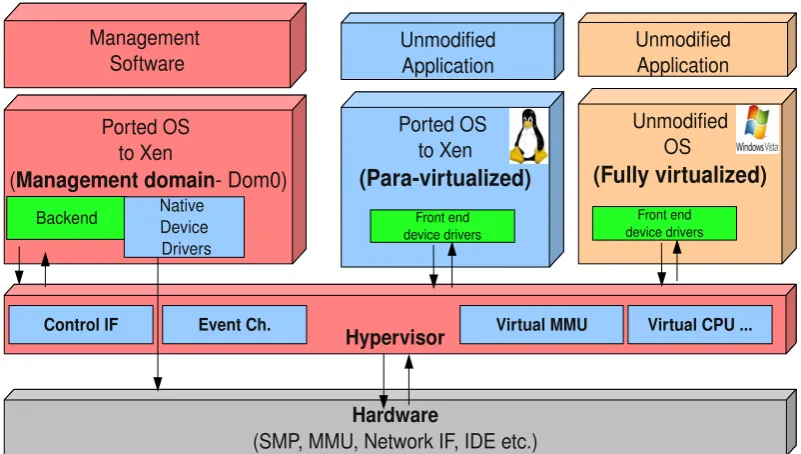
Xen is an open source Virtual Machine Monitor that enables running multiple operating systems on a single machine [33]. The overall Xen environment consists of several items that work together to give the virtualization experiance [106]. Some critical components of Xen environment are:
• Hypervisor
• Domain 0 (Dom 0 or Management Domain)
• Domain U (Dom U - can either be paravirtualized or fully virtualized instance of an OS)
[image:51.595.124.525.96.323.2]• Management Software
![Figure 3.4: Stages in default Xen migration [courtesy: [46]].](https://thumb-us.123doks.com/thumbv2/123dok_us/8079655.228635/55.595.135.517.116.396/figure-stages-default-xen-migration-courtesy.webp)