A Practical Guide to
Computer
James Hannan, Editor
•
Contributors To This Volume
George N. Baird Woodbridge VA
Paul F. Barbuto, Jr.
Data Base Manager, Washington State Library Network OlympiaWA
Norman Carter
Development Systems International, Los Angeles CA
David M. Clark
Computer Applications Consultant, Richmond VA
James F. Gross Sheboygan WI
Kathryn Heninger IBM Corporation, Chapel Hill NC
Paul Oliver
President, EDS-World Corporation, Bethesda MD
David Schechter
Consultant, Adjunct Assistant Professor of Management School of Continuing Education, New York University, New York NY
John E. Shore
Naval Research Laboratory, Washington DC
Bruce Winrow
A Practical Guide to
A
AUERBAC~
~
Computer
Programming
Management
Edited by James Hannan
AUERBACH Publishers Inc Pennsauken NJ
Library of Congress Catalog Card Number 82-11339
ISBN 0-442-20920-7
All rights reserved. No part of this work covered by the copyright hereon
may
be reproduced or used in any form or by any means-graphic,
electronic, or mechanical, including photocopying, recording, taping,
or information storage and retrieval systems-without written
permis-sion of the publisher.
Printed in the United States of America
Published in the United States in 1982
by Van Nostrand Reinhold Company Inc
135 West 50th Street
New York NY 10020 USA
16 15 14 13 12 11 10 9 8 7 6 5
Library of Congress Cataloging in Publication Data
Main entry under title:
.
A Practical guide to computer programming management.
(Auerbach data processing management library; v. 2)
1. Computer programming management.
I.Hannan,
James, 1946-
. ll. Series.
Contents
Preface
viiIntroduction
ixChapter
1
Acquiring Entry-Level Programmers
Bruce Winrow ...
2
Performance Appraisal of Programmers
Norman Carter ... 11
3
Estimating the Cost of Software
Paul Oliver ... 33
4
Designing Modular Programs
Kathryn Heninger and John E. Shore
...
495
Decision Tables
Paul F. Barbuto, Jr. ... 69
6
Program Portability
Paul Oliver ... 89
7
Writing Straightforward, Maintainable
Programs
James F. Gross . . . 0 • • • • • • • • • • • • • • • • • 101
8
Programming Style in COBOL
George N. Baird ... 113
9
The Skeleton Program Approach to Standard
Implementation
David Schechter ... 125
10
Tools for Top-Down Testing
Paul F. Barbuto, Jr ... 137
11
A
Methodology for Program Maintenance
Preface
In its relatively brief existence, the computer has emerged from the back rooms of most organizations to become an integral part of business life. Increasingly sophisticated data processing systems are being used today to solve increasingly complex business problems. As a result, the typical data processing function has become as intricate and specialized as the business enterprise it serves.
Such specialization places a strenuous burden on computer professionals. Not only must they possess specific technical expertise, they must understand how to apply their special knowledge in support of business objectives and goals. A computer professional's effectiveness and career hinge on how ably he or she manages this challenge.
To assist computer professionals in meeting this challenge, AUERBACH Publishers has developed the AUERBACH Data Processing
Management Library. The series comprises eight volumes, each addressing the
management of a specific DP function:
A Practical Guide to Data Processing Management A Practical Guide to Programming Management
A Practical Guide to Data Communications Management A Practical Guide to Data Base Management
A Practical Guide to Systems Development Management A Practical Guide to Data Center Operations Management A Practical Guide to EDP Auditing
A Practical Guide to Distributed Processing Management
Each volume contains well-tested, practical solutions to the most common and pressing set of problems facing the manager of that function. Supplying the solutions is a prominent group of DP practitioners-people who make their living in the areas they write about. The concise, focused chapters are designed to help the reader directly apply the solutions they contain to his or her environment.
AUERBACH has been serving the information needs of computer professionals for more than 25 years and knows how to help them increase their effectiveness and enhance their careers. The AUERBACH Data
Processing Management Library is just one of the company's many offerings in
this field.
James Hannan Assistant Vice President AUERBACH Publishers
Introduction
Perhaps no other function in data processing has gained the notoriety that programming has. To the uninitiated, it is the most impenetrable of all the DP black arts, with technical sorcerers employing ritualistic "metho-dologies" and arcane "languages" to make the electronic leviathan do their bidding. Solutions to the most complex business and scientific problems can be
had simply by petitioning the sorcerers, who then produce results in the time it takes to utter the requisite incantations.
For most programming managers, this naive but all-too-prevalent attitude on the part of users is a fact they must cope with in meeting their organizations' need for application systems. Creating programs entails the skillful management of both people and technology, a process that many managers might argue is almost as difficult as conjuring spells. And whether users are knowledgeable or uninformed about the realities of programming, they generally make rigorous demands of programming managers. This vol-ume of the AUERBACH Data Processing Management Library is designed to help programming managers satisfy those demands.
We have commissioned an outstanding group ofDP practition-ers to share the benefits of their extensive and varied experience in program-ming. Our authors have written on a carefully chosen range of topics and have provided proven, practical advice for managing the programming function more efficiently and effectively.
In Chapter One, Bruce Winrow discusses an effective way to deal with the chronic shortage of experienced programmers-hiring and train-ing entry-level programmers. He provides guidelines for hirtrain-ing high-potential graduates from educational institutions and outlines procedures for establishing an entry-level training program.
In addition to hiring and training programmers, a manager is also responsible for assessing programmer performance. Such assessments help reduce turnover by keeping programmers informed about their strengths, weaknesses, and progress. In his "Performance Appraisal of Programmers," Norman Carter discusses techniques that help managers make and understand evaluations; he also offers procedures, a checklist, and sample forms that can facilitate performance appraisal.
As challenging as personnel issues are, the programming man-ager must also deal with an equally demanding set of technical problems. Determining the resources required to develop a software product is one such problem. In Chapter Three, Paul Oliver explains why it is so difficult to develop accurate estimates and suggests policies, procedures, and formats that can reduce the level of difficulty and improve the accuracy of estimates.
System design is another subject that presents knotty technical problems. Managers and programmers are often encouraged to design modular programs to increase software reliability and reduce overall software costs. Kathryn Heninger and John E. Shore introduce the basic concepts of modular program design and explain how to apply them in Chapter Four.
In the area of program design, an effective but often over-looked technique is the use of decision tables. Most programming tools are valuable at a specific stage in the program life cycle but do not serve nearly as well at other stages. Decision tables, on the other hand, can be used with equal effect in analysis, design, programming, and documentation. In Chapter Five, Paul F. Barbuto, Jr., discusses the construction, modification, and uses of decision tables.
Since many programs are moved from computer to computer during their lifetimes, it makes economic sense to consider the costs of portabil-ity at the design stage. In "Program Portability," Paul Oliver describes the problems inherent in portability and discusses how to minimize software conversion costs during program design and implementation.
Many of the problems and costs associated with program design and implementation can be reduced or eliminated through the develop-ment and enforcedevelop-ment of standard policies and procedures. In "Writing Straightforward, Maintainable Programs, " James F. Gross examines some of the factors that make programs hard to maintain and suggests some general considerations and specific coding practices that can yield more maintainable programs. George N. Baird presents guidelines for producing source programs that appear as though written by a single programmer, thus facilitating mainte-nance, in his "Programming Style in COBOL." And David Schechter de-scribes a technique for reducing implementation costs in his chapter detailing the skeleton program approach to implementation.
The testing phase of program development can benefit as much from the use of top-down methods as the design phase. Moving the testing process forward in the development cycle and integrating it into top-down design enables testing to provide timely feedback. Paul Barbuto describes top-down testing and the tools that support it in Chapter Ten.
Although it consumes a significant amount of time and re-sources, program maintenance is generally viewed as an uncontrollable neces-sity. To help bring this activity under control, David M. Clark presents a workable methodology for program maintenance that emphasizes programmer preparation, program and task overviews, and change follow-through.
~
Acquiring Entry-Level
Programmers
by
BruceWinrowINTRODUCTION
Many organizations are encountering difficulties caused by the severe shortage of experienced programmers. The various recruiting alternatives are expensive and often unfruitful. In addition, even experienced personnel often require considerable training to become familiar with an organization's unique mix of hardware, software packages, programming techniques, project methodologies, and so on.
As a result, an increasing number of programming managers are establishing entry-level training courses to attract high-potential (but inexperienced) gradu-ates of educational institutions. The aim is to produce-as quickly as possible-productive programmers trained to meet the organization's specific needs. Recent graduates can be hired at lower salaries than experienced programmers. Hiring inexperienced candidates also encourages promotion from within for other job openings, and effective programmer training can reduce turnover.
In this chapter, it is assumed that the reader is familiar with the basic tasks involved in undertaking a training needs analysis, exploring training sources, and setting up the training program. This chapter discusses the need for management commitment to entry-level training and recruiting, the value of aptitude testing for entry-level candidates, and a proven procedure for hiring trainees. A case study of a large DP installation is presented.
MANAGEMENT COMMITMENT
ROLE OF THE TRAINING DEPARTMENT
If the organization includes a training department, this department must establish its role in the hiring process, and senior management must demon-strate its support of that role. Often, department managers or personnel depart-ments hire new employees and tum them over to the training department to upgrade their skills. The problem with this procedure is that different managers use different criteria for selection and have varying degrees of skill in the hiring process (e.g., interviewing). Even though the training department often has to train less-than-ideal candidates, the trainers are still held responsible for the new employee's performance. If the training department is judged by the performance of its trainees, it behooves the training manager to have some control over the quality of the candidates.
Many organizations, of course, have no separate training department; con-sequently, essential functions of establishing the program, obtaining manage-ment support, determining hiring criteria, and coordinating the efforts must be performed by other appropriate personnel. The trainers can be drawn from programming managers, senior programmers, personnel department staff, and soon.
RECRUITING PROGRAMMER TRAINEES
Hiring high-aptitude candidates maximizes the likelihood of success. Hiring poor candidates, even at the entry level, is expensive and can be disastrous. Selection techniques are limited and usually involve screening resumes, inter-viewing, checking references, and objective testing. To use only one of these approaches would be irresponsible, especially since all but testing are more or less subjective.
As with any other worthwhile project, the most important step .in the recruiting process is planning. Figure 1-1 illustrates a network plan for hiring entry-level trainees. This plan has proved successful for a large organization with approximately 2,500 DP employees at all skill levels.
It is essential to identify the type of individual desired, where he or she can be found, and the best recruiting method. Four obvious groups that may provide candidates for entry-level programming positions are:
• University graduates whose curricula include DP courses • Community college graduates in DP
• Graduates of an accredited computer institute
• Internal candidates possessing a high aptitude for programming
Determine role of testing
Determine role of training dept
Establish costs
Determine criteria for selection
Schedule test
[image:14.414.36.601.50.334.2]Determine interviewers
Figure 1·1. Sample Network Plan for Hiring Programmer Trainees
m
z
-f~
r
~
m r
"'0
~
Ci)
JJ
»
s:::
s:::
mJJ
en
Many educational institutions have a placement selVice that will supply organizations with resumes of graduating students on request. At the vel)' least, notices can be posted on campus, announcing the organization's intent to hire. The training manager should sUlVey local schools to determine which offer courses that best match the organization's needs. Advertising in local papers and using placement agencies are other alternatives, but these can be time consuming and vel)' expensive, especially for entty-Ievel personnel.
Prior to obtaining resumes, the criteria for screening should be determined. Some criteria (e.g., scholastic average, work experience, curriculum) may have particular value to an employer. The job requirements should be studied (even for entty-Ievel personnel) in order to compare the candidate's qualifica-tions with the needs of the job. The resumes should then be read over carefully, noting such things as gaps in background, inconsistencies, insufficient infor-mation, reasons for leaving previous employment, and attitudes.
If testing is used as a tool for selection, administrative details must be taken care of first. This may include arranging for testing premises and ensuring that there are enough tests on hand. Potential employees will be taking the test, and the company should give a professional first impression. There is no excuse for administrative foul-ups, considering the enormous value of hiring the best candidates. As many candidates as possible should be tested at one sitting, especially if many of them are being recruited from the same educational institution. Avoid using the same test more than once for students from a single institution. Some applicants who have already spent hundreds of dollars on programming courses may rationalize that there is nothing wrong with getting "help" with the test as long as they finally understand how to do the problems. Most good tests are designed on the assumption that the problems are new to the applicant. Scheduling as few testing sessions as possible greatly reduces the problem of one applicant coaching another.
APTITUDE TESTING AND HIRING DISCRIMINATION
Because of the intense EEOC scrutiny to which aptitude tests have been subjected, many employers wonder whether they are allowed by law to use objective tests as part of their selection criteria. Employers should realize that testing is not illegal; it is not even disapproved of. Organizations are free to use any professionally developed aptitude test that is not discriminatol)'. They are also free to use a test that, in practice, screens out protected classes of individuals in disproportionate numbers, provided the test can be shown to be a valid indicator of on-the-job performance.
ENTRY-LEVEL PROGRAMMERS
Table 1-1. Determination of Adverse Impact (4/5 Rule)
Selection Procedure Administered to
100maies 60femaies
Hired
65maies 20 females
Percentage Selected
65 33
Hiring Ratio·
33/65(50%)
'In this example, the hiring ratio for females is less than 80% of that for males, indicating hiring practices adversely affect females. This means the selection procedure must be validated.
5
any race, sex, or ethnic group are not permissable unless justified by business necessity,
Employers who use a selection procedure that has no adverse affect on a protected group may avoid application of the guidelines. Selection procedures that do have adverse impact should be validated to demonstrate the relationship between the procedure and on-the-job performance. In the case of testing, scores must be predictive of performance on the job. If the employer has substantial evidence of the validity of a particular test, it may be used in the selection procedure while data is collected for a local validation study. To determine "substantial evidence," the abilities required for successful per-formance of the jobs should be established, and these criteria should be compared to what is measured by the test. If the criteria in the job description and those in the test are very much the same, and if the test has been validated elsewhere, the test can be used. It should be considered only one factor (less than 50 percent) in making the selection decision.
To perform a validation study, a sample of at least 30 persons-either present employees (concurrent validation) or new hires (predictive validation)-must be measured over a period of time to determine whether there is a meaningful relationship (predictive validation coefficient) between on-the-job performance ratings and the test predictions. The testing/test marketing organization should gather the data on the employer's behalf, perform all necessary statistical work, and provide a detailed written validation report showing the results of the study for the employer's organization.
At least three factors should be considered when selecting a test to use: • Relevance-A relevant test measures abilities that are critical to job
success.
• Reliability-A reliable test should predict success on the job over a long period of time and with a wide range of applications.
• Predicting on-the-job success-There should be close agreement of test scores and supervisory ratings of performance on the job.
THE INTERVIEW PROCESS
Screening resumes and testing are only two tools in the selection procedure and, although they are important, they involve very little interaction between the organization and the candidate. The interview process, if well planned and executed, can mean the difference between hiring excellent candidates and not meeting the recruiting quota.
First, qualified interviewers should be chosen, and the same interviewers should be used throughout the hiring campaign. If experienced interviewers are not available, a course on effective interviewing should be considered.
In one successful organization, the training manager, an employment coor-dinator from the personnel department, and the programmer training instructor separately interview each candidate. After all candidates have been seen, each interviewer arranges the applicants in order of preference. A general meeting takes place to merge the lists and select those to whom job offers will be sent.
The interviewers should meet before the interviews and plan their approach. They should establish objectives for interviewing and, as much as possible, avoid duplication of questions or areas of discussion. Planning also facilitates probing for in-depth information; inexperienced interviewers often try to cover too many items in too short a time and might never, for example, uncover the real reason for a job change.
Careful scheduling is also important. Applicants appreciate professionalism and are impressed when they are interviewed on time by three successive people, with no delays in between. This can be accomplished by allowing each interviewer about 45 minutes (30 minutes for the interview and 15 minutes to document the evaluation). At the end of30 minutes, the candidate is brought to the next interviewer. Each interviewer must be well prepared and familiar with the applicant's resumes. With this system, the candidate is finished with three interviews in 90 minutes, with no delays (this assumes that the interviewers are
in close proximity). "
ENTRY-LEVEL PROGRAMMERS 7
It is important that the organization remain in constant contact with the applicant at all stages of the selection process. This reduces the chances of surprise if a candidate accepts a position elsewhere; in addition, it improves the organization's professional image. Every applicant, whether accepted or re-jected, should receive some sort of response. The vehicle may be a form letter or a personal phone call. A company with good follow-up procedures has a competitive edge over those with shoddy hiring practices. Even though a candidate is turned down, he or she may be in a position to refer future candidates; thus, the interview process should leave all candidates with a positive image of the organization.
THE JOB OFFER
Before making a job offer (even, in fact, before initiating the interview process), competitive salary ranges for entry-level programmers should be established. Many companies set their pay scales according to scholastic attainment and thus offer salaries that depend on whether the applicant is a community college, computer institute, or university graduate. It is possible to offer lower than competitive salaries if there is an extensive entry-level training program; however, the salaries should be made competitive at the end of training, or the students who have completed the program may be enticed to other firms.
Consideration should be given to raising everyone's salary to the same level at the completion of training, regardless of educational background. If the training is effective, the students will have similar abilities to perform similar jobs. Salary figures that competent performers can expect after training and after one year with the organization should be identified. Commitment to these figures when making a job offer can help offset any negative feelings an applicant might have about a less-than-competitive starting salary.
It is important to be careful about having the applicant sign a contract committing him or her to the firm for a period of time in an attempt to guarantee some return for the training. If the individual becomes disgruntled, the firm may be better off without him or her.
Before writing the job offer, it is wise to inform the applicant by telephone that it is coming. This may cause the applicant to stop job hunting; it also provides an opportunity for the applicant to affirm his or her interest in the position.
CASE STUDY OF A LARGE DP INSTALLATION
employees who were hired when testing was part of the selection procedure were rated higher-by a margin of approximately 20 percent-by their manag-ers than candidates selected without testing.
The bank's training department was responsible for both recruiting and training the new personnel. Table 1-2 indicates the cost of hiring 10 candidates and training them in a five-month course.
Table 1-2. Budgetfor Hiring and Training 10 Trainees
Management Salaries (0.8 man-years) Clerical
Trainee Salaries Aptitude Tests Training Materials· Computer Time
Hardware (TSO terminal rental) Premises
Travel
Subtotal
$1,000 21
4
50
75 3
4
12
5
11
1
Total 111 CostfTrainee 11.1 CostfTrainee/Month 2.2
"This amount represents replacement costs only, since this organization owns most of Its training materials.
The bank found that graduates of the training program performed at a level comparable to that of an externally hired programmer with approximately two years of experience. Part of the cost justification for the training was that the five-month graduates, who were familiarized with organization-specific proce-dures and became productive quickly, were paid a lower salary than their counterparts with two years of experience. In addition, turnover was lower, in part because entry-level personnel are not attractive to other firms until they gain some experience. Over an eight-year period, the average yearly turnover rate of personnel who had completed the training (approximately 350 people) was 8.8 percent. Those who did resign stayed for an average of2.6 years.
The bank used the scale in Table 1-3 for entry-level salaries. As can be seen,
all students were brought to the same salary level towards the end of the training program and were reviewed again in six months. It was felt that the 10-month review was necessary for competitive reasons, especially since the graduates were by then fully productive. From that point, the bank's yearly salary policy took over, with employees receiving a five to ten percent increase based on performance ratings established by the employee's immediate supervisor. In
addition, the bank usually granted a six to nine percent across-the-board increase (a market adjustment for competent or better-than-competent employees).
ENTRY-LEVEL PROGRAMMERS
Table 1-3. Salary Scale for Entry-Level Programmers
Time
Entry
4 months 10 months 22 months
Education
1-year institute
2-year community college University
Everyone Everyone Everyone
Salary
$11,200 11,760 12,400 13,800 15,700 5-10% merit 6-9% market
9
competitive than the entry-level rates. The interviewers explained the training program to the applicants to ensure that they understood why the initial salary was low. Using this procedure, the bank had no difficulty in attracting and keeping good candidates.
The bank experienced another benefit from hiring and training in groups. With several people going through the same curriculum, students with perform-ance problems were identified and dealt with early. (In some instperform-ances this meant dismissal.) This relieved individual supervisors of the burden of ident-ifying poor performers, provided a more objective means of evaluation, and saved the company time and money by releasing substandard personnel before they became long-term employees.
During the 20-week training program, the training manager received re-quests from other managers for the services of the graduating students. The training manager, knowing the capabilities of the students and the work requirements of the various requesting areas, made a preliminary allocation of students to the various managers. Interviews were arranged, and if the manager and student reached amutual agreement, the graduating student was assigned a position. If there were problems (such as personality clashes), other interviews were held until good matches could be found. Because of careful manpower planning, in eight years there were never more graduating students than available positions at the end of training.
CONCLUSION
When hiring entry-level programmers for a training program, the following points should be considered:
• Plan the recruiting process, and adopt a uniform recruiting procedure. • Obtain budget approval in advance for recruiting and training. • Use selection tools wherever possible in the hiring process.
• Hire candidates for their potential, and train them in the necessary skills. • Consider long-term manpower requirements, and hire and train in
groups.
• Determine the role the training department should take in the recruiting process.
• Conduct planned and professional interviews with appropriate follow-up.
• Identify standards of perfonnance for the training program so that substandard trainees can be identified early.
72
Performance
Appraisal of
Programmers
INTRODUCTION
by Norman Carter
DP employees with excellent working tools (e.g., systems development methodologies and test data generators) are usually well trained in their use. The question of how well the individual actually uses these tools, however, is often ignored. Some managers apparently feel that a raise and an occasional pat on the back obviate the need for fonnal employee evaluation.
Companies that conduct regular feedback interviews six months after em-ployees leave have found that lack of effective performance appraisal is high on the list of reasons for leaving. In many cases, this reason precedes the financial motivation so often discussed at the time of leaving. If lack of effective performance appraisal is indeed a major reason for employee turnover, there are straightforward ways to attack the problem.
There is another reason for conducting regular formal performance appraisal of DP personnel: both the Equal Employment Opportunity Commission (EEOC) and Affirmative Action (AA) require that a company be able to demonstrate a direct and traceable relationship among a job description, per-formance criteria for the job, appraisal of perper-formance against the description and criteria, and direct involvement of the individual in setting, monitoring, and measuring objectives.
Objectives of Performance Appraisal
The primary objectives of performance appraisal are to:
• Review employee progress in terms directly related to the organization and the individual's job family and position
• Review and establish measurable performance goals for the next given time period
• Design objectives, action plans, and training curricula for each individ-ual for current, and in preparation for future, job responsibilities • Comply with company personnel and salary administration policies and
guidelines
objectivity of the perfonnance evaluation; the manager may find that in order to support a requested increase, he must make unsupported statements or state-ments that do not reflect a consistent view of the individual's contribution to the department.
Perfonnance appraisal provides the framework within which the growth of an employee can be evaluated independently of the availability of money to compensate that individual. In fact, consistent appraisals are one lever a manager can use to correct salary grades or ranges with the compensation manager. Once-a-year fudged perfonnance appraisals make correction of sal-ary inequities almost impossible.
Perfonnance appraisal can also be used for mutual discussion of the profes-sional and technical achievements of the employee. Perfonnance objectives can be negotiated, thus avoiding unilateral goal-setting by the manager.
Managers as Coaches, Not Umpires
The role of a manager can be likened to that of the coach of a team. Each player is taught what to do and how to do it in nonnal circumstances. As the game proceeds, minor adjustments are made by the coach. A coach who does not modify the game plan in response to the play is usually neither respected by his players nor successful in developing or maintaining a winning team.
At the same time, a player has the responsibility to call time-out to discuss a situation he has observed on the field so that the coach can offer further assistance. In this sense, the success of the team is as important as the success of each individual.
Perfonnance appraisal involves the manager, supervisor, or team leader in the coaching or counseling of employees in tenns of their ongoing overall development, not just as an umpire dealing with disputes and disruptions. In addition, perfonnance appraisal helps the leader and staff feel like members of a team and helps allay the feeling that each approach by the manager is related to disciplinary action or financial reward.
TYPES OF PERFORMANCE APPRAISAL
Perfonnance appraisal is typically viewed as a single activity: sit down, fill out the fonn, conduct a cursory everything-is-all-right discussion, sign the fonn, and get back to work. It is not, however, as simple as that.
Employees generally fall into three categories: • High perfonners with high potential • Averageperfonners
• Marginal perfonners
PERFORMANCE APPRAISAL 13
~
High P.rformer Average Performer Marglna' PerformerTraining Category R.ady Future Short Plan Long Plan Keep
Separate Activity
SeIf-devetDpment High High average Above Average Low expected None
CI.,sesl To round out Key subjects for Next required Selective skill for
To maintain skill
workshops' knowledge next pOSition mlssmgSkllis advancement
. . mlnar.
To maintain To supplement To prepare lor
CoachingicounMHng Intensive Intensive To maintain skill minimum skill
skills advancement until separation
Involvement In other
High High Some As available Minimum
company acltvlt~.
Figure 2-1. PerformancelTraining Activity Requirements
The high perfonner should, of course, be expected to do more than the low perfonner and should also be expected to perfonn more job-related develop-ment activities outside of work. A low perfonner, however, who will be separated from the company, may be on the job for longer than expected while a replacement is found. Training may be required to ensure that job skills do not fall below an acceptable level. No other training activities should be scheduled for this category.
Performance Appraisal Roles
Three complementary roles in perfonnance appraisal-the company, the manager, and the individual-can, when linked, provide an effective perfonnance-oriented environment. Effective communication among the three areas is essential.
The three roles can be defined as follows: • The Company
-Provides the overall climate for individual growth -Demands high perfonnance standards
-Expects managers to develop their subordinates -Recognizes the need for training and makes it available
-Rewards accomplishments financially and in tenns of advancement • The Manager
-Provides continuous coaching and guidance
- Demands the demonstration of immediate and sustained performance improvement in each assigned task
-Expects help from staff resources in the coaching role and recognition for the accomplishment of this role
• The Individual
-Is self-motivated in the area of personal and professional growth -Demands a say in detennining his or her career path
- Expects help from the company and immediate supervisor -Recognizes responsibility for applying his or her training
-Rewards the company with an immediate return on investment through increased productivity
I
Career Path ChartWhere You Are
l
Where You Can Go!
Position Definition Critical
Performance Areas
What to DO!
-~~
Position Definition
Individual Performance Career Path Plan
Descriptions Howto Do Itt
Career Counseling:
You and Your Your Map fo Task/Training Supervisor the Next Yea
Matrix and the Job
t
t
I
Training [image:25.414.55.368.68.361.2]What you Need More to Know Knowledge
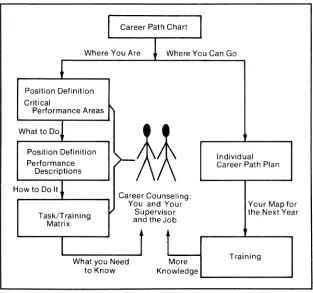
Figure 2·2. Performance Evaluation/Career Planning Relationships
PREPARING FOR THE PERFORMANCE APPRAISAL
As one of the most demanding, difficult, and rewarding managerial activi-ties, effective performance appraisal takes time-and managers often say they have no time for such appraisals. Time can always be found, however, to interview applicants, to correct work if employee objectives have been poorly set, or to provide training when lack of knowledge causes errors. In many cases, more time is required to correct a performance problem than is necessary to conduct an appraisal, set objectives, and help the employee understand them. Preparing and conducting a thorough, effective performance appraisal should require less than five hours per person.
PERFORMANCE APPRAISAL 15
Discussion. After preparation by the employee and the supervisor, per-formance, productivity, and new and continuing objectives should be dis-cussed. This step should also take an hour to an hour and a half per person.
Negotiation. If performance evaluation is done consistently and at logical checkpoints throughout the year, differences of opinion and viewpoint should be minimal. Several discussions may be necessary, however, to reach a mutually agreeable set of performance objectives. These discussions may require two meetings of about an hour each.
Completion, Completing and submitting all paperwork in accordance with company procedures (after appraising and ranking all individuals in a section or department) should take about 15 minutes per person.
The Tools
The following types of tools facilitate performance appraisal.
Standard Forms and Procedures. If standard forms and procedures have not been specified by the company, they should be developed and used consistently. This requirement becomes increasingly important as EEOC and AA continue to expand their roles as protectors of employee rights. Standard-ization also helps avoid government audits that often occur when individuals feel that varying standards are being applied.
Position Descriptions. Job descriptions should be written in specific terms detailing what is to be done and how, in addition to giving broad statements of responsibility and authority.
Job Standards. Job standards and tools should describe project require-ments, system development standards and guidelines, departmental standards and policies, and pertinent company policies and procedures.
Assignments/Results. The objectives set for the period should be avail-able for review, as should a list of assignments that may have facilitated or impeded achievement of the objectives.
Previous Appraisals. Several prior appraisals should be available for re-view to help detect such trends as failure to meet objectives or exceeding objectives frequently.
Setting the Meeting Date
time (preferably in writing). Self-assessment aids can also be made available at this time for the individual to use, if desired.
THE PERFORMANCE APPRAISAL DISCUSSION
At best, performance appraisal begins as a stressful interview. Both partici-pants come with different expectations. Until it is understood that the differ-ences are professional and not personal, that compromise need not be one-sided, and that effective negotiation is a sign of professional maturity, the discussion will achieve less than optimum results. The following suggestions help reduce the threatening aspects of the discussion.
The Environment. Do not conduct the discussion in a noisy environment or with other people present. For example, do not hold the meeting in a restaurant where customers and serving make communication difficult. (In addition, it is extremely difficult to enjoy a meal under the constraints of such a critical activity as performance appraisal.)
The best setting is a neutral environment such as a conference room, where both parties can come from behind their desks. In addition, try to ensure that the discussion is not interrupted; in no case should telephone calls be taken by either person during the discussion. Behaviorists state that each time a discus-sion is interrupted, it takes from five to ten minutes to regain the concentration and flow that existed before the interruption.
The atmosphere should be as comfortable as possible. If the atmosphere of the department is shirt sleeve, keep it that way. Do not set up artificially formal barriers. Have some liquid refreshment (coffee, soft drink, or water) available.
The Discussion. The process must be a discussion, not a monologue. Both parties, but especially the manager, should practice active listening techniques. Notes should be taken and, whenever necessary, read back so that both parties understand and agree on what has been discussed.
Negotiating. When differences of opinion on performance arise, the man-ager should be prepared to use conflict-resolution skills. Resolutions must be within the scope of and consistent with the performance appraisal tools men-tioned earlier. Agreements reached outside these constraints, unless carefully documented and well understood, often lead to additional conflict. They are, therefore, self-defeating as a means of improving performance.
Legal Requirements
Although all of the EEOC rulings and AA requirements cannot be detailed in this chapter, the following points should not be overlooked:
• Compliance with the law is compulsory, not voluntary. • Intent to follow the law is not sufficient.
PERFORMANCE APPRAISAL 17
• The responsible organizations have stated that audits of compliance will be conducted more frequently than in the past.
Goal Setting
Two types of goal setting are required for performance evaluations: qualita-tive and quantitaqualita-tive.
Qualitative Goals. Too often, all of the established goals are qualitative and include such statements as:
• Will maintain a level of production consistent with the average achieved by the group
• Will comply with procedures established by management
Although some qualitative goals can be beneficial, they should be expressed in concrete terms so that the individual understands exactly what is expected. For example, a more explicit qualitative goal might be:
• To comply with the requirements described in the Systems Standards Manual for the appropriate phase of the assigned development tasks • To comply with Documentation Standard X
• To understand and be guided by Company Policy Y related to attendance on the job
Qualitative goals should be kept to the minimum consistent with the assumption that the employee knows the general requirements of the company and the job.
Quantitative Goals. As far as possible, performance goals should be quan-titative and restricted to an attainable number, generally between three and five. With more than five goals, activity and accomplishment tend to become too diffuse, and judgment can become imprecise. Spreading fewer than three goals over a similar period of time tends to make recalling sufficient detail difficult.
A quantitative goal should at least include the following elements: • A description of the task to be done
• A definition of the standard to be used
• A breakdown of the task into deliverable items and the standard for each • The relationship of each deliverable to a phase or project activity with
earliest/latest completion schedules, such as:
To complete program A in System B with fewer than three as-semblies, using Test Assembly Standard E and Document Standard F. To be completed not later than Date H. Performance of this goal contingent on input from prior program delivery by Date G.
• Statement of the value to the individual in meeting the goal. For example:
JUDGING REWARDS AND PENALTIES
An effective challenge to individuals to improve their performance requires rewards and penalties. Often, the reward is more money and the penalty less, with a range of three to six percent. In view of today' s economy, this may not be sufficient motivation. Rewards that are not exclusively tied to money should be used.
Weighted Performance Goals. Once agreed-upon objectives are accepted as the normal, expected performance, the effect of other-than-normal perfor-mance can be judged. Weighted goals, which define other-than-standard performance, can be expressed as follows:
• The objective is to complete the tasks on the schedule described and within a budget of $X, over which you have control. Upon completion, your performance reward will be:
-On schedule, below budget
=
Normal increase+
10 percent of budget saved-Before schedule, below budget
=
Normal increase+
25 percent of budget saved-After schedule or over budget
=
No increase• The objective is to successfully implement the XYZ software package in accordance with the vendor's contract terms and planned schedule and to achieve a level of user satisfaction so that fewer than four complaints will be received by senior management in the first three months of operation. -Should this occur, 50 percent of your performance award will be
earned.
-If the schedule is missed by more than one month or if user complaints exceed four during that period, the performance award will be de-creased to 35 percent.
-If the schedule is missed by more than three months or if complaints exceed 10, the goal will be considered not met.
These examples show that while weighted goals expedite quantification of rewards, they require considerable thought, precise definition, and tough-mindedness in their enforcement. In most cases, however, a demanding atmo-sphere, coupled with fair and firm goal-setting and evaluation, is beneficial to the individual and the company.
Additional Techniques
Three additional techniques can be used to make performance appraisal more effective. Totem poling, tie breaking, and ranking aid in weighing individuals against one another; they are perhaps most beneficial in situations where resources and opportunities are limited.
PERFORMANCE APPRAISAL
Individual Rating Value Rating
1. Demonstrated ability to bring projects in on time and within budget (±5%)
1..
Usually better ~ As planned ..!.. Usually misses 2. Adherence to SDlC Process, stated guidelines, project (JobProcedure)
~Always 2 Satisfactory ..!.. Fails to Comply
3. Effective user relationships (does not require manager intervention)
3 Fewer than 2 complaints/yr 2 3 to 5 complaints
x 3
x 1
- ..!. More than 6 complai nts x 3 4. Quality Production
~ Consistently above standard
.l.
Meets standard..!. Below standard 5. Quantity Production
3 Consistently above standard 2 Meets standard - 1 Below standard
6. Meeting agreed-upon objectives 3 Usually betters performance
-
2-
Rarely meets2 Meets at least 2 out of 3
7. Making creative input outside of assigned project area
x 2
x 2
x 1
1..
Often (2 to 3 times/yr)1..
Sometimes (1/yr) .LRarely x 1 8. Applies training received, when back on jobLAlways 2 Sometimes .LRarely x 1
9. Consistency and accuracy of project planning and estimating 3 Plan always met (barring outside intervention)
.£
Plan met - 80% of time ..!. Plan met less than half the time x 3 10. Knows and actively supports management objectives [image:30.414.44.351.57.479.2]LAlways
2...
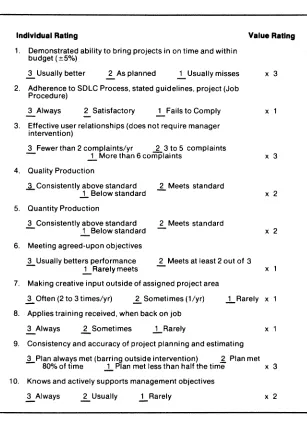
Usually ..!..Rarely x 2Figure 2-3. Typical Tie-Breaking Questions
19
Inconsistencies in judgment at appraisal time are minimized since the person completing the totem pole is forced to ask:
Why have I put this person in this place? Is this placement consis-tent with the perfonnance appraisal rating?
advancement. Pertinent rating questions can be developed, with the value of each determined on a basis acceptable to all managers involved in the selection process. Figure 2-3 shows the kinds of questions and value rating that can be created.
With this tie-breaking technique, each individual is rated and the score calculated by multiplyin~ the numeric value of the answer by the value rating and adding all rated items. The result can be used as one input to help break a tie.
Ranking. Totem poles of the employees in an organization (or department) can be combined for similar job families or project groups. This provides top-to-bottom ranking of all programmers, for example, covered by one job description. Using a master ranking list, management can:
• Identify evaluation inconsistencies between organizations or supervi-sors
• Identify candidates -For advancement
-For evaluation oflow performance
-Who are expected to change ranking position during the next 12 to 24 months
PERFORMANCE APPRAISAL PROCEDURES
Regularly conducted performance appraisals are vital in keeping program-mers aware of how well they are doing in their jobs. Use of standard forms and procedures makes the performance appraisal process easier to accomplish and to apply consistently. This enables managers and employees to communicate more freely; it also helps meet EEOC and AA requirements. The remainder of this chapter describes standardized procedures for planning, preparing, and conducting performance evaluations and shows the types of forms that can be used.
STEPS IN PERFORMANCE EVALUATION
The steps to be taken in conducting an effective appraisal, including prepa-ration, the discussion itself, and follow-through, are indicated in subsequent sections.
Planning Procedures
• Review with the employee the position description, task definition, job standards or requirements, and other pertinent procedures or policy statements.
PERFORMANCE APPRAISAL 21
During the Year
• Give ongoing feedback to the employee about his or her strengths and weaknesses.
• Solicit the individual's input on how well he or she is accomplishing the set objectives. Adjust goals as needed.
• Monitor performance, and keep notes. Perform interim evaluations as goals are reached or as observation indicates a necessity for corrective action or review.
Before the Formal Appraisal
• Set an appointment for the interview.
• Discuss the procedures to be followed (i.e., who will do what). • Prepare for the discussion:
-The employee should prepare his or her own performance assessment. -The supervisor should prepare his or her assessment of the employee. • Assemble job and career planning tools.
The Discussion
• Discuss the employee's performance, and share perceptions of it. • Negotiate in order to gain concurrence on the performance, if necessary . • Jointly review the position definition, job standards, and work
assign-ments.
• Establish new or revised objectives. • Discuss career planning.
• Allow the employee to add his or her comments to the appraisal form. • Both the evaluator and the employee should sign the forms.
PERFORMANCE EVALUATION AND PLANNING PROCEDURES
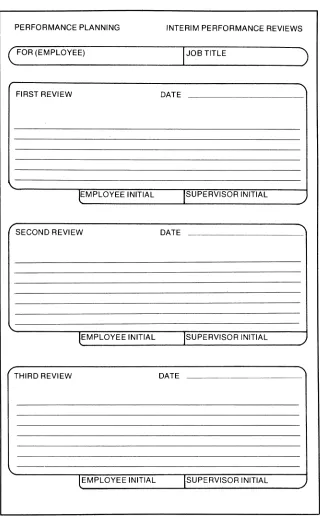
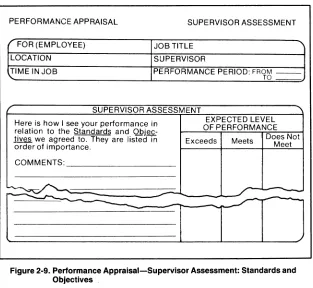
Each employee's job performance should be evaluated regularly. This evaluation becomes part of the employee's personnel records and is a factor in compensation, promotion, training, transfer, and termination. The forms shown in Figures 2-4 through 2-14 can be used in preparing for and conducting performance evaluations.
Employee Performance Categories
Explicitly defined tenns, such as the following, should be inserted in describing an employee's level ofperfonnance:
• New in Position-This category includes employees who need more training and/or experience to achieve basic competence levels (e.g., trainees and persons in new positions). An employee should remain in this category until perfonnance and productivity increase through expe-rience. A limit of three months is suggested.
• Marginal-This category includes employees whose perfonnance needs improvement to achieve basic competence levels; that is, the perfor-mance does not meet minimum job standards or the negotiated objec-tives. The expected results have not been achieved. Improvement to a competent perfonnance level within a reasonable time is required for the employee to continue in the position.
• Competent-This is the standard level of fully adequate performance; that is, the employee's performance meets the previously negotiated objectives. Employees in this category consistently discharge all job requirements in an able manner, and the expected results are achieved. • Commendable-This category includes employees whose job
perfor-mance exceeds the previously negotiated objectives. The commendable employee is clearly above average in meeting requirements; better-than-expected results are consistently achieved.
• Distinguished-Employees in this category have proved themselves
exceptional in surpassing objectives. Such employees are outstanding perfonners whose achievements are readily apparent. These employees are ready for promotion or added responsibilities at an early time.
PERFORMANCE PLANNING
The Performance Planning Interview. The supervisor should prepare for
the interview by reviewing:
• The employee's position definition.
• Organizational objectives-This review aids in determining which em-ployee accomplishments are necessary to achieve organizational objec-tives.
• Appropriate documents prepared by the employee on the job.
The Performance Planning Worksheet. The worksheet should be
com-pleted as follows:
• The supervisor and employee should discuss the job standards, in order of importance, that will be used to evaluate the employee's perfonnance (see Figure 2-4).
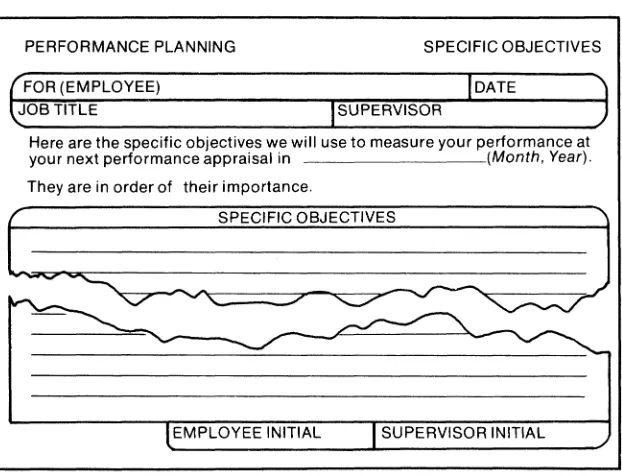
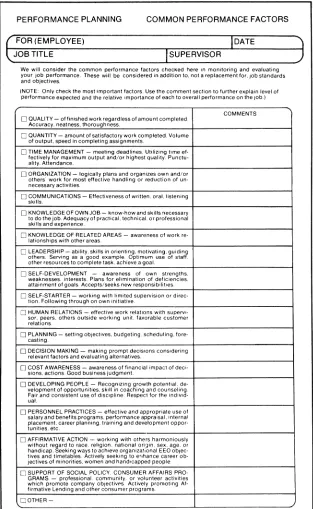
• Specific objectives that should be met by the employee should be discussed and listed, also in order of importance (see Figure 2-5). • Common performance factors (i.e., those not related to specific jobs or
PERFORMANCE APPRAISAL
PERFORMANCE PLANNING JOB STANDARDS FOR (EMPLOYEE) DATE
JOB TITLE SUPERVISOR
Here are the job standards we will use to evaluate your performance at vour next performance appraisal in (Month, Year),
They are in order of their importance,
[image:34.414.41.354.65.299.2]EMPLOYEE INITIAL SUPERVISOR INITIAL
Figure 2·4. Performance Planning Worksheet: Job Standards
23
PERFORMANCE PLANNING SPECIFIC OBJECTIVES
FOR (EMPLOYEE) DATE JOB TITLE SUPERVISOR
Here are the specific objectives we will use to measure your performance at your next performance appraisal in (Month, Year),
They are in order of their importance,
[-s
'V'
[image:34.414.43.354.326.564.2]EMPLOYEE INITIAL SUPERVISOR INITIAL
PERFORMANCE PLANNING COMMON PERFORMANCE FACTORS
FOR (EMPLOYEE) DATE JOB TITLE SUPERVISOR
We will consider the common performance factors checked here in monitoring and evaluating your job performance. These will be considered in addition to. not a replacement for. job standards and objectives.
(NOTE: Only check the most important factors. Use the comment section to further explain level of performance expected and the relative Importance of each to overall performance on the job.)
COMMENTS
o
QUALITY - of finished work regardless of amount completed.Accuracy. neatness. thoroughness.
D QUANTITY - amount of satisfactory work completed. Volume of output. speed in completing assignments.
D TIME MANAGEMENT - meeting deadlines. Utilizing time ef-fectively for maximum output andlor highest quality. Punctu-ality. Attendance.
D ORGANIZATION - logically plans and organizes own andlor others' work for most effective handling or reduction of un-necessary activities.
D COMMUNICATIONS - Effectiveness of written. oral. listening skills.
D KNOWLEDGE OF OWN JOB - know-how and skills necessary to do the job. Adequacy of practical. technical. or professional skills and experience.
D KNOWLEDGE OF RELATED AREAS - awareness of work re-lationships with other areas.
o LEADERSHIP - ability. skills in orienting. motivating. guiding others. Serving as a good example. Optimum use of staff. other resources to complete task. achieve a goal.
D SELF-DEVELOPMENT - awareness of own strengths. weaknesses. interests. Plans for elimination of deficiencies. attainment of goals. Accepts/seeks new responsibilities. o SELF-STARTER - working with limited supervision or
direc-tion. Following through on own initiative.
o HUMAN RELATIONS - effective work relations with supervi-sor. peers. others outside working unit. favorable customer relations.
o PLANNING - setting objectives. budgeting. scheduling. fore-casting.
o DECISION MAKING - making prompt decisions considering relevant factors and evaluating alternatives.
o COST AWARENESS - awareness of financial impact of deci-sions. actions. Good business ludgment.
D DEVELOPING PEOPLE - Recognizing growth potential. de-velopment of opportunities. skill in coaching and counseling. Fair and consistent use of discipline. Respect for the individ-ual.
o PERSONNEL PRACTICES - effective and appropriate use of salary and benefits programs. performance appraisal. internal placement. career planning. trainmg and development oppor-tunities. etc.
D AFFIRMATIVE ACTION - working with others harmoniously without regard to race. religion. national origin. sex. age. or handicap. Seeking ways to achieve organiza~jonal EEO objec-tives and timetables. Actively seeking to erlhance career ob-jectives of minorities. women and handicapped people.
D SUPPORT OF SOCIAL POLICY. CONSUMER AFFAIRS PRO-GRAMS - professional. community. or volunteer activities which promote company objectivps. Actively promoting Af-firmative Lending and other consumer programs.
[image:35.414.60.373.67.576.2]
PERFORMANCE APPRAISAL 25
Quarterly Reviews. When quarterly reviews are necessary or desirable, the supervisor should review the Perfonnance Planning Worksheet in order to gauge the employee's progress toward achieving the stated goals. The em-ployee should be notified of the review and its expected content at least 24 hours in advance. The following should occur during the review:
• Objectives and desired results should be discussed. If altered circum-stances require changing the objectives, new or modified objectives should be inserted at this time (see Figure 2-7).
• The supervisor and the employee should discuss the progress made and complete the appropriate section on the worksheet (see Figure 2-8). The Perfonnance Planning Worksheet is nonnally retained within the depart-ment after this review.
PERFORMANCE PLANNING
These are the revisions, additions,or deletions we've made and the date of change.
Figure 2·7. Performance Planning Worksheet: Negotiated Objectives
PERFORMANCE APPRAISAL
The perfonnance planning interview, at which objectives should be nego-tiated between the employee and the supervisor, should be held within three weeks of the last evaluation (these activities can, of course, be done together). The completed Performance Planning Worksheet should be forwarded within one week to the general manager, personnel, and other appropriate departments for review. The worksheet should then be returned to the supervisor.
The Appraisal Form
PERFORMANCE PLANNING INTERIM PERFORMANCE REVIEWS
( FOR (EMPLOYEE) IJOB TITLE
)
FIRST REVIEW DATE
lEMPLOYEE INITIAL ISUPERVISOR INITIAL
SECOND REVIEW DATE
[EMPLOYEE INITIAL ISUPERVISOR INITIAL
THIRD REVIEW DATE
[image:37.414.50.370.60.578.2][EMPLOYEE INITIAL ISUPERVISOR INITIAL
PERFORMANCE APPRAISAL 27
PERFORMANCE APPRAISAL SUPERVISOR ASSESSMENT
FOR (EMPLOYEE) JOB TITLE LOCATION SUPERVISOR
TIME INJOB PERFORMANCE PERIOD: FROM
-TO
SUPERVISOR ASSESSMENT
Here is how I see your performance in OF PERFORMANCE EXPECTED LEVEL relation to the Standards and ObjS!.Q:
Does Not
~ we agreed to. They are listed in Exceeds Meets
order of importance. Meet COMMENTS:
[image:38.414.43.356.67.355.2]~
TIl
Figure 2·9. Performance Appraisal-Supervisor Assessment: Standards and Objectives
PERFORMANCE APPRAISAL SUPERVISOR ASSESSMENT
COMMON PERFORMANCE FACTORS
Focus for Here's how I see your per- EXPECTED LEVEL Improve- formance in relation to OF PERFORMANCE ment the Common Perfor- Does Not
mance Factors we set at Exceeds Meets
the beginning of this ap- Meet praisal cycle. They are
listed in order of impor-tance.
COMMENTS:
,.../"'..
rl
-r
~----I
[
Figure 2-10. Performance Appraisal-Supervisor Assessment: Common Performance Factors
PERFORMANCE APPRAISAL SUPERVISOR ASSESSMENT
Here are what I see as your major strengths and abilities, the things you've done particularly well, and the significant improvements you've made since your last appraisal:
I think improvement in these areas will increase your overall effectiveness on the job: (Explain)
I also considered these additional factors (if any) in reaching the overall rating for you:
OVERALL PERFORMANCE
Here's how I rate your overall performance, based on the performance criteria we established and considering the relative importance of each:
DOES NOT MEET EXPECTED LEVEL OF PERFORMANCE 0
MEETS EXPECTED LEVEL OF
PERFORMANCE 0
EXCEEDS EXPECTED LEVEL OF PERFORMANCE 0
PERFORMANCE APPRAISAL 29
Other factors that the evaluator might consider are absences, outside job-related activities, time management, human relations, and such administrative skills as planning, leadership, organizing, and controlling (see Figure 2-11). The overall performance rating (as shown in Figure 2-11) should be the criterion later used to recommend merit increases. The rating should be based on a comparison of the achieved results with the expected results. The supervi-sor should emphasize the employee's strengths and abilities in relation to his or her job performance (see Figure 2-11). The supervisor should comment on areas in which the employee can upgrade his or her current performance rating and/or be considered for additional responsibilities.
During the discussion the following should occur:
• The evaluator should consider the employee's own assessment (see Figures 2-12 and 2-13) in terms of improving his or her effectiveness in the current position as well as possibly developing the employee for advancement (see Figure 2-14).
• The employee should write any additional comments concerning the evaluation (see Figure 2-14).
• If there is not sufficient time to prepare a Performance Planning Work-sheet for the next period (see Figures 2-4 through 2-7), the evaluator and employee should schedule a time within the next three weeks in which to do so.
PERFORMANCE APPRAISAL EMPLOYEE ASSESSMENT
FOR (EMPLOYEE) JOB TITLE LOCATION SUPERVISOR
TIME INJOB PERFORMANCE PERIOD: FROM--TO
EMPLOYEE ASSESSMENT
Here is how I see my performance in relation to Job Standards and S~ Q.bj~since my last appraisal. They are listed in order of importance.
~
--
----~
'l==~~~ ~-~
PERFORMANCE APPRAISAL EMPLOYEE ASSESSMENT
I have shown greatest strength or improvement in performing my job in these areas:
I would like to improve my performance on the job in these areas:
These are my objectives for this job, or for a career, or for my own improvement, for now and in the future.
OR:
0
At this time, I am satisfied in my current position and wish to remain. (NOTE: This section is optional. By noting your interests, even if they change later on, your supervisor can provide counseling and direction to help you reach your goals.)Here are ways that would help me improve my performance or meet my objectives (e.g., more or different help from your supervisor, special training in basic or new skills, cross-training in other areas,).
PERFORMANCE APPRAISAL 31
PERFORMANCE APPRAISAL DEVELOPMENT/COMMENTS DEVELOPMENTAL PLAN
I think we should take these steps to improve your performance on the job or to help you progress toward your personal career objectives.
(Use career planning tools if appropriate. If the employee wants to remain in the present assignment at this time, please say so here.)
EMPLOYEE COMMENTS What do you think about this appraisal?
EMPLOYEE SIGNATURE DATE
(Signature indicates you have seen and discussed this appraisal with your supervisor. It does not necessarily imply agreement with the appraisal or overall rating.)
SUPERVISOR'S SIGNATURE DATE
REVIEWED BY DATE
ADDITIONAL REVIEW - (If any) DATE
Processing the Performance Appraisal Form
The Perfonnance Appraisal fonn should be routed to Personnel and other appropriate departments within two days after the interview. The Perfonnance Planning Worksheet covering the period evaluated should be attached.
CONCLUSION
Regular perfonnance appraisals, using the methods and standardized proce-dures and fonns recommended in this chapter, can significantly help employees understand how well they are performing their jobs and how they are perceived by their supervisors. The lack of this infonnation is frequently an important factor in employee dissatisfaction and subsequent resignation.