Distributed Consensus Protocols for Coordinating
Buyers
Dario Bauso
∗, Laura Giarr´e
∗, Raffaele Pesenti
∗∗∗
DIAS, Universit´a di Palermo, Italy, e-mail: [email protected], [email protected]
∗∗DINFO, Universit´a di Palermo, Italy, e-mail: [email protected]
Abstract— In this paper, we introduce a distributed consensus protocol for coordinating orders of a network of buyers also called agents/decision makers. Each buyer chooses a different threshold strategy, defining its intention to place an order only if at least otherlbuyers will do the same. We prove that consensus is reached asymptotically globally and coordination is the same that if the decision making process would be centralized, namely, any decision maker (DM) has access to the thresholds of all other DMs and chooses to order or not. The proposed distributed protocol has the advantage that buyers do not have to communicate their threshold strategy in advance, and consensus is reached without exploring all the possible threshold values.
I. INTRODUCTION
Coordination of a team of agents/vehicles is an important task in several applications including inventory routing [3], formation flight of unmanned air vehicles (UAV’s) [6], attitude alignment of underwater vehicles, and congestion/flow control in communication networks [4].
All these types of problems can be addressed in the context ofcooperativeanddistributedcontrol systems. For such prob-lems, the lack of a centralized information processing places emphasis on the role of a number of distributed protocols for the information propagation.
In [1] a decentralized bang-bang continuous time control law is proposed that track a desired state for a failure prone network in presence of unknown but bounded disturbances.
In a particular type of cooperative and distributed problems, known asagreementorconsensusproblems [7], it is requested the eventual convergence of all the node states to a common decision-value a-priori unknown.
A central point in consensus problems is the connection between the graph structure, and delays or distortions in communication links [2].
In this paper we consider a group of buyers (in the fol-lowing also called either agents or decision makers–DMs) aiming at coordinating their daily ordering decisions. Such a coordination is generally motivated by the possibility of shar-ing fixed transportation costs. We will express coordination requirements for each buyer in terms of a minimum threshold on the number of buyers, l, to coordinate orders with. Here, each threshold li is assumed constant and a-priori known
only to the corresponding ith agent. In this context, we are
interested in defining a protocol for information interchange among buyers such that the number of active buyers, i.e. the buyers that eventually place orders, on the bases of the available information is maximized.
We will show that it can be trivially defined a central-ized protocol such that the number of active buyers can be maximized. More interestingly, we will prove that the same maximal set of active buyers can be achieved by means of a distributed protocol. In particular, we will show that it is sufficient that each agent communicates to a subset of other agents its current local estimation of the possible percentage of active buyers.
II. PROBLEMSTATEMENT
In this section some notation is initially introduced and hence the problem dealt with in this paper is formally stated.
• Consider a network G = (V,E); each buyer is a node vi ∈ V, where i= 1,2, ..., n, and each communication
link is an edge e= (vi, vj)∈ E; i, j = 1,2, ..., n. Let
n=|V|, where|S|indicates the cardinality of the setS. • Let the state of theith-node bexi ∈ <m, i.e., the local
information vector; denote with x = {xi} the network
state, i.e., the collection of the states of all the nodes. • Let the information vector transmitted by theith-node be
yi∈ <q; let the vectory={yi} be the collection of the
information transmitted by all nodes.
• Consider a protocolΠ ={(fi, hi, φi) : i= 1,2, ..., n},
where, for eachi,
– fi:<qn× <m→ <mdescribes the dynamics of the
state of theith-node as a function of the information
both available at the node itself and transmitted by the other nodes (x˙i=fi(y, xi))
– hi : <m −→ <q generates the transmitted
in-formation vector yi given the state node xi (i.e.,
yi=hi(xi))
– φi:<m−→ <estimates the number of active buyers
given the information vectorxi.
• Associate to protocol Π the set of the eventually active buyers AΠ = {i ∈ V : φi(xi) ≥ li}, where, for each
i, xi is the final value, if it exists, of the state of the
ith-node given the protocol Π and li is the threshold
value of the ith-buyer as defined in the introduction. We conventionally set li = ∞ if the ith-buyer is not
interested in ordering whichever the number of active buyer is.
Definition:
of the transmitted information vectors of the nodes in the neighborhood Ji of i, where Ji = {j : (i, j) ∈ E} ∪ {i},
i.e., the set all the agents with which i is connected and i itself. Let us make the two following assumptions:
Assumption 1: information about the total number of agents in the network, n, is shared by all agents
Assumption 2: At the beginning, each agent assumes its threshold strategy is chosen by all other agents.
Let us now formally state the problem under concern.
Problem 1
Given a set of buyers reviewed as dynamic agents of a network with topology G = (V,E). Let characterize the generic ith
-node by the thresholdli. Given Assumptions1−2, determine
a distributed protocolΠwhich maximizes the set of the active buyers AΠ and minimizes the dimensions of both the node
states mand the transmitted information vector q.
In the rest of the paper it is proved that a distributed protocol exists which is an optimal solution for the above problem, i.e., it optimizes all the three stated objectives at the same time. In the following subsection an upper bound for AΠ is trivially determined. Then, in Section IV, we define an optimal distributed protocol.
III. PRELIMINARYRESULTS
In this section an upper bound for AΠ is determined. To this aim, let us define Pl = {i ∈ V : li ≤l} the subset of
agents that would place an order if at leastl−1 other buyers would do the same.
Definition:
Define S ∈ V as a compatible set iff∀ i∈S it is such that li≤ |S|. In other words, a compatible setS of buyers is a set
of buyers that would order if they were sure that all the other agents in S would do the same.
Let A = max{S : Sis compatible} the maximal set of possible active buyers.
Theorem 1
It holdsA=P˜lwhere˜lis defined by the following condition
˜
l= max{l∈ 1, . . . , n: |Pl|=l}. (1)
Proof: We prove first that A=P|A|
1) A ⊇P|A| Maximality and compatibility ofA leads to A⊇ {i: li ≤ |A|}=P|A|. The second equality comes from the definition itself ofP|A|.
2) A ⊆P|A| Let {l¯} = max{li : i ∈A}. Then it holds,
¯
l≤ |A|. Hence,A⊆ {li≤¯l} ⊆ {i: li≤ |A|}=P|A|
Let us observe that|P|A||=|A|. Because of (1) and observing Pl⊆Pl+1 for the definition itself of Pl, it holds|A| ≤˜l that
yields P|A| ⊆ P˜l. Since P˜l = {i ∈ V : li ≤ ˜l} = {i ∈
V : li ≤ |P˜l|} then P˜l is compatible and therefore for the maximality of A, |A| ≥ |P˜l| = ˜l. Then, ˜l ≤ |A| ≤ ˜l from
whichA=P˜l.
Given Theorem 1 it can be verified that exists at least a centralized protocolΠˆ that yieldsAΠˆ =A.
On the purpose, defineΠˆ as follows: for eachi∈ V,
hi(xi) = const=li
fi(y, xi) = δ(t) max{l∈ {1, . . . , n}:
P
i∈V1(yi≤l) =l}
φ(xi) = xi.
To finally show that AΠˆ = A observe that given the above defined protocol each node i transmits the information yi =
li, and assumes the state xi = max{l ∈ {1, . . . , n} :
P
i∈V1(yi ≤l) = l}, where Pi∈V1(yi ≤l) simply counts
the nodes whose threshold is less than or equal tol, and hence, P
i∈V1(yi ≤ l) = |Pl| which in turns implies, due to (1),
xi = ˜l = φi(xi). Then AΠˆ = {i ∈ V : ˜l ≥ li} which, by
definition, is equal toP˜l=A.
In the following section we will show that it exists also a decentralized protocol on information that solve Problem1
and leads to the same result that in the centralized case.
IV. DECENTRALIZEDPROTOCOLS
In order to obtain a distributed protocolΠsuch thatAΠ=A it would be sufficient that the ith-node could estimate ˜l and
consequently to make the decision of ordering ifli≤˜l. A way
to realize this is connected to the possibility of evaluating in a decentralized setting|Pl| for eachl and hence˜l from 1.
A. Linear Consensus Protocol
We indicate with Li• the ith-row of the Laplacian Matrix of the graph.
Theorem 2
For fixed l, the distributed protocol Γdefined by
hi(xi) = xi
fi(y, xi) = −Li•x φ(xi) = n xi.
where theith-agent initializes its state component
xi(0) =
1 if i∈Pl (“everyone orders”)
0 if otherwise (“no one orders”) (2)
is such that all the local estimation of the cardinality of the set of active buyers converges asymptotically to the exact value, i.e. for the ith-agent it holds
lim
t→∞φi(xi) =|Pl| (3)
Proof: Γis an average consensus protocol. Thus, theith
information vector is guaranteed to converge to the average computed on the initial values [7], namely,
¯
xi:= lim
t→∞xi=Ave(x(0)) (4)
We limit ourselves to note that
|Pl|= n
X
i=1
ˆ
xi(0) =n·Ave(ˆx(0)). (5)
At each time instant the information vector can be inter-preted as the local current estimation based on the available information up to the current instant time, of the percentage of nodes belonging to the set Pl. Initially, since information
has not been exchanged yet, each agent estimates simply that all agents behaves in the same way as he does.
Converging properties of ProtocolΓentail the consideration of a new protocol for the solution of Problem 1, defined as
hi(xi) = xi
fi(y, xi) = {−Li•x0l•}n l= 1,2, ..., n φ(xi) = max(l: nxli=l).
where theith-agent initializes thelth-component of its initial
state xi(0) ={0,1}n according to
xli(0) =
1 if i∈Pl (“everyone orders”)
0 if otherwise (“no one orders”) (6)
which is proved to verifyAΠ=A.
This protocol allows to solve in parallelnaverage consensus problems, one for each possible value of the threshold, l. Hence, it holds m=n and this represent the main drawback of the protocol. Let us observe that other distributed protocols
ΠwithAΠ=Aandm=ncan be defined. However, we have introduced the previous one because its structure will turn to be useful for the sequel.
It is possible to reduce m=n= 1 by running consensus protocols in sequence for successive threshold values. All this protocol are optimal with respect to Problem 1.
A possible consensus protocol is generated by the following algorithm:
Algorithm 1
for{l=n, l >0;l=l−1} { estimate|Pl| in tf sec
if |Pl|=l
then ˜l=l exit
}
This protocol may converge in a fewer number of steps as it is evident from the following remark
Remark
-If at the lth-iteration it holds|P
l|=rwithr < l, all sets|Ps|
with r < s < l have cardinality |Ps| ≤ r < swhich means
˜
l < sand thereforePs are not optimal.
Example
If|P9|= 5then is certainly|P8| ≤5,|P7| ≤5,|P6| ≤5, and it must be checked the solution |P5|= 5.
Then an equivalent algorithm is the following, that requires fewer step.
Algorithm 2
g= 1
for (l=n; l >0; l=l−g) { estimate |Pl|
if |Pl|=l then ˜l=l exit
g=l− |Pl|
}
In Example at the1st-iteration one estimates|P
V|= 5; at the
2nd-iteration one must estimate|P
5|.
In the following subsection a possible implementation of the above described algorithm is introduced.
B. Nonlinear Consensus Protocol
In the proposed protocol we setl=n. Theith-buyer
com-municates its initial estimation about the percentage of active buyers,xito the neighbors. Then he updates it on-line on the
basis of new estimates data received from neighbors. At any time, ti, whenever the number of active buyers, φi(xi), goes
below its threshold,li, it leaves the group and communicate
its decision to “give up” ordering by activating an exogenous impulse signal,δi(t−ti). This exogenous impulse is activated
everytf, where tf is an estimate of the worst case possible
settling time, corresponding to the worst possible topology of the network, i.e., a chain graph. The settling time is then related to the algebraic connectivity:1/λ2(G), i.e., the second smallest eigenvalue of the Laplacian corresponding to a chain of V nodes. Theorem 3
Setl=n, the distributed protocolΠ defined by
hi(xi) = xi
fi(y, xi) = −Li•x−δi(t−ti)·1[(n xi(ti)< li) AND(xi(0)6= 0)
AND(ti=ktf, k∈ N)] φ(xi) = n xi.
where1[γ]a boolean function which returns the value1when condition γ is true, 0 otherwise, and where each ith-agent
initializes its state component
xi(0) =
1 if i∈Pn (“everyone orders”)
0 if otherwise (“no one orders”) (7)
is such that all local estimations of the cardinality of the set of active buyers converge asymptotically to the exact value, i.e., for eachith-agent it holds
lim
t→∞φi(xi) =|A| (8)
Proof: The presence of an exogenous negative impulse signal does not influence the dynamics of the system, but it acts as if the system evolves from a new initial state value anytime it occurs. Thus, when an impulse occurs at the jth
node, at instant ti, it yields to a new initial condition where:
xj(t+i ) =xj(t−i )−1. (Clearly, the evolution starting at time
ti has Laplace Transform (sI+L)X(s) = x(t−i )−1 and
impulse occurs, as shown in [7]. Because of the exogenous negative impulse signal, Ave(x) is no longer an invariant quantity. It is evident that the final convergence value depends on how many impulse signals occur. If at time ti = tf,
only one impulse occurs, we getAve(x(t)) =Ave(x(t+i )) =
Ave(x(t−i ))−1/n=Ave(x(0))−1/n.
In particular, the starting value xj(0) for each j node is
0 or 1, see (7). An impulse corresponds to a buyer which decides not to order anymore, then it occurs only for buyers whose initial value was1. The average value after successive impulses is monotonic decreasing and lower bounded by zero.
Ave(x)0> Ave(x)00> ...≥0 (9)
Only when all the buyers were active (all ones inx(0)) at the beginning and they all decide not to order anymore, we reach the lower bound: Ave(x(∞)) = 0.
Clearly, every time that a buyer drops off his order the average final value is decreased by one, then the final value is Ave(x) =Ave(x(0))−M
n whereM is the total number of
buyers having decided to drop off the order and so:
lim
t→∞φi(xi) =n Ave(x(0))−M (10)
Consider now, a possible implementation of Algorithm 2, where at time instant 0 the ith-agent initializes its state component as in (7), and, to start estimating the cardinality of Pl at the generic (kth−1)-iteration, let the agents reset
their state xi(kt+f) = 1 if their threshold li ≤l,0 otherwise.
Hence, it holdsxi(kt+f)6=xi((k−1)t+f)for the agentsiwith
li ≥ l, xi(kt+f) = xi((k−1)t+f) otherwise. Let us observe
that at instantkt−f it holds
Ave(x(kt−f)) =Ave(x((k−1)t+f)) =
P
ixi((k−1)t
+
f)
n =
P
ixi(kt − f) n
(11)
whereas, after the agents reset their state it holds
Ave(x(kt+f)) =
P
ixi(kt+f)
n =
P
ixi(kt−f)
n −
Mtf
n (12)
where Mtf is the number of agents i such that xi(kt+f) 6=
xi((k−1)t+f) with threshold less than l. Note now that the
same value of the left-hand term in (12) could be obtained if at time instant kt+f, the agents i with threshold li ≤ l keep
their state xi(kt+f) =xi(kt−f) whereas agents with threshold
li ≥l are required to activate the impulse so that xi(kt+f) =
xi(kt−f)−1. On the bases of what have been said, it is apparent
that protocol Π performs like Algorithm 2.
The above theorem has shown that |AΠ|= |A|. In addition, observe that in this casem=n= 1. Note that this protocol is more suitable for application because at each instant ktf the
only agents which are required to activate a control are those that are no longer interested in coordinating orders. Hence, even this protocol is optimal for Problem 1.
V2 V6
V1 V3 V5 V7
[image:4.612.325.550.53.175.2]V4 V8
Fig. 1. Decentralized Information Structure
V. SIMULATIONSET-UP
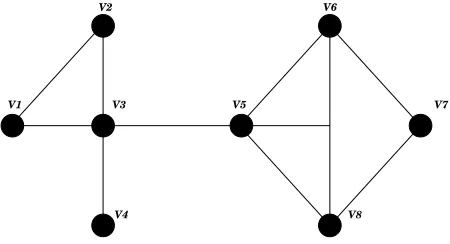
We considered a network of 8 agents and the associated information structure as in Fig. 1.
The components of the initial state vectorx(0)are randomly extracted from a uniform distribution in zero and one. The vector of thresholds is randomly extracted between one and eight. Thresholds associated to non active buyers are set equal to infinity. In particular the realization of both vector are shown in the table below
agents 1 2 3 4 5 6 7 8
xi(0) 1 0 0 0 1 1 1 1
li 6 ∞ ∞ ∞ 3 2 5 2
The information flow among agents is governed by the Laplacian that in this case takes on the form
L=
2 −1 −1 0 0 0 0 0
−1 2 −1 0 0 0 0 0
−1 −1 4 −1 −1 0 0 0
0 0 −1 1 0 0 0 0
0 0 −1 0 3 −1 0 −1
0 0 0 0 −1 3 −1 −1
0 0 0 0 0 −1 2 −1
0 0 0 0 −1 −1 −1 3
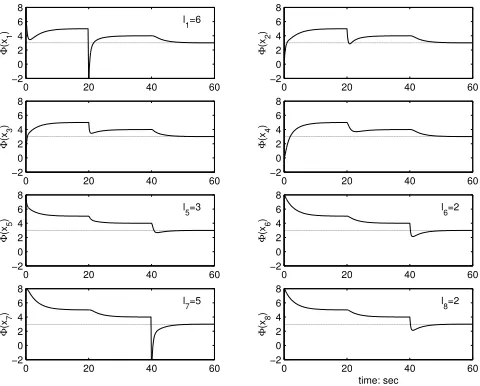
Simulation of the protocol in Fig.2 shows that at the beginning there is agent1−5−6−7−8that intend to order. Aftertf = 20 sec all local estimationsφ(xi)of the number
of active buyers are supposed to converge to5. Now, agent1
give up because the estimation is lower than his corresponding threshold. Then at tf = 40 sec the new converging value is
φ(xi) = 4and agent7gives up ordering. Finally the estimated
number of active buyers isφ(xi) = 3.
VI. CONCLUSION
In this paper we propose a distributed consensus protocol for a network of buyers aiming at coordinating their ordering strategies.
0 20 40 60 −2
0 2 4 6 8
l 1=6
Φ
(x1
)
0 20 40 60
−2 0 2 4 6 8
Φ
(x2
)
0 20 40 60
−2 0 2 4 6 8
Φ
(x3
)
0 20 40 60
−2 0 2 4 6 8
Φ
(x4
)
0 20 40 60
−2 0 2 4 6 8
l 5=3
Φ
(x5
)
0 20 40 60
−2 0 2 4 6 8
l 6=2
Φ
(x6
)
0 20 40 60
−2 0 2 4 6 8
l 7=5
Φ
(x7
)
0 20 40 60
−2 0 2 4 6 8
l 8=2
Φ
(x8
)
[image:5.612.55.295.55.248.2]time: sec
Fig. 2. Consensus for a group of8retailers
its desired threshold on the minimum number of active buyers to coordinate orders with. A centralized protocol processes all exchanged data and coordinates orders.
Alternatively, coordination can be achieved in a decentralized setting without the necessity that each buyer communicates the threshold. The method is based on a local estimation of the percentage of active buyers. The problem is formalized as an average-consensus problem. Thus, at the beginning of the day each buyer exchanges information with its neighbors regarding its initial local estimate (this initial information embeds its initial intention to order or not). Information propagates in a decentralized setting and converges to a common decision-value on the estimate within a pre-specified time interval. Once convergence is reached the current active buyers synchronize their new decision to give up ordering if the decision-value is lower than their threshold. We show that consensus on the final number of active buyers is reached globally asymptotically and coordination is the best achievable for the assigned thresholds.
ACKNOWLEDGMENT
This work is supported in part by the National Project PRIN: “Robust Techniques for the Control of Uncertain Systems” and by the National Research Council of Italy (CNR) under grant n. 00.00333.ST74.
REFERENCES
[1] F. Blanchini, S. Miani, W. Ukovich, “Control of Production-Distribution Systems with Unknown Inputs and Systems Failures”IEEE trans. on Automatic Control, vol 45, NO.6, June 2000
[2] A. Fax and R. M. Murray, “Information Flow and Cooperative Control of Vehicle Formations”The 15th IFAC World Congress, June 2002. [3] A. J. Kleywegt, V. S. Nori, M. W. P. Savelsbergh, “The Stochastic
In-ventory Routing Problem with Direct Deliveries”Transportation Science, vol 36, No.1, 94-118, Feb 2002.
[4] S. H. Low, F. Paganini, J. C. Doyle, “Internet Congestion Control”IEEE Contr. Syst. Mag., vol 22, No.1, 28-43, Feb 2002.
[5] K. Passino, M. Polycarpou, D. Jacques, M. Pachter, Y. Liu, Y. Yang, M. Flint, and M. Baum, “Cooperative Control and Optimization, Chapter 12: Cooperative Control for Autonomous Air Vehicles,Kluwer Academic Publishers, 2002.
[6] R. O. Saber, W. B. Dunbar, R. M. Murray, “Cooperative Control of Multi-vehicle Systems using Cost Graphs and Optimization”submitted to the American Control Conference, June 2003.