KEIR FRASER
University of Cambridge Computer Laboratory and
TIM HARRIS
Microsoft Research Cambridge
Mutual exclusion locks remain thede factomechanism for concurrency control on shared-memory data structures. However, their apparent simplicity is deceptive: It is hard to design scalable locking strategies because locks can harbor problems such as priority inversion, deadlock, and convoying. Furthermore, scalable lock-based systems are not readily composable when building compound operations. In looking for solutions to these problems, interest has developed innonblocking sys-tems which have promised scalability and robustness by eschewing mutual exclusion while still ensuring safety. However, existing techniques for building nonblocking systems are rarely suitable for practical use, imposing substantial storage overheads, serializing nonconflicting operations, or requiring instructions not readily available on today’s CPUs.
In this article we present three APIs which make it easier to develop nonblocking implemen-tations of arbitrary data structures. The first API is amultiword compare-and-swapoperation (MCAS) which atomically updates a set of memory locations. This can be used to advance a data structure from one consistent state to another. The second API is aword-based software transac-tional memory(WSTM) which can allow sequential code to be reused more directly than with MCAS and which provides better scalability when locations are being read rather than being updated. The third API is anobject-based software transactional memory(OSTM). OSTM allows a simpler implementation than WSTM, but at the cost of reengineering the code to use OSTM objects.
We present practical implementations of all three of these APIs, built from operations available across all of today’s major CPU families. We illustrate the use of these APIs by using them to build highly concurrent skip lists and red-black trees. We compare the performance of the resulting implementations against one another and against high-performance lock-based systems. These results demonstrate that it is possible to build useful nonblocking data structures with performance comparable to, or better than, sophisticated lock-based designs.
Categories and Subject Descriptors: D.4.1 [Operating Systems]: Process Management— Concur-rency, mutual exclusion, synchronization
This work was supported by donations from the Scalable Synchronization Research Group at Sun Labs Massachusetts. The evaluation was carried out using the Cambridge-Cranfield High Perfor-mance Computing Facility.
Authors’ addresses: K. Fraser, Computer Laboratory, University of Cambridge, 15JJ Thomson Avenue, Cambridge, CB3 OFB, UK; T. Harris, Microsoft Research Cambridge, Roger Needham Building, 7JJ Thomson Ave., Cambridge CB3 0FB, UK; email: [email protected].
Permission to make digital or hard copies of part or all of this work for personal or classroom use is granted without fee provided that copies are not made or distributed for profit or direct commercial advantage and that copies show this notice on the first page or initial screen of a display along with the full citation. Copyrights for components of this work owned by others than ACM must be honored. Abstracting with credit is permitted. To copy otherwise, to republish, to post on servers, to redistribute to lists, or to use any component of this work in other works requires prior specific permission and/or a fee. Permissions may be requested from Publications Dept., ACM, Inc., 2 Penn Plaza, Suite 701, New York, NY 10121-0701 USA, fax+1 (212) 869-0481, or [email protected].
C
General Terms: Algorithms, Languages, Performance
Additional Key Words and Phrases: Concurrency, lock-free systems, transactional memory
ACM Reference Format:
Fraser, K. and Harris, T. 2007. Concurrent programming without locks. ACM Trans. Comput. Syst. 25, 2, Article 5 (May 2007), 61 pages. DOI=10.1145/1233307.1233309 http://doi.acm.org/ 10.1145/1233307.1233309
1. INTRODUCTION
Mutual-exclusion locks are one of the most widely used and fundamental ab-stractions for synchronization. This popularity is largely due to their appar-ently simple programming model and the availability of implementations which are efficient and scalable. Unfortunately, without specialist programming care, these benefits rarely hold for systems containing more than a handful of locks:
—For correctness, programmers must ensure that threads hold the neces-sary locks to avoid conflicting operations being executed concurrently. To avoid mistakes, this favors the development of simple locking strategies which pes-simistically serialize some nonconflicting operations.
—For liveness, programmers must be careful to avoid introducing deadlock and, consequently, they may cause software to hold locks for longer than would otherwise be necessary. Also, without scheduler support, programmers must be aware of priority inversion problems.
—For high performance, programmers must balance the granularity at which locking operates against the time that the application will spend ac-quiring and releasing locks.
This article is concerned with the design and implementation of software which is safe for use on multithreaded multiprocessor shared-memory ma-chines, but which does not involve the use of locking. Instead, we present three different APIs for making atomic accesses to sets of memory locations. These enable the direct development of concurrent data structures from sequential ones. We believe this makes it easier to build multithreaded systems which are correct. Furthermore, our implementations arenonblocking(meaning that even if any set of threads is stalled, the remaining threads can still make progress) and generally allowdisjoint-access parallelism(meaning that updates made to nonoverlapping sets of locations will be able to execute concurrently).
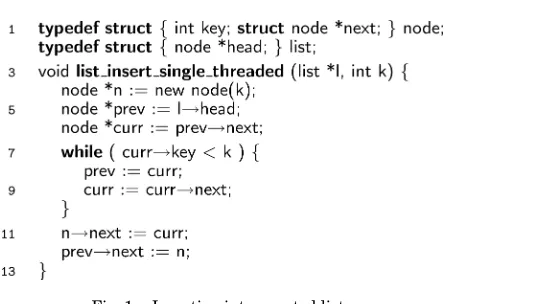
To introduce these APIs, we shall sketch their use in a code fragment that inserts items into a singly-linked list which holds integers in ascending order. In each case the list is structured with sentinel head and tail nodes whose keys are, respectively, less than and greater than all other values. Each node’s key remains constant after insertion. For comparison, Figure 1 shows the corre-sponding insert operation when implemented for single-threaded use. In that figure, as in each of our examples, the insert operation proceeds by identifying nodesprevandcurrbetween which the new node is to be placed.
Fig. 1. Insertion into a sorted list.
which retries the insertion until it succeeds in committing the updates to memory.
Our first API providesmultiword compare-and-swap(MCAS) which gener-alizes the single-word CAS operation found on many processors: It atomically updates one or more memory locations from a set of expected values to a set of new values. Figure 2 shows how the insertion could be expressed using MCAS. There are two fundamental changes from the sequential algorithm. Firstly, instead of updating shared locations individually, the code must callMCASto perform the complete set of memory accesses that need to be made atomically. In the example there is only a single update to be made withMCAS, but a cor-responding delete operation would pass two updates toMCAS: one to excise the node from the list and a second to clear itsnextfield toNULLto prevent con-current insertion after a deleted node. Secondly, the code must callMCASRead
whenever it reads from a location that might be subject to a concurrent update byMCASin another thread.
MCASandMCASReadpresent a rather low-level API: Programmers must be careful to useMCASRead where necessary and must also remember that the subsequentMCASdoes not know which locations have been read. This can lead to cumbersome code in which the program keeps lists of the locations it has read from, and the values that it has seen in them, and then passes these lists toMCASto confirm that the values represent a consistent view of shared memory.
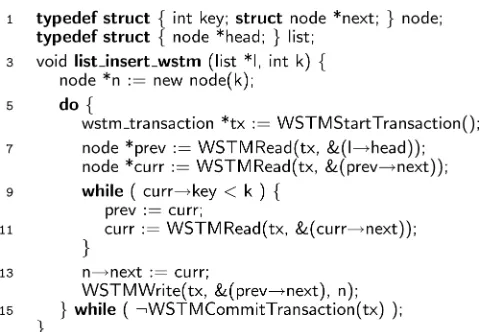
The second abstraction provides aword-based software transactional mem-ory(WSTM) which avoids some of these problems by allowing a series of reads and writes to be grouped as a software transaction which can be applied to the heap atomically [Harris and Fraser 2003]. Figure 3 shows our list example using WSTM. The changes from sequential code are that reads and writes to shared locations are performed throughWSTMReadandWSTMWritefunctions, and that this whole set of memory accesses is wrapped in a call to WSTMStart-Transactionand a call toWSTMCommitTransactioncalls.
[image:3.612.201.477.109.261.2]Fig. 2. Insertion into a sorted list managed using MCAS. In this case the arrays specifying the update need contain only a single element.
Fig. 3. Insertion into a sorted list managed using WSTM. The structure mirrors Figure 2 except that the WSTM implementation tracks which locations have been accessed based on the calls to
WSTMReadandWSTMWrite.
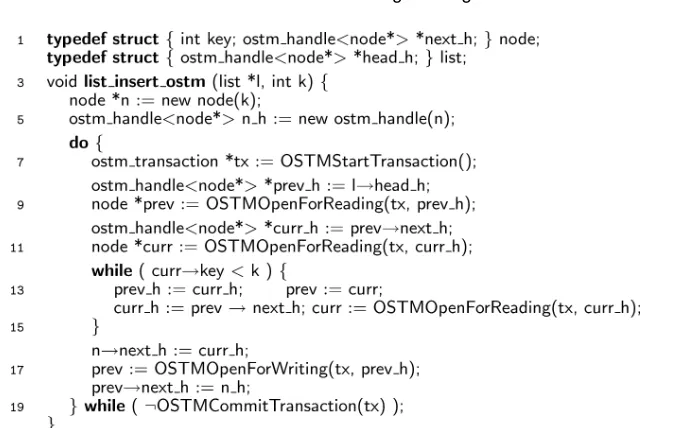
Figure 4 illustrates this style of programming: Each object is accessed through
an OSTM handle which must be subject to an OSTMOpenForReading or
OSTMOpenForWriting call in order to obtain access to the underlying data. In short examples, the code looks more verbose than WSTM, but the OSTM im-plementation is more straightforward and often runs more quickly.
[image:4.612.162.423.102.260.2] [image:4.612.188.436.296.462.2]Fig. 4. Insertion into a sorted list managed using OSTM. The code is more verbose than Figure 3 because data is accessed by indirection through OSTM handles which must be opened before use.
sequential code, offer performance which competes with and often surpasses state-of-the-art lock-based designs.
1.1 Goals
We set ourselves a number of goals in order to ensure that our designs are practical and perform well when compared with lock-based schemes:
—Concreteness.We must consider the full implementation path down to the instructions available on commodity CPUs. This means we build from atomic single-word read, write, and compare-and-swap (CAS) operations. We define CAS to return the value it reads from the memory location.
atomicallywordCAS(word a, word e, word n, ){
word x:=*a;
if(x=e) *a:=n;
returnx;
}
—Linearizability.In order for functions such asMCASto behave as expected in a concurrent environment, we require that their implementations be lin-earizable, meaning that they appear to occur atomically at some point between when they are called and when they return [Herlihy and Wing 1990].
—Nonblocking progress guarantee. In order to provide robustness against many liveness problems such as deadlock, implementations of our APIs should be nonblocking. This means that even if any set of threads is stalled, the re-maining threads can still progress.
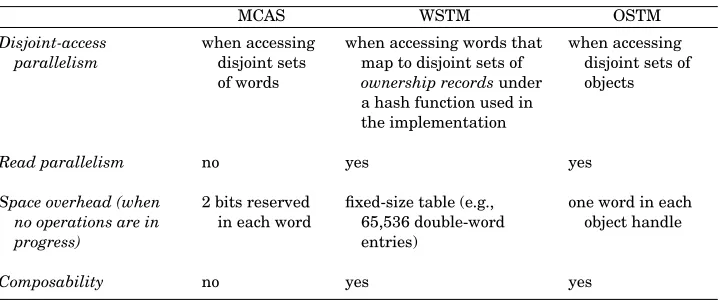
[image:5.612.149.486.103.317.2]Table I. Assessment of Our Implementations of These Three APIs Against Our Goals
MCAS WSTM OSTM
Disjoint-access parallelism
when accessing disjoint sets of words
when accessing words that map to disjoint sets of ownership recordsunder a hash function used in the implementation
when accessing disjoint sets of objects
Read parallelism no yes yes
Space overhead (when no operations are in progress)
2 bits reserved in each word
fixed-size table (e.g., 65,536 double-word entries)
one word in each object handle
Composability no yes yes
—Read parallelism.Implementations of our APIs should allow shared data that is read on different CPUs to remain in shared mode in those CPUs’ data caches: Fetching a location from the cache of another CPU can be hundreds of times slower than fetching it from a local cache [Hennessy and Patterson 2003] and so we must preserve sharing where possible.
—Dynamicity. Implementations of our APIs should be able to support dynamically-sized data structures, such as lists and trees, in which constituent objects are allocated and reclaimed over time.
—Practicable space costs.Space costs should scale well with the number of threads and volume of data managed using the API. It is generally unacceptable to reserve more than two bits in each word (often such bits are always zero if locations hold aligned pointers) and it is desirable to avoid reserving even this much if words are to hold unrestricted values, rather than being restricted to aligned pointers.
—Composability.If multiple data structures separately provide operations built with one of our APIs, then these should be composable to form a sin-gle compound operation which still occurs atomically (and which can itself be composed with others).
All of our APIs have concrete, linearizable, nonblocking implementations which can be used to build dynamically-sized data structures. Table I indicates the extent to which they meet our other goals.
We also have a number of non-goals.
Firstly, although our implementations of these APIs can be used concurrently in the same application, we do not intend that they be used to manage parts of the same data structure.
Secondly, we assume that a separate mechanism will be used to control con-tention between concurrent threads. This separation between progress in iso-lation and progress under contention follows Herlihy et al. [2003a, 2003b] and Scherer and Scott’s [2005] recent work.
determining when a particular piece of memory can be deallocated. In some settings this is achieved naturally by automatic garbage collection [Jones and Lins 1996] which can readily be extended to manage the data structures used by the implementations of our APIs [Harris et al. 2005]. Our examples in Figures 2–4 all assume a garbage collector. In Section 8.1.3 we describe the memory reclamation techniques that we used for our evaluation. Other authors have developed techniques that can be used in systems without a garbage col-lector: Herlihy et al.’s. “Repeat Offender” problem [2005] and Michael’s “Safe Memory” reclamation [2002] both allow threads to issue tentative deallocation requests that are deferred until it is established that no other thread can access the memory involved.
1.2 Source Code Availability
Source code for our MCAS, WSTM, and OSTM systems, data structure imple-mentations, and test harnesses is available for Alpha, Intel IA-32, Intel IA-64, MIPS, PowerPC, and SPARC processor families athttp://www.cl.cam.ac.uk/ netos/lock-free.
1.3 Structure of This Article
In Section 2 we present the three alternative APIs and compare and contrast their features and the techniques for using them effectively. We discuss previous work with respect to our goals in Section 3. In Section 4 we describe our overall design method and the facets common to each of our designs. In Sections 5–7 we explore the details of these three APIs in turn and present our implemen-tations of them, their relationship to previous work, and, where applicable, to contemporary work with similar goals of practicability.
In Section 8 we evaluate the performance of data structures built over our implementations of each of the APIs, both in comparison with one another and with sophisticated lock-based schemes. We use skip lists and red-black trees as running examples, highlighting any particular issues that arise when adapting a sequential implementation for concurrent use.
2. PROGRAMMING APIS
In this section we present the programming interfaces for using MCAS (Section 2.1), WSTM (Section 2.2), and OSTM (Section 2.3). These provide mechanisms for accessing and/or modifying multiple unrelated words in a sin-gle atomic step; however, they differ in the way in which those accesses are specified and the adaptation required to make a sequential operation safe for multithreaded use.
After presenting the APIs themselves, Section 2.4 discusses how they may be used in practice in sharedmemory multithreaded programs.
2.1 Multiword Compare-and-Swap (MCAS)
preparing a list of updates to make in a thread-private phase before invoking
MCASto apply them to the heap. MCAS is defined to operate onNdistinct mem-ory locations (ai), expected values (ei), and new values (ni): Eachaiis updated to valueniif and only if eachaicontains the expected valueeibefore the operation. MCASreturns TRUE if these updates are made and FALSE otherwise.
Heap accesses to words which may be subject to a concurrent MCASmust be performed by callingMCASRead. This restriction is needed because, as we show in Section 5, the MCAS implementation places its own values in these locations while they are being updated. Furthermore, the MCAS implementa-tion reserves two bits in each locaimplementa-tion that it may work on. In practice this means that these locations must hold aligned pointer values in which at least two low-order bits are ordinarily clear on a machine with 32-bit or 64-bit words. The full API is consequently
1 // Update locations a[0]..a[N-1] from e[0]..e[N-1] to n[0]..n[N-1] boolMCAS(int N, word **a[ ], word *e[ ], word *n[ ]);
3 // Read the contents of location a word *MCASRead(word **a);
This API is effective when a small number of locations can be identified which need to be accessed to update a data structure from one consistent state to another.
UsingMCASalso allows expert programmers to reduce contention between concurrent operations by paring down the set of locations passed to each atomic update, or by decomposing a series of related operations into a series ofMCAS
calls. For instance, when inserting a node into a sorted linked list, we relied on the structure of the list and the immutability of key fields to allow us to update just one location, rather than needing to check that the complete chain of pointers traversed has not been modified by a concurrent thread. However, this flexibility presents a potential pitfall for programmers directly using MCAS.
The API also precludes our goal of composability.
2.2 Word-Based Software Transactional Memory (WSTM)
Although MCAS eases the burden of ensuring correct synchronization of up-dates, many data structures also require consistency among groups of read operations and it is cumbersome for the application to track these calls to
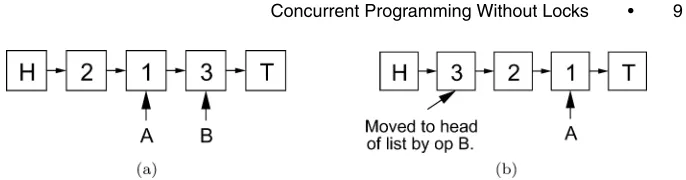
MCASRead and to use the results to build arrays of “no-op” updates to pass toMCAS. For instance, consider searching within a move-to-front list, in which a successful search promotes the discovered node to the head of the list. As in-dicated in Figure 5, a na¨ıve algorithm which does not consider synchronization between concurrent searches may incorrectly fail.
Software transactional memories provide a way of dealing with these prob-lems by grouping shared-memory accesses into transactions. These transac-tions succeed or fail atomically. Furthermore, composability is gained by allow-ing nested transactions: A series of WSTM transactions can be composed by bracketing them within a further transaction.
Fig. 5. The need for read consistency: A move-to-front linked list subject to two searches for node 3. In snapshot (a), search A is preempted while passing over node 1. Meanwhile, in snapshot (b), search B succeeds and moves node 3 to the head of the list. When A continues execution, it will incorrectly report that 3 is not in the list.
locations. However, as we show in Section 6.1, this is not a guarantee because false conflicts can be introduced if there are collisions under a hash function used in the WSTM implementation.
Within a transaction, data accesses are performed by WSTMRead and
WSTMWrite operations. As with MCAS, the caller is responsible for using these operations when accessing words which may be subject to a concurrent
WSTMCommitTransaction.
Unlike MCAS, our WSTM implementation does not reserve space in each word, allowing it to act on full word-size data, rather than just pointer-valued fields in which “spare” bits can be reserved. The full API is
1 // Transaction management
wstm transaction *WSTMStartTransaction();
3 boolWSTMCommitTransaction(wstm transaction *tx);
boolWSTMValidateTransaction(wstm transaction *tx);
5 voidWSTMAbortTransaction(wstm transaction *tx);
// Data access
7 wordWSTMRead(wstm transaction *tx, word *a);
voidWSTMWrite(wstm transaction *tx, word *a, word d);
As we will show later, the interface often results in reduced performance com-pared with MCAS.
2.3 Object-Based Software Transactional Memory (OSTM)
The third API, OSTM, provides an alternative transaction-based interface. As with WSTM, data managed with OSTM can hold full word-size values and transactions can nest, allowing composability.
However, rather than accessing words individually, OSTM exposes OSTM
objectsthrough a level of indirection provided by OSTMhandles. OSTM objects are allocated and deallocated byOSTMNewandOSTMFree, respectively, which behave analogously to standardmallocandfreefunctions, but act on pointers to OSTM handles rather than directly on pointers to objects.
Before the data it contains can be accessed, an OSTM handle must beopened
in order to obtain access to the underlying object: This is done by OSTMOpen-ForReadingandOSTMOpenForWritingwhich, along with a transaction ID, take pointers to handles of typeostm handle<t*>and return object pointers of type
[image:9.612.149.492.94.184.2]copy of the underlying object, that is, a private copy on which the thread can work before attempting to commit its updates.
Both OSTMOpenForReading and OSTMOpenForWriting are idempotent: If the object has already been opened in the same access mode within the same transaction, then the same pointer will be returned.
The caller must ensure that objects are opened in the correct mode: The OSTM implementation may share data between objects that have been opened for reading between multiple threads. The caller must also be careful if a trans-action opens an object for reading (obtaining a reference to a shared copyC1) and subsequently opens the same object for writing (obtaining a reference to a shadow copy C2): Updates made toC2 will, of course, not be visible when reading fromC1.
The OSTM interface leads to a different cost profile from WSTM: OSTM introduces a cost on opening objects for access and potentially producing shadow copies to work on, but subsequent data access is made directly (rather than through functions likeWSTMReadandWSTMWrite). Furthermore, it admits a simplified nonblocking commit operation.
The OSTM API is
1 // Transaction management
ostm transaction *OSTMStartTransaction();
3 boolOSTMCommitTransaction(ostm transaction *tx);
boolOSTMValidateTransaction(ostm transaction *tx);
5 voidOSTMAbortTransaction(ostm transaction *tx);
// Data access
7 t *OSTMOpenForReading(ostm transaction *tx, ostm handle<t*>*o);
t *OSTMOpenForWriting(ostm transaction *tx, ostm handle<t*>*o);
9 // Storage management
ostm handle<void*>*OSTMNew(size t size);
11 voidOSTMFree(ostm handle<void*>*ptr);
2.4 Programming with Our APIs
This section discusses some general questions that arise when developing soft-ware that uses any of our three APIs.
2.4.1 Programming Languages. This article concentrates on the mecha-nisms that can be used for making atomic nonblocking accesses to sets of mem-ory locations. In practice there are two scenarios in which we envisage our APIs being used:
Firstly, our APIs may be used directly by expert programmers. For instance, when the code implementing a data structure is small and self-contained, then the shared-memory accesses in the code can be replaced directly with oper-ations on WSTM, or the data structure’s layout reorganized to use OSTM objects.
those languages which support it) is to use runtime code generation to add the level of indirection that programming using OSTM objects requires [Herlihy 2005]. Aside from CCRs, hybrid designs are possible which combine lock-based abstractions with optimistic execution over transactional memory [Welc et al. 2004].
A further direction, again beyond the scope of the current article, is using a language’s type system to ensure that theonlyoperations attempted within a transaction are made through an STM interface [Harris et al. 2005]. This can avoid programming errors in which irrevocable operations (such as network I/O) are performed in a transaction that subsequently aborts.
2.4.2 Invalidity During Execution. A nonobvious complication when us-ing our APIs is that atomicity is only enforced at the point of a call toMCAS,
WSTMCommitTransaction, orOSTMCommitTransaction. It remains possible for a thread to see a mutually inconsistent view of shared memory if it performs a series ofMCASRead,WSTMRead, orOSTMOpencalls. This can happen due to atomic updates by other threads. Note that in all three APIs, arbitrary val-ues cannot be returned: The value returned byMCASRead must have been current at some time during the call, and the values read throughWSTMRead
or OSTMOpenForReading must have been current at some point during the transaction.
If a thread does see a mutually inconsistent set of values, then its subsequent
MCASor STM commit operation will not succeed. However, it is possible that the inconsistency may cause an algorithm to crash, loop, or recurse deeply before it attempts to commit.
We do not seek to provide a general-purpose solution to this problem at the level of APIs in this article: The solution, we believe, depends on how the APIs are being used.
In the first scenario we discussed before—where one of our APIs is being used directly by an expert programmer—it is the responsibility of that pro-grammer to consider the consequences of transactions that see inconsistent views of memory during their execution. Two different cases arise in the ex-amples we have seen. Firstly, some simple algorithms are guaranteed to reach a call toMCASor a STM commit operation even if they see a mutually incon-sistent set of values; they can be used without modification. Secondly, other algorithms can loop internally, recurse deeply, or dereference NULL pointers if they see an inconsistent set of values. In these cases, we ensure that some validation is performed within every loop and function call and we use a signal handler to catchNULL-dereferences (explicit tests againstNULLcould be used in environments without signal handlers). We emphasize that these are only the cases that arise in the examples we have studied: Other programs using these APIs may need additional “hardening” against floating point exceptions, out-of-bound memory accesses, and so on, if these are possible due to sets of inconsistent reads.
As others have explored, an alternative approach would be to ensure validity throughout a transaction by performing work onWSTMReadandOSTMOpen
a mutually consistent snapshot of part of the heap. This is effectively the ap-proach taken by Herlihy et al.’s [2003b] DSTM, and leads to the need either to make reads visible to other threads (making read parallelism difficult in a streamlined implementation) or to explicitly revalidate invisible reads (leading to O(n2) behavior when a transaction opensnobjects in turn). Either of these approaches could be integrated with WSTM or OSTM if the API is to be ex-posed directly to programmers whilst shielding them from the need to consider invalidity during execution.
In the second scenario, where calls on the API are generated automatically by a compiler or language runtime system, we believe it is inappropriate for the application programmer to have to consider mutually inconsistent sets of values within a transaction. For instance, when considering the operational semantics ofatomicblocks built over STM in Haskell [Harris et al. 2005], definitions where transactions run in isolation appear to be a clean fit with the existing language, while it is unclear how to define the semantics of atomic blocks that may expose inconsistency to the programmer. Researchers have explored a number of ways to shield the programmer from such inconsistency [Harris and Fraser 2003; Harris et al. 2005; Riegel et al. 2006; Dice et al. 2006]. These can broadly be classified as approaches based on hardening the runtime system against behav-ior due to inconsistent reads, and approaches based on preventing inconsistent reads from occuring. The selection between these goes beyond the scope of the current article.
2.4.3 Optimizations and Hints. The final aspect we consider is the avail-ability of tuning facilities for a programmer to improve the performance of an algorithm using our APIs.
The key problem isfalse contention, where operations built using the APIs are deemed to conflict even though logically they commute. For instance, if a set of integers is held in numerical order in a linked list, then a thread transactionally inserting 15 between 10 and 20 will perform updates that conflict with reads from a thread searching through that point for a higher value.
It is not clear that this particular example can be improved automati-cally when a tool is generating calls on our APIs; realizing that the opera-tions do not logically conflict relies on knowledge of their semantics and the set’s representation. Notwithstanding this, the ideas of disjoint-access par-allelism and read-parpar-allelism allow the programmer to reason about which operations will be able to run concurrently without interfering with each other.
These operations all require great care: Once released or discarded, data plays no part in the transaction’s commit or abort. A general technique for using them correctly is for the programmer to ensure that: (i) As a transaction runs, it always holds enough data for invalidity to be detected; and (ii) when a transaction commits, the operation it is performing is correct, given only the data that is still held. For instance, in the case of searching a sorted linked list, it would need to hold a pair of adjacent nodes to act as a “witness” of the operation’s result. However, such extreme use of optimization APIs loses many of the benefits of performing atomic multiword updates (the linked-list example becomes comparably complex to a list built directly from CAS [Harris 2001] or sophisticated locking [Heller et al. 2005]).
3. RELATED WORK
The literature contains several designs for abstractions, such as MCAS, WSTM, and OSTM. However, many of the foundational designs have not shared our re-cent goals of practicality, for instance, much work builds on instructions such as strong-LL/SC or DCAS [Motorola 1985] which are not available as primitives in contemporary hardware. Our experience is that although this work has identi-fied the problems which exist and has introduced terminology and conventions for presenting and reasoning about algorithms, it has not been possible to ef-fectively implement or use these algorithms by layering them above software implementations of strong-LL/SC or DCAS. For instance, when considering strong-LL/SC, Jayanti and Petrovic’s recent design reserves four words of stor-ageper threadfor each word that may be accessed [Jayanti and Petrovic 2003]. Other designs reserveN or logN bits of storage within each word when used withNthreads: Such designs can only be used whenN is small. When consid-ering DCAS, it appears no easier to build a general-purpose DCAS operation than it is to implement our MCAS design.
In discussing related work, the section is split into three parts. Firstly, in Section 3.1 we introduce the terminology of nonblocking systems and de-scribe the progress guarantees that they make. These properties underpin the liveness gurantees that are provided to users of our algorithms. Secondly, in Section 3.2 we discuss the design of “universal” transformations that build nonblocking systems from sequential or lock-based code. Finally, in Section 3.3, we present previous designs for multiword abstractions, such as MCAS, WSTM, and OSTM, and assess them against our goals.
3.1 Nonblocking Systems
Nonblocking algorithms can be classified according to the kind of progress guarantee that they make:
—Obstruction-freedom is the weakest guarantee: A thread performing an operation is only guaranteed to make progress so long as it does not contend with other threads for access to any location [Herlihy et al. 2003a]. This requires an out-of-band mechanism to avoid livelock; exponential backoff is one option. —Lock-freedom adds the requirement that the system as a whole makes progress, even if there is contention. In some cases, lock-free algorithms can be developed from obstruction-free ones by adding ahelpingmechanism: If thread
t2encounters threadt1obstructing it, thent2helpst1to completet1’s operation. Once that is done,t2can proceed with its own operation and hopefully not be obstructed again. This is sufficient to prevent livelock, although it does not offer any guarantee of per-thread fairness.
—Wait-freedomadds the requirement thatevery threadmakes progress, even if it experiences contention. It is seldom possible to directly develop wait-free algorithms that offer competitive practical performance. However, Fich et al. have recently developed a transformation which converts an obstruction-free algorithm into one that is wait-free in the unknown-bound semisynchronous model of computation [Fich et al. 2005].
Some previous work has used the terms “lock-free” and “nonblocking” inter-changeably: We follow Herlihy et al.’s recent use of lock-freedom to denote a particular kind of nonblocking guarantee [Herlihy et al. 2003a]. In this article we concentrate on lock-free algorithms, although we highlight where simplifi-cations can be made to our implementations by designing them to satisfy the weaker requirement of obstruction-freedom.
We must take care to deliberate over what it means for an implementa-tion of an API like WSTM and OSTM to offer a given form of nonblocking progress: We care not just about the progress of individual operations on the API, but also about the progress of complete transactions through to successful
WSTMCommitTransactionorOSTMCommitTransactioncalls.
We say that an implementation of a transactional abstraction provides a given nonblocking progress guarantee if complete transactions running over it have that guarantee. For example, an obstruction-free transactional abstraction requires transactions to eventually commit successfully if run in isolation,1but allows a set of transactions to livelock, aborting one another if they contend. Similarly, a lock-free transactional abstraction requires some transaction to eventually commit successfully even if there is contention.
3.2 Universal Constructions
Universal constructions are a class of design technique that can transform a sequential data structure into one that is safe for concurrent usage. Herlihy’s original scheme requires a shadow copy of the entire data structure to be taken.
1We sayeventuallybecause the transaction may have to be reexecuted before this occurs (just as
A thread then makes updates to this in private before attempting to make them visible by atomically updating a single “root” pointer of the structure [Herlihy 1993]. This means that concurrent updates will always conflict, even when they modify disjoint sections of the data structure.
Turek et al. devised a hybrid scheme that may be applied to develop lock-free systems from deadlock-free lock-based ones [Turek et al. 1992]. Each lock in the original algorithm is replaced by an ownership reference which is either
NULL or points to a continuation describing the sequence of virtual instruc-tions that remain to be executed by the lock “owner”. This allows conflicting operations to avoid blocking: instead, they execute instructions on behalf of the owner and then take ownership themselves. Interpreting a continuation is cum-bersome: After each “instruction” is executed, a virtual program counter and a nonwrapping version counter are atomically modified using a double-width CAS operation which acts on an adjacent pair of memory locations.
Barnes proposes a similar technique in which mutual-exclusion locks are replaced by pointers tooperation descriptors[Barnes 1993]. Lock-based algo-rithms are converted to operate on shadow copies of the data structure; then, after determining the sequence of updates to apply, each “lock” is acquired in turn by making it point to the descriptor, the updates are performed on the structure itself, and finally the “locks” are released. Copying is avoided if con-tention is low by observing that the shadow copy of the data structure may be cached and reused across a sequence of operations. This two-phase algorithm requires strong-LL/SC operations.
3.3 Programming Abstractions
Although universal constructions have the benefit of requiring no manual mod-ification to existing sequential or lock-based programs, each exhibits some sub-stantial performance or implementation problem which places it beyond practi-cal use. Another class of technique provides programming APIs which, although not automatic “fixes” to the problem of constructing nonblocking algorithms, make the task of implementing nonblocking data structures much easier com-pared with using atomic hardware primitives directly. The two best-known abstractions are multiword compare-and-swap (MCAS), and forms of software transactional memory (STM).
Israeli and Rappaport described the first design which builds a lock-free MCAS from strong-LL/SC, which in turn is built from CAS [Israeli and Rappoport 1994]. ForNthreads, their method for building the required LL/SC from CAS reserves N bits within each updated memory location; the MCAS algorithm then proceeds by load-locking each location in turn, and then at-tempting to conditionally store each new value in turn. Although the space cost of implementing the required strong-LL/SC makes their design impractical, the identification of disjoint-access parallelism as a goal has remained a valuable contribution.
location, rather than N. This bound is achieved at the cost of considerable bookkeeping to ensure that version numbers are not reused. A further drawback is that the accompanying MCASRead operation is based on primitives that acquire exclusive cache-line access for the location, preventing read parallelism. Moir developed a streamlined version of this algorithm which provides “con-ditionally wait-free” semantics [Moir 1997]. Specifically, the design is lock-free, but an out-of-band helping mechanism may be specified which is then respon-sible for helping conflicting operations to complete. This design suffers many of the same weaknesses as its ancestor; in particular, it requires strong-LL/SC and does not provide a read-parallelMCASRead.
Anderson et al. provide two further versions of MCAS suitable for systems using strict priority scheduling [Anderson et al. 1997]. Both algorithms store a considerable amount of information in memory locations subject to MCAS updates: a valid bit, a process identifier (logN bits), and a “count” field (which grows with the base-2 logarithm of the maximum number of addresses specified in an MCAS operation). Furthermore, their multiprocessor algorithm requires certain critical sections to be executed with preemption disabled, which is not generally feasible.
Greenwald presents a simple MCAS design in his Ph.D. dissertation [1999]. This constructs a record describing the entire operation and installs it into a single shared location which indicates the sole in-progress MCAS. If installa-tion is prevented by an existing MCAS operainstalla-tion, then the existing operainstalla-tion is helped to completion and its record is then removed. Once installed, an op-eration proceeds by executing a DCAS opop-eration for each location specified by the operation: One update is applied to the address concerned, while the other updates a progress counter in the operation record. This can be seen as a de-velopment of Turek’s continuation-based scheme [Turek et al. 1992]. The use of a single shared installation point prevents the design from being disjoint-access parallel. Greenwald’s subsequent technique of “two-handed emulation” generalized this scheme, but did not address the lack of disjoint-access paral-lelism [Greenwald 2002].
Herlihy and Moss first introduced the concept of a transactional memory
which allows shared-memory operations to be grouped into atomic transac-tions [1993]. They originally proposed a hardware design which leverages ex-isting multiprocessor cache-coherency mechanisms.
Shavit and Touitou introduced the idea of implementing transactional mem-ory in software [1995], showing how a lock-free transactional memmem-ory could be built from strong-LL/SC primitives. A notable feature is that they abort con-tending transactions rather than recursively helping them, as is usual in lock-free algorithms; lock-lock-free progress is still guaranteed because aborted trans-actions help the transaction that aborted them before retrying. Their design supports only “static” transactions, in which the set of accessed memory loca-tions is known in advance, the interface is therefore analogous to MCAS rather than to subsequent STM designs.
contains a word-size entry for each block in the memory, consisting of a block identifier and a version number. The initial embodiment of this scheme required arbitrary-sized memory words and suffered the same drawbacks as the condi-tionally wait-free MCAS on which it builds: Bookkeeping space is statically allocated for a fixed-size heap, and the read operation is potentially expensive. Moir’s wait-free STM extends his lock-free design with a higher-level helping mechanism.
Herlihy et al. have designed and implemented an obstruction-free STM con-currently with our work [Herlihy et al. 2003b]. It shares many of our goals. Firstly, the memory is dynamically sized: Memory blocks can be created and destroyed on-the-fly. Secondly, a practical implementation is provided which is built using CAS. Finally, the design is disjoint-access parallel and, in one im-plementation, transactional reads do not cause contended updates to occur in the underlying memory system. These features serve to significantly decrease contention in many multiprocessor applications, and are all shared with our lock-free OSTM. We include Herlihy et al.’s design in our performance evalua-tion in Secevalua-tion 8.
Recently, researchers have returned to the question of building various forms of hardware transactional memory (HTM) [Rajwar and Goodman 2002; Hammond et al. 2004; Ananian et al. 2005; Moore et al. 2005; McDonald et al. 2005; Rajwar et al. 2005]. While production implementations of these schemes are not available, and so it is hard to compare their performance with software systems, in many ways they can be seen as complementary to the development of STM. Firstly, if HTM becomes widely deployed, then effective STM imple-mentations are necessary for machines without the new hardware features. Secondly, HTM designs either place limits on the size of transactions or fix pol-icy decisions into hardware; STM provides flexibility for workloads that exceed those limits or benefit from different policies.
4. DESIGN METHOD
Our implementations of the three APIs in Sections 2.1–2.3 have to solve a set of common problems and, unsurprisingly, use a number of similar techniques.
The key problem is that of ensuring that a set of memory accesses appears to occur atomically when implemented by a series of individual instructions accessing one word at-a-time. Our fundamental approach is to deal with this problem by decoupling the notion of a location’sphysical contentsin memory from itslogical contentswhen accessed through one of the APIs. The physical contents can, of course, only be updated one word at-a-time. However, as we shall show, we arrange that the logical contents of a set of locations can be updated atomically.
For each of the APIs there is only one operation which updates the logical con-tents of memory locations:MCAS,WSTMCommitTransaction, and OSTMCommit-Transaction. We call these operations (collectively) thecommit operations and they are the main source of complexity in our designs.
(1) Define the format of the heap, the temporary data structures used, and how an application goes about allocating and deallocating memory for the data structures that will be accessed through the API.
(2) Define the notion of logical contents in terms of these structures and show how it can be computed using a series of single-word accesses. This un-derpins the implementation of all functions other than the commit opera-tions. In this step we are particularly concerned with ensuring nonblocking progress and read-parallelism so that, for instance, two threads can per-formWSTMReadoperations to the same location at the same time, without producing conflicts in the memory hierarchy.
(3) Show how the commit operation arranges to atomically update the logical contents of a set of locations when it executes without interference from con-current commit operations. In this stage we are particularly concerned with ensuring disjoint-access parallelism so that threads can commit updates to disjoint sets of locations at the same time.
(4) Show how contention is resolved when one commit operation’s progress is impeded by another, conflicting, commit operation. In this step we are concerned with ensuring nonblocking progress so that the progress is not prevented if, for example, the thread performing the existing commit oper-ation has been preempted.
Before considering the details of the three different APIs, we discuss the common aspects of each of these four steps in Sections 4.1–4.4, respectively.
4.1 Memory Formats
All three of our implementations introduce descriptorswhich: (i) set out the “before” and “after” versions of the memory accesses that a particular commit operation proposes to make, and (ii) provide a status field indicating how far the commit operation has progressed. These descriptors satisfy three properties which make it easier to manage them in a concurrent system:
Firstly, descriptors are conceptually managed by garbage collection rather than being reused directly. This means that if a thread holds a reference to a given descriptor, then it can be sure that it has not been reused for another purpose.2
The second property is that, aside from its status field, a descriptor’s contents are unchanged once it is made reachable from shared memory. This means that if one threadt1encounters a descriptor allocated by another threadt2, thent1
can read a series of values from it and be sure of receiving mutually consistent results. For instance, in the case of an MCAS descriptor,t1can read details both about a location thatt2accessed and the value thatt2proposes to write there. The third property is that once the outcome of a particular commit operation has been decided, the descriptor’s status field remains constant: If a thread
2This does not mean that the designs can only be used in languages that traditionally provide
wishes to retry a commit operation, for example, if the code in Figures 2–4 loops, then each retry uses a fresh descriptor. This means that threads reading from a descriptor and seeing that the outcome has been decided can be sure that the status field will not subsequently change.
The combination of the first two properties is important because it allows us to avoid many A-B-A problems in which a thread is about to perform a CAS conditional on a location holding a valueA, but then a series of operations by other threads changes the value toBand then back toA, allowing the delayed CAS to succeed. These two properties mean that there is effectively a one-to-one association between descriptor references and the intent to perform a given atomic update.
Our implementations rely on being able to distinguish pointers to descriptors from other values. In our pseudocode in Sections 5–7 we abstract these tests with predicates, for instance,IsMCASDescto test if a pointer refers to an MCAS descriptor. We discuss ways in which these predicates can be implemented in Section 8.1.2.
4.2 Logical Contents
Each of our implementations uses descriptors to define the logical contents of memory locations by providing a mechanism for a descriptor toown a set of memory locations.
In general, when a commit operation relating to a location is not in progress, then the latter is unowned and holds its logical contents directly. Otherwise, when a location is owned, the logical contents are taken from the descriptor and chosen from the “before” and “after” versions based on the descriptor’s status field. This means that updating the status field has the effect of updating the logical contents of the whole set of locations that the descriptor owns.
Each of our designs uses a different mechanism to represent the ownership relationship between locations and transactions. This forms the key distinction between them and we cover the details in Sections 5 (MCAS), 6 (WSTM), and 7 (OSTM).
4.3 Uncontended Commit Operations
The commit operations themselves are each structured in three stages. A first phaseacquiresexclusive ownership of the locations being updated, and a second
read-check phase ensures that the locations which have been read, but not updated, hold the values expected in them. This is followed by the decision pointat which the outcome of the commit operation is decided and made visible to other threads through the descriptor’s status field, and then the finalrelease
phase occurs, in which the thread relinquishes ownership of the locations being updated.
There are four status values:UNDECIDED, READ-CHECK,SUCCESSFUL, and FAILED. A descriptor’s status field is initially UNDECIDED at the start of a commit operation. If there is a read-check phase then the status is set to READ-CHECK for the relevant duration. At the decision point it is set to
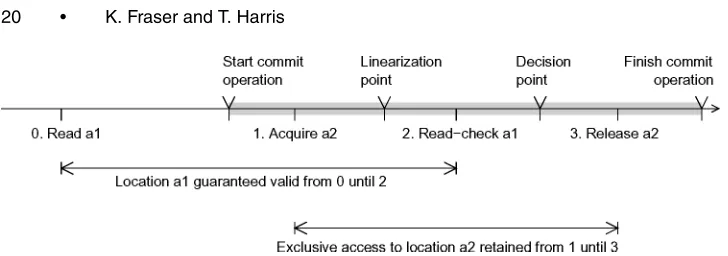
Fig. 6. Timeline for the three phases used in commit operations. The grey bar indicates when the commit operation is executed; prior to this, the thread prepares the heap accesses that it wants to commit. In this example locationa1has been read but not updated, and locationa2has been updated. The first phase acquires exclusive access to the locations being updated. The second phase checks that the locations read have not been updated by concurrent threads. The third phase releases exclusive access after making any updates. The read-check made at point 2 ensures that a1is not updated between 0 and 2. The acquisition ofa2ensures exclusive access between 1 and 3.
succeeded; otherwise it is set toFAILED. These updates are always made using CAS operations. If a thread initiating a commit operation is helped by another thread, then both threads proceed through this series of steps, with the prop-erties described in Section 4.1 ensuring that only one of these threads sets the status toSUCCESSFULorFAILED.
In order to show that an entire commit operation appears atomic, we identify within its execution alinearization pointat which it appears to operate atomi-cally on the logical contents of the heap from the point of view of other threads.3 There are two cases to consider, depending on whether an uncontended commit operation is successful:
Firstly, considering unsuccessful uncontended commit operations, the lin-earization point is straightforward: Some step of the commit operation observes a value that prevents the commit operation from succeeding, either a location that does not hold the expected value (in MCAS) or a value that has been written by a conflicting concurrent transaction (in WSTM and OSTM).
Secondly, considering successful uncontended commit operations, the lin-earization point depends on whether the algorithm has a read-check phase. Without a read-check phase the linearization point and decision point coincide: The algorithm has acquired ownership of the locations involved, and has not observed any values that prevent the commit from succeeding.
However, introducing a read-check phase makes the identification of a lin-earization point more complex. As Figure 6 shows, in this case the linlin-earization point occurs at thestartof the read-check phase, whereas the decision point (at which the outcome is actually signaled to other threads) occurs at the endof the read-check phase.
This choice of linearization point may appear perverse for two reasons:
(1) The linearization point comesbeforeits decision point: How can an opera-tion appear to commit its updates before its outcome is decided?
3In the presence of helping, the linearization point is defined with reference to the thread that
[image:20.612.127.491.91.219.2]The rationale for this is that holding ownership of the locations being up-dated ensures that these remain under the control of this descriptor from acquisition until release (1 until 3 in Figure 6). Similarly, read-checks en-sure that any locations accessed in a read-only mode have not been updated4 between points 0 and 2. Both of these intervals include the proposed lin-earization point, even though it precedes the decision point.
(2) If the operation occurs atomically at its linearization point, then what are the logical contents of the locations involved before the descriptor’s status is updated at the decision point?
Following the definition in Section 4.2, the logical contents are depen-dent on the descriptor’s status field, thus updates are not revealed to other threads until the decision point is reached. We reconcile this definition with the use of a read-check phase by ensuring thatconcurrent readers help com-mit operations to complete, retrying the read operation once the transaction has reached its decision point. This means that the logical contents do not need to be defined during the read-check phase because they are never required.
4.4 Contended Commit Operations
We now consider contended commit operations. In order to achieve nonblock-ing progress, we have to be careful about how to proceed when one threadt2
encounters a location that is currently owned by another threadt1. There are three cases to consider:
The first and most straightforward case is whent1’s status is already decided, that is, if its status isSUCCESSFULorFAILED. In this case, all of our designs rely on havingt2 help t1 to complete its work, using the information in t1’s descriptor to do so.
The second case is whent1’s status is not decided and the algorithmdoes not
include aREAD-CHECKphase. In this case there are two general nonblocking strategies for handling contention with anUNDECIDEDtransaction:
—The first strategy is for t2 to cause t1 to abort if it has not yet reached its decision point; that is, ift1’s status is stillUNDECIDED. This leads to an obstruction-free progress property and the risk of livelock, unless contention management is employed to preventt1retrying its operation and aborting
t2.
—The second strategy is for the threads to sort the locations that they require and fort2to helpt1complete its operation, even if the outcome is currently
UNDECIDED. This kind ofrecursive helping leads to a guarantee of lock-free progress because each recursive step involves a successively higher ad-dress, guaranteeing progress of the descriptor holding the highest contended address.
4Of course, the correctness of this argument does not allow the read-checks to simply consider the
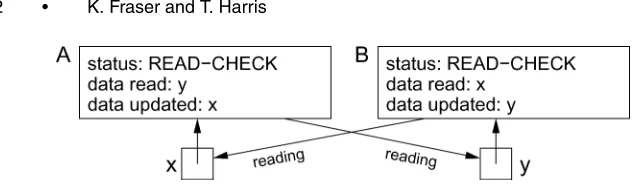
Fig. 7. An example of a dependent cycle of two operationsAandB. Each needs the other to exit its read-check phase before it can complete its own.
The third and final case, and the most complicated, is whent1’s status is not decided and the algorithmdoesinclude aREAD-CHECKphase.
The complexity stems from the fact that, as we described in Section 4.3, a thread must acquire access to the locations that it is updatingbeforeit enters its READ-CHECK phase. This constraint on the order in which locations are accessed makes it impossible to eliminate cyclic helping by sorting accesses into a canonical order. Figure 7 shows an example:Ahas acquired data xfor update and B has acquired data y for update, but A must wait for B before validating its read fromy, whileBin turn must wait forAbefore validating its read fromx.
The solution is to abort at least one of the operations to break the cycle; however, care must be taken not to abort them all if we wish to ensure lock-freedom rather than obstruction-lock-freedom. For instance, with OSTM, this can be done by imposing a total order≺on all operations, based on the machine address of each transaction’s descriptor. The loop is broken by allowing a transaction
tx1 to abort a transaction tx2 if and only if: (i) both are in their read phase; (ii) tx2owns a location thattx1is attempting to read; and (iii)tx1≺ tx2. This guarantees that every cycle will be broken, but the “least” transaction in the cycle will continue to execute. Of course, other orderings can be used if fairness is a concern.
5. MULTIWORD COMPARE-AND-SWAP (MCAS)
We now introduce our practical design for implementing the MCAS API. MCAS is defined to operate on N distinct memory locations (ai), expected values (ei), and new values (ni). Eachaiis updated to valueniif and only if eachaicontains the expected valueeibefore the operation. Note that we define our MCAS API to work on memory locations containingpointers. As we described in Section 2.1, the MCAS implementation reserves two bits in each location that it may work on and so, in practice, these locations must hold aligned pointer values in which at least two low-order bits are ordinarily clear on a machine with 32-bit or 64-bit words. Sequentially, we define the MCAS operation as
atomicallyboolMCAS(int N, word **a[ ], word *e[ ], word *n[ ]){
for( int i:=0; i<N; i++ )if( *a[i]=e[i] )returnFALSE;
for( int i:=0; i<N; i++ ) *a[i]:=n[i];
returnTRUE;
}
[image:22.612.136.454.96.188.2]location to control the execution of a normal CAS operation. If the conditional location holds the status valueUNDECIDED, then the operation proceeds, oth-erwise CCAS has no effect. The conditional location may not itself be subject to updates byCCASorMCAS. As with locations accessed by MCAS, two bits are reserved in locations updated by CCAS and so the function is defined to work on addresses holding pointers. Furthermore: (i)CCASReadoperations must be used to read from locations that may be updated by a concurrentCCAS, and (ii) the implementation ofCCASmust allow ordinary read, write, andCAS opera-tions to be used on locaopera-tions, so long as they are not being concurrently updated byCCAS.
atomicallyword *CCAS(word **a, word *e, word *n, word *cond){
word *x:=*a;
if( (x=e)∧(*cond=0) ) *a:=n;
returnx;
}
atomicallyword *CCASRead(word **a){
return*a;
}
This CCAS operation is a special case of the DCAS primitive that some pro-cessors have provided [Motorola 1985] and which has often been used in re-lated work on building MCAS. However, unlike the more general DCAS (or even a double-compare single-swap), this restricted double-word operation has a straightforward implementation using CAS; we present this implementation in Section 5.4.
The implementation of MCAS is simpler than those of the two STMs because it does not involve a read-check phase. If the arrays passed to MCAS happen to specify the same value asei andni, then this is treated as an update between two identical values.
5.1 Memory Formats
Each MCAS descriptor sets out the updates to be made (a set of (ai,ei,ni) triples) and the current status of the operation (UNDECIDED, FAILED, or
SUCCESSFUL). In our pseudocode we define an MCAS descriptor as
1 typedef struct{
word status;
3 int N;
word **a[MAX N], *e[MAX N], *n[MAX N];
5 }mcas descriptor;
A heap location is ordinarily unowned, in which case it holds the value logically stored there, or it refers to an MCAS (or CCAS) descriptor which is said to own it and which describes an MCAS (or CCAS) operation that it is being attempted on the location.
The type of a value read from a heap location can be tested using the
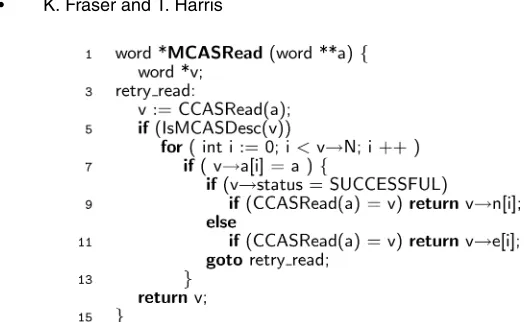
Fig. 8. MCASRead operation used to read from locations which may be subject to concurrent MCAS operations.
by the application; This is why the MCAS implementation needs two reserved bits in the locations that it may update. However, for simplicity, in the pseu-docode versions of our algorithms we use predicates to abstract these bitwise operations. Many alternative implementation techniques are available: For in-stance, some languages provide runtime type information, and in other cases descriptors of a given kind can be placed in given regions of the process’ virtual address space.
5.2 Logical Contents
There are four cases to consider when defining the logical contents of a location. If the location holds an ordinary value, then that is the logical contents of the location. If the location refers to anUNDECIDEDdescriptor then the descriptor’s old value (ei) is the location’s logical contents. If the location refers to aFAILED descriptor then, once more, the old value forms the location’s logical contents. If the location refers to aSUCCESSFUL descriptor then the new value (ni) is the logical contents.
The assumptions made about descriptor usage in Section 4.1 make it straightforward to determine the logical contents of a location because a series of words can be read from the descriptor without fear of it being deallocated or updated (other than the status field at the decision point).
[image:24.612.158.422.97.258.2]5.3 Commit Operations
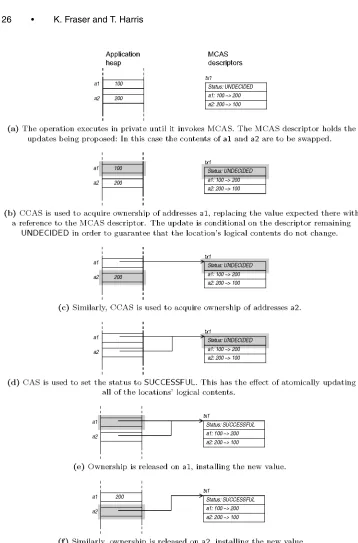
Figure 9 illustrates the progress of an uncontended MCAS commit operation attempting to swap the contents of addressesa1anda2.
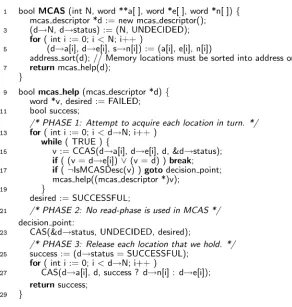
Figure 10 presents the lock-free implementation of this algorithm in pseu-docode. The first phase (lines 12–19) attempts to acquire each locationai by updating it from its expected valueei to a reference to the operation’s descrip-tor. Note that the CCAS operation invoked onai must preserve the logical con-tents of the location: Either the CCAS fails (making no updates) or succeeds, installing a reference to a descriptor holdingeias the old value forai. The “con-ditional” part of CCAS ensures that the descriptor’s status is stillUNDECIDED, meaning thateiis correctly defined as the logical contents ofai—this is needed in case a concurrent thread helps complete the MCAS operation via a call to
mcas helpat line 18.
Note that this lock-free implementation must acquire updated locations in address order. As we explained in Section 4.4, this recursive helping eventually results in system-wide progress because each level of recursion must be caused by a conflict at a strictly higher memory address than the previous level. If we do not want nonblocking progress, then we could omit the sorting step and abort an MCAS operation if it encounters contention (branch from line 17 to line 21 irrespective of the value seen inv).
The first phase terminates when the loop has completed each location (mean-ing that the descriptor has been installed in each of them (line 16)), when an unexpected nondescriptor value is seen (line 17), or when the descriptor’s status is no longerUNDECIDED(line 16 or 17, because another thread has completed the first phase).
The first thread to reach the decision point for a descriptor must succeed in installingSUCCESSFULorFAILED. If the MCAS has failed then the lineariza-tion point of the first CCAS that failed for this descriptor forms the linearizalineariza-tion point of the MCAS operation: The unexpected value was the logical contents of the location and contradicts the expected valueei for that location. Other-wise, if the MCAS has succeeded, note that when the status field is updated (line 23) thenallof the locationsai must hold references to the descriptor, and consequently the single status update changes the logical contents of all the locations. This is because the update is made by the first thread to reach line 23 for the descriptor and so no threads can yet have reached lines 25–27 nor started releasing the addresses.
The final phase then is to release the locations, replacing the references to the descriptor with the new or old values according to whether the MCAS has succeeded.
5.4 Building Conditional Compare-and-Swap
The MCAS implementation is completed by considering how to provide the CCAS operation used for acquiring locations on behalf of a descriptor.
Fig. 10. MCAS operation.
CCAS proceeds by attempting to install aCCAS descriptor in the location to be updated (line 8, Figure 12(a)). The descriptor is used to ensure that the location’s logical contents match the expected value while the conditional loca-tion is being tested. If the descriptor fails to be installed at line 8 then either: (i) A descriptor for another CCAS was seen (line 10), which is helped to comple-tion before retrying the proposed CCAS, or (ii) the expected value was not seen (line 9), in which case the failed CAS at line 8 forms the linearization point of the CCAS.
If the update location is successfully acquired, the conditional location is tested (line 24, Figure 12(b)). Depending on the contents of this location, the descriptor is either replaced with the new value or restored to the original value (line 25, Figure 12(c)). CAS is used so that this update is performed exactly once, even when the CCAS operation is helped to completion by other processes. A CCAS operation whose descriptor is installed successfully linearizes when the conditional location is read by the thread whose update at line 25 succeeds.
[image:27.612.159.451.112.419.2]Fig. 11. Conditional compare-and-swap (CCAS). CCASRead is used to read from locations which may be subject to concurrent CCAS operations.
communicate the success/failure result back to the first thread. This cannot be done by extending the descriptor with a Boolean field for the result: There may be multiple threads concurrently helping the same descriptor, each executing line 25 withdifferentresult values.
CCASRead proceeds by reading the contents of the supplied address. If this is a CCAS descriptor, then the descriptor’s operation is helped to completion and the CCASRead retried. CCASRead returns a nondescriptor value once one is read. Notice thatCCASHelpensures that the descriptor passed to it has been removed from the address by the time that it returns, so CCASRead can only loop while other threads are performing new CCAS operations on the same address.
5.5 Discussion
[image:28.612.141.437.91.395.2]Fig. 12. The steps involved in performing the first CCAS operation needed in Figure 9. In this case the first locationa1is being updated from 100 to refer to MCAS descriptortx1. The update is conditional on the descriptortx1beingUNDECIDED.
it is worth noting that the three batches of N updates all act on the same locations: Unless evicted during the MCAS operation, the cache lines holding these locations need only be fetched once.
We did develop an alternative implementation of CCAS which uses an ordi-nary write in place of its second CAS. This involves leaving the CCAS descriptor linked into the location being updated and recording the success or failure of the CCAS within that descriptor. This 2N +1 scheme is not a worthwhile im-provement over the 3N +1 design: It writes to more distinct cache lines and makes it difficult to reuse CCAS descriptors in the way we describe in Sec-tion 8.1.3. However, this direcSec-tion may be useful if there are systems in which CAS operates substantially more slowly than an ordinary write.
[image:29.612.189.432.339.413.2]logical contents of the location being updated. The weaker progress guarantee makes this possible by avoiding recursive helping: Ift2encounterst1 perform-ing an MCAS then t2causes t1’s operation to abort if it is stillUNDECIDED. This avoids the need to CCAS because only the thread initiating an MCAS can now update its status field toSUCCESSFUL: There is no need to check it upon each acquisition.
Finally, notice that algorithms built over MCAS will not meet the goal of read-parallelism from Section 1.1. This is because MCAS must still perform CAS operations on addresses for which identical old and new values are supplied: These CAS operations force the address’s cache line to be held in exclusive mode on the processor executing the MCAS.
6. WORD-BASED SOFTWARE TRANSACTIONAL MEMORY
We now turn to the word-based software transactional memory (WSTM) that we have developed. WSTM improves on the MCAS API from Section 5 in three ways: (i) by removing the requirement that space be reserved in each location in the heap, (ii) by presenting an interface in which the WSTM implementation is responsible for tracking the locations accessed, rather than the caller, and (iii) by providing read parallelism: Locations that are read (but not updated) can usually remain cached in shared mode.
Unfortunately, the cost of this is that the WSTM implementation is substan-tially more complex. Due to this complexity we split our presentation of WSTM into three stages: firstly presenting the core framework without support for resolving contention (Sections 6.1–6.3), then showing how to provide a basic lock-based instantiation of this framework, and then showing how to provide one that supports obstruction-free transactions (Section 6.4).
The complexity of WSTM motivates the simpler obstruction-free OSTM in Section 7.
6.1 Memory Formats
WSTM is based on the idea of associating version numbers with locations in the heap and using updates to these version numbers as a way of detecting conflicts between transactions.
Figure 13 illustrates this with an example. Theapplication heapcomprises the memory locations holding data being manipulated through the WSTM API; in this case values 100, 200, 300, and 400 at addresses a1, a2, a101, and a102, respectively.
A table ofownership records (orecs) hold the information that WSTM uses to coordinate access to the application heap. The orec table has a fixed size. A hash function is used to map addresses to orecs. One possible hash function is to use a number of the low-order bits of the address: In this case addresses a1 and a101 map to r1 while addresses a2 and a102 map to r2.
Fig. 13. The heap structure used in the lock-based WSTM. The commit operation acting on de-scriptor tx1 is midway through an update to locations a1 and a2: 200 is being written to a1 and 100 to a2. Locations a101 and a102 are examples of other locations which happen to map to the same ownership records, but which are not part of the update.
when an update is being committed, the orec refers to the descriptor of the transaction involved. In the figure, transaction tx1 is committing an update to addresses a1 and a2; it has acquired orec r1 and is about to acquire r2. Within the transaction descriptor, we indicate memory accesses using the notation
ai:(oi,voi)→(ni,vni) to indicate that addressaiis being updated from valueoi at version numbervoito valueniat version numbervni. For a read-only access,
oi =niandvoi =vni. For an update,vni =voi+1.
Figure 14 shows the definition of the data types involved. Awstm transaction
comprises a status field and a list ofwstm entrystructures. As indicated in the figure, each entry provides the old and new values and old and new version numbers for a given memory access. In addition, the obstruction-free version of WSTM includes aprev ownershipfield to coordinate helping between trans-actions.
The lock-based WSTM uses orecs of typeorec basic: Each orec is a simple union holding either aversionfield or a reference to the owning transaction. The obstruction-free WSTM requires orecs of typeorec obsfreeholding either a versionfield or a pair containing an integer count alongside a reference to the owning transaction.5In both implementations the current usage of a union can be determined by applying the predicateIsWSTMDesc: If it evaluates true then the orec contains a reference to a transaction, else it contains a version number. As before, these predicates can be implemented by a reserved bit in the space holding the union.
A descriptor iswell formedif, for each orec, it either: (i) contains at most one entry associated with that orec, or (ii) contains multiple entries associated with that orec, but the old version number is the same in all of them, as is the new.
5The maximum count needed is the maximum number of concurrent commit operations. In practice,
[image:31.612.186.460.92.240.2]Fig. 14. Data structures and helper functions used in the WSTM implementation.
6.2 Logical Contents
As with MCAS, we proceed by defining the logical contents of a location in the heap. There are three cases to consider:
LS1 : If the orec holds a version number then the logical contents comes directly from the application heap. For instance, in Figure 13, the logical contents ofa2is 200.
[image:32.612.135.456.89.523.2]