Cyclic-by-Row Approximation of Iterative
Polynomial EVD Algorithms
Jamie Corr
∗, Keith Thompson
∗, Stephan Weiss
∗, John G. McWhirter
†, and Ian K. Proudler
‡ ∗Department of Electronic & Electrical Engineering, University of Strathclyde, Glasgow, Scotland†School of Engineering, Cardiff University, Cardiff, Wales, UK
‡School of Electrical, Electronics and Systems Engineering, Loughborough University, Loughborough, UK {jamie.corr,keith.thompson,stephan.weiss}@strath.ac.uk
Abstract—A recent class of sequential matrix diagonalisation (SMD) algorithms have been demonstrated to provide a fast converging solution to iteratively approximating the polynomial eigenvalue decomposition of a parahermitian matrix. However, the calculation of an EVD, and the application of a full unitary matrix to every time lag of the parahermitian matrix in the SMD algorithm results in a high numerical cost. In this paper, we replace the EVD with a limited number of Givens rotations forming a cyclic-by-row Jacobi sweep. Simulations indicate that a considerable reduction in computational complexity compared to SMD can be achieved with a negligible sacrifice in diagonalisation performance, such that the benefits in applying the SMD are maintained.
I. INTRODUCTION
For many signal processing and in particular array problems, the eigenvalue decomposition (EVD) of the data’s covariance matrix is an essential tool. The EVD permits e.g. subspace de-compositions or the construction of optimum linear processing for MIMO systems. For the broadband case with a multichan-nel data vectorx[n], the use of narrowband phase shifts are not sufficient, and the time delays have to be explicitly addressed. The space-time covariance matrixR[τ] =Ex[n]xH[n−τ], where E{·} is the expectation operator and{·}H denotes the Hermitian transpose, thus arises. Its z-transform is the cross-spectral density (CSD) matrix R(z) = τR[τ]z−τ, which is a polynomial matrix that cannot be decomposed by the narrowband EVD.
A polynomial EVD (PEVD) was defined in the context of subband coding [2], which can be applied to a parahermitian matrix R(z) = ˜R(z)such that
R(z)≈H(z)D(z) ˜H(z) , (1)
with the parahermitian operatorR˜(z) =RH(z−1). The factors on the r.h.s. of (1) include a paraunitary matrixH(z)such that H(z) ˜H(z) = ˜H(z)H(z) = I, and a parahermitian D(z), which is diagonal,
D(z) =diag{D0(z)D1(z) . . . DM−1(z)} . (2) The matrix D(z) is spectrally majorised, such that the power spectral densities Dm(ejΩ) = Dm(z)|z=ejΩ satisfy
Dm+1(ejΩ)≥Dm(ejΩ)∀Ω, m= 0. . .(M −1). In [2], (1) is stated with equality for the optimum subband coder, even though the existence of an exact PEVD with FIR paraunitary
matrices is not guaranteed [3]. However, the close approxima-tion in (1) is supported in [4] for H(z) of sufficiently high order.
To calculate the PEVD, a number of iterative algorithms have been developed. The second order sequential best rotation (SBR2) algorithm [3] is a generalisation of the Jacobi method whereby in every step the off-diagonal element of maximum absolute value — referred to below as the dominant element — ofR(z)is eliminated by an elementary paraunitary operation. In this operation, a time shift matrix brings this dominant off-diagonal element into the zero lag matrix, where its energy is then transferred onto the diagonal by a Givens rotation. An alternative approach in [5] uses a paraunitary filter bank of fixed order with a lower computational complexity than SBR2, but unlike SBR2 is not guaranteed to converge. A modified SBR2 version, optimised for the coding gain problem, was proposed in [6], which identifies and eliminates the maximum normalised off-diagonal element at every iteration step.
A new family of algorithms, termed sequential matrix diag-onalisation (SMD), have been introduced in [7]–[9]. Different from SBR2, these algorithms do not only transfer the dominant element, but instead eliminate all off-diagonal elements in the zero lag plane by means of a (scalar) EVD. SMD algo-rithms have been demonstrated to diagonalise a parahermitian matrix in fewer iterations, with higher precision, and with a lower order paraunitary matrix H(z) than SBR2, which makes SMD very attractive for applications that e.g. require accurate broadband subspace decompositions [10]. A number of SMD algorithms will be reviewed later in this paper; while their application is attractive, the computational complexity of performing the actual decomposition is significantly higher than SBR2.
II. ITERATIVEPEVD ALGORITHMS
A number of iterative PEVD algorithms have been discussed in the literature, of which SBR2 [3], [6] is the most prominent due to its simplicity and proven convergence. Here we will not repeat the derivation of SBR2, but instead focus on the recently derived class of sequential matrix diagonalisation (SMD) algorithms [7], [9] and their characteristics.
A. General Iteration Approach
The SMD and SBR2 algorithm classes both perform a sequence of elementary paraunitary operationsH(i)(z), with iteration index i, by which a parahermitian matrix R(z)
is eventually approximately diagonalised, such that the off-diagonal energy of
S(I)(z) = H˜(z)R(z)H(z) (3)
H(z) =
I
i=0
H(i)(z) =I
i=0
Λ(i)(z)Q(i) (4)
is minimised. Each iteration i consists of a delay operation by a diagonal matrix Λ(i)(z), which creates an intermediate parahermitian matrix
S(i)(z) = ˜Λ(i)(z)S(i−1)(z)Λ(i)(z), i= 1. . . I , (5)
and a unitary operationQ(i) such that
S(i)(z) =Q(i)HS(i)(z)Q(i) (6)
completes the ith iteration.
The delay operationΛ(i)(z)is based on an elementary delay
Λ(i,j)(z) = diag{1 . . . 1
k(i,j)−1
z−τ(i,j)
1 . . . 1
M−k(i,j)
} , (7)
which delays the k(i,j)th column by τ(i,j) lags. In general, at the ith iteration, a maximum ofM −1 columns could be shifted, resulting in
Λ(i)(z) =J
j=1
Λ(i,j)(z) (8)
withJ ≤M−1. For the standard versions of SBR2 [3], [6] and SMD as introduced in [9], only a single elementary delay J = 1 is used.
Per iteration, the various PEVD algorithms differ in the selection of the parametersk(i,j),τ(i,j), and the construction of the unitary matrix Q(i). This parameter selection will be detailed below. The iterations stop when a threshold for a norm on the off-diagonal elements is passed. The norm selection is specific to the particular iterative PEVD method.
B. Second Order Sequential Best Rotation Algorithm
In the SBR2 algorithm, at every iteration the maximum scalar off-diagonal element is identified, transferred to the lag-zero slice by a single elementary delay matrix,J= 1, and then eliminated by a Givens rotation.
Based on a modified column vector ˆs(ki)[τ] ∈ CM−1
containing all elements in thek(i)th column ofS(i)[τ]except
for the diagonal element, the optimum parameter set for (7) is determined by
{k(i,1), τ(i,1)}= arg max
k,τ ˆs
(i−1)
k [τ]∞ , (9)
such that in theith iteration the optimum off-diagonal element will now lie in the lag zero matrixS(i)[0].
The maximum element is then transferred onto the diagonal ofS(i)[0]by means of a Givens rotation, such that
Q(i)=
⎡ ⎢ ⎢ ⎢ ⎢ ⎢ ⎣
I1
cosϕi . . . ejϑ(i)sinϕ(i)
..
. I2 ...
−e−jϑ(i)
sinϕ(i) . . . cosϕ(i)
I3
⎤ ⎥ ⎥ ⎥ ⎥ ⎥ ⎦
(10)
where the rotation angles ϕ(i) and ϑ(i) are determined by the maximum element identified by the search in (9). The identity matrices Ij, j = 1,2,3, in (10) have dimen-sions (min{m(i), k(i)} −1), (|m(i)−k(i)| −1) and (M − max{m(i), k(i)}+1), respectively. The resulting unitary matrix
Q(i) has to be left- and right-multiplied to every lag matrix
S(i)[τ]according to (6); however, no full matrix multiplication
is required, due to the sparse structure ofQ(i)only two rows and columns in S(i)(z)will be affected.
The convergence of SBR2 has been proven in [3] by showing that the paraunitary operations do not alter the total energy inS(i)(z), while in every step the off-diagonal energy is further minimised. The algorithm stops after I iterations, once the maximum off-diagonal element
max
k,τ ˆs
(I)
k [τ]∞< ρ (11)
falls below a predetermined thresholdρ.
C. Sequential Matrix Diagonalisation Algorithm
Different from SBR2, in theith iteration the SMD approach will not just eliminate the largest off-diagonal element but diagonalisesS(i)[0]. Based on the initialisation
S(0)[0] =Q(0)HR[0]Q(0) , (12)
withQ(0) the modal matrix obtained from the EVD ofR[0], every subsequent iteration brings one row and column to
S(i)[0], whose energy is then transferred onto the diagonal
by an EVD.
To maximise the reduction in off-diagonal energy, the SMD parameter selection in theith iteration is
{k(i,1), τ(i,1)}= arg max
k,τ ˆs
(i−1)
k [τ]2 , (13) which differs from (9) in the use of the l2 instead of the l∞ norm. To achieve complete diagonalisation ofS(i)[0],Q(i) is the modal matrix obtained by the EVD ofS(i)[0].
because more energy is transferred from off-diagonal to on-diagonal elements. However, an EVD has to be calculated at every iteration, and the modal matrix Q(i) has no longer the sparse structure of the Givens rotation in (10), requiring a full matrix multiplication at every lag τ.
While the EVD and full matrix multiplications makes the SMD algorithm much more costly to calculate compared to SBR2, two benefits can be noted:
• SMD can reach levels of diagonalisation that SBR2 cannot achieve;
• SMD generally leads to lower-order paraunitary matri-ces H(z), which have a lower cost compared to those obtainable by SBR2.
Therefore, for applications such as those requiring broadband signal subspace decompositions, SMD permits better perfor-mance with lower order paraunitary filter banks compared to SBR2.
D. Multiple Shift Maximum Element SMD Algorithm
To simplify the search phase of the SMD algorithm and avoid the calculation of modified column norms at every iteration, a maximum element SMD (ME-SMD) algorithm has been proposed in [9]. Replacing the l2 norm in (13) by the l∞ norm, the parameter search and delay operation within a single iteration is identical to SBR2. However, the zero-lag slice S(i)[0] is still diagonalised at every step, such that from iteration to iteration step, ME-SMD differs from SBR2. The ME-SMD algorithm has a very similar behaviour to the standard SMD algorithm, in terms of convergence, but also in terms of complexity, which is dominated by the EVD calculation and modal matrix application, rather than the parameter search.
Realising that the main advantage of SMD over SBR2 comes from the enhanced reduction in off-diagonal energy at every iteration, a multiple shift ME-SMD algorithm has been proposed [7], which shifts not one but several columns with elements onto the lag zero slice. As a column operation will partially undo previous row operations and vice versa, the sequence of these shifts is important. This sequence is guided by the definition of search spacesS(i,j)to which the parameter search is limited during the jth step of the ith iteration [7], [8], withS(i,j)being a function of bothS(i,j−1)andk(i,j−1). Based onS(i,j), the identified parameter set will be
{k(i,j), τ(i,j)}= arg max
k∈S(i,j),τˆs
(i−1)
k [τ]∞ , (14)
Different search spaces have been defined to ensure that the maximal number J = M −1 columns can be brought onto the zero lag matrix [7], [8]. All of the above algorithms have in common a considerably enhanced diagonalisation over the basic SMD algorithm as discussed in Sec. II-C.
III. CYCLIC-BY-ROWITERATIVEPEVD
Sec. II-C identified the computational cost to compute an approximate PEVD via SMD algorithms as a potential ob-stacle. In experiments using Matlab’s profiler, the calculation
1 2 3 4
5 6 7
8 9
[image:3.612.381.494.52.169.2]10
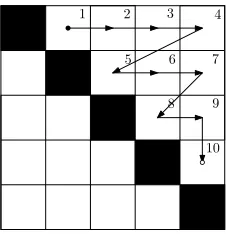
Fig. 1. Cyclic-by-row execution of Givens rotations implementing one Jabobi sweep, exemplified for a5×5matrix with start•and end point◦.
and application of an EVD per iteration step was singled out as the major contributor to this high cost. Therefore, this section proposes an inexpensive numerical approximation of the EVD by a Jacobi sweep consisting of a limited number of Givens rotations in a cyclic-by-row approach [12]. Below, Sec. III-A motivates the approach and Sec. III-B outlines the general procedure, which is then applied to a number of SMD algorithms in Sec. III-C.
A. EVD Approximation
A number of variations exist to implement the EVD of a Hermitian matrix [11], [12]. An iterative approach to an approximate EVD is the classical Jacobi algorithm [12], which consists of a sequence of Givens rotations targeting the max-imum off-diagonal element at each iteration step — note that the SBR2 algorithm is a generalisation of this technique to the parahermitian case [3]. A simpler alternative which does not require a maximum search at every step is the cyclic-by-row algorithm [11], [12], which is outlined below
The cyclic-by-row approach uses a sequence of so-called Jacobi sweeps until off-diagonal elements are suppressed below a given threshold or a predefined number of sweeps have been executed. A Jacobi sweep for anM×M matrix consists of a fixed number of (M2−M)/2 Givens rotations, which are applied in a cyclic row approach as highlighted in Fig. 1. Each Givens rotation as defined in (10) will transfer the energy of an off-diagonal element onto the diagonal while undoing some of the work of previous Givens rotations. However, over the course of one Jacobi sweep, the off-diagonal energy is reduced. By performing more Jacobi sweeps, the accuracy of the EVD approximation is improved.
B. Cyclic-by-Row Algorithm
Iterative approximate PEVD algorithms such as SBR2 and SMD minimise off-diagonal energy until a predefined thresh-oldρ is reached, as described by (11). Therefore, within one iteration step of SMD, a full EVD with a suppression of off-diagonal energy to the numerical equivalent of zero appears to be an overkill, and a lower precision with a limited number of Jacobi sweeps will very likely suffice to achieve the task of reducing off-diagonal energy below the valueρ.
Jacobi sweep proved sufficient and provided the best cost-performance trade-off, as we will detail in Sec. IV. With this approach, the unitary Jacobi rotation matrix Q(i) from SBR2 in (10) now becomes the product ofN= (M2−M)/2Givens rotations,
Q(i)= N
n=1
Q(i,n) , (15)
whereQ(i,n)is thenth Givens rotation used in theith iteration of an iterative PEVD algorithm using the single sweep cyclic-by-row approach.
C. Cyclic-by-Row SMD Algorithms
The cyclic-by-row single Jacobi sweep approximation of the EVD can be embedded in all algorithms of the SMD family. It may be argued that the term sequential matrix
diagonalisation is no longer appropriate, as the approximate EVD also results in only an approximate diagonalisation, and algorithms will therefore share some properties of SBR2, where only part of the off-diagonal energy of the lag zero matrix is transferred onto the diagonal. However, we assume that the approximation is within the boundρfor off-diagonal energy, and that therefore the termdiagonalisationis justified within the SMD family’s limited, pre-defined accuracy of decomposition.
All SMD algorithms perform an initial diagonalisation by an EVD according to (12), which in the cyclic-by-row ver-sion is approximated by a single Jacobi sweep. The EVD in subsequent iterations is also replaced by a single Jacobi sweep, and the unitary matrix (15) as applied in (6) can be implemented as a sequence of Givens rotations rather than a full matrix multiplication. The specific SMD family versions therefore consistently apply the single Jacobi sweep approach, and only differ in the way columns and rows are identified for transfer to the lag zero matrix using (5) at theith iteration:
• SMD [9]: in its original form, the sequential matrix diago-nalisation algorithm transfers the column with the largest off-diagonal column norm onto the lag zero matrix;
• ME-SMD [9]: with a simplified search compared to SMD, the column containing the maximum off-diagonal element is transferred to the lag zero matrix;
• MSME-SMD [7]: this multiple-shift version transfers
(M−1)columns identified by their maximum elements;
• C-MSME-SMD [8]: a causally-constrained multiple-shift version, with a more restricted search space for maxima as compared to MSME-SMD.
The cyclic-by-row approximations of these algorithms will be compared to their standard versions as well as to SBR2 in the next section.
IV. RESULTS
A. Simulation Set-Up and Performance Metrics
To assess the proposed iterative PEVD algorithms, we consider the diagonalisation performance over an ensemble of102random5×5parahermitian matricesR(z)of order 11. Each instance of R(z) is generated as R(z) = A(z) ˜A(z),
0 10 20 30 40 50 60 70 80 90 100
−30 −25 −20 −15 −10 −5
iteration indexi
5l
o
g10
E{
E
(
i
)
no
rm
}
/[
d
B
]
[image:4.612.316.560.55.255.2]SBR2 ME−SMD SMD C−MSME−SMD MSME−SMD cyclic−by−row approx
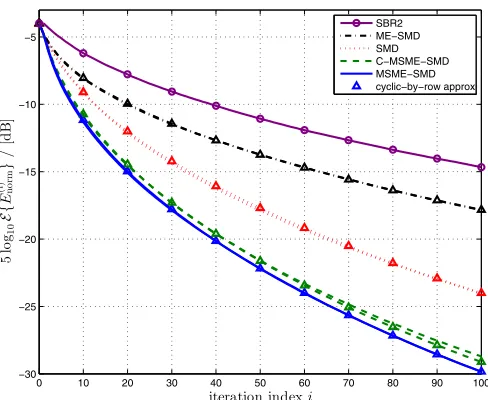
Fig. 2. Normalised remaining off-diagonal energyEnorm(i) according to (16) for various iterative PEVD algorithms versus iterations.
where A(z) ∈ C5×5 is a random polynomial matrix of order 6 with independent and identically distributed zero mean unit variance complex Gaussian entries. - To measure diagonalisation, the remaining normalised off-diagonal energy after iiterations,
E(i) norm=
τ
M
k=1ˆs(ki)[τ]22
τR[τ]2F ,
(16)
is considered, where ˆs(ki)[τ] is the modified column vector of (9) and · F the Frobenius norm. The computational complexity of various algorithms is measured by the execution time in Matlab R2013a under Ubuntu 12.04 on a Dell Precision T3610 with IntelR XeonR E5-1607V2 3.00 GHz x 4 cores
and 8 GB RAM.
B. Convergence Speed
The diagonalisation performance versus iterations is shown in Fig. 2 for the various algorithms. The SMD family con-verges generally significantly faster than SBR2, as also high-lighted in [7]–[9], with the multiple-shift versions performing best. Interestingly, the cyclic-by row single Jacobi sweep approximations of the EVD lead to no noticeable performance degradation for the SMD family of algorithms, thereby con-firming the single sweep selection in Sec. III-B.
C. Calculation Cost
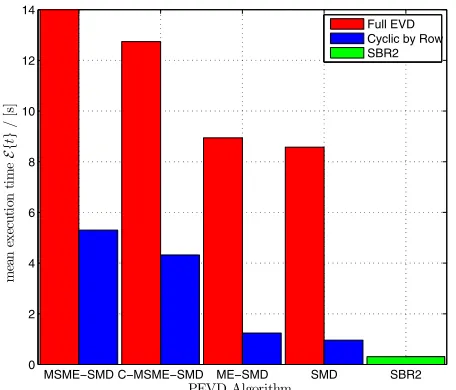
The computation time required for 100 iterations of the dif-ferent iterative PVD algorithms is plotted in Fig. 3. Compared to SBR2, the SMD algorithms require much more processing time. However, a significant reduction in cost can be noticed for the cyclic-by-row approximations of SMD algorithms. These are still more costly than the SBR2 algorithm, which only requires a single Givens rotation per iteration and there-fore is guaranteed to have a lower complexity.
MSME−SMD C−MSME−SMD ME−SMD SMD SBR2 0
2 4 6 8 10 12 14
PEVD Algorithm
m
ean
ex
ecuti
on
ti
m
e
E{
t
}
/[
s]
[image:5.612.61.289.55.250.2]Full EVD Cyclic by Row SBR2
Fig. 3. Mean execution time for 100 iterations of the various PEVD algorithms.
10−3 10−2 10−1 100 101
−30 −25 −20 −15 −10 −5
mean execution timeE{t}/ [s]
5l
og
10
E{
E
(
i
)
no
rm
}
/[
d
B
]
[image:5.612.55.294.285.479.2]SBR2 ME−SMD SMD C−MSME−SMD MSME−SMD cyclic−by−row approx
Fig. 4. Normalised remaining off-diagonal energy versus mean execution time for various iterative PEVD algorithms.
Fig. 4 shows the normalised remaining off-diagonal energy as a function of the time taken to calculate this specific decom-position. This graph is obtained by merging the information of Fig. 2 and 3. Using a full EVD, the SMD family of algorithms are inferior to SBR2 when a low level of diagonalisation suffices. For high values of diagonalisation, SBR2 cannot provide the required diagonalisation, and the computationally expensive SMD family is on the only option, with particular benefit for multiple-shift versions as established in [7], [8].
Using the cyclic-by-row approximation, the actual cost to reach a specific level of diagonalisation is reduced below even what is required for SBR2. Therefore, the cyclic-by-row approximation of SMD algorithms does not only yield lower application cost — as established in [7], [9], SMD decompositions yield paraunitaryH(z)of lower order — but in terms of total cost per decomposition is also less expensive to calculate than SBR2.
V. CONCLUSION
This paper has presented a cyclic-by-row approximation of sequential matrix diagonalisation algorithms. SMD algorithms have previously been shown to be attractive for application because of their excellent diagonalisation performance and lower order paraunitary filter banks compared to sequential best rotation algorithms; however the SMD family has been previously been shown to be computationally costly to cal-culate due an EVD required at every iteration. This costly step has been replaced by a single Jacobi sweep using a fixed number of Givens rotations in a cyclic-by-row approach.
Simulation results indicate that the algorithm performance is not compromised by this approximation, such that SMD algorithms retain their superior features for application. How-ever, the computational cost is reduced such that a significantly lower complexity to calculate a decomposition compared to standard SMD implementation is achieved. This holds also for lower levels of diagonalisation, where SBR2 previously retained an advantage in terms of calculation cost, such that the proposed cyclic-by-row approximations of SMD algorithms now globally offer the best cost-performance trade-off both in terms of calculating and applying an iterative PEVD.
ACKNOWLEDGEMENT
This work was supported by the Engineering and Phys-ical Sciences Research Council (EPSRC) Grant number EP/K014307/1 and the MOD University Defence Research Collaboration in Signal Processing.
REFERENCES
[1] P. Vaidyanathan. Theory of optimal orthonormal subband coders. IEEE Trans SP, 46(6):1528–1543, June 1998.
[2] P. Vaidyanathan.Multirate Systems and Filter Banks. Prentice Hall, New Jersey, 1993.
[3] J.G. McWhirter, P.D. Baxter, T. Cooper, S. Redif, and J. Foster. An EVD Algorithm for Para-Hermitian Polynomial Matrices. IEEE Trans SP, 55(5):2158–2169, May 2007.
[4] S. Icart and P. Comon. Some properties of Laurent polynomial matrices. In9th IMA Conf. Maths in Sig. Proc., Birmingham, UK, Dec. 2012. [5] A. Tkacenko. Approximate eigenvalue decomposition of para-hermitian
systems through successive fir paraunitary transformations. In IEEE Int. Conf. Acoustics Speech Signal Proc., pp. 4074–4077, Mar. 2010. [6] S. Redif, J.G. McWhirter, and S. Weiss. Design of FIR paraunitary filter
banks for subband coding using a polynomial eigenvalue decomposition. IEEE Trans SP, 59(11):5253–5264, Nov. 2011.
[7] J. Corr, K. Thompson, S. Weiss, J.G. McWhirter, S. Redif, I.K. Proudler Multiple Shift Maximum Element Sequential Matrix Diagonalisation for Parahermitian Matrices.IEEE Workshop on Statistical Signal Proc., Gold Coast, Australia, June. 2014.
[8] J. Corr, K. Thompson, S. Weiss, J. G. McWhirter, I. K. Proudler Causal Multiple Shift Maximum Element Sequential Matrix Diagonalisation for Parahermitian Matrices. 22nd European Signal Proc. Conf., Lisbon, Portugal, Sept. 2014.
[9] S. Redif, S. Weiss, and J.G. McWhirter. Sequential Matrix Diagonalisa-tion Algorithms for Polynomial EVD of Parahermitian Matrices. IEEE Trans SP, submitted, 2014.
[10] M. Alrmah, S. Weiss, and S. Lambotharan. An extension of the MUSIC algorithm to broadband scenarios using polynomial eigenvalue decomposition. In 19th European Signal Proc. Conf., pp. 629–633, Barcelona, Spain, Aug. 2011.
[11] J. G ¨otze Monitoring the stage of diagonalization in Jacobi-type meth-ods IEEE International Conference on Acoustics, Speech, and Signal Processing, Adelaide, Australia, vol. III, pp. 441–444, Apr. 2014. [12] G.H. Golub and C.F. Van Loan. Matrix Computations. John Hopkins