264
Role play-based question-answering by real users for building chatbots
with consistent personalities
Ryuichiro Higashinaka1
, Masahiro Mizukami1
, Hidetoshi Kawabata2
Emi Yamaguchi2
,Noritake Adachi2
,and Junji Tomita1 1
NTT Corporation 2
DWANGO Co., Ltd.
{higashinaka.ryuichiro, mizukami.masahiro}@lab.ntt.co.jp
{hidetoshi kawabata, emi yamaguchi, noritake adachi}@dwango.co.jp
Abstract
Having consistent personalities is impor-tant for chatbots if we want them to be believable. Typically, many question-answer pairs are prepared by hand for achieving consistent responses; however, the creation of such pairs is costly. In this study, our goal is to collect a large number of question-answer pairs for a particular character by using role play-based question-answering in which mul-tiple users play the roles of certain char-acters and respond to questions by online users. Focusing on two famous charac-ters, we conducted a large-scale experi-ment to collect question-answer pairs by using real users. We evaluated the ef-fectiveness of role play-based question-answering and found that, by using our proposed method, the collected pairs lead to good-quality chatbots that exhibit con-sistent personalities.
1 Introduction
Having a consistent personality is important for chatbots if we want them to be be-lievable (Li et al., 2016; Gordon et al., 2016;
Curry and Rieser, 2016; Sugiyama et al., 2017;
Akama et al., 2017). Although neural network-based methods are emerging for achieving con-sistent personalities, their quality is not that high (Li et al., 2016). Therefore, in many sys-tems, question-answer pairs are prepared by hand for consistent responses (Takeuchi et al., 2007;
Leuski et al.,2009;Traum et al.,2015). However, the creation of such pairs is costly.
In this study, our aim is to collect a large number of question-answer pairs for a particu-lar character by using role play-based question-answering (Higashinaka et al., 2013a) in which
multiple users play the roles of certain characters and respond to questions by online users. The con-cept is shown in Figure1. The main idea is that role players collectively represent a single acter and that a question is broadcast via a char-acter to all role players. In this way, question-answer pairs can be efficiently collected because there is less burden on people responding, and the entertaining nature of role playing makes people likelier to participate (Ments, 1999). In a small-scale experiment, Higashinaka et al. found that question-answer pairs of a character can be effi-ciently collected by multiple users and that users are highly motivated to provide questions and an-swers.
There were two limitations to their work. One was that the experiment was conducted using only a small number of people, who were recruited by the authors. It was not clear if the scheme would work with real users (i.e., users who are not re-cruited nor paid by researchers). The other lim-itation was that the applicability of the collected data to the creation of chatbots was not verified. In their small-scale experiment, the maximum num-ber of question-answer pairs for a character was only about 80. This was because users were al-lowed to register any of their favorite characters, resulting in a small amount of data per character. It was difficult to create a chatbot with such little data.
In this paper, we tackle these limitations by us-ing role play-based question-answerus-ing for col-lecting question-answer pairs from real users. Re-garding the second limitation, we limited the char-acters to two famous ones so as to collect a large number of question-answer pairs per character and create workable chatbots. We conducted a sub-jective evaluation of the chatbots by using human participants. Our contributions are as follows:
question-Role-Player 1
Role-Player N
User 1
User M Character
Question
…
…
Answer Broadcast
questions
Answer Question Answer
[image:2.595.317.515.61.190.2]Answer
Figure 1: Role play-based question-answering scheme (Higashinaka et al.,2013a).
answering works with real users, collecting a large number of question-answer pairs per character in a short period.
• We proposed a method to create chatbots from collected question-answer pairs and verified that it can lead to good-quality chat-bots exhibiting consistent personalities.
We first describe our data collection by us-ing role play-based question-answerus-ing with real users. Then, we propose our method for creat-ing chatbots uscreat-ing the collected question-answer pairs. Next, we describe the experiment we con-ducted to evaluate the quality of the chatbots by using human participants. After covering related work, we summarize the paper and mention future work.
2 Data collection by real users
To collect a large number of question-answer pairs per character, we focused on two characters: a real person called Max Murai and a fictional charac-ter in a novel, Ayase Aragaki. They are popular characters in Japan and have a large number of fans. We created Web sites in their fan communi-ties so that fans could try role play-based question-answering. We first describe the two characters in more detail and then briefly go over the Web sites. Finally, we present the statistics of the data and look at the results from several aspects.
2.1 Characters
Max Murai His real name is Tomotake Murai (Max Murai is his stage name). Born in 1981, Murai is a CEO of the IT company AppBank but also a YouTuber who specializes in the live coverage of TV games. He is known to have a frank personality.
[image:2.595.81.283.62.170.2]Ayase Aragaki A fictional character in the novel “Ore no imouto ga konnnai kawaii wakega
Figure 2: Web site for Max Murai.
c
Tsukasa Fushimi/ASCII MEDIA WORKS/OIP2 cBANDAI NAMCO
Entertainment Inc. Copyright c2017 Live2D Inc.
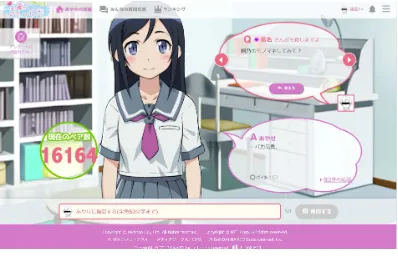
Figure 3: Web site for Ayase Aragaki.
nai” (My Little Sister Can’t Be This Cute), which has sold more than five million copies in Japan in its series. Ayase is not a main character but plays a supporting role. Her character is often referred to as a “Yandere”. According to Wikipedia, Yandere characters are mentally unstable, incredibly deranged, and use extreme violence or brutality as an outlet for their emotions.
2.2 Web sites
On the Japanese streaming service NICONICO Douga1, each character has a channel for their fans. The channel is limited to subscribers. Through the generosity of this service, we were allowed to establish our Web sites for role play-based question-answering on their channels. Mu-rai has more than 10,000 subscribers; the number of subscribes for Ayase is not disclosed.
We opened the Web sites in March and Octo-ber 2017 for Murai and Ayase, respectively. Fig-ures2and3show screenshots of the sites. The ap-pearances of the sites were adjusted to the charac-ters. The users can ask the characters questions by
[image:2.595.317.516.230.358.2]Murai Ayase
No. of users who participated 340 333
No. of question-answer pairs 12,959 15,112
No. of questions 7,652 6,482
Average words per question 10.38 13.09
Average letters per question 17.42 20.35 No. of unique words in questions 7,317 6,654
No. of words in questions 79,412 84,838
No. of users who posted questions 284 262
No. of questions per user 22.51 19.47
No. of answers 12,959 15,112
No. of answers per question 1.69 2.33
Average words per answer 7.03 15.27
Average letters per answer 11.59 24.64
No. of unique words in answers 8,666 10,208
No. of words in answers 91,119 230,707
No. of users who posted answers 243 290
[image:3.595.309.522.61.148.2]No. of answers per user 38.11 45.38
Table 1: Posting statistics.
means of a text-field interface, and users who want to play the role of the characters can post answers. To stimulate interaction, the Web sites show the rankings of users by their number of posts. In ad-dition, a “like” button is placed beside each answer so that when a user thinks the answer sounds very much “like” the character in question, this opinion can be reflected in the number of “likes”. The sites were primarily for collecting one-shot question-answer pairs. It was also possible for the Murai site to collect follow-up question-answer pairs, but this function was rarely utilized by users.
2.3 Statistics
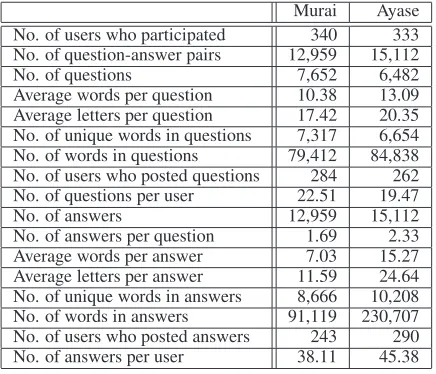
The statistics of the postings (at the time of sub-mission) are listed in Table1. We obtained a to-tal of 12,959 and 15,112 question-answer pairs for Murai and Ayase, respectively. The size of the data is quite large. We want to emphasize that the users were not paid for their participation; they did so voluntarily. This indicates that role play-based question-answering works well with real users. As seen in the table, more than 300 users partici-pated for each character. The questions/answers for Ayase were longer and contained more words and letters.
2.4 Efficiency
Table 2 shows the times when the number of question-answer pairs exceeded certain thresh-olds. We can see how fast we could collect a few thousand question-answer pairs. For both charac-ters, it took just about a couple of days to reach 2,000 question-answer pairs. For Ayase, the pace was much faster than for Murai, reaching 10,000 question-answer pairs in 18 days. After a
cer-Murai Ayase
Threshold Hours Days Hours Days
1K 21.36 0.89 25.71 1.07
2K 22.17 0.92 26.88 1.12
5K 1,730.05 72.09 72.21 3.01
10K 2,307.60 96.15 443.73 18.49
12K 2,808.91 117.04 993.37 41.39
15K N/A N/A 2,834.26 118.09
Table 2: Time taken to reach certain number of question-answer pairs.
tain period, the pace of the postings slowed. Al-though role play-based question-answering is cer-tainly entertaining, we may need to consider ways to keep users engaged in the interaction. En-abling more sustainable collection of question-answer pairs is future work.
2.5 Quality of the postings
We also evaluated the answers given by the users through subjective evaluation (see GOLD in Tables 4 and 5). We obtained the average naturalness/character-ness scores of around 3.5– 4.0 on a five-point Likert scale, indicating that the answers collected through role play-based question-answering were good. However, it was surprising that human users also struggled to ob-tain scores over 4.0, indicating that generating ut-terances for a particular character is difficult, even for humans.
2.6 Satisfaction of users
We asked users of the channels to participate in a survey to determine their user satisfac-tion. We used the same questionnaire as in (Higashinaka et al., 2013a). It consisted of three questions: (Q1) How do you rate the usability of the Web site?, (Q2) Would you be willing to use the Web site again?, and (Q3) Did you enjoy role playing on the Web site? The users answered based on a five-point Likert scale, with one being the lowest score and five the highest. Twenty-three and 36 participants took part in the survey for Mu-rai and Ayase, respectively.
[image:3.595.73.291.62.249.2]Questionnaire item Murai Ayase
Q1 Usability of Web site 3.74 4.08
[image:4.595.315.516.62.232.2]Q2 Willingness for future use 4.57 4.56 Q3 Enjoyment of role playing 4.39 4.53
Table 3: Questionnaire results.
3 Creating chatbots from collected question-answer pairs
Now that we have successfully collected a large number of question-answer pairs for our two char-acters, the next step is to determine if the col-lected pairs can be useful for creating chatbots that exhibit the personalities of the characters in question; namely, Murai and Ayase. Since the size of the data was not large enough to train neural-generation models (Vinyals and Le,2015), we opted for a retrieval-based approach in which relevant question-answer pairs are retrieved using an input question as a query and the answer part of the most relevant pair is returned as a chatbot’s response. One of the methods we used is a sim-ple application of an off-the-shelf text search en-gine, and the other is our proposed method, which is more sophisticated and uses neural-translation models for ranking.
3.1 Simple retrieval-based method
This method uses the text search engine LUCENE2 for retrieval. Questions and
an-swers are first indexed with LUCENE. We use a built-in Japanese analyzer for morphological analysis. Given an input question, the BM25 algorithm (Walker et al., 1997) is used to search for a similar question using the content words of the input question. The answers for the retrieved questions are used as the output of this method. Although simple, this method is quite compet-itive with other methods when there are many question-answer pairs because it is likely that we will be able to find a similar question by word matching.
3.2 Proposed method
Only using word-matching may not be sufficient. Therefore, we developed a more elaborate method that re-ranks the results retrieved from LUCENE. Our idea comes from cross-lingual question an-swering (CLQA) (Leuski et al., 2009) and re-cent advances in neural conversational models (Vinyals and Le, 2015). We also conducted se-mantic and intent-level matching between
ques-2https://lucene.apache.org/
Figure 4: Flow of proposed method.
tions so that appropriate answer candidates could be ranked higher. Figure4shows the flow of this method. Given an input question Q, the method outputs answers in the following steps. The de-tails of some of the key models/modules used in the steps are described later.
1. GivenQ, LUCENE retrieves top-N question-answer pairs (Q′
1, A′1). . .(Q′N, A′N), as
de-scribed in Section3.1.
2. The question-type estimation and extended named entity recognition modules estimate the question types of Q and Q′ and extract extended named entities (Sekine et al.,2002) contained in A′. The question-type match score is calculated by using the match of the question type and the number of extended named entities in A′ requested by Q. See Section3.3for details.
3. The center-word extraction module extracts center-words (noun phrases (NPs) that repre-sent foci/topics) from both Q and Q′. The word score is 1.0 if one of the center-words ofQis included in those ofQ′; other-wise it is 0.0.
to obtain the translation scores. That is, if the rank isr, its score is calculated by
1.0−(r−1)/max rank, (1)
where max rank is the maximum number of elements to be ranked.
5. The semantic similarity model is used to cal-culate the semantic similarity score between QandQ′. We use Word2vec (Mikolov et al.,
2013) to calculate this score. First, we ob-tain word vectors (trained from Wikipedia) for each word in Q and Q′ and then calcu-late the cosine similarity between the aver-aged word vectors.
6. The score calculation module integrates the above scores to obtain a final score:
score(Q,(Q′, A′))
= w1∗search score
+ w2∗qtypes match score + w3∗center-word score + w4∗translation score + w5∗rev translation score
+ w6∗semantic similarity score(2)
Here, search score indicates the score con-verted from the rank of the search results from LUCENE. The conversion is done using Eq. (1). rev translation score indicates the translation score derived fromp(Q|A′). The w1. . . w6denote the weights of the scores.
7. The question-answer pairs are sorted by their scores, and top-M answers are returned as output.
3.3 Modules
We describe some of the models/modules used in the above steps.
Question-type estimation and extended named entity recognition We estimated four question types for a question. One is a general ques-tion type. We used the taxonomy described in (Higashinaka et al.,2014), which has 16 question subtypes. We trained a logistic-regression based question-type classifier that classifies a question into one of the 16 question types. The other three question types come from an extended named en-tity taxonomy proposed by Sekine (2002). The taxonomy has three layers ranging from abstract
(e.g., Product, Location) to more concrete enti-ties (e.g., Car, Spa, City). We trained a logistic-regression-based classifier that classifies which of the named entity types is requested in a question. We trained a classifier for each layer; thus, we had three classifiers. Using our in-house data, by two-fold cross-validation, the classification accu-racies are 86.0%, 84.9%, 76.9%, and 73.5% for the general question type, layer-1, layer-2, and layer-3 question types, respectively. We also ex-tract extended named entities from an answer can-didate (A′) by using our extended named entity recognizer (Higashinaka et al., 2013b) and check whether the extended named entities correspond-ing to the layer-1, layer-2, and layer-3 question types of a question (Q) are included inA′.
The qtypes match score is calculated as fol-lows: if there is a match of the general ques-tion type between Qand Q′, the score of one is obtained. Then, the number of extended-named-entity question types covered by the answer can-didate is added to this score. Finally, this score is divided by four for normalization.
Center-word extraction We define a center-word as an NP that denotes the topic of a con-versation. To extract such NPs from an utter-ance, we used conditional random fields (CRFs) (Lafferty et al., 2001). For the training and test-ing, we prepared about 20K sentences with center-word annotation. The sentences were those ran-domly sampled from our in-house open-domain conversation corpus. The feature template uses words, part-of-speech (POS) tags, and semantic categories of current and neighboring words. The extraction accuracy is 76% in F-measure with our in-house test set.
Translation model We trained a translation model by using a seq2seq model. We trained the model by using the OpenNMT Toolkit3 with default settings. The translation model learns to translate a question into an answer. By using the trained model, we can obtain the generative probability of an answer given a question; namely p(A′|Q). Since the amount of question-answer pairs was limited, we first trained a model by using our in-house question-answering data comprising 0.5 million pairs. The data were collected using crowd-sourcing. We then adapted the model to our question-answer pairs. The model forp(Q|A′) was trained in the same manner by swapping the
source and target data. To reflect the number of “likes” associated with the answers (see Sec-tion 2.2), we augmented the number of samples by their number of “likes”; that is, if a question-answer pair has n “likes”, n samples of such a question-answer pair are included in the training data.
3.4 Extending question-answer pairs
When developing our method, we noticed that, in some cases, top-N search results do not contain good candidates because of the lack of question coverage. When the top-N questions do not se-mantically match reasonably with the input ques-tion, the answers are likely to be inappropriate. To have a wider coverage of questions, we ex-tended our question-answer pairs by using Twit-ter. Our methodology was simple: for each answer A that occurred twice or more in our question-answer pairs, we searched for tweets that resemble Awith a Levenshtein distance (normalized by the sentence length) below 0.1. Then, if the tweets had an in-reply-to relationship to other tweets, they were retrieved and coupled with A to form ex-tended question-answer pairs. The reason we fo-cused on an answer that occurred twice or more is mainly due to the efficiency of crawling, but such answers that occur multiple times are likely to be characteristics of the characters in question. We obtained 2,607,658 and 1,032,492 extended question-answer pairs for Murai and Ayase, re-spectively.
4 Experiments
We conducted a subjective evaluation to determine the quality of chatbots created from our collected question-answer pairs. We first describe how we prepared the data for evaluation and how we re-cruited participants. We then describe the eval-uation criteria. Next, we describe the methods for comparison, in which we compared the meth-ods presented in the previous section with a rule-based baseline and gold data (human-generated data). Finally, we explain the results and present our analyses.
4.1 Data
To create the data for testing, we first randomly split the question-answer pairs into train, devel-opment, and test sets with the ratios of 0.8, 0.1, and 0.1, respectively. The splits were made so that the same question would not be included over multiple sets. We used the train and development
sets to train the translation models. In addition, the question-answer pairs used by LUCENE for retrieval consisted only of train and development data. For each character, 50 questions were ran-domly sampled from the test set and used as input questions for this experiment.
4.2 Procedure
We recruited 26 participants each for Murai and Ayase. The participants were recruited mainly from the subscribers of the channels for the two characters. Before taking part in the experiment, they self-declared their levels of knowledge about the characters. Then, they rated the top-1 output of the five methods (shown below) for the 50 ques-tions; they rated at maximum 250 answers (since some methods output duplicate answers, such an-swers were only rated once). We compensated for their time by giving Amazon gift cards worth about 20 US dollars.
4.3 Evaluation criteria
The participants rated each output answer by their degree of agreement to the following statements on a five-point Likert scale (1: completely dis-agree, 5: completely agree).
Naturalness Not knowing who’s speaking, the answer is appropriate to the input question.
Character-ness Knowing that the character in question is speaking, the answer is appropri-ate to the input question.
The first criterion evaluates the interaction from a general point of view, while the second from the character point of view. Ideally, we want the character-ness to be high, but we want to maintain at least reasonable naturalness when considering the deployment of the chatbots. Note that an ut-terance can be rated low in terms of naturalness but high in character-ness, or vice-versa: for ex-ample, some general utterances, such as greetings, can never be uttered by particular characters.
4.4 Methods for comparison
All High Low
Natural Character Natural Character Natural Character
(a) AIML 2.93 2.60 2.93 2.49 2.96 2.95
(b) LUCENE 2.80 2.87aa
2.81 2.80aa
2.75 3.10
(c) PROP WO EXDB 3.16aabb 3.17aabb 3.17abb 3.09aabb 3.13 3.42aa
(d) PROP 3.39aabbcc 3.20aabb 3.42aabbcc 3.14aabb 3.32bb 3.39a
[image:7.595.85.519.63.141.2](e) GOLD 3.91aabbccdd 3.81aabbccdd 3.93aabbccdd 3.80aabbccdd 3.85aabbccdd 3.85aabbccdd
Table 4: Results for Murai. The scores were averaged over the participants. Superscripts indicate whether the value is significantly better than those for the methods denoted with letters; two letters, such as ‘aa’, indicate statistical significance p < 0.01, and a single letter indicates p < 0.05. The Steel-Dwass multiple comparison test was used as a statistical test. The best scores (excluding GOLD) are in bold.
All High Low
Natural Character Natural Character Natural Character
(a) AIML 2.71 2.44 2.74 2.42 2.49 2.63
(b) LUCENE 2.98aa 3.13aa 3.05aa 3.13aa 2.48 3.11
(c) PROP WO EXDB 3.04aa 3.15aa 3.09aa 3.14aa 2.62 3.19a
(d) PROP 3.23aabbc 3.24aa 3.28aabb 3.23aa 2.78 3.27aa
[image:7.595.81.508.212.290.2](e) GOLD 3.61aabbccdd 3.74aabbccdd 3.68aabbccdd 3.75aabbccdd 3.11aabb 3.65aab
Table 5: Results for Ayase. See caption of Table4for notations in table.
Rule-based baseline (AIML) The typical ap-proach to implement a chatbot is by using rules. We used the rules written in AIML created by Higashinaka et al (2015). There are roughly 300K rules. In Japanese, sentence-end expressions are key factors to exhibit personality. Therefore, following the method by Miyazaki et al. (2016), we created sentence-end conversion rules so that the output of this method would have the sentence-end expressions that match the characters in question.
Retrieval-based method (LUCENE) The retrieval-based method described in Section
3.1.
Proposed method 1 (PROP WO EXDB) The proposed method described in Section 3.2. This method does not use the extended question-answer pairs from Twitter. The weightsw1. . . w6 are all set to 1.0. We used
10 for N for document retrieval.
Proposed method 2 (PROP) The proposed method with extended question-answer pairs from Twitter, as described in Section 3.4. We retrieved 10 candidates from collected question-answer pairs and 10 from extended ones. The weights w1. . . w6 are all set to
1.0.
Upper bound (GOLD) The gold responses by the online users to the test questions. When multiple answers are given to a question, one is randomly selected.
4.5 Results
Tables4and5list the results for Murai and Ayase, respectively. The topmost row indicates the level of knowledge about the characters. ‘All’ indicates the results of all participants, ‘High’ those who self-declared as being very knowledgeable, and ‘Low’ those who self-declared otherwise. We had 26 High and 6 Low participants for Murai, and 23 High and 3 Low participants for Ayase.
The tendencies were the same for the two char-acters, although the scores for Ayase were gener-ally lower than those of Murai. AIML performed the worst followed by LUCENE. It was surprising that AIML’s score was low; this is probably be-cause of the peculiarities of the input questions for the characters. PROP WO EXDB and PROP per-formed better than AIML and LUCENE with sta-tistical significance in many cases. GOLD was al-ways the best-performing method. PROP was sig-nificantly better than PROP WO EXDB for natu-ralness but not for character-ness.
These results indicate that simple text-based re-trieval is not sufficient, and we need more elabo-rate methods. The effectiveness of the extended question-answer pairs seems to be limited. It can be useful to make the interaction seem natural, but this does not necessarily improve character-ness, although we believe that having the ability to con-verse naturally is a requirement for chatbots.
Question Method Answer Nat. Char. What did you eat for
lunch today?
AIML I had a chicken breast rice bowl. It was good. What did you eat?
4.50 3.46
LUCENE Anything will do when you are playing video games. 1.88 2.08
PROP WO EXDB Ramen! 4.81 4.77
PROP Ramen. 4.73 4.31
[image:8.595.68.531.62.134.2]GOLD I had a ginger grilled meal at Hidakaya. 4.92 4.15
Table 6: Examples of answers for Murai by each method. Questions and answers were originally in Japanese. English translations are by the authors.
Question Method Answer Nat. Char.
You are so cute. AIML Cute is the best. 2.69 2.15
LUCENE Shut up or I will sew your mouth. 3.04 4.12
PROP WO EXDB Thank you! It’s a little embarrassing. 4.69 4.08
PROP Thank you! 4.62 4.15
GOLD You say silly things all the time. I may take it seriously. 4.08 4.27
Table 7: Examples of answers for Ayase by each method.
participants. For example, for Murai, there were only few cases in which there was statistical sig-nificance between the proposed methods when the knowledge level was low. The tendency was the same for Ayase. This highlights the difficulty in evaluating for characters.
Tables 6 and 7 show examples of answers for Murai and Ayase, respectively. Overall, since the proposed methods achieved character-ness scores well over 3 (which is the middle point in the scale), we conclude that we can create chatbots with con-sistent personalities by means of role play-based question-answering.
5 Related Work
Although there have not been any studies involv-ing role play-based question-answerinvolv-ing for data collection, there is a large body of research for cre-ating chatbots that show consistent personalities.
There have been several studies on char-acters by generating or rewriting utterances reflecting the underlying personality traits (Mairesse and Walker, 2007; Sugiyama et al.,
2014; Miyazaki et al., 2016). In addition, there has been extensive research on extending neural conversational models to reflect personal profiles (Li et al., 2016). Although such neural network-based methods show promising results, they still suffer from sparsity of data and non-informative utterances (Li et al., 2015). This paper proposed increasing the source data for character building; the data can be useful for neural models.
6 Summary and future work
Our goal for this study was to verify the effec-tiveness of role play-based question-answering for creating chatbots. Focusing on two famous
char-acters in Japan, we successfully collected a large volume of question-answer pairs for two charac-ters by using real users. We then created chat-bots using the question-answer pairs. Subjective evaluation showed that although a simple text-retrieval based method does not work well, our proposed method that uses translation models as well as question-type matching and center-word extraction works well, showing reasonable scores in terms of naturalness and character-ness.
For future work, we need to consider ap-proaches to improve the quality of the proposed method. For example, we are currently using equal weights for scoring. We believe that they can be optimized using training data. We also want to incorporate other pieces of information that may contribute to the ranking of answers, such as sentence embeddings (Kiros et al.,2015), discourse relations (Lin et al.,2009;Otsuka et al.,
2017), and external knowledge about the charac-ters. Although we used two very different char-acters in this paper, we want to use additional types of characters as targets for role play-based question-answering. We also want to incorporate the chatbots into the Web sites so that the users can feel they are training up the characters.
Acknowledgments
References
Reina Akama, Kazuaki Inada, Naoya Inoue, Sosuke Kobayashi, and Kentaro Inui. 2017. Generating stylisti-cally consistent dialog responses with transfer learning. In
Proc. IJCNLP, volume 2, pages 408–412.
Amanda Cercas Curry and Verena Rieser. 2016. A subjective evaluation of chatbot engines. InProc. WOCHAT.
Carla Gordon, Jessica Tin, Jeremy Brown, Elisabeth Fritzsch, and Shirley Gabber. 2016. Wochat chatbot user experi-ence summary. InProc. WOCHAT.
Ryuichiro Higashinaka, Kohji Dohsaka, and Hideki Isozaki. 2013a. Using role play for collecting question-answer pairs for dialogue agents. InProc. INTERSPEECH, pages 1097–1100.
Ryuichiro Higashinaka, Kenji Imamura, Toyomi Meguro, Chiaki Miyazaki, Nozomi Kobayashi, Hiroaki Sugiyama, Toru Hirano, Toshiro Makino, and Yoshihiro Matsuo. 2014. Towards an open-domain conversational system fully based on natural language processing. InProc. COL-ING, pages 928–939.
Ryuichiro Higashinaka, Toyomi Meguro, Hiroaki Sugiyama, Toshiro Makino, and Yoshihiro Matsuo. 2015. On the dif-ficulty of improving hand-crafted rules in chat-oriented di-alogue systems. InProc. APSIPA, pages 1014–1018.
Ryuichiro Higashinaka, Kugatsu Sadamitsu, Kuniko Saito, and Nozomi Kobayashi. 2013b. Question answering tech-nology for pinpointing answers to a wide range of ques-tions. NTT Technical Review, 11(7).
Ryan Kiros, Yukun Zhu, Ruslan R Salakhutdinov, Richard Zemel, Raquel Urtasun, Antonio Torralba, and Sanja Fi-dler. 2015. Skip-thought vectors. In Proc. NIPS, pages 3294–3302.
John Lafferty, Andrew McCallum, and Fernando CN Pereira. 2001. Conditional random fields: Probabilistic models for segmenting and labeling sequence data.
Anton Leuski, Ronakkumar Patel, David Traum, and Bran-don Kennedy. 2009. Building effective question answer-ing characters. InProc. SIGDIAL, pages 18–27.
Jiwei Li, Michel Galley, Chris Brockett, Jianfeng Gao, and Bill Dolan. 2015. A diversity-promoting objective func-tion for neural conversafunc-tion models. arXiv preprint arXiv:1510.03055.
Jiwei Li, Michel Galley, Chris Brockett, Georgios P Sp-ithourakis, Jianfeng Gao, and Bill Dolan. 2016. A persona-based neural conversation model. arXiv preprint arXiv:1603.06155.
Ziheng Lin, Min-Yen Kan, and Hwee Tou Ng. 2009. Rec-ognizing implicit discourse relations in the penn discourse treebank. InProc. EMNLP, pages 343–351.
Franc¸ois Mairesse and Marilyn Walker. 2007. PERSON-AGE: Personality generation for dialogue. InProc. ACL, pages 496–503.
Morry Van Ments. 1999. The Effective Use of Role Play: Practical Techniques for Improving Learning. Kogan Page Publishers.
Tomas Mikolov, Ilya Sutskever, Kai Chen, Greg S Corrado, and Jeff Dean. 2013. Distributed representations of words and phrases and their compositionality. InProc. NIPS, pages 3111–3119.
Chiaki Miyazaki, Toru Hirano, Ryuichiro Higashinaka, and Yoshihiro Matsuo. 2016. Towards an entertaining natu-ral language generation system: Linguistic peculiarities of Japanese fictional characters. InProc. SIGDIAL, pages 319–328.
Atsushi Otsuka, Toru Hirano, Chiaki Miyazaki, Ryuichiro Higashinaka, Toshiro Makino, and Yoshihiro Matsuo. 2017. Utterance selection using discourse relation filter for chat-oriented dialogue systems. InDialogues with So-cial Robots, pages 355–365. Springer.
Satoshi Sekine, Kiyoshi Sudo, and Chikashi Nobata. 2002. Extended named entity hierarchy. InProc. LREC.
Hiroaki Sugiyama, Toyomi Meguro, and Ryuichiro Hi-gashinaka. 2017. Evaluation of question-answering sys-tem about conversational agent’s personality. In Dia-logues with Social Robots, pages 183–194. Springer.
Hiroaki Sugiyama, Toyomi Meguro, Ryuichiro Higashinaka, and Yasuhiro Minami. 2014. Large-scale collection and analysis of personal question-answer pairs for conversa-tional agents. InProc. IVA, pages 420–433.
Shota Takeuchi, Tobias Cincarek, Hiromichi Kawanami, Hi-roshi Saruwatari, and Kiyohiro Shikano. 2007. Construc-tion and optimizaConstruc-tion of a quesConstruc-tion and answer database for a real-environment speech-oriented guidance system. InProc. Oriental COCOSDA, pages 149–154.
David Traum, Kallirroi Georgila, Ron Artstein, and Anton Leuski. 2015. Evaluating spoken dialogue processing for time-offset interaction. In Proc. SIGDIAL, pages 199– 208.
Oriol Vinyals and Quoc Le. 2015. A neural conversational model.arXiv preprint arXiv:1506.05869.
Steve Walker, Stephen E Robertson, Mohand Boughanem, Gareth JF Jones, and Karen Sparck Jones. 1997. Okapi at TREC-6 automatic ad hoc, VLC, routing, filtering and QSDR. InProc. TREC, pages 125–136.