Title: Beyond Rhetorical Difference: A cohesive account of post-devolution developments in UK health policy
Authors: Smith, K.E. 1* and Hellowell, M.1
1 Global Public Health Unit, School of Social & Political Science, University of Edinburgh * Corresponding author
Abstract
Health is perhaps the most significant policy area to be devolved to decision-makers in Northern Ireland, Scotland and Wales. Consequently, there has been a great deal of interest in assessing the extent to which health policies (which already differed somewhat prior to devolution) have diverged since 1999. To date, analyses have tended to focus either on healthcare policies or on specific public health issues (e.g. health inequalities or tobacco control). The story that emerges from this body of work suggests healthcare policies have diverged significantly, whilst public health policies have remained remarkably similar. This paper is one of the first to consider healthcare and public health policy alongside each other. It reassesses and updates previous analyses, incorporating developments relating to the 2010 general election and the 2007 and 2011 devolved administration elections. Drawing on a variety of textual sources (policy documents, research evidence and corporate literature), our findings differ from existing analyses in suggesting that, despite some noticeable differences in policy rhetoric, approaches to both healthcare provision and tackling public health problems remain similar. Looking to the future, the paper concludes that the common economic challenges, combined with a tight fiscal policy (that remains excepted from devolution), means the similarities in healthcare provision across the UK are likely to remain more pronounced than the differences. However, current debate about the constitutional settlement, and in particular the prospect of greater fiscal freedoms for the devolved administrations, may provide opportunities for more meaningful divergence in health policy than has been possible hitherto.
Abstract word count: 250
Key words: Devolution; healthcare; policy divergence; public health; UK; health inequalities.
Beyond Rhetorical Difference: A cohesive account of post-devolution developments in UK health policy
Introduction
Since the first elections were held in 1999 for the newly devolved administrations, the Scottish Executive (from May 2007, the Scottish Government), the Northern Ireland Executive and the Welsh Assembly Government have each1 produced a wealth of documents setting out distinct approaches
to health policy. However, the scope for genuinely divergent approaches to health policy is constrained by the fact many other areas, notably fiscal policy, continue to be determined by the UK. The Northern Ireland Executive and Welsh Assembly Government have no powers to raise additional revenue through taxation, while Scotland’s 3% tax varying power remains unused; and all three administrations have, at the time of writing, limited powers to borrow. Despite the restricted nature of political devolution, it was welcomed by many as an opportunity to create distinctive and innovative policies (see Mooney, Scott, and Williams 2006) and health was held up as one of the most significant areas to be devolved (Woods, 2004). This makes health policy of central interest to those interested in the impact of devolution (Greer 2004; Keating 2005).
To date, most analyses focus either on healthcare policies (Greer 2001; 2005; 2009; Woods, 2004) or on specific public health issues (Cairney, 2007; Smith et al, 2009). From these assessments, two discrete stories emerge. The first, is that policymakers have responded to healthcare problems and debates in ways that vary territorially, producing “policy divergence that matters” (Greer 2005, p. 501). Greer has characterised these different emphases as: a belief in markets and managerialism in England; the influence of the medical profession and the promotion of co-operation in Scotland; localism and the prioritisation of public health in Wales; and policy inertia and permissiveness in Northern Ireland. Greer concludes: “The four systems are heading in different directions, and in so far as policy affects the work of health systems it is turning them into four different working environments with ever more distinct cultures” (Greer 2009, p.80). This characterisation of post-devolution policy is widely cited (e.g. Cairney, 2007; Keating, 2005; Connolly et al 2010) and has led to claims that we are experiencing a “natural experiment” in the efficacy of different healthcare delivery models (Bevan 2010, Propper et al 2009, Connolly et al 2010).
In contrast, the story emerging from analyses of public health policies (i.e. those focused on the prevention of ill health, health improvement and health inequalities) is one of greater consistency. For
example, Smith and colleagues (2009) found that all four UK administrations, while initially making strong rhetorical commitments to addressing the wider social determinants of health (with Welsh policymakers providing perhaps the boldest statements), ultimately resorted to similar medical and targeted interventions (Smith et al 2009). Similarly, while divergence was initially evident in relation to proposals to ban smoking in public places, the whole of the UK had implemented a similar ban by July 2007 (Cairney 2009). Taken together, these two examples suggest a high degree of consistency between the four UK polities within public health policy.
In revisiting previous assessments of the impact of devolution on health policy, this article is one of the first to consider healthcare and public health policy alongside each other (see also Greer, 2004). Drawing on an analysis of various textual sources (notably policy documents and, for healthcare, corporate literature), our findings differ from existing analyses in suggesting that, despite some noticeable differences in policy rhetoric, approaches to both healthcare provision and tackling public health problems have remained remarkably similar across the UK to date. This paper also represents an important update on previous assessments of the impacts of devolution on health policy, by considering developments since 2007, including those relating to the 2007 and 2011 devolved administration elections and the 2010 general election. This is important because, from May 1999 to the Scottish elections in May 2007, the Labour party dominated three out of the four political contexts2. In addition, as the party in power at Westminster, Labour had a significant influence over
policy in Northern Ireland between October 2002 and May 2007, during which time political devolution was suspended and executive power passed to the Secretary of State for Northern Ireland. As a result, up until 2007, the post-devolution policy decisions made in these regions all occurred under the broad framework of the Labour party, and it was generally accepted that significant diversity within UK health policies was unlikely in this context (e.g. Woods, 2004). From 2007-2010, the political differences became more noticeable, with Labour retaining power in the UK, whilst a Scottish National Party minority government took control in Scotland, a Labour and Plaid Cymru coalition governed Wales and, following the restoration of power to the Northern Ireland Assembly, the Democratic Unionist Party and Sinn Féin shared power in Northern Ireland. After the devolved government elections in 2011, for the first time since devolution, different political parties now govern in each of the four regions, with a Conservative-Liberal Democrat coalition leading the UK, a minority Labour administration again governing in Wales, the Democratic Unionist Party and Sinn Féin
continuing to share power in Northern Ireland, and the Scottish National Party governing Scotland with a clear majority. If devolution was going to lead to distinct health policies in the different regions of the UK, one might expect these differences to be most apparent in this fragmented political context.
In light of the consistency that has been evident in health policies to date, a key question is whether we can expect to see the four administrations continuing to adopt similar approaches (reflecting, perhaps, comparable economic situations, shared public opinion and similar kinds of political pressures from interest groups and the media) or whether the distinct political leaderships will now pave the way for significant divergence. Whilst it is too early to reach any definitive conclusions about the extent of health policy divergence in this new, politically diverse environment, this paper provides some preliminary assessments, concluding that consistency is likely to remain a feature of UK health policies for some time but that important areas of divergence may now being emerging for some key public health issues.
Devolution and healthcare policy in the UK
Below, we explore the similarities and differences between healthcare policies in England and the rest of the UK. We show that the design of many of the most important healthcare system functions have remained similar between the four territories. All four systems are based on the core values and principles which have underlined the NHS since its inception. Each system is funded from general taxation and largely delivered by public service providers, alongside a relatively small (and, in recent years shrinking) commercial healthcare market. In each system, the design of services ensures that care is equitably accessible, comprehensive and (for most categories of care) free-at-the-point-of-use. The organisation of care is based on a separation between primary and secondary care, with general practice being the foundation of primary care (BMA 2010). Meanwhile, the key focus of policy divergence – at least in terms of its contribution to system performance – is not the distinction between market and non-market approaches, but rather the extent to which the availability of additional financial resources has been tied to targets and other forms of bureaucratic “command and control” (Le Grand, 2003).
Areas of policy consistency across the four healthcare systems of the UK Financing
Before examining the nature of policy divergence, it is useful to consider the extent to which there is consistency in healthcare policy between the jurisdictions of the UK. The most obvious point is that the healthcare financing system in each of the four jurisdictions retains the basic characteristics of the NHS model introduced in 1948. In each territory, revenue collection is overwhelmingly dominated by general taxation3, with funds accumulated in a single risk pool and services made available to the
population free-at-the-point-of-use. In none of the four regions has a switch to, for example, social health insurance or an increasing role for voluntary private health insurance been seriously considered. Indeed, across the UK the proportion of public expenditure as a percentage of total expenditure on healthcare has increased from 80.4% in 1998 to 87.3% in 2010, a trend that is reflected in each country (Thompson 2009). The increasing dominance of the public sector in healthcare expenditure across the UK, and the corresponding retreat of the csector has been little remarked upon in public debate, but has major implications for the degree of progressivity (Wagstaff et al 1999), equity of access to needed care (World Health Organisation 2010) and efficiency with which healthcare resources are spent (Evans 2002).
Political accountability
Because of the centrality of tax in NHS financing, there is a high degree of centralisation in political accountability in each of the four UK territories, with responsibility for the provision and development of healthcare lying with the respective ministers4.
Resource allocation
From a population health perspective, it is important that the allocation of resources from the centre to local or regional healthcare organisations is based on an assessment of healthcare need within the localities they serve. While the resource allocation method varies between the systems, all four are modelled (albeit not entirely determined) on a needs-based allocation formula. In addition, a common theme of funding across the countries is the allocation of a significant proportion of the NHS budget to local organisations (e.g. Primary Care Trusts in England, Health Boards in Scotland), which are responsible for meeting local need. Though, in England, the mode of payment for secondary care has moved from a prospective global budget system (in which hospital providers receive a budget which is set to equal their aggregate expenditures over the year) to retrospective case-based system (in which providers receive a fixed ‘tariff’ for each completed treatment), this does not violate a key principle that has always been at the heart of resource allocation in each of the four territories: that the level of access to comprehensive healthcare should be equal across the country.
Expenditure
Following devolution, there was a commitment by the then Prime Minister Tony Blair to unprecedented and sustained real terms increases in healthcare expenditure. This would, due to the Barnett formula,5 apply across the UK, and was designed to remedy a funding crisis in the NHS that
had led to inadequate infrastructure, problems in staff recruitment and retention, poor clinical outcomes (e.g. cancer survival rates), perceptions of low quality and long hospital waiting times. Figure 1 shows the real terms trend in per capita expenditure on the NHS between 1998-99 (the financial year preceding the beginning of devolution) and 2008-09. The increase in NHS expenditure over this period is extremely high (more than 120% in each territory), and the consistency in the rate of increase between the four countries is remarkable. There is nothing inevitable about this: while the
4 Currently, the Secretary of State for Health in England, the Minister for Health and Community Care for Scotland, the Minister for Health and Social Services for Wales and the Minister for Health, Social Services and Public Safety for Northern Ireland.
overall funding envelope is determined by expenditure levels in England6, the devolved
administrations are free to allocate current expenditure between government departments as they wish. However, due to small differences in the rate at which expenditure has increased, per capita expenditure in England, Scotland and Wales has converged since devolution, as the increase in expenditure in England and Wales has outpaced that in Scotland.
Sources: HM Treasury 2010; Scottish Government 2011; Northern Ireland Executive 2011; Welsh Assembly Government 2011
In contrast, recent budget restrictions mean that in each of the four jurisdictions, NHS budgets are to remain, in real terms, roughly at their current levels until the middle of the decade (HM Treasury 2010; Scottish Government 2011; Welsh Assembly Government 2011; Northern Ireland Executive 2011). Over the same period, the King’s Fund (2011) estimates, demographic changes will increase the costs of healthcare by 1.1% in real terms, meaning that the NHS will be subject to increasing pressure to restrict the depth of coverage In each of the four UK jurisdictions. Indeed, increasing waiting times were, at the time of writing, already being reported (King’s Fund 2011).
The significance of markets and private involvement
purchaser) is responsible for contracting with the NHS and independent-sector organisations (the providers) to supply services for patients, and Scotland and Wales, which dismantled the market-orientated purchaser-provider split in 2004 and 2009 respectively. The purchaser-provider split was first introduced across the UK between 1991-1997, with the intention of promoting competition between public hospitals, thereby establishing a ‘quasi-market’ in the NHS (Bartlett and Le Grand 1993). In 1997, the newly elected Labour administration retained the purchaser-provider split but reduced the scope of competition between Trusts and implemented longer, more cooperative relationships between purchasers and providers (Cooper et al 2010). While this collaborative form of the purchaser-provider split has largely been retained in Northern Ireland, in England a move back to competition, patient choice and a commitment to greater private sector involvement, has been a feature of policy, initially under New Labour and now under the coalition government. In Scotland and Wales, Local Health Boards are now responsible for both funding and providing NHS services (as was the case across the UK prior to 1991). As a result, the NHS in England has become a more mixed system on the delivery side.
Reforms introduced by New Labour also saw private sector organisations involved in new ways. For example, from 2003 to 2007 the government commissioned 35 “independent sector treatment centres” (ISTCs) with the stated aim of helping to reduce waiting times for elective (i.e. planned) treatments, such as cataract removal. These centres are owned and operated by private companies (many of them based outside the UK), but are contracted to provide care to NHS patients. Despite the controversy they have generated in policy and academic debate (e.g. Pollock and Kirkwood 2009), ISTCs made only a marginal impact on the ownership structure of NHS delivery. According to the King’s Fund (2011), the proportion of NHS-funded elective operations performed by the private sector peaked at 2.14% in 2009/10.
services), but it has recently announced plans to commission £500 million of new infrastructure through the Private Finance Initiative6.
It is evident that the UK coalition government’s proposals are likely to further increase the scope of competition in the delivery of NHS care in England, as these have the aim of creating a level playing field between providers in different sectors, with a commitment to enabling patients to choose services from “any qualified provider” (Department of Health 2011). At the time of writing, the UK government was planning to “outlaw any policy to increase the market share of any particular sector”, which includes the public sector (Department of Health 2011). These reforms, contained in the Health and Social Care Bill 2011,7 will over the medium term result in an increase in the proportion of
NHS-funded services undertaken by the private sector, although the magnitude of this will depend on a number of factors, including the behaviour of commissioners, the choices patients make and the desire of the private sector to tender for contracts. This last source of uncertainty is perhaps the most important. Given the restricted budgets that will be available to NHS purchasers, which will be reflected in the price they are able to pay for services through the case-based “tariff”, the opportunities for substantial profit-making are likely to be negligible.
In contrast, the budget restrictions facing the NHS, and the impact they are likely to have in terms of the health system’s capacity to maintain the depth of coverage, mean that there are likely to be more lucrative opportunities for the private sector in the “self-pay” and Private Medical Insurance markets (Laing and Buisson 2010). Indeed, leading private healthcare companies, such as Spire, are investing in diagnostics, pathology, cancer, fertility and cosmetics services in anticipation of increased NHS rationing (Ireland 2011).
Command and control
The degree to which healthcare providers are subject to “challenge” from within the public sector is significantly different between the four jurisdictions (Bevan 2010). Following the New Labour government’s decision to increase healthcare resources in the late 1990s, the government in England was unique in linking the additional resources to a requirement for a significant improvement in performance, to be assessed via targets set by the Treasury. For the devolved governments in Scotland, Wales and Northern Ireland, there was neither external pressure from the Treasury on health ministries, nor did health ministries impose such “command and control” measures. There is
6 The plans include a £300 million project for the Royal Hospital for Sick Children and the Department of Clinical Neurosciences in Edinburgh and £200 million of projects in primary care.
now a broad consensus that these managerialist solutions have been responsible for significantly superior performance (in terms of productive efficiency and waiting times) in England as compared with the systems of the other three countries (Le Grand 2009; Propper et al 2009, Bevan 2010, Connolly et al 2010).
Devolution and public health policies in the UK
Substantially less attention has been paid to public health policies in the UK than to healthcare policies (Hunter et al, 2010). This is despite the fact both that many major improvements in life expectancy in developed economies have been the result of changes in public, rather than, clinical health (McKeown, 1976) and that, in the early years of devolution, public health was relatively high on the official policy agenda in all four regions (e.g. Department of Health, 2003; Department of Health, Social Services and Public Safety 2002; Scottish Executive, 2000; Public Health Strategy Division, 2002). The lesser academic attention reflects the relatively low status of public health within the medical profession (Hunter et al, 2010; Webster, 2002) and, according to Greer (2004), amongst many policymakers. Public health is a wide-ranging area (Hunter et al, 2010) so it is not possible to explore every facet within this paper and this section focuses particularly on developments relating to health inequalities and key ‘lifestyle-behaviours’ (alcohol, tobacco and food).
Approaches to tackling health inequalities
The election of New Labour in 1997 heralded the promise of a new era for health inequalities in the UK. Seventeen-years after the publication of the widely cited Black Report on inequalities in health (Black et al., 1980), New Labour was keen to emphasise that the Conservative government had failed to implement any of the report’s (largely socio-economic) recommendations (Department of Health 1997). In-line with the new government’s general commitment to evidence-based policy (Cabinet Office 1999), it commissioned a follow-up to the Black Report (Acheson 1998), and promised that the evidence-based conclusions would underpin a new health strategy. Following devolution, health inequalities remained high on the official agendas of all four regions and, as Table 1 illustrates, policies consistently emphasised the need to tackle the wider (social and economic) determinants.
Table 1: Illustrative examples of the universal emphasis placed on social and economic determinants of health in the early post-devolution years
UK region Illustrative extract
England From Vision to Reality (Department of Health 2001, p1): ‘The worst health problems in the country will not be tackled without dealing with their fundamental causes – poverty, lack of education, poor housing, unemployment, discrimination and social exclusion.’
Ireland 2002): ‘A large proportion of this unnecessary premature death and disease is determined by social and economic inequalities. The evidence is clear - there is a direct correlation between poverty, social disadvantage and your health.’
Scotland Our National Health (Scottish Executive, 2000, p7): ‘Poverty, poor housing, homelessness and the lack of educational and economic opportunity are the root causes of major inequalities in health in Scotland. We must fight the causes of illness as well as illness itself.’
Wales Well Being in Wales (Public Health Strategy Division, 2002: 5): ‘The mix of social, economic, environmental and cultural factors that affect individuals’ lives determines their health and well being. We can only improve well being in the long term by addressing these factors.’
Although there are some notable difference between the policies from the four regions in terms of their different historical legacies and environments as Table 1 illustrates, all four regions initially seemed to be adopting a social and economic model of health, reflecting empirically informed theories about the causes of health inequalities (Graham, 2004; Macintyre, 2000). Many other similarities were also evident, as Table 2 summarises.
Table 2: A basic overview of policy approaches to addressing health inequalities in the four UK constituencies
Aspect of policy
approach England Northern Ireland Scotland Wales
Conceptualisation of health
inequalities
As health gaps resulting from health deprivation.
As health gaps resulting from health deprivation.
As health gaps resulting from health deprivation.
As health gaps resulting from health deprivation.
Commitment to a joined-up
approach?
Yes. Yes. Yes. Yes.
References to
evidence-base? Yes. Yes. Yes. Yes.
Introduction of targets for reducing health inequalities?
Yes, specific health inequalities targets set in 2001, to be achieved by 2010.
Yes, specific health inequalities targets set in 2002, to be achieved by 2010.
Yes, specific health inequalities targets set in 2004, to be achieved by 2008/2010. In 2002-2004, ‘health gain’ targets were announced and included ‘health inequalities targets’ but these were non-quantified statements of aspiration.
Articulation of
targets? To reduce health gaps (mainly between areas).
To reduce health gaps (between areas and socio-economic groups).
To improve the health of the most deprived groups at a particular rate.
To improve the health of the most deprived groups rapidly. Location of responsibility for meeting health inequalities targets?
Local NHS bodies
(PCTs). Unclear but ‘local agencies’ expected to take action to help achieve targets.
Local NHS bodies (Local Health Boards).
The way in which health inequalities are conceptualised is important because it has implications for policy responses (Graham and Kelly, 2004). If policymakers focus on the health disadvantage facing poorer groups, or on ‘health gaps’ between more and less deprived groups, then policies targeting health improvement measures at deprived groups seems logical (even though it will not reduce health inequalities if the health of advantaged groups continues to improve at a faster rate). Whereas, if health inequalities are framed as a continuous ‘social gradient’ affecting the whole of society (Graham and Kelly, 2004; Marmot, 2010), then targeted interventions alone are likely to appear insufficient. It is therefore notable that all four regions conceptualised health inequalities in terms of health deprivation and health gaps, providing a logical foundation for targeted responses.
Beyond this, all four regions committed to employing cross-cutting policies (Department of Health, 1999; Department of Health, Social Services and Public Safety, 2002; Public Health Strategy Division, 2002; Scottish Executive, 2000) and all four drew on empirical data in refining their implementation strategies (Acheson, 1998; McWhirter, 2004; Scottish Executive, 2003; Townsend, 2001), although only England and Wales initially commissioned reviews of the available evidence to inform their strategies (Acheson, 1998; Townsend, 2001). By 2004, all four regions had also articulated targets to reduce health inequalities of some kind (see Bauld et al, 2008; Smith et al, 2009), although the targets in Wales remained un-quantified. The way in which the targets were framed in all four regions reinforced the idea that policymakers could tackle health inequalities through targeted health improvement measures (Bauld et al, 2008; Smith et al, 2009).
what had, initially, been the most radical public health policy of the four regions also relates to the limited powers of the Welsh Assembly (Greer, 2004). It is less clear why Scottish policies also shifted towards a focus on lifestyle-behaviours and health services in this period (albeit in a somewhat less pronounced manner) but the specific and time-limited nature of the targets may have played a role (Smith et al, 2009). In Northern Ireland, the situation is somewhat different, as there is less evidence of a policy shift away from socio-economic concerns (e.g. Department of Health, Social Services and Public Safety, 2005; 2006). However, the suspension of the Northern Irish Assembly between 2002 and 2007 resulted in a reduced focus on non-essential matters, leaving much public health decision-making to the local level (Greer, 2004).
The fact that different reasons appeared to underpin a similar shift in policy focus is important because it suggests that subsequent policies may be more likely to diverge. Indeed, in the period between 2008 and now, it appears that approaches to health inequalities are becoming increasingly distinct. There has been little change in Wales, with the focus on health promotion (as opposed to tackling health inequalities) outlined in Health Challenge Wales continuing (although a 2011 Lancet
editorial argues that Welsh policymakers are still committed to a more radical public health agenda). Meanwhile, the restoration of powers to the Northern Ireland Assembly appears to have facilitated a fresh concern with public health, with a new Public Health Agency being established in 2009, although there is little to yet indicate the extent of the focus that will be placed on health inequalities or social and economic determinants. The most significant developments have occurred in Scotland and England, where policies appear to be moving in opposite directions. In Scotland, Equally Well
(Scottish Government, 2008) and the follow-up review (Scottish Government, 2010) both articulate an evidence-informed approach to tackling health inequalities which takes social and economic determinants seriously and which accepts the need for central government action. In contrast, the UK coalition government’s Public Health White Paper (Secretary of State for Health, 2010) pays little more than lip service to wider social and economic determinants of health, choosing instead to stress that the causes of premature death are dominated by ‘diseases of lifestyle’, for which the government accepts only limited responsibility.
than focusing on tightly defined, high-level targets. This may be a result both of the failure to achieve the national targets and of criticisms relating to the targets that were set (e.g. Bauld et al, 2008).
Approaches to health damaging lifestyle-behaviours
Some of the most important and obvious changes in policy approaches to public health in the UK relate to fundamental disagreements over the respective roles of individuals, communities, local agencies and the state (Hunter, 2005; Jochelson, 2006). The World Health Organization argues that the stewardship function of government ought to be strengthened on the grounds that protection of the public’s health is a fundamental government responsibility (Travis et al, 2002) but this view has clearly not been shared by all of the post-devolution UK regional administrations. Indeed, the increasing divergence between English and Scottish approaches to health inequalities can be at least partially understood by their contrasting positions on this issue. Whilst the Conservative-led coalition in England is ideologically committed to achieving less state intervention, the Scottish National Party’s government reflects a more paternalist approach traditionally associated with public heath (Hunter et al, 2010).
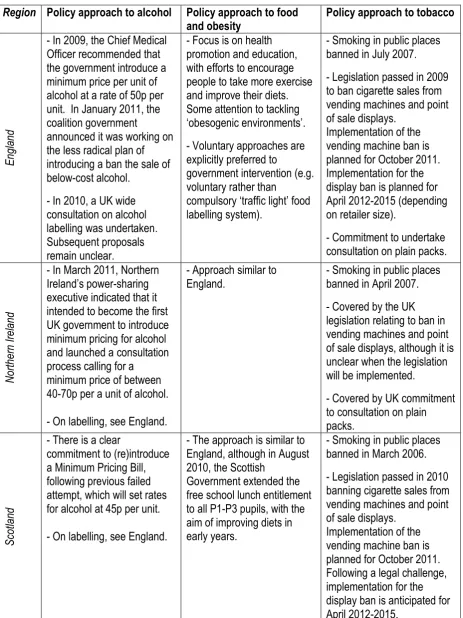
Table 3: A brief summary of recent UK regional approaches to alcohol food and tobacco
Region Policy approach to alcohol Policy approach to food
and obesity Policy approach to tobacco
En
gla
nd
- In 2009, the Chief Medical Officer recommended that the government introduce a minimum price per unit of alcohol at a rate of 50p per unit. In January 2011, the coalition government
announced it was working on the less radical plan of introducing a ban the sale of below-cost alcohol.
- In 2010, a UK wide consultation on alcohol labelling was undertaken. Subsequent proposals remain unclear.
- Focus is on health promotion and education, with efforts to encourage people to take more exercise and improve their diets. Some attention to tackling ‘obesogenic environments’.
- Voluntary approaches are explicitly preferred to
government intervention (e.g. voluntary rather than
compulsory ‘traffic light’ food labelling system).
- Smoking in public places banned in July 2007. - Legislation passed in 2009 to ban cigarette sales from vending machines and point of sale displays.
Implementation of the vending machine ban is planned for October 2011. Implementation for the display ban is planned for April 2012-2015 (depending on retailer size).
- Commitment to undertake consultation on plain packs.
North
ern
Irel
an
d
- In March 2011, Northern Ireland’s power-sharing executive indicated that it intended to become the first UK government to introduce minimum pricing for alcohol and launched a consultation process calling for a
minimum price of between 40-70p per a unit of alcohol.
- On labelling, see England.
- Approach similar to
England. - Smoking in public places banned in April 2007. - Covered by the UK legislation relating to ban in vending machines and point of sale displays, although it is unclear when the legislation will be implemented.
- Covered by UK commitment to consultation on plain packs.
Sco
tla
nd
- There is a clear
commitment to (re)introduce a Minimum Pricing Bill, following previous failed attempt, which will set rates for alcohol at 45p per unit.
- On labelling, see England.
- The approach is similar to England, although in August 2010, the Scottish
Government extended the free school lunch entitlement to all P1-P3 pupils, with the aim of improving diets in early years.
- Smoking in public places banned in March 2006.
- Legislation passed in 2010 banning cigarette sales from vending machines and point of sale displays.
W
ales
- The English approach to minimum pricing will apply to Wales. It is unclear, despite expressed support for minimum pricing amongst some Welsh Assembly ministers, whether additional legislation will be introduced. - On labelling, see England.
- The approach is similar to
England. - Smoking in public places banned in April 2007. - Covered by the UK legislation relating to ban in vending machines and point of sale displays, although it is unclear when the legislation will be implemented.
- Covered by UK commitment to consultation on plain packs.
As Table 3 illustrates, the consistency in approaches to tackling key lifestyle-behavioural concerns is far greater than any divergence so far. However, there are also a number of indications that significant divergence in relation to alcohol policy may soon emerge, with England and Wales implementing a far weaker version of minimum pricing than Scotland and Northern Ireland have committed to.
Ongoing tensions between healthcare and public health budgets
Relating to its relatively low status compared to healthcare, public health policy commitments have frequently been undermined by raids on public health budgets to support other aspects of NHS activity, hampering the delivery of local health programmes (Hunter et al, 2010; Wanless et al, 2007). The decision of the coalition government to ring-fence public health funding in England (Secretary of State for Health, 2010) (a decision which has not so far been replicated in any of the other UK regions) is therefore particularly notable and it will be important to try to assess whether this does impact on the ability of local agencies to promote and protect the health of local populations, or whether the vaguely-defined nature of ‘public health’ (Hunter et al, 2010) means that funds will still be diverted.
Concluding Discussion: Convergence or divergence?
these accounts, suggesting that, for both healthcare and public health policy, there remains a remarkable degree of consistency across the UK.
In all four regions, the NHS remains free at the point of delivery and is financed to a remarkably similar degree, based on the same basic model of tax-funding. Whilst the extent of ‘command and control’ style performance assessment frameworks initially varied, the success of the English NHS in reducing waiting times appears to have promoted the policy transfer of this idea, with unfavourable comparisons of waiting times in first Wales, then Northern Ireland, leading to the adoption of stronger performance assessment regimes. Furthermore, whilst much has been made of the different approaches of the four regions to the use of private sector provision within the NHS, with England and Northern Ireland both relying on some private provision to help keep waiting lists down, whilst Wales and Scotland both rejected private healthcare provision (BMA, 2010), this paper illustrates that the predictions of private healthcare providers in terms of investment opportunities remain remarkably consistent across the UK. Indeed, the private sector appears to relate potential investment opportunities more to the unequal spread of population wealth and restricted NHS budgets than to divergent policy approaches. All this suggests that post-devolution approaches to healthcare policy remain remarkably consistent across the UK. This may well be because, as the BMA notes, ‘public opinion can be a strong force for convergence’ (BMA, 2010: p3) and, broadly speaking, ‘there are high expectations that UK citizenship provides individuals with equal rights’ (BMA, 2010, p.4).
The concerns relating to waiting times, discussed above, highlight the links between healthcare and public health decisions as the resulting shift in attention towards in healthcare in the devolved regions appears to have inadvertently restricted public health policy divergence. This may be one reason why, in relation to both the cross-cutting issue of health inequalities and the more traditional concerns lifestyle-behaviours, it is the similarities between the four regions, rather than the differences, which are most striking. Some level of ‘policy learning’ may also be playing a role. For example, within public health (in contrast to healthcare) there recently appears to have been a UK-wide rejection of New Labour’s target-orientated approach, with none of the four regions replacing recently expired health inequalities and health improvement targets.
more meaningful divergence in public health policy than has been possible hitherto. In this respect, some important differences are beginning to emerge, which indicate that significant variations are most likely between Scotland and England. These two regions currently appear to be the most distinct in terms of both the extent to which governing administrations accept the need for the central government ‘stewardship’ and the extent to which they subscribe to social or medical models of health. Recent Scottish policy statements (Scottish Government, 2008; 2010) indicate that the Scottish National Party government accepts its role as a public health steward and that is placing a renewed emphasis on the social and economic determinants of health. In contrast, whilst the 2010 Public Health White Paper in England acknowledges the role of socio-economic determinants in health, medical and individualised accounts are also clearly present and (with the exception of tobacco), the English government has explicitly rejected the need for central government action. For example, the White Paper states that, ‘it is simply not possible to promote healthier lifestyles through Whitehall diktat and nannying about the way people should live’ (Secretary of State for Health, 2010, p.2) and concludes that (beyond the need to protect the public from health ‘threats’), public health responsibility rests with local agencies, communities and individuals. The contrasting stance of these two governments to public health policy is therefore markedly different and, whilst the Welsh Assembly’s initially radical post-devolution public health statements remained largely rhetorical, not only does the Scottish Government have substantially more powers, it has also already demonstrated (with the ban on smoking in public places) that it is prepared to lead the way on public health legislation in the UK.
Overall, however, whilst differences are becoming more apparent, the comparable economic context, and the broader European and global context in which all UK policymaking takes place, might indicate that the potential for radical policy divergence remains limited. Or, as Keating (2005) suggests, it may be that policy divergence is ‘a matter of degree rather than nature’.
References
Acheson, D. (1998), Independent Inquiry into Inequalities in Health. London: TSO.
Bartlett, W. and Le Grand, J (1993), Quasi-markets and social policy. Basingstoke: Macmillan Press. Bauld, L., Judge, K., Platt, S. (2007), Assessing the impact of smoking cessation services on
reducing health inequalities in England: observational study Tobacco Control 16(6): pp.400-4. Bauld, L., Day, P. and Judge, K. (2008), Off target: a critical review of setting goals for reducing
health inequalities in the United Kingdom. International Journal Of Health Services: Planning, Administration, Evaluation, 38(3): pp.439-54.
Bevan, G. (2010), Impact of devolution of healthcare in the UK: provider challenge in England and provider capture in Wales, Scotland and Northern Ireland? Journal of Health Services Research and Policy, 15(2): pp.67-68.
Blackman, T., Elliott, E., Greene, A., Harrington, B., Hunter, D., Marks, L., McKee, L., Smith, K.E. and Williams, G. (2009), Tackling Health Inequalities in Post-devolution Britain: Do targets matter?
Public Administration, 87(4): pp.762–78.
BMA (2010), Devolution – a map of divergence. London: BMA.
Cabinet Office (1999), Modernising Government (White Paper). London: The Stationary Office. Cairney, P. (2007), Using devolution to set the agenda? Venue shift and the smoking ban in
Scotland. British Journal of Politics and International Relations 9: pp.73-89.
Cairney, P. (2009), The role of ideas in policy transfer: the case of UK smoking bans since devolution. Journal of European Public Policy 16: pp.471-88.
Connolly, S., Bevan, G. and Mays, N. (2010), Funding and Performance of Healthcare Systems in the Four Countries of the UK Before and After Devolution. London: The Nuffield Trust.
Department of Health. (1997), Press Release: Public Health Strategy Launched to Tackle the Root Causes of Ill-health. London: Department of Health.
Department of Health (1999). Reducing Health Inequalities: An Action Report. London: The Stationary Office.
Department of Health (2001), From Vision to Reality. London: Department of Health.
Department of Health (2003), Tackling Health Inequalities: A Programme for Action. London: Department of Health.
Department of Health (2011), Government Response to the NHS Futures Forum report. London: Department of Health.
Department of Health, Social Services and Public Safety (2002), Investing for Health. Belfast: Northern Ireland Executive.
Department of Health, Social Services and Public Safety (2004), A Healthier Future - A Twenty Year Vision for Health and Wellbeing in Northern Ireland 2005-2025. Belfast: DHSSPS.
Department of Health, Social Services and Public Safety (2005), Investing for Health Update 2005. Belfast: Health Promotion Agency for Northern Ireland on behalf of the DHSSPS.
Department of Health, Social Services and Public Safety (2006), Investing for Health Update Report 2006. Belfast: Health Promotion Agency for Northern Ireland on behalf of the DHSSPS.
Dixon, A and Ham, C (2010), Liberating the NHS: The right prescription in a cold climate? London: The King’s Fund.
Evans, R (2002), Financing Health care: taxation and the alternatives. In Mossialos, E., Dixon, A., Figueras, J. & Kutzin, J. (eds.) Funding Health Care: Options for Europe, pp.31-58
Graham, H. (2004), Social determinants and their unequal distribution: Clarifying policy understandings. The Milbank Quarterly 82(1): pp.101-124.
Graham, H. and Kelly, M. (2004), Health inequalities: concepts, frameworks and policy. London: HDA.
Greer, S. (2001), Divergence and Devolution. London: Nuffield Trust.
Greer, S. (2004), Territorial Politics and Health Policy – UK Helath Policy in Comparative Perspective. Manchester: Manchester University Press.
Greer, S. (2005), The Territorial Bases of Health Policymaking in the UK after Devolution. Regional and Federal Studies 15: pp.501-18.
Greer, S. (2009), Devolution and divergence in UK health policies. BMJ 338: pp.78-80. HM Treasury (2010), The Spending Review 2010. London: The Stationery Office.
Hunter, D.J. (2005), Choosing or losing health? Journal of Epidemiology & Community Health 59: pp.1010-12.
Hunter, D.J., Marks, L., Smith, K.E. (2010), The Public Health System in England. Bristol: Policy Press.
Ireland, T (2011), Lift Off. Health Investor, 8(5), pp. 26-29.
Jervis, P. and Plowden, W. (2003), The Impact of Political Devolution on the UK’s Health Services.
Jochelson, K. (2006), Nanny or steward? The role of government in public health. Public Health 120: pp.1149-55.
Keating, M. (2005), Policy convergence and divergence in Scotland under devolution. Regional Studies 39:453-63.
King’s Fund (2011), Where next for the NHS reforms: The case for integrated care. London: The King’s Fund.
Laing and Buisson (2010), Healthcare market review. London: Laing and Buisson.
Lancet, The (2011), Editorial: Public health in Wales: a nation comes of age. The Lancet, 378: 374. Le Grand, J. (2003), ‘Models of public service provision: command and control, networks or
quasi-markets?’ In: Public services productivity. London: HM Treasury: pp. 14-17.
Le Grand, J (2009), Choice and competition in publicly funded health care. Health Economics, Policy and Law,4: pp.479–88
Macintyre, S. (2000), Modernising the NHS – Prevention and the reduction of health inequalities. BMJ 320: 1399-1400.
Marmot, M. (2010), Strategic review of health inequalities in England post-2010. Marmot review final report. London: University College London.
McKeown, T. (1976), The role of medicine: dream, mirage or nemesis. London: Nuffield Principal Hospital Trust.
McWhirter, L. (2004), Equality and Inequalities in Health and Social Care in Northern Ireland: A Statistical Overview. Belfast: DHSSPS.
Mooney, G., Scott, G. and Williams, C. (2006), Introduction: Rethinking social policy through devolution, 26: pp. 483-97.
Northern Ireland Executive (2011), Draft Budget. Belfast: Northern Ireland Executive.
Pollock, A. and Kirkwood, G. (2009), Is the private sector better value for money than the NHS? A Scottish case study. BMJ: 338: pp.1108-11.
Propper, C., Sutton, M., Whitnall, C. and Windmeijer, F. (2009), Incentives and Targets in Hospital Care: Evidence from a natural experiment. Working paper no. 08/205. London: University of Bristol.
Public Health Strategy Division (2002), Well Being in Wales. Cardiff: Office of the Chief Medical Officer.
Scottish Executive (2000), Our National Health: A plan for action, a plan for change. Edinburgh: The Stationary Office.
Scottish Executive (2003), Inequalities in Health: Report of the Measuring Inequalities in Health Working Group. Edinburgh, URL:www.scotland.gov.uk/library2/doc07/sjmd.pdf.
Scottish Government (2008), Equally Well: Report of the Ministerial Task Force on Health Inequalities. Edinburgh: Scottish Government. -
Scottish Government (2010), Equally Well Review. Edinburgh: Scottish Government. Scottish Government (2011), Draft Budget. Edinburgh: Scottish Government.
Secretary of State for Health (2010), Healthy lives, healthy people: our strategy for public health in England (White Paper) Norwich: The Stationary Office.
Smith, K.E., Hunter, D.J., Blackman, T., Elliott, E. et al. (2009), Divergence or convergence? Health inequalities and policy in a devolved Britain. Critical Social Policy 29: pp.216-242.
Thompson, G. (2009), Health expenditure: international comparisons. Standard Note: SN/SG/2584. House of Commons Library.
Townsend, P. (2001), Targeting Poor Health: Professor Townsend's Report of the Welsh
Assembly's National Steering Group on the Allocation of NHS Resources (Vol 1). Cardiff: National Assembly for Wales.
Wagstaff, A., Van Doorslaer, E., van der Burg, H., Calonge, S., et al. (1999), Equity in the finance of health care: some further international comparisons. Journal of Health Economics, 18: pp.263– 290.
Webster, C. (2002), The National Health Service: a political history. Oxford: Oxford University Press. Welsh Assembly Government (2011), Draft Budget. Cardiff: Welsh Assembly Government.
Woods, K.J. (2004), Political Devolution and the Health Services in Great Britain. International Journal of Health Services, 34(2): pp.323-39.