R E S E A R C H A R T I C L E
Open Access
Sociodemographic differences in linkage
error: an examination of four large-scale
datasets
Sean Randall
1*, Adrian Brown
1, James Boyd
1, Rainer Schnell
2, Christian Borgs
2and Anna Ferrante
1Abstract
Background:Record linkage is an important tool for epidemiologists and health planners. Record linkage studies will generally contain some level of residual record linkage error, where individual records are either incorrectly marked as belonging to the same individual, or incorrectly marked as belonging to separate individuals. A key question is whether errors in linkage quality are distributed evenly throughout the population, or whether certain subgroups will exhibit higher rates of error. Previous investigations of this issue have typically compared linked and un-linked records, which can conflate bias caused by record linkage error, with bias caused by missing records (data capture errors). Methods:Four large administrative datasets were individually de-duplicated, with results compared to an available ‘gold-standard’ benchmark, allowing us to avoid methodological issues with comparing linked and un-linked records. Results were compared by gender, age, geographic remoteness (major cities, regional or remote) and socioeconomic status.
Results: Results varied between datasets, and by sociodemographic characteristic. The most consistent findings were worse linkage quality for younger individuals (seen in all four datasets) and worse linkage quality for those living in remote areas (seen in three of four datasets). The linkage quality within
sociodemographic categories varied between datasets, with the associations with linkage error reversed across different datasets due to quirks of the specific data collection mechanisms and data sharing practices.
Conclusions: These results suggest caution should be taken both when linking younger individuals and those in remote areas, and when analysing linked data from these subgroups. Further research is required to determine the ramifications of worse linkage quality in these subpopulations on research outcomes.
Keywords: Record linkage, Bias, Sociodemographic differences, Methodological research
Background
Record linkage is a set of methodologies designed to bring together information relating to the same person from within or across datasets [1]. This technique is widely used for conducting longitudinal observational health research [2]. The process of record linkage typic-ally involves the comparison of persontypic-ally identifying in-formation such as name, address and date of birth contained in these records.
Studies using linked data will generally contain linkage error. There are two types of record linkage errors; false
positives, where two records are designated as belonging to the same individual when in truth they do not; and false negatives, where two records are designated as belonging to different individuals when in truth they belong to the same individual. Linkage error can occur due to both le-gitimate changes in a person’s particulars (i.e. change of address) or due to data fields being missing or in error (i.e. poor recording practices in the data collection in ques-tion). Researchers using linked data will generally not have the personally identifying information made available to them for privacy reasons [3]. This means they are unable to evaluate the accuracy or quality of the linkage directly and instead must rely on the quality provided by the or-ganisation that performs the linkage.
* Correspondence:[email protected]
1Centre for Data Linkage, Curtin University, Perth 6849, Western Australia
Full list of author information is available at the end of the article
A number of studies have illustrated how poor linkage quality can cause bias and distort results. A study of the effect of linkage methods (two deterministic strategies and one probabilistic strategy) on mortality rate esti-mates showed relative differences of up to 25% between the true estimate and that found through record linkage [4]. In a study on child neglect which applied an iterative linkage approach (deterministic followed by probabilis-tic) to reduce false positives, errors in linkage quality were shown to bias incidence proportions by up to 43% [5]. The incidence proportions were based on the num-ber of children under the age of 6 years from the 2009 births to Alaska residents with at least one multi-source maltreatment report. In a recent study of men with and without HIV, the probabilistic linkage method applied (with estimated sensitivity and specificity of 88.4 and 99.7 respectively) led to a finding of a significantly lower rate of hospitalisation in HIV positive men as compared to the general population (0.46, 0.37–0.58), while im-provements in linkage quality revealed the opposite find-ing; a significantly higher rate of hospitalisation in HIV positive men (1.45, 1.33–1.59) [6].
A key question is whether errors in linkage quality are distributed evenly across a study population. In other words, do the linked records of people from cer-tain subgroups (for instance, people with lower socio-economic status or individuals in particular ethnic groups) contain a greater proportion of errors? If a cer-tain subgroup was found to have lower linkage quality, this would suggest research results might be systemat-ically biased against this group.
There are a number of plausible reasons why linkage quality may vary between subgroups. Key causes of link-age error are changing or incorrect identifiers [7]. Given the common cultural norm of women changing their surname upon marriage, women may have a higher rate of linkage errors than men. Individuals who are more mobile (that is, change address often), such as younger adults, may also be harder to correctly link, resulting in more errors. Individuals from different ethnic groups may have their name information recorded poorly [8] (for instance due to difficulty spelling, or different trans-literations), or may use name conventions different from Western standards (for instance, a very large proportion of Vietnamese women have the same middle name;Thi), which will make their data harder to link. Different eth-nic groups may also display different rates of identifier reporting; for instance, in the United States, African American adults are less likely to report social security number, a highly identifying attribute, making their data harder to link [9]. Recording practices may differ be-tween different hospitals, or different types of hospitals, which may service differing constituencies. Of import-ance to health researchers is knowing whether linkage
errors differ between socioeconomic status and by geo-graphic region (metropolitan compared to rural), as these are two key demographic factors known to influ-ence health status [10]. Different health conditions may also be correlated with missing or invalid identifiers; for instance, medical conditions relating to newborns who may not have recorded first names [11]. A recent study of the existence of identifier error in administrative data-sets showed the level of error to vary by age, sex and ethnicity [12], indicating the potential for differences in linkage quality across these attributes.
A number of studies have explored the relationship between linkage quality and sociodemographic factors, although typically as part of a wider study. A review by Bohensky et al. [13] found differences in age, sex, ethni-city, geography, socio-economic status and health, al-though there was little consistency between studies. In general, these studies of variations in linkage quality across or within populations have used the same re-search design. In nearly all cases, the study method in-volved the linkage of two datasets, where each dataset contained only one record per person. Each record in the first dataset was expected to be contained within the second dataset. Using this method, records in the first dataset could be divided into two categories; those that matched with a record in the second dataset and those that did not. These unmatched records were then com-pared against the matched records to determine whether there was any difference in the social and demographic characteristics (i.e. gender, age, socioeconomic status) of these groups [14–27].
Two key issues arise when using this research design to explore bias caused by poor linkage quality. Firstly, the approach focusses only on false negative errors (re-cords which incorrectly did not find a match) and does not consider the issue of false positive errors, an equally important type of linkage error. By only reporting on one of the two error types, we cannot gain an accurate understanding of the relationship between linkage qual-ity and sociodemographic factors.
unmatched individuals likely reflect the demographics of those who are/are not covered under Medicare. Simi-larly, in a linkage of a survey cohort to a maternity regis-try, unmatched records were typically the result of individuals moving outside of the maternity registry catchment area, rather than the result of errors in the linkage process [22]. As such, any found bias is more likely to reflect the different demographics of individuals who emigrate, rather than reflect linkage quality issues.
In this paper, we attempt to address these methodo-logical shortcomings through the use of an alternate research design. Four large, real-world Australian admin-istrative datasets were de-duplicated, with results and compared to an available ‘truth-set’, allowing comparison of both false positive and false negative errors.
Methods
Datasets
Each of the four separate administrative health data-sets used in the evaluation contained multiple event--based records per person. The datasets comprised: ten years of Western Australian (WA) hospital admission data (n= 6,772,949), ten years of New South Wales (NSW) hospital admissions data (n= 19,874,083), three years of NSW public emergency department (ED) presentation data (n= 4,304,459) and three years South Australian (SA) ED presentation data (n= 813,839). Each dataset con-tained errors typical of administrative data, including missing and incorrect identifiers, and identifiers that change over time. Each dataset had previously been de-duplicated (identifying the records within each dataset belonging to the same individual) to a high quality by jur-isdictional linkage units (the Centre for Health Record Linkage, the Western Australian Data Linkage Branch, and SANT Data Link for NSW, WA, and SA datasets re-spectively). These linkage units utilised a variety of dedu-plication methods including probabilistic record linkage, intensive manual review of created links and quality assur-ance procedures to analyse and review potential errors [28, 29]. The links created by these linkage units have been further validated through their regular use in aca-demic and government research [2]. The linkage units provided the present study with the results of their match-ing processes, allowmatch-ing us to use this as a‘gold-standard’ with which to compare the results of our deduplication of these datasets. The data was made available as part of proof of concept work for the Population Health Research Network [30].
Record linkage methods
Each dataset was de-duplicated using a single probabilis-tic linkage strategy, based on a previously published‘ de-fault’linkage strategy [31] (no linkages were conducted between any of the four datasets). This default strategy
utilised two sets of blocks (Soundex of surname concatenated with first initial, and full date of birth), with all available variables used in comparisons. String similarity measures (Jaro-Winkler metric) were used for alphabetic variables, while exact matching strategies were used for other variables. Agreement and disagree-ment weights were calculated from the available gold standard benchmark.
Linkage quality metrics
Linkage error occurs when pairs of records are not complete or include wrong matches. Where record pairs are incorrectly assigned as belonging to the same individual, we have false positives. In situations where record pairs are incorrectly identified as be-longing to different people, there are false negatives. The aim in linkage is to maximise the number of true positives and true negatives.
Linkage quality was evaluated using pair-based quality metrics. Precision and recall were calculated by comparing the found results to those in the gold-standard bench-mark. Precision referred to the proportion of found record-pairs that were correct, while recall referred to the proportion of all correct record-pairs found. The calcula-tions for the measures are shown below.
Precision¼ TP
TPþFP; Recall¼ TP TPþFN;
where
TP = number of true positives, FP = number of false positives, and FN = number of false negatives
A linkage with a high precision will have few false pos-itives; similarly, a linkage with high recall will have few false negatives. The arithmetic mean of precision and re-call was taken to determine the appropriate threshold score for which to report results.
Sociodemographic variables
The SEIFA metric of social disadvantage was used; this was also derived using the individual’s residential address. The SEIFA score is developed using factor analysis of responses to the Australian census and includes information on in-come, education, employment, occupation and housing. The score is computed for small geographic areas (approxi-mately 200 dwellings) [33]. The SEIFA score was classified into quintiles.
Measuring extent of linkage bias
A de-duplication linkage was conducted on each of the four datasets, using the record linkage method described above, resulting in a series of matched record-pairs. Link-age quality was calculated for each of the sociodemo-graphic characteristics by ignoring those record-pairs that did not include at least one record with that sociodemo-graphic category. For example, linkage quality for individ-uals for remote areas was calculated by evaluating the linkage quality on all pairs of records of which at least one record was from a remote area. Pair-based linkage quality was calculated directly on these record-pairs. Additionally, the metrics were calculated for a range of threshold scores to investigate how linkage bias may change as the thresh-old is either increased or decreased.
As clinical content data for each dataset was not available, statistics on the incidence of hospital encoun-ters (admissions per person-year; a crude indicator of health) were calculated for each socio-demographic-category, with results compared against results from the gold-standard benchmark.
Results
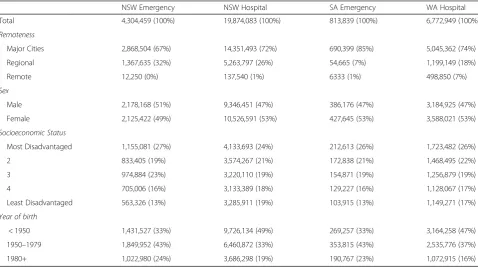
The number of records within each sociodemographic category for each dataset is shown in Table 1. The pro-portion of records in each category was similar but not identical across datasets. Both ED datasets had lower proportions of older individuals, and higher proportions of persons born 1950–1979, compared with the hospital datasets. There were some differences between states in terms of remoteness, with Western Australia having a much larger proportion of individuals living in remote areas (7%) compared with the other states (0–1%), and New South Wales having a higher proportion of individ-uals living in regional areas. All datasets showed similar distributions for socioeconomic status, with a slightly higher proportion in the most disadvantaged quintile compared with the least disadvantaged. Additional file1: Table S1 in the supplementary material describes the proportion of missing values in each of these datasets, stratified by sociodemographic category. All of the datasets had relatively low levels of missing values, with the exception of the NSW hospital dataset, for which roughly one third of name information was missing. Differences in the proportion of missing values could be found for some sociodemographic categories in par-ticular datasets.
[image:4.595.58.537.465.732.2]Overall, the linkage quality achieved in the deduplica-tion of each dataset was very high. Linkage results at the optimal threshold (the threshold that maximised the average of precision and recall scores) are shown in Table2below.
Table 1Sociodemographic profile of each dataset - number and proportion of records in each sociodemographic category
NSW Emergency NSW Hospital SA Emergency WA Hospital
Total 4,304,459 (100%) 19,874,083 (100%) 813,839 (100%) 6,772,949 (100%)
Remoteness
Major Cities 2,868,504 (67%) 14,351,493 (72%) 690,399 (85%) 5,045,362 (74%)
Regional 1,367,635 (32%) 5,263,797 (26%) 54,665 (7%) 1,199,149 (18%)
Remote 12,250 (0%) 137,540 (1%) 6333 (1%) 498,850 (7%)
Sex
Male 2,178,168 (51%) 9,346,451 (47%) 386,176 (47%) 3,184,925 (47%)
Female 2,125,422 (49%) 10,526,591 (53%) 427,645 (53%) 3,588,021 (53%)
Socioeconomic Status
Most Disadvantaged 1,155,081 (27%) 4,133,693 (24%) 212,613 (26%) 1,723,482 (26%)
2 833,405 (19%) 3,574,267 (21%) 172,838 (21%) 1,468,495 (22%)
3 974,884 (23%) 3,220,110 (19%) 154,871 (19%) 1,256,879 (19%)
4 705,006 (16%) 3,133,389 (18%) 129,227 (16%) 1,128,067 (17%)
Least Disadvantaged 563,326 (13%) 3,285,911 (19%) 103,915 (13%) 1,149,271 (17%) Year of birth
< 1950 1,431,527 (33%) 9,726,134 (49%) 269,257 (33%) 3,164,258 (47%)
1950–1979 1,849,952 (43%) 6,460,872 (33%) 353,815 (43%) 2,535,776 (37%)
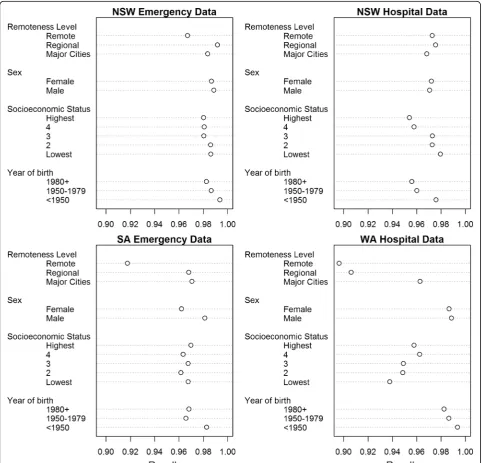
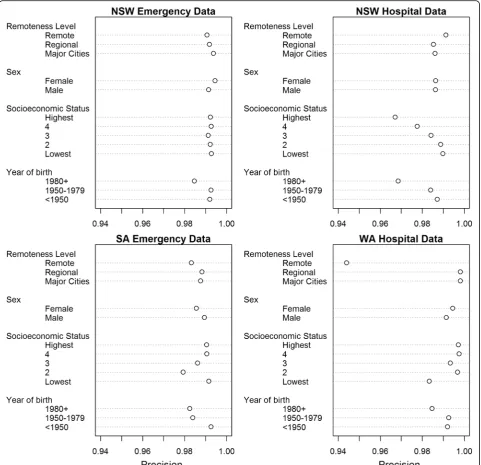
Variations in linkage quality by sociodemographic category for each of the four datasets, calculated at the optimal threshold score, are shown in Figs. 1 and 2. Results varied between datasets, and by sociodemo-graphic category. There was generally little difference in precision and recall between males and females, al-though there was a greater number of missed matches (lower recall) for females in SA emergency data (recall
[image:5.595.56.289.99.169.2]male= 0.981, recallfemale= 0.962). There was an identifi-able effect of age on linkage quality, with persons born after 1980 having a lower linkage quality (both preci-sion and recall) for all four datasets, as compared to
Table 2Optimal overall linkage quality for each of the four datasets
Precision Recall Average
NSW Emergency 0.993 0.988 0.991
NSW Hospital 0.986 0.971 0.979
SA Emergency 0.988 0.971 0.980
WA Hospital 0.994 0.987 0.991
[image:5.595.57.540.244.707.2]those born before 1950 (on average a reduction of 0.01 for both precision and recall). The effect of geographic re-moteness on linkage quality was not as clear. In the NSW emergency, SA emergency and WA hospital datasets, re-cords of persons in remote areas had lower recall com-pared with those in major cities (NSW emergency; recall major cities: 0.984, recallremote areas: 0.967; SA emergency; re-callmajor cities: 0.971, recallremote areas: 0.918; WA hospital recall major cities: 0.963, recallremote areas: 0.896 . The pro-portion of false matches (precision) was only noticeably greater for those in remote areas in the WA hospital data-set (precision = 0.944 compared to 0.998 for both regional
areas and major cities). For socioeconomic status, the ef-fect on linkage quality, in terms of precision and recall, was even less clear. In the WA hospital dataset, precision and recall both generally decreased as socioeconomic sta-tus decreased, with those in the upper quintiles having the highest linkage quality. For the NSW hospital dataset, however, the effect was the opposite, with precision and recall generally decreasing as socioeconomic status in-creased. Results for the NSW emergency dataset showed little difference in precision and recall between socioeco-nomic quintiles, while the results for SA emergency data did not show any clear trend.
[image:6.595.58.540.88.553.2]We further determined the optimal threshold score for each particular sociodemographic factor (i.e. calcu-lating precision and recall using separate thresholds for those in major cities, regional and remote areas). How-ever, this resulted in no substantial change in linkage quality (changes were extremely small, beyond the fourth significant figure).
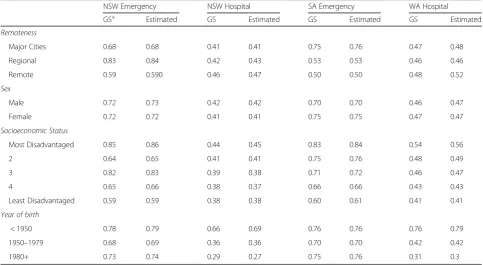
Comparisons of incidence rates for each dataset and sociodemographic category are shown in Table3. Differ-ences, where they existed, were generally small.
Discussion
There was some evidence that linkage quality varied across and within different sociodemographic categories. While some differences were found for gender and so-cioeconomic status, these results occurred only in par-ticular datasets. The finding of poorer linkage quality for those in remote areas was more consistent, appearing in three of the four datasets. The most reliable finding was decreased linkage quality for younger individuals as compared to older individuals, found in all four datasets. There are a number of reasons why poorer linkage qual-ity may be expected in younger individuals and individuals who live in more remote areas. Younger individuals are more mobile and so change address more often [34]. Birth records in particular will often be missing the infants first name and may be given the surname of the mother, mak-ing them particularly difficult to link. Those in remote
areas are more likely to be Indigenous (28% Indigenous in remote areas, as compared to 1% in major cities). While data indicating the Indigenous status of individuals was not directly available in our datasets, previous studies have shown Indigenous Australians to be associated with poorer linkage quality [35]. Smaller remote hospitals may have fewer resources available to ensure high quality recording standards. Those in remote areas are also more likely to be transferred to larger hospitals in more populous areas, resulting in a second admission with patient details again recorded, providing greater opportunity for mistakes. While no high quality studies exist comparing levels of geographic remoteness, several previous studies have found lower linkage quality in younger individuals [36,37].
[image:7.595.56.540.459.724.2]The results found in this study suggests differences in linkage error across sociodemographic categories are highly dataset dependent. Specific quirks in recording standards in some data collections account for some of these findings. For instance, the NSW hospital admissions dataset did not contain name information for individuals attending private hospitals (containing only date of birth and address information). This is likely the reason for the finding in this dataset that linkage quality decreases as in-dividuals have higher socioeconomic status, since those with higher socioeconomic status are more likely to attend private hospitals, and so have missing name data. It is quite possible that other findings in our dataset also reflect specific recording anomalies that we are not aware of.
Table 3Incidence rates (admissions/presentations per person-year) by sociodemographic category and dataset, comparing the gold-standard benchmark to the linkage results
NSW Emergency NSW Hospital SA Emergency WA Hospital
GSa Estimated GS Estimated GS Estimated GS Estimated
Remoteness
Major Cities 0.68 0.68 0.41 0.41 0.75 0.76 0.47 0.48
Regional 0.83 0.84 0.42 0.43 0.53 0.53 0.46 0.46
Remote 0.59 0.590 0.46 0.47 0.50 0.50 0.48 0.52
Sex
Male 0.72 0.73 0.42 0.42 0.70 0.70 0.46 0.47
Female 0.72 0.72 0.41 0.41 0.75 0.75 0.47 0.47
Socioeconomic Status
Most Disadvantaged 0.85 0.86 0.44 0.45 0.83 0.84 0.54 0.56
2 0.64 0.65 0.41 0.41 0.75 0.76 0.48 0.49
3 0.82 0.83 0.39 0.38 0.71 0.72 0.46 0.47
4 0.65 0.66 0.38 0.37 0.66 0.66 0.43 0.43
Least Disadvantaged 0.59 0.59 0.38 0.38 0.60 0.61 0.41 0.41
Year of birth
< 1950 0.78 0.79 0.66 0.69 0.76 0.76 0.76 0.79
1950–1979 0.68 0.69 0.36 0.36 0.70 0.70 0.42 0.42
1980+ 0.73 0.74 0.29 0.27 0.75 0.76 0.31 0.3
a
The differences found in linkage quality were generally small, with a few larger differences (a drop in recall of around 0.05) found in remote areas. These differences in linkage quality had little notable effect on incidence rates. The effect of these errors on other derived clinical indicators is an important area of further study.
The use of subgroup-specific threshold settings made little difference to overall linkage quality, and based on these results cannot be recommended. Other published techniques such as the use of graph theory methods [38] or alternate grouping strategies [39] may be more fruitful methods of improving linkage quality across subpopula-tions. It remains to be proved whether other measures, such as the use of specific linkage strategies, parameters or techniques for specific subpopulations can lead to im-provements in linkage quality for these groups.
A key strength of our study was the use of validated, real world datasets where the‘answer’in relation to linkage re-sults is known. This allowed us to assess both false posi-tive and false negaposi-tive errors in record linkage. The use of a gold standard benchmark avoids the difficulty associated with determining whether non-matched records are the result of linkage error or some other reason (i.e. data cap-ture error), a key weakness in many previously published studies. It should be noted that while the gold-standard results used in this study were of very high quality due to extensive clerical review and quality assurance, errors may still exist within the gold-standard results.
This study utilised a ‘default’ probabilistic linkage strategy, which we consider a relatively standard ap-proach, and which achieves high quality results. As such, the level of error found in this study we consider to be small. While we could deliberately degrade the linkage strategy to reduce linkage quality and therefore amplify the level of bias in the results, we would risk introducing bias that would not typically be found in practice.
Information on additional subpopulations that may have higher risk of lower linkage quality, such as Indi-genous Australians, immigrant groups, those with poorer health status, and those with mental health con-ditions, was not available but further research in these areas is warranted. Our study used structured and de-fined administrative datasets, with high quality data col-lection standards; as a result, overall linkage quality was very high. Data collections with overall poorer quality may produce magnified or alternate results to those found in this study. Interactions are likely to exist be-tween several variables that influence linkage quality. For instance, Indigenous Australians make up a greater proportion of the population in remote areas as com-pared to major cities and are more likely to be from lower socioeconomic status areas. In addition, regional and especially remote areas generally have lower socio-economic status as compared to major cities. Interaction
effects such as these were not explored in this study. It is also not clear whether the number of existing records per person influences the difficulty of linking data related to that individual; this may interact with the tested sociode-mographic categories, particularly those related to age.
Conclusions
Our results suggest linkage quality in those younger and those living in remote areas may be lower, as a result, cau-tion should be taken when analysing differences in linked Australian hospital data by age or geographic remoteness. Further research is required to determine the ramifica-tions of these results for researchers utilising linked data.
Additional file
Additional file 1:Table S1.Proportion of missing values in each dataset, stratified by sociodemographic variable. (DOCX 21 kb)
Abbreviations
ED:Emergency department; NSW: New South Wales; SA: South Australia; WA: Western Australia
Acknowledgements
We would like to thank the Ministry of Health NSW, Department of Health WA, and SA Health for allowing the use of their data for this project, as well as the Centre for Health Record Linkage, the WA-Data Linkage Branch, and SA-NT DataLink for use of their linkage keys as a benchmark in this study.
Funding
This project is supported by the Australian Government National Collaborative Research Infrastructure Strategy’s Population Health Research Network. We would like to thank the German Academic Exchange Service (DAAD) for funding which facilitated international collaboration on this project.
Availability of data and materials
The raw data used in this project cannot be made available for privacy reasons, but can be requested from state data linkage units in NSW, SA and WA. Code along with more detailed aggregate results are available by request from the author.
Authors’contributions
The initial concept for the paper was developed by AF, with further design by SR, JB, RS and CB. Analysis was carried out by SR and AB, with interpretation and display of results by SR, CB and RS. The first draft of the manuscript was written by SR, with modifications by all authors, but particularly significant additions from AF, JB and RS. All authors approved the final manuscript.
Ethics approval and consent to participate
This study received ethical approval under the Population Health Research Network’s Proof of Concept project, which included approval for developing and refining linkage methodology. Approval was obtained from Curtin University Human Research Ethics Committee (Reference: HR 15/2010) as well as approval from New South Wales Cancer Institute Human Research Ethics Committee (HREC/10/CIPHS/37) and Western Australian Department of Health Human Research Ethics Committee (HREC/2009/54). Ethics approval included a waiver of consent based on the criteria in the national statement on ethical conduct in human research.
Consent for publication Not applicable.
Competing interests
Publisher’s Note
Springer Nature remains neutral with regard to jurisdictional claims in published maps and institutional affiliations.
Author details
1Centre for Data Linkage, Curtin University, Perth 6849, Western Australia. 2German Record Linkage Center, University of Duisburg-Essen, D-47057
Duisburg, Germany.
Received: 10 May 2018 Accepted: 24 August 2018
References
1. Newcombe HB. Handbook of record linkage: methods for health and statistical studies, administration and business. New York: Oxford University Press; 1988. 2. Brook EL, Rosman DL, Holman CDAJ. Public good through data linkage:
measuring research outputs from the western Australian data linkage system. Aust N Z J Public Health. 2008;32(1):19–23.
3. Boyd JH, Randall SM, Ferrante AM. Application of privacy-preserving techniques in operational record linkage centres. In: Medical Data Privacy Handbook. edn. Switzerland: Springer International Publishing; 2015. p. 267– 87.
4. Oberaigner W. Errors in survival rates caused by routinely used deterministic record linkage methods. Methods Inf Med. 2007;46(4):420–4.
5. Parrish JW, Shanahan ME, Schnitzer PG, Lanier P, Daniels JL, Marshall SW. Quantifying sources of bias in longitudinal data linkage studies of child abuse and neglect: measuring impact of outcome specification, linkage error, and partial cohort follow-up. Injury Epidemiology. 2017;4(1):23. 6. Moore CL, Gidding HF, Law MG, Amin J. Poor record linkage sensitivity
biased outcomes in a linked cohort analysis. J Clin Epidemiol. 2016;75:70–7. 7. Boyd JH, Ferrante AM, Irvine K, Smith M, Moore E, Brown A, Randall SM:
Understanding the origins of record linkage errors and how they affect research outcomes. Aust N Z J Public Health 2017, 41(2):215–215. 8. Miller EA, McCarty FA, Parker JD. Racial and ethnic differences in a linkage
with the National Death Index. Ethnicity Dis. 2017;27(2):77. 9. Lariscy JT. Black–white disparities in adult mortality: implications of
differential record linkage for understanding the mortality crossover. Popul Res Policy Rev. 2017;36(1):137–56.
10. Australian Institute of Health and Welfare. Australia’s health 2016. Australia’s health series no. 15. Cat. no. AUS 199. Canberra: AIHW; 2016.
11. Hall ES, Marsolo K, Greenberg JM. Evaluation of identifier field agreement in linked neonatal records. J Perinatol. 2017;37(8):969.
12. Harron K, Hagger-Johnson G, Gilbert R, Goldstein H. Utilising identifier error variation in linkage of large administrative data sources. BMC Med Res Methodol. 2017;17(1):23.
13. Bohensky MA, Jolley D, Sundararajan V, Evans S, Pilcher DV, Scott I, Brand CA. Data linkage: a powerful research tool with potential problems. BMC Health Serv Res. 2010;10(1):346.
14. Ford JB, Roberts CL, Taylor LK. Characteristics of unmatched maternal and baby records in linked birth records and hospital discharge data. Paediatr Perinat Epidemiol. 2006;20(4):329–37.
15. Waller DK, Lustig LS, Cunningham GC, Feuchtbaum LB, Hook EB. The association between maternal serum alpha-fetoprotein and preterm birth, small for gestational age infants, preeclampsia, and placental complications. Obstet Gynecol. 1996;88(5):816–22.
16. Bopp M, Minder CE. Mortality by education in German speaking Switzerland, 1990–1997: results from the Swiss National Cohort. Int J Epidemiol. 2003;32(3):346–54.
17. Jebamani LS, Burchill CA, Martens PJ. Using data linkage to identify first nations Manitobans: technical, ethical, and political issues. Can J Public Health. 2005;96:S28–32.
18. Holian J. Live birth and infant death record linkage: methodological and policy issues. J Health Soc Policy. 2000;12(1):1–10.
19. Blakely T, Woodward A, Salmond C. Anonymous linkage of New Zealand mortality and census data. Aust N Z J Public Health. 2000;24(1):92–5. 20. Gyllstrom ME, Jensen JL, Vaughan JN, Castellano SE, Oswald JW. Linking
birth certificates with Medicaid data to enhance population health assessment: methodological issues addressed. J Public Health Manag Pract. 2002;8(4):38–44.
21. Rosman DL, Knuiman MW. A comparison of hospital and police road injury data. Accid Anal Prev. 1994;26(2):215–22.
22. Nitsch D, Morton S, DeStavola BL, Clark H, Leon DA. How good is probabilistic record linkage to reconstruct reproductive histories? Results from the Aberdeen children of the 1950s study. BMC Med Res Methodol. 2006;6(1):15. 23. Cote TR, Obrien TR, Ward JW, Wilson SE, Blattner WA. AIDS and cancer
registry linkage: measurement and enhancement of registry completeness. Prev Med. 1995;24(4):375–7.
24. Sunderam S, Schieve LA, Cohen B, Zhang Z, Jeng G, Reynolds M, Wright V, Johnson C, Macaluso M. Research MCfARTE: Linking birth and infant death records with assisted reproductive technology data: Massachusetts, 1997– 1998. Matern Child Health J. 2006;10(2):115.
25. Lawson EH, Ko CY, Louie R, Han L, Rapp M, Zingmond DS. Linkage of a clinical surgical registry with Medicare inpatient claims data using indirect identifiers. Surgery. 2013;153(3):423–30.
26. Chiu M, Lebenbaum M, Lam K, Chong N, Azimaee M, Iron K, Manuel D, Guttmann A. Describing the linkages of the immigration, refugees and citizenship Canada permanent resident data and vital statistics death registry to Ontario’s administrative health database. BMC Med Inform Decis Mak. 2016;16(1):135.
27. Shkolnikov VM, Jasilionis D, Andreev EM, Jdanov DA, Stankuniene V, Ambrozaitiene D. Linked versus unlinked estimates of mortality and length of life by education and marital status: evidence from the first record linkage study in Lithuania. Soc Sci Med. 2007;64(7):1392–406.
28. Centre for Health Record Linkage. Quality Assurance [http://www.cherel.org. au/quality-assurance]. Accessed 30 Aug 2018.
29. Rosman D, Garfield C, Fuller S, Stoney A, Owen T, Gawthorne G. Measuring data and link quality in a dynamic multi-set linkage system. In: Symposium on health data linkage 2002. Sydney: Public Health Information Development Unit; 2002.
30. Boyd JH, Ferrante AM, O’Keefe CM, Bass AJ, Randall SM, Semmens JB. Data linkage infrastructure for cross-jurisdictional health-related research in Australia. BMC Health Serv Res. 2012;12(1):480.
31. Ferrante A, Boyd J. A transparent and transportable methodology for evaluating data linkage software. J Biomed Inform. 2012;45(1):165–72. 32. Glover JD, Tennant SK. Remote areas statistical geography in Australia: notes
on the Accessibility/Remoteness Index for Australia (ARIA+ version). Adelaide: Public Health Information Development Unit, the University of Adelaide; 2003.
33. Trewin D. Socio-economic indexes for areas (information paper, census of population and housing). Canberra: Australian Bureau of Statistics; 2003. 34. Ringland C, Correll PK, Lim K, Williamson M, Marks GB. Hospital readmissions
for asthma: a feasibility study comparing strategies for linking hospital morbidity data. Aust N Z J Public Health. 2006;30(5):435–9.
35. Australian Bureau of Statistics. Australian Social Trends, Dec 2010. In., vol. 4102.0. Canberra: ABS; 2010.
36. Zingmond DS, Ye Z, Ettner SL, Liu H. Linking hospital discharge and death records—accuracy and sources of bias. J Clin Epidemiol. 2004;57(1):21–9. 37. Hagger-Johnson G, Harron K, Goldstein H, Aldridge R, Gilbert R. Probabilistic
linkage to enhance deterministic algorithms and reduce data linkage errors in hospital administrative data. J Innov Health Inform. 2017;24(2):234–46. 38. Randall SM, Boyd JH, Ferrante AM, Bauer JK, Semmens JB. Use of graph
theory measures to identify errors in record linkage. Comput Methods Prog Biomed. 2014;115(2):55–63.