R E S E A R C H A R T I C L E
Open Access
The German version of the
high-performance work systems questionnaire
(HPWS-G) in the context of patient safety: a
validation study in a Swiss university
hospital
Juliane Mielke
1, Sabina De Geest
1,2, Sonja Beckmann
1,3, Lynn Leppla
1,4, Xhyljeta Luta
1, Raphaelle-Ashley Guerbaai
1,
Sabina Hunziker
5,6and René Schwendimann
1,7*Abstract
Background:High performance work systems (HPWSs) are successful work systems in the context of safety climate
and patient safety. The 10-item HPWS questionnaire is a validated instrument developed to assess existing HPWS structures in hospitals. The objectives of this cross-sectional study were to translate the English HPWS questionnaire into German (HPWS-G), to rate its content validity, and to examine its psychometric properties.
Methods:Content validity was examined by a panel of 12 physicians and nurses, and I-CVI and S-CVI calculated. For internal consistency, Cronbach’sαand item-scale correlations were determined. Construct validity was measured via confirmatory factor analysis.
A convenience sample of 782 nurses and physicians in a University hospital setting in Switzerland’s German-speaking region was surveyed. Four inclusion criteria were applied: working in intensive care, emergency department or operating room; having daily patient contact; having worked in the current clinical area for more than three months; and more than 40% employment.
Results:A total of 281 questionnaires were completed (response rate: 35.9%). Overall, the 10-item HPWS-G
questionnaire showed good content validity (I-CVI = .83–1; S-CVI = .86) and internal consistency (Cronbach’s α= .853). HPWS-G scores correlated significantly with safety climate (rs = .657, p < .01) and teamwork climate
(rs = .615, p< .01). The proposed 1-factor model was accepted considering results of applied minimum rank
factor analysis; a confirmatory factor analysis indicated an acceptable to good model fit (GFI = .968; CFI = .902; RMSEA = .043).
Conclusions: The HPWS-G showed good psychometric properties. In clinical practice it can be used to assess
HPWS practices and for intra- and inter-hospital benchmarking. Some minor adaptions to the wording could be made as well as reassessing the psychometric properties at other clinical sites.
Keywords: Igh-performance work systems (HPWS), Safety climate, Patient safety, Content validity,
Psychometrics
© The Author(s). 2019Open AccessThis article is distributed under the terms of the Creative Commons Attribution 4.0 International License (http://creativecommons.org/licenses/by/4.0/), which permits unrestricted use, distribution, and reproduction in any medium, provided you give appropriate credit to the original author(s) and the source, provide a link to the Creative Commons license, and indicate if changes were made. The Creative Commons Public Domain Dedication waiver (http://creativecommons.org/publicdomain/zero/1.0/) applies to the data made available in this article, unless otherwise stated. * Correspondence:[email protected]
1
Institute of Nursing Science, Department Public Health, University of Basel, Basel, Switzerland
7Chief Medical Office, Patient Safety Office, University Hospital of Basel, Spitalstrasse 22, 4031 Basel, Switzerland
Background
High performance work systems (HPWSs) are particu-larly successful in the context of patient safety [1, 2]. Simply put, HPWSs are bundles of work practices, in-cluding information sharing, training, and empower-ment, that promote employees’ skills, motivation and participation opportunities and result in improved indi-vidual or organisational outcomes such as increased patient satisfaction, efficiency, quality of care and patient safety [3–7]. In hospitals, critical work systems such as those in intensive care units, operating rooms, and emergency departments, which are characterised by spe-cialisation, interdependency and high workflow, are also especially prone to adverse events [8]. Under pressure to find ways to keep patients safe, health care researchers, institutions, and policymakers the world over are focus-ing on safety culture and teamwork in other sectors; and increasingly, they are recognizing, adapting and imple-menting HPWSs used in high-risk industries such as aviation and nuclear power [8–11].
Links between HPWSs, safety culture and patient safety Before the current study, one previous conceptual model linked HPWSs to patient safety: Garman et al. (2011) indi-cated that, as‘organisational factors’, HPWSs can influence employee and organisation-level outcomes – including patient safety – via multiple pathways [3] (Fig. 1). Two additional critical safety factors affected by HPWS and influencing the same outcomes were staffing and care pro-cesses [3,7]. Chuang et al. (2012) identified three HPWS practices; supervisor support, team-based work prac-tices and flexible work arrangements positively associ-ated with job satisfaction and, when complemented with performance-based incentives, positively associ-ated with frontline health care worker’s perceived quality of care [7]. Other health care related studies
revealed that HPWS is positively associated with job satisfaction [12, 13], whereas job satisfaction posi-tively affects perceived quality of care [14, 15]. In systematizing organisational behaviour in terms of three interrelated aspects – culture, structure and pro-cesses–Guldenmund’s organisational triangle [16] depicts HPWSs and safety culture as dynamically interrelated. Springing from the‘underlying values, beliefs and behav-iours’ (e.g., at the patient care team and institutional levels), safety culture influences [17, 18] ‘how safety is viewed and treated in an organisation’. And while it is not possible to measure safety culture directly, it can be evalu-ated in relation to safety climate [9,10,17,19], the surface features of which indicate the characteristics of the under-lying safety culture [9].
In contrast to safety culture, safety climate [18] is an aggregation of the ‘shared perceptions of employees about safety relevant aspects’of their clinical workplaces. By measuring HPWSs, findings supported the associ-ation between HPWSs most strongly associated with safety climate [5], e.g. the relationship between HPWSs and higher patient safety scores, lower rates of patient mortality and medication errors [2, 4, 20]. Qualitative study data also indicate that HPWS practices facilitate employees` speak up, an important factor in the context of patient safety culture [21]. Further important factors influencing clinical practice and patient safety include organisational learning and the teamwork climate.
Measurement of HPWSs
Despite challenges such as construct underrepresenta-tion or construct-irrelevant variance [2], measurement of HPWSs in health care is gaining attention. One prom-ising barometer of HPWS success is Etchegaray et al.’s [5] US-developed and tested 10-item HPWS question-naire. Based on a literature review and hospital senior
HPWS-Subsystem 1
Engaging Staff
HPWS-Subsystem 2
Aligning Leaders
HPWS-Subsystem 3
Acquiring/Developing Talent
HPWS-Subsystem 4
Empowering the Frontline Organisational
factors
Staffing Care processes Organisational
Outcomes
Quality↑
Safety↑
[image:2.595.58.540.538.714.2]executive ratings, this instrument assesses HPWS prac-tice elements such as rewards, employee surveys or job security. The scale showed good psychometric properties (Cronbach’sα= .92); confirmatory factor analysis yielded good construct validity (GFI = .92; CFI = .94; RMSEA = .06) [5]. The HPWS questionnaire allows measurements in health care organisations, while developing or select-ing HPWS target practices that promote patient safety outcomes via safety culture.
HPWS assessment provides a basis for intra- and inter-hospital benchmarking. Studying their relationships with patient safety outcomes can illuminate factors that poten-tially provide leverage points for interventions. As each health care context has a unique set of policy and organisa-tional parameters, it is necessary to assess whether observa-tions in the US also hold for other parts of the world. This should be done via tools validated in the target context. As no instrument is yet available to assess and explore HPWS in German speaking health care settings, this study’s two purposes were (1) to translate the original English-language HPWS questionnaire into German (HPWS-G) and rate its content validity; and (2) to examine its psychometric prop-erties, including internal consistency, construct validity and concurrent validity.
Methods
We used a cross-sectional design, applying a stepwise ap-proach. The first step was to translate the HPWS into German and validate the content of the resulting version (the HPWS-G); the second involved psychometric testing of the HPWS-G. Content validation and psychometric testing adhered to American Educational Research Associ-ation (AERA) standards for educAssoci-ational and psychological testing, which include tests of content, internal structure, and relations to other variables [22]. As the completion of the questionnaire was to be anonymous, response pro-cesses were not considered. The methods for each object-ive are separately described below according to the Standards for the Reporting of Diagnostic Accuracy Stud-ies (STARD) statement [23]. To address the study’s overall purpose, i.e., to produce a validated German-language ver-sion of the HPWS, we formulated the following objectives (O) and hypotheses (H):
O1 Translation and content validation of the HPWS-G questionnaire:
H1 Evidence based on test content - content validity:
All items are relevant, appropriate to measure the target HPWS characteristics in the German-speaking Swiss health care setting, and clearly stated.
O2 Examination of internal consistency, construct and concurrent validity:
H2 Reliability - internal consistency:
The HPWS-G questionnaire demonstrates good internal consistency.
H3 Evidence based on internal structure - construct validity:
Empirical Data confirm the proposed 1-factor model of the HPWS-G questionnaire.
H4 Evidence based on relations to other variables -concurrent validity:
The HPWS-G questionnaire correlates significantly with the safety climate, teamwork climate, organisational learning, critical incident reporting system (CIRS) prac-tices and patient safety rating subscales.
Using a multistage sampling approach, we first chose a purposive sample from three clinical settings: medical/sur-gical intensive care units (ICUs), the emergency depart-ment (ED), and operating rooms (OR), including surgery and anaesthesiology.
Second, we selected separate samples for objectives 1 and 2 via the inclusion criteria listed below. Both samples included health professionals from a 770-bed University hospital in the German-speaking part of Switzerland.
Translation and content validity of the HPWS-G questionnaire (O1)
Design, setting, sample
The translation process of the original 10-item HPWS questionnaire followed the adapted Brislin translation model [24]. Two Swiss native speakers of German pro-ficient in English translated the questionnaire from English to German, adapted the wording to the Swiss setting. To check their accuracy, a native speaker of English proficient in German translated it back to English. The translation and the original items were compared and checked, leading to a slight revision of wording to ensure comprehensibility. Inconsistencies were discussed in the research team to reach consen-sus. To examine the HPWS-G’s content validity, a purposive sample of 12 expert health care profes-sionals [25] - six registered nurses (RN) and six physi-cians - were chosen. Two main inclusion criteria were applied: working in direct patient care and being an experienced clinician (with or without a leadership position) (e.g., clinical nurse specialist, head nurse or senior physician).
Variables and measurement
Data collection
After being personally invited to participate, each eligible expert was provided written information about the study’s purpose and a paper copy of the 10-item HPWS-G questionnaire via internal post.
Data analysis
All 10 item responses were dichotomised as ‘relevant’ (quite or highly relevant) or ‘not relevant’(somewhat or not relevant) [25]. The item-level content validity index (I-CVI) was calculated by dividing the number of ‘ rele-vant’ ratings for each item by the total number of sur-veyed experts. To determine the content validity of the overall scale (S-CVI/Ave), all I-CVIs were summed and divided by the number of items [25]. An I-CVI of .78 and S-CVI/Ave values greater than .90 indicated good content validity [26].
Examination of internal consistency, construct and concurrent validity (O2)
Design, setting, sample
A survey was conducted using a sample of virtually all eligible physicians and RNs, working in the study hospi-tal’s medical and surgical ICUs, ED, or OR. Inclusion criteria were daily patient contact, employment in the clinical area for more than three months, more than 40% of full time employment, and having sufficient German language skills to answer the questionnaire.
Ethical approval was obtained from the regional Ethics Committee in July 2017. All participants were informed that the participation was voluntary and fully confiden-tial. Consent was given by answering and returning the questionnaire.
Variables and measurement
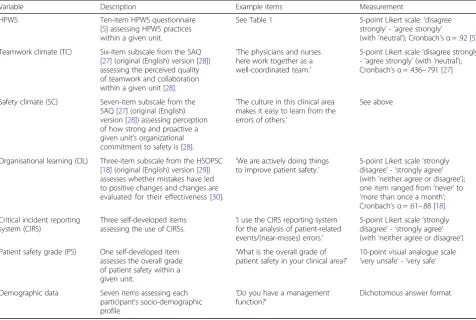
In addition to the 10 item HPWS-G questionnaire, we added self-developed items assessing the study hospital’s critical incident reporting system practices and overall patient safety. To test validity, we also included subscales from the Safety Attitudes Questionnaire (SAQ) [27] and the Hospital Survey on Patient Safety Culture (HSOPSC) [18] (Table 2). Space was provided for additional com-ments. Both of the validated and widely used SAQ scales we added assess the safety climate from the health care worker’s perspective. Whereas the SAQ focuses on health care worker perceptions and attitudes regarding patient safety (6 subscales), such as teamwork and safety climate [27,28], the HSOPSC covers seven unit-level dimensions (e.g., organisational learning), three hospital-level dimen-sions (e.g., teamwork across hospital units) and four out-come variables (e.g., overall perceptions of safety).
Data collection
Survey data collection took place between 04.10. -17.11.2017. All eligible RNs and physicians received the 37-item paper-pencil questionnaire via internal mail. A reminder was sent to all participants after two and four weeks, as the period of data collection was extended for two weeks.
Data analysis
Data were analysed using IBM® SPSS® 24.0.0. For the con-firmatory factor analysis (CFA), we used IBM® SPSS® AMOS™24.0. Descriptive analysis included each item’s fre-quencies, percentage, mean, median, interquartile range (IQR) and standard deviation (SD). Data were screened for out-of-range values, homogeneity of variances and univari-ate outliers by preparing boxplots, histograms and scatter-plots [31]. To detect multivariate outliers, Mahalanobis distances were calculated [31]. The level of significance was set at p< .05. Before analysis, data were checked for plausibility and comprehensiveness.
Internal consistency (reliability) (H2)
First, to determine the degree of inter-item correlation, we generated a correlation matrix including all 10 items. For this to yield a Cronbach’s α of .80 (indicating good internal consistency) an average inter-item correlation of .29 would be necessary [25, 32]. Second, we assessed item-scale correlations, values > .30 correlate very well with the overall scale [32,33].
Construct validity (H3)
[image:4.595.56.290.96.324.2]To test whether our empirical data confirmed the pro-posed 1-factor HPWS model, we performed a confirmatory factor analysis. Only non-statistically significant results (p< .05) could confirm construct validity [34]. According to Häcker’s [35] recommendations, sample size should be Table 1Ten items of the HPWS questionnaire [5]
Item No. Lable Employees in my hospital area
1 Skills …are provided opportunities to learn
new skills.
2 Rewards …are given rewards for doing a good job.
3 Information …receive necessary information to do a
good job.
4 Teamwork Teamwork is important for providing quality
service to patients.
5 Workplace …are asked how workplace processes can
be improved.
6 Appraisal …receive performance appraisals that help
them to improve their performance.
7 Quality …receive training on quality improvement
methods.
8 Job security …have job security.
9 Survey …see improvements in this hospital area
based on results of employee surveys.
10 Candidate The best candidate for the job is hired in this
about 200 to 250. Goodness of fit was proved by the good-ness of fit index (GFI) (values > .90 indicating good model fit), the root-mean-square residual (RMR), the normed fit index (NFI) (values > .95 indicating reasonable model fit), the comparative fit index (CFI) (values > .95 indicating rea-sonable model fit), and the root-mean-square error of ap-proximation (RMSEA) (values > .06 indicating reasonable model fit) [31,35–37]. For potential adjustments of model fit, we finally screened modification indices.
To determine specific indices assessing the dimension-ality of the model, we applied the Hull method with minimum rank factor analysis (MRFA) for factor extrac-tion and raw varimax rotating, using FACTOR (Version 10.8.04) [38, 39]. The model was considered unidimen-sional, if the explained common variance (ECV) index and item explained common variance (I-ECV) ranged between .70 to .85 or above, and mean of item residual absolute loadings (MIREAL) and item residual absolute loadings (I-REAL) were lower than .30 [39].
Concurrent validity (H4)
To examine concurrent validity, we needed to compare correlations between‘HPWS’and‘teamwork climate’,‘safety climate’,‘organisational learning’,‘critical incident reporting’,
and‘patient safety grade’. To do so, we generated a correl-ation matrix, and calculated Spearman’s Rho [34].
Results
Translation and content validity of the HPWS-G questionnaire (H1)
The scale-level content validity index (S-CVI) of the 10-item HPWS-G questionnaire was .86, indicating overall good content validity. For the individual items, the con-tent validity (I-CVI) varied between .83 and 1, also indi-cating good content validity per item. According to the study experts’ ratings and comments, the wordings of five items (‘skills’,‘information,’‘teamwork’,‘appraisal’, and ‘quality’) were slightly revised, or examples added to en-sure comprehensibility. After these adaptations, content validity was not re-examined by the experts.
Examination of internal consistency, construct and concurrent validity (H2–4)
Participants
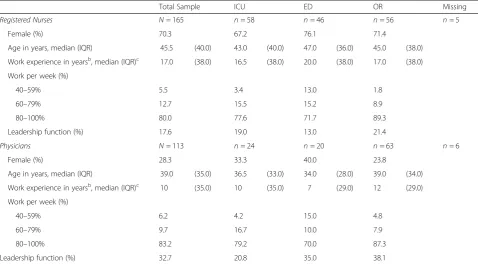
[image:5.595.58.535.99.419.2]Of 782 questionnaires distributed, 281 (35.9%) were returned. Participants included 165 (58.7%) nurses, 113 (40.2%) physicians, and 3 (1.1%) participants who did not specify their professions. This sample’s socio-demographic data are described in Table3.
Table 2Variables assessed by the 37-item paper-pencil questionnaire
Variable Description Example items Measurement
HPWS Ten-item HPWS questionnaire
[5] assessing HPWS practices within a given unit.
See Table1 5-point Likert scale:‘disagree
strongly’-‘agree strongly’
(with‘neutral’); Cronbach’sα= .92 [5]
Teamwork climate (TC) Six-item subscale from the SAQ
[27] (original (English) version [28]) assessing the perceived quality of teamwork and collaboration within a given unit [28].
‘The physicians and nurses here work together as a well-coordinated team.’
5-point Likert scale‘disagree strongly’ -‘agree strongly’(with‘neutral’); Cronbach’sα= .436–.791 [27]
Safety climate (SC) Seven-item subscale from the
SAQ [27] (original (English) version [28]) assessing perception of how strong and proactive a given unit’s organizational commitment to safety is [28].
‘The culture in this clinical area makes it easy to learn from the errors of others.’
See above
Organisational learning (OL) Three-item subscale from the HSOPSC [18] (original (English) version [29]) assesses whether mistakes have led to positive changes and changes are evaluated for their effectiveness [30].
‘We are actively doing things to improve patient safety.’
5-point Likert scale‘strongly disagree’-‘strongly agree’ (with‘neither agree or disagree’); one item ranged from‘never’to ‘more than once a month’; Cronbach’sα= .61–.88 [18]
Critical incident reporting system (CIRS)
Three self-developed items
assessing the use of CIRSs. ‘
I use the CIRS reporting system for the analysis of patient-related events/(near-misses) errors.’
5-point Likert scale‘strongly disagree’-‘strongly agree’ (with‘neither agree or disagree’)
Patient safety grade (PS) One self-developed item assesses the overall grade of patient safety within a given unit.
‘What is the overall grade of patient safety in your clinical area?’
10-point visual analogue scale ‘very unsafe’-‘very safe’
Demographic data Seven items assessing each
participant’s socio-demographic profile
‘Do you have a management function?’
Response patterns
Conducting a missing values analysis, we found more than 5% missing values in demographic items including age (15.7%) and work experience (5.3%) as well as in the HPWS ‘candidate’ item (6.0%). As Little’s MCAR test yielded a statistically significant result (p = .001), we in-ferred that these data had been missed at random [31]. To conduct a CFA, we replaced missing values with the person-specific mean or, where appropriate, group spe-cific means (items 291and 302) of the available data.
The Kolomogorov-Smirnov and Shapiro-Wilk tests showed that all items differed significantly from normal (p< .001). This was supported by skewness and kurtosis values, as well as Q-Q plots and histograms. Multivariate normality was excluded as the z-value of the Mardia test was 7.383.
Analyses of boxplots, histograms and scatterplots identified two univariate outliers in‘patient safety grade’. Via the Mahalanobis distance, we detected six (2.5%) multivariate outliers. We calculated regressions for all to highlight what distinguished them from the other cases [31]. In comparison to the main sample, their scores were skewed more extremely, as they often involved the answer option ‘disagree strongly’ or ‘agree strongly’. As we assumed that these cases accurately represented a segment of the population, they were kept in the data set. However, as such cases tend to distort results, robust sta-tistics and methods, such as the median or Bollen-Stine bootstrap, were used [33]. Descriptive analyses of the
questionnaire items showed a number of significant re-sponse behaviour differences between nurses and physi-cians, between clinicians with and without leadership functions, and between clinical areas.
Internal consistency (reliability) (H2)
H2 was supported by a Cronbach’s α of .846. Mean inter-item correlation was .448, and item-scale correl-ation ranged from 2.77 to 4.62 (Table 4). While ‘ team-work’and‘job security’items showed low discriminating power (.224 and .366), all items were initially retained, as the greatest α increase – by deleting the ‘job security’ item – would be .008. Based on the low factor loading (.053), we decided to delete the ‘teamwork’ item. This produced a corrected Cronbach’sαof .853.
Construct validity (H3)
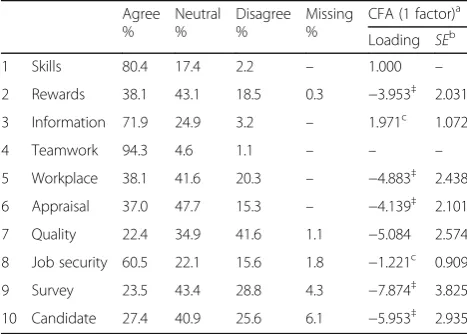
A CFA based on the remaining nine items initially confirmed the proposed 1-factor model with HPWS as latent factor (p (chi2) = .215). Fit indices indicated acceptable to good model fit3with chi2= 40.880 (df= 27,
[image:6.595.57.536.99.363.2]p= .2054), GFI = .968, RMR = .025, NFI = .770, CFI = .902, and RMSEA = .043 (90% CI = .008–.068). All factor load-ings except for the ‘information’ and ‘job security’ item were significant (p < .05) and their size was ex-cellent (> 0.70) [40] (Table 5). However, examination of the modification indices showed significant covariations of certain error variables, suggesting that the model was not unidimensional. To explain these results and improve Table 3Socio-demographic characteristics of participants (N= 281a)
Total Sample ICU ED OR Missing
Registered Nurses N= 165 n= 58 n= 46 n= 56 n= 5
Female (%) 70.3 67.2 76.1 71.4
Age in years, median (IQR) 45.5 (40.0) 43.0 (40.0) 47.0 (36.0) 45.0 (38.0)
Work experience in yearsb, median (IQR)c 17.0 (38.0) 16.5 (38.0) 20.0 (38.0) 17.0 (38.0)
Work per week (%)
40–59% 5.5 3.4 13.0 1.8
60–79% 12.7 15.5 15.2 8.9
80–100% 80.0 77.6 71.7 89.3
Leadership function (%) 17.6 19.0 13.0 21.4
Physicians N= 113 n= 24 n= 20 n= 63 n= 6
Female (%) 28.3 33.3 40.0 23.8
Age in years, median (IQR) 39.0 (35.0) 36.5 (33.0) 34.0 (28.0) 39.0 (34.0)
Work experience in yearsb
, median (IQR)c 10 (35.0) 10 (35.0) 7 (29.0) 12 (29.0)
Work per week (%)
40–59% 6.2 4.2 15.0 4.8
60–79% 9.7 16.7 10.0 7.9
80–100% 83.2 79.2 70.0 87.3
Leadership function (%) 32.7 20.8 35.0 38.1
a
n= 3 (1.1) participants could not be assigned to a profession due to missing information;b
in this working area (ICU, ED, OR);c
our factor structure, we therefore applied additional statis-tics as follows. To examine whether local dependency and unidimensionality were violated, leading to biased param-eter estimations, we applied item response theory [41]. After the contribution of the latent trait had been re-moved, this showed some significant correlations among the items. As the highest correlation between the items ‘information’ and ‘workplace’ was negative (r =−.354,
p < .000) and other significant correlations were below r < .03, the items’locally dependency was not clearly con-firmed [42]. However, conducted MRFA indicated an ECV index of .888 (95% CI5 = .873–.916) and I-ECV values above 0.70, except for the item ‘skills’, suggesting a unidimensional solution. This was supported by a MIREAL of .214 (95% CIe = .178–.251) as well as seven of nine items having I-REAL values lower than 0.30. Furthermore, the generalized H (G-H) indices of both factors, determined for a multidimensional solu-tion, were below .80, with .670 (95% CI = .611–.692)
for factor 1 and .764 (95% CI = .730–.778) for factor 2, indicating poorly defined latent variables [39]. Con-sidering these results, for HPWS the one-factor model seems to be most appropriate.
Concurrent validity (H4)
‘HPWS’correlated significantly with all five dimensions, i.e.,‘safety climate’(rs= .657,p< .01),‘teamwork climate’
(rs = .615, p < .01), ‘organisational learning’ (rs = .660, p < .01),‘critical incident reporting’ (rs = .438, p < .01),
and ‘patient safety grade’ (rs = .575, p < .01). Following
Cohen’s [43] directions, we found that the ‘critical inci-dent reporting’dimension’s effect was medium (r> .30); all others’were large (r> .50). These results support our hypothesis. Additional bivariate correlation tests indi-cated that HPWS was the strongest predictor for safety climate (r = .673, p < .01), teamwork climate (r = .641,
p< .01), and patient safety grade (r= .567,p< .01).
Discussion
This study examined the content validity and psycho-metric properties of the HPWS-G questionnaire. Con-tent validity of the scale and individual items was
confirmed (H1); and the translated questionnaire
showed good internal consistency (H2) and concurrent validity (H4). Considering the results of the MRFA, the initially proposed 1-factor model was accepted, indicat-ing acceptable to good model fit (H3). With minor revi-sions (e.g., wording of items to fit the context), the HPWS-G questionnaire can be used to assess and moni-tor HPWSs in German speaking hospitals, yielding inter-nationally comparable results.
Response patterns and demographics
[image:7.595.57.541.98.281.2]Analysing response patterns revealed differences in re-sponse behaviour across professions and clinical areas, as well as across management levels. Regarding safety Table 4Internal consistency 10 item HPWS-G questionnaire (reliability);N= 281
Mean SD 1 2 3 4 5 6 7 8 9 10
Inter-item correlation 0.358 0.141
Item-scale correlation Inter-item correlation matrix of HPWS-G items
1 Skills 4.09 0.761 1.000
2 Rewards 3.22 0.928 .479 1.000
3 Information 3.90 0.777 .425 .507 1.000
4 Teamwork 4.62 0.661 .186 .181 .225 1.000
5 Workplace 3.21 0.940 .364 .527 .430 .189 1.000
6 Appraisal 3.24 0.894 .332 .533 .436 .175 .623 1.000
7 Quality 2.77 1.012 .207 .365 .379 .058 .466 .482 1.000
8 Job security 3.60 1.164 .111 .235 .268 .169 .225 .254 .305 1.000
9 Survey 2.92 0.920 .332 .520 .498 .131 .557 .480 .509 .333 1.000
10 Candidate 3.00 0.986 .434 .481 .499 .208 .424 .462 .365 .305 .429 1.000
Table 5HPWS-G questionnaire item characteristics (N= 281)
Agree %
Neutral %
Disagree %
Missing %
CFA (1 factor)a
Loading SEb
1 Skills 80.4 17.4 2.2 – 1.000 –
2 Rewards 38.1 43.1 18.5 0.3 −3.953‡ 2.031
3 Information 71.9 24.9 3.2 – 1.971c 1.072
4 Teamwork 94.3 4.6 1.1 – – –
5 Workplace 38.1 41.6 20.3 – −4.883‡ 2.438
6 Appraisal 37.0 47.7 15.3 – −4.139‡ 2.101
7 Quality 22.4 34.9 41.6 1.1 −5.084 2.574
8 Job security 60.5 22.1 15.6 1.8 −1.221c 0.909
9 Survey 23.5 43.4 28.8 4.3 −7.874‡ 3.825
10 Candidate 27.4 40.9 25.6 6.1 −5.953‡ 2.935
a
CFA on 9 items;b
[image:7.595.56.290.548.715.2]climate and teamwork climate, such differences have been reported elsewhere [28,44], highlighting the danger of in-ferring generalizability across professions or clinical areas.
One of the three items with more than 5% missing values was the HPWS ‘candidate’ item. In that case, we assume that not all respondents could judge whether the best candidate was hired for each job given their pos-ition in the team. Considering the above-mentioned inter-group response differences, it might be advisable to use that item only in HPWS questionnaires for respon-dents with leadership functions. For demographic items, respondents expressed concerns about their anonymity, although we merged the clinical areas, the medical and surgical ICUs, as well as the OR and anaesthesiology.
Internal consistency (reliability)
The HPWS-G’s Cronbach’sα was lower than that of the original version, but was improved somewhat by deleting the‘teamwork’item. Initially, we retained both the‘ team-work’and ‘job security’items despite their low discrimin-ant power, as they play importdiscrimin-ant roles in the HPWS conceptual model [3]. Regarding the ‘teamwork’ item, in combination with its low factor loading in the first factor analysis and the fact that it made a statement6 without raising a condition, we decided to exclude it. In fact, the same item had been excluded from the original HPWS questionnaire [5]. The‘job security’item also showed low discriminant power– possibly resulting from its strongly right-skewed distribution (which can be improved by re-formulating the item [45]); however, its standard deviation was good. Differing national-level employment policies may explain why job security appears less important to the Swiss sample than to those in the US [46].
Construct validity
The suggested 1-factor HPWS-G model showed an over-all acceptable to good fit. The low NFI value might have resulted from underestimation of fit due to the relatively small samples and violations of multivariate normality [47, 48]. Other fit indices such as the CFI overcome these problems [47]. The 1-factor model fits the results of Etchegaray et al. [5], also evidence that the HPWS–G questionnaire distinguishes between safety climate and teamwork climate. Our data did not confirm this, as safety climate and teamwork climate were not included in the CFA. However, HPWS as unidimensional con-struct is not equivalent to the four HPWS subsystems mentioned in Garman et al.’s [3] model (‘engaging staff’, ‘aligning leaders’, ‘acquiring/developing talent’,‘ empow-ering the frontline’). One possible reason for this is a lack of a standard HPWS-related terminology, as well as uncertainty about which HPWS patient safety-related practices, and in which combinations, are most promising.
Concurrent validity
The HPWS-G questionnaire correlates well with safety climate and teamwork climate scales, subscales for pa-tient safety grade, and items on organisational learning and CIRS. In Garman et al.’s [3] conceptual model, HPWS’s influence on patient safety is mediated by staff-ing and care processes, which could not be shown in our study. Unlike Etchegaray et al.’s findings [5], our analyses indicated that HPWS was a stronger predictor of safety climate than of patient safety grade. Two other studies support this result. First, Guldenmund’s organisational triangle theoretically maintains [16] that safety climate interrelates dynamically with HPWSs and can influence patient safety. Second, Zacharatos et al. [49] showed a mediating effect of safety climate between HPWSs and both safety incidents and personal-safety orientation. Additional qualitative study findings from health care or-ganizations in the U.S. highlight HPWS as crucial elem-ent, facilitating speak up, an important factor in the context of safety climate [21].
Transferred to the health care setting, these findings suggest that clinicians should regard the presence of HPWSs as a predictor of safety climate, which in fact impacts outcomes including patient safety (as HPWSs bolster efforts to prevent adverse events [27]). According to the World Health Organization [50], successful adverse event reduction strategies would lead to‘over 3.2 million fewer days of hospitalisation, 260´000 fewer incidents of permanent disability, and 95´000 fewer deaths per year’in the European Union alone. Measures reducing adverse events by increasing patient safety and quality focus mainly on the improvement of safety climate [51]. Facili-tating development of a robust safety climate – which leads to associated clinical outcomes including, for ex-ample, reductions in central line-associated bloodstream infections [52] or patient mortality [20]–is one clear way HPWSs improve patient safety. However, further longitu-dinal studies will be necessary both to investigate causality between these work systems and safety related outcomes and to support the very encouraging findings reported here and elsewhere.
Limitations
same hospital or other hospital settings in Switzerland. As participation was anonymous, evidence of response processes could not be assessed; instead we analysed re-sponse patterns. To replace missing values the advantage of chosen procedure (person-specific mean imputation) is that‘the mean for the distribution as a whole does not change’[31]. However, variance of the variables could be reduced [31].
Conclusions
This study provides first evidence supporting the use of a 9-item German-language HPWS practice measurement tool in a Swiss university hospital setting. The German-language HPWS-G questionnaire allows systematic individual-level assessment and monitoring of HPWS practices in clinical settings against the background of patient safety. Our findings allow intra- and inter-hospital benchmarking of HPWSs, encouraging attempts to im-prove them.
Several minor changes are necessary. Based on psycho-metric testing results, the wording of the item‘job secur-ity’ needs to be improved. Additionally, as teamwork appears to be important in the context of HPWSs, the deleted‘teamwork’item should be reformulated; and the entire 10-item questionnaire cross-validated.
Further research is recommended to test the HPWS-G questionnaire in other clinical units of the study hos-pital, as well as in other hospital settings. In this way, re-sults assessed via the HPWS-G can be evaluated, informing cut-off values for intra- and inter-hospital benchmarking.
At the interventional level, the HPWS-G can be ap-plied in other settings to assess the relationship be-tween HPWSs and patient safety mediated by safety climate. Finally, we recommend HPWS measurement at the individual (i.e., professional group) or unit level (i.e., clinical area) rather than that of the institution, as tests at these levels best indicate which HPWS practices lead to improved patient safety outcomes in those specific contexts [53].
Endnotes
1
How many times in the last six months had CIRS cases been discussed in your clinical area, e.g. in case re-views or team meetings? (‘not at all’to‘once a month’).
2
What is the overall grade of patient safety in your clinical area? (Scale from 1 to 10).
3
calculated using Maximum likelihood,N= 281. 4
correctedp-value performing Bollen-Stine bootstrap. 5
Bootstrap confidence intervals. 6‘
teamwork is important for providing quality service to patients’.
Abbreviations
CFA:Confirmatory factor analysis; CFI: Comparative fit index; ECV: Explained common variance; ED: Emergency department; EFA: Exploratory factor analysis; GFI: Goodness of fit; G-H: Generalized H index; HPWS: High performance work systems; HSOPSC: Hospital Survey on Patient Safety Culture; ICU: Intensive care unit; CVI: Item-level content validity index; I-REAL: Item residual absolute loadings; MII-REAL: Mean of item residual absolute loadings; MRFA: Minimum rank factor analysis; NFI: Normed fit index; OR: Operating room; RMR: mean-square residual; RMSEA: Root-mean-square error of approximation; RN: Registered nurse; SAQ: Safety Attitudes Questionnaire; S-CVI/Ave: Overall scale-level content validity index; WHO: World Health Organization
Acknowledgments
The authors thank Dr. Kris Denhaerynck for statistical support, Chris Shultis for manuscript editing, Mark Marston for back translation of the HPWS-G and peer review, as well as Matthias Exl, Nathalie Möckli and Marian Struker for peer review.
Authors’contributions
JM conducted the research, data analysis and manuscript drafting. RS was the study mentor, proposed the study idea and substantially supported the research process by providing methodical and contextual input and feedback. SDG, SB, LL, XL, RAG and SH provided technical support, contributed substantially to manuscript revision and editing. All authors read and approved the final manuscript.
Funding
This research was not funded by any specific grant from any agency in the public, commercial or not-for-profit sectors.
Availability of data and materials
The data that support the findings of this study are available from the corresponding author on reasonable request.
Ethics approval and consent to participate
This study was approved by the Ethics Committee“Northwest/Central Switzerland”(Req_20217–00544), including the form of implied consent, given by answering and returning the questionnaire.
Consent for publication
Not applicable.
Competing interests
The authors declare that they have no competing interests.
Author details
1Institute of Nursing Science, Department Public Health, University of Basel, Basel, Switzerland.2Department of Public Health and Primary Care, Academic Center for Nursing and Midwifery, KU Leuven, Leuven, Belgium.3Center of Clinical Nursing Science, University Hospital Zurich, Zurich, Switzerland. 4Departments of Hematology and Oncology, Freiburg University Medical Center, Freiburg, Germany.5Department of Medical Communication/ Psychosomatic Medicine, University Hospital of Basel, Basel, Switzerland. 6Medical Faculty, University of Basel, Basel, Switzerland.7Chief Medical Office, Patient Safety Office, University Hospital of Basel, Spitalstrasse 22, 4031 Basel, Switzerland.
Received: 23 November 2018 Accepted: 28 May 2019
References
1. Tomer JF. Understanding high-performance work systems: the joint contribution of economics and human resource management. J Socio Econ. 2001;30(1):63–73.
2. Etchegaray JM, St. John C, Thomas EJ: measures and measurement of high-performance work systems in health care settings: propositions for improvement. Health Care Manag Rev 2011, 36(1):38–46.
4. Weinberg DB, Avgar AC, Sugrue NM, Cooney-Miner D. The importance of a high-performance work environment in hospitals. Health Serv Res. 2013; 48(1):319–32.
5. Etchegaray JM, Thomas EJ. Engaging employees: the importance of high-performance work Systems for Patient Safety. J Patient Saf. 2015;11(4):221–7. 6. Scotti DJ, Harmon J, Behson SJ. Links among high-performance work
environment, service quality, and customer satisfaction: an extension to the healthcare sector. J Healthc Manag. 2007;52(2):109–25.
7. Chuang E, Dill J, Morgan JC, Konrad TR. A configurational approach to the relationship between high-performance work practices and frontline health care worker outcomes. Health Serv Res. 2012;47(4):1460–81.
8. Kohn LT, Corrigan JM, Donaldson MS. To err is human. Washington: National Academies Press; 2000.
9. Flin R, Burns C, Mearns K, Yule S, Robertson EM. Measuring safety climate in health care. Qual Saf Health Care. 2006;15(2):109–15.
10. Colla JB, Bracken AC, Kinney LM, Weeks WB. Measuring patient safety climate: a review of surveys. Qual Saf Health Care. 2005;14(5):364–6. 11. Schwendimann R, Blatter C, Dhaini S, Simon M, Ausserhofer D. The
occurrence, types, consequences and preventability of in-hospital adverse events–a scoping review. BMC Health Serv Res. 2018;18(1):521. 12. Mihail DM, Kloutsiniotis PV. The effects of high-performance work systems
on hospital employees’work-related well-being: evidence from Greece. Eur Manag J. 2016;34(4):424–38.
13. Young S, Bartram T, Stanton P, Leggat SG. High performance work systems and employee well-being: a two stage study of a rural Australian hospital. J Health Organ Manag. 2010;24(2):182–99.
14. Lee SM, Lee D, Kang C-Y. The impact of high-performance work systems in the health-care industry: employee reactions, service quality, customer satisfaction, and customer loyalty. Serv Ind J. 2012;32(1):17–36.
15. Leggat SG, Bartram T, Casimir G, Stanton P. Nurse perceptions of the quality of patient care: confirming the importance of empowerment and job satisfaction. Health Care Manag Rev. 2010;35(4):355–64.
16. Guldenmund FW. (Mis) understanding safety culture and its relationship to safety management. J Risk Res. 2010;30(10):1466–80.
17. Manser T, Brösterhaus M, Hammer A. You can't improve what you don't measure: safety climate measures available in the German-speaking countries to support safety culture development in healthcare. Z Evid Fortbild Qual Gesundhwes. 2016;114:58–71.
18. Pfeiffer Y, Manser T. Development of the German version of the hospital survey on patient safety culture. Saf Sci. 2010;48(10):1452–62. 19. Gehring K, Mascherek AC, Bezzola P, Schwappach DLB. Safety climate in
Swiss hospital units: Swiss version of the safety climate survey. J Eval Clin Pract. 2015;21(2):332–8.
20. West MA, Borrill C, Dawson J, Scully J, Carter M, Anelay S, Patterson M, Waring J. The link between the management of employees and patient mortality in acute hospitals. Int J Hum Resour Man. 2002;13(8):1299–310. 21. Robbins J, McAlearney AS. Toward a high-performance management system
in health care, part 5: how high-performance work practices facilitate speaking up in health care organizations. Health Care Manag Rev. 2018.
22. Standards for educational and psychological testing. Washington, DC: American Educational Research Association; 2014.
23. Cohen JF, Korevaar DA, Altman DG, Bruns DE, Gatsonis CA, Hooft L, Irwig L, Levine D, Reitsma JB, de Vet HC, et al. STARD 2015 guidelines for reporting diagnostic accuracy studies: explanation and elaboration. BMJ Open. 2016;6(11).
24. Jones PS, Lee JW, Phillips LR, Zhang XE, Jaceldo KB. An adaption of Brislin’s translation model for cross-cultural research. Nurs Res. 2001;(5):50. 25. Polit DF, Beck CT, Owen SV. Is the CVI an acceptable indicator of
content validity? Appraisal and recommendations. Res Nurs Health. 2007;30(4):459–67.
26. Polit DF, Beck CT. The content validity index: are you sure you know what's being reported? Critique and recommendations. Res Nurs Health. 2006; 29(5):489–97.
27. Zimmermann N, Küng K, Sereika SM, Engberg S, Sexton B, Schwendimann R. Assessing the safety attitudes questionnaire (SAQ), German language version in Swiss university hospitals - a validation study. BMC Health Serv Res. 2013;13(1):347.
28. Sexton JB, Helmreich RL, Neilands TB, Rowan K, Vella K, Boyden J, Roberts PR, Thomas EJ. The safety attitudes questionnaire: psychometric properties, benchmarking data, and emerging research. BMC Health Serv Res. 2006;6(1):44.
29. Sorra JS, Nieva VF. Hospital Survey on Patient Safety Culture (Prepared by Westat, under Contract No. 290–96-0004). Rockville, MD: Agency for Healthcare Research and Quality; 2004.
30. Sorra JS, Dyer N. Multilevel psychometric properties of the AHRQ hospital survey on patient safety culture. BMC Health Serv Res. 2010;10(1):199. 31. Tabachnick BG, Fidell LS. Using multivariate statistics, 4th ed. edn. Boston,
MA: Allyn and Bacon; 2001.
32. Polit DF, Beck CT. Nursing research, 10th edn. Philadelphia: Wolters Kluwer; 2017.
33. Field A, Allison PD: Discovering statistics using SPSS / multiple regression: sage publications; 2010.
34. Leonhart R: Lehrbuch Statistik, 3rd edn. Bern: Huber; 2013.
35. Häcker H. Standards für pädagogisches und psychologisches Testen, vol. 1, 1st edn. Bern; Göttingen; Toronto; Seattle: Huber; 1998.
36. Tinsley HE, Brown SD: Multivariate statistics and mathematical modeling.
Handbook of applied multivariate statistics and mathematical modeling
2000:3–36.
37. Thompson B: Exploratory and confirmatory factor analysis, 3rd edn. Washington, DC: American Psychological Assoc; 2008.
38. Lorenzo-Seva U, Timmerman ME, Kiers HAL. The Hull method for selecting the number of common factors. Multivariate Behav Res. 2011;46(2):340–64. 39. Ferrando PJ, Lorenzo-Seva U. Assessing the quality and appropriateness of
factor solutions and factor score estimates in exploratory item factor analysis. Educ Psychol Meas. 2018;78(5):762–80.
40. DiStefano C, Hess B. Using confirmatory factor analysis for construct validation: an empirical review. J Psychoeduc Assess. 2005;23(3):225–41. 41. Reise SP, Revicki DA. Handbook of item response theory modeling.
Routledge: Applications to typical performance assessment; 2014. 42. Christensen KB, Makransky G, Horton M. Critical values for Yen’s Q3:
identification of local dependence in the Rasch model using residual correlations. Appl Psychol Meas. 2017;41(3):178–94.
43. Cohen J. Statistical power analysis current directions. Psychol Sci. 1992; 1(3):98–101.
44. Singer SJ, Gaba DM, Falwell A, Lin S, Hayes J, Baker L. Patient safety climate in 92 US hospitals: differences by work area and discipline. Med Care. 2009; 47(1):23–31.
45. Bühner M: Einführung in die Test-und Fragebogenkonstruktion: Pearson Deutschland GmbH; 2011.
46. De Witte H. Job insecurity: review of the international literature on definitions, prevalence, antecedents and consequences. SA J Ind Psychol. 2005;31(4):1–6.
47. Bentler PM. Comparative fit indexes in structural models. Psychol Bull. 1990; 107(2):238.
48. Hu L-T, Bentler PM. Fit indices in covariance structure modeling: sensitivity to underparameterized model misspecification. Psychol Methods. 1998;3(4):424.
49. Zacharatos A, Barling J, Iverson RD. High-performance work systems and occupational safety. J Appl Psychol. 2005;90(1):77–93.
50. World Health Organization Regional Office for Europe: Patient safety - Data and Statistics [http://www.euro.who.int/en/health-topics/Health-systems/ patient-safety/data-and-statistics. Accessed 31 Jan 2017.]
51. Schwendimann R, Zimmermann N, Küng K, Ausserhofer D, Sexton B. Variation in safety culture dimensions within and between US and Swiss hospital units: an exploratory study. BMJ Qual Saf. 2012;22(1):32–41. 52. McAlearney AS, Hefner J, Robbins J, Garman AN. Toward a
performance management system in health care, part 4: using high-performance work practices to prevent central line-associated blood stream infections-a comparative case study. Health Care Manag Rev. 2016;41(3):233–43.
53. Powell M, Dawson J, Topakas A, Durose J, Fewtrell C. Systematic review of the high-performance work systems literature in the health-care sector. In: Powell M, Dawson J, Topakas A, Durose J, Fewtrell C, editors. Staff satisfaction and organisational performance: evidence from a longitudinal secondary analysis of the NHS staff survey and outcome data.
Southampton: NIHR journals Library; 2014.
Publisher’s Note

![Table 1 Ten items of the HPWS questionnaire [5]](https://thumb-us.123doks.com/thumbv2/123dok_us/8258920.277335/4.595.56.290.96.324/table-items-hpws-questionnaire.webp)