SOLAR POWERED ELECTRIC BICYCLE
FAHRULRAZI BIN HASHIM B010510028
―I hereby declare that I have read through this report and found that it has comply the partial fulfillment for awarding the degree of Bachelor of Electrical Engineering (Control,
Instrumentation & Automation)‖
Signature : ………
Supervisor‘s Name : ………
SOLAR POWERED ELECTRIC BICYCLE
FAHRULRAZI BIN HASHIM
This Report Is Submitted In Partial Fulfillment Of Requirement For the Degree Of Bachelor In Electrical Engineering (Control, Instrumentation & Automation)
Faculty of Electrical Engineering Universiti Teknikal Malaysia Melaka
― I hereby declare that this report is a result of my own work except for the experts that have been cited clearly in the reference.‖
Signature : ………
Name : ………
APPRECIATION
ABSTRACT
ABSTRAK
TABLE OF CONTENT
CHAPTER CONTENT
PAGE
APPRECIATION i
ABSTRACT ii
TABLE OF CONTENT iv
LIST OF FIGURE vii
LIST OF ABBREVIATION viii
LIST OF APPENDIX ix
1 INTRODUCTION
1.1Introduction 1.2Problem statement 1.3Project objective 1.4 Scope of project
1 1 2 2
2 LITERATURE REVIEW
2.1 Introduction
2.2 Previous project [1]
2.2.1 Ultimate test
2.2.2 Performance 2.2.3 Components 2.2.4 Motor
2.2.5 Solar bicycle load 2.2.6 Solar bicycle cost
2.2.7 Schematic Diagram 2.3 Previous project [2]
2.3.1 Background of the invention 2.3.2 Summary of the present invention 2.3.3 Brief description of the drawing 2.4 Previous project [3]
2.4.1 Background of the invention 2.4.2 Summary of the invention 2.4.3 Brief description of the drawings 2.5 Previous project [4]
2.5.1 Background and summary of the invention 2.5.2 Electrical schematic diagram
2.6 Previous project [5]
2.6.1 Field of the invention
2.6.2 Background of the invention 2.6.3 Hardware designing
2.6.4 Schematic diagram 2.7 Previous project [6]
2.7.1 Zinc-Air Powered Electric Vehicles 2.7.2 Recharging a Zinc-Air Battery 2.7.3 Cost of Solar Power Generation 2.7.4 Shipping Energy in Zinc Pellets 2.7.5 Fuel for Local Transportation
3 METHODOLOGY 3.1 Introduction
3.2 Project Methodology
28 29
4 PROJECT PROGRESS
4.1 Introduction 4.2 Components
4.3 Specification of project 4.4 Schematic circuit diagram
32 32 36 36
5 RESULTS AND DISCUSSION
5.1 Introduction 5.2 Project Progress 5.3 Project Analysis
37 37 38
6
5.4 Example Calculation 5.5 Problem Encountered
CONCLUSION
44 48
49
REFERENCES 50
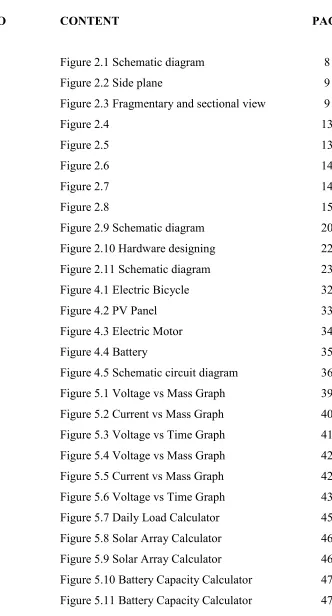
LIST OF FIGURE
NO CONTENT PAGE
1 Figure 2.1 Schematic diagram 8 2 Figure 2.2 Side plane 9 3 Figure 2.3 Fragmentary and sectional view 9
4 Figure 2.4 13
5 Figure 2.5 13
6 Figure 2.6 14
7 Figure 2.7 14
8 Figure 2.8 15
9 Figure 2.9 Schematic diagram 20 10 Figure 2.10 Hardware designing 22 11 Figure 2.11 Schematic diagram 23
12 Figure 4.1 Electric Bicycle 32
13 Figure 4.2 PV Panel 33
14 Figure 4.3 Electric Motor 34
15 Figure 4.4 Battery 35
[image:11.612.84.416.107.723.2]LIST OF ABBREVIATION
DC - Direct current
V - Volt
FYP - Final Year Project PV - Photovoltaic A - Ampere
mph - Miles per hour kph - Kilometer per hour km - Kilometer
m - Meter
W - Watt
LIST OF APPENDIX
TOPIC PAGE
Gant chart 53
GSE Solar Power Module 30 Watt 54
Mitsubishi Electric Modules 56
CHAPTER 1
INTRODUCTION
1.1Introduction
In the modern societies, the increasing needs of mobility means sometimes increasing the number of vehicles circulating. Ambient concerns, as for instance the local pollutant emissions for the atmosphere, influence also, in nowadays, the technical decisions related with all kind of vehicles. In this context, new alternatives to the existing internal combustion engines are mandatory. So, vehicles with solar powered system seem to be an interesting alternative. Therefore in this context, solar powered electric bicycle is now developed for fulfill the necessity.
1.2 Problem statement
The problem statements of this project are:
a) The recently street bicycle do not have solar powered that can be an alternative replacing the usage of fuel.
b) It is difficult to buy a photovoltaic cell because it is too expensive.
c) Need to find the suitable specifications of motor that can be use depends on the application of the ordinary street bicycle.
d) How to optimize the usage of the photovoltaic cells on this electric bicycle.
1.3Project objective
a) To develop an electric bicycle by using solar energy that can be used for leisurely rides and as a vehicle where parking traffic are the problems.
b) To study the relationship and characteristic between solar energy and electrical propulsion system.
c) To compare the characteristics and performance between solar electric bicycle and conventional electric bicycle.
d) To analyze the effect of solar energy on the performance of DC motor.
1.4Scope of project
This project will focus on how to apply the photovoltaic (PV) panels on the electric bicycle in term of:
Flat road condition and angel less than 300 road
The performance of the DC motor for a specific distance that will be determined afterward.
Analyzing the application of solar panels on the electric bicycle.
Analyzing the usage of rechargeable battery on the electric bicycle.
Because of the high-cost and need a lot of time to analyze and develop an
CHAPTER 2
LITERATURE REVIEW
2.1 Introduction
This chapter reviews existing project created to get an idea about the project design, conception and any information that related to improve the project. There are many creations and innovations of projects that have been done by other people with differences concept and design. This chapter also covers the researches related to the subject. This will provide a clearer understanding of the system and its design. This project is all about the solar powered electric bicycle operation system and design.
2.2 Previous project (1)
Early 2001, David Clay was built a solar-electric bicycle. On this solar and human powered rig, he rode from San Francisco, California, to Carbondale, Colorado, arriving just in time to start a summer of classes at Solar Energy International. In the summer of 2001, he went to China, and continued solar cycling around the world. [15
2.2.1 Ultimate test
trailer with spoke wheels. And after 1,500 miles, he finally decided that he needed a more powerful motor.
2.2.2 Performance
The rig has a 24V DC system. In full sun, the array of four Solarex MSX Lite modules produces 4 to 5 A. His trailer weighs 190 pounds (86kg) empty, and he pulled an additional 85 to 100 pounds (39–45 kg) of gear. On flat ground, he can cruise at 18 mph (29 kph) without pedaling, with the motor drawing 13 amps.
He then tested the range of the bike on flat ground, with an unloaded trailer and a 150 pound (68 kg) rider, from full battery to empty battery (100% SOC to 20% SOC). With no pedaling and no sunshine, it has a range of 25 to 30 miles (40–50 km). With no pedaling, but with good sun, the solar cycle has a range of 35 to 40 miles (55–65 km). When pedaling, the rider‘s fitness level becomes the only limit.
On his journey, he averaged 45 miles (72 km) a day on his travel days, pedaling consistently at a moderate pace, averaging 12 mph (19 kph). Typically he would start the day (late morning) with the batteries at about 24.5 volts, and finish the day at dusk at about 24 volts. He would often reach 25+ volts by midday, because he didn‘t rely heavily on the motor until later in the day, when he was tired, and also more confident in the battery‘s state of charge.
2.2.3 Components
and is mostly aluminum. The trailer carries the batteries, which power a 24 V pedal-assist electric motor on his bike.
2.2.4 Motor
Originally I had a pedal-assist motor setup called the US Pro Drive (model B-CTI-3VP-K), made by Currie Bicycles. It is a 400 W brush-type motor, with an integrated controller. The motor is mounted on a drive train that mounts onto the spoke base of the rear wheel, and provides a 14 to 1 reduction, with the help of a built-in planetary gear. It is a very tidy and compact setup, but I found that the motor would overheat on a daily basis, even when it was running below 16 A (400 W).
2.2.5 Solar bicycle load
Load WH / Day Weight (lbs.)
Motor (DC) 300–800 20
Boombox 10–50 5
Computer 0–70 7
Cell phone 0–5 1
Total 310–925 33
Table 2.1 Solar Bicycle Load
2.2.6 Solar bicycle cost
Item Weight (lbs.) Cost (US$)
4 Solarex modules, 120 W 32 620
Bikes at Work trailer, 6 foot 35 400
Scott motor, 1 hp 20 250
2 Dynasty batteries, 33 AH 60 200
Curtis controller, 175 A 5 200
E-Meter 1 200
Miscellaneous 35 100
Amcamex inverter, 140 W 2 90
Charge controller, 10 A 1 55
Battery charger, 2 A 5 50
Total 196 2165
2.2.7 Schematic Diagram
2.3 Previous project (2)
On the April 29, 1993, Henry M.Gannon was proposed an electric and pedal driven bicycle with solar charging. This invention relates to an electric propulsion system for a multi-wheeled vehicle including though not limited to a bicycle. [12]
Figure 2.2 Side plane
Figure 2.3 Fragmentary and sectional view
2.3.1 Background of the invention 2.3.1.1 Field of the invention
2.3.1.2 Description of the Prior Art
There are many previously known forms of motorized vehicles. In particular, it has also been previously known to provide a motor means for driving a bicycle in order to supplement or replace manually driver pedal mechanism provided on such vehicles. Although such bicycles are often powered by a small internal combustion engines, it has been known to employ electric motors powered by a battery source.However, the disadvantage of battery powered propulsion units is that the battery discharges and must then be recharged or replaced. Consequently, the vehicles is unavailable for use during recharging of the battery unless the battery is removed and replaced by a fully charged battery.
2.3.2 Summary of the present invention
The present invention overcomes the disadvantages by providing a solar energy conversion device carried by the vehicle. More particularly, PV cell are secured to exposed sides of wheels of the vehicle. Preferably, the cells are aligned at an angle to a plane which is normal to the axis of the wheel. Accordingly, the cells are disposed in direct contact with sunlight even during normal operation of the vehicle.
panels are supported in the desired angular alignment. In addition, the positive and negative conductors of the PV panels can be easily wired to annular rings secured to the rim of the bicycle wheels. Moreover, the bicycle fork which supports the axle for the bicycle wheel can also be used to support electrical conductors adjacent the annular rings for the purpose of electrically connecting the PV panels with the load device. Preferably, the PV panels are connected to a battery through a voltage regulator which prevents overcharging of the battery.
2.3.3 Brief description of the drawing
The present invention will be more clearly understood by looking in the several views and in which:
FIG. 2.2 is a side plane view of a bicycle constructed in
accordance with the present invention to include solar energy conversion devices
FIG. 2.3 is a fragmentary view taken substantially along the line 2-2 in FIG. 2-2.2-2
FIG. 2.4 is an enlarged sectional view taken substantially along the line 3-3 in FIG. 2.2
2.4 Previous project (3)
panel secured to the wheel of the bicycle. The conductors of the PV panels are electrically connected to annular rings secured to the wheels so that a plunger supported adjacent the annular ring to the appropriate wire conductors at a junction box which applies the current to the battery and the electric motor. [11]
Figure 2.4
Figure 2.6