City, University of London Institutional Repository
Citation
:
Garner, S. R. and Howe, M. L. (2014). False memories from survival processing make better primes for problem-solving. Memory, 22(1), pp. 9-18. doi:10.1080/09658211.2012.759975
This is the accepted version of the paper.
This version of the publication may differ from the final published
version.
Permanent repository link:
http://openaccess.city.ac.uk/3998/Link to published version
:
http://dx.doi.org/10.1080/09658211.2012.759975Copyright and reuse:
City Research Online aims to make research
outputs of City, University of London available to a wider audience.
Copyright and Moral Rights remain with the author(s) and/or copyright
holders. URLs from City Research Online may be freely distributed and
linked to.
City Research Online: http://openaccess.city.ac.uk/ [email protected]
RUNNING HEAD: False Memories from Survival Processing
False Memories from Survival Processing Make Better Primes for Problem-Solving
Sarah R. Garner, Lancaster University, UK
and
Mark L. Howe, City University, London, UK
Address correspondence to: Mark L. Howe
Department of Psychology City University, London Northampton Square
London, EC1V 0HB United Kingdom
e-mail: [email protected]
Abstract
Previous research has demonstrated that participants remember significantly more
survival-related information and more information that is processed for its survival relevance. Recent
research has also shown that survival materials and processing result in more false memories,
ones that are adaptive inasmuch as they prime solutions to insight-based problems.
Importantly, false memories for survival-related information facilitate problem solving more
than false memories for other types of information. The present study explores this survival
advantage using an incidental rather than intentional memory task. Here, participants rated
information either in the context of its importance to survival-processing scenario or to
moving to a new house. Following this, participants solved a number of compound remote
associate tasks (CRATs), half of which had the solution primed by false memories that were
generated during the processing task. Results showed that (a) CRATs were primed by false
memories in this incidental task, with participants solving significantly more CRATs when
primed than when unprimed, (b) this effect was greatest when participants rated items for
survival than moving, and (c) processing items for a survival scenario improved overall
problem solving performance even when specific problems themselves were not primed.
Results are discussed with regard to adaptive theories of memory.
False Memories from Survival Processing Make Better Primes for Problem-Solving
Recent research on memory has focused on the mechanisms and processes that evolved to
make memory the highly adaptive system that it is. One line of research has examined
whether memory for survival information, as well as non-survival material that is processed for its survival relevance, is better remembered than other non-survival materials and material not processed for its survival relevance. For example, Nairne, Thomson, and
Pandeirada (2007) demonstrated that memory systems have evolved such that they exhibit an
advantage when it comes to recalling and recognizing information processed for survival
relevance. In their experiments, participants were asked to imagine themselves in a survival
situation (e.g., surviving in the grasslands or on a desert island) and then rate a selection of
words for their survival relevance. Following this rating task, participants were administered
a surprise (and hence incidental) recall task. Their results showed that words processed for
survival relevance rather than pleasantness or moving resulted in enhanced recall. This
finding has been replicated numerous times and it has been shown that such results cannot be
dismissed as simply being due to other well known effects in memory such as self-relevance
(e.g., Weinstein, Bugg & Roediger, 2008; but see Klein, in press), arousal, novelty, or media
exposure (Kang, McDermott, & Cohen, 2008). In fact, this advantage persists even under
control conditions that are known to enhance memory retention (Nairne, Pandeirada, &
Thompson, 2008) and when visual stimuli are used (Otgaar, Smeets, & van Bergen, 2010).
Of more than passing interest is the finding that the same survival information and
survival processing that produces higher rates of true memory also produces higher rates of
false memory (Howe & Derbish, 2010; Otgaar & Smeets, 2010). Given that false memories
are part of this same reconstructive memory system, what role do they play in this survival
information that was never studied? Howe and Derbish (2010) theorised that if
survival-related processing of information primes networks of strongly intersurvival-related concepts, then
once activation spreads to these highly interconnected concepts, they should become active
and serve as the basis of false memory illusions. Therefore, to the extent that survival
processing promotes more relationalprocessing (also see Howe & Derbish, in press; Howe &
Otgaar, in press), false memory rates should be higher for survival-related terms than
non-survival items. To examine this idea, Howe and Derbish (2010) conducted an incidental
memory experiment and manipulated not only the type of information processing
(pleasantness or survival ratings of items) but also the types of words being processed
(neutral, negative, or survival-related). It was found that both survival-related words and
words processed for relevance to survival were more susceptible to false memories than
negative and neutral words, and than words processed for their pleasantness. This effect was
obtained in both an incidental memory task as well as in an intentional memory task, in
which participants were explicitly instructed to remember list items. In addition, when net
accuracy was calculated (true memory/true + false memory), the accuracy of both
survival-related information and information rated for its survival relevance was lower than for neutral
and negative lists, and for information rated for pleasantness.
Howe and Derbish (2010) proposed that false memories for survival-related
information can be a by-product of something that is very functional, namely, the activation
of highly integrated (i.e., semantically rich) associative networks of related information that
can be used to guide attention to other survival-relevant information. This activation of
survival-relevant knowledge can have adaptive consequences inasmuch as it can be used to
draw attention to key aspects of the environment that will enhance survival. Such a trait may
be essential to adaptation and if the only side effect of this fitness-relevant mechanism is an
Similar arguments have been made by Newman and Lindsay (2009) who also take a
functionalist stance on the utility of false memories. They propose that false memories are a
consequence of an otherwise powerful and functional system, one that is designed to help
relive the past and imagine the future. As well, Schacter, Guerin, and Jacques (2011) have
suggested that the function of episodic memory is to support simulations in preparation for
future events, a process that is highly adaptive but one that is also prone to memory errors.
Using this thinking, the way in which our memory system must operate in order to be highly
adaptive and reconstructive is, by necessity, in extremely flexible and reconstructive fashion.
To perform the cognitive acts of remembering the past and imagining the future, both highly
adaptive traits, one’s memory system must be capable of flexibly producing illusory episodes.
Without this, we might only remember events as they may have occurred without the ability
to reconsider how changes in decisions or behaviour might have affected outcomes. Indeed,
without a flexible memory system capable of producing illusory episodes, one would also not
be capable of guiding and imagining future events, and we would not be able to construct
various possible scenarios about the future and the decisions that might change anticipated
outcomes. This powerful memory system is clearly functional, but false memories and
memory distortion can be a by-product of this highly flexible system (also see Howe, 2011).
That false memories are just a by-product of an adaptive system is one possible
explanation of the false memory survival effect. An alternative explanation however, is that
false memories themselves may serve an adaptive function (see Howe, 2011). Although this
argument is not a common one, it is one that has begun to make an increasing appearance
within the false memory literature (e.g.,, see Schacter et al., 2011). Howe and Derbish (2010)
suggested that it may be adaptive to falsely recall the presence of a predator at a location
where there were only signs suggesting that a predator had been there previously. Similarly,
adaptive memory system, false memories may have specific functions themselves; in this
case the social function of maintaining self-identity and group enhancement. With regard to
self- identity for example, Dewhurst and Marlborough (2003) have shown that students who
surpassed their anticipated exam grade falsely recalled their anxiety levels as being higher
than they reported at the time. Similarly, students who did not achieve their desired results
remembered their pre-exam anxiety as being lower. Dewhurst and Marlborough attributed
these findings to self-enhancement motives that biased the recall of pre-exam anxiety in the
direction that maximized their self-esteem.
Consistent with these arguments about the adaptive nature of false memories is recent
research by Howe and his colleagues who propose that memory serves the adaptive function
of priming complex problem solving, regardless of whether that memory is true or false (e.g.,
Howe, 2011; Howe, Garner, Dewhurst, & Ball, 2010; Howe, Garner, Charlesworth, & Knott,
2011). With regard to correct remembering, research suggests that these true memories serve
a predictive mechanism for the future (e.g., Newman & Lindsay, 2009). Similarly, Klein,
Cosmides, Tooby, and Chance (2002) have proposed that implicit priming is an adaptive,
functional component of memory designed to take information from one memory system to
another to help solve future problems. Nowhere is this more apparent than in the spreading
activation mechanisms used to generate both false memories (e.g., Howe, Wimmer, Gagnon,
& Plumpton, 2009) and to solve insight-based problems (e.g. Knoblich, Ohlsson, Haider, &
Rhenius, 1999).
An increase in false memories for survival-related information therefore, may not
only serve the function of guiding attention, but also could serve the function of priming and
aiding adaptive problem solving in a similar manner to true memory (i.e., via spreading
activation). For example, in an experiment by Howe et al. (2010), the ability of false
memory was tested, using Compound Remote Associate Tasks (CRATs). Originally
developed by Mednick (1962), these tasks involve the presentation of three words (e.g.,
apple, family, and house)all of which are associated with a fourth word (tree). In order to gain insight and solve this problem, theorists have suggested a process of spreading activation
through associative networks, a process that continues until the correct concept has been
activated (Bowden, Jung-Beeman, Fleck, & Kounios, 2005). In research by Howe et al.
(2010), participants were presented with Deese/Roediger-McDermott (DRM; Deese, 1959;
Roediger & McDermott, 1995) lists (e.g., nap, doze, dream, pillow) whose critical lures (an unpresented item that is associated with the presented items, e.g., sleep) served as potential primes for half of the subsequent CRAT problems that participants were then required to
solve. They found that when participants falsely recalled the critical lures of the studied
DRM lists, the corresponding CRAT problems were solved more frequently and significantly
faster than CRATs that had not been primed by DRM lists or than CRATs that were primed
but the critical lure had not been falsely recalled. This finding has since been replicated with
children (Howe et al., 2011). Moreover, it is now known that the activation of the critical
lure occurs during the study, and not during the test, phase of the procedure (Howe,
Wilkinson, Monaghan, Ball, & Garner, 2013).
Key to this priming effect is that it occurs only when the critical lure is also falsely
remembered on a memory test, either recall or recognition. That is, the importance of the
priming effect lies in the fact that it is not just having seen a list of related items prior to the
problem solving task that increases the rate at which these problems are solved, but rather,
that these effects only occur when the critical lure is falsely remembered. This theoretical
constraint is important because it suggests that (a) false memories can themselves have
adaptive consequences for problem solving and (b) the ability of these false memories to
achieve activation levels that are sufficient enough to produce recall or recognition. Despite
the importance of testing in order to establish that false memories have been generated, the
test itself does not affect priming rates (Howe et al., 2010, 2011, 2013). That is, when study
only conditions have been implemented (i.e., no memory tests are administered following
study of related lists or processing of related lists), the same rates of priming are observed as
in conditions where both study and test have been administered. Thus, because we know the
locus of false memory creation (during list encoding), and because additional testing of what
has been studied does not affect subsequent problem-solving performance, it is no longer a
necessary to include tests in this type of research.
Although this body of research suggests that false memories serve the adaptive
function of facilitating the solutions to complex problems, it is somewhat limited inasmuch as
it has only shown false memory priming effects for problems that are not survival relevant –
indeed, this effect has mainly been established for problems that are relatively neutral in
valence and arousal. Although this research is novel and does provide key evidence that false
memories can and do have adaptive consequences, something that is essential for establishing
the role false memories play in problem solving, it does not confirm the survival advantage of
false memories.
To date, there is only one study that has specifically addressed the issue of false
memory priming using survival-related information. Here, Howe, Garner, and Patel (in
press) gave both adults and children survival-related DRM lists to remember in an intentional
memory paradigm as well as more neutral DRM lists. Following study of these lists,
participants were given age appropriate CRAT problems, some of whose solutions were
related to survival or neutral critical lures. The results showed that regardless of age,
survival-related words were not only better recollected but were also more susceptible than
were better than neutral false memories as primes for subsequent problem solving. That is,
problems whose solutions involved survival-related information were more readily primed by
false memories than problems whose solutions involved neutral information and these effects
were developmentally invariant. These results provide compelling evidence that false
memories could have evolved to be as adaptive as true memories and that, like Porter and
Leach (2010) have speculated, these problems are more easily primed because survival
information affords a more rapid and enhanced access to information in memory, information
that is necessary for insight-based problem solving.
Despite these unique findings, the results are potentially limited to instances in which
participants are instructed to intentionally remember the words from DRM lists. That is,
priming on complex problem-solving tasks has only been demonstrated under those
circumstances in which false memories are created when intentionally trying to remember
information for a later memory test. Given that a robust survival memory advantage, and an
increase in false memories, has also been found for information that is processed for its
survival relevance, the question arises as to whether false memories created out of survival
processing also serve as better primes for solving CRATs than primes created out of more
neutral or control processing (e.g., moving to a new house)?
This question is important to theories of adaptive memory because false memories
that arise from simply processing any information for its survival-relevance (rather than
studying survival-relevant materials) should also benefit subsequent problem solving.
Moreover, if false memories were adaptive, then one would expect a problem solving
advantage even in situations where previously encountered information (survival-related or
any information processed for its survival relevance) was not studied with the explicit
intention of remembering it. As Howe and Derbish (2010) argued, if falsely recalling the
also be beneficial in situations when one has not intentionally tried to memorise the various
signs that suggest a predator had been there previously. One would hope that this advantage
prevails in circumstances when one has incidentally processed these signs during observation
of the surroundings and environment. One would also expect this information to be
beneficial to survival even when one has not retrieved this information before (as per the
memory test administered in Howe et al., in press), given that this might be the first time the
information had been required for problem solving.
The present research addresses these issues in an experiment designed to test the
effectiveness of priming from false memories created by incidentally processing information
for its survival relevance. We used an incidental processing task identical to that
administered by Howe and Derbish (2010) in which items from DRM lists were rated for
their relevance to either a survival scenario or a scenario about moving to a new house.
However, instead of completing a memory test, participants completed CRAT problems.
Although the disadvantages of not using a memory test to measure false memory rates has
been discussed at length elsewhere (see Howe et al., 2013), as already noted, it is well known
that critical lures are generated during encoding and that the additional effect of a memory
test is negligible. In fact, memory testing is only relevant with regard to measuring levels of
false memory activation and has no influence on the priming effect itself. Because previous
research has established that higher levels of false memories for information processed for its
survival relevance is exceedingly robust (e.g., see Howe & Derbish, in press; Otgaar, Howe,
Smeets, Raymaekers, & van Beers, in press), we do not need a direct measure of false
memories rates in this task. In fact, with regard to enhancing arguments concerning the
adaptive nature of memory, using a direct memory task after processing items is not akin to
how one acquires information for use in later complex problem solving in real life survival
information processing, a situation that is more akin to acquiring information in real life
adaptive problem solving. We anticipated that participants would be primed on problems for
which they had processed information during the incidental memory task, with CRATs being
solved more often when participants were primed than when they were not. Moreover, it was
predicted that survival false memories would make better primes, with CRAT facilitation
being more effective when participants were primed with false memories created during the
survival scenario than the moving scenario.
Method
Participants
Forty-eight undergraduate students aged between 18 and 25 participated (M = 19.22). All participants provided written informed consent prior to the study and were fully debriefed
about the purpose of the study upon completion.
Materials
The rating task consisted of a booklet containing one of two possible scenarios, with
both the survival and moving scenarios taken from Nairne et al. (2007). Participants read one
of the following instructions:
Survival - In this task, we would like you to imagine that you are stranded in the grasslands of a foreign land, without any basic survival materials. Over the next few months, you’ll need to
find steady supplies of food and water and protect yourself from predators. We are going to
show you a list of words, and we would like you to rate how relevant each of these words
would be for you in this survival situation. Some of the words may be relevant and others
Moving - In this task, we would like you to imagine that you are planning to move to a new home in a foreign land. Over the next few months, you’ll need to locate and purchase a new
home and transport your belongings. We are going to show you a list of words, and we would
like you to rate how relevant each of these words would be for you in accomplishing this
task. Some of the words may be relevant and others may not—it’s up to you to decide.
These instructions were followed by a list of 48 items (12 items from each of the 4
DRM lists) that were compiled into a single list and presented in random order, 12 words to a
page. To the right of each word was a standard seven-point scale on which participants could
rate the item for its relevance to the survival scenario or moving scenario. The relevance
scales in all conditions ranged from 1 (extremely irrelevant) to 7 (extremely relevant).
Participants were randomly assigned to one of these two processing conditions.
Eight CRATs were selected from the normative data collected and reported in (Howe
et al., 2013). (DRM lists and the associated CRAT problems used can be found in
Appendix.) Each CRAT consisted of three words, each of which had a single word that
would link the three together. Each of the CRAT problems selected was taken from the
medium difficulty range of the normed CRATs (between 25% to 75% solution rates with no
priming).
A total of eight DRM lists (from Roediger, Watson, McDermott, & Gallo, 2001) were
used, each of which consisted of 12 associates of the critical lure. The lists, each of whose
critical lures uniquely corresponded to the solution words of one of the CRATs, were split
into two sets of four. This was done so that participants would be primed by the DRM lists
on exactly half of the CRATs they were subsequently presented. The two sets of DRM lists
and CRATs were balanced for both CRAT difficulty and Backward Associative Strength
solution rates) was 52%. The mean BAS for the second set was .15 and the difficulty (as
based on normative solution rates) was also 52%. Neither the difficulty nor the BAS for the
sets differed significantly from each other (t(6) = .00 p = 1.00; t(6) = -.39 p = .71, respectively).
Experimental Design
A mixed design was used with one between-participants (Scenario: survival vs.
moving) and one within-participant condition (Priming: primed vs. unprimed). Whereas
participants were randomly assigned to one of the scenario-rating conditions, all participants
were primed on half the CRATs and not primed on the other half. The order the DRM lists
were rated in the scenario was carefully counterbalanced to reduce any order effects.
Presentation order of the CRATs was also randomised using the computer software used to
conduct the experiment.
Procedure
At the start of the study, participants were informed that there would be two separate
parts to the study – a rating task where we were interested in the different ratings people give
to words with regard to a particular scenario and another task that involved problem solving.
Participants were tested individually and were given one of two possible scenarios to read,
either survival or moving, followed by four out of the eight DRM lists in a randomised order
to rate. This was followed by a distracter task (a letter circling task) before they were asked
to complete eight CRATs. Before solving the target CRATs, participants were given a
sample problem followed by two practice CRATs. Each CRAT was presented on a computer
screen, using the experimental programme PsyScript, in a randomised order, and participants
were asked to provide a verbal solution. If participants failed to correctly solve a CRAT, they
were given feedback as to the correct answer after each problem. The solution process was
Upon completion of the tasks, participants were debriefed about the nature and
purpose of the experiment. Participants were not made explicitly aware of any connection
between the rating task and the CRATs during study and all participants were asked during
debriefing whether they had been aware that the rating task might bear some connection to
the problem solving task. Only one participant suggested that some of the CRATs could be
solved by words from the prior task, although they were not aware that these were
self-generated false memories. The data of this participant was removed from the analysis.
Results
Both the mean CRAT solution rates (proportion correctly solved) and the mean
CRAT solution times (in seconds) were analysed using separate 2 (Condition: survival vs.
moving) x 2 (Priming: primed vs. unprimed) analyses of variance (ANOVAs). For solution
rates, there was a main effect of priming, F(1, 46) = 14.03, p < .01, 2p = .23, where the mean
CRAT solution rate was higher when participants were primed (M = .51) than when they were unprimed (M = .34). There was also a significant main effect of condition, F(1, 34) = 6.69, p < .05, 2p = .13, where participants in the survival condition solved significantly more
CRATs (M = .51 ) than those in the moving condition (M = .35). There was no Priming x Condition interaction, F(1, 46) = .49, p = .49.
For the overall solution time data, the ANOVA revealed no effect of priming, F(1, 34) = .22, p = .64, with participants solving CRATs equally fast when primed (M = 13.72-sec) compared to when they were not primed (M = 12.68-sec). As well, there was no significant main effect of condition, F(1, 34) = 1.27, p = .27, with participants solving CRATs equally as fast when in the survival condition (M = 12.15-sec) as those in the moving condition (M = 14.67-sec). Finally, there was no Priming x Condition interaction F(1, 34) = .094, p = .26.
However, upon further examination, the solution time data were constrained by two
solved correctly, the data upon which unprimed times were calculated was somewhat sparse,
especially in the moving condition where solution rates for unprimed CRATs was as low as
25%. What this means is that solution time data are biased and to some extent unreliable in
the unprimed conditions given the relatively low solution rate data in this study. This leads to
a bias in solution time data for unprimed problems when compared to primed problems,
making direct comparisons difficult. Therefore, the unprimed solution data were not
considered further.
Second, when analysing the data for the primed solutions, it became apparent that
there was considerable variability in the data. What this suggests isa lack of consistency in
participants’ response times, meaning that these data were not normally distributed. After
examining these data in greater detail, it became apparent that participants fell into two
possible categories when solving the CRATs: those who were fast solvers and those who were slow solvers. That is, the solution time data were more consistent with a bimodal than a normal distribution. Because of these limitations, comparisons of the impact of different
types of processing within the primed condition must be analysed separately for fast and slow
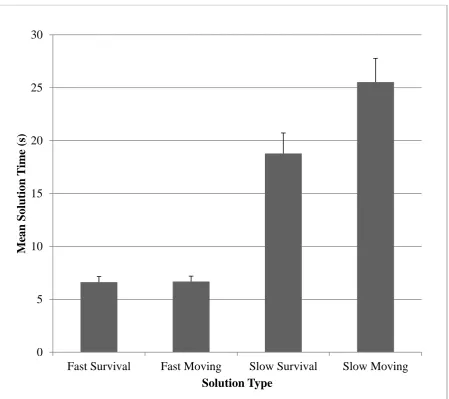
solvers (fast solvers were defined as those who on average solved CRATs faster than the mean and slow solvers were those who on average solved CRATs slower than this mean). For fast solvers, there was no significant difference between rating conditions, with
participants who were primed in the moving condition solving CRATs equally as fast (M = 6.68-sec) as those in the survival condition (M = 6.63-sec). However, for slow solvers, there was a significant difference due to rating condition, with slow solvers who were primed in the
survival condition solving CRATs significantly quicker (M = 18.79-sec) than slow solvers who were primed in the moving condition (M = 25.54-sec), F(1, 19) = 5.18, p < .05, 2p = .21
Discussion
The aim of the present study was to extend current research that demonstrates the
adaptive significance of false memories, particularly when it comes to priming insight-based
problem solving. To do this, we presented participants with the now robust false memory,
priming paradigm (Howe et al., 2010, 2011, 2013, in press). However, instead of using an
intentional memory design in which participants studied information and were then tested on
their memory for that information, we used an incidental memory paradigm without memory
testing. We choose this paradigm because we believe it has greater ecological validity. That
is, it more closely resembles what people do spontaneously. That is, they do not always
intentionally memorise information in their immediate environment or, even if they do, they
are not routinely tested for that information prior to using it in a subsequent
(problem-solving) context. To this end, in the current research, incidental false memories were created
using DRM list items that were rated for their relevance to either a survival or a moving
scenario. We predicted that CRAT problems that were primed by false memories would have
faster solution times and higher solution rates than those that were not primed. As well, we
anticipated that false memory primes created from survival processing would exhibit greater
facilitation for CRAT solution times and rates than those created from processing information
for its relevance to moving.
The results confirmed our predictions. Participants who were primed solved more
CRATs than those who were not primed, with participants also solving more CRATs when
primed in the survival than the moving condition. In addition, when participants were
categorised based on the speed of their problems-solving responses, slow solvers’ solution
rates tended to be faster for those who rated items in the survival condition than in the
moving condition. These results not only extend previous findings using an intentional
memory task in which information is processed for its survival relevance serve as better
primes than those created when information is processed for its relevance to moving.
These findings are unique in a number of ways. First, this is the first research to
demonstrate that false memories created out of incidental processing, like those generated
from intentional memory tasks, are capable of priming insight-based problem-solving tasks.
This is particularly important when considering the various types of adaptive functions that
false memories could serve. Moreover, this is critical to understanding false memory priming
in real-life adaptive problem-solving situations in which prior information is not intentionally
being remembered and may not be used or tested prior to solving a survival-relevant problem.
In these real-life situations, information is not intentionally acquired, but is more frequently
acquired incidentally during the processing of more general information in the environment.
Second, this research is the first to demonstrate that the facilitation of problem solving
speed in this paradigm may be limited to those participants who are categorised as slow
solvers. This suggests that spreading activation from priming is most beneficial when
participants are relatively slower at reaching the correct problem solutions. That there was
little or no facilitation occurring for participants who are already fast problem solvers may
represent an important individual differences factor in adaptive memory. However, such a
conclusion must await further research as the finding on which it is based may be
complicated by overall ceiling effects in speed of processing for the fast problem solvers.
Third, these findings extend research by Howe et al. (in press) who found that false
memories for survival-related information serve as better primes for problem solving than
neutral false memory primes. That is, the current research demonstrated that this survival
advantage for problem solving occurs not just for intentionally remembered survival
information but also for information that was processed for its survival value. Although
to false memories, this decrease in memory accuracy comes with an advantage, which is that
these false memories serve as better primes on later problem solving tasks.
Why is it that false memories created out of survival information and survival
processing served as better primes? From a spreading activation perspective, survival
information is generally thought to contain highly inter-related concepts in memory and is
represented in memory in denser, more highly integrated associative networks (e.g. Howe &
Derbish, 2010). Spreading activation through these more densely integrated concepts
promotes more relational processing than other types of information or information processed
for purposes other than survival (also see Howe & Otgaar, in press). Indeed, there is research
suggesting that survival processing encourages more item-specific information
(stimulus-specific features that make items distinctive in memory) and relational information
(across-item information that links different stimuli, enhancing memory integration) processing
(Kroneisen & Erdfelder, 2001). Although both of these processes make information more
easily remembered, they also increase false memory rates (Howe & Derbish, in press). By
this account, increased spreading activation caused by survival processing will be more rapid
and efficient, providing enhanced access to both true and false memories during later problem
solving (e.g. Porter & Leach, 2010).
Interestingly, the present research also reports an unanticipated finding, namely, a
facilitation effect of survival processing on problem solving more generally. That is, there
was an overall facilitation from survival processing that was obtained even on problems that
were not primed with a false memory. Although unexpected, these results are exciting and fit
well with adaptive theories of memory and problem solving. Indeed, this finding suggests
that the power of survival processing lies not just in the retention of survival-relevant
information, but also in the improvement of problem-solving ability more generally. A
having demonstrated the importance of creativity, affect, mood, confidence, and achievement
motivation (Cassidy, 2012; Cassidy & Burnside, 1996; Cassidy & Long, 1996). However, to
our knowledge, the present research is the first to demonstrate the influence of survival
processing on general problem-solving abilities. The precise mechanisms that underlie this
survival processing advantage in problem solving are not known. However, perhaps it is
related to a number of factors, ones that encourage the construction of a survival schema or a
survival ‘frame of mind’ that increases one’s readiness or motivation to solve problems. If
true, then future research should consider the fitness relevance of survival processing in terms
of problem solving, and not just its ability to improve the retention of information.
It should be noted that although our research successfully demonstrates that false
memories can have adaptive consequences for problem solving within the controlled
laboratory conditions used in this experiment, these findings may not necessarily generalise
to more episodic memory situations, such as those in real life survival scenarios. A number
of other factors may play a role within these situations, such as arousal, stress, motivation,
and so forth, factors that should be considered in future research. However, it should be
noted that the adaptive consequences of false memories have been demonstrated outside of
associative memory paradigms. For example, Edleson, Sharot, Dolan, and Dudai (2011)
have shown that misinformation errors, such as those caused by social conformity, may
reflect the operation of a flexible memory system that is designed to update memory with
new information. This ability, however, comes at a cost in situations such as eyewitness
memory, when source memory accuracy is stressed (for additional examples, see Howe,
2011; Newman & Lindsay, 2009; Schacter et al., 2011).
To summarise, the present research has demonstrated that an increase in false
memories from survival processing may not be maladaptive. This is particularly poignant
research adds to the growing list of adaptive benefits provided by our powerful and
reconstructive memory system, ones that accrue regardless of whether our focus on
“memory” is on information that was actually experienced (true memory) or for
References
Bowden, E. M., Jung-Beeman, M. J., Fleck, J., & Kounios, J. (2005). New approaches to
demystifying insight. Trends in Cognitive Sciences, 9, 322-328.
Cassidy, T. (2002). Problem-solving style, achievement motivation, psychological distress
and response to a simulated emergency. Counselling Psychology Quarterly, 15, 325-332.
Cassidy, T. & Burnside, E. (1996). Cognitive appraisal, vulnerability and coping: An
integrative analysis of appraisal and coping mechanisms. Counselling Psychology Quarterly, 9, 261–279.
Cassidy, T. & Long, C. (1996) Problem-solving style, stress and psychological illness:
Development of a multifactorial measure. British Journal of Clinical Psychology, 35, 265–277.
Deese, J. (1959). On the prediction of occurrence of particular verbal intrusions in
immediate recall. Journal of Experimental Psychology, 58, 17-22.
Dewhurst, S. A., & Marlborough, M. A. (2003). Memory bias in the recall of pre‐exam
anxiety: the influence of self‐enhancement. Applied cognitive psychology, 17, 695-702.
Edelson, M., Sharot, T., Dolan, R. J., & Dudai, Y. (2011). Following the crowd: brain
substrates of long-term memory conformity. Science, 333(6038), 108-111.
Howe, M. L. (2011). The adaptive nature of memory and its illusions. Current Directions in Psychological Science, 20, 312-315.
Howe, M. L., & Derbish, M. H. (2010). On the susceptibility of adaptive memory to false
memory illusions. Cognition, 115, 252-267.
Howe, M. L. & Derbish, M. H. (in press). Adaptive memory: Survival processing,
Toglia, & H. Otgaar (Eds.), What is adaptive about adaptive memory? New York: Oxford University Press.
Howe, M. L., Garner, S. R., & Patel, M. (in press). The positive consequences of false
memories. Behavioural Science and the Law.
Howe, M. L., Garner, S. R., Charlesworth, M., & Knott, L. (2011). A brighter side to memory
illusions: False memories prime children’s and adults’ insight-based problem solving.
Journal of Experimental Child Psychology, 108, 383-393.
Howe, M. L., Garner, S. R., Dewhurst, S. A., & Ball, L. J. (2010). Can false memories prime
problem solutions? Cognition, 117, 176-181.
Howe, M. L., & Otgaar, H. (in press). Proximate mechanisms and the development of
adaptive memory. Current Directions in Psychological Science.
Howe, M. L., Wilkinson, S., Monaghan, P., Ball, L. J., & Garner, S. R. (2013). Why are illusions adaptive? The curious case of false memories. Manuscript submitted for publication.
Howe, M. L., Wimmer, M. C., Gagnon, N., & Plumpton, S. (2009). An associative-activation
theory of children’s and adults’memory illusions. Journal of Memory and Language,
60, 229–251.
Jablonka, E., Oborny, B., Molnar, I., Kisdi, E., Hofbauer, J., & Czaran, T. (1995). The
adaptive advantage of phenotypic memory in changing environments. Philosophical Transactions of the Royal Society of London. Series B: Biological Sciences,
350(1332), 133-141.
Kang, S. H., McDermott, K. B., & Cohen, S. M. (2008). The mnemonic advantage of
Klein, S. B. (in press). Evolution, memory, and the role of self-referent recall in planning for
the future. In B. L. Schwartz, M. L. Howe, M. P. Toglia, & H. Otgaar (Eds.), What is adaptive about adaptive memory? New York: Oxford University Press.
Klein, S., Cosmides, L., Tooby, J., & Chance, S. (2002). Decisions and the evolution of
memory: Multiple systems, multiple functions. Psychological Review, 109, 306-329. Knoblich, G., Ohlsson, S., Haider, H., & Rhenius, D. (1999). Constraint relaxation and chunk
decomposition in insight problem solving. Journal of Experimental Psychology: Learning, Memory, and Cognition, 25, 1534-1542.
Kroneisen, M., & Erdfelder, E. (2001). On the plasticity of the survival processing effect.
Journal of Experimental Psychology: Learning, Memory, and Cognition, 37, 1553-1562.
Mednick, S. A. (1962). The associative basis of the creative process. Psychological Review, 69, 220-232.
Nairne, J. S., Pandeirada, J. N., & Thompson, S. R. (2008). Adaptive memory: The
comparative value of survival processing. Psychological Science, 19, 176-180. Nairne, J. S., Thompson, S. R., & Pandeirada, J. N. S. (2007). Adaptive memory: Survival
processing enhances retention. Journal of Experimental Psychology: Learning, Memory, & Cognition,33, 263-273.
Newman, E. J., & Lindsay, D. S. (2009). False memories: What the hell are they for? Applied Cognitive Psychology, 23, 1105 – 1121.
Otgaar, H., Howe, M. L., Smeets, T., Raymaekers, L., & van Beers, J. (in press). Memory
errors in adaptive recollections. In B. L. Schwartz, M. L. Howe, M. P. Toglia, & H.
Otgaar, H., & Smeets, T. (2010). Adaptive memory: Survival processing increases both true
and false memory in adults and children. Journal of Experimental Psychology: Learning, Memory, and Cognition, 36, 1010-1016.
Otgaar, H., Smeets, T., & van Bergen, S. (2010). Picturing survival memories: Enhanced
memory after fitness-relevant processing occurs for verbal and visual stimuli. Memory & Cognition, 38, 23-28.
Porter, H., & Leach, J. (2010). Executive dysfunction in a survival environment. Applied Cognitive Psychology, 24, 41-66.
Roediger, H. L., III, & McDermott, K. B. (1995). Creating false memories: Remembering
words not presented on lists. Journal of Experimental Psychology: Learning, Memory, and Cognition, 21, 803-814.
Roediger, H. L., III, Watson, J. M., McDermott, K. B., & Gallo, D. A. (2001). Factors that
determine false recall: A multiple regression analysis. Psychonomic Bulletin & Review, 8, 385-407.
Schacter, D. L., Guerin, S. A., & St Jacques, P. L. (2011). Memory distortion: an adaptive
perspective. Trends in Cognitive Sciences, 15, 467-474.
Weinstein, Y., Bugg, J.M., & Roediger, H.L. (2008). Can the survival recall advantage be
Appendix
DRM Lists and Associated CRAT Problems (critical lure/CRAT solution in CAPs)
CRAT problem DRM list
band/ball/tyre
RUBBER - elastic, bounce, ball, eraser, springy, foam, soles, latex, glue,
flexible, resilient, stretch
spa/mental/care
HEALTH - sickness, happiness, wealth, ill, doctor, service, strong, hospital, disease, body, centre, pain
shop/washer/frame
WINDOW - door, glass, pane, shade, ledge, sill, house, curtain, view, breeze, screen, shutter
base/territorial/boot
ARMY - Navy, soldier, United States, rifle, air force, military, Marines, infantry, captain, way, uniform, combat
pole/national/ship
FLAG - banner, American, symbol, stars, anthem, stripes, wave, raised, checkered, emblem, sign, freedom
flower/friend/scout
GIRL - boy, dolls, female, young, dress, pretty, niece, beautiful, cute, date, daughter, sister
bomb/white/alarm
SMOKE - cigarette, puff, blaze, pollution, ashes, cigar, chimney, fire, tobacco, pipe, lungs, flames
tooth/potato/heart
Authors’ Note
Sarah R. Garner, Department of Psychology, Lancaster University, UK. Professor Mark L.
Howe, Department of Psychology, City University London, Northampton Square, London
UK. This research was supported by grants to MLH from the Economic and Social Research
Council of Great Britain (RES-062-23-0452 and RES-062-23-3327). Address
correspondence to either Sarah R. Garner ([email protected]) or Professor Mark L.
Note: Error bars represent standard errors. Times are presented in seconds(s).
Figure 1. Mean solution times for fast and slow solvers as a function of rating condition. 0
5 10 15 20 25 30
Fast Survival Fast Moving Slow Survival Slow Moving
M
ean S
olu
tion
T
im
e
(s)