City, University of London Institutional Repository
Citation
:
Ayers, S., Radoš, S.N. & Balouch, S. (2015). Narratives of traumatic birth: Quality and changes over time. Psychological Trauma: Theory, Research, Practice, and Policy, 7(3), doi: 10.1037/a0039044This is the accepted version of the paper.
This version of the publication may differ from the final published
version.
Permanent repository link: http://openaccess.city.ac.uk/11896/
Link to published version
:
http://dx.doi.org/10.1037/a0039044Copyright and reuse:
City Research Online aims to make research
outputs of City, University of London available to a wider audience.
Copyright and Moral Rights remain with the author(s) and/or copyright
holders. URLs from City Research Online may be freely distributed and
linked to.
City Research Online: http://openaccess.city.ac.uk/ [email protected]
Narratives of Traumatic Birth: Quality and Changes over Time
Susan Ayers a,*, Sandra Nakić Radoš b,Sara Balouch c
a
Centre for Maternal and Child Health Research, School of Health Sciences, City University
London, London EC1A 7QN, UK
b
Department of Obstetrics & Gynaecology, University Hospital Centre Sisters of Mercy,
Vinogradska 29, Zagreb, Croatia
c
School of Psychology, University of Sussex, Brighton, BN1 9QH, UK
* Corresponding author:
Susan Ayers, PhD CPsychol
Professor of Maternal and Child Health
Centre for Maternal and Child Health Research
School of Health Sciences
City University London
London EC1A 7QN
Tel: +44 (0)20 7040 5834
Fax: +44 (0)20 7040 5457
E-mail: [email protected]
Acknowledgements
We wish to thank all the women who took part in this study and Michele McKenner for her
Abstract
Childbirth is a highly emotive event that can involve complications. Around 1% of births in the UK involve life-threatening complications to the mother (Waterstone, Bewley, & Wolfe, 2001) and 0.8% result in stillbirth or perinatal death (Confidential Enquiry into Maternal and Child Health (CEMACH, 2009). A review found that 3.1% of women report post-traumatic stress disorder (PTSD) after birth (Grekin & O’Hara, 2014). The aim of this study was to examine whether narrative characteristics of traumatic birth were specific to women with PTSD or observed in all women who experience a highly emotive and potentially traumatic birth. Parturient women were matched for birth events, but either had severe PTSD symptoms (n=22) or no, or very low, PTSD symptoms (n=22). Women were interviewed about the birth three and six months postpartum, and their birth narratives were examined for content, coherence, cognitive and perceptual processing. Results showed birth narratives became shorter and more coherent over time. Consistent with PTSD literature, birth memories were more likely to be recalled and involuntarily triggered in women with PTSD symptoms. However, women with PTSD symptoms had more coherent narratives, used more causal and fewer tentative words. These latter findings are inconsistent with research finding that PTSD is associated with fragmented or incoherent memories, but are consistent with the view that highly emotive events result in improved memory (e.g. Berntsen, Willert, & Rubin, 2003). Possible reasons for this are discussed.
Introduction
Linguistic narratives of events are thought to be closely related to how such events are conceptualised cognitively. Many theories of language suggest language and speech are central in the development of cognitive concepts and awareness (e.g. Sapir, 1921; Vygotsky, 1934; Whorf, 1956). Narrative stories of traumatic events are central to psychotherapeutic treatment of post-traumatic stress disorder (PTSD). There is evidence that characteristics of trauma narratives are associated with PTSD; and that recovery during therapy is associated with changes in narratives. For example, studies of responses to traumatic events, such as road traffic accidents or assault, show an association between PTSD and trauma narratives that are less coherent and more disorganised (Evans, Ehlers, Mezey, & Clark, 2007; van Minnen, Wessel, Dijkstra, & Roelofs, 2002). Similarly, studies of changes in people’s trauma
narratives during therapy suggest recovery may be associated with increased narrative length, increased organisation of thoughts about the event, and increased conceptual processing (Foa, Molnar, & Cashman, 1995; Kindt, Buck, Arntz, & Soeter, 2007).
trauma memories and nontrauma memories in clinical samples of people with diagnosed PTSD. However, there is less evidence this is the case in nonclinical samples of people who have experienced a traumatic event and show a range of PTSD symptoms but do not have diagnostic disorder (Brewin, 2007).
Alternative explanations include the landmark hypothesis (Berntsen et al., 2003) which argues that trauma memories are similar to other autobiographical memories formed under conditions of strong emotional arousal. Berntsen et al. (2003) refer to research on autobiographical memory in nonclinical samples that suggests emotional arousal – whether positive or negative - improves memory for key characteristics of the event. They propose that these significant emotional events act as ‘landmarks’ by having multiple links with other
autobiographic memories and therein become a reference point for interpreting new
experiences and generating expectations. There is some evidence to support this view with, for example, Berntsen et al. (2003) finding that although students with a PTSD symptom profile reported more emotional and sensory memories they did not report more memory fragmentation than students without PTSD.
Studies that use people’s narratives to examine autobiographical memory disruption
provide mixed support for these different explanations. A review of narrative studies
concluded there is consistent evidence PTSD symptoms are associated with increased sensory and perceptual information but evidence is inconsistent about whether the coherence of trauma narratives (as measured by fragmentation, disorganised or organised thoughts in narratives) is associated with PTSD (O'Kearney & Perrott, 2006). It is possible that these narrative characteristics are not specific to PTSD but observed in many people following a highly emotive or potentially traumatic event. As O’Kerney and Perrott point out, these
often with different conceptualisation and measures of fragmentation or coherence in
narratives. Analysis of narratives ranges from qualitative examination of codes to quantitative examination of linguistic characteristics such as the proportion of different word categories used or reading level (Zoellner, Alvarez-Conrad, & Foa, 2002). Both these approaches make assumptions about the relationship between variables such as repetition or reading ease and fragmented memories. Many have therefore called for more reliable measures of coherence or fragmentation (Brewin & Holmes, 2003; O'Kearney & Perrott, 2006). A first step towards this would be to use multiple measures of narrative characteristics to see if they are consistent.
The current study examines some of these issues by looking at the coherence and content of narratives of difficult or traumatic births. Childbirth is a highly emotive event that can involve complications. Around 1% of births in the UK involve life-threatening
complications to the mother (Waterstone et al., 2001) and 0.8% result in stillbirth or perinatal death (CEMACH, 2009). A review of PTSD after birth concluded that 3.1% of women report PTSD after birth (Grekin & O’Hara, 2014). Childbirth therefore provides an ideal paradigm to examine characteristics of memories for an emotive event that can be positive, negative or traumatic. However, surprisingly little research has been done in this area. One study looked at narratives of birth within 72 hours after birth and the association with PTSD symptoms and disorganised memories six weeks postpartum (Briddon, Slade, Isaac, & Wrench, 2011). This study found that although less positive birth experiences were associated with disorganised narratives, there was no relationship between disorganised narratives and PTSD. This suggests that negative emotional events may disrupt memory processes and result in
memories were more central to a woman’s identity (Foley, Crawley, Wilkie & Ayers, 2014).
However, to date these are the only studies to look at this in relation to childbirth and use different methods and measures so more research is needed to replicate or refute this.
In summary, previous studies provide inconsistent results in respect to whether the coherence of trauma narratives is associated with PTSD. The relationship between coherence of trauma narratives and PTSD is important in terms of informing and developing theories of PTSD. Childbirth is a highly emotive event that is traumatic for a small proportion of women. It therefore provides a unique opportunity to examine differences in trauma narratives
between women who have PTSD or not after birth. However, to date only one study has examined this.
The aim of the study was therefore to examine whether narrative characteristics are specific to PTSD or observed in all those who experience a highly emotive and potentially traumatic event, such as birth, and to examine changes of narrative characteristic over time. Women with high PTSD symptoms after a difficult or traumatic birth were matched on key obstetric events with women with no, or very low, PTSD symptoms. Thus groups were matched for the objective severity of birth to ensure that all women experienced potentially traumatic birth events. Descriptions of women’s experiences of birth and appraisals are
reported elsewhere (Ayers, 2007). In this analysis, narratives three and six months after birth were examined for content (threat, emotion, support, and postpartum stress), coherence (fragmentation, nonfluencies, inability to remember details), cognitive and perceptual
processing. It was hypothesised that women with PTSD symptoms would have more sensory, perceptual and emotional information in their narratives. No hypothesis was made for
would change over time because of the lack of evidence in relation to change of birth narratives over time1.
Method
Sample
Women were recruited from a prospective study that followed community sample of women (N = 289) from pregnancy to six months after birth (Ayers & Pickering, 2001). Inclusion criteria for PTSD symptom groupwasscore above the cut off for severe childbirth-related posttraumatic stress symptoms on either of two questionnaires (PTSD Symptom Scale and Impact of Event Scale) completed one and six weeks after birth. Thirty-eight women fulfilled criteria for inclusion. Eligible women were contacted by telephone or mail and asked if they would participate in the study. Twenty eight (74%) of these women agreed to take part in the study. Due to recording errors data for three women could not be used; and a further three women did not complete the six month interview, leaving 22 women in the PTSD symptom group. None of the participants were engaged in the therapy.
Women with high symptoms of childbirth-related posttraumatic stress were matched with women with no symptoms based on obstetrical variables. Women were eligible for inclusion in the control group (1) if they either had no, or very low, symptoms of
In both groups, 68.2% (n=15) of women were primiparous and 31.8% (n=7) were multiparous. The two groups did not differ in ethnicity, education level, marital status, previous traumatic delivery, or previous psychological problems. However, a larger
proportion of women in the PTSD symptom group had previous traumatic events other than birth (χ2
(1)=4.49, p<0.05). Previous traumatic events mostly included previous miscarriage (3 women in PTSD group and 2 in control group), death of a close person (3 women in PTSD group and 2 in control group), rape (2 women in PTSD group), and other traumatic events (6 women in PTSD group and 2 in control group).
Description of sample recruitment and qualitative description of women’s birth
experiences and appraisals is reported elsewhere (Ayers, 2007).
Procedure and Measures
Women were screened for PTSD symptoms using the PTSD Symptom Scale (PSS; Foa, Riggs, Dancu, & Rothbaum, 1993) or Impact of Event Scale (IES; Horowitz, Wilner, & Alverez, 1979) 1 week, 6 weeks, 3 months and 6 months after birth. The PSS is a 17-item scale (range 0-51) which measures DSM-IV symptoms of re-experiencing, avoidance and numbing, and arousal. A cut-off of >15 was used to indicate severe PTSD symptoms as recommended by Falsetti, Resnick, Resick, and Kilpatrick (1993) for use in nonclinical samples. The items were modified in that wording the traumatic event was replaced with
birth. The IES is a 15-item scale (range 0–75) that was anchored to birth and measured
symptoms of intrusion (7 items; range 0-35) and avoidance (8 items; range 0-40). A cut-off of >20 on either subscale was used to indicate severe symptoms as recommended by (Horowitz, 1982). These measures do not measure event criteria A so diagnosis of PTSD was not
possible. Hence we refer to this group as a PTSD symptom group.
spontaneous narratives of birth. The first part of the semi-structured interview therefore asked women to recount their experiences from the beginning of labor to when their baby was born (e.g. If you could remember back to when your contractions first started and then describe to
me from there what happened up until your baby was born?). In the second part of the
interview, women were asked about their responses to birth, support, additional stress, and trauma history (e.g. How did you feel after baby was born? Do you still think about the birth now? Did you had a lot of support after you had baby? Has anything traumatic ever
happened to you in the past?). Finally, women were asked how often they remembered the
birth and whether isolated parts of their memories of birth were triggered. In the 6 months interview, there was an additional question on stressful events in the period from 3-month interview (e.g. Have you found anything else really stressful over the last few months?). Interviews were taped and transcribed and analyzed using NVivo8 software (NVivo, 2008) and Linguistic Inquiry Word Count (LIWC, 2007).
Narrative contentwas measured using guided thematic analysis to identify quotes directly relevant to aspects of birth identified as important by theory and evidence on postpartum PTSD (e.g. Ayers 2004; Ayers & Ford 2014). The first aspect was threat and emotions during birth. This included DSM-IV Criterion A variables (baby-life threat; own-life threat; threat of injury; fear, helplessness or horror) as well as other negative emotions
mentioned by women. The second aspect was support during and after birth (Ford & Ayers, 2011). Support was coded for partners, staff, and others (friends and families). Finally, postpartum stress was coded to include postpartum mental health problems, ongoing physical problems for the woman, or with the baby. These were coded as present only when women directly specified mental health problems (e.g. panic, depression) or ongoing physical problems, but none of the interview questions addressed this specifically.
these variables. In the first step, six interviews were examined and all segments of interviews relevant to the above variables were coded. Codes and themes were discussed and agreed by the first and second authors and a coding schedule developed. In the second step, all interview transcripts were coded using the coding schedule. Reliability of coding was checked in two ways. First, the researchers went through each code and checked that all coded segments were appropriate to that code. Second, an external rater coded 10% of coded segments in each code chosen randomly. Kappacoefficient was calculated for each code with an average of .89 (range 0.70 to 1.0), indicating high inter-rater reliability.
Finally, the frequency with which each code occurred in narratives of women with and without PTSD three and six months after birth was calculated. Some of the codes occurred more than once within one interview but they were coded each time. Therefore, the frequency numbers presented in the result section were calculated as the total sum of the code
occurrence.
Narrative coherencewas measured in three ways. First, the coding system developed by Foa et al. (1995) was used to measure fragmented memory. This looks at various
parameters of fragmented memory: repetition of utterance unit, unfinished thoughts, and speech fillers. Repetition was coded if an utterance unit was repeated within five lines (e.g. “No one came to see me. There was no nurse or no doctor, nobody came to see me.”). Unfinished thought was coded when thought was not finished (e.g. “I was...”, “I didn’t care what I...”). Examples of speech fillers are: “um”, “you know”, and “like”.
Cognitive and perceptual processingwas measured using LIWC to calculate the proportion of women’s narratives that comprised of words indicating cognitive or perceptual
processing. Cognitive processing words included insight (e.g. mean, aware), causation (e.g.
lead, reason), discrepancy (e.g. shouldn’t, wouldn’t), tentative (e.g. guess, might), certainty
(e.g. absolutely, clearly), inhibition (e.g. restrain, block), inclusive (e.g. both, close), and exclusive (e.g. except, either) words. Perceptual processing words included seeing, hearing, and feeling words. Prior to analysis using LIWC (2007), women’s narratives were prepared as
per the LIWC manual (Pennebaker, Booth, & Francis, 2007). Sample of narrative coding is presented in Figure 1.
Analysis
Most narrative content and coherence variables were positively skewed so were analysed using Chi-Square or Fisher’s exact test when expected frequencies were less than 5, or were first log transformed. In contrast, linguistic text analysis data were normally
distributed so analysed using repeated measures ANOVA. Because of the relatively small sample, effect sizes (partial eta squared, η2
) are also reported for repeated measures ANOVA. These are interpreted as small (η2
> 0.01), medium (η2 > 0.06) or large (η2 > 0.14) effects (Cohen, 1988).
Results
PTSD symptoms over time
measurement points. Symptoms in the PTSD symptom group decreased from 6 weeks to 6 months, and this effect was significant on IES scale (t(21) = 5.99, p < .001), but not significant on the PSS scale (t(21) = 1.97, ns).
Narratives of birth
Narratives of birth ranged greatly in length for all participants. In the whole sample the word count at three months ranged from 470 to 7701 and decreased significantly over time (word count at six months 171 to 2629; F(1) = 79.85, p < .001). However, there were no differences between women in the PTSD and control groups (F(1, 42) = 0.09, ns). Results are reported below for differences in narrative content, coherence, and cognitive/perceptual processing.
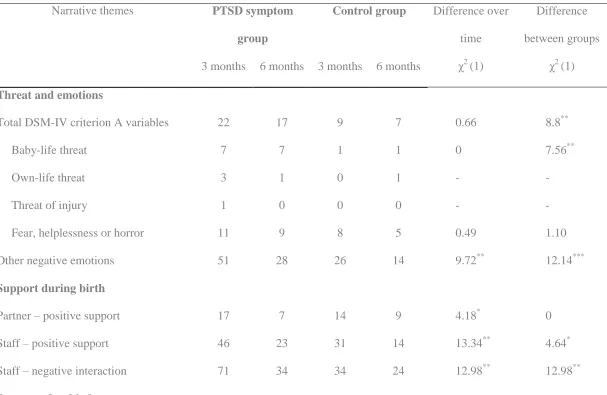
Narrative content.Differences in narratives of high and low PTSD women over time for threat and emotion, support, and postpartum stress are shown in Table 2. Hypotheses regarding emotional content were partly supported. Although there were no differences between the PTSD symptom and control groups in specific aspects of DSM-IV Criterion A, women with PTSD perceived significantly more threat to the baby and had a higher frequency for total DSM-IV Criterion A variables. They also described more negative emotions than the control group. Although mention of these negative emotions decreased over time, they
remained more frequent than Criterion A emotions of fear, helplessness and horror combined (χ2
(1) = 47.54, p<.001).
In relation to postpartum stress, women in the PTSD symptom group described more postpartum mental health issues, such as depression and panic attacks, as well as more long-lasting or ongoing physical problems, e.g. difficulty with episiotomy healing or breast
narratives did not change significantly over time except for negative interactions with partner which increased. In contrast, the occurrence of support during birth in narratives significantly decreased over time for all women regardless of whether it was positive or negative support or who provided it. There were no significant differences between the PTSD and control groups in positive support from the partner. Since only one woman mentioned negative interaction with her partner during birth, it was not analysed.Support from staff appeared more important with women in the PTSD symptom group describing both more positive and negative support from staff.
Narrative coherence. Differences in coded narrative coherence are shown in Table 2. Results indicate groups did not differ significantly in the frequency with which they
mentioned not remembering details about the birth or their frequency of unfinished thoughts. On the other hand, differences were found in aspects of memory directly related to reliving symptoms; namely that women in the PTSD symptom group remembered their birth more frequently and isolated parts of memory were more likely to be triggered. Women in the PTSD symptom group also had significantly more repetition in their narratives but used less speech fillers.
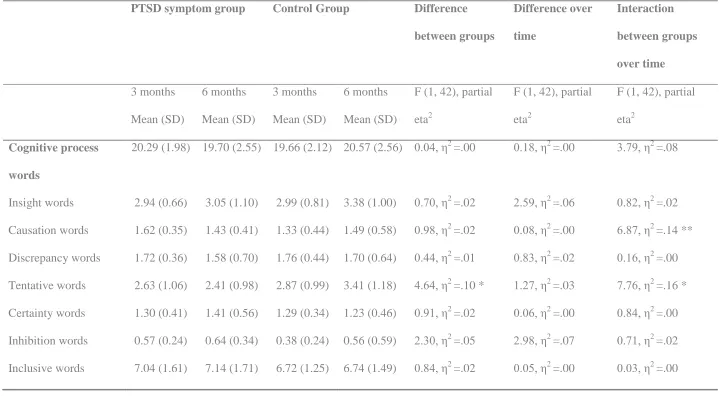
Results of linguistic text analysis are shown in Table 3 and are consistent with these findings in that women in the PTSD group had proportionately fewer nonfluencies and speech fillers than women in the control group, although the difference between groups is not
significant for speech fillers but the effect size indicates a medium sized effect (η2 >.06). In both groups, most measures of narrative incoherence decreased over time, although this decrease was not always significant.
supported. There were no significant differences between groups in the proportion of perceptual processing words used in narratives. Interestingly, perceptual processing words made up approximately 2.5% of women’s narratives of birth, whereas cognitive processing
words made up approximately 20%. There were few significant differences between groups in the types of cognitive processing words used in narratives. The exception was that significant interactions were observed between groups over time in the use of tentative and causal words. Women in the PTSD symptom group used less tentative words at both time points and the use of tentative words even decreased over time for PTSD group but not for the control group. The PTSD symptom group also used more causal words at three months but this reduced to similar levels as the control group six months after birth.
Discussion
This is the first study to look at characteristics of narratives of birth over time in women who appraised birth as traumatic but did or did not have PTSD symptoms as a result of the birth. The results suggest the narratives of women with and without PTSD symptoms were broadly equivalent in most aspects of coherence. Women with PTSD used more repetition in their narratives but did not differ in their use of speech fillers, nonfluencies, not being able to remember aspects of birth or the occurrence of unfinished thoughts about the birth in their narratives. Cognitive and perceptual processing words in narratives also did not differ between groups or over time; with the exception that women with PTSD used less tentative words and more causal words. Other key findings are that narratives became shorter and more coherent over time for all women. The area where narratives of women with PTSD symptoms
did differ was in aspects of reliving the birth, such as frequency of recall and memories being triggered.
traumatic birth. The focus on birth in this study extends the range of events that have been examined in literature on memory for traumatic events. The use of different methods of measuring memory characteristics also allows us to consider how measurement may influence memory characteristics identified and subsequent results. However, there are a number of ways in which birth differs from other traumatic events. These include that birth is a normative event, in that it is a common occurrence. Birth is also subject to many cultural expectations about the context, sequence of events, and the birth of the baby being a positive outcome. Similarly, talking about birth is not taboo or culturally unacceptable in the way that talking about many other traumatic events might be. Women may therefore have many opportunities to tell their birth story so that it becomes well-rehearsed. All these factors are likely to influence women’s narratives. Generalisation from these narratives and memories of
birth to other traumatic events must therefore be tentative.
The current study is consistent with this previous research and theory in that it confirms women with PTSD symptoms recalled more emotional information, recalled birth more often, and that specific memories of birth were more likely to be triggered. However, expected differences in perceptual information, sensory information, and narrative coherence were not observed. A key issue is how these results fit with previous literature and theoretical
understandings of PTSD. As mentioned in the introduction, cognitive theories of PTSD argue that trauma memories are more dominated by sensory, perceptual, and emotional information; as well as being more fragmented, disorganised, and involuntarily recalled. Previous narrative research supports differences in sensory, perceptual and emotional information, but not in fragmented or incoherent narratives (O'Kearney & Perrott, 2006). The inconsistency between this study and previous literature may be due to the factors mentioned above or to
memories concluded there is evidence these memories are more fragmented, disorganised, and involuntarily recalled in clinical samples; but less evidence this is the case in nonclinical samples (Brewin, 2007).
Although these results may be restricted to non-clinical samples or postpartum women they still raise a number of issues and questions. The first is that, if narrative incoherence is observed in all women after a traumatic birth, and some measures of incoherence are higher in women without PTSD symptoms; then what is the relationship between narrative incoherence and PTSD after birth? One possible explanation is consistent with the landmark hypothesis (Berntsen et al., 2003) which is that narrative incoherence occurs as a result of experiencing a highly emotive event but is not specific to PTSD. A few other research studies support this view. For example, Bohanek, Fivush, and Walker (2005) found no differences in narrative characteristics for negative events and traumatic events. Another possibility is that, contrary to previous beliefs, people with PTSD are more coherent and show more causal processing and less tentative words than others who experience a traumatic event but do not have PTSD. Again, there is some other research evidence supporting this. Megías, Ryan, Vaquero, and Frese (2007) carried out a study of characteristics of trauma memories (as measured by self-report questionnaire) using a similar design to the current study where people who had experienced a range of traumatic events were divided into those with or without PTSD symptoms. They found that trauma memories for people with PTSD were more clear and detailed compared to the control group.
A second issue is the use of women’s narratives to examine memory processes. Despite narratives often being used as a proxy measure of memory characteristics, they can be
influenced by many factors such as social context, verbal fluency, perceptions of the
addition, the current study used narratives from research interviews whereas many previous studies have taken narratives from therapy sessions where clients may be more emotionally engaged (e.g. Foa et al., 1995). Spontaneous narratives of birth or other traumatic events might not accurately reflect memory processes or the events but rather the individual’s
interpretation of what happened, their emotional response, and the sense they have made, or are making, of the traumatic event at the time of the interview. Thus in narratives of a difficult or traumatic birth, women’s accounts are likely to involve different appraisals and
interpretation of events, which was the case in this sample (Ayers, 2007). This is also supported by the finding that approximately 20% of women’s narratives comprised of
cognitive processing words.
The lack of expected differences in perceptual processing and coherence brings us to the third issue, which is that narrative content may be as, or more, important. In particular,
women with PTSD mentioned more negative emotions, positive support and negative interactions with staff. The importance of negative interaction with staff is consistent with a large amount of research showing that interpersonal traumas, such as abuse, are more pathogenic than non-interpersonal traumas (Charuvastra & Cloitre, 2008). Similarly, meta-analyses show that support is negatively associated with PTSD (Brewin, Andrews, &
Valentine, 2000). However, what is interesting in this study is that women with PTSD talked about both positive and negative interactions with staff. One explanation for this is that women with PTSD had more interpersonal difficulties during birth and negative emotions, and that these may have been more important than the actual events of birth in the onset of PTSD. An alternative explanation is that women with PTSD describe more negative emotion during birth and that recalling this negative emotion may in turn lead to narratives including more consideration of support and possible transgressions from others. There is some
had a current emotional impact people used more emotion words than if the event had no current emotional impact. Another possible explanation is that interactions with other people are more salient to women with high PTSD symptoms because they describe both more positive and negative interactions.
Finally, a number of other methodological issues need to be considered before drawing conclusions. The strengths of this study are that it used a matched design, multiple measures and was not confounded by women receiving therapy. The matching of women for birth events was important to examine which narrative characteristics were due to
experiencing traumatic birth and which were specific to PTSD. In addition, the longitudinal design enabled us to examine changes in these narratives over time. However, women in the PTSD group were identified as having severe symptoms on screening so did not have full diagnostic PTSD. In addition, symptoms decreased over time in the PTSD group. This means lack of differences in narratives at six months may be because there was not a large enough difference in PTSD symptoms between the PTSD and control groups at this point. Finally, the sample was small and effect sizes suggest the study was only powered to identify medium to large effects as significant. It is therefore important that narrative characteristics in people exposed to trauma are examined further in larger samples where the PTSD group is identified using clinical interviews. Future research may also consider including a group of women who had a normal birth experience to check whether aspects of narratives are specific to having a traumatic experience or common to all women following birth.
Conclusions
Footnotes
References
Ayers S. (2004). Delivery as a traumatic event: prevalence, risk factors, screening & treatment. Clinical Obstetrics & Gynecology, 47(3), 552-567.
Ayers, S. (2007). Thoughts and emotions during traumatic birth: A qualitative study. Birth, 34(3), 253-263. doi:10.1111/j.1523-536X.2007.00178.x
Ayers, S., & Ford, E. (2014). Post-traumatic stress during pregnancy and the postpartum period. In A. Wenzel, & S. Stuart (Eds.), Oxford Handbook of Perinatal Psychology.
Oxford University Press.
Ayers, S., & Pickering, A. (2001). Do women get posttraumatic stress disorder as a result of childbirth? A prospective study of incidence. Birth, 2, 111-118. doi:10.1046/j.1523-536X.2001.00111.x
Berntsen, D., Willert, M., & Rubin, D.C. (2003). Splintered memories or vivid landmarks? Qualities and organization of traumatic memories with and without PTSD. Applied Cognitive Psychology, 17, 675-693. doi:10.1002/acp.894
Bohanek, J. G., Fivush, R., & Walker, E. (2005). Memories of positive and negative
emotional events. Applied Cognitive Psychology, 19(1), 51-66. doi:10.1002/acp.1064 Brewin, C. R. (2007). Autobiographical memory for trauma: Update on four controversies.
Memory, 15(3), 227-248. doi:10.1080/09658210701256423
Brewin, C. R., Andrews, B., & Valentine, J. D. (2000). Meta-analysis of risk factors for posttraumatic stress disorder in trauma-exposed adults. Journal of Consulting and Clinical Psychology, 68(5), 748-766. doi:10.1037/0022-006X.68.5.748
Brewin, C. R., & Holmes, E. A. (2003). Psychological theories of posttraumatic stress disorder. Clinical Psychology Review, 23, 339-376. doi:10.1016/S0272-7358(03)00033-3
Briddon, E., Slade, P., Isaac, C., & Wrench, I. (2011). How do memory processes relate to the development of posttraumatic stress symptoms following childbirth? Journal of
Anxiety Disorders, 25, 1001-1007. doi:10.1016/j.janxdis.2011.06.008
Charuvastra, A., & Cloitre, M. (2008). Social bonds and posttraumatic stress disorder. Annual Review of Psychology, 59, 301-328. doi:10.1146/annurev.psych.58.110405.085650 Cohen, J. (1988). Statistical power analysis for the behavioral sciences (2nd ed.). Hillsdale,
NJ: Lawrence Erlbaum Associates.
Confidential Enquiry into Maternal and Child Health (CEMACH). (2009). Perinatal Mortality 2007. London: CEMACH.
Ehlers, A., & Clark, D. M. (2000). A cognitive model of posttraumatic stress disorder.
Behaviour Research and Therapy, 38(4), 319-345. doi:10.1016/S0005-7967(99)00123-0
Evans, C., Ehlers, A., Mezey, G., & Clark, D. M. (2007). Intrusive memories in perpetrators of violent crime: Emotions and cognitions. Journal of Consulting and Clinical Psychology, 75(1), 134-144. doi:10.1037/0022-006X.75.1.134
Falsetti, S. A., Resnick, H. S., Resick, P. A., & Kilpatrick, D. G. (1993). The modified PTSD symptom scale: A brief self-report measure of posttraumatic stress disorder. Behavior Therapist, 16, 161-162.
Foa, E. B., Riggs, D. S., Dancu, C. V., & Rothbaum, B. O. (1993). Reliability and validity of a brief instrument for assessing post-traumatic stress disorder. Journal of Traumatic Stress, 6, 459-473. doi:10.1002/jts.2490060405
Foa, E. B., & Rothbaum, B. O. (1998). Treating the trauma of rape: Cognitive behavioral therapy for PTSD. New York: Guilford Press.
Foley, S., Crawley, R., Wilkie, S., & Ayers, S. (2014). The Birth Memories and Recall Questionnaire (BirthMARQ): development and evaluation. BMC Pregnancy and
Childbirth, 14, 211. doi:10.1186/1471-2393-14-211
Ford, E., & Ayers, S. (2011). Support during birth interacts with trauma history and birth intervention to predict postnatal post-traumatic stress symptoms. Psychology &
Health, 26, 1553-1570.
Grekin, R., & O’Hara, M.W. (2014). Prevalence and risk factors of postpartum posttraumatic
stress disorder: a meta-analysis. Clinical Psychology Review, 34(5), 389-401. doi: 10.1016/j.cpr.2014.05.003
Horowitz, M. J. (1982). Stress response syndromes and their treatment. In L. Goldberger & S. Breznitz (Eds.), Handbook of Stress: Theoretical and Clinical Aspects (pp. 711-732). New York: The Free Press.
Horowitz, M., Wilner, N., & Alverez, W. (1979). Impact of Event Scale: A measure of subjective stress. Psychosomatic Medicine, 41(3), 209-218.
Kindt, M., Buck, N., Arntz, A., & Soeter, M. (2007). Perceptual and conceptual processing as predictors of treatment outcome in PTSD. Journal of Behavior Therapy and
Megías, J. L., Ryan, E., Vaquero, J. M. M., & Frese, B. (2007). Comparisons of traumatic and positive memories in people with and without PTSD profile. Applied Cognitive
Psychology, 21(1), 117-130. doi:10.1002/acp.1282
NVivo qualitative data analysis software (Version 8). (2008). QSR International Pty Ltd. O'Kearney, R., & Perrott, K. (2006). Trauma narratives in posttraumatic stress disorder: A
review. Journal of Traumatic Stress, 19(1), 81-93. doi:10.1002/jts.20099
Pennebaker, J. W., Booth, R. J., & Francis, M. E. (2007). Operator's Manual: Linguistic Inquiry and Word Count: LIWC2007. Austin, Texas: www.LIWC.net.
Rullkoetter, N., Bullig, R., Driessen, M., Beblo, T., Mensebach, C., & Wingenfeld, K. (2009). Autobiographical memory and language use: Linguistic analyses of critical life event narratives in a non-clinical population. Applied Cognitive Psychology, 23(2), 278-287. doi:10.1002/acp.1456
Sapir, E. (1921). Language: An Introduction to the Study of Speech. New York: Harcourt, Brace.
van Minnen, A., Wessel, I., Dijkstra, T., & Roelofs, K. (2002). Changes in PTSD patients' narratives during prolonged exposure therapy: A replication and extension. Journal of Traumatic Stress, 15(3), 255-258. doi:10.1023/A:1015263513654
Vygotsky, L. (1934/1986). Thought and Language. Cambridge, MA: MIT Press.
Waterstone, M., Bewley, S., & Wolfe, C. (2001). Incidence and predictors of severe obstetric morbidity: Case-control study. British Medical Journal, 322(7294), 1089-1093. doi:10.1136/bmj.322.7294.1089
Table 1.
PTSD symptoms over time
PTSD symptom
group
Mean (SD)
Control
group
Mean (SD)
Difference
between groups
Appraisal of birth as traumatic 5.03 (3.11) 4.02 (2.86) t (41) = -1.12
PTSD symptoms
1 week postpartum
IES 34.81 (15.26) 7.00 (7.75) t (41) = -7.58 *** 6 weeks postpartum
IES 23.36 (13.39) 8.41 (7.28) t (42) = -4.60 *** PSS 14.00 (8.87) 6.18 (3.16) t (42) = -3.90 *** 3 months postpartum
IES 15.90 (12.11) 5.14 (5.27) t (39) = -3.71 *** PSS 9.59 (6.65) 4.11 (3.17) t (36) = -3.17 ** 6 months postpartum
Table 2.Differences in the frequency of themes within narratives of women in the PTSD symptom and control groups over time
Narrative themes PTSD symptom group
Control group Difference over time χ2
(1)
Difference between groups
χ2
(1) 3 months 6 months 3 months 6 months
Threat and emotions
Total DSM-IV criterion A variables 22 17 9 7 0.66 8.8** Baby-life threat 7 7 1 1 0 7.56** Own-life threat 3 1 0 1 - - Threat of injury 1 0 0 0 - - Fear, helplessness or horror 11 9 8 5 0.49 1.10 Other negative emotions 51 28 26 14 9.72** 12.14***
Support during birth
Partner – positive support 17 7 14 9 4.18* 0 Staff – positive support 46 23 31 14 13.34** 4.64* Staff – negative interaction 71 34 34 24 12.98** 12.98**
Partner – positive support 10 10 15 10 0.36 0.36 Partner – negative interaction 0 5 2 9 7.56** 1.56 Others – positive support 25 14 17 12 3.30 1.20 Others – negative interaction 5 4 0 0 - -
Postpartum stress and vulnerability
Postpartum mental health issues 19 10 3 4 1.36 12.26*** Ongoing physical problems 12 5 0 1 1.38 12.5*** Baby’s health issues 6 6 4 2 0.06 1.38
Narrative coherence
Table 3.
Proportion of narratives using cognitive processing words and sensory and perceptual words in the PTSD symptom and control groups over time
PTSD symptom group Control Group Difference
between groups Difference over time Interaction between groups over time 3 months Mean (SD) 6 months Mean (SD) 3 months Mean (SD) 6 months Mean (SD)
F (1, 42), partial eta2
F (1, 42), partial eta2
F (1, 42), partial eta2
Cognitive process
words
20.29 (1.98) 19.70 (2.55) 19.66 (2.12) 20.57 (2.56) 0.04, η2 =.00 0.18, η2 =.00 3.79, η2 =.08
Exclusive words 3.72 (0.85) 3.41 (1.09) 3.48 (1.03) 3.67 (0.98) 0.00, η2 =.00 0.11, η2 =.00 2.10, η2 =.05 Nonfluencies 0.95 (0.97) 0.38 (0.73) 1.77 (1.55) 0.67 (0.96) 5.43, η2 =.12 * 13.46, η2 =.24 *** 1.32, η2 =.03 Filler words 1.11 (0.74) 0.79 (0.59) 1.56 (0.82) 1.03 (0.72) 3.61, η2 =.08 12.20, η2 =.23 *** 0.64, η2 =.02