UIVERSITI TEKIKAL MALAYSIA MELAKA
DEVELOPMET OF AGGREGATE PLAIG USIG
LIEAR PROGRAMMIG TECHIQUE I CASTIG
IDUSTRY
This report submitted in accordance with requirement of the Universiti
Teknikal Malaysia Melaka (UTeM) for the Bachelor Degree of
Manufacturing Engineering (Manufacturing Design) with Honours.
by
TAI CHUI YEE
UTeM Library (Pind.1/2007)
UHIVERSTfi TEKNIXAT'UTAIAYSIA ilIEIAKA
TAJUK: Development of Aeqreeate Planninq usine Linear Proqrammine
Technique in Casting Industrv
SES|
PENGAJIAN:
2OOA2AA9
Semester
2
Saya
Tai Chui Yee
mengaku
rnembenarkan
laporan PSrtJl
ini disimpan
di Perpustakaan
UniversitiTeknkal
i,tataysia
Metaka
(UTeM)
dengan
syarat-syarat
kegunaan
seperti berikut:
1. Laporan
PSM
adatah
hak mitik Universiti
Teknikal
Mataysia
Metaka
dan penutis.
z. Perpustakaan
Universiti Teknikal lvlataysia
Melaka dibenarkan
membuat satinan
untuk tujuan pengajian
sahaja
dengan
izin penutis.
3. Perpustakaan
dibenarkan
membuat
satinan
laporan
PSM
/ tesis ini sebagai
bahan
pertukaran antara institusi pengajian tinggi.
F, ,, ,_ (ftlengandungi maktumat yang berdariah keselamatan atau >uLl I
kepentingan lvlatapia yang termaktub di datam AKTA RAHSIA RASMI 1972r,
TERHAD (Mengandungi maklumat TERHAD yang telah ditentukan oteh organisasi /badan di mana pen!,€tidikan dijalankan)
TIDAK
TERHAD
Disalrlcanoleh: (
n
n
V
(TANDATANGAN
PENULIS)
Alamat T,etap:
T62, Lorong
9, Taman
Taf Fui Yin,
Batu 8, Jalan Labuk,
90000 Sandakan,
Sabah.
I ITarikh:
ttlbslol
(TANDATANGAN
PENYELIA)
Cop Rasmi: FRor' trDYA oRlI[ sAPtARl
Faku{i (cjurutcraan pernhlrtan Untvcrsili Tcknikal Malaysia tue,rka
*.'' **lH
ffi;rerxerorr-Tarikh: Aa o'/ rc% &a2"1
''*lfb-$tu'6'1 "*
DECLARATION
I hereby, declaredthis report entitled "Development of Aggregate Planning Using Linem Programming Technique Casting Industy" is the results of my ovrm research
except as cited in references.
APPROVAL
This report is submitted to the Faculty of Manufacturing Engineering of UTeM as a partial frrlfillment of the requirements fot the degree of Bachelor of Manufacturing
Engineering (Manufacturing Design) with Honours. The member of the supervisory committee is as follow:
Main Supervisor (Otricial Stamp & Date)
gROF. MAi,"r{
DR. ADt SAPTAR|
l-.;tsyarah ,,-Faj(ultj Ke,uruteraan pembuatah unrversttt Teknikal_ Mataysia tUelaka
-ABSTRACT
ABSTRAK
ACK OWLEDGEME TS
I want first to acknowledge with special thanks and appreciation for the contributions of ABC Company, who allowed me to use their production data as my project’s target to fulfill the requirement of the subject of Project Sarjana Muda - BMFG 4913 which is one of the compulsory subject for the bachelor of Manufacturing Engineering in Universiti Teknikal Malaysia Melaka (UTeM).
Next, I would like to deliver my special thanks to my supervisor Prof Madya. Dr. Adi Saptari for his guidances and opinions along my project duration. His precious advice, contributions and comments has given great help for me in order to complete my project successfully.
TABLE OF CO TE TS
Abstract i
Abstrak ii
Acknowledgements iii
Table of Content iv List of Tables vii
List of Figures viii
1.
I TRODUCTIO
1
1.1
Background
1
1.2
Problem Statements
2
1.3
Objectives
3
1.4
Scope of Study
3
1.5
Organization of the Study
4
.
2.
LITERATURES REVIEW
6
2.1
Introduction to Aggregate Planning
6
2.2
Aggregate Planning Strategies
9
2.3
Aggregate Planning Problem
16
2.4
Techniques for Aggregate Planning
17
2.4.1 Informal Trial and Error Technique
18
2.4.2 Mathematical Technique
20
2.5
Current Development
25
3.
METHOLODOLOGY
29
3.1
Introduction to Methodology
29
3.2
Planning of Study
29
3.2.2 Define Objectives and Scope
31
3.2.3 Literature Review
32
3.2.4 Study Current Manufacturing System
33
3.2.5 Data Collection
34
3.2.6 Formulate and Analyze data
36
3.2.7 Documentation and Present Result
38
4.
RESULTS
40
4.1
Current Manufacturing System
40
4.2
Data Collection
41
4.2.1 Customer Demand
43
4.2.2 Unit Production Cost
43
4.2.3 Unit Inventory Cost
46
4.2.4 Manpower Cost
46
4.2.5 Maximum Available Storage Capacity
46
4.2.6 Capacity Available for Production
47
4.3
Assumption
47
4.4
Formulation of Aggregate Planning in Linear Programming 48
4.4.1 Assigning Objective Function and Constraints
50
4.5
Aggregate Planning Template
51
4.5.1 Running
Solver
on the Aggregate Planning Template
52
4.5.2 Results on the Aggregate Planning Template
54
5.
DISCUSSIO
59
5.1
Result Finding
59
5.1.1 First Case Study: Starting Inventory = 10,000 units with
60
Number of Workers ≤ 150
5.1.2 Second Case Study: Starting Inventory = 0 units with Number 68
Constraints for the Number of Workers Needed
5.2
Comparison between the Three Case Studies
82
5.3
Discussion on the Objectives
83
5.3.1 First Objective
83
5.3.2 Second Objective
84
5.3.3 Third Objective
85
6.
CO CLUSIO
86
6.1
Conclusion
86
6.2
Recommendations
87
Reference
88
Appendices
90
Appendix A: Answer and Sensitivity Report for First Case Study
Appendix B: Answer and Sensitivity Report for Second Case Study
Appendix C: Answer and Sensitivity Report for Third Case Study
Appendix D: Gantt Chart PSM 1
LIST OF TABLES
2.1 Aggregate Planning Inputs and Outputs 8 2.2 Aggregate Planning Options: Advantages and Disadvantages 12 2.3 Comparison of Reactive Strategies 15 2.4 Table for Solving Aggregate Planning Problem Using Linear 21
Programming
2.5 An Example of An aggregate Planning by The Method of Linear 22 Programming
2.6 The Current Development of Aggregate Planning 25
4.1 Collected Data from ABC Company 42 4.2 Customer Demand for Twelve Month Period 43 4.3 An Example of the Inputting Data and Formula before Running the 53
Solver
4.4 An Example of a Plan When Solver had Performed 55
5.1 Aggregate Planning Template for the First Case Study 62 5.2 Range of Optimality of the Decision Variables for First Case Study 63 5.3 Range of Feasibility of RHS Value to the Constraint for First Case Study 66 5.4 Aggregate Planning Template for the Second Case Study 69 5.5 Range of Optimality of the Decision Variables for Second Case Study 70 5.6 Range of Feasibility of RHS Value to the Constraint for Second Case 73
Study
LIST OF FIGURES
2.1 Relationships of the aggregate plan 7 2.2 Level output strategy 14 2.3 Chase demand strategy 15 2.4 General procedure for aggregate planning 18 2.5 Graphical aggregate planning 19 2.6 Quadratic cost functions used in deriving linear decision rule 23
3.1 General flowchart of methodology 30 3.2 Flow chart of data collection 34
4.1 An Example of Answer Report Generated by the Solver, MS Excel 57
CHAPTER 1
ITRODUCTIO
1.1
Background
Manufacturing planning is crucial in order to lead to a smooth production line. This
is where the aggregate planning comes in. Aggregate planning is one of the most
vital of all in the manufacturing planning. It is like the backbone of the
manufacturing planning. Aggregate planning is the process of developing, analyzing
and maintaining groundwork, approximate schedule of the overall operations of an
organization. The goal of having aggregate planning is that to achieve a production
plan which will effectively use the organization’s resources to satisfy expected
demand at a minimum cost.
Aggregate planning is importantly a big-picture approach to planning. Planners
generally try to avoid focusing on individual products or services unless the
company has only one major product or service. Instead, they concentrate on overall
capacity. Aggregate planning in actual is very closely related to budgeting of a
company. Most budgets are based on assumptions about aggregate output, personnel
levels, inventory levels, and purchasing levels. An aggregate plan should thus be the
basic for initial budget development and for budget revisions.
The operation plan is driven by customers’ firm orders, or forecasts demand and
then developed from three component plans: the aggregate plan, where short term
capacity adjustments are made, the master production schedule and the material
This thesis is regarding the development of a framework for manufacturing planning
based on the aggregate planning. For this research, ABC Company was selected to
perform the study. This company general produce casting product. The material used
to produce casting product is aluminum. The casting methods that used to produce
the products are pressure die casting and gravity die casting.
1.2
Problem Statement
In manufacturing industry, the company which applies line production and
continuous processing production had implemented the push system as their
manufacturing strategy so that they could be competitive in the market. Improper
manufacturing strategy and process choice may cause much longer lead time, low
productivity and poor on time delivery. This would indirectly affect the company’s
competitiveness in the market and their reputation. Furthermore, the company may
suffer huge loss in their business if the process planning is not implemented properly.
Moreover, industrial and service enterprise face increase pressure to minimizing the
time it takes to service customer and fulfill demand. Today, customers tend to set
high expectation on the product and service quality with custom features at
affordable prices. This situation has put tremendous pressure on business manager to
maximize profits while minimizing the risks.
However, due to meet the customer demand that varies from a period to a period, it
makes it difficult for the company to plan their production schedule. This is
especially when the company had a variety of products. Due to the fluctuation
demand of the customer, the company had to make a lot of changes to their
production line and workforce arrangement. Things go bad when there is a sudden
change of quantity or products from the customer. This gives difficulty and
challenge to the company which resulting the production line and inventory level to
Moreover, the company will also suffer losses that are unknown too. Material and
other consumable items that are used to produce the products might be over used
and wasted in order to meet the customer demands so that the delivery could be
makes on time. As such, this gives another obscurity for the company.
1.3
Objectives
The objectives of this project are:
a) To recognize the constraints and objective of problem in developing
aggregate planning.
b) To formulate the aggregate planning in linear programming.
c) To generate alternative solutions using a spreadsheet and select the best
planning based on company’s requirement.
1.4
Scope of Study
This project will be mainly focus on manufacturing planning where the production
planning system will be generated. Demands from the customers will be leveled in
the production plan schedule. This gives means to that the demand from the
customer throughout the year will be aggregated. In this project, the aggregate
process will focus on 12 months of period time in order to fulfill the delivery date
dateline of each period.
The aggregate plan will be planned by using the linear programming technique. The
current manufacturing system of the company will be studied in order to get a better
understanding of the current problem facing by the company. The input and output
data that is needed in programming out the aggregate plan will be identified and
hence collect the input data that is needed. The input data are as such the unit
production cost, unit holding inventory cost, product quantity of customer demand,
These input data will then be used in programming out the linear programming
model. Output data will be the result generated out by the linear programming model.
In this study, the output data will be focus on the production level that is going to be
run in that particular period, inventory level for that particular period, number of
workers needed, the number of workers need to be hired or fired and so on.
1.5
Organization of The Study
This study will be categorized into six chapters, which are Introduction, Literature
Review, Methodology, Results, Discussion, and Conclusion.
a) Chapter 1 : Introduction
This chapter contains the background of the problem statement, the
objectives and the scope of the study. In this chapter, it summarizes the
progress of the study and describes the plan to accomplish the study.
b) Chapter 2: Literature Review
In this chapter, the information and theory which is related to the research is
studied and summarized. The source of the information is from journals,
books, internet, articles and etc.
c) Chapter 3 : Methodology
It describes overview of the research methods and how to conduct the
research methods. The steps to perform aggregate planning method will be
included in this part.
d) Chapter 4 : Results
In this chapter, a full detail on how to develop the linear programming model
will be included in this chapter. The result of developing the aggregate
e) Chapter 5: Discussion
The outcome of the results will be discussed more in detail. The discussion
includes the alternative solutions that are proposed for the company with the
scenario that is almost in accordance with the problem faced by the company.
The best alternative solution will be proposed in order to enhance the
company’s manufacturing performance. The objective achievement of this
study will be discussed in this chapter as well.
f) Chapter 6 : Conclusion and Recommendations
It summarizes the main findings and how the scope is covered fully and brief
recommendation for further studies. Hence, alternative ways or suggestions
CHAPTER 2
LITERATURE REVIEW
2.1
Introduction to Aggregate Planning
Aggregation refers to the combining of products into groups or families for planning
purpose (Vonderembse and White, 2004). In aggregate planning, it concerns with
the overall operations of an organization over a specified time horizon. It determines
the efficient way of responding which allocating resources to market conditions. On
top of that, it effectively allocates system capacity which consists of plant,
equipment, and manpower over a designated period.
Aggregate planning is an intermediate-range capacity planning that typically covers
a time horizon of 2 to 12 months (Stevenson, 2005). It is a medium range tactical
problem of establishing aggregate production rates, work force sizes, inventory
levels and changes, back orders and subcontracting in or out. This planning comes to
usefulness for organizations that experience seasonal or other fluctuations in demand
or capacity.
Aggregate planning decisions are strategic decisions that define the framework
within which operating decisions will be made. They are the starting point for
scheduling and production control systems. They provide input for financial plans;
they involve forecasting input and demand management and they may require
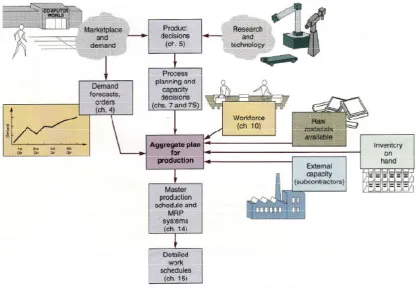
changes in employment levels. The aggregate plan will guide the more detailed plan
planning that eventually leads to a master schedule. The figure below illustrates the
Figure 2.1: Relationships of the aggregate plan Source: Heizer and Render (2006)
Aggregate planning methodology is designed to translate demand forecasts into a
blueprint for planning staffing and production levels for the firm over a
predetermined planning horizon. Aggregate planning horizon is not limited to top
level planning. Although generally considered to be a macro planning tool for
determining overall workforce and production levels, large companies may find
aggregate planning useful at the plant level as well. Production planning may be
viewed as a hierarchical process in which purchasing, production, and staffing
decisions must be made at several levels in the firm. Aggregate planning methods
may be applied at almost any level, although the concept is one of managing groups
of items rather than single items (Nahmias, 2005).
Aggregate planning is important to many organizations no matter to large or small
organizations as according to Stevenson (2005), aggregate planning is connected to
the budgeting process. Most organizations plan their financial requirements annually
it is not possible to predict with any degree of accuracy the timing and volume of
demand for individual items. So if an organization were to concentrate on individual
items, it would lose the flexibility to respond to the market. Furthermore, aggregate
planning is important because it can help synchronize flow throughout the supply
chain: it affects costs, equipment utilization, employment levels, and customer
satisfaction (Stevenson, 2005).
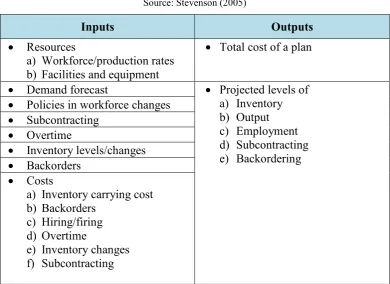
An effective aggregate planning requires good information or inputs in order to
produce a valuable output. It requires information of the available resources over the
planning period must be known. Then a forecast of expected demand must be
available. Finally, planners must take into account any policies regarding changes
such as employment levels as some organizations view layoffs as extremely
undesirable, so they would use that only as last resort (Stevenson, 2005). A good
production plan should be consistent with organizational policy, meet demand
requirement, be within capacity constraints, and minimizes cost. The production
plan links the strategic goals to production and is coordinated with sales objectives,
[image:20.595.124.515.465.749.2]resource availabilities, and financial budgets.
Table 2.1: Aggregate Planning Inputs and Outputs Source: Stevenson (2005)
Inputs Outputs
• Resources
a) Workforce/production rates b) Facilities and equipment
• Total cost of a plan
• Demand forecast • Projected levels of a) Inventory b) Output c) Employment d) Subcontracting e) Backordering • Policies in workforce changes
• Subcontracting • Overtime
• Inventory levels/changes • Backorders
• Costs
a) Inventory carrying cost b) Backorders
c) Hiring/firing d) Overtime
2.2
Aggregate Planning Strategies
Aggregate planning strategies can be described as proactive, reactive, or mixed.
Proactive strategies involve demand options; they attempt to alter demand so that it
matches capacity. Reactive strategies involve capacity options. They attempt to alter
capacity so that it matches demand. Mixed strategies involve an element of each of
these approaches.
Steps taken to produce an aggregate plan begin with the determination of demand
and the determination of current capacity. Capacity is expressed as total number of
units per time period that can be produced (this requires that an average number of
units be computed since the total may include a product mix utilizing distinctly
different production times). Demand is expressed as total number of units needed.
If the two are not in balance (equal), the firm must decide whether to increase or
decrease capacity to meet demand or increase or decrease demand to meet capacity.
In order to accomplish this, a number of options are available.
Options for situations in which demand needs to be increased in order to match
capacity include:
a) Influencing demand. When demand is low, a company will try to increase
demand through advertising, promotion, personal selling, and price cuts
(Jacobs et al, 2006). Pricing differentials are commonly used to shift demand
from peak periods to off-peak periods. An important factor to consider is the
degree of price of elasticity for the product or service; the more elasticity, the
more effective pricing will be in influencing demand patterns. Unlike pricing
policy, promotion had much less control over the timing of demand. Thus
there is the risk that promotion can worsen the condition it was intended to
improve (Stevenson, 2005).
b) Back ordering. By postponing delivery on current orders demand is shifted
to period when capacity is not fully utilized. This is really just a form of
reservations or by making appointments in an attempt to avoid walk-in
customers. Some refer to this as "partitioning" demand. According to
Stevenson (2005), the success of this approach depends on how willing
customers are to wait for delivery. Moreover, the costs associated with back
orders can be difficult to pin down since it would include lost sales, annoyed
or disappointed customers, and perhaps additional paperwork.
c) (ew demand creation and counterseasonal product. It is a widely used
active smoothing technique among manufacturers in order to develop a new
product or counterseasonal items (Jacob et al, 2006). A new, but
complementary demand is created for a product or service. Many
organizations are faced with the problem of having to provide products or
services for peak demand in situations where demand is very uneven.
Manufacturing firms that experience seasonal demand for certain products
are sometimes able to develop a demand for a complementary product that
makes use of the same production processes. They thereby achieve a more
consistent use of labor, equipment, and facilities (Stevenson, 2005).
Options which can be used to increase or decrease capacity to match current demand
include:
a) Hire/lay off. In order to meet demand, one of the ways is to hire or lay off
production workers to match production rates. It is often that new employees
needed to be train, and as such it makes the average productivity of a
company drops temporarily (Heizer and Render, 2006). According to
Stevenson (2005), laying off can present serious problems for workers.
Layoffs or firings will lower the morale of all workers and can lead to lower
productivity (Heizer and Render, 2006). There are some firms have policies
that either prohibit or limit downward adjustments to a workforce in order to
maintain the image of the company and the company productivity.
b) Overtime. The use of overtime can be especially attractive in dealing with
severe method for changing capacity than hiring and laying off workers
(Stevenson, 2005). It is to be known that overtime requires more pay to the
workers and too much overtime will wear the workers down to the point that
overall productivity drops off. On top of that, overtime will also affect the
increment of overhead cost as the need to keep the facility open (Heizer and
Render, 2006)
c) Part-time or casual labor. The use of part time workers is a feasible option.
It is depends very much on the nature of work, training and skills is needed.
Seasonal work require low-to-moderate job skills will usually in need of
part-time workers who generally cost less than regular workers in hourly
wages and fringe benefits. In order to be successful, these organizations must
be able to hire part-time employees when they are needed. In addition to
having different pay scales and no benefits, they can be hire or layoff from
the workforce without difficulty than regular workers. This gives the
companies great flexibility in adjusting the size of the workforce (Stevenson,
2005).
d) Inventory. Managers can increase inventory during periods of low demand
to meet high demand in future periods. According to Heizer and Render
(2006), if this strategy is selected, costs associated with storage, insurance,
handling, obsolescence, pilferage, and capital invested will increase. (These
costs typically range from 15% to 40% of the value of an item annually). On
the other hand, if the firm experienced an increasing demand, shortages can
result in lost sales due to personality longer lead times and poorer customer
service. In essences, inventories can be built up during periods when
production capacity exceeds demand and drawn down in periods when
demand exceeds production capacity (Stevenson, 2005).
e) Subcontracting. A firm can acquire temporary capacity by subcontracting
work during peak demand periods. By subcontracting work to an alternative
may lead to higher costs and quality problems (Stevenson, 2005).
Subcontracting however has its disadvantages. First, it may be costly, second
it risks opening the client’s door to a competitor. Third, it is often hard to
find the perfect subcontract supplier, one who always delivers the quality
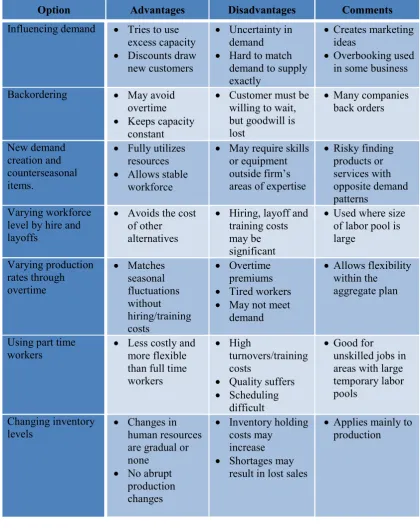
[image:24.595.108.529.249.780.2]product on time (Heizer and Render, 2006).
Table 2.2: Aggregate Planning Options: Advantages and Disadvantages Source: Heizer and Render (2006)
Option Advantages Disadvantages Comments
Influencing demand • Tries to use excess capacity
• Discounts draw new customers
• Uncertainty in demand
• Hard to match demand to supply exactly
•Creates marketing ideas
•Overbooking used in some business Backordering • May avoid
overtime
• Keeps capacity constant
• Customer must be willing to wait, but goodwill is lost
•Many companies back orders New demand
creation and counterseasonal items.
• Fully utilizes resources
• Allows stable workforce
• May require skills or equipment outside firm’s areas of expertise
•Risky finding products or services with opposite demand patterns
Varying workforce level by hire and layoffs
• Avoids the cost of other
alternatives
• Hiring, layoff and training costs may be significant
•Used where size of labor pool is large Varying production rates through overtime • Matches seasonal fluctuations without hiring/training costs • Overtime premiums
• Tired workers
• May not meet demand
•Allows flexibility within the aggregate plan Using part time
workers
• Less costly and more flexible than full time workers
• High
turnovers/training costs
• Quality suffers
• Scheduling difficult
•Good for unskilled jobs in areas with large temporary labor pools
Changing inventory levels •
Changes in human resources are gradual or none
• No abrupt production changes
• Inventory holding costs may
increase
• Shortages may result in lost sales