A Framework for
Performance Based Competency Standards for
Project Controls
Type of document: Normative
Stage of document: Exposure draft forPublic Comment
Date of issue: Version 0.01 30th June 2018
www.globalpmstandards.org [email protected]
ISBN 0-0000000-0-0
Copyright (c) 2018
Global Alliance for the Project Professions (GAPPS)
•
The final version of this document will be released with thestandard GAPPS “copyleft” license inserted here.
•
However, this exposure draft is released under standardcopyright terms: it cannot be copied or distributed except to solicit comments. Recipients are prohibited from using the document for any other purpose.
•
This document should be referenced as:GAPPS (2018) Exposure Draft of a Framework for Performance Based Competency Standards for Project Controls: Global Alliance for the Project Professions
Contents
1.
Process and Scope ... 1
1.1.
Role Context ... 2
1.2.
Role Definition for Project Controls ... 3
2.
Project Controls: Units, Elements, and Performance Criteria ... 4
2.1.
Overview of Performance Based Competence Standards ... 4
2.2.
Design of the GAPPS Framework ... 4
2.3.
Detail of Units, Elements, and Performance Criteria ... 6
2.4.
Summary of Unit Titles and their Elements ... 7
2.5.
Detail of Units, Elements, and Performance Criteria ... 8
APPENDIX A ... 17
Foreword
As program and project management have become more widely recognised management approaches, governments, individuals, and both public and private sector organisations have become interested in frameworks and standards that describe levels of acceptable workplace performance for program and project personnel.
The Global Alliance for the Project Professions, formerly known as Global Alliance for Project Performance Standards (GAPPS) is a volunteer organisation working to create such
frameworks and standards by providing a forum for stakeholders from differing countries, systems, backgrounds, and operating contexts to work together to address the needs of the global program and project management community.
These frameworks are intended to support the development and recognition of local
standards and to provide a sound basis for mutual recognition and transferability of project, program and other management role related qualifications.
The GAPPS frameworks are intended to be used by businesses, academic institutions, training providers, professional associations, and government standards and qualifications bodies globally. Frameworks may be used “as is” to speed the development of local standards, or they may be adapted to local needs.
This document is the fourth framework produced by the GAPPS. In 2006 the GAPPS
released the first version of A Framework for Performance Based Competency Standards for Global Level 1 and 2 Project Managers. In 2011 the GAPPS released the first version of A Framework for Performance Based Competency Standards for Program Managers. In 2015 the GAPPS released the first version of A Guiding Framework for Project Sponsors.
Future documents may address other roles involved with projects and programs. Further information or copies of the frameworks can be found at
https://www.globalpmstandards.org
Version Date Summary of Changes
A Framework for
Performance Based Competency Standards
for Project Controls
1.
Process
and Scope
Work on performance or competency based standards for a ‘Project Controls’ job family began in October 2011 at GAPPS Thought Leadership Forum No 23 hosted by the BG Group/QGC in Brisbane. The starting point was a review of existing standards for Project Controls in various forms, initially drawing on the following resources:
− ProVoc1/ ACostE Project Control Qualifications
− National Occupational Standards for Project Control – UK NVQ 2004
− Total Cost Management Framework – First Edition, 2006, AACE International − South African Qualification Authority standards for project controls
− APM Introduction to Project Control
− Competency Standards for Quantity Surveyors, Asia Pacific Region, 2001
It is noted that a number of these resources have since been updated.
Review and comparison of these documents provided a picture of coverage of roles in project controls and formed the basis for input and development over subsequent GAPPS Thought Leadership Forums. Globally representative and experienced project management and project controls professionals (see Appendix A) were asked to focus on what practitioners are required to do when providing project control services and oversight for projects. At each of the sessions where project controls were addressed the work of previous groups was reviewed and progressed in an ongoing validation process. In 2017 a review of the document was undertaken by several experienced practitioners and their comments addressed during 2018 GAPPS Thought Leadership Forums.
Accepted practice in development of performance based competency standards2 is to seek input from practitioners on what is considered to be minimum acceptable performance in a particular role. Therefore, the process should start with a definition of the role. This proved to be extremely difficult in the area of project controls where it was agreed that roles are both broad and deep. The roles extend from entry level project support roles to very senior Project Controls Director roles which may be at Board level. Project Controls are also provided by specialist consulting firms and include a wide range of specialist areas including cost, scheduling, risk, quality, estimation, quantity and document control.
1ProVoc is the UK National steering Committee raising the profile of Professional level National Vocational Qualifications (NVQs) for Project Management and Project Control staff in industry and commerce.
Work to date has focused on developing an understanding of a core set of performance based competencies expected of a Project Controller or Project Controls Manager. This was intended to provide a shared understanding of the ‘job family’ and a basis for further attempts at actually defining the roles.
At GAPPS Thought Leadership Forum No 38 in London the core set of performance based competencies were agreed in the form provided in this document.
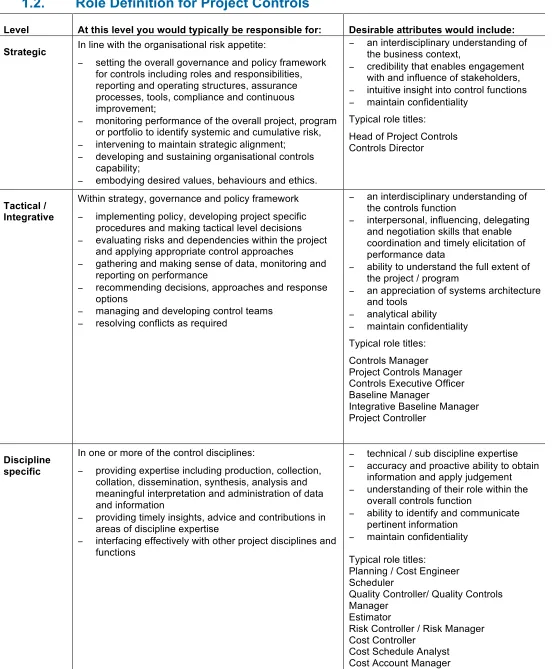
A Project Controls Role Definition is provided in Section 1.2 and it is intended that this will be provided in a Wiki via the GAPPS website to enable ongoing development between GAPPS sessions.
1.1.
Role Context
The role of the project controls manager in this context may be for single or multiple projects. The role of project controls manager is generally to support the project manager(s) to achieve project objectives by establishing the baseline plan, confirming the control basis, metrics and assumptions, identifying deviations and recommending corrective actions. In some organizations the project controls manager is a position with that title, while in others, it may be termed differently. This may be a position or an assignment. Whenever a single individual is clearly responsible for providing project controls support to the project manager, that individual can be considered to be a project controls manager for the purposes of this framework.
Incidental notes:
− Activities referred to in the standard may be undertaken by the Project Controls
Manager or by a member of their team or other specialist.
− Every decision must support business value.
− The project controls manager is the navigator. The Project Manager is the pilot. − Project Controls have a key role of providing reliable information in a timely manner to
1.2.
Role De
finition for Project Controls
Level At this level you would typically be responsible for: Desirable attributes would include:
Strategic In line with the organisational risk appetite:
− setting the overall governance and policy framework
for controls including roles and responsibilities, reporting and operating structures, assurance processes, tools, compliance and continuous improvement;
− monitoring performance of the overall project, program
or portfolio to identify systemic and cumulative risk,
− intervening to maintain strategic alignment; − developing and sustaining organisational controls
capability;
− embodying desired values, behaviours and ethics.
− an interdisciplinary understanding of
the business context,
− credibility that enables engagement
with and influence of stakeholders,
− intuitive insight into control functions − maintain confidentiality
Typical role titles: Head of Project Controls Controls Director
Tactical / Integrative
Within strategy, governance and policy framework
− implementing policy, developing project specific
procedures and making tactical level decisions
− evaluating risks and dependencies within the project
and applying appropriate control approaches
− gathering and making sense of data, monitoring and
reporting on performance
− recommending decisions, approaches and response
options
− managing and developing control teams − resolving conflicts as required
− an interdisciplinary understanding of
the controls function
− interpersonal, influencing, delegating
and negotiation skills that enable coordination and timely elicitation of performance data
− ability to understand the full extent of
the project / program
− an appreciation of systems architecture
and tools
− analytical ability − maintain confidentiality
Typical role titles: Controls Manager
Project Controls Manager Controls Executive Officer Baseline Manager
Integrative Baseline Manager Project Controller
Discipline specific
In one or more of the control disciplines:
− providing expertise including production, collection,
collation, dissemination, synthesis, analysis and meaningful interpretation and administration of data and information
− providing timely insights, advice and contributions in
areas of discipline expertise
− interfacing effectively with other project disciplines and
functions
− technical / sub discipline expertise − accuracy and proactive ability to obtain
information and apply judgement
− understanding of their role within the
overall controls function
− ability to identify and communicate
pertinent information
− maintain confidentiality
Typical role titles: Planning / Cost Engineer Scheduler
Quality Controller/ Quality Controls Manager
Estimator
Risk Controller / Risk Manager Cost Controller
[image:7.595.32.591.53.722.2]Cost Schedule Analyst Cost Account Manager
2.
Project Controls: Units, Elements, and Performance Crite
ri
a
2.1.
Overview of Performance Based Competence Standards
This section provides a brief overview of the subject of performance based competency standards (PBCS) for potential users of this document who are not familiar with the topic.
Competent comes from the Latin root competere which means “to be suitable.” In today’s workplace, the term “competent” is generally used to describe someone who is sufficiently skilled to perform a specified task or to fill a defined position — a competent physician, a competent salesperson, a competent plumber. Increasingly, organisations are interested in assessing the competency of individuals in order to guide employment and development decisions.
Broadly speaking, there are two major approaches to defining and assessing competency:
•
Attribute based wherein personal attributes such as knowledge, skills, values, attitudes, and other characteristics are identified and assessed. Competency is inferred based on the presence of the necessary attributes.•
Performance based wherein work outcomes and performance levels are identified andassessed. Competency is inferred based on the demonstrated ability to satisfy the performance criteria.
PBCS, also called occupational competency standards, are widely used throughout the world and have been developed within the context of government endorsed standards and qualifications frameworks in Australia (Department of Employment, Education and Workplace Relations: DEEWR), New Zealand (New Zealand Qualifications Authority: NZQA), South Africa (South African Qualifications Authority: SAQA), and the United Kingdom (Qualifications and Curriculum Development Agency: QCDA). Although all of these approaches are focused primarily on performance based competency assessment, some approaches do include aspects of attribute based competency assessment.
2.2.
Design of the GAP
PS Framework
PBCS typically address at least the following two questions:
•
What is usually done in this occupation, profession, or role by competent performers?•
What standard of performance is usually considered acceptable to infer competency? In the GAPPS frameworks, these questions are answered by defining:•
Units of CompetencyA Unit of Competency defines a broad area of professional or occupational performance that is meaningful to practitioners and which is demonstrated by individuals in the workplace. This GAPPS framework includes 6 Units of Competency.
•
Elements of Competency•
Performance CriteriaPerformance Criteria set out the type and/or level of performance required to demonstrate competency in each element. They describe observable results and/or actions in the workplace from which competent performance can be inferred. In the GAPPS framework, Performance Criteria can be satisfied in many different ways; there are no mandatory approaches, tools, or methodologies. This GAPPS framework includes a total of 79 Performance Criteria.
•
Explanatory StatementsExplanatory Statements help to ensure consistent interpretation of the Elements and the Performance Criteria by expanding on critical or significant aspects of them to enable consistent application in different contexts. They also may include a description of a range that may apply to the context of the experience. Where the Explanatory Statements contain lists, the lists are generally illustrative and not exhaustive.
Although some of the terms and definitions of the GAPPS framework described above differ in some respects from other PBCS, the overall approach is consistent and compatible with generally accepted practice within the field of competency development and assessment.
The Performance Criteria in this document focus on threshold performance — demonstration of the ability to do something at a standard considered acceptable in the workplace. They do not measure superior performance — what the best project controllers do. Superior performers should be able to satisfy the threshold criteria without difficulty.
The GAPPS frameworks include the minimum number of Performance Criteria needed to infer competency. As a result, a candidate must satisfy all of the Performance Criteria in the applicable Units in order to be viewed as competent. In addition, the Performance Criteria represent different levels of effort. The number of Performance Criteria in a Unit or Element is not proportional to the amount of time or effort that an individual must spend in that area to be viewed as competent. The material in this document can also be used to support learning and development when applied by qualified educators and trainers. In order to provide such support, the GAPPS framework would need to be expanded to address questions such as:
2.3.
Detail of Units, Elements, and Performance Criteria
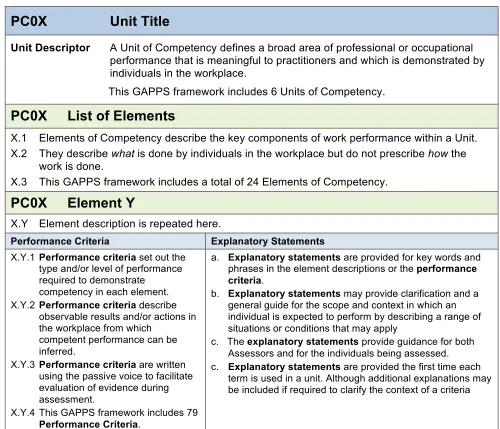
The following pages detail the Units, Elements, and Performance Criteria of this framework. They are presented using the format illustrated below in Figure 2.
PC0X
Unit Title
Unit Descriptor A Unit of Competency defines a broad area of professional or occupational performance that is meaningful to practitioners and which is demonstrated by individuals in the workplace.
This GAPPS framework includes 6 Units of Competency.
PC0X
List of Elements
X.1 Elements of Competency describe the key components of work performance within a Unit. X.2 They describe what is done by individuals in the workplace but do not prescribe how the
work is done.
X.3 This GAPPS framework includes a total of 24 Elements of Competency.
PC0X
Element Y
X.Y Element description is repeated here.
Performance Criteria Explanatory Statements
X.Y.1 Performance criteria set out the type and/or level of performance required to demonstrate
competency in each element. X.Y.2 Performance criteria describe
observable results and/or actions in the workplace from which
competent performance can be inferred.
X.Y.3 Performance criteria are written using the passive voice to facilitate evaluation of evidence during assessment.
X.Y.4 This GAPPS framework includes 79
Performance Criteria.
a. Explanatory statements are provided for key words and phrases in the element descriptions or the performance criteria.
b. Explanatory statements may provide clarification and a general guide for the scope and context in which an individual is expected to perform by describing a range of situations or conditions that may apply
c. The explanatory statements provide guidance for both Assessors and for the individuals being assessed. c. Explanatory statements are provided the first time each
[image:10.595.46.546.121.550.2]term is used in a unit. Although additional explanations may be included if required to clarify the context of a criteria
2.4.
Summary of
U
nit
T
itles and their
E
lements
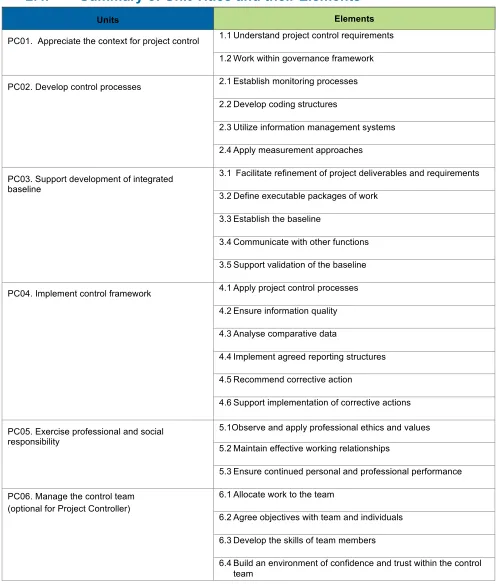
Units Elements
PC01. Appreciate the context for project control 1.1 Understand project control requirements
1.2 Work within governance framework
PC02. Develop control processes 2.1 Establish monitoring processes
2.2 Develop coding structures
2.3 Utilize information management systems
2.4 Apply measurement approaches
PC03. Support development of integrated baseline
3.1 Facilitate refinement ofproject deliverables and requirements
3.2 Define executable packages of work
3.3 Establish the baseline
3.4 Communicate with other functions
3.5 Support validation of the baseline
PC04. Implement control framework 4.1 Apply project control processes
4.2 Ensure information quality
4.3 Analyse comparative data
4.4 Implement agreed reporting structures
4.5 Recommend corrective action
4.6 Support implementation of corrective actions
PC05. Exercise professional and social responsibility
5.1Observe and apply professional ethics and values
5.2 Maintain effective working relationships
5.3 Ensure continued personal and professional performance
PC06. Manage the control team (optional for Project Controller)
6.1 Allocate work to the team
6.2 Agree objectives with team and individuals
6.3 Develop the skills of team members
[image:11.595.49.545.69.653.2]6.4 Build an environment of confidence and trust within the control team
2.5.
Detail of Units, Elements, and Performance Criteria
The following pages detail the Units, Elements, and Performance Criteria of this framework.
PC01
Appreciate the context for project control
Unit Descriptor This Unit defines the Elements required to demonstrate an understanding and appreciation of the requirements for project controls.
It includes the Performance Criteria required to demonstrate competency in how the project controls work, within an organisation/project and within a governance framework.
PC01
List of Elements
1.1 Understand project control requirements 1.2 Work within governance framework.
PC01
Element 1
1.1 Understand project control requirements
Performance Criteria Explanatory Statements
1.1.1 Project and project control objectives are understood.
1.1.2 Established budget for project control function is confirmed
1.1.3 Understanding of project controlorganization structure is demonstrated.
1.1.4 Limits of personalexpertise are acknowledged. 1.1.5 Roles and responsibilities are confirmed.
1.1.6 Operating processes and procedures are
identified.
1.1.7 Control requirements of relevant stakeholders
are understood.
Appreciate should be interpreted and applied relative to the context within which the person is operating.
Budget may be in terms of time, cost and/or resources. Note that this is the budget for the control function for the project. The budget may be provided or may be negotiated by the Project Controls Manager.
Project control organization structures will vary according to project type, size and complexity. Controls include a wide range of specializations.
Acknowledgement of personal expertise is an important element in
determining additional controls assistance and expertise that may be required.
Roles and responsibilities will include reporting relationships and authority levels.
Confirmed may include negotiation to deal with variations in expertise.
Operating processes and procedures are those relevant to the project and the controls function. They may be those of the parent organization, joint venture or alliance partners, contractors and any other relevant parties.
Control requirements may include interpretation and treatment of
baselines and change requests.They include approval, monitoring
and reporting processes and may include or be affected by such things as the level of project complexity, form of contract,
commercial and regulatory requirements. They may include defining measures, tolerances, frequencies or other parameters.
Stakeholders include individuals and organisations whose interests may be affected by the project, or whose actions may have an effect on some aspect of the project. Stakeholders may include project proponents, sponsors, clients, customers, contractors, collaborators, contributors, champions, constituent project managers, project team members, project support staff, subcontractors, suppliers, media representatives, and the general public. Stakeholders may be internal to or external from the sponsoring organisation.
PC01
Element 2
1.2 Work within governance framework
Performance Criteria Explanatory Statements
1.2.1 Alignment of reporting structures with
organisational and project strategy is maintained.
1.2.2 Information required to control the project is defined, agreed and reviewed
1.2.3 Prescribed signing and approval authorities are fully understood and applied. Approval processes and authorities are confirmed and applied.
Governance framework refers to the corporate and project governance frameworks within which the project will be conducted.
Breadth and depth of information gathered should be limited to the minimum required to satisfy stakeholder control requirements. Information requirements should be reviewed at key stages of the project life cycleto ensure they remain fit for purpose
PC02
Develop control processes
Unit Descriptor This Unit defines the Elements required to develop project control processes. It includes the Performance Criteria required to demonstrate competency in
how to establish monitoring processes, develop coding structures, utilize information management systems and apply measurement approaches.
PC02
List of Elements
2.1 Establish monitoring processes 2.2 Develop coding structures
2.3 Utilize information management systems 2.4 Apply measurement approaches
PC02
Element 1
2.1 Establish monitoring processes
Performance Criteria Explanatory Statements
2.1.1 Criteria for acceptable performance are
established and agreed.
2.1.2 Report content, formats and frequencies are determined.
2.1.3 Sources of data are identified.
2.1.4 Responsibilities for information provision, monitoring and control are defined and accepted.
Criteria for acceptable performance may include tolerances e.g. 5% above or below budget or schedule; triggers for unacceptable performance, escalation, key performance indicators (KPI) and the like.
PC02
Element 2
2.2 Develop coding structures
Performance Criteria Explanatory Statements
2.2.1 Coding structures are selected to facilitate measurement and reporting requirements. 2.2.2 Compatibility with organizational accounting and
data reporting requirements is maintained.
Coding structures are a means of integrating elements of project control, reporting and accounting particularly for use with information management systems. They may be provided or required by the client, based on organizational processes, industry or ISO
standards, determined by the information management system to be used, or developed specifically for the project. They may be a combination of the above.
PC02
Element3
2.3 Utilize information management systems
Performance Criteria Explanatory Statements
2.3.1 Information management systems are selected
or adapted to suit the specific requirements of the project.
2.3.2 A data repository is established.
2.3.3 Agreed data integrity and security principles are applied.
Information management systems should be used effectively for sharing of information and integrated reporting.
PC02
Element 4
2.4 Apply measurement approaches
Performance Criteria Explanatory Statements
2.4.1 Performance measures to be used are
determined and agreed by relevant
stakeholders.
2.4.2 Compliance with applicable industry standards
is ensured.
2.4.3 Measurement criteria are established.
Performance measures will be appropriate to the size and complexity of the project and may include staff turnover, rates of production, number of rejects, number of change requests, rate of work performance or output compared to expectations, safety performance, labour productivity. Earned Value measures of SPI and CPI are examples of performance measures.
Stakeholders include individuals and organisations whose interests may be affected by the project, or whose actions may have an effect on some aspect of the project. Stakeholders may include project proponents, sponsors, clients, customers, contractors, collaborators, contributors, champions, constituent project managers, project team members, project support staff, subcontractors, suppliers, media representatives, and the general public. Stakeholders may be internal to or external from the sponsoring organisation.
The relevance of a stakeholder may be affected by the impact on the stakeholder, or by the stakeholder’s impact on the project, and by cultural or ethical considerations. Different stakeholders are relevant in different situations.
Applicable industry standards include local and national regulations. The same information may need to be provided in different ways to satisfy different requirements.
PC03
Support development of integrated baseline
Unit Descriptor This Unit defines the Elements required to support the development of an integrated baseline for a project.
It includes the Performance Criteria required to demonstrate competency in defining packages of work, establishing, validating and integrating baselines and communicating with other functions.
In the context of project controls, a baseline is an approved start point used as a basis for performance measurement
PC03
List of Elements
3.1 Facilitate refinement ofproject deliverables and requirements 3.2 Define executable packages of work
3.3 Establish the baseline
3.4 Communicate with other functions 3.5 Support validation of the baseline
PC03
Element 1
3.1 Facilitate refinement of project deliverables and requirements
Performance Criteria Explanatory Statements
3.1.1 Detail of deliverables and
requirements for the overall project or phase are verified.
3.1.2 Assumptions and constraints are
documented.
Integrated baseline may also be referred to as the project plan. Items in Integrated baseline should include audit requirements.
High level deliverables and requirements would be provided by the Project
Manager. Input for refinement of deliverables and requirements may be
obtained from participating specialists.
Assumptions and constraints made in developing baselines must be documented.
PC03
Element 2
3.2 Define executable packages of work
Performance Criteria Explanatory Statements
3.2.1 Detailed breakdown structures are developed.
3.2.2 Responsibilities for work packages are identified.
Breakdown structures may include breakdown of project, product, resource, organisation and work breakdown structures, milestone deliverables, work packages and the like.
PC03
Element 3
3.3 Establish the baseline
Performance Criteria Explanatory Statements
3.3.1 Resource requirements are
determined
3.3.2 Sources of data are identified. 3.3.3 Input is sought from other functions.
3.3.4 Scope,cost, schedule, risk and
quality baselines are integrated.
Baseline in the context of project controls is an approved start point used as a basis for performance measurement.
Resource requirements may include staffing, material, funding, machinery, time, equipment, supplies
Input may include confirmation of resource availability, scope, cost, timing, regulatory, environmental, political, economic, contractual and other implications and do-ability review
Other functions may include design, engineering, procurement, construction, human resources, finance, commercial, operations and the like.
Development of scope, cost, schedule, risk and quality baselines may be
the responsibility of separate specialists. Procurement, operational,
PC03
Element 4
3.4 Communicate with other functions
Performance Criteria Explanatory Statements
3.4.1 Report content, formats and frequencies are determined.
3.4.2 Responsibilities for information provision are defined and accepted.
3.4.3 Baseline information is provided as an input to other functions.
3.4.4 Information on quality and availability of potential resources is provided.
Resources may include but are not limited to staffing, material, funding, machinery, time, equipment, supplies
PC03
Element 5
3.5 Support validation of the baseline
Performance Criteria Explanatory Statements
3.5.1 Compliance with applicable standards and regulations is verified.
3.5.2 Alignment with declared strategy is maintained.
3.5.3 Independent expert review is sought. 3.5.4 Supporting artefacts are provided
Declared strategy is that which has been adopted by the project. It may be specific for the project, an organisation strategy and / or the project control strategy.
Independent Expert review may include peer review or be provided by specialists independent from the project, internal or external.
PC04
Implement control frameworkUnit Descriptor This Unit defines the Elements required to implement the control framework. It includes the Performance Criteria required to demonstrate competency in
how to support the project applying control processes, gathering and
analysing data and information, providing reports, recommending corrective actions and supporting the implementation of corrective action.
PC04
List of Elements
4.1 Apply project control processes 4.2 Ensure information quality 4.3 Analyse comparative data
4.4 Implement agreed reporting structures 4.5 Recommend corrective action
4.6 Support implementation of corrective actions
PC04
Element 1
4.1 Apply project control processes
Performance Criteria Explanatory Statements
4.1.1 Actual performance data is captured 4.1.2 Impacts of change are analysed.
4.1.3 Approved changes are incorporated
intothe baseline andrelevant documents
Impact is the effect of a change on the baseline or project objectives.
Change is a positive or negative deviation from baseline and can be as the result of for example; a scope change, inefficiencies, external influences, safety issues.
Approved changes should only result in a change to the baseline if this is in accordance with the governance framework.
PC04
Element 2
4.2 Ensure information quality
Performance Criteria Explanatory Statements
4.2.1 Ability to obtain information from stakeholders is demonstrated. 4.2.2 Information is questioned for meaning,
validity and reliability.
4.2.3 Information is stored, maintained, updated and utilized
Reliability includes backward (accurate) and forward looking (forecast) perspectives. It also includes confidence that information will continue to be provided predictably.
PC04
Element 3
4.3 Analyse comparative data
Performance Criteria Explanatory Statements
4.3.1 Performance variances are analysed 4.3.2 Performance forecasts are conducted.
PC04
Element 4
4.4 Implement agreed reporting structures
Performance Criteria Explanatory Statements
4.4.1 Project reports are issued in accordance with the governance and control
frameworks.
4.4.2 Applicable regulatory and commercial
control requirements are supported. 4.4.3 Information is collated to validate
submissions.
Regulatory requirements will usually be imposed as a result of legislation. They may be generic or industry specific and will normally vary with jurisdiction.
Commercial control requirements will be defined by the contract or other applicable form of engagement.
Submissions may be from contractors, suppliers, vendors, service providers, consultants or to customers, clients or other stakeholders and may include claims, bids / tenders, product reviews, invoices, reports, updated schedules etc.
PC04
Element 5
4.5 Recommend corrective action
Performance Criteria Explanatory Statements
4.5.1 Response options are generated.
4.5.2 Viable options are identified. 4.5.3 Selected response options are
documented and proposed
Corrective actions address reported variances in project performance. They may relate to variations from baseline or to requirements or opportunities for continuous improvement.
Viability is established by way of expert judgement or a qualitative assessment, or by quantitative analysis.
Response options may include but is not limited to requests for further information / detail, engagement of other experts, coaching and mentoring, updating of systems, re-planning, or stopping depending on the particular challenge. Impact analysis may be undertaken in developing options.
PC04
Element 6
4.6 Support implementation of corrective actions
Performance Criteria Explanatory Statements
4.6.1 Approved response options are
communicated for implementation. 4.6.2 Relevant documents are updated to
reflect the impacts of action approved for implementation.
4.6.3 Adjustments to systems, policies, and procedures are documented, proposed, approved by relevant stakeholders and tracked to resolution.
4.6.4 Impacts of implemented corrective actions are monitored, captured and reported.
Adjustments may be highlighted by insights from, for example; reviews, system failures and gaps, benchmarking.
Resolution may include updated or changed systems, processes, policies and procedures but may be finalised by non-acceptance. Where possible official sign-off should be obtained.
PC05
Exercise professional and social responsibility
Unit Descriptor This Unit defines the Elements required to maintain effective and professional working relationships.
It includes the Performance Criteria required to demonstrate competency in applying values and ethics in a professional manner, achieving effective working relationships and continuing development of performance.
PC05
List of Elements
5.1 Observe and apply professional ethics and values 5.2 Maintain effective working relationships
5.3 Ensure continued personal and professional performance
PC05
Element 1
5.1 Observe and apply professional ethics and values
Performance Criteria Explanatory Statements
5.1.1 Accepted values and ethics are defined and communicated
5.1.2 Behaviours reflect accepted ethics and values
5.1.3 Sensitivity to local cultural values, ethics and practices is demonstrated.
Values and ethics referred to here will include industry ethics and those stated at organisational, team, professional and cultural level.
Behaviours may be agreed at organisational, project or team level.
Sensitivity includes accommodation of differing values, ethics and practices of communities, suppliers, workforce, political context and the like.
PC05
Element 2
5.2 Maintain effective working relationships
Performance Criteria Explanatory Statements
5.2.1 Desired results are achieved through influence and positive behaviour. 5.2.2 The priorities, expectations and needs
of colleagues are understood and considered when making decisions and taking actions.
5.2.3 Issues are resolved in a constructive manner.
5.2.4 Communications are conducted in
accordance with the approved communication plan.
5.2.5 People are treated with respect.
Constructive manner may include Conflict resolution techniques such as: Crucial conversations, Negotiation, escalation up the line, dealing with the issue not the person.
Communications may include content required, method used (e.g., electronic, phone, meeting), geographical dispersion, protocols, cultural differences, and confidentialityrequirements. They may be documented formally or informally and may be included in other project documentation.
Respect may include consideration of cultural differences, sensitivity of information shared etc.
PC05
Element 3
5.3 Ensure continued personal and professional performance
Performance Criteria Explanatory Statements
5.3.1 Personal development plan is
documented, updated and implemented. 5.3.2 Personal performance is evaluated and
reviewed against an agreed performance contract
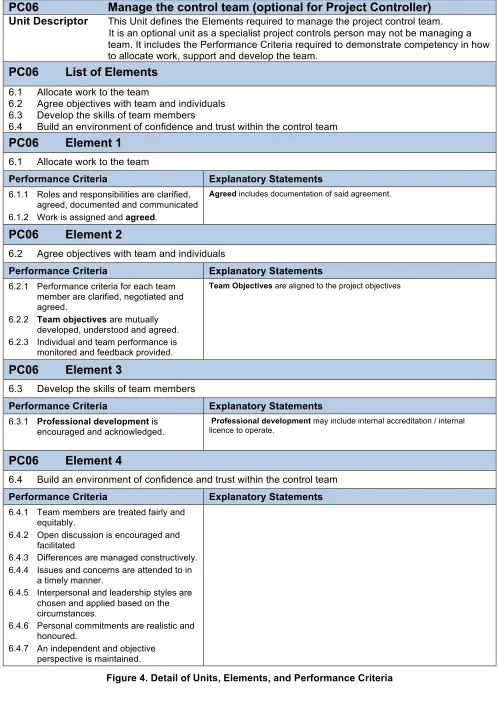
PC06
Manage the control team (optional for Project Controller)
Unit Descriptor This Unit defines the Elements required to manage the project control team. It is an optional unit as a specialist project controls person may not be managing a
team. It includes the Performance Criteria required to demonstrate competency in how to allocate work, support and develop the team.
PC06
List of Elements
6.1 Allocate work to the team
6.2 Agree objectives with team and individuals 6.3 Develop the skills of team members
6.4 Build an environment of confidence and trust within the control team
PC06
Element 1
6.1 Allocate work to the team
Performance Criteria Explanatory Statements
6.1.1 Roles and responsibilities are clarified, agreed, documented and communicated 6.1.2 Work is assigned and agreed.
Agreed includes documentation of said agreement.
PC06
Element 2
6.2 Agree objectives with team and individuals
Performance Criteria Explanatory Statements
6.2.1 Performance criteria for each team member are clarified, negotiated and agreed.
6.2.2 Team objectives are mutually
developed, understood and agreed. 6.2.3 Individual and team performance is
monitored and feedback provided.
Team Objectives are aligned to the project objectives
PC06
Element 3
6.3 Develop the skills of team members
Performance Criteria Explanatory Statements
6.3.1 Professional development is
encouraged and acknowledged.
Professional development may include internal accreditation / internal licence to operate.
PC06
Element 4
6.4 Build an environment of confidence and trust within the control team
Performance Criteria Explanatory Statements
6.4.1 Team members are treated fairly and equitably.
6.4.2 Open discussion is encouraged and facilitated
6.4.3 Differences are managed constructively. 6.4.4 Issues and concerns are attended to in
a timely manner.
6.4.5 Interpersonal and leadership styles are chosen and applied based on the circumstances.
6.4.6 Personal commitments are realistic and honoured.
[image:20.595.48.546.57.759.2]APPENDIX A
Record of contributors to
the
performance based framework for P
roject
C
ontrols
NAME REPRESENTING COUNTRY
Adamopoulos, Pierre Heriot Watt University UK
Aitken, Alicia PPG / Telstra Australia
Al-Qahtani, Ali S Ma’aden Aluminium Company Saudi Arabia
Al-Shammary, Sami Ma’aden Aluminium Company Saudi Arabia
Andrew Gale University of Manchester
The University of Manchester
UK
Andrew Tims Major Projects Authority, UK
UK
UK
Angelilo, Stephen NASA USA
Baker, Chris NAB Australia
Baker, Rod APMG UK
Bibby, Jon Costain UK
Ben Aiben, Saad Ma’aden Aluminium Company Saudi Arabia
Bentley, Lesley Living Planit Australia
Best, Robert Services SETA South Africa
Billat, Pensilla Sasol Ltd South Africa
Botes, Melani SOLAL South Africa
Buhagiar, Michael Sydney University Australia
Callaway, Amy TBH Group Australia
Castillo, Omar Sydney University Australia
Chen, Helen Centre for Public Project Management Singapore
Chung, Ken Sydney University Australia
Coleman, Sarah APM UK
Crawford, Lynn Bond University Australia
Darley, Martin AACEI USA
David Preece APM UK
Duncan, Bill asapm USA
Edwards, Andrew State Emergency Services/NSW Fire & Rescue Australia
Egbu, Charles Doctoral student, London Southbank University, LSBU UK
Eltinayn, Nuha Doctoral student, London Southbank University, LSBU UK
Ferrabone, Galileo Sasol South Africa
Fitzgerald, Donna asapm USA
Floris, Maurizio JGCPL, Sydney University Australia
Forth, Shane Costain
PMO Director Costain
UK
Framp, Melody Human Systems Asia Pacific Australia
Gardiner, Paul BUiD UAE
Gaspar, Josephine Snowdon Group Australia
George, Stella Athabasca University Canada
Giammalvo, Paul PTMC Indonesia
Graham, Robert Heriot Watt University UK
NAME REPRESENTING COUNTRY
Haddad, Rania Caparol Paints Dubai
Haggerty, Patrick AACEI USA
Hancock, Gill APM UK
Haniff, Amos Heriot Watt University UK
Heymans, Christa Sasol Ltd South Africa
Ho, Bernard SPM Singapore
Hoffman, Ed NASA USA
Kaesler, Shane BAE Systems Australia Australia
Kananu, Rose Sasol South Africa
Keeys, Lynn Independent consultant South Africa
Kirkham Richard University of Manchester
The University of Manchester
UK
Knoepfel, Hans IPMA Switzerland
Khorsand Moadab Mohsen University of Manchester UK
Kruger, J C Greybeards South Africa
Lai, Ruby SPM Singapore
Langston, Craig Bond University Australia
Liu, Lucia Lend Lease Australia
Magee, Kevin NASA USA
Manton-Hall, Patricia Independent Consultant (formerly Bechtel) Australia
Maria Doufa University of Manchester UK
Mavuso, Johannes Sasol Ltd South Africa
Milsom, Peter APMG Canada
Morar, Sunil Sasol Ltd South Africa
Morgan, David BG Group UK
Myezo, Mpho Petro SA South Africa
Nalewaik, Alexia AACEI USA
Noble, Will Human Systems Asia Pacific Australia
Omokhomion , Itua London Southbank University UK
Peh, Luke SPM Singapore
Petit, Ivan UQAM Canada
Petro, Yacoub MHW, Stantec Dubai
Piesker, Julia Heriot Watt University UK
Preece, David APM UK
Pretorius, Carl Sasol Ltd South Africa
Radyati, Maria Independent consultant South Africa
Reay Atkinson, Simon Sydney University Australia
Reinhard Wagner IPMA Germany
Rider, Lesley Services SETA / PMSA South Africa
Rodrigues, Chantal Services SETA South Africa
Ruiz, Natalie Heriot Watt University UK
Rutherford Jones, John Sasol Ltd South Africa
Sakhaee, Ehssan Sydney University Australia
Sargent, Roy Building and Asset Services Australia
Schaden, Brigitte IPMA Austria
NAME REPRESENTING COUNTRY
Sompie, Meiske TBH Group Australia
Tharakan Mulackal, Philips AACEI Dubai
Thomas, Janice Athabasca University Canada
Tillin, Adrian QGC / BG Group Australia
Van Waveren, Beno Sasol Ltd South Africa
Veloz, Carolina UTS Australia
Voolhofer, Alexander Projekt Management Austria Austria
Wallace, Yvonne Living Planit Australia
Wilson, Liz APM UK
Witte, Rob Worley Parsons South Africa
Ying Chang University of Manchester UK
Yip, Kim Seng SPM Singapore
Yuen, Mun Wye SPM Singapore