
23 11
Article 19.2.5
Journal of Integer Sequences, Vol. 22 (2019), 2
3 6 1 47
Solving Computational Problems in the
Theory of Word-Representable Graphs
¨
Ozg¨
ur Akg¨
un and Ian Gent
School of Computer Science
University of St Andrews
St Andrews, Fife KY16 9SX
United Kingdom
[email protected]
[email protected]
Sergey Kitaev
School of Computer and Information Sciences
University of Strathclyde
Glasgow, G1 1HX
United Kingdom
[email protected]
Hans Zantema
Department of Computer Science
Eindhoven University of Technology
P. O. Box 513
5600 MB Eindhoven
Abstract
A simple graph G= (V, E) is word-representable if there exists a word w over the alphabet V such that letters x and y alternate in w iff xy ∈ E. Word-representable graphs generalize several important classes of graphs. A graph is word-representable iff it admits a semi-transitive orientation. We use semi-transitive orientations to enumer-ate connected non-word-representable graphs up to the size of 11 vertices, which led to a correction of a published result. Obtaining the enumeration results took 3 CPU years of computation.
Also, a graph is word-representable iff it isk-representable for some k, that is, if it can be represented usingkcopies of each letter. The minimum suchkfor a given graph is called graph’s representation number. Our computational results in this paper not only include distribution ofk-representable graphs on at most 9 vertices, but also have relevance to a known conjecture on these graphs. In particular, we find a new graph on 9 vertices with high representation number. Also, we prove that a certain graph has highest representation number among all comparability graphs on odd number of vertices.
Finally, we introduce the notion of ak-semi-transitive orientation refining the notion of a semi-transitive orientation, and show computationally that the refinement is not equivalent to the original definition, unlike the equivalence of k-representability and word-representability.
1
Introduction
Lettersxand yalternate in a wordwif after deleting in wall letters but the copies ofx and
ywe either obtain a wordxyxy· · · (of even or odd length) or a wordyxyx· · · (of even or odd length). For example, the letters 2 and 5 alternate in the word 11245431252, while the letters 2 and 4 do not alternate in this word. A simple graph G = (V, E) is word-representable if there exists a wordwover the alphabetV such that letters xandyalternate inwiffxy∈E. By definition, w must contain each letter in V. We say that w represents G, and that w is aword-representant.
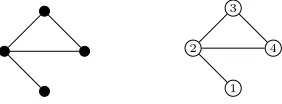
The definition of a word-representable graph works both for vertex-labeled and unlabeled graphs because any labeling of a graph G is equivalent to any other labeling of G with respect to word-representability (indeed, the letters of a word w representing G can always be renamed). For example, the graph to the left in Figure1is word-representable because its labeled version to the right in Figure1can be represented by 1213423. For another example, each complete graph Kn can be represented by any permutation π of {1,2, . . . , n}, or by π concatenated any number of times. Also, theempty graphEn (also known as edgeless graph, or null graph) on vertices {1,2, . . . , n} can be represented by 12· · ·(n−1)nn(n−1)· · ·21, or by any other permutation concatenated with the same permutation written in the reverse order.
3
2 4
[image:3.612.243.384.65.117.2]1
Figure 1: An example of a word-representable graph
if w representsG then w with v removed representsG′.
There is a long line of research on word-representable graphs (see, e.g. [1, 3, 4, 5, 7, 10,
12, 13, 14, 15, 18, 21, 25]) that is summarized in [19, 20]. The roots of the theory of word-representable graphs are in the study of the celebratedPerkins semigroup in [23], which has played a central role in semigroup theory since 1960, particularly as a source of examples and counterexamples. However, the significance of word-representable graphs is in the fact that they generalize several important classes of graphs such as 3-colorable graphs, comparability graphs and circle graphs.
One of the key tools to study word-representable graphs is the notion of a semi-transitive orientation to be defined next.
1.1
Semi-transitive orientations
The notion of a semi-transitive orientation was introduced in [14, 15], but we follow [20, Section 4.1] to introduce it here. A graph G = (V, E) is semi-transitive if it admits an
acyclic orientation such that for any directed path v1 → v2 → · · · → vk with vi ∈ V for all
i, 1≤i≤k, either
• there is no edge v1 →vk, or
• the edge v1 → vk is present and there are edges vi → vj for all 1 ≤ i < j ≤ k. In
other words, in this case, the (acyclic) subgraph induced by the vertices v1, . . . , vk is transitive (with the unique source v1 and the unique sink vk).
We call such an orientationsemi-transitive. In fact, the notion of a semi-transitive orientation is defined in [14,15] in terms ofshortcutsas follows. Asemi-cycleis the directed acyclic graph obtained by reversing the direction of one edge of a directed cycle in which the directions form a directed path. An acyclic digraph is a shortcut if it is induced by the vertices of a semi-cycle and contains a pair of non-adjacent vertices. Thus, a digraph on the vertex set {v1, . . . , vk} is a shortcut if it contains a directed path v1 → v2 → · · · → vk, the edge
v1 → vk, and it is missing an edge vi → vj for some 1 ≤i < j ≤ k; in particular, we must
have k ≥ 4, so that any shortcut is on at least four vertices. Clearly, this definition is just another way to introduce the notion of a semi-transitive orientation presented above.
Theorem 1 ([14, 15]). A graph G is word-representable if and only if it admits a semi-transitive orientation (that is, if and only if G is semi-transitive).
A corollary to Theorem1is the useful fact that any 3-colorable graph is word-representable.
1.2
Comparability graphs and permutational representation
An orientation of a graph is transitive if the presence of edges u → v and v → z implies the presence of the edge u → z. An unoriented graph is a comparability graph if it admits a transitive orientation. A graph G = (V, E) is permutationally representable if it can be represented by a word of the formp1· · ·pk where pi is a permutation.
The following theorem is an easy corollary of the fact that any partially ordered set can be represented as intersection of linear orders, and that a linear order can be represented by a permutation.
Theorem 2 ([23]). A graph is permutationally representable if and only if it is a compara-bility graph.
Permutational representation of a graph is a special case of uniform representation, to be discussed next.
1.3
Uniform representations
A wordwisk-uniformif each letter inwoccursktimes. For example, the word 342321441231 is 3-uniform, while 43152 is a 1-uniform word (a permutation). A graph G is k -word-representable, or k-representable for brevity, if there exists a k-uniform word w representing it. We say that w k-represents G. A somewhat surprising fact establishes equivalence of word-representability and uniform word-representability:
Theorem 3 ([21]). A graph is word-representable iff it is k-representable for some k.
Thus, in the study of word-representable graphs, word-representants can be assumed to be uniform. Graph’s representation numberis theleastksuch that the graph isk-representable. For non-word-representable graphs, we letk =∞. It is known [15] that the upper bound on the length of a shortest uniform word-representant for a graphG onn vertices is essentially 2n2
, that is, one needs at most 2n copies of each letter to represent G. We let R(G) denote
G’s representation number andRk ={G:R(G) = k}.
The class of complete graphs is clearly the class of graphs with representation number 1. Further, the class of graphs with representation number 2 is precisely the class ofcircle graphs
1
1′
H1,1
1
1′
2
2′
H2,2
1
1′
2
2′
3
3′
[image:5.612.213.419.61.130.2]H3,3
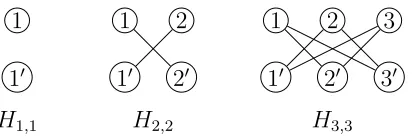
Figure 2: Crown graphs
However, there is a number of interesting results on graphs with representation numbers higher than 2, some of which we mention next (see [19] for references to the original sources in relation to the results, and for more results in this direction).
The representation number of the Petersen graph and any prism is 3. Also, for every graphGthere are infinitely many 3-representable graphsH that containGas aminor. Such a graphH can be obtained fromGby subdividingeachedge intoany number of, butat least
three edges.
1.4
Graphs with high representation number
As for graphs with high representation number, only crown graphs and graphsGn based on them (see the definitions below) were known until this paper; Figure 5 gives an example of another such graph. A crown graph (also known as a cocktail party graph) Hn,n is obtained from the complete bipartite graph Kn,n by removing a perfect matching. That is, Hn,n is obtained from Kn,n by removing n edges such that each vertex was incident to exactly one removed edge. See Figure 2 for examples of crown graphs.
By Theorem 2, Hn,n can be represented by a concatenation of permutations, because
Hn,n is a comparability graph (to see this, just orient all edges from one part to the other). In fact, Hn,n is known to require n permutations to be represented (the maximum possible amount for a comparability graph on 2n vertices by the well known theorem on the poset dimensions by Hiraguchi [16]). However, we can provide a shorter representation for Hn,n, to be discussed next, which is still long (linear inn).
Note that H1,1 ∈ R2. Further, H2,2 6=K4, the complete graph on four vertices, and thus
H2,2 ∈ R2 because it cannot be represented by a permutation but can be 2-represented by
2′12′121′21′. Also,H
3,3 =C6, acycle graph, which belongs to R2 as is shown, e.g. in [19,20].
Finally, H4,4 ∈ R3 because H4,4 is a prism (it is the 3-dimensional cube). The following
theorem gives the representation number R(Hn,n) in the remaining cases.
Theorem 4 ([10]). If n≥5, then the representation number of Hn,n is⌈n/2⌉.
Conjecture 5. Hn,n has the highest representation number among all bipartite graphs on 2n vertices.
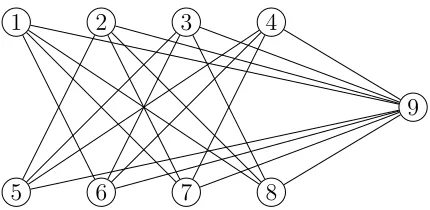
word-1 2 3 4
5 6 7 8
[image:6.612.222.437.61.166.2]9
Figure 3: The graph G4 with representation number 4
representable graph in the sense that it requires the maximum number of copies of each letter to be represented, as recorded in the following theorem.
Theorem 6 ([21]). The representation number of Gn is ⌊(2n+ 1)/2⌋.
It is unknown whether there exist graphs on n vertices with representation number be-tween⌊n/2⌋ and essentially 2n (the known upper bound), but one has the following conjec-ture.
Conjecture 7. Gn has the highest representation number among all graphs on 2n + 1 vertices.
It is easy to see thatGn is a comparability graph (just make the apex to be a source, or a sink, and orient the remaining crown graph from one part to the other). Surprisingly, the following result onGn does not seem to be recorded in the literature.
Theorem 8. Gn has the highest representation number among all comparability graphs on 2n+ 1 vertices.
Proof. LetG be a comparability graph on 2n+ 1 vertices. By Theorem 2, G can be repre-sented by a concatenation of permutations, which is equivalent to representing the partially ordered set corresponding toGby intersection of linear orders. It is known [16] that for any finite posetP, the dimension ofP is at most half of the number of elements inP. Thus, the number of permutations required to representGcannot exceedn, which in turn implies that
R(G)≤ n (dropping the requirement to represent G permutationally, we can only shorten a word-representant). Thus, by Theorem 6,R(G)≤ R(Gn).
1.5
Organization of the paper
we raise some concerns about Conjecture 7, while confirming it for graphs on at most 9 vertices. In Section3 we present a complementary computational approach using constraint programming, enabling us count connected non-word-representable graphs. In particular, in Section3we report that using 3 years of CPU time, we found out that 64.65% of all connected graphs on 11 vertices are non-word-representable. Another important corollary of our results in Section3is the correction of the published result [19,20] on the number of connected non-word-representable graphs on 9 vertices (see Table2). In Section4we introduce the notion of ak-semi-transitive orientation refining the notion of a semi-transitive orientation, and show that 3-semi-transitively orientable graphs are not necessarily semi-transitively orientable. Finally, in Section 5 we suggest a few directions for further research and experimentation.
2
Finding word-representants by SMT
How to find ak-uniform word-representation of a given graphG= (V, E)? In this section we discuss how this can be done by means of SMT:satisfiability modulo theories. In particular, we focus on the theory of linear inequalities, and want to exploit the fact that current SMT solvers are strong in establishing whether a Boolean formula composed from ∧, ∨, ¬ and linear inequalities admits a solution, and if so, finds one. Here by a solution we mean a choice for the values of the variables such that the formula yields true; if such a solution exists the formula is called ‘satisfiable’, and the solution is called a ‘satisfying assignment’. So, our goal is to find such a Boolean formula for which any solution corresponds to a k -uniform word-representation of a given graph. For doing so, we need a way to express the unknown k-uniform word of length kn, where n = #V is the number of vertices in the graph in question, by a number of variables. This is done as follows. Number the vertices from 1 ton, and represent a wordw that we are looking for by kn integer variablesAi,j, for
i= 1, . . . , n,j = 1, . . . , k. The intended meaning ofAi,j is the position of thej-th occurrence of symbol i inw, for i= 1, . . . , n, j = 1, . . . , k. For example, for the following graph
1 2 3
the word w = 132312 is a 2-uniform word-representing the graph, and is expressed by the values A1,1 = 1, A1,2 = 5, A2,1 = 3, A2,2 = 6, A3,1 = 2, A3,2 = 4.
Now, our formula is the conjunction of a number of requirements on these integer variables
Ai,j that all together describe a word w representing a given graph G = (V, E). These requirements are:
• Ai,j >0, for all i= 1, . . . , n, j = 1, . . . , k;
• Ai,j ≤kn, for all i= 1, . . . , n,j = 1, . . . , k;
• for all i1i2 ∈E,
(Ai1,1 < Ai2,1 < Ai1,2 < Ai2,2 <· · ·< Ai1,j < Ai2,j)
∨(Ai2,1 < Ai1,1 < Ai2,2 < Ai1,2 <· · ·< Ai2,j < Ai1,j);
• for all i1i2 6∈E,
¬(Ai1,1 < Ai2,1 < Ai1,2 < Ai2,2 <· · ·< Ai1,j < Ai2,j)
∧ ¬(Ai2,1 < Ai1,1 < Ai2,2 < Ai1,2 <· · ·< Ai2,j < Ai1,j).
.
So, for our graph above, the formula reads
A1,1 >0∧A1,2 >0∧A2,1 >0∧A2,2 >0∧A3,1 >0∧A3,2 >0∧
A1,1 ≤6∧A1,2 ≤6∧A2,1 ≤6∧A2,2 ≤6∧A3,1 ≤6∧A3,2 ≤6∧
distinct(A1,1, A1,2, A2,1, A2,2, A3,1, A3,2)∧
((A1,1 < A2,1 < A1,2 < A2,2)∨(A2,1 < A1,1 < A2,2 < A1,2))∧
((A2,1 < A3,1 < A2,2 < A3,2)∨(A3,1 < A2,1 < A3,2 < A2,2))∧
¬(A1,1 < A3,1 < A1,2 < A3,2)∧ ¬(A3,1 < A1,1 < A3,2 < A1,2)).
For the values A1,1 = 1, A1,2 = 5, A2,1 = 3, A2,2 = 6, A3,1 = 2, A3,2 = 4 this formula
yields true, as is found by the SMT solver Z3, yielding the 2-uniform word-representation
w= 132312 of the graph.
Up to syntactic details (boolean operators are written as ‘not’, ‘and’, ‘or’, all operators are written in prefix notation), it is exactly this formula on which an SMT solver like Z3 [30] or YICES [29] can be applied, yielding ‘satisfiable’, and the corresponding satisfying assignment gives our values of Ai,j.
We wrote a tool doing this in a way where the internal use of an SMT solver is hidden from the user. It is available at
http://www.win.tue.nl/~hzantema/reprnr.html .
The tool reads a graph and then tries to find ak-representation fork= 2,3,4, . . .by building the formula as presented above and then calling an SMT solver. As soon as a satisfying assignment is found, the computation stops and the resulting values are transformed to the corresponding k-uniform word-representation, which is returned to the user. The tool is available both for Windows (calling the SMT solver Z3) and for Linux (calling the SMT solver YICES), together with several examples. Typically, for graphs like the cube, the prism on the triangle, Petersen graph, andG4 (see below), thek-uniform word representing
# of # of conn. representation number vertices graphs 1 2 3 4 >4
3 2 1 1 0 0 0
4 6 1 5 0 0 0
5 21 1 20 0 0 0
6 112 1 109 1 0 1
7 853 1 788 39 0 25
[image:9.612.165.462.63.203.2]8 11,117 1 8335 1852 0 929 9 261,080 1 117,282 88,838 2 54,957
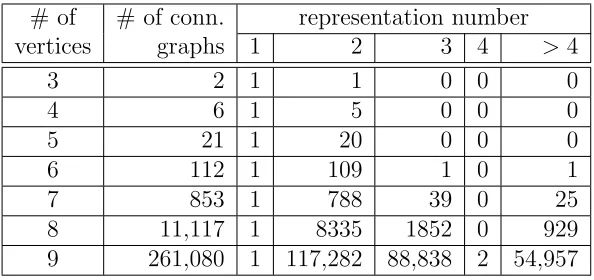
Table 1: Distribution of connected graphs with representation number k, 1 ≤ k ≤ 4, on at most 9 vertices. The cases k = 2,3 are the sequences A319489 and A319490 in [28], respectively.
As this tool works quite quickly, it is feasible to run it on a great number of graphs. In particular, we ran it on all connected graphs on ≤9 vertices as they are available from
http://users.cecs.anu.edu.au/~bdm/data/graphs.html .
The results are listed in Table 1, where ‘representation number > 4’ means that no 4-representation exists, so either the 4-representation number is >4, or the graph is not word-representable (for which the representation number is ∞). However, as these numbers co-incide with the respective numbers in Table 2, we conclude that only the latter occurs, and no word-representable graph exists on ≤9 vertices with representation number >4.
The single graph on 6 vertices with representation number 3 is the prism on the triangle; the single non-word-representable graph on 6 vertices is the wheel on 5 vertices. The 39 graphs on 7 vertices with representation number 3 are given in Figure4.
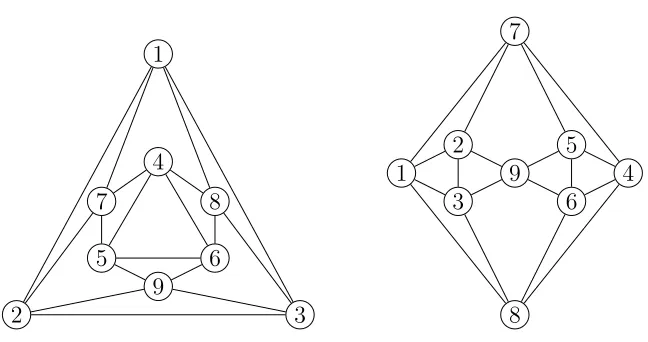
The most surprising result in Table 1is the two graphs on 9 vertices with representation number 4. One of them was known before, namely, G4 presented in Figure 3, and it was
believed to be the only graph on 9 vertices with representation number 4. However, our computations have shown the existence of another such graph, namely the graph J4 shown
in Figure 5. We note that J4 is a non-comparability graph, which is easy to check, while
G4 is. This may suggest that Conjecture 7 might not be true, since there are many more
Figure 4: The 39 connected graphs on 7 vertices with representation number 3
1
2 3
4
5 6
7 8
9
1 2
3
4 5
6 7
8 9
Figure 5: The graphJ4with representation number 4. It is shown in two ways to demonstrate
[image:10.612.152.476.417.588.2]3
Counting non-word-representable graphs using
con-straint programming
Similarly to our studies of k-word-representable graphs, we performed large computations using constraint programming [27] to count the numbers of non-word-representable connected graphs with up to 11 vertices. To do this, we used the constraint modelling tool Savile Row [26] and the constraint solver Minion [8]. These tools have been used successfully in the past to obtain novel enumerations of a variety of combinatorial structures including semigroups [6], equidistant frequency permutation arrays [17], and S-crucial and bicrucial permutations with respect to squares [9].
Our starting point was to model the concept of word-representability in a way similar to that when using SMT in Section2. However, here we use Theorem1showing the equivalence between word-representability and semi-transitivity, so that semi-transitive orientations are now used to determine whether or not a graph is word-representable. As with SMT in Section4, we use a booleanuij to indicate an undirected edge betweeniandj, and a boolean
eij to indicate a directed edge from i to j. Moreover, we use a boolean tij to indicate the
transitive closure of e, which is true when there is a path of directed edges from i to j. Most of the model expresses the appropriate linkages between these sets of variables. For example, constraints in the model express thattis the transitive closure of e. The acyclicity ofe is elegantly expressed by eachtiibeing false, i.e. no vertex being reachable from itself in the transitive closure. The final constraint expresses the property of semi-transitivity. This states that if two vertices are connected by a directed path, and there is an undirected edge between them, then all pairs of intermediate vertices must have a directed edge between them in the appropriate direction.
# of # of conn. All non-word-representable graphs
vert. graphs Total % of cand. Time Min. Non-Min.
6 112 1 0.89% 3.0s 1 0
7 853 25 2.93% 4.0s 10 15
8 11,117 929 8.36% 26s 47 882
9 261,080 54,957 21.05% 29m 179 54,778 10 11,716,571 4,880,093 41.65% 74h - -11 1,006,690,565 650,856,040 64.65% 1,100d -
-Table 2: The numbers of all non-word-representable connected graphs (the sequenceA290814
in [28]), as well as the numbers of such graphs, callednon-minimal, that include smaller non-word-representable subgraphs, and those, called minimal, that do not. The percentage of non-word-representable connected graphs to all connected graphs is given to 2 decimal places. Times indicate the CPU time used to compute all non-word-representable connected graphs, to 2 significant figures in an appropriate unit (seconds, minutes, hours, days). The time to count minimal/non-minimal connected graphs is not shown.
graph admitting more than one semi-transitive orientation would be repeated in the output, wasting both search time and necessitating extra work in removing duplicates.
Results of our computations are shown in Table 2. Note that in one case numbers are different to those previously reported. The true number of connected non-word-representable graphs on 9 vertices is 54,957,not68,545 as was reported in [19,20] (which was a copy/paste mistake).
It is also interesting to identify minimal non-word-representable graphs of each size, i.e. graphs containing no non-word-representable strict induced subgraphs. To do this, we stored all non-word-representable graphs of each size. After computing withgengall possible graphs with one more vertex, we eliminate graphs containing one of the stored graphs as an induced subgraph. We did this with a simple constraint model which tries to find a mapping from the vertices of the induced subgraph to the vertices of the larger graph, and if successful discards the larger graph from consideration. This enabled us to count all minimal non-word-representable graphs of each size up to 9, which is shown in Table 2. The filtering process we used was too inefficient to complete the cases n≥10.
4
Refining semi-transitivity
The notion of k-word-representability refines that of word-representability. However, The-orem 3 shows that these notions are equivalent. Still, k-word-representability plays a very important role in the theory of word-representable graphs.
[image:12.612.114.513.62.186.2]language ESSENCE’ 1.0 given n : int
given triangle_table : matrix indexed by [int(1..numgraphs),int(1..(n-1)*(n)/2)] of int(0,1)
letting LETTER be domain int(1..n)
find upper_triangle : matrix indexed by [int(1..((n-1)*n/2))] of int(0,1)
find u : matrix indexed by [LETTER, LETTER] of int(0,1) $ graph undirected edges find e : matrix indexed by [LETTER, LETTER] of int(0,1) $ graph directed edges find t : matrix indexed by [LETTER, LETTER] of int(0,1) $ transitive closure branching on [u]
such that
$ the diagonal is empty
forAll i : LETTER . u[i,i] = 0, $ the graph is undirected
forAll i,j : LETTER . u[i,j] = u[j,i],
$ linking u and the upper triangle
forAll i,j : LETTER . i < j -> (u[i,j] = upper_triangle[n*(i-1)+j-((i+1)*i/2)]), $ the graph is one of the preprocessed graphs
table(upper_triangle,triangle_table),
$ linking e and u
forAll i,j : LETTER . u[i,j] = 0 -> e[i,j]=0,
forAll i,j : LETTER . u[i,j] = 1 -> ((e[i,j]=1) \/ e[j,i]=1),
$ directed graph is irreflexive and antisymmetric forAll i : LETTER . e[i,i] = 0,
forAll i,j : LETTER . i < j -> ( (e[i,j] = 0) \/ (e[j,i] = 0)),
$ t is transitive closure of e and is acyclic
forAll i,j : LETTER . (e[i,j] = 1) -> (t[i,j] = 1),
forAll i,j,k : LETTER . ( (t[i,j] = 1) /\ (t[j,k] = 1)) -> (t[i,k] = 1), forAll i : LETTER . t[i,i] = 0,
$ semi transitive ordering forAll i,k: LETTER .
((t[i,k] = 1) /\ (u[i,k] = 1)) -> ((ordering[i,k] = 1) /\
forAll j : LETTER .
((t[i,j]=1 /\ t[j,k]=1) -> (e[i,j] = 1 /\ e[j,k]=1)))
Theorem 1. Recall the definition of a shortcut in Section 1.1. An undirected graph is k -semi-transitively oriented, ork-semi-transitivefor brevity, if it admits an acyclic orientation avoiding shortcuts of length k (longer shortcuts are allowed). In particular, an undirected graph is 3-semi-transitive if it admits an acyclic orientation such that for any directed path
v0 →v1 → v2 →v3 of length 3 for which v0 →v3 is an edge, also v0 →v2 and v1 → v3 are
edges.
The notion of 3-semi-transitivity is easily expressed in SMT. Writing uij for the boolean expressing whether there is an undirected edge fromitoj, andeij for the boolean expressing whether there is a directed edge fromi toj, the connection between directed and undirected graph is expressed by
uij ⇔(eij ∨eji)
for all vertices i, j. Being acyclic is expressed by the existence of a weight function w such that
eij ⇒w(i)> w(j)
for all vertices i, j. Finally, the path condition is expressed by
((∃k, m: ((eik∧ejk)∨(eki∧ekj))∧eim∧emj) ⇒ eij
for all verticesi, j, where∃runs over the vertices. For a given undirected graph, we take the conjunction of the above requirements and for alli, j we add∧uij if there is an edge fromito
j, and add ∧¬uij otherwise. Then, by construction, the resulting formula is satisfiable if and only if the undirected graph is 3-semi-transitive. We built these formulas for all connected graphs on ≤ 9 vertices, and applied Z3 on them. As a result, we determined that for ≤ 8 vertices a graph is 3-semi-transitive if and only if it is word-representable. In contrast, for 9 vertices we determined that there are exactly 4 graphs that are 3-semi-transitive but not word-representable, and hence not semi-transitive. They are depicted in Figure7. An SMT encoding of checking semi-transitivity is also included in the tool linked to in Section 2.
Using a similar encoding of the problem, these computational results were extended to finding the number of all 3-semi-transitively orientable connected graphs on up to 10 vertices using the constraint programming methods described in Section3. We refer to Table3where these results are recorded along with the number of minimal (not containing smaller such graphs as induced subgraphs) non-3-semi-transitively orientable connected graphs. Com-paring Tables 2 and 3, we see that there are 585 3-semi-transitively orientable, but not semi-transitively orientable connected graphs on 10 vertices.
Thus, the notions ofk-semi-transitively orientable graphs and semi-transitively orientable graphs are not equivalent.
5
Concluding remarks
Figure 7: 3-semi-transitively, but not semi-transitively orientable graphs
# of # of conn. All non-3-semi-transitively orientable graphs vert. graphs Total % of cand. Time Minimal Non-Minimal
6 112 1 0.89% 4.0s 1 0
7 853 25 2.93% 6.0s 10 15
8 11,117 929 8.36% 80s 47 882
9 261,080 54,953 21.05% 2.8h 175 54,778 10 11,716,571 4,879,508 41.65% 22d -
-Table 3: Numbers of (minimal) non-3-semi-transitively orientable connected graphs (the se-quenceA319492in [28]) and the CPU time to obtain them. The time to count minimal/non-minimal graphs is not shown.
support finding new results. In particular, one could try to use our tools to take all bipartite graphs and to test Conjecture 5for larger graphs.
It would be interesting to extend the construction of J4 in Figure 5 (in a natural way)
to more than 9 vertices so that new graphs with high representation numbers would be obtained. This may help to prove or disprove Conjecture7.
Also, an intriguing question is whether or not there exists k such that semi-transitive orientability is equivalent to k-semi-transitively orientability. If such a k exists, it must be
> 3 (e.g. because of the graphs in Figure 7). In either case, to study the properties of
k-semi-transitively orientable graphs (at least 3-semi-transitively orientable graphs) is an interesting and challenging direction of research. Many questions that can be asked about word-representable graphs [19,20] can be asked aboutk-semi-transitively orientable graphs, e.g. how many such graphs there are, or how we can describe these graphs in terms of forbidden subgraphs, etc, etc.
Finally, even though it seems that our current methods would not be able to extend the results of Table 2 to 12 vertices, it is interesting if it would be ever possible to achieve.
References
[image:15.612.111.518.174.283.2][2] C. Bessiere, Constraint propagation. In F. Rossi, P. van Beek, and T. Walsh, eds.,
Handbook of Constraint Programming, Elsevier Science, 2006, pp. 29–83.
[3] T. Z. Q. Chen, S. Kitaev, and B. Y. Sun, Word-representability of face subdivisions of triangular grid graphs,Graphs and Combin. 32(5) (2016), 1749–1761.
[4] T. Z. Q. Chen, S. Kitaev, and B. Y. Sun, Word-representability of triangulations of grid-covered cylinder graphs,Discr. Appl. Math. 213 (2016), 60–70.
[5] A. Collins, S. Kitaev, and V. Lozin, New results on word-representable graphs, Discr. Appl. Math. 216 (2017), 136–141.
[6] A. Distler, C. Jefferson, T. Kelsey, and L. Kotthoff, The semigroups of order 10. In
Proceedings of the Principles and Practice of Constraint Programming — 18th Inter-national Conference, CP 2012, Lect. Notes in Comp. Sci., Vol. 7514, Springer, 2012, pp. 883–899.
[7] A. Gao, S. Kitaev, and P. Zhang, On 132-representable graphs.Australasian J. Combin. 69 (2017), 105–118.
[8] I. P. Gent, C. Jefferson, and I. Miguel, Minion: A fast scalable constraint solver. In Pro-ceedings of the 2006 conference on ECAI 2006: 17th European Conference on Artificial Intelligence, 2006, pp. 98–102.
[9] I. Gent, S. Kitaev, A. Konovalov, S. Linton, and P. Nightingale, S-crucial and bicrucial permutations with respect to squares, J. Integer Sequences 18 (2015),Article 15.6.5.
[10] M. Glen, Colourability and word-representability of near-triangulations, preprint, 2016. Available athttps://arxiv.org/abs/1605.01688 .
[11] M. Glen, Software to deal with word-representable graphs, preprint, 2017. Available at https://personal.cis.strath.ac.uk/sergey.kitaev/
word-representable-graphs.html .
[12] M. Glen and S. Kitaev, Word-representability of triangulations of rectangular polyomino with a single domino tile, J. Combin. Math. Combin. Comput. 100 (2017), 131–144.
[13] M. M. Halld´orsson, S. Kitaev, and A. Pyatkin, Graphs capturing alternations in words. In Y. Gao, H. Lu, S. Seki, and S. Yu, eds., Developments in Language Theory. DLT 2010, Lect. Notes in Comp. Sci., Vol. 6224, Springer, pp. 436–437.
[15] M. Halld´orsson, S. Kitaev and A. Pyatkin, Semi-transitive orientations and word-representable graphs,Discr. Appl. Math. 201 (2016), 164–171.
[16] T. Hiraguchi, On the dimension of partially ordered sets, Sci. Rep. Kanazawa Univ. 1
(1951), 77–94.
[17] S. Huczynska, P. McKay, I. Miguel, and P. Nightingale, Modelling equidistant frequency permutation arrays: an application of constraints to mathematics. InProceedings of the Principles and Practice of Constraint Programming — 15th International Conference, Lect. Notes in Comp. Sci., Vol. 5732, Springer, 2009, pp. 50–64.
[18] S. Kitaev, On graphs with representation number 3,J. Autom. Lang. Combin.18(2013), 97–112.
[19] S. Kitaev, A comprehensive introduction to the theory of word-representable graphs. In ´
E. Charlier, J. Leroy, and M. Rigo, eds.,Developments in Language Theory. DLT 2017, Lect. Notes in Comp. Sci., Vol. 10396, Springer, 2017, pp. 36–67.
[20] S. Kitaev and V. Lozin,Words and Graphs, Springer, 2015.
[21] S. Kitaev and A. Pyatkin, On representable graphs,J. Autom. Lang. Combin.13(2008), 45–54.
[22] S. Kitaev, P. Salimov, C. Severs, and H. ´Ulfarsson, On the representability of line graphs. In G. Mauri and A. Leporati, eds., Developments in Language Theory. DLT 2011, Lect. Notes in Comp. Sci., Vol. 6795, Springer, 2001, pp. 478–479.
[23] S. Kitaev and S. Seif, Word problem of the Perkins semigroup via directed acyclic graphs,Order 25 (2008), 177–194.
[24] B. D. McKay and Adolfo Piperno, Practical graph isomorphism, II, J. Symb. Comput. 60 (2014), 94–112.
[25] Y. Mandelshtam, On graphs representable by pattern-avoiding words, preprint, 2016. Available athttps://arxiv.org/abs/1608.07614.
[26] P. Nightingale, ¨O. Akg¨un, I. P. Gent, C. Jefferson, I. Miguel, and P. Spracklen, Auto-matically improving constraint models in Savile Row,Artificial Intelligence251(2017), 35–61.
[27] F. Rossi, P. Van Beek, and T. Walsh, Handbook of Constraint Programming, Elsevier, 2006.
[28] N. J. A. Sloane, The Online Encyclopedia of Integer Sequences, published electronically
[29] The SMT solver Yices, 2018. Available at http://yices.csl.sri.com/.
[30] The SMT solver Z3, 2018. Available at https://github.com/Z3Prover/z3.
2010 Mathematics Subject Classification: Primary 05C62; Secondary 68R15.
Keywords: word-representable graph, representation number, enumeration, semi-transitive orientation, k-semi-transitive orientation.
(Concerned with sequencesA156808,A290814,A319489,A319490,A319491, andA319492.)
Received October 1 2018; revised versions received February 22 2019; February 23 2019. Published in Journal of Integer Sequences, February 24 2019.
![Table 2: The numbers of all non-word-representable connected graphs (the sequence A290814in [28]), as well as the numbers of such graphs, called non-minimal, that include smaller non-word-representable subgraphs, and those, called minimal, that do not](https://thumb-us.123doks.com/thumbv2/123dok_us/1328862.86786/12.612.114.513.62.186/representable-connected-sequence-minimal-smaller-representable-subgraphs-minimal.webp)
![Table 3: Numbers of (minimal) non-3-semi-transitively orientable connected graphs (the se-quence A319492 in [28]) and the CPU time to obtain them](https://thumb-us.123doks.com/thumbv2/123dok_us/1328862.86786/15.612.164.465.64.128/table-numbers-minimal-transitively-orientable-connected-graphs-quence.webp)
