The role of social media presence, responsiveness, and
interactivity in enhancing key relationship strength
indicators within B2B contexts: the customer's
perspective
Maria Karampela
1Ewelina Lacka
2Graeme McLean
11
The Role of Social Media Presence, Responsiveness, And Interactivity in
Enhancing Key Relationship Strength Indicators within B2B Contexts: The
Customer’s Perspective
Abstract
Extant research on use of social media by firms has mostly focused on B2C contexts, yet given their benefits for firms (e.g. creating awareness, enhancing brand image, etc.), scholars’ attention has increasingly turned to the role and usage of social media for B2B brands. In such contexts, research has primarily examined the challenges relating to the use of social media from the seller’s perspective. This paper extends this line of research by investigating the impact of B2B brands’ social media presence, interactivity, and responsiveness on key supplier-customer relationship indicators (commitment,
interactivity, satisfaction, and partner quality) from the customer’s perspective. Data from an online survey (N=200) with customers of B2B brands were analysed using structural equation modelling. We reveal that social media presence has a positive impact on all indicators, responsiveness positively influences commitment, while interactivity enhances perceptions of brand partner quality.
Keywords
B2B; social media; customer-buyer relationships
Track
2
1. Introduction
In recent years social media, providing brands with unique opportunities to foster relationships with customers, have become an integral part of marketing efforts (Andzulis et al, 2012). This is because social media, building on the ideological and technological
foundations of Web 2.0 (Kaplan and Haenlein, 2010), enable synchronous and asynchronous communication. Thus, brands can establish their presence on social media and update their pages with content, with which consumers can engage (Osei-Frimpong and McLean, 2017). Social media also offer opportunities for instant communication, which not only enables brand-customer interaction, but also allows brands to respond to customers’ queries. The role of social media, and particularly presence, interactivity, and responsiveness, have been extensively examined in the context of B2C relationships (see Ou et al, 2014). However, it has increasingly become important for B2B businesses as well to adopt and use these
platforms to build relationships with customers and other stakeholders (Agnihotri et al, 2016). Yet, research examining the role of social media in a B2B context is at an early stage, having primarily focused on challenges B2B brands face while using social media
(Michaelidou et al, 2011), and on the assessment of factors driving the adoption and use of these platforms (Lacka and Chong, 2016). Only recently, Agnihotri et al (2016) verified the role of social media responsiveness on customer satisfaction in B2B contexts. This paper extends this research stream, by examining the impact of social media on key relationship indicators in B2B settings. Specifically, this study aims to assess the role of B2B brands’ presence, interactivity, and responsiveness on social media on customers’ perceptions of key relationship quality indicators: commitment, interactivity, satisfaction, and partner quality. To achieve those aims, we draw from social media and brand relationship quality literature in B2C, and extend it to the B2B realm, which is a common practice (see Agnihotri et al, 2016).
2. Literature Review
2.1. B2B supplier-customer relationship strength indicators
Given the nature of B2B transactions (i.e. large value, complex decision-making, customization needs, etc.), interactions between suppliers and customers in such settings have predominantly been examined under the lens of the relationship paradigm(e.g. Crosby et al, 1990), with scholars attempting to discover the factors that make such interactions more long-lasting and durable. Naturally, a key focus of their efforts has been relationship quality, as it constitutes the most important goal for managers (Gummesson, 2002), given its role in providing value to customers, creating loyalty, and thus enhancing brand equity
(Zaichkowsky et al, 2010). Yet, such scholarly efforts abound with numerous challenges. First, previous literature has observed that B2B relationships are not viewed and interpreted in the same way by suppliers and buyers (Ulaga & Eggert, 2005). Second, numerous studies have attempted to define relationship quality and its dimensions, yet no consensus has been reached. Indeed, the same constructs feature as dimensions or
consequences in different studies, while different layers of relationship quality (e.g.
interpersonal, organisational) have also been proposed (Rauyruen & Miller, 2007). There are however certain indicators that appear in the literature more often than others, such as
satisfaction (e.g. Crosby et al, 1990) and commitment (e.g. Dorsch et al, 1998).
3
examine supplier-buyer relationship quality in such contexts, it is imperative to consider aspects of brand relationship quality (BRQ). Yet, in the absence of research conceptualising and measuring BRQ indicators in B2B settings, we turn to relevant literature in B2C settings, as is common practice (e.g. Agnihotri et al, 2016).
In B2C research, BRQ was developed by Fournier (1998), who proposed that the construct consists of six dimensions (love/passion, self-connection, intimacy, commitment, partner quality, interdependence). To examine consumer-brand interactions online,
Thorbjörnsen et al (2002) drew from Fournier’s qualitative work to develop a BRQ scale for B2C settings, including: love/passion, intimacy, self-connection, and partner quality. Soon afterwards, Aaker et al (2004) also drew from Fournier to identify four relationship strength indicators: commitment, intimacy, satisfaction, and self-connection. While some of these indicators are not applicable outside B2C markets (e.g. love, self-connection), it remains unclear how key brand relationship strength indicators such as commitment, satisfaction, intimacy, and partner quality are influenced by B2B brands’ social media efforts.
2.2. The role of social media presence, interactivity, & responsiveness in strengthening B2B supplier-customer relationships
Presence is a natural consequence of social media use (Lowry et al, 2009). By setting up social media accounts, brands become present on these platforms, and manifest this presence by posts and updates. Presence in the online context refers to customers’ perception of a brand being present despite physical separation from its location (Ou et al, 2014).
Presence can be manifested through customers’ perception of psychological intimacy with a brand (i.e. social presence) and/or through the perception of physical proximity to a brand (i.e. telepresence). Since intimacy is one of the key indicators of brand relationship quality, we postulate that brand presence enabled by social media has positive impact on brand relationship quality and its indicators. This is in line with previous research in B2C contexts, which recognises that presence has positive impact on seller (i.e. brand) relationships with consumers (Ou et al, 2014). Thus, we hypothesise that:
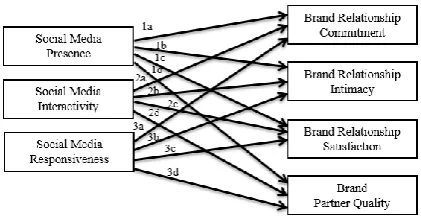
H1: Social Media Presence has positive impact on Brand Relationship Quality: Commitment (a), Intimacy (b), Satisfaction (c), and Partner Quality (d).
Social media is a communication rich environment, which ‘encourages customers to interact, engage, and establish relationships’ with brands (Agnihotri et al, 2012, p. 341). Social media interactivity refers to customers’ perception of high-quality interactions with the brand. It is demonstrated through reciprocal and synchronised communication controlled by brands and consumers alike (Ou et al, 2014). Previous research has showed that interactivity can enhance consumers’ purchase intentions and help firms build high-quality relationships with consumers (Teo et al, 2003). This is because, Ou et al (2014) notes, interactivity helps develop mutual understanding between parties, and it helps brands meet consumers’ expectations (Agnihotri et al, 2015). Interactivity therefore can serve as a means through which brands demonstrate commitment to satisfy their customers’ needs; commitment and satisfaction are indicators of brand relationship quality. Although increased interaction between brands and consumers in B2B context can yield some positive results (Agnihotri et al, 2015), there is no indication what these results might be. To develop insights into the role of social media interactivity in strengthening B2B supplier-customer, we postulate that:
H2: Social Media Interactivity has positive impact on Brand Relationship Quality: Commitment (a), Intimacy (b), Satisfaction (c), and Partner Quality (d).
4
literature notes that resolving customer issues and reacting to emerging needs enable greater customer satisfaction (Sharma, 1997). Accordingly, social media responsiveness has been found to have a positive impact on customer satisfaction in B2B context (Agnihotri et al, 2015). Responsiveness however can enhance not only customer satisfaction but also perception of partner quality. This is because responsiveness is linked to firms’ reliability (Ahearne et al, 2007), which may signal quality of the business partner (i.e. brand). Since, satisfaction and partner quality are indicators of brand relationship quality, we hypothesise:
H3: Social Media Responsiveness has positive impact on Brand Relationship Quality: Commitment (a), Intimacy (b), Satisfaction (c), and Partner Quality (d).
[image:5.595.81.292.260.368.2]The above stated hypotheses are illustrated in Figure 1.
Figure 1. Research framework
3. Methods
To test the research model and hypotheses, an online survey was conducted. The questionnaire was divided into three parts. First, some screening questions were included to ensure that respondents (1) use social media, (2) work for a firm which buys goods/services from other firms, (3) follow suppliers on social media. To test the research hypotheses, items from previous research were adopted: commitment, intimacy, and satisfaction from Aaker et al (2004), brand partner quality from Thorbjörnsen et al (2002), social media presence and intimacy from Ou et al (2014), and responsiveness from Agnihotri et al (2016). All items were modified to fit the study’s context, and were measured on a 7-point Likert scale. Finally, some demographic questions were also included.
The online questionnaire was emailed to respondents identified via FAME database. In total, 200 usable responses were collected (52% males, 47% females, with most (30%) being 51+ years old). The majority of respondents (88%) confirmed that they use social media for both professional and personal reasons, while the most popular social media were Twitter (71.5%), LinkedIn (67.5%), and Facebook (38.5%). Respondents worked in sectors ranging from professional services to logistics and agriculture, with 56% of them having over 25 years of work experience in the particular sector and 48.5% having more than 5 years of work in their firm. Almost 8 in 10 identified themselves as decision makers; sample included Directors/General Managers (33.5%), Marketing Directors/Managers (28%), Sales
Directors/Managers (6.5%), Social Media Directors (9.5%), and other positions (22.5%).
4. Results
To prepare the dataset for analysis, scale reliability was assessed via Cronbach’s alpha coefficient. All scales were above the critical value of .7 (Pallant, 2013), hence are reliable measures of their corresponding variables. To test the hypotheses, structural equation
5
moment structures takes a confirmatory approach to SEM. The first step is to estimate the CFA measurement model followed by the structural model. The fit statistics outline good fit of the measurement model (x2(329)= 549.823, ρ = .001, x2/df = 1.67, RMSEA = .058, RMR =
.083, SRMR = .057, CFI = .937). In line with the statistics, all loadings were adequate and significant (p < .05). In addition, convergent and discriminant validity were supported: (1) all loadings were significant (p < .001), (2) the composite reliability for each construct exceeded the recommended level of .70 (Fornell and Larcker, 1981), and (3) the average variance extracted (AVE) for each construct fulfilled the recommended benchmark of .50, and also met the requirement of above the maximum shared variance (MSV) (Hair et al, 2010). Furthermore, the discriminant validity was assessed; the square root of the AVE for each construct exceeded the inter-correlation for each construct (Hair et al, 2010).
Due to the good fit of the measurement model and subsequent analyses, the second stage of the SEM process took place by specifying and estimating the hypothesised structural model shown in Figure 1. The fit statistic of the structural model showed reasonable fit (x2(1)
= 38.040, p < .05, x2/df = 38.04, RMSEA = .431, SRMR = .0821, RMR = .082, CFI = .935,
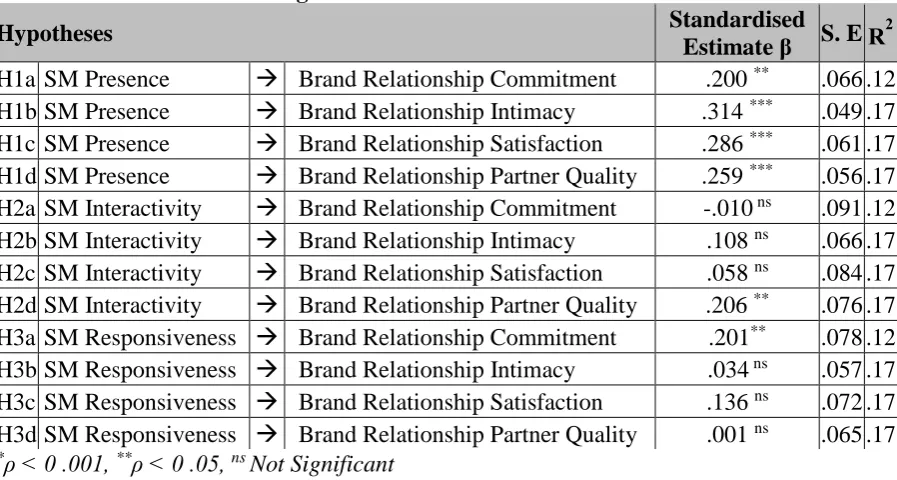
[image:6.595.82.531.374.614.2]NFI = .935, GFI = .953) and provided supporting evidence for the hypothesised relationships. The RMSEA in our model shows poor fit, however models with low degrees of freedom can have artificially large values from the RMSEA calculation, therefore following Kenny et al (2014) the RMSEA value should be ignored. The standardised path coefficient regression weights and statistical significance can be seen in Table 1.
Table 1. SEM Standardised Regression Estimates
Hypotheses Standardised
Estimate β S. E R
2
H1a SM Presence Brand Relationship Commitment .200 ** .066 .12 H1b SM Presence Brand Relationship Intimacy .314 *** .049 .17 H1c SM Presence Brand Relationship Satisfaction .286 *** .061 .17 H1d SM Presence Brand Relationship Partner Quality .259 *** .056 .17
H2a SM Interactivity Brand Relationship Commitment -.010 ns .091 .12 H2b SM Interactivity Brand Relationship Intimacy .108 ns .066 .17 H2c SM Interactivity Brand Relationship Satisfaction .058 ns .084 .17 H2d SM Interactivity Brand Relationship Partner Quality .206 ** .076 .17 H3a SM Responsiveness Brand Relationship Commitment .201** .078 .12 H3b SM Responsiveness Brand Relationship Intimacy .034 ns .057 .17 H3c SM Responsiveness Brand Relationship Satisfaction .136 ns .072 .17 H3d SM Responsiveness Brand Relationship Partner Quality .001 ns .065 .17
***ρ < 0 .001, **ρ < 0 .05, ns Not Significant
The results in Table 1 show some strong regression coefficients and statistically significant relationships (p < .05), thus supporting some of the hypotheses. The results assert that social media presence has a significant influence on commitment, intimacy, and
6
5. Conclusions, Implications, & Areas for Future Research
Social media present many benefits and opportunities for organisations both in B2B and B2C contexts, yet surprisingly, limited empirical academic research has been conducted within B2B settings. Building upon Agnihotri et al’s (2016) initial work on social media in a B2B context, we provide insight into the impact of specific social media dimensions on enhancing key supplier-customer relationship indicators in B2B settings, namely intimacy, commitment, satisfaction, and partner quality. While Agnihotri et al (2016) verified the role of social media responsiveness on consumers’ satisfaction in a B2B context, the other two key dimensions of social media, presence and interactivity, have only been assessed in B2C settings (Ou et al, 2014). Extending this research stream, we find that not all dimensions are equally important in influencing key relationship strength indicators in a B2B setting.
Our results indicate that being present on channels such as LinkedIn, Facebook, and Twitter via posts and updates enhances brand relationship quality. Presence provides customers the perception of being close to the brand without necessarily interacting with it. Thus, being present in social media enhances customers’ commitment, intimacy, and satisfaction towards their B2B brand partners and allows them to keep up to date with their posts at a time and place convenient to them. Moreover, in line with previous research in B2B contexts (Agnihotri et al, 2016), this study affirms the importance of social media
responsiveness on influencing commitment to the B2B brand. Thus, responding to a customer-firm’s enquiry in a timely manner will influence their commitment to the brand.
Finally,previous B2C research has showed that interactivity can enhance consumers’ purchase intentions and help firms build high-quality relationships with them (Teo et al, 2003), as it helps in developing mutual understanding (Ou et al, 2014). However, our results assert that in B2B contexts interactivity has no influence on brand relationship quality. Therefore, B2B brands are unlikely to benefit from any brand engagement within their social media channels; customers however still expect them to have presence on social media, which in turn has a positive influence on brand relationship quality indicators.
Overall therefore, while in B2C settings the success of social media is often
associated with the level of engagement and interactivity established on such channels, B2B firms ought to be cautious in using the level of interactivity as a basis of measuring success and should note that returns are gained from their presence on social media.
As a final note, we observe that our findings raise further questions which future research should address. For instance, a more in-depth exploration of the reasons why interactivity is not perceived to be so important for customers of B2B firms is needed. Furthermore, the current study focused on four relationship strength indicators but future research might wish to extend this research by examining other aspects of supplier-customer relationships, such as trust, attitudinal loyalty, willingness to recommend the supplier to other firms within the customer’s network, or to forgive the supplier-brand’s transgressions.
References
Aaker, J., Fournier, S. & Brasel, S.A., (2004). When good brands do bad. Journal of Consumer research, 31(1), 1-16
Agnihotri R., Dingus R., Hu M., & Krush M., (2016) ‘Social media: Influencing customer satisfaction in B2B sales’ Industrial Marketing Management, 53, 172-180
7
Ahearne, M., Jelinek, R., & Jones, E. (2007). Examining the effect of salesperson service behaviour in a competitive context. Journal of the Academy of Marketing Science, 35(4), 603–616
Andzulis, J., Panagopoulos, N., & Rapp, A (2012). A review of social media and implications for the sales process, Journal of Personal Selling & Sales Management, 32(3), 305–316 Crosby L., Evans K., & Cowles D. (1990) Relationship quality in services selling: an interpersonal influence perspective. Journal of Marketing, 54, 68–81
Dorsch, M, Swanson, S, & Kelley, S. (1998) The role of relationship quality in the
stratification of vendors as perceived by customers. Journal of the Academy of Marketing Science, 26(2), 128–42
Fornell, C. & Larcker, D. F. (1981). Evaluating Structural Equation Models with
Unobservable Variables and Measurement Error. Journal of Marketing Research, 18, 39-50. Fournier, S. (1998), “Consumers and Their Brands: Developing Relationship Theory in Consumer Research,” Journal of Consumer Research, 24 (March), 343–73.
Gummesson, Evert (2002), Total Relationship Marketing, Oxford: Butterworth Heinemann. Hair, J., Black, W., Babin, B. & Anderson, R. (2010). Multivariate Data Analysis, 7th Edition, Prentice Hall.
Kaplan, A., & Haenlein, M. (2010). Users of the world, unite! The challenges and opportunities of social media. Business Horizons, 53, 59–68.
Kenny, D. A., Kaniskan, B., & McCoach, D. B. (2015). The performance of RMSEA in models with small degrees of freedom. Sociological Methods & Research, 44(3), 486-507 Lacka E., & Chong A., (2016) Usability perspective on social media sites' adoption in the B2B context. Industrial Marketing Management 54, 80-91
Lowry, P.B., Roberts, T. L., Romano, Jr., N.C., Cheney, P., & Hightower, R.T., (2006) The Impact of Group Size and Social Presence on Small-Group Communication: Does Computer- Mediated Communication Make a Difference?” Small Group Research (37:6), 631-661 Lynch, J., & de Chernatony, L. (2007). Winning hearts and minds: Business-to-business branding and the role of the salesperson. Journal of Marketing Management, 23, 123–135. Michaelidou, M., Siamagka, N., & Christodoulides G., (2011) Usage, barriers and
measurement of social media marketing: An exploratory investigation of small and medium B2B brands. Industrial Marketing Management 40, 1153-1159
Osei-Frimpong, K. & McLean, G. (2017) Examining online social brand engagement: a social presence theory perspective. Technological Forecasting and Social Change, 1-13 Ou C., Pavlou P., & Davison R., (2014) Swift Guanxi in online marketplaces: the role of computer mediated communication technologies. MIS Quarterly 38(1)
Pallant, J. (2013) SPSS Survival Manual: A step by step guide to data analysis, 5th Ed., Open University Press, New York
Rauyruen, P. & Miller, K. (2007), 'Relationship quality as a predictor of B2B customer loyalty', Journal of Business Research, 60, 1, 21-31
Sharma, A. (1997). Customer satisfaction-based incentive systems: Some managerial and salesperson considerations. Journal of Personal Selling & Sales Management, 17(2), 61–70 Teo, H., Oh, L., Liu, C., & Wei, K. (2003) An Empirical Study of the Effects of Interactivity on Web User Attitude, International Journal of Human-Computer Studies, 58, 281-305 Thorbjörnsen H., Supphellen M., Nysveen H., & Pedersen P., (2002) Building brand relationships online: a comparison of two interactive applications. Journal of Interactive Marketing, 16 (3), 17-34
Ulaga, W. & Eggert, A. (2005). Relationship value in business markets: The construct and its dimensions. Journal of Business to Business Marketing, 12 (1), 73–99