City, University of London Institutional Repository
Citation:
Susen, S. (2018). Language. In: B. S. Turner, C. Kyung-Sup, C. F. Epstein, P.
Kivisto, W. Outhwaite & J. M. Ryan (Eds.), The Wiley-Blackwell Encyclopedia of Social
Theory. (pp. 1278-1290). Chichester, UK: John Wiley & Sons. ISBN 9781118430866
This is the accepted version of the paper.
This version of the publication may differ from the final published
version.
Permanent repository link:
http://openaccess.city.ac.uk/18942/
Link to published version:
http://dx.doi.org/10.1002/9781118430873
Copyright and reuse: City Research Online aims to make research
outputs of City, University of London available to a wider audience.
Copyright and Moral Rights remain with the author(s) and/or copyright
holders. URLs from City Research Online may be freely distributed and
linked to.
Language
SIMON SUSEN
City, University of London, UK
THE DEFINITION OF LANGUAGE
The concept of “language” refers to any system of symbolically mediated – notably, spoken or written – communication used by actors to establish a meaning-laden relationship to the objective, normative, and subjective dimen- sions of their existence. Etymologically, the term language has Indo-European roots and derives from the Latin word lingua, mean- ing “language,” “tongue,” or “speech.” The term natural language is usually employed in relation to a language that is mastered and transmitted by ordinary actors capa- ble of speech and action. The term formal language, by contrast, is commonly used to describe artificially constructed communi- cation systems, designed to provide a set of signs, codes, and ciphers allowing for the encoding and decoding of information.
Different theories of language place dif-ferent emphasis on difdif-ferent features of language. It is generally agreed, however, that all human languages can be studied in terms of the following – constitutive –
components: morphology (structure of
words); vocabulary (variety of words); seman- tics (meaning-ladenness of words); syntax
(arrangement of words in sentences, clauses, and phrases); grammar (set of rules govern- ing the composition of sentences, clauses, phrases, and words); phonetics (sounds of human speech); and pragmatics (use of language in particular contexts).
THE STUDY OF LANGUAGE
Linguistics is the discipline that is concerned with the scientific study of language (see, for instance, Matthews 2003). Historical linguists widely believe that the systematic examina- tion of language began more than 2,000 years ago, notably in ancient India. Among the most influential examples in the history of the study of language are the following: Pa¯n.
ini, who was a Sanskrit grammarian from ancient India in the fourth century BCE;
Antoine Arnauld and Claude Lancelot, who developed what is known as the (French)
Port-Royal Grammar in the seventeenth century; William Jones and Wilhelm von Humboldt, famous for advocating a
comparative linguistic method in the eighteenth century; Ferdinand de Saussure, the founding figure of structural(ist) linguistics in the early twentieth century; and Noam Chomsky, promoter of the
generative theory of language and trans- formational grammars in the late twentieth century.
THE CLASSIFICATION OF LANGUAGE
Just as there are different types of linguistics, there are different types of language. First, there are human languages and nonhuman languages, that is, those used by humans and those used by animals. Second, there are
natural languages and artificial languages. The former are spoken or signed; they are acquired by most human beings on the basis of their daily exposure to and involvement in one or more linguistic communities. The latter are invented or fabricated; they can be employed for several – especially, transcultural and technological – purposes. In principle, all languages can be encoded into secondary media using auditory, visual, or tactile stimuli. Third, there are multiple modes of language, notably spoken languages
(auditive modality), written languages (typo- graphic modality), sign languages (visual modality), body languages (corporeal modal- ity), and braille languages (tactile modality) – to mention only the most significant ones.
THE FUNCTIONS OF LANGUAGE
All human languages possess at least four fundamental anthropological functions: first, owing to their assertive function, they permit actors to raise constative validity claims in relation to the objective dimensions of their existence; second, owing to their regula- tive function, they permit actors to raise
normative validity claims in relation to the
intersubjective dimensions of their existence; third, owing to their individuative function, they permit actors to raise expressive validity claims in relation to the subjective dimensions of their existence; and, fourth, owing to their
intelligible function, they permit actors to raise communicative validity claims in rela- tion to – in principle – all dimensions of their existence.
THE FEATURES OF LANGUAGE
Although not without controversy, it is widely assumed that “human language” can be dis- tinguished from “animal language.” This conceptual differentiation is founded on the conviction that the former contains a number of species-constitutive features that cannot be found when examining the composition of the latter. Arguably, among these – distinctly anthropological – characteristics of human language are the following:
• the combination of its morphological,
terminological, semantic, syntactic, gram- matical, phonetic, and pragmatic elements, all of which constitute both relatively
independent and relatively interdependent
components underlying the production, reproduction, and transformation of human language;
• the combination of its assertive, regulative,
individuative, and intelligible functions, enabling human actors to raise constative,
normative, expressive, and communicative
validity claims in relation to the objective,
intersubjective, subjective, and immersive
dimensions of their existence;
• an unparalleled degree of complexity
in terms of the development of the aforementioned elements and functions, playing a pivotal role in the unfolding of
human history in general and of human evolution in particular;
• an unparalleled degree of complexity
in terms of the development of the
physiological underpinnings of human language, notably the Broca’s area and the Wernicke’s area of the human brain. THE ORIGIN(S) OF LANGUAGE
this respect, several prominent examples are worth mentioning. Jean-Jacques Rousseau
and Johann Gottfried Herder traced the origin of language to emotions, arguing that, in its primary variants, it was intimately interre- lated with creative symbolic forms, such as music and poetry. According to the rational- ist accounts provided by Immanuel Kant and
René Descartes, the development of language is inextricably linked to the development of
reason: actors capable of speech and action are cognitively sophisticated entities able to make judgments based on contemplative processes of critical reflection. In the eyes of the later Ludwig Wittgenstein, language games emerge in relation to particular life forms; on this view, symbolic representations cannot be dissociated from the sociohistor- ical conditions in the context of which they come into existence. Furthermore, from a Wittgensteinian perspective, philosophical problems are essentially linguistic problems; on this account, the study of philosophy requires the study of language.
Irrespective of the theoretical perspective that one may favor when attempting to shed light on the origins of language, most con- temporary linguists maintain that human beings possess an innate drive toward lan- guage acquisition. This is reflected in the fact that healthy children – insofar as they are exposed to and participate in the everyday interactions of at least one language com- munity – are equipped with the capacity to acquire language without formal instruction. Perhaps one of the most distinctive – and existentially empowering – features of human language is that it permits subjects capable of speech and action to engage in processes of displacement, by means of which they can refer to states of affairs that are spatiotem- porally remote from the particular situation or sociohistorical context in which they find themselves immersed. Arguably, nonhuman forms of language lack this species-distinctive
characteristic. Different theories about the origins of language draw upon different assumptions concerning the nature of lan- guage. In this regard, two currents of thought are particularly influential:
• Continuity-focused approaches (e.g., Steven Pinker) affirm that, in light of its evolutionary complexity, language has
gradually evolved from prelinguistic ways of communication developed by our prehuman ancestors.
• Discontinuity-focused approaches (e.g., Noam Chomsky) assert that, considering its anthropological uniqueness, language is an incommensurable component of the human – and only the human – world, representing a species-constitutive fea- ture that suddenly emerged during the historical transition from prehominids to hominids.
The former tend to emphasize the fact that language stands for a communicative system that is culturally constructed and, thus, absorbed and reproduced through social interactions. The latter tend to conceive of language as a product of an innate faculty
THE SIGNIFICANCE OF LANGUAGE
The wider significance of language – or, to be exact, the anthropological centrality of human language – concerns 10 key levels of analysis (see Susen 2007: 283–287).
1 As an anthropological specificity, it is embedded in human nature and, in terms of its unparalleled complexity, intrinsic only to the human, and not the nonhuman, world.
2 As an anthropological invariant, it con- stitutes an integral part of all human life forms, irrespective of their spatiotempo- ral or sociocultural specificity.
3 As an anthropological ground, it is not only inherent in, but also fundamental to, the human social, that is, it deter- mines the nature of human coexistence in a constitutive, rather than tangential, sense and is anchored in the lifeworld. 4 As an anthropological field, it represents
an ensemble of relationally structured conditions the existence of which is necessary for the emergence of social order.
5 As an anthropological competence, it represents a fundamental capacity that permits human actors to participate in the meaning-laden construction of the social world.
6 As an anthropological driving force, it can be regarded as an engine of social evolu- tion that substantially shapes the histor- ical development of the human species, including the conditions of its existence. 7 As an anthropological need, it is vital to
human life, that is, its existence is a precondition for the subject’s self- fulfillment, and its repression is a source of the subject’s alienation.
8 As an anthropological resource, it is both a motor and a vehicle of social struggle, representing a source of both human
harmony and human conflict, that is, the struggle over its control is a struggle over empowerment and disempowerment. 9 As an anthropological world relation, it
defines the way in which we relate to (a) the natural world, (b) the social world, and (c) our subjective world. 10 As an anthropological telos, it possesses
a quasi-transcendental teleological orientation, which consists in reaching mutual understanding and which per- vades every subject’s ordinary engage- ment with the world.
THE PARADOX OF LANGUAGE
Unless they are hindered by severe phys- iological or psychological illness directly affecting their speech ability, humans are equipped with a linguistic competence, that is, with the capacity to communicate with their fellow human beings by mobilizing their language-specific resources. One of the curious paradoxes of human language can be described as follows: as a universal resource, language constitutes a species-distinctive
medium to the extent that, in principle, all actors capable of speech and action have access to it; as a particular resource, language constitutes a species-divisive medium to the extent that, in practice, all actors capable of speech and action are socially separated by it. All human languages are united by the fact that they are based on morphological, terminological, semantic, syntactic, gram- matical, phonetic, and pragmatic elements; yet, all human languages are divided by both the personal and the cultural contingency – and, hence, variability – of each of these dimensions. In other words, language varies both from person to person and from culture to culture.
resembles the task of studying, recogniz- ing, and categorizing the world’s biological species: both investigative endeavors grapple with fundamental existential issues such as
genesis, development, survival, competition,
differentiation, production, reproduction,
transformation, evolution, and extinction. Regardless of their abundant idiosyncrasies, however, all languages share a number of essential properties, which – in their totality – both reflect and shape the consti- tution of symbolically mediated interactions as they are performed by linguistically skilled members of humanity.
By definition, human language is uniquely human. Not only are we a “knowing species,”
Homo sapiens, but we are also a “talking species,” Homo loquens. Our cognitive ability to relate to, to act upon, and to attribute meaning to the world by means of rational- ity is inextricably linked to our linguistic capacity to raise claims to objective, nor- mative, or subjective validity by engaging in communicative – and, if necessary, dis- cursive – processes oriented toward mutual intelligibility. Our immersion within and dependence upon language are so profound that, when scrutinizing its nature, develop- ment, and functions, we cannot but start as insiders, that is, as native representatives of a speaking species. Owing to our linguistic capacity, we undertake every form of critical analysis from a particular sociocultural posi- tion, which we occupy as members of a given linguistic community.
Ever since hominid life history began to detach itself from the evolutionary line of chimpanzees, approximately 5–8 million years ago, the development of gradually more complex forms of Verstand (reason) was intimately interrelated with the unfold- ing of increasingly sophisticated modes of
Verständigung (communication). Notwith- standing the question of whether one favors biological or sociological, biogenetic or
sociogenetic, essentialist or constructivist, universalist or particularist frameworks of analysis, the human capacity to acquire and to use language cannot be explained without reference to the role of both prenatal faculties and postnatal experiences – that is, both
nature and nurture, both innate and envi- ronmental factors – in shaping the human ability to establish a symbolically mediated relationship with the objective, normative, and subjective dimensions of worldly realities.
THE CRITICAL SOCIOLOGY OF LANGUAGE
The critical sociology of language is concerned, above all, with the power-laden constitution
of symbolic forms in general and of linguistic forms in particular. The following ten features of language are crucial in this respect (see Susen 2013a, 2013b).
1 Language is social. As a socially con- structed force, its existence is contingent upon the collective production of lin- guistic utterances; as a socially embedded
force, its existence is dependent upon the
collective framing of linguistic utterances. 2 Language is dialectic. (a) On the level
of competence and performance, it owes its existence to subjects who are both in principle and in practice capable of speech and action. (b) On the level of
grammar and pragmatics, it owes its existence to both symbolic structures
and symbolic processes. (c) On the level of commonality and singularity, it owes its existence to both shared points of cultural reference and unique sources of lived experience.
3 Language is interpretive. Humans
things and not see other things, that is, it permits them to see some things and precludes them from seeing other things in a particular way.
4 Language is doxic. Inevitably, when mobilizing our linguistic resources, we impose symbolically mediated back- ground assumptions upon the world. As linguistic beings, we are prejudgmental entities: all our foreground utterances are embedded in background traditions. 5 Language is discursive. Human actors
produce different discourses in different social realms. Language is the principle vehicle of these discourses.
6 Language is legitimacy-dependent. Legit- imate languages are reflected in legit- imate representations, situated in legitimate contexts, embodied in legiti- mate linguistic capacities, materialized in legitimate authority, and imbued with legitimate normativity.
7 Language is ideological. By definition, it serves either to sustain or to undermine specific sets of ideas – that is, concep- tual representations – about particular aspects of reality. To the degree that every language creates its own view of the world, every Sprachanschauung
constitutes a form of Weltanschauung. 8 Language is contestable. In principle,
the validity of every linguistically raised claim to truth, rightness, or sincerity can be called into question. Struggles over languages – and, thus, over the validity claims raised within and through them – are struggles over how to attribute meaning to the world.
9 Language is commodifiable. In strat- ified societies, it functions not only as a marker of identity but also as an indicator of social status. The interplay between linguistic fields, linguistic habi- tus, and linguistic capital permeates every economy of linguistic exchanges.
Human actors need to participate in linguistic fields, cultivate a linguistic habitus, and acquire linguistic capital, in order to contribute to the linguistically mediated construction of reality.
10 Language is both a source and a medium of symbolic power. To the extent that all linguistic relations are social rela- tions and all social relations are power relations, our daily immersion in language involves our complicit par- ticipation in the exercise of symbolic power.
Sociologists of language draw on socio- linguistics. In essence, sociolinguistics is the study of the relationship between language and society (e.g., Edwards 2013). The most obvious sociological variables that shape (a) linguistic fields, (b) linguistic habitus, and (c) linguistic capital are class, ethnicity, gen- der, age, and ability. The importance of each of these dimensions is context-dependent, in the sense that different sets of circumstances involve different dynamics of social position- ing and also different sets of opportunities, limitations, and expectations.
The relationship between language and society has been an object of enquiry in a number of influential twentieth-century
of performativity. Although these concep- tual frameworks differ on several counts, they share the assumption that language is, by definition, a relational state of affairs. On this view, language is – always and unavoidably – history-laden, context-laden, situation-laden, value-laden, meaning-laden, perspective-laden, tension-laden, interest- laden, and power-laden.
THE DIVERSITY OF LANGUAGE
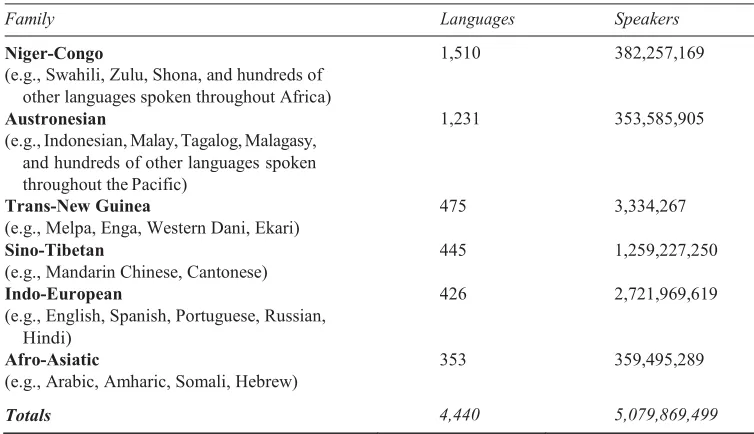
Inevitably, languages evolve and diversify over time and in different contexts. The develop- mental and diversifying nature of language is reflected in the emergence of language families. A “language family” can be defined as a group of languages that can be shown to be genetically related to one another in terms of a common ancestry. The main language families that exist in the contemporary era can be classified as shown in Table 1.
A “living language” can be defined as a language that is used as a primary vehicle of communication by a particular group of people existing in the contemporary era. It is generally accepted that, in the present world, the number of living languages amounts to 6,000–7,000 – an estimate that varies depending on how “language,” as opposed to “dialect,” is conceptualized. In 2009, the
Ethnologue (Lewis 2009) identified 6,909 living human languages.
[image:8.595.108.485.471.688.2]Although the distinction between “lan- guage” and “dialect” is fairly arbitrary, it normally rests on political and cultural cri- teria – such as distinctive writing systems, degrees of mutual intelligibility, and sym- bolic representations. The stereotypical – and, arguably, erroneous – representation of these two speech forms can be synthesized as follows: “languages” are spoken by nations; “dialects” are spoken by tribes, towns, regions, or other “sub-national” groups. “Languages,” then, are often associated with issues such as statehood, markets, literary traditions,
Table 1 Classification of language families.
Family Languages Speakers
Niger-Congo
(e.g., Swahili, Zulu, Shona, and hundreds of other languages spoken throughout Africa)
Austronesian
(e.g., Indonesian, Malay, Tagalog, Malagasy, and hundreds of other languages spoken throughout the Pacific)
1,510 382,257,169
1,231 353,585,905
Trans-New Guinea
(e.g., Melpa, Enga, Western Dani, Ekari)
475 3,334,267
Sino-Tibetan 445 1,259,227,250
(e.g., Mandarin Chinese, Cantonese)
Indo-European 426 2,721,969,619
(e.g., English, Spanish, Portuguese, Russian, Hindi)
Afro-Asiatic 353 359,495,289
(e.g., Arabic, Amharic, Somali, Hebrew)
Totals 4,440 5,079,869,499
and widely accepted writing systems, but also with symbols and structures of power, authority, legitimacy, and culture. Thus, merely linguistic considerations play a rela- tively insignificant role in the construction of modern “languages.” In fact, from the point of view of linguistics, the distinction between “language” and “dialect” is blurred and fuzzy, lacking universal scientific criteria that would allow for a straightforward and unambiguous conceptual differentiation between these two categories.
The criterion of mutual intelligibility for defining a “language” can be summarized as follows: “if the speakers of A can understand the speakers of B without difficulty, A and B must be the same language” (Anderson 2012: 67). Ultimately, however, this criterion fails to account for the messiness of linguistic diversity; in some cases, it may be harder to communicate between different versions of the same
“language” (e.g., High German
[Hochdeutsch] and Swiss German [Schweiz- erdeutsch]) than between different languages (e.g., Russian and Ukrainian).
Far from representing a merely analytical – let alone descriptive – endeavor, the task of identifying human languages – and their cor- responding language families – constitutes a profoundly normative challenge. For most linguists, all languages – irrespective of their cultural, political, economic, ideological, and demographic status and influence – are precious. Yet, owing to their varying degrees of status and influence, the development of languages and language families cannot be properly understood without examining the underlying power mechanisms that shape – if not determine – their destiny.
Perhaps it will never be possible to give a conclusive answer to the question con- cerning the origin(s) of human language. In this respect, two main scenarios can be distinguished. In accordance with the prin- ciple of monogenesis, it may be assumed that,
once upon a time, there must have been an “original” form of language, from which all subsequent linguistic traditions are directly or indirectly derived. In accordance with the principle of polygenesis, by contrast, it may be posited that several “original” forms of lan- guage emerged more or less simultaneously in different places and then either died out or
survived by constantly developing and adapt- ing to changing environmental conditions.
In the current context, the greatest number of speakers – that is, approximately 2.5 bil- lion in total – can be found among the 450 Indo-European languages. By contrast, the
Niger-Congo and Austronesian families, which are sustained by approximately 350 million speakers each, reveal much greater linguistic diversity – with at least 1,500 languages in the case of the former, and nearly 1,300 in the case of the latter. An example of an extremely elevated degree of linguistic diversity is Papua New Guinea, with an estimated 832 languages spoken by a population of around 3.9 million. If we consider the bigger picture, the distribution of living languages in the con- temporary world looks roughly as follows, according to the Ethnologue (Lewis 2009):
• Europe: 234
• Asia: 2,322
• Africa: 2,110
• Americas: 993
• Pacific: 1,250
• Total: 6,909
The uneven distribution of languages and language families represents a curious feature of the contemporary world. Comparable to the irregular distribution of plant and animal species across the planet, some places or regions are highly, and others hardly, diverse in terms of living languages.
phonetic, and pragmatic composition, languages are in a constant state of flux. Languages change as their speakers invent (and reinvent) new ways of speaking. Lin- guistic traditionalists tend to be skeptical of language changes, considering them as, at best, an expression of unnecessary or rushed modernization or, at worst, a sign of civilizational decay, mental enfeeblement, and collective hebephrenia.
However one may wish to assess both the causes and the consequences of lin- guistic developments, language change is inevitable. In fact, openness to change and transformation is built into the very nature of language, since a living language, in order to survive, needs to prove capable of adjusting to constantly altering circumstances and requirements. Indeed, variation is one of the most noticeable linguistic constants. There are both external factors and internal factors for language change: the former are exogenous
(e.g., social, cultural, political, economic, geographic, environmental); the latter are
endogenous (e.g., pronunciation difficulties, terminological or grammatical ambiguities).
Given the changeability inherent in human linguisticality, language cannot escape the power of spatiotemporal contingency. For instance, even if – hypothetically – there were a moment in time at which every human inhabitant of this planet spoke one and the same language (e.g., Esperanto), within a few decades – if not years or months – significant linguistic differences would emerge, reflect- ing dissimilarities in the social conditions of cultural production.
THE HIERARCHIES OF LANGUAGE
Both in terms of distribution and in terms of
status and influence, languages are situated on an uneven – global – playing field. Perhaps the most striking statistical reality in this
regard is the fact that a relatively small num- ber of languages (389, that is, 6 percent) with over one million speakers account for the vast majority (94 percent) of the world’s speakers
(Anderson 2012: 19). The imbalanced world- wide distribution of “majority languages” can be categorized as follows:
1 Chinese: ∼1,213,000,000 speakers. 2 Arabic: ∼221,000,000 speakers (of
Arabic dialects).
3 Spanish, English, Hindi, Bengali, Por- tuguese, Russian, Japanese, German:
“the over 100 million speakers club.”
To be sure, given that it encompasses a mas- sive internal ethno-linguistic diversity, the concept of “Chinese” as a single language, spoken by one homogeneous speech com- munity, may be misleading. Yet, even if we confine it to “Mandarin” (which barely rep- resents a significantly more homogenous ethno-linguistic group of people), the corre- sponding figure of approximately 845,000,000 speakers puts this language in first place in the global league table.
In contrast to this focus on the world’s majority languages, it is worth noting that, in the contemporary era, there are 6,520 languages with under one million speakers (94 percent) and that these are spoken by only about 6 percent of the world’s popula- tion. Put differently, 94 percent of all existing languages are spoken by only about 6 percent of the world’s population. To put it crudely, it appears that, on a global scale, the “small languages” are being systematically marginal- ized by the cultural imperialism of the “big languages.”
respect, the late Max Weinreich’s famous aphorism according to which “a language is a dialect with an army and a navy” is of little use value, taking into account that there are various “languages” to which this definition does not apply (consider, in particular, lan- guages of “stateless nations” – for example, in Spain, with Basque and Catalan).
A further difficulty arises from the fact that an increasing number of people around the world are bi- or multilingual and, hence, speak particular languages as their second, third, fourth, … language (in some cases, as native or quasi-native speakers; in most cases, as non-native speakers). Thus, the
statistical representation of the
distribution of living languages will differ depending on whether or not only languages that are spoken as first languages are part of the equation.
In short, analytical distinctions – such as “recognized” versus “nonrecognized,” “state- specific” versus “stateless,” “official” versus “unofficial,” “institutionalized” versus “non- institutionalized,” “native” versus “nonna- tive” – have a significant impact on the ways in which languages are counted, compared, and contrasted.
For instance, the Ethnologue (Lewis 2009) provides statistical data on the distribution of living languages in the global context by taking into account the total number of people who use a particular language as their first language, irrespective of the place in the world where they may reside. As a conse- quence, the figure of 328 million for English does not include the more than 167 million people who speak English as a second (or third, fourth, etc.) language.
Over the past centuries, many “national” governments have sought to make the “coun- tries” they claimed to represent linguistically uniform, but often – that is, even in cases of extreme political centralism – with less success than one may assume. Three striking European examples are the United Kingdom,
France, and Spain. In all three cases, minority languages survived decades of systematic attempts to marginalize, if not annihilate, them (UK: Cornish, Irish, Scots, Scottish
Gaelic, Ulster-Scots, Welsh; France:
Alsatian, Basque [unrecognized], Breton, Catalan, Corsican, Gallo, Occitan, 40 native
languages of New Caledonia; Spain:
Aragonese, Asturian, Basque, Catalan, Galician, Occitan). In other words, even when the ideal of linguistic uniformity is imposed “from above,” the reality of linguistic diversity may continue to be supported “from below.” Of course, some states (e.g., Afghanistan, Algeria, Belgium, Canada, Egypt, Spain, Switzerland, and Uganda) openly and explicitly promote bi- or multilingualism as a national policy.
Especially in multicultural settings, the reality of bi- or multilingualism – at the micro-level of the individual, the meso-level of community, and the macro-level of soci- ety – remains an issue of controversy. Defend- ers of bi- or multilingualism make reference to its advantages and opportunities, such as the following: enhancement of cultural richness and open-mindedness; fostering of perspective-taking attitudes; increasing tolerance toward, or even acceptance of, dif- ference; elevated levels of cognitive capacity; and stimulation of personal and social cre- ativity. Critics of bi- or multilingualism make reference to its disadvantages and pitfalls, such as the following: at the micro-level, lack of a clear cultural identity; at the meso-level, lack of stable normative parameters; and, at the macro-level, lack of cultural homogeneity and interactional predictability.
THE ENDANGERMENT OF LANGUAGE
long, tension-laden history. Languages ful- fill several sociological functions: they serve as markers of identity, indicators of social status, vehicles of both inclusion and exclu- sion – to mention only a few. An obvious example of “language stratification” – or, if one prefers, “language struggles” – is the distinction between “legitimate” and “illegit- imate,” “official” and “unofficial,” “standard” and “deviant,” “dominant” and “peripheral” modes of language use.
As critical sociologists are eager to point out, linguistic standards are usually imposed by powerful social groups, whose members have privileged access to dominant forms of symbolic, cultural, and educational capital and who use language to defend and stabilize their hegemonic position in society. Conse- quently, the exercise of social dominance (not only in the linguistic field, but also in other interactional fields) provides the hegemonic sectors of society with the structural capacity to translate “difference” into “deficiency” and, thus, “nonstandard” into “marginality” and “deviance” into “inferiority.”
Mechanisms of “language stratification” and dynamics of “language struggle,” how- ever, are crucial to normalization processes that operate not only within but also between
languages. Nowhere is this illustrated with more clarity than in the issue of language endangerment. Language endangerment comes about when a language is at risk of falling out of use, because its speakers die out or shift to speaking another language, or because of a combination of these two developments. People may be encouraged or, in extreme situations, forced to stop speaking their language and, out of convenience or under surveillance, move to speaking an alternative, socially more powerful, language instead.
It is widely estimated that 50–90 percent of the 6,000–7,000 languages spoken at the beginning of the twenty-first century will
have become extinct by 2100. In an era of globalization, characterized not only by unprecedented degrees of interconnectedness but also by neocolonialist and neoimperialist structures of domination, the economically powerful, geographically widespread, and demographically widely spoken languages dominate less influential and, in many cases, relatively marginalized languages. In the current context, the top 20 majority lan- guages, that is, those spoken by more than 50 million speakers each, are spoken by 50 percent of the world’s population.
According to UNESCO (United Nations Educational, Scientific and Cultural Orga- nization), there are five levels of language endangerment:
1 “safe” (spoken by enough people to con- tinue to exist);
2 “vulnerable” (not spoken by children out- side home);
3 “definitely endangered” (not spoken by children);
4 “severely endangered” (spoken only by the oldest generations); and
5 “critically endangered” (spoken by a few members of the oldest generation, often semi-speakers).
There may be strong arguments for and against the use of a global lingua franca
In light of the “survival of the fittest” modus operandi to which languages are constantly exposed, it is difficult not to draw analogies between linguistic reproduction and biolog- ical reproduction. Just as living species, in order to survive, need to “reproduce,” so do languages. A language is reproduced by ensuring its transmission from a current gen- eration of speakers to a successive – ideally, equally strong, if not growing – generation of speakers. Vital to the realistic survival of a language, then, is the degree to which succeeding generations are learning it – that is, not only using it but also, albeit within limits, constantly modernizing it. Particu- larly important in this respect is the extent to which young children are acquiring a language, since full mastery of a language is most effectively (if not, as some may argue, exclusively) acquired during one’s childhood. Surely, some “dead” languages can be, at least partially, “revived” (for example, when studying ancient Greek or Latin, or when reconstructing the traces of an extinct lan- guage). In this sense, the death of a language may be less conclusive than the disappearance of a species. The survival of a language may depend on various factors: at the micro-level, on individual attitudes, mind-sets, habits, and preferences; at the meso-level, on behavioral, ideological, and institutional norms within communities; and, at the macro-level, on state policies.
Notwithstanding the main driving forces behind the reproduction or disappearance of a language, there are several good reasons why researchers in the humanities and social sciences, in particular, in addition to ordi- nary actors, in general, should take language endangerment seriously.
First, languages possess idiosyncratic com- ponents that are of objective significance. The adaptability of their key elements – notably of their morphological, terminological, seman- tic, syntactic, grammatical, phonetic, and
pragmatic dimensions – is symptomatic of the sociocultural variability of human lan- guages. Linguistic diversity can be regarded as a crucial object of scientific enquiry, illus- trating that even the foundational facets of human existence possess significant degrees of arbitrariness and malleability.
Second, languages possess idiosyncratic components that are of normative signifi- cance. Owing to their value-laden nature, languages make those who use them relate to, attribute meaning to, and act upon reality in particular ways. In practice, linguistic diversity is inconceivable without people’s right to express themselves in their own lan- guage and thereby develop a sense of cultural belonging.
Third, languages possess idiosyncratic components that are of aesthetic significance. Their main characteristics – such as signs, symbols, structure, sounds, and rhythm – have a distinctly aesthetic dimension. Lin- guistic diversity, then, implies that different languages constitute both vehicles and objects of aesthetic perception and appreciation.
The ongoing competition between “local languages” and “global languages,” as well as between “minority languages” and “majority languages,” reflects an imbalance in access to material and symbolic resources. Within the discipline of sociolinguistics, the comprehen- sive analysis of symbolic forms must involve the study of the power-laden conditions under which languages live, survive, and – potentially or actually – die.
SEE ALSO: Bourdieu, Pierre; Communication
Theory; Culture; Derrida, Jacques;
Evolutionary Theory; Power; Rationality; Saussure, Ferdinand de; Understanding (Verstehen); Wittgenstein, Ludwig
REFERENCES
Boltanski, Luc and Thévenot, Laurent. 1991. De la justification. Les économies de la grandeur. Paris: Gallimard.
Bourdieu, Pierre. 1992. Language and Symbolic Power, edited by John B. Thompson, trans- lated by Gino Raymond and Matthew Adamson. Cambridge, UK: Polity Press.
Butler, Judith. 1990. Gender Trouble: Feminism and the Subversion of Identity. London: Routledge. Derrida, Jacques. 1967. De la grammatologie. Paris:
Minuit.
Eagleton, Terry. 1991. Ideology: An Introduction. London: Verso.
Edwards, John. 2013. Sociolinguistics: A Very Short Introduction, Oxford: Oxford University Press. Foucault, Michel. 1975. Surveiller et punir.
Naissance de la prison. Paris: Gallimard. Habermas, Jürgen. 1981a. Theorie des kommunika-
tiven Handelns. Band 1: Handlungsrationalität und gesellschaftliche Rationalisierung. Frankfurt am Main: Suhrkamp.
Habermas, Jürgen. 1981b. Theorie des kommunika- tiven Handelns. Band 2: Zur Kritik der funk- tionalistischen Vernunft. Frankfurt am Main: Suhrkamp.
Honneth, Axel. 1994. Kampf um Anerkennung. Zur moralischen Grammatik sozialer Konflikte. Frankfurt am Main: Suhrkamp.
Laclau, Ernesto and Mouffe, Chantal. 2001. Hege- mony and Socialist Strategy: Towards a Radi- cal Democratic Politics, 2nd edn. London: Verso. First published 1985.
Lewis, M. Paul, ed. 2009. Ethnologue: Languages of the World, 16th edn. Dallas, TX: SIL Interna- tional.
Matthews, Peter H. 2003. Linguistics: A Very Short Introduction. Oxford: Oxford University Press. Susen, Simon. 2007. The Foundations of the Social:
Between Critical Theory and Reflexive Sociology. Oxford: Bardwell Press.
Susen, Simon. 2013a. Bourdieusian Reflections on Language: Unavoidable Conditions of the Real Speech Situation. Social Epistemology, 27(3–4): 199–246.
Susen, Simon. 2013b. A Reply to My Critics: The Critical Spirit of Bourdieusian Language. Social Epistemology, 27(3–4): 323–393.
Žižek, Slavoj. 1989. The Sublime Object of Ideology. London: Verso.
FURTHER READING
Agha, Asif. 2006. Language and Social Relations. Cambridge: Cambridge University Press. Aitchison, Jean. 2013. Language Change: Progress
or Decay?, 4th edn. Cambridge: Cambridge University Press. First published 1981.
Blommaert, Jan. 2010. The Sociolinguistics of Globalization. Cambridge: Cambridge University Press.
Chomsky, Noam. 2000. The Architecture of Lan- guage, edited by Nirmalangshu Mukherjee, Bibudhendra Narayan Patnaik, and Rama Kant Agnihotri. Oxford: Oxford University Press. Coupland, Nikolas and Jaworski, Adam, eds.
2009. Sociolinguistics, 6 vols. London: Routledge.
Coupland, Nikolas, Sarangi, Srikant, and Candlin, Christopher N., eds. 2001.
Sociolinguistics and Social Theory. Harlow, UK: Longman.
Edwards, John. 2009. Language and Identity: An Introduction. Cambridge: Cambridge University Press.
Evans, Nicholas. 2010. Dying Words: Endangered Languages and What They Have to Tell Us. Oxford: Wiley-Blackwell.
Fitch, William Tecumseh and Westphal Fitch, Gesche, eds. 2012. Language Evolution, 4 vols. London: Routledge.
Mesthrie, Rajend, ed. 2011. The Cambridge Hand- book of Sociolinguistics. Cambridge: Cambridge University Press.
Pinker, Steven. 1994. The Language Instinct: The New Science of Language and Mind. London: Allen Lane.
Susen, Simon. 2014. Reflections on Ideology: Lessons from Pierre Bourdieu and Luc Boltan- ski. Thesis Eleven, 124(1): 90–113.
Susen, Simon. 2015. The “Postmodern Turn” in the Social Sciences. Basingstoke, UK: Palgrave Macmillan.
Susen, Simon. 2016. Pierre Bourdieu et la dis- tinction sociale. Un essai philosophique. Oxford: Peter Lang.
Susen, Simon. 2017. Hermeneutic Bourdieu. In
Bourdieusian Prospects, edited by Lisa Adkins, Caragh Brosnan, and Steven Threadgold, 132– 159. London: Routledge.