promoting access to White Rose research papers
White Rose Research Online
[email protected]
Universities of Leeds, Sheffield and York
http://eprints.whiterose.ac.uk/
White Rose Research Online URL for this paper:
http://eprints.whiterose.ac.uk/9009/
Conference paper
Siersdorfer, S., San Pedro, J. and Sanderson, M. (2009)
Automatic Video
Tagging using Content Redundancy.
In: The 32nd Annual ACM SIGIR
Conference, July 19-23 2009, Boston, Massachusetts, USA.
Automatic Video Tagging using Content Redundancy
Stefan Siersdorfer
L3S Research Center Appelstr. 9a 30167 Hannover, Germany
[email protected]
Jose San Pedro
University of Sheffield 211 Portobello Street Sheffield S1 4DP, UK
[email protected]
Mark Sanderson
University of Sheffield 211 Portobello Street Sheffield S1 4DP, UK
[email protected]
ABSTRACT
The analysis of the leading social video sharing platform YouTube reveals a high amount of redundancy, in the form of videos with overlapping or duplicated content. In this pa-per, we show that this redundancy can provide useful infor-mation about connections between videos. We reveal these links using robust content-based video analysis techniques and exploit them for generating new tag assignments. To this end, we propose different tag propagation methods for automatically obtaining richer video annotations. Our tech-niques provide the user with additional information about videos, and lead to enhanced feature representations for ap-plications such as automatic data organization and search. Experiments on video clustering and classification as well as a user evaluation demonstrate the viability of our approach.
Categories and Subject Descriptors
H.4 [Information Systems Applications]: Miscellaneous;
H.3.5 [Information Systems]: INFORMATION
STOR-AGE AND RETRIEVAL—On-line Information Services
General Terms
Algorithms
Keywords
video duplicates, content-based links, automatic tagging, neighbor-based tagging, tag propagation, data organization
1.
INTRODUCTION
The rapidly increasing popularity and data volume of mod-ern Web 2.0 content sharing applications originate in their ease of operation for even unexperienced users, suitable mech-anisms for supporting collaboration, and attractiveness of shared annotated material (images in Flickr, bookmarks in del.icio.us, etc.). One of the primary sites for video sharing
Permission to make digital or hard copies of all or part of this work for personal or classroom use is granted without fee provided that copies are not made or distributed for profit or commercial advantage and that copies bear this notice and the full citation on the first page. To copy otherwise, to republish, to post on servers or to redistribute to lists, requires prior specific permission and/or a fee.
SIGIR’09,July 19–23, 2009, Boston, Massachusetts, USA. Copyright 2009 ACM 978-1-60558-483-6/09/07 ...$5.00.
is YouTube1. Recent studies have shown that traffic to/from
this site accounts for over 20% of the web total and 10% of the whole internet [5], comprising 60% of the videos watched on-line [9].
The growing size of folksonomies has motivated a real ne-cessity to provide effective knowledge mining and retrieval tools. Current solutions are primarily focused on the analy-sis of user generated text; folksonomies have shown to pro-vide relevant results at a relatively low cost, as they are contributed by the community and text-based tools have been used for topic detection and tracking [1], information filtering [30], or document ranking [29].
However, manually annotating content such as videos in YouTube, is an intellectually expensive and time consuming process, and, as a consequence, annotations such as tags are often very sparse. Furthermore, keywords and community-provided tags lack consistency and present numerous irreg-ularities (e.g. abbreviations and mistypes). This can lead to a decreased quality of the information presented to users of the Web 2.0 environment; moreover, it makes the utilization of techniques for automatic data organization using clas-sification or clustering, retrieval and knowledge extraction relying on textual features a difficult task. Content-based techniques, however, are not yet mature to outperform text-based methods for these purposes [11].
Recent studies [3, 27] show evidence of a significant amount of visually redundant footage (i.e. near-duplicate videos) in video sharing websites, with a reported average of over 25% near-duplicate videos detected in search results. Many works have already started to consider this redundancy a problem for content retrieval, and propose ways to remove it from the system. In this paper, we look at duplication from a differ-ent perspective and demonstrate that contdiffer-ent redundancy in Web 2.0 environments such as Youtube can be seen as a feature rather than a problem. We automatically analyze the dataset to find duplicates and exploit them to obtain richer video annotations as well as additional features for automatic data organization.
Previous work has focused on metadata as the way to get to the content. In our work we proceed differently, using content to improve the overall quality of annotations. We present a novel hybrid approach combining video content analysis and network algorithms to improve the quality of annotations associated to videos in community websites. In contrast to existing approaches, we adapt robust video du-plicate detection methods to the Web 2.0 context, enabling us to effectively use content features to link video assets and
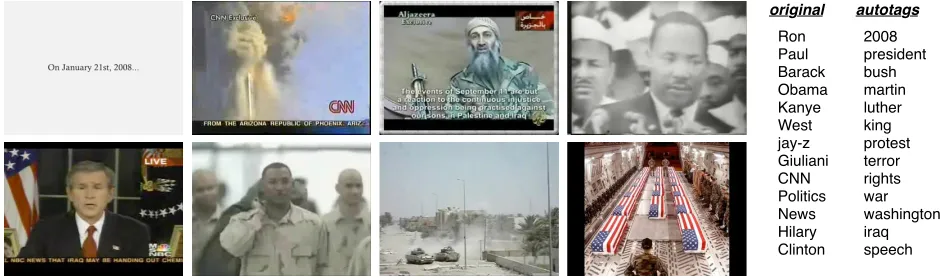
2008 president bush martin luther king protest terror rights war washington iraq speech Ron
Paul Barack Obama Kanye West jay-z Giuliani CNN Politics News Hilary Clinton
[image:3.612.65.535.54.193.2]original autotags
Figure 1: Tags in duplicated or visually overlapping videos may convey additional interpretations and com-plementary information which can help to create a richer description.
build a new graph structure connecting videos. In what is a novel approach to folksonomy analysis, we use these new content-based links to propagate tags to adjacent videos, utilizing visual affinity to spread community knowledge in the network.
Figure 1 shows an example of automatically generated tags using our proposed methods. Uploaders of overlap-ping sequences of the same video provide their personal per-spective on its content, in the form of different keywords. Individually, each description lacks part of the semantics conveyed by the asset; when considering them together, we achieve a more comprehensive description. By uploading videos containing redundant sequences, different users have contributed to complete the information about the original source video, including characters (e.g. Bush), dates (e.g. 2008), and other more general concepts (e.g. protest, rights). The rest of this paper is organized as follows: In Sec-tion 2 we discuss related work on folksonomies and sharing environments, tagging, and duplicate detection. We pro-vide a short overview of duplicate and overlap detection of videos and a graph formalization of these relationships in Section 3. Based on this formalization, we describe several techniques for automatic tagging in Section 4, both neighbor and context-based (TagRank). In Section 5 we provide the results of the evaluation of our automatic tagging methods for YouTube video clustering and classification as well as a user study. We conclude and show directions of our future work in Section 6.
2.
RELATED WORK
Mining links between resources has received growing re-search interest, especially on the web, the most popular and referenced example being Google’s PageRank [21], where the graph of web document nodes is formed by the hyperlinks contained in them. We can also find examples of algorithms taking advantage of “implicit” links [29], where links are in-ferred from user actions (e.g. access patterns). In this later category we can include near-duplicate document detection techniques [28]. Tools, such as Charikar’s fingerprint [4], have shown success in achieving near-duplicate identifica-tion in massive collecidentifica-tions of web pages [20]. The graph of inter-document links is used, in this case, to perform many common procedures in web processes optimization, such as web crawling filtering [20], enhanced ranking schemes [29], first story detection [24], or plagiarism detection [8]. These
techniques rely on the textual nature of documents. In this
paper, we focus on exploiting visual relationships available
in richer multimedia scenarios.
Visual content analysis enhances knowledge about video collections. Many previous works use this information to im-prove retrieval results. Re-ranking is perhaps the most
com-mon application. Hauptmannet al. [27] use a Content-based
copy retrieval (CBCR) approach to detect near-duplicate videos in order to promote diversity on search results by
re-moving redundant entries. Liuet al. [19] proceed similarly,
but consider also text to establish links between videos, to enable covering different interpretations of queries at the top of the results list. In contrast to previous approaches, we ex-ploit visual links between videos to improve the quality and
homogeneity ofannotations.
Various approaches have been exploiting graph structures in Folksonomies. A node ranking procedure for folksonomies, the FolkRank algorithm, has been proposed in [12]. FolkRank operates on a tripartite graph of users, resources and items, and generates a ranking of tags for a given user. Another procedure is the Markov Clustering algorithm (MCL) in which a renormalization-like scheme is used in order to de-tect communities of nodes in weighted networks [26]. A PageRank-like algorithm based on visual links between
im-ages is used to improve the ranking function for photosearch
in [14]; in contrast we are using weight propagation for
au-tomatic video tagging. In another paper on image search
Craswell and Szummer [6] introduce a random walk algo-rithm operating on a bipartite click graph with edges con-necting queries and clicked images. The term “TagRank” oc-curs in another context in the preliminary work [25] where a general ranking of tags for whole folksonomies is generated, rather than the relevancy of tags for individual objects as described in our work for the specific case of videos.
To the best of our knowledge, our paper is the first to pro-pose a hybrid approach using content-based copy retrieval techniques in combination with novel tag propagation meth-ods to automatically annotate videos in folksonomies.
3.
CONTENT LINKS BETWEEN VIDEOS
3.1
Duplication and Overlap Detection on Videos
The identification of near-duplicate video content has re-ceived significant attention by the multimedia research
com-munity for a number of applications, e.g. copyright
in-frigement detection. These techniques are commonly re-ferred as Content-based Copy Retrieval (CBCR). Current works feature recall and precission values close to 100%, and support the detection of noisy and degraded copies, which may include compression artifacts, analog conversion distor-tions, overlaid content such as subtitles or chromatic changes among others [15]. Many of the principles used by text-based duplicate detection techniques can be adapted to the video domain [13]. Fingerprints are the most commonly used de-tection tool; they are generated using specific features of moving visual content, such as temporal video structure or time-sampled local or global image invariants.
We built a video copy detection system to detect redun-dancy in the YouTube scenario based on the work origi-nally presented in [23]. This fingerprint-based method re-lies on robust hash functions, which take an input message (video frames in our case) and generate a compact output hash value, with the condition that similar input messages generate similar output values. All videos involved in the detection are converted into hash values, and detection is performed as a search problem in the hash space.
The detailed description of the CBCR system used is be-yond the scope of this paper and can be consulted in the original publication. However, it is necessary to introduce a global overview of how the system works as well as some terminology which we will use in the following sections. We
consider a video collection C = {Vi : 1 ≤ i ≤ N} of
N elements. Each video Vi = {fji : 1 ≤ j ≤ |Vi|} of
the collection is composed of a number, |Vi|, of frames,
fi
j. We also consider a set of video queries, denoted by
Qk={fjk: 1≤j≤ |Qk|}. The system uses the robust hash
function and search procedure described in [23] to identify
in the incoming stream Qk any occurrences of a complete
video Vi, or a fragment Vi(m,n) = {f
i
j : m ≤ j ≤ n} of
it. The ability to detect video fragments enables us to ob-tain a more comprehensive visual affinity graph, compris-ing not just near-duplicates, but other forms of redundancy which can also be exploited in the context of this paper. The computational complexity of this process is linear with the database size, but can be reduced using Locality Sensi-tive Hashing (LSH [16]) techniques to improve performance in more demanding scenarios. We conducted a pilot ex-periment to validate the viability of this detector using 150 hours obtained by querying for popular music video clips in YouTube, including numerous duplicates and common dis-tortions (different frame rates, resolutions, subtitles, etc).
We used this as the query video collection, Qk, and
com-pared them to a databaseCof DVD quality versions of the
queried songs. The precision-recall break-even point was approximately 0.8.
3.2
Relationships between Videos
If we consider our content databaseC={Vi: 1≤i≤N}
to be a set of YouTube search results, every item Vi can
potentially include content from every other. To perform a comprehensive identification, we need to consider the set
C′
=C−Vi and the input query Qi =Vi for i ∈ [1, N],
whereN denotes the size of the database.
Visual connections between each pair of videos in the
ana-lyzed set are expressed in the formVi(m,n)↔Vj(p,q). A
sub-sequent processing stage is performed, in which connections
found for each pair of videos (Vi, Vj) are closely analyzed to
classify their relationship. We consider the duration of each
pair of videos, |Vi| and |Vj|. We also consider the visual
overlap between them, O(Vi, Vj), i.e. the video resulting of
the frames present in both Vi and Vj. According to these
parameters we classify videos as:
• Duplicates: when |Vi| ≈ |Vj| and |O(Vi, Vj)| ≈ |Vi|,
both videos are said to beduplicates, formallyVi≡Vj
• Part-of: when|Vi|>|Vj|and|O(Vi, Vj)| ≈ |Vj|,Vj is
said to bepart-of Vi, formallyVj⊂Vi
• Overlap: if |O(Vi, Vj)| > 0, both videos are said to
overlap, formallyVi∩Vj6=∅. We consider overlaps as
a super-set ofduplicateandpart-of relationships:
Vi≡Vj −→ Vi∩Vj6=∅
Vi⊂Vj −→ Vi∩Vj6=∅.
These relationships can be formalized in a visual affinity
graphGO = (VO, EO) with undirected weighted edges
de-noting overlaps. In this abstraction, videos can be consid-ered as single elements instead of frame sets; we will refer to
them asvi in the rest of the paper.
The set of nodes VO ⊆ C is the subset of videos in the
collection having one or more relationships of any kind to
others. The set of edgesEO links together visually related
videos:
EO={{vi, vj}:vi∩vj6=∅}, vi, vj∈VO⊂C
4.
AUTOMATIC TAGGING
In this section, we describe two classes of novel methods for automatic tag assignment using content overlap. These
are 1)neighbor-basedmethods, which take just immediately
overlapping videos, i.e. direct neighbors in the overlap graph
into account, and 2) theTagRankmethod based on
propa-gation of tag weights within the visual overlap graph.
4.1
Neighbor-based Tagging
For neighbor-based tagging we consider relationships in
the overlap graph GO = (VO, EO) in order to transfer tags
between adjacent videos.
4.1.1
Simple Neighbor-based Tagging
For simple neighbor-based tagging, we transform the undi-rected overlap graph into a diundi-rected and weighted graph
G′
O= (VO, EO′ ), with (vi, vj) and (vj, vi)∈EO′ iff{vi, vj} ∈
E0. The weightw(vi, vj) assigned to an edge (vi, vj) reflects
the influence of videovi on videovj for tag assignment. In
this paper we are using the heuristic weighting function
w(vi, vj) = |
vi∩vj|
|vj|
(1)
where|vj|is the (temporal) length of videovj, and|vi∩vj|
denotes the length of the intersection between vi and vj.
This weighting function describes to what degree video vj
is covered by videovi. Note that in case wherevi and vj
are duplicates, ifviis a parent ofvj(meaning thatviis the
Figure 2: Overlap regionsR1, . . . , R5 of a videov
cov-ered by four other videos
scene from this video) then the weighting functionwassigns
the maximum value 1 to (vi, vj).
How can we use the described relationships and weights
for automatic tagging? LetT ={t1, . . . , tn} be the set of
tags originally (manually) assigned to the videos inVO and
letI(t, vi) be an indicator function for original tags t∈ T,
withI(t, vi) = 1 iffvi was manually tagged by a user with
tag t, I(t, vi) = 0 otherwise. We compute the relevance
rel(t, vi) of a tagtfrom adjacent videos as follows:
rel(t, vi) =
X
(vj,vi)∈EO′
I(t, vj)w(vj, vi) (2)
i.e., we compute a weighted sum of influences of the
overlap-ping videos containing tagt. In this way, we obtain relevance
values for all tags from the overlapping videos, and can
gen-erate autotags(vi) of automatically assigned new tags for
each videovi∈V using a thresholdδfor tag relevancy:
autotags(vi) ={t∈T|I(t, vi) = 0∧rel(vi, t)> δ} (3)
In order to compute feature vectors (e.g. for clustering
or classification) for videosvi, we use the relevance values
rel(vi, t) of tags t as features weights. Enhanced feature
vectors can be constructed as a combination of the
origi-nal tag weights (I(t, vi) normalized by the number of tags)
and the relevance weights for new, automatically added tags (normalized by the number of tags).
4.1.2
Overlap Redundancy Aware Tagging
For a set of overlapping videos, i.e. neighbors in the graph, situations with multiple redundant overlaps as shown in Fig-ure 2 can occur. In order to avoid a too high increase of the relevance values for automatically generated tags in com-parison to original tags, we propose a relaxation method for regions with redundant overlap.
Let N(v) = {vi|(vi, v) ∈ E′O} be the set of overlapping
videos for videov. Anoverlap regionRiofvcan be defined
as a video subsequences ⊆v,|s|>0, of maximum length
contained in a maximum subsetY ⊂N(v), i.e. with none of
the remaining videosN(v)−Y overlapping withs. Figure 2
shows an example of a video with 5 overlap regions. For
the k = P
y∈YI(t, y) videos from Y containing tag t, the
contribution oftto an overlap regionsis computed by
k−1
X
i=0
αi
·|s|
|v| (4)
i.e., for each additional video contributing the same tag t,
this contribution is reduced by a relaxation parameter 0<
α≤1. In order to obtain all contributions to the relevance
[image:5.612.316.554.242.336.2]of tag t to video v, we sum up the contributions for the
Figure 3: Although there is no overlap between videosv1andv3, a context relationship (dotted line)
can be established via the overlap graph.
(disjoint) overlap regions. Putting all pieces together we
obtain the following equation for the relevance of tag tfor
videov:
rel(t, v) = X
X∈P(N(v))
k(X)−1
X
i=0
αi· ˛ ˛ ˛ ˛ ˛ ˛
v∩ \
x∈X
x− [
u∈N(v)−X
u
˛ ˛ ˛ ˛ ˛ ˛
|v|
(5) where
k(X) = X
x∈X
I(t, x) (6)
is the number of videos in subsetXcontaining tagt.
Thresh-olds can be applied and feature vectors constructed as de-scribed above for the simple case.
4.2
TagRank: Context-based Tag Propagation
in Video Graphs
Up to now, we have just taken the direct neighbors of videos in the overlap graph into account, neglecting context relationships as shown in Figure 3. In this subsection we describe a tag weight propagation method which allows for the iterative transfer of tags along paths of arbitrary length. Due to its similarity to PageRank-like weight propagation
for web pages, we call the method TagRank. However, the
objective of TagRank is not to assign relevance values for
the videos in the overlap graph; instead, TagRank is an
al-ternative method for computing relevance valuesrel(t, v) of
atagtfor a given videov.
Letw(vi, vj) be the edge weight corresponding to the
in-fluence of video vi to an overlapping video vj. Then we
define the TagRank TR(t, vi) for a videovby the following
recursive relationship:
rel(t, vi) = TR(vi, t) =
X
(vj,vi)∈E′O
TR(vj, t)w(vj, vi) (7)
For all videos vi this computation can be expressed in
matrix form as:
TR(t) =
0
B B @
w(v1, v1) w(v1, v2) · · · w(v1, vn)
w(v2, v1) w(v2, v2) · · · w(v2, vn)
. . .
. .
. . .. ... w(vn, v1) w(vn, v2) · · · w(vn, vn)
1
C C A
T
·
0
B B @
TR(v1, t)
TR(v2, t)
. . . TR(vn, t)
1
C C A
for PageRank, we don’t consider the possibility of random jumps within the video graph. For the TagRank method to converge, this is not necessary because sinks as in the Web graph are impossible due to the reflexivity of the overlap relationship. Furthermore, this enables us to perform the TagRank computation separately, and thus more efficiently, for each connected component, which is crucial because of the high number of tags.
Another aspect is that we want to take the original (man-ually generated) tag assignments into account. If we would simply consider the solution for Equation 8 we would lose
this information because for a given nodevin a connected
component the solution would eventually converge to the
same value TR(v, t) for each tagt. This is not intuitive and
instead we perform a limited number Γ of iterations (where Γ is a tuning parameter) using the original tag assignment in the form
TR(t) =“I(t, v1), . . . , I(t, vn)
”T
(9)
as start vector for the TagRank iterations. Limiting the number of iterations results in higher weights for tags from videos in the closer neighborhood, and is similar to the strat-egy deployed in [6] for random walks in click graphs.
5.
EVALUATION
In this section we present the results of our evaluation for automatic tagging. We first describe our strategy for gathering a video collection from YouTube, and elaborate on the characteristics of our data set. Then, we present the outcome of our two-fold evaluation methodology: 1) we examine the influence of the enhanced tag annotations on automatic video classification and clustering; 2) we provide the results of a user evaluation by direct relevance assess-ment of the automatically generated tags for a set of videos.
5.1
Data
5.1.1
Data Collection
We created our test collection by formulating queries and subsequent searches for “related videos”, analogously to the typical user interaction with the YouTube system. Given that an archive of most common queries does not exist for YouTube, we selected our set of queries from Google’s Zeit-geist archive from 2001 to 2007. These are generic queries, used to search for web pages and not videos. In order to re-move queries not appropriate to video search (e.g. “windows update”) we removed those for which YouTube returned less than 100 results. In total, 579 queries were accepted, for which the top 50 results were retrieved. Altogether, we
col-lected 28,216 videos using those queries (some of the results
were not accessible during the crawling because they were removed by the system or by the owner). A random sam-ple of these videos was used to extend the test collection by gathering related videos, as supported by the YouTube API. In total, 267 queries for related videos were performed,
generating 10,067 additional elements.
The complete collection, C, used for the evaluation had
a final size of 38,283 videos, 390 GB of information
com-prising over 2900 hours of video with an average duration of 4:15 min per video. We used the ‘Fobs project’ [22] as the programming interface to access content and characteristics of downloaded videos.
Table 1: Results of CBCR analysis for collection C.
Set Size Proportion
|C| 38,283 100%
|VO| 13,672 35.71%
Duplicates,{vi:∃vj, vi≡vj} 6,051 15.80%
Children,{vi:∃vj, vi⊂vj} 3,570 9.32%
Parents,{vi:∃vj, vj⊂vi} 3,200 8.35%
5.1.2
Visual Redundancy Analysis
We analyzed the collected setC to quantify the presence
of visual connections in them, and studied the distribution of the different relationships. We considered the study of
GO = (VO, EO), the graph of related videos, as well as the
relevance of each kind of relationship, computing the subset of nodes having each of the defined visual links.
Table 1 summarizes the results. A significant proportion of videos in the test collections, over 35%, feature one or more connections to other elements. These videos, denoted
by the setVO, represent the subset of the collection that we
used to evaluate our tag propagation methods in Section 5.2. They are organized in 3779 connected components, with an
average size of 3.61 videos per component. Note that any
video can be linked by more than one relationship, contribut-ing to the different categories that we analyze below.
Duplication is the most common form of visual relation-ship, accounting for over 15% of the videos. Note that du-plicated videos share the exact same visual content, and their tags should be intuitively valid in any element of the clique they belong to. The high presence of this relation-ship suggests the occurrence of many useful links which can
be exploited to propagate relevant tags. Part-of
relation-ships have also noticeable presence in the set, though their amount is considerably lower than duplicates, with an aver-age of around 9%.
5.2
Data Organization using Automatically
Generated Tags
In Section 4, we have presented different methods for au-tomatically generating tags, resulting in richer feature rep-resentations of videos. Machine learning algorithms make use of this feature information to generate models, and to automatically organize the data. In this section, we will show results for classification (supervised learning) as well as clustering (unsupervised learning) of YouTube videos us-ing feature vectors obtained by automatic taggus-ing.
5.2.1
Classification Experiments
Classifying data into thematic categories usually follows a supervised learning paradigm and is based on training items that need to be provided for each topic. We used linear sup-port vector machines (SVMs) in our experiments, as they have been shown to perform very well for text-based classi-fication tasks (see, e.g.,[7]).
experiments for all`7 2
´
= 21 combinations of these class pairs (e.g. “Music” vs. “Sports”). Settings with more than two classes can be reduced to multiple binary classification prob-lems that can be solved separately [2]. For each category, we randomly selected 400 videos for training the classification model and a disjoint set of 500 videos for testing the model. We trained different models based on T=10,25,50,100, 200, and all 400 training videos per class.
We compared the following methods for constructing fea-ture vectors from video tags:
1. BaseOrig: Vectors based on the original tags of the videos (i.e. tags manually assigned by the owner of the video in YouTube). This serves as the baseline for the comparison with our the vector representations based on automatic tagging.
2. NTag: Vectors constructed based on the tags and
their relevance values produced by simple neighbor-based tagging described in Section 4.1.1 in addition to the original tags.
3. RedNTag: Vectors using tags generated by overlap redundancy aware neighbor-based tagging plus the orig-inal tags as described in Section 4.1.2. We did not
pur-sue any extensive parameter tuning and choseα= 0.5
for the relaxation parameter.
4. TagRankΓ (with Γ = 2,4,8 iteration steps): Vectors using, in addition to the original tags, new tags pro-duced by the TagRank algorithm described in Sec-tion 4.2.
Our quality measure is the fraction of correctly classified
videos (accuracy). Finally, we computed micro-averaged
re-sults for all topic pairs. The rere-sults of the comparison are shown in Table 2. The main observations are:
• Classification taking automatically generated tagging
into account clearly outperforms classification using just the original tags. This holds for all of the three introduced tagging methods. For classification using 50 training documents per class, for example, we in-creased the accuracy from approximately 70% to 76%.
• Overlap redundancy aware neighbor-based tagging
pro-vides slightly but consistently more accurate results than the simple neighbor-based tagging variant.
• Both of the Neighborhood-based methods outperform
TagRank, although the later might seem the more ap-pealing method from a theoretical point of view. We observed that the accuracy decreased with a higher number of iterations. Context relationships link to-gether videos with no overlapping content by means of a common neighbor (see Figure 3). With each ad-ditional iteration, tags are pushed farther in the link graph. The relationship between source and targets of the propagated tags becomes increasingly weak, intro-ducing increasing amounts of noise and which explains the systematic decrease of accuracy.
5.2.2
Clustering Experiments
Clustering algorithms partition a set of objects, YouTube
videos in our case, into groups calledclusters. For our
exper-iments we choosek-Means[10], a simple but still very
popu-lar and efficient clustering method. Letkbe the number of
classes and clusters, Ni the total number of clustered
doc-uments inclassi,Nij the number of documents contained
in classi and having cluster label j. Unlike classification
results, the clusters do not have explicit topic labels. We define the clustering accuracy as follows:
accuracy= max(j1,...,jk)∈perm((1,...,k))
Pk i=1Ni,ji
Pk i=1Ni
(10)
Accuracy for clustering can be seen as a measure of how good the partitioning produced by a clustering method re-flects the actual class structure. Note that, similar to some other measures of cluster validity known in the literature, the minimum value for clustering accuracy is larger than 0
(1/k for the case of equal number of items in each of thek
classes).
For a number of clusters k = 2,3,4,5 we considered all
possible`7
k
´
combinations of tuples of classes (e.g. the triple “Music” vs. “Sports” vs. “Film & Animation”) for the 7 YouTube categories mentioned in Section 5.2.1. For each tuple, we randomly selected 500 videos per class, performed the k-means algorithm and computed the macro-averaged
accuracy for thek-tuples.
We constructed feature vectors based on the original tags (BaseOrig), simple neighbor-based tagging (NTag),
over-lap redundancy aware neighbor-based tagging (RedNTag),
and TagRank (TagRankΓ with number of iterations Γ =
2,4,8) in the same way as for the classification experiments described in the previous Section 5.2.1. The results of the comparison are shown in Table 3. The main observations are very similar to the supervised scenario:
• Clustering using automatically generated tags clearly
outperforms clustering with features just obtained from
the original tags. For example, for clustering with
k = 3 we increased the accuracy from approximately
40% to 55%.
• Overlap redundancy aware neighbor-based tagging
out-performs simple neighbor-based tagging; both of the neighbor-based techniques outperform TagRank.
5.3
User-based Evaluation
To support the results obtained for automatic data orga-nization, we conducted an additional user-based experiment. Three assessors provided relevance judgments for the auto-matically generated tags. For this experiment we chose the
neighbor based methods (NTag and RedNTag) as they
provided the best results for both classification and cluster-ing.
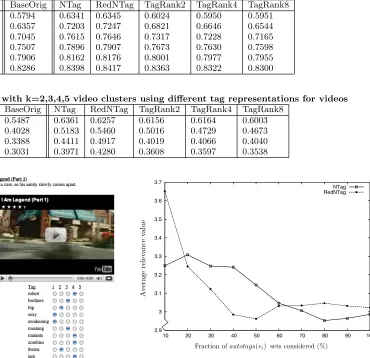
A web service was implemented to help the assessors to provide their judgments. The interface included a playable version of the video, automatically extracted key-frames, the title and the description to help them understand the con-tent, so they could provide more accurate judgments. The videos presented to the evaluators were randomly selected and the tags were displayed in random order. The evalua-tors were asked to rate each new tag using a five-level Likert scale [18]. This interface is depicted in Figure 4.
A total of 3578 tags, for 300 different videos, were manu-ally assessed using the described interface. (Manual evalua-tion of video annotaevalua-tions can require a substantial amount of time including the inquiry of background information.) We studied the average relevance for the set of generated
Table 2: Classification with T=10,25,50,100,400 training videos using different tag representations for videos
BaseOrig NTag RedNTag TagRank2 TagRank4 TagRank8
T = 10 0.5794 0.6341 0.6345 0.6024 0.5950 0.5951
T = 25 0.6357 0.7203 0.7247 0.6821 0.6646 0.6544
T = 50 0.7045 0.7615 0.7646 0.7317 0.7228 0.7165
T = 100 0.7507 0.7896 0.7907 0.7673 0.7630 0.7598
T = 200 0.7906 0.8162 0.8176 0.8001 0.7977 0.7955
[image:8.612.177.547.73.431.2]T = 400 0.8286 0.8398 0.8417 0.8363 0.8322 0.8300
Table 3: Clustering with k=2,3,4,5 video clusters using different tag representations for videos
BaseOrig NTag RedNTag TagRank2 TagRank4 TagRank8
k = 2 0.5487 0.6361 0.6257 0.6156 0.6164 0.6003
k = 3 0.4028 0.5183 0.5460 0.5016 0.4729 0.4673
k = 4 0.3388 0.4411 0.4917 0.4019 0.4066 0.4040
[image:8.612.53.298.113.474.2]k = 5 0.3031 0.3971 0.4280 0.3608 0.3597 0.3538
Figure 4: Web interface for the collection of rele-vance judgments
equation 3). For this purpose, we sorted the list of tags in
decreasing order ofrel(t, vi) value, and selectedδ values at
different levels of that list, in increments of 10% of the full
autotags(vi) size. The results are shown in Figure 5.
The figure reveals an expected decreasing relevance
pat-tern for growing values ofautotags(vi) set sizes. By raising
the thresholdδ, we can obtain increasingly higher average
relevance values for the sets of new tags. When
consider-ing the 10% best ratedautotags(vi) for each method,
Red-NTagachieves higher relevance in comparison withNTag.
On average, the difference between both methods is small, in consonance to results obtained for automatic data orga-nization.
6.
CONCLUSIONS AND FUTURE WORK
In this paper, we have shown that content redundancy in social sharing systems can be used to obtain richer anno-tations for shared objects. More specifically, in what is a
!"#$ !% !%#& !%#" !%#% !%#' !%#( !%#) !%#*
!&+ !"+ !%+ !'+ !(+ !)+ !*+ !,+ !$+ !&++ -./0 123-./0
Fraction ofautotags(vi) sets considered (%)
A
v
erage
relev
ance
valu
[image:8.612.306.550.153.423.2]e
Figure 5: Average relevance judged manually by as-sessors for increasing sizes ofautotags(vi)considered
novel hybrid approach, we have used content overlap in the video sharing environment YouTube to establish new con-nections between videos forming a basis for our automatic tagging methods. Classification and clustering experiments show that the additional information obtained by automatic tagging can largely improve automatic structuring and orga-nization of content; our preliminary user evaluation indicates an information gain for viewers of the videos.
We think that the proposed techniques have direct appli-cations to search improvement, where augmented tag sets can reveal resources previously concealed. In this connec-tion, integration and user evaluation within a system con-text and encompassing additional complementary retrieval and mining methods is of high practical importance.
7.
ACKNOWLEDGEMENTS
This research was partially funded by the EU Marie Curie
ToK GrantMemoir(MTKD-CT-2005-030008), and the
Large-Scale Integrating EU ProjectLivingKnowledge.
8.
REFERENCES
[1] J. Allan, R. Papka, and V. Lavrenko. On-line new
event detection and tracking. InSIGIR ’98, pages
37–45. ACM Press, 1998.
[2] E. L. Allwein, R. E. Schapire, and Y. Singer. Reducing multiclass to binary: a unifying approach for margin
classifiers.Journal of Machine Learning Research,
1:113–141, 2001.
[3] M. Cha, H. Kwak, P. Rodriguez, Y.-Y. Ahn, and S. Moon. I tube, you tube, everybody tubes: analyzing the world’s largest user generated content
video system. InIMC ’07, pages 1–14, NY, USA,
2007. ACM.
[4] M. S. Charikar. Similarity estimation techniques from
rounding algorithms. InProceedings of the thiry-fourth
annual ACM symposium on Theory of computing, pages 380–388, NY, USA, 2002. ACM.
[5] X. Cheng, C. Dale, and J. Liu. Understanding the characteristics of internet short video sharing: Youtube as a case study, Technical Report
arXiv:0707.3670v1 [cs.NI], Cornell University, arXiv e-prints, July 2007.
[6] N. Craswell and M. Szummer. Random walks on the
click graph. InSIGIR’07, pages 239–246, 2007.
[7] S. Dumais, J. Platt, D. Heckerman, and M. Sahami. Inductive learning algorithms and representations for
text categorization. InCIKM ’98, pages 148–155,
Bethesda, Maryland, United States, 1998. ACM Press. [8] N. Shivakumar and H. Garcia-Molina. Scam: A copy
detection mechanism for digital documents. In Proceedings of the Second Annual Conference on the Theory and Practice of Digital Libraries. June 1995. [9] P. Gill, M. Arlitt, Z. Li, and A. Mahanti. Youtube
traffic characterization: a view from the edge. InIMC
’07: Proceedings of ACM SIGCOMM, pages 15–28, New York, USA, 2007.
[10] J. Han and M. Kamber.Data Mining: Concepts and
Techniques. Morgan Kaufmann, 2001.
[11] J. S. Hare, P. H. Lewis, P. G. B. Enser, and C. J. Sandom. Mind the gap: another look at the problem
of the semantic gap in image retrieval.Multimedia
Content Analysis, Management, and Retrieval 2006, 6073(1), 2006.
[12] A. Hotho, R. J¨aschke, C. Schmitz, and G. Stumme. Information Retrieval in Folksonomies: Search and
Ranking. InThe Semantic Web: Research and
Applications, volume 4011 ofLNAI, pages 411–426, Heidelberg, 2006. Springer.
[13] S. Huffman, A. Lehman, A. Stolboushkin, H. Wong-Toi, F. Yang, and H. Roehrig.
Multiple-signal duplicate detection for search
evaluation. InSIGIR ’07, pages 223–230, New York,
USA, 2007. ACM.
[14] Y. Jing and S. Baluja. Pagerank for product image
search. InWWW ’08, pages 307–316, New York, NY,
USA, 2008. ACM.
[15] A. Joly, O. Buisson, and C. Frelicot. Content-based copy retrieval using distortion-based probabilistic
similarity search. Multimedia, IEEE Transactions on,
9(2):293–306, 2007.
[16] Y. Ke, R. Sukthankar, and L. Huston. An efficient parts-based near-duplicate and sub-image retrieval
system. InACM Multimedia, MM’04, pages 869–876,
New York, USA, 2004. ACM Press. [17] J. M. Kleinberg. Authoritative sources in a
hyperlinked environment.Journal of the ACM,
46(5):604–632, 1999.
[18] R. Likert. A technique for the measurement of
attitudes.Archives of Psychology, 22(140):1–55, 1932.
[19] L. Liu, W. Lai, X.-S. Hua, and S.-Q. Yang. Video histogram: A novel video signature for efficient web
video duplicate detection.Advances in Multimedia
Modeling, pages 94–103, 2006.
[20] G. S. Manku, A. Jain, and A. D. Sarma. Detecting
near-duplicates for web crawling. InIn ACM
WWW’07, pages 141–150, NY, USA, 2007. ACM. [21] L. Page, S. Brin, R. Motwani, and T. Winograd. The
pagerank citation ranking: Bringing order to the web. Technical report, Stanford Digital Library
Technologies Project, 1998.
[22] J. San Pedro. Fobs: an open source object-oriented
library for accessing multimedia content. InACM
Multimedia, MM ’08, pages 1097–1100, 2008. [23] J. San Pedro and S. Dominguez. Network-aware
identification of video clip fragments. InCIVR ’07,
pages 317–324, New York, USA, 2007. ACM Press. [24] N. Stokes and J. Carthy. Combining semantic and
syntactic document classifiers to improve first story
detection. InSIGIR ’01, pages 424–425, New York,
USA, 2001. ACM.
[25] B. Szekely and E. Torres. Ranking bookmarks and bistros: Intelligent community and folksonomy
development. Inhttp://torrez.us/archives/2005/07/
13/tagrank.pdf (unpublished), 2005.
[26] S. van Dongen. A cluster algorithm for graphs.
National Research Institute for Mathematics and Computer Science in the Netherlands, Amsterdam, Technical Report INS-R0010, 2000.
[27] X. Wu, A. G. Hauptmann, and C.-W. Ngo. Practical elimination of near-duplicates from web video search. InACM Multimedia, MM’07, pages 218–227, 2007. [28] H. Yang and J. Callan. Near-duplicate detection by
instance-level constrained clustering. InSIGIR ’06,
pages 421–428, New York, USA, 2006. ACM. [29] B. Zhang, H. Li, Y. Liu, L. Ji, W. Xi, W. Fan,
Z. Chen, and W.-Y. Ma. Improving web search results
using affinity graph. InSIGIR ’05, pages 504–511,
New York, USA, 2005. ACM.
[30] Y. Zhang, J. Callan, and T. Minka. Novelty and
redundancy detection in adaptive filtering. InSIGIR