tatistics
&S
No r t h e r n I r e l a n dRESEARCH REPORT
Education & Training
Evaluating The Potential for Virtual Learning
Environments (VLEs): A VLE for Teaching Citizenship
by John Gardner, Mary Mallon, Pamela Cowan and Miriam McArdle
2005
E
VALUATING THE
P
OTENTIAL FOR
V
IRTUAL
L
EARNING
E
NVIRONMENTS
(VLE
S
)
A
VLE
FOR
T
EACHING
C
ITIZENSHIP
J
OHNG
ARDNER*,
M
ARYM
ALLON**,
P
AMELAC
OWAN*
ANDM
IRIAMM
CA
RDLE*
C
ONTENTSC
ONTENTS... 2
A
CKNOWLEDGEMENTS... 4
E
XECUTIVES
UMMARY... 5
A
IMS OF THEP
ROJECT... 11
P
ROJECTD
ETAILS,
O
BJECTIVES ANDM
ETHODS... 13
Details ... 13
Specific Objectives... 13
Methods ... 14
The Schools ... 16
The Teachers ... 17
T
HEVLE
D
EVELOPMENTP
HASE... 19
Choice of Curriculum Area... 19
Developing the Scheme of Work ... 20
Choice of VLE Software... 21
Process of Designing a VLE ... 21
Final VLE Design ... 24
T
HET
EACHING ANDL
EARNINGP
HASE... 32
Evaluation of Blackboard ... 32
Usage Patterns ... 32
Teachers’ Objectives ... 35
Teachers’ Concerns ... 36
Project Interactions ... 37
Internal Pupil-Pupil Communications ... 38
Pupils’ External Communications ... 40
Teachers’ Perceptions ... 45
Learning ... 45
Assessment... 48
Collaboration and Communication... 49
Pupils’ Skills ... 49
Teaching ... 50
Teachers’ Skills ... 51
Interaction and the Teaching Environment ... 53
Planning ... 54
Access... 55
Time ... 56
Teachers’ Initial Perspectives on ICT and VLE Issues ... 57
Teacher Attitudes to Innovation ... 58
Teachers’ Final Perspectives on ICT and VLE Issues ... 58
I
MPLICATIONS FORP
OLICY ANDP
RACTICE... 63
A
PPENDIX1 ... 65
Context of Education Technology Development in Northern Ireland... 65
Online Learning Environments... 67
The European Schools Report... 67
Computer-based Training or Computer Supported Collaborative Learning? ... 68
What is a Learning Environment?... 70
Summary... 70
A
PPENDIX2 ... 72
Promoting the Integration of ICT in Classroom Practice ... 72
A
PPENDIX3 ... 74
Scheme of Work ... 74
A
PPENDIX4 ... 77
Mini and Final Tasks ... 77
A
PPENDIX5 ... 79
A
CKNOWLEDGEMENTSThe research team would like to express its sincere gratitude to the six teachers who contributed so much time, effort and personal reflection to this project; to their schools and principals for facilitating the research; to their pupils for taking part so willingly and so well; and to the C2k consultants for their expertise so diligently offered. The input of the
Commissioner for Human Rights, Professor Brice Dickson, to the e-mail discussion board was particularly appreciated. Our sincerest appreciation must also go to the Department of Education for enabling this innovative project to be carried out.
John Gardner (Co-Director) Mary Mallon (Co-Director)
Pamela Cowan Miriam McArdle
E
XECUTIVES
UMMARYPreamble
This summary lists the key details and findings deriving from the report that follows. It must be borne in mind that the project was small-scale in terms of its focusing on three classes in three schools, and the work of six teachers during different parts of one school year. The extent to which the findings might be generalized to other settings, or to which policy and practice should be influenced, is therefore problematic. However it is a very detailed study and as such its findings are grounded on a solid experiential base: the experiences of normal schools, teachers and pupils in working to develop and use a VLE. Readers are therefore asked to judge the findings in terms of their strong likelihood to reflect the potential difficulties and successes that a more broadly based VLE development in schools might experience.
Project details
1. This project was commissioned by the Department of Education and was carried out by the Graduate School of Education at Queen’s University Belfast in collaboration with C2k. The project proceeded in two phases: the VLE development phase (November 2002 - end of February 2003) and the teaching and learning phase (end of February - mid-June 2003). The data analysis, report writing and dissemination work was carried out from mid-June - November 2003.
2. The aim of the project was to evaluate the readiness of schools to undertake the transition to integrating e-learning into their everyday activities. A new curriculum area was identified as the focus (citizenship education) and the chosen VLE platform was Blackboard. The proposal was to develop the VLE from ‘scratch’ and to integrate it into a selection of school classes.
3. The Department of Education determined the main project parameters: subject area (citizenship), target group (Year 10 pupils) and a mixture of boys’ and girls’ post-primary schools. Three schools, one boys’ and two girls’ high schools, agreed to take part in the project and in each case two participating teachers were identified by the principal.
4. The selected teachers included a teacher of English, two teachers of modern languages, a geography teacher, an art teacher and a careers teacher. The two modern languages teachers were in separate schools. The gender breakdown was four women and two men.
5. The schools offered classes of pupils that were broadly consistent in levels of academic performance within their own group. They provided a project mix comprising one each of low, moderate to high and high academic performance classes. The class sizes were 13, 18 and 14 pupils respectively.
Developing a scheme of work and its resources
6. It was decided early in the project to design and develop a common scheme of work for the project classes on the sub-themes of Children in Slavery, Children in Conflict and Trafficking of Children. It was considered important to ensure that the scheme allowed the teachers the flexibility to organize and manage the unit of work in a way that met the needs of their pupils.
7. Once the target curriculum areas were identified, it became evident that the vast quantity of high quality resource material available on the Internet required the teachers to be selective in what they felt was appropriate to the age and ability of their pupils.
Developing a VLE
9. The experience of developing the VLE demonstrated unequivocally that the support of technical design experts, such as the C2k consultants, was necessary throughout and that considerable time and training must be afforded to teachers who wish to develop VLEs. Ensuring that good examples of how VLEs are used in schools by teachers and pupils in the teachers’ own subjects or, if not available, in other subject areas across the key stages, was an important element of this training. It was also considered important to set up individual areas on the VLE for teachers and to give them sufficient time to practise navigation, creating folders and posting resource material etc. in advance of any attempt to use the system in a classroom environment.
10. The large volume of resources available created a number of structural design difficulties and the expertise of technical experts is crucial to ensure a navigable design. The identification, quality assurance and structural design processes required considerable time and effort. The vetting of materials on a common platform for use by pupils across all three schools proved to be an early problem, owing to teachers’ concerns about
inappropriate aspects of the content. This was resolved by controlling access using locked folders for each school.
11. Some of the resource materials were judged useful but inappropriately presented (e.g. written for adults) and had to be recast to be amenable to pupils. This was also a time-consuming process that may have to be addressed in other VLE developments where resource material is less available.
12. It was evident that the interpretation of the structural design of the VLE was different for each teacher, resulting in inconsistencies in the location of different types of resources. It was clear that the uploading of materials from different schools and teachers required to be coordinated centrally in some way (e.g. by one school acting as a lead site or through the technical support personnel).
13. The teachers felt that the Blackboard interface had many shortcomings including being overly wordy, having an inflexible menu structure and a lack of age-appropriate features such as variety in colour options, flash and other animations.
14. Right from the outset, the teachers indicated that they were concerned about their own lack of VLE skills. All of them had completed their NOF training but this did not
necessarily help them to feel confident in the use of computers, the Internet or the VLE. They all developed a greater understanding of computer and VLE systems and managed to hold their own technically. However, they were modest about the extent to which they were proficient. All of them acknowledged that they could benefit from more training but not all of them were sufficiently interested to seek it or accept it, if offered.
The VLE in the classroom
15. Most of the teachers would agree that they experienced a new and positive teaching and learning environment but had serious reservations about the large amount of time and effort used to create the environment. All of them would agree that the VLE offered facilities for the pupils that significantly enhanced the curriculum area.
16. There were mixed views about whether the VLE facilitated greater pupil-controlled learning. Some argued that the pupils would never be autonomous learners while others reported that generally pupils took on full responsibility for various tasks and being much more engaged in ensuring the best quality of their own efforts. There may be a ‘chicken and egg’ situation here i.e. does the teachers’ belief that the pupils cannot work
autonomously prevent autonomous learning being fostered?
17. There was no evidence in the project that the teachers developed the ability to manage pupils’ learning more effectively using a VLE. It was clear that much more familiarity with the environment (and the subject) would be required. However, they did develop
familiarity with novel interaction modes (discussion boards, drop boxes, banner
(scanned newspaper articles, pamphlets etc) of information. Several of the teachers felt they had progressed considerably in professional development and one of the group was promoted to coordinate citizenship teaching.
18. There was no evidence of the teachers responding electronically to individual pupils’ needs though lesson-based feedback was evident. This must be partly due to the fact that after-school work on the VLE was very limited. There was very limited evidence of any kind of pupil-to-teacher communication and no evidence of teacher-to-individual pupil communication via the discussion boards. If responding electronically at all, it was in the form of a message to all pupils on the discussion board (particularly in the case of requests to desist from inappropriate communications).
19. Despite a rota of ‘hot-seating’ being established, electronic monitoring and giving feedback to pupils on their work was unsuccessful as most of the teachers resolutely declined to give up their own time after school to respond to pupils’ questions and
problems. It is not clear how teachers can do this for any VLE context in the busy-ness of a school day unless time is specifically given over for it.
20. The concept of virtual learning is poorly understood and the term is perhaps unhelpful as its ‘virtual-ness’ might suggest that the pupils are simply left to get on with it, so to speak. Normal lesson interactions such as questions and feedback were noticeably decreased, especially in the early stages, but an effective question and feedback process was evident in at least one of the schools by the end of the teaching phase of the project. All of the teachers recognized that a different teaching approach or style was required in a VLE context but did not have the time, in this short project, to experiment in any significant way with their own teaching style.
21. The pattern of teaching approach across the project raised sufficient concern for the research team to provide a professional development session on ‘blended learning’. This was felt essential to ensure that appropriate teaching approaches were not set aside simply because the pupils were engaged in a virtual learning environment. As the project progressed closer to its conclusion, the teachers seemed to recognize the importance of blending traditional teaching with the VLE activities.
22. The teachers who used a team-teaching method felt they had a distinct advantage over those who did not because the team teaching situation allowed greater flexibility and response to pupils’ needs. Teachers who did not team-teach found it difficult to work cohesively and to present an organized and well planned front to pupils. Some difficulties in terms of the two teachers in each school simply communicating and collaborating were evident.
23. Although there was a broadly positive perspective on the use of VLEs as learning and teaching environments, only one teacher was strongly positive about using them in the future.
Teachers’ time and access
24. Time was an issue to which the teachers returned repeatedly and with good reason. Time problems existed at all levels and in all activities related to the project: on-line activities were time consuming, there was a limited time in the school day to work on project-related needs and the duration of the project itself also limited time to complete tasks or activities.
25. The teachers experienced a degree of stress under the pressure to create the VLE and then teach with it. They were vocal on the extent to which a VLE-type of development, if it had to be developed at a school level, would cause intolerable strains on the work-life time balance.
27. Access problems raised their heads throughout the teaching phase though the principals and other teachers (e.g. the ICT coordinators) made extra efforts to facilitate the work and encourage compromises on bookings. Virtually the only positive comments were reserved for access from home, for those who had it. Complaints centred on slow response levels of the school networks, the timetabling of rooms, technical difficulties and the costs of linking up at home. Those with an IT technician to support classroom work had significantly fewer concerns about technical problems.
28. Though timetabled, it quickly became apparent that the short one-period model of access was very unsuitable. The speed and reliability of the school computer connections was a continuing problem, caused largely by the security systems used to ensure the machines and networks were not used inappropriately. A common problem was the system logging out users after waiting times had been exhausted in a queuing system
29. In some instances tensions arose in relation to other teachers wishing to use the computer rooms only to find that they were being used by the project. However, for the most part the project activities were facilitated by all concerned.
Classroom and on-line interactions
30. The teachers made a variety of comments with regard to the structure of the classroom and teaching environment including the unfamiliar situation of the pupils facing away from them. Some also perceived a loss of person-to-person interaction while others saw the environment as UpromotingU one-to-one support. Most of the teachers recognized that a
different style of teaching and learning was developing. There was evidence of more pupil-pupil interaction, with more opportunities than would be normal for discussion and evaluation of work, for both the better performing pupils and the ‘quieter’ pupils.
31. One-to-one communications between pupils tended to be with other pupils with whom they were friendly. All discussion board messages were one-to-many and sometimes attracted many-to-one responses. In the group page discussion boards, pupils could communicate only with other group members and in these areas the level of one-to-many-to-one communication was more the norm, as was the increased complexity and purposefulness of the exchanges. Communication within the group pages was task-related in almost every case unlike those in the main discussion board, which were more general and conversational. The group page environments appeared to provide an element of security for those pupils who might have been less confident communicating with a larger group of users.
• After much discussion among the group, the teachers agreed that it was important to monitor all exchanges between pupils and controlled this by requiring all
communications to be through discussion boards. However, even within the discussion boards there were examples of inappropriate exchanges.
32. As the project progressed there was a significant improvement in the length and quality of exchanges among pupils. Exchanges between the pupils and the external expert
contributed significantly to the planned objectives of assisting pupils to develop a better understanding of the world around them and to relate global issues to their local environment.
33. There was evidence that pupils developed an understanding of policies in other countries and to a certain extent empathized with other young people around the world. They recognized that there are forces outside their control that have a direct effect on them. They took the opportunity to comment on their own rights and freedoms as young people and freely discussed controversial local topics such as the problems that are associated with neighbourhood disturbances and punishment beatings.
34. The general trend in the VLE lessons was towards an improvement in discipline for most pupils across the three schools. However some of the teachers observed isolated behavioural difficulties with a small number of pupils and two felt that they had much less control in the classroom. The VLE created a busy and sometimes noisy working
This presented some problems for those teachers who were not comfortable in this mode of learning.
Pupil learning and engagement
35. Most of the pupils demonstrated the ability to engage in electronic and verbal discussion, to justify their opinions orally and in writing and address examples of stereotypes, injustice, prejudice and abuse of human rights. Through the VLE they demonstrated empathy with the experiences of others and were able to express or explain views that were not their own.
36. Task allocation, within the groups overall, worked smoothly and efficiently though some tensions existed over instances of unkind criticism between pupils in different schools. Those in the same-school sub-groupings were always more cohesive if for no other reason than they were meeting together in the same lesson while the members in other schools were working in different lesson times and days.
37. The virtual learning environment was argued to be less suitable for some pupils than others. It was evident that pupils who are not comfortable communicating through text had difficulty using the VLE but this may be a feature of the Blackboard interface rather than an inherent difficulty with VLE approaches. Certain pupils also seemed not to want to engage with technology, in contrast to their normal reaction to conventional lessons.
38. There was some evidence that disaffected and low performing pupils were motivated to engage with learning in the areas covered by the VLE but all of the teachers felt that the ability and skills of the pupils had an influence on the confidence and speed at which they used the VLE. There were mixed views about whether the VLE itself motivated the pupils to learn. The stronger view was that it did motivate most of the pupils (especially the less ‘able’ and ‘disaffected’) but that this motivation was towards ICT skill development rather than citizenship.
39. Although the emphasis on the technology was therefore felt to distract the pupils from the curricular learning objectives little evidence was observed of any adjustment in the teaching approach to take account of this distracting influence.
40. The pupils quickly grasped the navigational environment and the PowerPoint skills necessary for the final task. This task, on an aspect of human rights of young people, was executed to extraordinary levels of quality and expressiveness by all of the pupil groups. This might have been expected of some pupils but the work of the usually
underperforming pupils, those from whom the teachers and indeed principals might usually have expected little, confirmed the solid achievement of this objective.
41. Pupils were able to search the given websites and more widely on the Internet to select their own material in completing their tasks and constructing their presentation. They were able to analyse (research, read and process) information about a chosen theme within the ‘Human Rights of Young Adults’ framework.
42. A diversity in learning was evident inasmuch as the learning context often mixed different discussion modes (e.g. electronic and verbal, pupil-pupil and pupil-external expert etc) and the content matter took the pupils into international issues and resource bases.
Implications for policy and practice
43. The work of the project has shown that a VLE can considerably enhance citizenship education, making it amenable to key stage 3 pupils and opening for them a window onto a global view of its complex and often contentious breadth of social and political issues.
45. Planning should ensure there is appropriate engagement of teachers in the pedagogic design of any VLE to support any area of the curriculum. There needs to be considerable time set aside for teachers to develop the knowledge, skills and understanding necessary to underpin their involvement in new teaching contexts; to identify, select and marshal the vast resources available on-line to support their pupils’ learning and their own teaching; and to monitor their pupils’ work and progress on-line.
46. There also needs to be a substantial training programme for teachers that covers the technical aspects of VLE usage and develops the skills and judgements needed to blend good traditional pedagogic practice with the integration of innovative learning contexts; the skills of assessing and recognizing pupils’ progress and performance in increasingly complex learning contexts ranging from wholly individualized to wholly collaborative; and the skills needed in engaging with pupils in on-line feedback and support and learning outside the classroom (in existing or developed collaborative communities).
47. The project has demonstrated clearly that school managers may be very aware of the potential of VLE-type technology and their responsibilities in providing the leadership that facilitates its integration in their schools. However, it has also clearly demonstrated that there is unlikely to be sufficient flexibility in the current staffing and resourcing levels of schools for school managers to realize their aspirations. Estimates of resource needs are very difficult to make with any quantitative certainty but the extent of VLE training, course development and practice time needed in the first few years of the roll-out of the next phase in the education technology strategy will be considerable.
48. There was little evidence in this project that the construction of VLE learning communities around classes, teachers and pupils will be easy. The project has shown that the
understandable reluctance of teachers to engage in after-hours work to support such developments will be one major factor.
49. The project leaves little doubt that VLEs are viable and powerful learning environments for all types of pupil in key stage 3 (and by extrapolation from it, in combination with the findings of other VLE projects, to advanced level and key stage 4). It also leaves little doubt that there are considerable challenges ahead for policy makers and implementers in securing the necessary willingness and enthusiasm of teachers, affording them the time and training to reach the levels of competence and confidence needed and
supporting school managers in well planned integration of VLE-type technology into their schools.
E
VALUATING THE
P
OTENTIAL FOR
V
IRTUAL
L
EARNING
E
NVIRONMENTS
(VLE
S
)
A
V
IRTUAL
L
EARNING
E
NVIRONMENT FOR
T
EACHING
C
ITIZENSHIP
A
IMS OF THEP
ROJECTThe Northern Ireland education system is currently undertaking one of the most systematic and comprehensive initiatives in the resourcing of schools ever experienced in these islands. Costing in the region of £300 million, the programme underway is designed to change the delivery of learning and teaching in our schools quite radically over the next 5-10 years. Focusing on the potential for computer-based enhancement of education, and specifically the innovative practices enabled by the introduction of e-learning, the Education Technology Strategy for Northern Ireland was initiated in 1997 (ETS, 1997)1. At that time, the Education Technology Strategy Management Group (ETSMG) set about twinning professional
development initiatives in information and communication technologies (ICT) for teachers, funded by the New Opportunities Fund, with the development of a system-wide ICT
infrastructure and connectivity for the education community, undertaken by C2k. These large-scale programmes were dovetailed in the first of two 5-year plans to revolutionize the ICT resourcing of schools. The second 5-year phase is underway and has moved from an emphasis on provision to an emphasis on learning (NIEL 2003)2.
In the wider education community, the Curriculum Review being undertaken by the Council for Curriculum, Examinations and Assessment has been focusing on the development of the pupil in the context of the global, knowledge-based economy. Emerging proposals for a fundamentally revised curriculum, especially at key stage 3, emphasize the centrality of employability, the inclusion of citizenship and a shift in focus from content to skills
development and a thematic approach to learning and teaching. Key to much of the recent and planned future developments is an increasingly sophisticated use of ICT in the delivery of learning and teaching. Running in parallel we also have the major development of the second 5-year phase: a Northern Ireland-wide ‘managed learning environment’ (MLE), which plans to put ‘virtual learning environments’ (VLEs) at the disposal of every school.
In the last five years, there has been an explosive growth in ICT in the form of global networking and a vast and growing range of communication tools. New technology is increasingly transforming society and the quantity and immediacy of information that is available to schools through the Internet seems boundless. The very scale of these resources demands a systematic approach to managing them and the education partners in Northern Ireland have not been slow to react and commit the necessary funds. Throughout 2002/3 a series of e-learning projects was undertaken to assess both the technical aspects (choice of VLE software, design and delivery issues etc.) and the education potential of such systems (for details of these see NIEL, 2003).
One of these projects, the project reported here, set out to examine another dimension of the evolving situation, that of the readiness of schools to undertake the transition to integrating e-learning into their everyday activities. A new curriculum area was identified as the focus (citizenship education) and the chosen VLE platform was Blackboard. In effect, the VLE had to be developed from ‘scratch’ and integrated in the teaching of the selected school classes. The project therefore proceeded in two main phases: first providing professional development for the participating teachers and developing the VLE and secondly using the VLE in
1
See Education Technology Strategy at www.deni.gov.uk/about/strategies/d_ets.htm
2
See the report of the Northern Ireland e-Learning Partnership at
classroom lessons on citizenship. This report, then, reveals the school and teacher
perspectives on developing and using a VLE approach in teaching and learning. It covers the design process, the professional development context and the classroom use of a VLE in a new area of the developing curriculum, that of citizenship.
P
ROJECTD
ETAILS,
O
BJECTIVES ANDM
ETHODSDetails
The contract for the project was issued in mid-September 2002 and a teacher researcher was appointed to begin work on 1st November 2002. The commissioning body, the Department of Education, determined the main working parameters i.e. that the subject area should be citizenship, that the target group should be pupils entering the last year of key stage 3 (Year 10 pupils, approximately 14 years of age) and that the schools chosen should include boys’ and girls’ schools. Three schools, one boys’ and two girls’ high schools, had previously agreed in principle to take part in the project and formal invitations were issued and accepted in late October-early November 2002.
In each school, two teachers were identified by the principal on the basis of a variety of attributes including the subject areas they taught, their teaching groups (i.e. they had to have an appropriate Year 10 class) and their likely interest in taking part. The selected teachers included a teacher of English, two teachers of modern languages, a geography teacher, an art teacher and a careers teacher. The two modern languages teachers were in separate schools. The gender breakdown was four women and two men.
The three schools were non-selective high schools and offered classes of pupils that were broadly consistent in levels of academic performance within their own group. They provided a project mix comprising one each of low, moderate to high and high academic performance classes. The class sizes were 13, 18 and 14 pupils respectively.
The project effectively began in November 2002 and by February 2003 a fully fledged VLE had been created and was ready for classroom use between the end of February 2003 and early June 2003. Data analysis continued over the summer and in the new school term a series of dissemination workshops was held with the group of principals first and then with the staff of each of the schools. The final report writing was completed in the period November to early December 2003.
Specific Objectives
The project had many objectives and it is perhaps best to conceptualize them in three groups: design objectives, learning and teaching objectives and policy and implementation objectives. Once the teachers came on board they identified a set of more refined objectives for the project overall. Then, as a result of a very productive series of meetings, they teased the educational objectives out still further into learning objectives for the pupils and professional development objectives for themselves. These latter sets of objectives are considered in the relevant sections while the overall project-level objectives are set out briefly here.
Design objectives
With the overarching aim of the proposal being the creation and evaluation of a virtual learning environment (VLE), the design objectives were to provide an on-line learning and teaching environment with features common to such systems. These features would include: a notice-board, a course outline area, course material, resource links, an e-mail facility for students and teachers, a conferencing area, students’ Web homepages, tools for teachers to upload and/or create assignments, student profiling tools and synchronous collaboration tools (chat rooms).
Learning and teaching objectives
teachers and to work on computer-mediated communication (CMC) tasks relevant to the curriculum and devised by their teachers.
In the context of enhancing and extending curriculum provision, the following objectives were also to be addressed: reducing disaffection and increasing student motivation by creating an environment that reduces fear of failure and fosters independent learning styles.
Policy and implementation objectives
The policy, teaching and technology-related objectives of the initiative may be summarized as identifying appropriate training for teachers who work with or wish to develop VLEs,
identifying the design principles and logistic issues relating to best practice in VLE provision, and creating and evaluating a VLE serving the citizenship aspects of the key stage 3 curriculum.
Project objectives from the teachers’ perspective
Early in the project, the general aim: to evaluate the potential for VLEs in the classroom, was teased out into a number of specific objectives through interviews and discussions with the teachers involved. The developed aims included the desire to:
• Promote social awareness among young people, in order to prepare them for a more diverse society
• Develop a stimulating and motivating on-line environment for teachers and pupils
• Introduce pupils to the concept of on-line communities through which ideas and opinions on global citizenship issues can be shared with children from other cultures
• Foster links and develop communication between pupils, schools, youth groups, community and voluntary groups in order to create an extended classroom environment.
• Provide professional development opportunities for the teachers, giving them increased confidence in and understanding of the use of VLEs
• Raise teachers’ awareness of the possibilities afforded by integrating aspects of a VLE into classroom delivery
• Identify some of the issues in terms of the access, training and support that need to be addressed in order to truly embed ICT into learning and teaching.
Methods
Variables
The essence of this project was an exploration and illumination of the processes, constraints, facilitators and design characteristics that influence or are likely to influence the development and embedding of VLE technologies in Northern Ireland schools. The twin dimensions of technical (virtual learning environments) and curricular (relating to a new subject, citizenship) innovations, both unfamiliar to the staff and schools, created an experimental context that few single-focus projects would match in terms of complexity and challenge. The variety of likely influences on the success or otherwise of such ‘new learning’ initiatives can be predicted to be widely based and to include such matters as the suitability and level of resourcing, modes of access to the technology, the complexity of the environments, the technical competence of the teachers and the attitudes of the teachers. Such complexity is not amenable to standard quantitative methods of research and the final design was therefore based around a close engagement with the schools and teachers on at least a weekly basis.
Data collection
and focus group interviews on a more periodic basis. The teachers’ views were perhaps the main data source in the project. Valuable insights into the plausibility of engaging teachers in VLE development, in the use of VLEs in the classroom and the models of development and usage, were drawn from the teachers’ inputs and represent a significant resource for anyone considering how a major VLE initiative might be undertaken.
The VLE system afforded the collection of statistical data on the pupils’ and teachers’ usage, with data on time-on-system, time of day and date, number of log-ons etc. This enabled the extent and pattern of engagement to be analysed.
The activities and work of pupils were also a focus for observation and provided a body of evidence of what the pupils had gained from the project. An attempt was also made to gauge any change in the pupils’ inter-cultural attitudes, using a short attitude scale administered at the beginning and end of the teaching and learning phase of the study. However, no change in attitudes was detectable partly, we believe, because the two measurement points in time were separated by only the 12 weeks of the citizenship teaching period, and partly because the pupils showed high positive levels of disposition at the beginning,
reducing the potential to show improvement later.
Data analysis
The teachers’ perceptions, in the form of interview notes and transcripts, were analysed initially to categorize their views into clusters of responses relating to particular issues. They were then grouped under themes to identify patterns that might exist, in their perception, on key areas of activity. The researcher’s observation notes were similarly grouped to enable the views expressed by the teachers to be compared, where relevant, to actual practice.
The pupils created PowerPoint slideshows to consolidate and present the learning they had undertaken. Although not analysed in anything other than an impressionistic way (they were all good!), the presentations did provide evidence of work carried out by the pupils and the extent of their grasp of the issues. The usage data were treated simply and are presented later in the report as frequency data in the form of appropriate charts. The pupil inter-cultural responses were also analysed using simple frequency-based statistics.
Anonymity
The primary source of data in the project was the group of six teachers. With such a small group, care is needed in the treatment of findings to ensure that anonymity, which
encouraged candidness in interview responses, discussions and other similar data collection activities, is preserved for the teachers and schools involved. This frankness was vital to the validity of the project’s findings and without it we would not have attracted the richness of data that we did. Examples illustrating this breadth included the reflective: “[I experienced] a ‘letting go’ of control [to become] a facilitator, a mentor, a tutor” to a crude misunderstanding of the project purpose: “I don’t want to put a lot of hard work in just to hand it over to C2k at the end of the day”.
To this end, the findings and any illustrative data, such as quotations, have been anonymized to ensure that specific people cannot be identified directly or by association. The source of any quotation is identified by Teacher 1, Teacher 2 etc., the gender of individual teachers is protected by using the colloquial plural (they, them etc.) and the gender of pupils is not given in circumstances that would associate them with their teachers. The schools, as mentioned earlier, are identified as School 1, School 2 and School 3.
Interpretation of findings
the potential difficulties and successes that a more broadly based VLE development in schools might experience.
The Schools
School 1
Target Group: 18 x Year 10 pupils, graded as being in the medium to high performance band.
Resources: There were three main computer rooms, one of which was used to facilitate the
citizenship VLE. The room was assigned to a full-time ICT teacher who gave it up each week to facilitate the project. When the ICT teacher did not have timetabled classes the room was available for booking by other teachers.
Support and Access: There was one ICT technician with an office down the hall from the
computer rooms. The technician’s main concern during the project year was the renovation of the computer rooms, with the computers having to be re-located and the new rooms cabled accordingly. The main responsibility of the technician was to support the teachers (but not during lessons) and maintain the system. The computer rooms were locked between lessons, at lunchtime and after school. There was no access for pupils without prior arrangements being made with a teacher.
General Information: At the outset of the project the school had a basic website that held
contact details but has since been considerably expanded to be much more informative and interesting.
School 2
Target Group: 13 x Year 10 pupils whose general performance put them into the category of
‘disaffected’.
Resources: There were four main computer rooms with each room occupied on an almost full
time basis by one teacher. Access to the rooms could be booked when they did not have timetabled lessons. In order to facilitate the VLE project, an ICT teacher gave up the class time each week.
Support: The school computer system was serviced by two technicians with responsibility for
supporting teachers and pupils (particularly the senior pupils) and maintaining the school website. The computer rooms were open in the morning, at lunchtime and after school for pupils to come in and work. Access to the Internet was also provided at these times.
General Information: The school was developing a new website which includes server space
for teachers to post course information and resources. There was an obvious ICT ‘culture’ in the school with experience in several ICT projects over recent years. Each teacher had a memory stick to save and back-up their work and all heads of department and teachers with specific responsibilities had a laptop with Internet capability.
School 3
Target Group: 14 x Year 10 pupils, graded as being in the high performance band.
Resources: The school had two computer rooms though additional classrooms also had
various numbers of computers. A small computer room was booked for the duration of the project. This room was not normally assigned to anyone and was free for teachers to book for lessons with their classes.
Support: The school had one technician based in an office overlooking the glass walled
computer rooms, offering immediate support and assistance to teachers and pupils when the need arose. An open access computer room was available to pupils over lunchtime and after school. These sessions were facilitated by the technician whose lunchtime was arranged to fit. Many teachers also availed of the after-school access so supervision was not a problem.
The Teachers
Teacher 1
• has more than 15 years experience of teaching
• uses a computer (but with no Internet connection) at home approximately 2-3 times per week
• does not plan to get the Internet at home where other responsibilities would prevent real benefits being had from Internet access
• does not have access to a computer and the Internet during school hours, except for booked lessons
• would like to use computers more often for personal and teaching use
• uses computers in teaching on average 2-3 times a week
Teacher 2
• is relatively new to the profession
• uses a computer and the Internet at home 2-3 times weekly and for school-related work approximately once a week
• uses computers in teaching monthly, when they are available and relevant to the lesson
• has limited access to a computer and the Internet during school hours
Teacher 3
• is new to the profession
• uses a computer and the Internet at home on a daily basis
• has limited access to a computer and the Internet during school hours, normally using them on a monthly basis in their teaching
• would like to make more personal use of computers and is happy with the level and quality of the use of computers in their teaching
Teacher 4
• is relatively new to the profession
• uses a computer and the Internet at home and in school on a daily basis, with a high level of confidence
• has full access to a computer and the Internet during school hours.
• uses computers in teaching on average 2-3 times a week
Teacher 5
• has been teaching for around 10 years
• had the Internet installed at home to help keep up-to-date with developments in the VLE
• has a position of responsibility in the school and finds that the nature of this role often uses up all free time during the school day
• completes a large amount of school work at home, including all marking
• though reporting low confidence at the outset of the project now feels is a capable user and used the VLE frequently at home
• uses computers in teaching at least once a month, by booking a computer room and taking pupils into it to complete on-line tasks and sound exercises
Teacher 6
• has been teaching for more than 10 years
• uses the computer while in school about 2-3 times each week, but only once a week in connection with teaching
• was very concerned about personal level of IT skills on entering the project and hoped that involvement in the project would allow the further development of skills
T
HEVLE
D
EVELOPMENTP
HASEAs described above, the project embraced two challenges within its overall intent: the development of a virtual learning environment and the development of a citizenship teaching unit. Both elements of this objective therefore constituted unknown territories for all concerned but most particularly the teachers, their pupils and their schools (though one teacher, it must be said, had a masters degree in a citizenship-related topic).
In this section, we report on the curricular, technical and professional processes involved in creating the VLE. This process was largely completed in the period November 2002 to the end of February 2003.
Choice of Curriculum Area
The general aim of the project was to create a VLE for teaching and learning in citizenship. In order to begin the process of narrowing the field down to a section of citizenship that could be addressed within the project timeframe, the teachers were provided with a range of teaching and non-teaching resources. Local organizations were approached and they provided information about the education resources and projects they organize. These included:
• The UNESCO Centre, which provided advice about the types of resources currently available and in particular an extensive book and video list.
• The Simon Community, which provided a booklet and CD called ‘Outhouse’, identifying the issues surrounding homelessness in Northern Ireland.
• The Children’s Law Centre, which provided a range of teaching resources suitable for key stage three pupils.
• The Save the Children Fund, which provided a wide range of teaching materials on a number of topics, for example ‘Survival for the Tribal Peoples’. The Fund made their library of resources available, allowing the teacher researcher to browse and borrow books.
• The Human Rights Commission, which provided access to their library and their range of educational information and resources.
• The One World Centre, which provided access to resources. Their staff advised on a selection of articles, which formed the main body of the material content in the VLE.
Once the resource bases had been identified, the next step involved the teachers discussing several topic areas which could form the basis of the curriculum aspects of the VLE. Three areas came to the fore at first: the World of Work, the Environment and Human Rights. The benefits and relevance of examining the area of human rights of young people were argued by several teachers in the initial meetings leading up to the first professional development day and the majority favoured this by the end of that day’s discussions. During these discussions, the reasons for choosing the area of the human rights of young people were variously argued as:
• Capitalizing on an area that affects the pupils’ own age group
• Involving experiences of their global peer group that would strike a chord with the pupils in relation to their own normal experiences (e.g. education, employment)
• Offering the pupils an opportunity to engage in work that draws on their experience and therefore provides a dimension of authenticity to their learning activities
• Capitalizing on the accessibility and quality of the range of resources already available, including sample lessons, games and role play information.
By the second development day, at the end of January 2003, consensus had been achieved and the human rights of young people became the one area that would be identified as the focus for all three schools.
quality resource material available, particularly on the Internet, was vast. It was clear that the teachers could afford to be selective in what they felt was appropriate to the age and ability of their pupils. The group discussed how the content areas might be made more manageable and from the original range of topics agreed to focus on three main themes: Children in Slavery, Children in Conflict and Trafficking of Children.
Over the course of this development phase of the project, a wide range of resources was identified by the teachers. These included selections of images, articles from local, national and international newspapers, posters and maps. Video is a strong media source for all pupil age groups and arguably more so for the 14 year olds in this project but it was the one resource type that proved disappointing in terms of finding good examples.
Developing the Scheme of Work
Inter-school collaboration was not a project objective but it was argued by several of the teachers that they had worked collaboratively in the past and that it had been very successful. At one meeting inter-school collaboration was discussed as a major feature of on-line
education, enabling pupils from different geographical areas to communicate about common interests including aspects of learning. The additional project benefits accruing from at-a-distance communication, rather than communication between pupils in the same class, were clearly recognized by the teachers.
In order to enable as much inter-school collaboration and as much consistency and similarity in the activities in each school as possible, it was decided early in the project to design and develop a common scheme of work for the project classes. The scheme had to enable each teacher to put their own stamp on the content and had to allow them the flexibility to organize and manage the unit of work in a way that met the needs of their pupils. The scheme format therefore took the form of an outline that identified the learning objectives for each lesson.
The scheme was designed around the human rights issues noted in the previous section: Children in Slavery, Children in Conflict and Trafficking of Children. The teachers worked collectively to develop the scheme of work around these topics and created their own lesson plans to ensure that the required content and planned activities would be completed in the allocated timeframe.
The design of the scheme of work
The design of the scheme of work took a standard approach i.e. drawing on what the teachers had outlined as the learning objectives they were setting for their pupils. As the teachers talked during the project meetings, about what they hoped the pupils would learn, the teacher researcher recorded their comments. The collection of comments was then re-cast as the initial outline of the scheme for discussion. The cycle of reflection and comment progressed by using resource examples and involving discussions on the learning objectives being targeted, and the teaching context that would be created to achieve them. For example, a game about rights and responsibilities was identified and altered to suit the purpose. Teachers discussed how long they felt it would take to cover this type of activity in their class. The process continued with the various points and ideas being recorded on a grid and e-mailed around the group for comment. Usually at least two teachers would comment on what was e-mailed and the early outline developed quickly until it was finally agreed at the end of January 2003.
Lesson planning
format reinforced the point that every individual has a role to play in upholding the rights of others.
The scheme of work was particularly successful in enabling the teachers to take their own approach to the development of lesson plans for their class groups. The variety was much as one might expect and ranged from the use of open discussion on the generalities of the subject content to the breaking down of these generalities into specific lesson activities, supported by additional resources where possible. The teachers organized various activities during the lessons, with images and notes posted on the VLE to assist the pupils in
developing an understanding of the content. Lesson plans included activities and tasks that were carefully set to be achievable by the pupils. To a large extent, normal lesson interactions such as questions and feedback, were noticeably decreased, especially in the early stages but an effective feedback process, on pupils’ work, was evident in at least one of the schools by the end of the teaching phase of the project.
A significant amount of time was spent debating what the final task or outcome should be. It was decided by teachers that the most appropriate outcome for a group of key stage 3 pupils of mixed ability would be a PowerPoint presentation. While all teachers agreed on this some teachers expressed concern that their pupils would not be capable of completing a
PowerPoint presentation. It was decided that the outcome should not be graded and should be relevant to the pupil’s ability. It was also agreed that sample presentations should be included to give guidance to both teachers and pupils in the area and this was carried out. The final task and the supporting mini-tasks are set out in Appendix 2.
Choice of VLE Software
The choice of VLE had been facilitated by C2k and a team of their consultants. They had been evaluating the VLE concept from a technical and educational point of view for some time as they developed the procurement needs and criteria for the Education Technology Strategy. Their recent experience in the development of several highly successful VLEs was to prove particularly valuable in the project’s development. C2k provided the necessary licensing of the Blackboard environment and software for the project, a quota of user ‘seats’ on the VLE network, server facilities and pedagogic, curricular and technical support.
At the outset, the Blackboard software was considered to offer a good structural basis for developing the course, allowing the necessary flexibility to customize design features such as colour schemes, buttons and a project banner. (This view was an initial view and was
considerably modified before the end of the project - see later in the report.)
Process of Designing a VLE
The limited time available to the project placed considerable constraints on the development phase. The aim was to have a working VLE ready as soon after Christmas 2002 as possible (the teacher researcher having started work at the beginning of November). By ‘working’ was meant a VLE tailored to the schools concerned, structured for pupil and staff ‘seats’,
populated with appropriate resources and functional in terms of the necessary management and monitoring facilities for the teachers and researchers. The effective working window was November 2002 through to January 2003, with a large part of December unavailable to the project through teacher and school activities and commitments leading up to Christmas. The bulk of February 2003 was given over to populating the VLE with appropriate resources. The work was taken forward on several axes, for example: curricular and professional
development issues were addressed with the teachers and schools, and technical and design issues were addressed with the C2k team of supporting consultants. This may give the impression that this phase was one of iterative development but the actual process involved many activities running in parallel and dovetailing as appropriate.
in the project. After the initial discussions it was agreed that the teachers should be party to any major decisions; partly to ensure that the best educational advice was being brought to bear on the design and partly to ensure that the teachers would properly own the
environment.
Design meetings with the teachers
Meetings with the teachers were initiated at the beginning of November 2002 on the
appointment of the teacher researcher. These centred on the subject area of citizenship and the resources available. During these initial meetings Internet resources, local and
international texts were evaluated and professional development days were identified to provide training on the Blackboard VLE. School based design meetings followed the first professional development day in January 2003 to expand on issues raised and to enable the teachers to take an active part in content research and evaluation. The teachers were introduced to the main features of Blackboard by the C2k consultants, who outlined what a VLE is and how it is currently being used in schools by teachers and pupils in other subject areas across key stages.
The second professional development day’s training focused on the use of the toolset within the VLE. The group examined the main menu areas, including options that would be available to the pupils. For the purposes of the learning experience, teachers were in fact playing the role of a pupil. They browsed through sample content that had been posted by the teacher researcher and evaluated the navigational system. Teachers worked their way through each menu option from the main operational menu, examining tools available and evaluating the interface that pupils would see on entering these options.
After this initial familiarization the teachers examined the Blackboard VLE through the ‘control panel’ which includes functions only available to them. These functions enable the teacher to add folders to the structure, items to the content material area and external links to provide additional resource material for pupils. The teachers worked in groups of two to complete short tasks within the VLE, with each pair assisted by the teacher researcher and a C2k consultant. Following this session the C2k consultants set up individual VLE areas for each teacher to practise creating folders and posting resource material to a VLE. Between these training days, the group continued to focus on researching and posting content and website links onto the VLE. Most of this work arose out of school-based design meetings conducted by the teacher researcher.
Each professional development day was designed with equal proportions of the time spent developing the teaching approach for citizenship and developing VLE knowledge and skills. However the teachers commented that initially they found this a very difficult process, having to link two new areas together cohesively and develop a full and clear understanding of the potential of the VLE. The most significant progress on Blackboard-related activities was made during the third professional development day when the teachers concentrated on facilities for posting on-line assessment tasks and examining the statistical usage patterns stored within the VLE. The C2k consultants facilitated the development of a colour scheme, banner and buttons for the VLE by producing several sample set-ups and allowing the teachers to choose the one they preferred. The final design chosen was a front screen banner that incorporated the three school logos.
A problem, which was experienced early in the design process, was the sheer volume of possible resources. Guidelines were not available to the teachers on limits and, with such a vast Internet resource, the information overload quickly gave rise to a quality control concern and a subsequent selection process for age-appropriate material. The large volume created a number of difficulties and needed a complex range of folders, which then confronted the user on entering the VLE. A restructuring exercise, managed by the C2k consultants, helped the teachers to identify and group the content under the three themed areas: Children in Slavery, Children in Conflict and Trafficking of Children.
unsuitable or did not reach a high enough standard in presentation or content were deleted. Some content was deemed useful but inappropriately presented (e.g. written for adults) and a number of these resources were recast by the teacher researcher in PowerPoint
presentations, in a register more amenable to the pupils.
The development of specific pages for the pupil groups, and the subsequent development of the group communication areas to allow confidential communication, gave rise to some problems, most importantly in the monitoring of the interactions. This issue took some weeks to resolve but it was eventually agreed by all that with limited time, it was better to monitor all communication carefully and leave lines of communication simple and uncomplicated. One teacher felt that because of the dynamics of the groups it was also better to prevent inappropriate interactions rather than run the risk of any such complications interfering with the progress of the project. It was decided to suspend the confidential e-mail facilities and offer pupils communication facilities via the discussion boards only in the general and group areas, so that all communications could be monitored. An illustration of the communication problem is presented later.
Populating the VLE with resources
Much progress had been made in the development and agreement of content areas throughout the month of January 2003. However, during interim meetings with the C2k consultants, an important structural issue had been raised. It was evident that the
interpretation of the structural design of the VLE was different for each teacher, resulting in inconsistencies between the location of resources across each area of human rights. For example, websites had been included in an area set aside for teaching material content. This is a common problem when several people are posting to a VLE but are doing so with different perceptions of its structure.
One solution was to divide the three themes among the teachers to reduce repetition in research and in posting content. This altered the agreed and developed structure of the VLE significantly and was at one point felt by the teachers to be a step backwards in the design process (because of the loss of a degree of independence on what was posted). However it proved to be an important part of the evaluation and improvement of the VLE, which was then ready for the start of classes at the end of February 2003.
Sensitive issues
The vetting of materials on a common platform for use by pupils across all three schools proved to be an early problem. The following example serves to illustrate the matter. During meetings with teachers in the preparatory phase one teacher mentioned a concern in dealing with the issue of educating girls in a Muslim culture. The concerns coincided with a lot of adverse coverage of Muslim issues on television. One teacher felt insufficiently
knowledgeable about the subject area to provide pupils with a balanced understanding of the culture. However, the main concern was based on the fact that Muslim pupils were studying at the school. The teacher was concerned to avoid comments picked up on the VLE being carried outside the classroom and used inappropriately. The issue was quickly resolved by the C2K consultants introducing locked folders. Such folders had already been in use for other functions. For example, locked folder systems were used to prevent pupils from accessing administration files held in the VLE, such as the attendance record folder which was locked and inaccessible to all pupils. Only users with teacher privileges could access it.
Hot seating
Teachers were asked who they would like to ‘hot seat’ for their pupils but were reluctant or unable to offer suggestions. The teacher researcher managed to engage the Commissioner for Human Rights in Northern Ireland and a very successful programme of ‘hot-seating’ was put in place.
Final VLE Design
The VLE was password protected so that only those authorized by C2k to use Blackboard could log-on and only those enrolled in the citizenship VLE course could enter the actual course area.
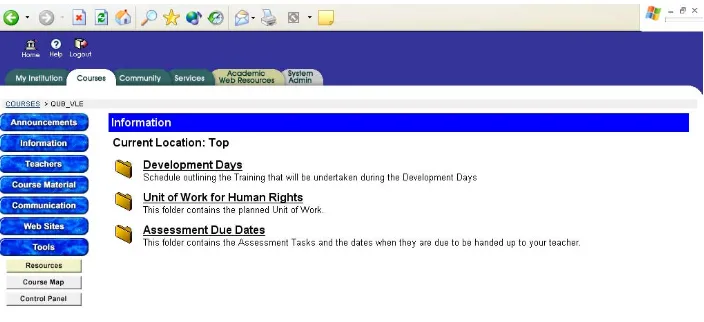
[image:25.595.92.444.375.536.2]The log-on sequence brought the user into the first page of the VLE, which displayed the school crests in a banner designed by C2k. Buttons along the left hand side of each screen gave access to the main options offered to the teachers and pupils as illustrated in Figure 1. Each option on the menu bar gave access to a series of folders that pupils could use to navigate quickly and easily to the information they require. The ‘Announcements’ button took the user back at any time to the front page, on which current announcements were presented under the main banner. As illustrated, the ‘Information’ area held three folders, one containing notes from the development days, one holding general information and one providing the scheme of work for the citizenship elements of the study. An additional folder contained the assessment information, tasks and dates due.
Figure 1: Information screen from the VLE
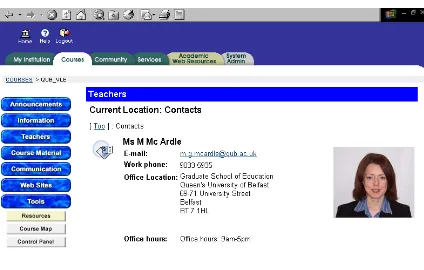
Figure 2: Screen from the Teachers folder in the VLE
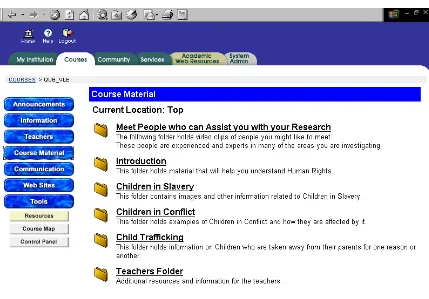
Figure 3: Course material screen from the VLE
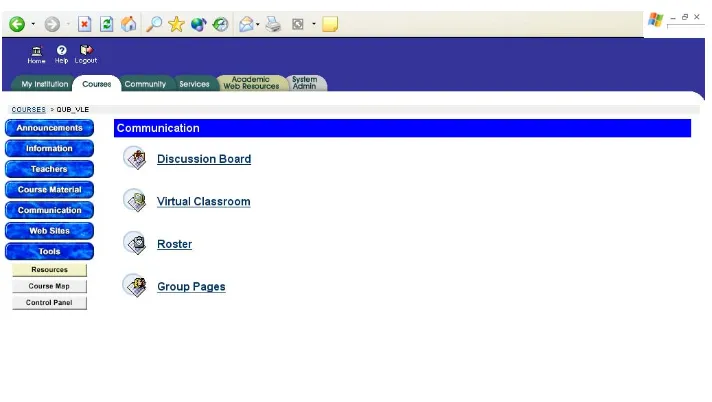
Figure 4: Communication screen from the VLE
The Discussion Board allowed pupils to chat with all members of the project and ask the experts questions.
The Virtual Classroom provided the teachers with a facility to communicate with all members of the project through simple text or text augmented by imported images or website details. However, it was not used in the teaching phase because timetabling of the classes in the three schools did not coincide.
The Roster allowed pupils to view the homepages of all other pupils involved in the project.
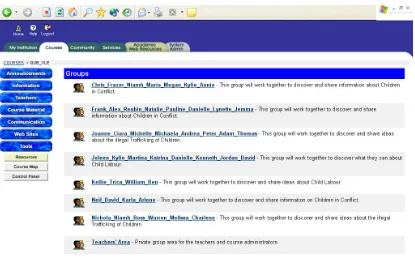
Figure 5: Groups screen from the VLE
Pupils could post questions to their teachers in this area and chat with all others involved in the group under topic areas called threads or informally through an area called the Coffee Bar. A similar group page was also set up for the teachers. As noted above, e-mail facilities were eventually restricted to the discussion board to prevent inappropriate and unmonitored communications.
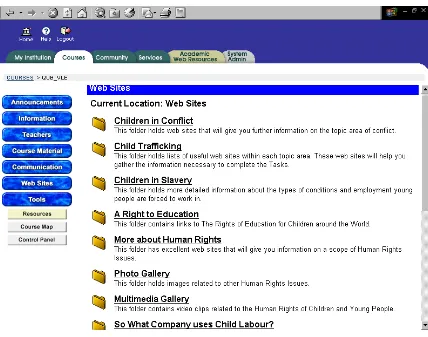
Figure 6: Web Sites screen from the VLE
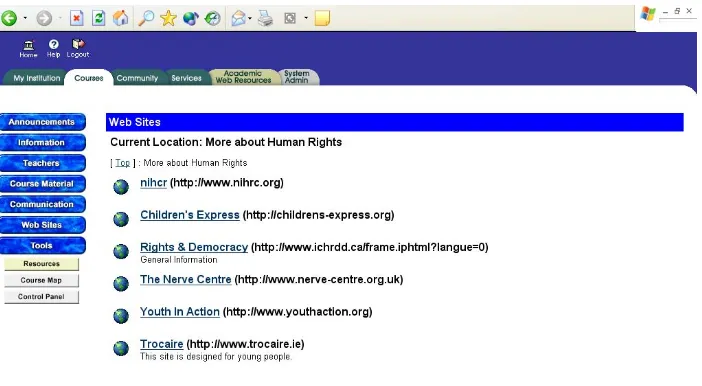
Figure 7: Web Sites screen for ‘More about Human Rights’
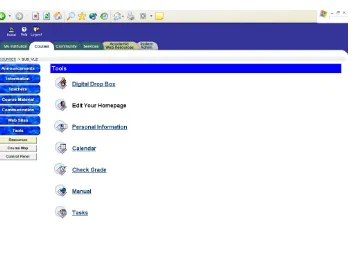
Figure 8: Tools screen from the VLE
T
HET
EACHING ANDL
EARNINGP
HASEEvaluation of Blackboard
The teachers felt that Blackboard had many shortcomings. While there was scope to alter the words used within the main template, the selection was very limited. For example, if the system had so allowed, ‘Announcements’ as a button option could have been replaced by a more suitable word like ‘News’ and ‘Communication’ could have been replaced by ‘Chat’. The teachers had to explain the more difficult terms to the pupils.
The number of screens accessed through the log-on sequence was considered too many. The teachers felt that there should be a log-on option on the home page to link directly into the system. Another concern for teachers was the navigation. They felt that because the structure of each area was similar pupils might become confused by the layered navigational system.
The interface design and layout was also commented on by several teachers who felt that it could be more age-appropriate and interesting by, for example, incorporating:
• a range of colours
• a range of graphics
• age-appropriate cartoon characters
• an easy to use help option, a help character wizard (similar to the paper clip used by Microsoft) or a question bank
• more interactive elements or flash sequences
• visual links or icons, rather than images of yellow folders One teacher was uncompromising:
The whole front end of Blackboard is rubbish anyway; it is boring. Teacher 2
Other recent projects in Northern Ireland have demonstrated that the higher education provenance of Blackboard does not translate well to school contexts because of its
wordiness, inflexible menu structure and the lack of flexibility in screen design. This has been recognized in the development of plans for the LearningNI system, which will incorporate several basic interfaces for different age-range pupils. Suffice to say that in this project the teachers were unanimous that the interface, which Blackboard offers, is unsuitable for key stage 3 pupils.
Usage Patterns
It was possible to use the VLE to monitor usage of the system by the pupils and teachers. It must be noted, of course, that the usage statistics should be interpreted carefully as they arise from a small sample of schools and from situations that are affected greatly by levels of access to the Internet.
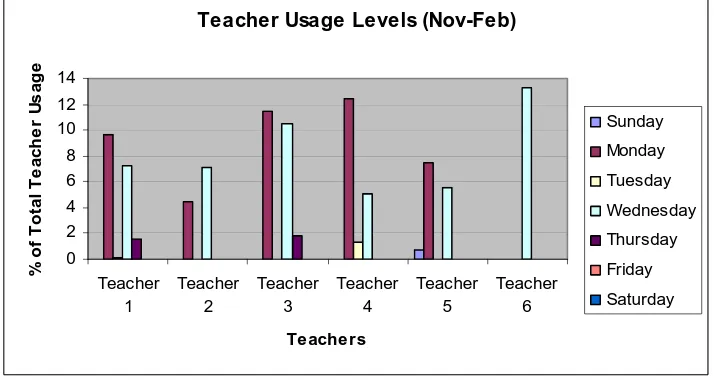
Prior to the beginning of the project the usage statistics related only to the days in which the teachers participated in professional development. These training days were Thursday 16 January, Wednesday 29 January, Thursday 30 January and Monday 24 February, all 2003.
Figure 9: VLE teacher usage levels in the preparatory period from November to February
Teacher Usage Levels (Nov-Feb)
0 2 4 6 8 10 12 14 Teacher 1 Teacher 2 Teacher 3 Teacher 4 Teacher 5 Teacher 6 Teachers % of Tot a l Te a c h e r U s a g e Sunday Monday Tuesday Wednesday Thursday Friday Saturday
Once the project began in the classrooms, the usage patterns increased significantly. This is illustrated in Figure 10:
Figure 10: Teachers’ VLE usage levels from February to June
Teacher Usage Levels (Feb-June)
0 2 4 6 8 10 12 14 16
Teacher 1 Teacher 2 Teacher 3 Teacher 4 Teacher 5 Teacher 6
Teachers % of To ta l Te a c h e r U s a g e Sunday Monday Tuesday Wednesday Thursday Friday Saturday
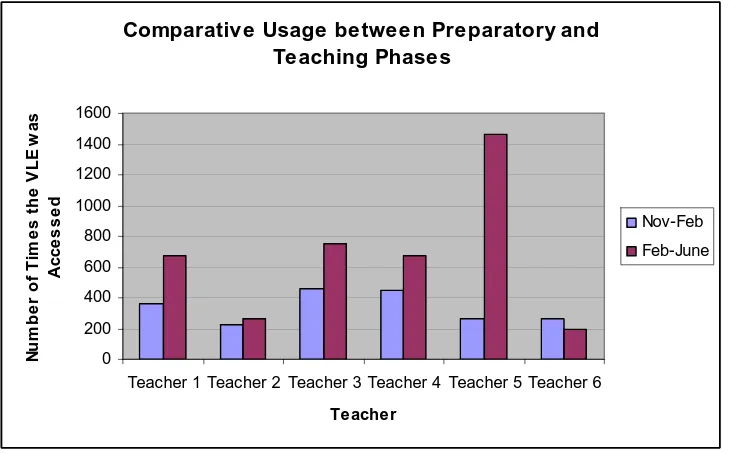
[image:34.595.93.454.384.630.2]Figure 11: Comparison of usage levels in the preparatory and teaching phases
Comparative Usage between Preparatory and Teaching Phases 0 200 400 600 800 1000 1200 1400 1600
Teacher 1 Teacher 2 Teacher 3 Teacher 4 Teacher 5 Teacher 6
Teacher N u m b er o f T im e s t h e V L E w a s A c c e ss ed Nov-Feb Feb-June
The time at which teachers accessed the VLE also altered significantly from the initial
preparatory development phase to the teaching and learning phase in classrooms. Figures 12 and 13 show that two of the five teachers (from two different schools) who had access at home made extensive usage of the VLE after school hours, especially during the teaching phase. Two others recorded very modest usage and the last used it almost negligibly. (The sixth teacher did not have access.)
Figure 12: Times of day that teachers accessed the VLE from November to February
Teacher Usage Times (Nov-Feb)
0 1 2 3 4 5 6 7 8 9 10
0 1 2 3 4 5 6 7 8 9 10 11 12 13 14 15 16 17 18 19 20 21 22 23
[image:35.595.93.503.437.675.2]