The SEN and Disability
Pathfinder programme
Evaluation: Readiness for
reform and effectiveness of
Pathfinder Champions
Research Brief
March 2014
2
Contents
Background 3
Key findings 3
Method 4
Assessment of readiness to meet the SEN reforms 5 Progress made by local areas since the previous readiness assessment 7 Initial review of the effectiveness of pathfinder champions 7 Conclusions and implications 8
List of tables
3
Background
SQW was commissioned by the Department for Education in September 2011 to lead a consortium of organisations to undertake the evaluation of the Special Educational Needs and Disability (SEN and Disability) Pathfinder Programme. The evaluation was commissioned in two stages to mirror the phases of the evolving programme:
Stage one - evaluated the first 18 months of the programme and focused on understanding the approaches adopted to deliver the new processes and the experiences and outcomes of the initial cohort of participating families. A series of reports detailing the findings from this stage of the evaluation are available on the government publications website1
Stage two – is evaluating the second 18 months of the programme (April 2013 – September 2014) to understand the progress made by pathfinders as they roll out the new processes, and the experiences and outcomes of the second cohort of participating families. An assessment of both pathfinder and non-pathfinder areas’ readiness to meet the forthcoming Special Educational Needs (SEN) reforms and a review of the effectiveness of the pathfinder champions is also being undertaken.
This report presents the findings from the readiness research, through which local areas reported on their readiness to meet the SEN reforms. The report also
provides a review of the effectiveness of the pathfinder champions as of October-December 2013.
Key findings
Pathfinder areas were more advanced in their developments relative to non-pathfinder areas, and had made progress across the majority of the elements of the reforms between February and October 2013. This had resulted in most pathfinder areas
reporting that they had either developed or were in the process of developing most of the requirements. Conversely, although non-pathfinder areas had also continued to make progress, a large proportion of this group had still to begin working on a number of key elements, which raises a risk around them completing all the relevant requirements by September 2014.
Progress against most of the reform elements was further advanced within SEN than in social care and particularly health. This is likely to reflect the primarily SEN-based nature of the reforms, an initial lack of capacity to engage and uncertainty on the part of health and social care practitioners around how to contribute and the extent to which the reforms would result in more efficient and effective processes.
A good level of progress had been made in developing certain aspects of the reforms, including the Education, Health and Care (EHC) coordinated assessment and planning
1
4
pathway, EHC plan templates, the local offer, and governance of the coordinated assessment and EHC plans. However, the following elements remained at an earlier developmental stage: eligibility criteria for the EHC plan; joint commissioning
arrangements between the local authority and partner Clinical Commissioning Groups (CCGs); joint resourcing arrangements; personal budgets - particularly in relation to SEN and health; and workforce development.
Method
A series of online surveys were developed, which sought to build on the previous readiness assessment undertaken as part of the SEN and Disability Green Paper Delivery Partner evaluation in February 2013. The updated surveys were designed to:
Include a further round of readiness-related feedback (gathered in Autumn 2013)
Target a wider audience than the original survey, which gathered the views of the Heads of SEN only
Include an additional section to assess the effectiveness of the pathfinder champions and the coordination between champion activity and other
DfE-commissioned support2 (to be disseminated in full to non-pathfinders and in part to non-champion pathfinder areas).
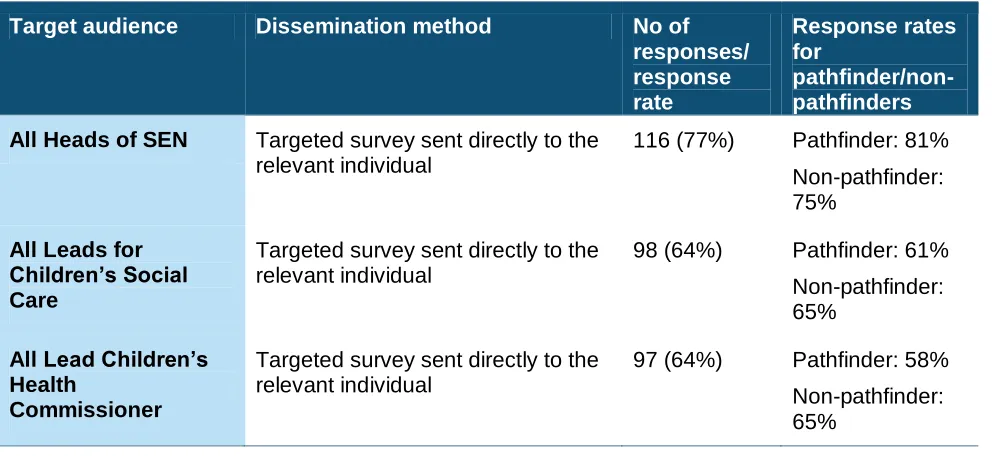
[image:4.595.52.548.472.700.2]Table 1 sets out the five target audiences, the means by which the updated surveys were disseminated and the associated number of responses or (adjusted) response rates that were achieved3.
Table 1 Readiness surveys
Target audience Dissemination method No of responses/ response rate Response rates for pathfinder/non-pathfinders
All Heads of SEN Targeted survey sent directly to the
relevant individual
116 (77%) Pathfinder: 81%
Non-pathfinder: 75%
All Leads for Children’s Social Care
Targeted survey sent directly to the relevant individual
98 (64%) Pathfinder: 61%
Non-pathfinder: 65%
All Lead Children’s Health
Commissioner
Targeted survey sent directly to the relevant individual
97 (64%) Pathfinder: 58%
Non-pathfinder: 65%
2
This section was prepared following a series of consultations with a number of the pathfinder champions.
3
5
Target audience Dissemination method No of responses/ response rate Response rates for pathfinder/non-pathfinders
Providers4 Open call for responses,
disseminated through the Council for Disabled Children’s website and newsletter
74 N/A
Parent carers5 Open call for responses,
disseminated through Contact a Family and National Network of Parent Carer Forums
284 Pathfinder: 80 responses
Non-pathfinder: 175 responses
Not disclosed: 29 responses
Source: SQW
Additional research was undertaken to understand the views of children and young people with special educational needs and disabilities. This comprised three focus groups with 23 children and young people, which were kindly facilitated by Mencap and KIDS6.
The report presents the findings from the five online surveys and three focus groups, and where possible, provides a comparison to illustrate the progress made since the previous readiness assessment in February 2013.
Assessment of readiness to meet the SEN reforms
Awareness of the SEN reforms was relatively high by October-December 2013 amongst service leads, and particularly Heads of SEN, followed by Leads for Children’s Social Care and Lead Children’s Health Commissioners. Providers also highlighted a good level of awareness, although this was lacking amongst parent carers, and children and young people, whose understanding was limited to one or two legislative aspects (key working and the local offer).
A good level of progress had been made in developing certain aspects of the reforms, including the coordinated assessment and planning pathway, EHC plan templates, the local offer, and governance of the coordinated assessment and EHC plans. However, a number of elements remained at an earlier developmental stage in many areas, notably eligibility criteria for the EHC plan, joint commissioning arrangements, joint resourcing
4
Providers are defined as organisations which deliver support and service provision to young people and children with additional needs.
5
Very few parent carers had experienced the new SEN reforms (e.g. through involvement in the EHC pathway).
6
6
arrangements, personal budgets and workforce development (where about half of respondents indicated that these elements were being developed, or were already developed). In addition, progress towards most of the reform elements was found to be moving at a faster pace within SEN than in social care and particularly health.
Focusing on the development of nine key elements of the reforms – the EHC coordinated assessment and planning pathway, EHC plan templates, the local offer, governance of the coordinated assessment and EHC plans, eligibility criteria for the EHC plan, joint commissioning arrangements between the local authority and partner CCGs, joint resourcing arrangements, personal budgets and workforce development - nearly all (80%) pathfinder areas had developed or were developing 7-9 of the nine elements. Conversely the majority (51%) of non-pathfinder areas had developed or were developing only 0-3 elements. Included in the group who assessed themselves as
developing only 0-3 elements as at October-December 2013, are a number of who stated that they intended to begin development within the next six months, or within the next six to twelve months). None the less, the findings implied that a significant number of non-pathfinder areas still had a lot to do and posed a potential risk that some of these areas would not meet the requirements of the reforms within the legislative timeframe.
It was also evident that areas that had developed or were developing their EHC pathway and their EHC plan template were more likely to have begun the development of other elements such as joint resourcing, governance arrangements and workforce
development. This implied that the development of the pathway and template often formed the basis for other developments. Similarly, the development of strategic multi-agency arrangements, including governance arrangements, joint resourcing and
workforce development appeared to be related, implying the development of one of these elements often triggered the associated developed of the other elements.
The involvement of providers in the reform process up to October-December 2013 seemed to have been effective, based on the feedback provided by the 74 providers that completed the survey. Involvement in the reforms had also been positively perceived by these providers. In contrast, more work needed to be done in more effectively engaging parent carers, and children and young people. Strong relationships existed between local areas and Parent Carer Forumss (particularly in areas where more progress has been made towards the reforms), which could be leveraged going forwards. Where children and young people are concerned, there had been a gap in engagement, which will need to be carefully addressed. The use of ‘modern’ communication channels (e.g. audio-visual and online media), appeared to be particularly favoured amongst the young people consulted.
Mixed opinions were expressed in regards to the likelihood that local areas would meet the reforms, with providers showing more optimism than parent carers. What was clear was that local areas would require further support in the run-up to implementation in areas including personal budgets, EHC plans and workforce development. Going
7
areas, including health, which had drawn the least on these funds at the time the surveys were carried out.
Progress made by local areas since the previous readiness
assessment
Awareness of the SEN reforms increased between February and October 2013, which translated into varied advances in the development of individual elements of the reforms across pathfinder and non-pathfinder areas.
Focusing first on pathfinder areas, it was evident that strong progress had been made between February and October 2013 in relation to the: consideration of the governance of the EHC assessment and planning pathway; development of the local offer;
development of mediation information and services; facilitation of workforce
development; and development of personal budgets. However, further progress was still required in relation to the development of joint commissioning arrangements between the local authority and partner CCGs.
Turning now to non-pathfinder areas, progress had been more mixed, with the intention being to begin development of the reforms in the next six months in most areas (as
opposed to an increase in those who had actually begun the various developments). This finding is unsurprising given that the majority of non-pathfinder areas were likely to have started their reform-related developments more recently. However, given the proposed September 2014 milestone for roll out of the reforms, it seemed likely that the pace of development in these areas would need to increase to ensure all the relevant
requirements were achieved.
Initial review of the effectiveness of pathfinder champions
Awareness of champion support was quite high amongst all three service leads by
October-December 2013, as was access to support, suggesting a good level of outreach. There had been more limited engagement of health in champion activities however, with only a half (50% (n=35)) of health leads believing they had received enough support. Going forwards it will be important to ensure more of a balance across the three service areas.
8
activity by October-December 2013, but where they had been involved, the feedback was also positive.
Local areas, and particularly pathfinder areas, had sought a range of alternative support in developing the reforms, from providers including In Control, Preparing for Adulthood and the Early Support Trust. This had largely been accessed to broaden the depth and breadth of expertise, rather than to ‘make up’ for insufficient champion support. This is a positive finding and will strengthen the readiness of local areas to meet the reforms; however it is important that champion support is effectively aligned with support from alternative providers, in order to avoid any duplication.
Conclusions and implications
Taken together, the feedback gathered provided a mixed picture of readiness, with a number of non-pathfinders still some way off. Many of this group intended to start work on key elements in the next six months. We would assume that for many this would have meant acting sooner rather than later given that they had in effect 10-11 months until the new approach was due to go live from the point the survey was undertaken.
On one reading of the results, many areas seemed comfortable with the timescale, with just 41% of service leads saying that they required further support. However, from the experience of the pathfinders there could be some concern that these developments usually take longer. It may be that non-pathfinders were assuming that they could move more quickly by building on the experience of the pathfinders, but the risk remains that they had not fully assessed the work required. Therefore, it could be appropriate to:
Monitor progress in the run-up to implementation – which could be informed by the DfE termly readiness assessment and from the views of pathfinder champions that may be able to provide an insight into progress made by the areas they are working with
Continue to produce materials which draw on the experience of the pathfinders, to assist and speed up non-pathfinder development – including further thematic case studies from the evaluation and good practice drawn from the pathfinder
champions and pathfinder support team
9 © SQW [March 2014]
Reference: DFE- RB329 ISBN: 978-1-78105-310-2
The views expressed in this report are the authors’ and do not necessarily reflect those of the Department for Education.
Any enquiries regarding this publication should be sent to us at:
[email protected] or www.education.gov.uk/contactus
This document and the full report are available for download at