Research and Information Service
Briefing Note
Paper 48/16 8th September 2016 NIAR 300-16
Caroline Perry
Academic selection: a brief
overview
1
Introduction
This Briefing Note considers academic selection in Northern Ireland. It is prepared to support Committee for Education consideration of inquiry topics, and is not intended to be comprehensive.
2
A brief history of academic selection in Northern Ireland
Academic selection was introduced in 1947 and there was little interest in change at a policy level until 1997, when the Labour government asked for research on its effects.
Figure 1: Key events relating to academic selection 1998-20041
1 Adapted from: Department of Education A timeline of the development of transfer policy [online] Available at:
Subsequently, the then Minister for Education, Martin McGuinness MLA, established a Post-Primary Review Body (chaired by Gerry Burns) to consider potential options.2 Its
recommendations included:3
Ending transfer tests; instead prioritising parental choice; and
Developing a pupil profile to provide information on progress and help inform
parental choice.
During a period of suspension of devolution, Jane Kennedy MP set up the Post-Primary Review Working Group in April 2003 (chaired by Steve Costello) to provide advice on potential options. The group submitted their report in November 2003, and Jane Kennedy MP accepted the recommendations in full.4 They included:5
Ending transfer tests (with the last tests in 2008), with transfer instead based
on parental and pupil choice, informed by the Pupil Profile; and
Introducing an Entitlement Framework offering a broader curriculum.
With suspension continuing, the Labour government brought forward the Education (Northern Ireland) Order 2006 with provisions to prevent Boards of Governors from including academic ability when drawing up admissions criteria.6
However, in the negotiations leading to the St Andrew’s Agreement, Prime Minister Tony Blair amended the provisions relating to academic selection so that the new devolved administration would decide whether or not to continue selection.7
Figure 2: Key events relating to academic selection 2006-20108
Following the restoration of devolution, in May 2008 the then Education Minister Caitríona Ruane MLA submitted proposals to the Executive aiming to end academic
2 Gallagher, T., Smith, A. (2003) Research update: Attitudes to Academic Selection in Northern Ireland Belfast: Ark 3 Burns (2001) Report of the Review Body on Post-Primary Education Bangor: Department of Education
4 Department of Education A timeline of the development of transfer policy [online] Available at:
https://www.education-ni.gov.uk/articles/timeline-development-transfer-policy
5 Costello (2004) Future Post-Primary Arrangements in Northern Ireland: Advice from the Post-Primary Review Working Group
Bangor: Department of Education
6 Legislation.gov.uk The Education (Northern Ireland) Order 2006 [online] Available at:
http://www.legislation.gov.uk/nisi/2006/1915/article/28/made
7 Walker, A. (2010) Selection challenged: The case against selection for 11+ Newtownards: Colourpoint Books 8 Adapted from: Department of Education A timeline of the development of transfer policy [online] Available at:
selection; the Executive did not discuss them. The last state-sponsored tests took place in November 2008.9
In the absence of a regulated approach, the Department of Education published guidance and policy for transfer in 2009 and 2010, to which schools were required to ‘have regard,’10 with an updated policy published in September 2015. Key features of
the policy included:11
Schools must admit applicantsto all available places (statutory duty);
Decisions on admissions should not relate to academic ability;
Recommendations include giving priority to pupils entitled to free school
meals, with other criteria relating to applicants with a sibling at the school,
applicants coming from a named primary schools and applicants residing in a defined catchment area; and
Primary schools must not depart from their statutory obligations to deliver the curriculum, and should not facilitate unregulated tests in any way.12
3
Where are we now?
On the 7th September 2016 the Minister for Education, Peter Weir MLA, released
revised guidance on transfer, reversing the previous policy on preventing primary schools from facilitating unregulated tests. It allows schools to:13
Supply support materials;
Carry out preparation for tests during core teaching hours;
Coach pupils in exam technique;
Provide a location for testing; and
Provide familiarisation with a testing environment.
The guidance also removes the provision within the previous guidance that decisions on admissions should not relate to academic ability, instead stating that it “supports the right of those schools wishing to use academic selection as the basis for admission.” It
9 Department of Education A timeline of the development of transfer policy [online] Available at:
https://www.education-ni.gov.uk/articles/timeline-development-transfer-policy
10 Department of Education A timeline of the development of transfer policy [online] Available at:
https://www.education-ni.gov.uk/articles/timeline-development-transfer-policy
11 Department of Education (2015) Post-primary transfer policy Bangor: DE
12 Including by supplying support materials, carrying out preparation for unregulated tests during core teaching hours, offering
afternoon school coaching or providing familiarisation with a testing environment.
13 Department of Education (2016) Guidance to primary school principals, post-primary schools’ Boards of Governors and principals, and the Education Authority on the process of transfer from primary to post-primary school from September 2016
notes that the Department believes that academic selection can “enable social mobility”.
Two consortia offer the commercial, unregulated ‘transfer’ tests in Northern Ireland: the Post-Primary Transfer Consortium (PPTC) and the Association for Quality Education (AQE). Broadly, pupils from Catholic maintained schools take the PPTC tests, while those from controlled schools use the AQE test.
While both claim to be based on Key Stage 2 maths and English, they lack regulation and the tests differ in structure, style and format.14 The OECD states that the
commercial tests are “driving and possibly distorting the curriculum,”15 while Elwood
suggests that they are of dubious validity, reliability or comparability.16
4
Distribution of students to grammars and non-grammars
In 2015/16, of all students transferring to post-primary, the majority, 13,235 (60%) attended a non-grammar, while 8,964 (40%) attended a grammar.17
Socio-economic background is one of the key predictors of academic performance at school.18 In Northern Ireland there are greater concentrations of disadvantaged
students in non-grammar schools than in grammars, using free school meal (FSM) entitlement as a proxy for deprivation).19
In 2015/16, 17% of all Year 8 pupils entitled to FSM attended a grammar, compared to 79% of their counterparts who attended a non-grammar.
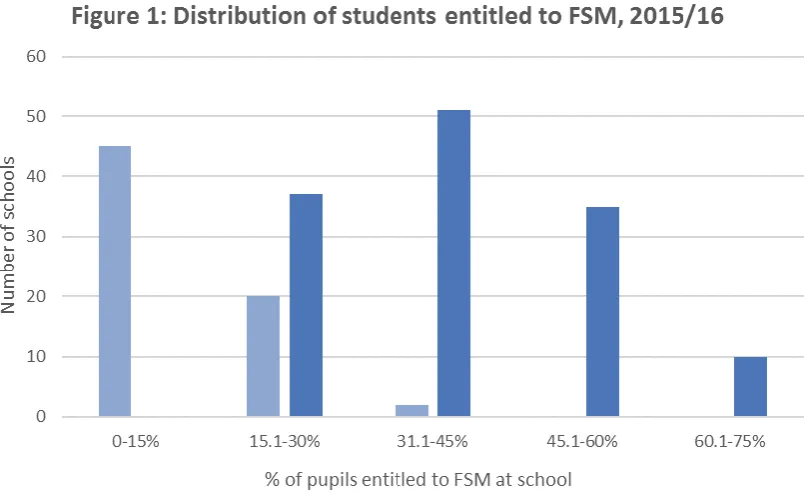
Figure 1 below illustrates the larger concentration of students from disadvantaged backgrounds in non-grammar schools, together with the more socially advantaged intake in grammar schools.20 At over two-thirds of grammar schools, fewer than 15.1%
of pupils are entitled to FSM, while no non-selective schools fall into this bracket. At ten non-selective schools, over 60% of pupils have FSM entitlement.
14 Shewbridge, C., Hulshof, M., Nusche, D., Stenius Staehr, L. (2014) OECD Reviews of Evaluation and Assessment in Education: Northern Ireland OECD Publishing
15 Shewbridge, C., Hulshof, M., Nusche, D., Stenius Staehr, L. (2014) OECD Reviews of Evaluation and Assessment in Education: Northern Ireland OECD Publishing
16 Elwood, J. (2011) Assessment and Opportunity to Learn in the context of Northern Ireland: Assessment and Examination policy and practice development – for what and for whom? Keynote address to the Association of Educational Assessment Europe 12th Annual Conference, Belfast, November 2011
17 Data provided by the Department of Education, June 2016
18 OECD (2011) Against the Odds: Disadvantaged Students Who Succeed in School Paris: OECD Publishing
19 Shewbridge, C., Hulshof, M., Nusche, D., Stenius Staehr, L. (2014) OECD Reviews of Evaluation and Assessment in Education: Northern Ireland OECD Publishing
20 Data from the Department of Education (2015) School enrolments - 2015/16 statistical bulletins [online] Available at:
5
Academic outcomes at selective and non-selective schools
[image:5.595.115.518.80.327.2]Data from the Department shows that around 95% of students at grammar schools achieve the GCSE threshold measure of five GCSEs at grades A*-C including English and maths, and that this has remained relatively static over the past seven years. In 2014/15 at non-grammars, less than half (45%) of students achieved this measure, representing an increase of 11.4% since 2008/09.21 These findings are illustrated in
Figure 2 overleaf.
6
Arguments around academic selection
Academic selection is a contentious subject with many stakeholders arguing for and against. Proponents of the system often suggest that grammar schools offer a direct route to higher education, and that grammars result in pupils in Northern Ireland accumulating higher grades than their counterparts in other jurisdictions.22
There is evidence that many parents deem entry to grammar schools as prestigious, while others may oppose selection but feel bound to enter their children to the unregulated tests in order to gain access to certain high-performing schools.23
However, the evidence indicates that the higher concentrations of disadvantaged students in non-grammars have a significant impact on academic outcomes, as well as on other contributing factors such as school attendance.24
In addition, the high results among the top performers in Northern Ireland mask a long tail of underachievement.25 The OECD notes that the selective system presents “clear
structural challenges to equity.”26
22 Gardner, J. (2016) “Education in Northern Ireland since the Good Friday Agreement: Kabuki theatre meets the danse
macabre” Oxford Review of Education Vol.42, No.3, pp. 346-361
23 Shewbridge, C., Hulshof, M., Nusche, D., Stenius Staehr, L. (2014) OECD Reviews of Evaluation and Assessment in Education: Northern Ireland OECD Publishing
24 Shewbridge, C., Hulshof, M., Nusche, D., Stenius Staehr, L. (2014) OECD Reviews of Evaluation and Assessment in Education: Northern Ireland OECD Publishing
25 Walker, A. (2010) Selection challenged: The case against selection for 11+ Newtownards: Colourpoint Books 26 Shewbridge, C., Hulshof, M., Nusche, D., Stenius Staehr, L. (2014) OECD Reviews of Evaluation and Assessment in
Other arguments against academic selection include the stress many children
experience when sitting the test, implications for their self-esteem if they do not pass27
and the perceived “stigma” associated with failing the transfer test.28
7
Conclusion
The last state-sponsored transfer tests in Northern Ireland took place in 2008, and since then a system of unregulated tests has operated. New guidance allows primary schools to facilitate these tests.
Academic selection remains a contentious subject, with proponents arguing in favour of the high grades many students in Northern Ireland achieve in comparison to other jurisdictions. However, there is clear evidence that non-selective schools have much higher concentrations of disadvantaged pupils, with a range of implications, including for academic outcomes. Areas for consideration could include:
The reliability and comparability of the unregulated system of tests;
The implications of the unregulated tests for students, parents and schools;
The high proportion of students who do not attend grammar schools;
The concentration of disadvantaged students in non-selective schools, and the implications of this;
The differences in academic outcomes for students from grammars and non-grammars;
The implications of the selective school system for equity; and
The implications of the selective system for other departmental objectives, for example, in relation to the departmental objective to close the performance gap and increase access and equality, and the Programme for Government
indicator on reducing educational inequality.
27 Walker, A. (2010) Selection challenged: The case against selection for 11+ Newtownards: Colourpoint Books 28 Gardner, J. (2016) “Education in Northern Ireland since the Good Friday Agreement: Kabuki theatre meets the danse