Rochester Institute of Technology
RIT Scholar Works
Theses Thesis/Dissertation Collections
3-22-2017
From Character to Characteristics
Yen-Ting ChenFollow this and additional works at:http://scholarworks.rit.edu/theses
This Thesis is brought to you for free and open access by the Thesis/Dissertation Collections at RIT Scholar Works. It has been accepted for inclusion in Theses by an authorized administrator of RIT Scholar Works. For more information, please [email protected].
Recommended Citation
Rochester Institute of Technology
A Thesis Submitted to the Faculty of
The College of Image Arts and Sciences
School of American Crafts
In Candidacy for the Degree of
Master of Fine Arts,
Furniture Design
Chef Advisor: Rich Tannen
Associate Advisor: Andy Buck
Associate Advisor:
Juan Carlos Caballero-Perez
From Character to Characteristics
by Yen-Ting Chen
2 Thesis Title : From Character to Characteristics
Student Name: Yen-Ting Chen
Thesis Committee Final Approvals
Chef Advisor: Rich Tannen
Signature Date
Associate Advisor: Andy Buck
Signature Date
Associate Advisor: Juan Carlos Caballero-Perez
Signature Date
Chairperson:
3 I. Abstract
Through my life experiences, the way my family raised me, and fostered my thoughts, I have
developed a strong connection to my native language. Taiwan is a country where the traditional
Chinese characters are still widely in use, alongside with Hong Kong, Macao and Singapore. In fact,
traditional Chinese characters can carry specific meaning individually, or further create various
meanings when used in combination, which is profound and intriguing. Focusing on the form and
structure of Chinese characters and their relationship with literal meaning, I wanted to design and
create furniture that brings together culture, family, and personal vision.
As an international student living in the United States, the longer I stay, the stronger I feel a paradox
between new adventure and homesickness for Taiwan. Until now, it has been two and a half years
since I left my country. My desire to reunite with my family in Taiwan has never been stronger.
Therefore, I chose the character “回” (return) as inspiration for my first piece as a starting point.
Since Asians mostly highlight our family bond and the connection with home, the chosen characters
would be strong representative symbols, which can precisely project my mindset. I would like to
make a series of furniture that will represent my own interpretation of the meaning from characters.
The composition or image of traditional Chinese characters is the first element utilized to create the
basic look of my furniture pieces. The geometric forms and clean lines are the preferable style in my
works, to show my interpretation of the characters in a simple way. The second element is its
meaning, which is used to decide the function of the furniture. Not only do I focused on the
meanings of the characters themselves, but also emphasized their connection. This could create
intensive and strong connections among my nostalgic memories of home in order to create the whole
picture of my personality. The connection between my own story and memory created a story-telling
piece in order to express the characters’ form, the meaning and the culture of traditional Chinese
4 II. Discussion of Sources and Research
Chinese character is a part of Chinese culture, as well as the carrier and medium of it. Without Chinese character, they—the vertical dissemination and horizontal communication of the culture—cannot go on.1
“Latin and Chinese scripts are two totally different systems. Where Latin script is a phonetic compound made of different alphabetical combination, Chinese script is an ideographic writing system, with characters carrying individual meanings. The varied lengths of Latin scripts command different size of breaks between alphabets(kerning) and words(spacing), whereas Chinese scripts are arranged into standard grids, regardless of the number of strokes each contains.2
The core idea of my work could be traced back to my self-identity which is to think about the
differences, uniqueness, and specialties from others in order to create pieces that reflect my culture.
From the language perspective, people from Taiwan and China both speak Mandarin as their daily
language; however, the learning and writing systems are quite different. Taiwanese learn traditional
characters by a phonetic written system and use the traditional character in our daily lives, which is
more complicated and expressive.
Recently, the typography group in Taiwan called JustFont raised more than $579,710 through a
crowdfunding platform in just two days. The fonts are named after a popular local variety of
oolong tea. This article obtained public awareness of the significance of font design while
re-establishing Taiwan as the standard bearer of traditional Chinese characters. This was a successful
example and an unprecedented case that brought the public’s attention to rediscover the beauty of
language and character from our Taiwanese culture.
Chinese characters are originally pictorial. But, while Egyptian hieroglyphs express in concrete pictures the ideas that provided the basis for conception of each character, Chinese characters rarely do. Even in their earliest form, Kanji have already undergone a fairly complex process of abstraction. They are conceptualized images, not ‘pictures.’ 3
1
Shuanhu An, China Media Report Overseas . Oct2011, Vol. 7 Issue 4, p19-24. 6p. 2
Julius Hui, Hanzi, Kanji,, Hanja 3
5
“Each character is an entity, a unique figure whose form cannot be confused with any other. Each represents a word and an idea, and consequently has its own existence, its value as a means of expression, and an evocative power.” 4
There are few technical expressions of ancient Chinese that classified characters into six categories,
and they each provide a complete explanation to comprehend Chinese characters: pictogram,
indicative symbols, logical combination, phonetic compounds, explanatory and Rebus (phonetic loan)
characters. My work is to focus on the pictogram as my picturized inspiration. The pictogram is
an ideogram that conveys its meaning through its pictorial resemblance to a physical object.
“How to make the micro relationship between phonetic elements, visual meanings and established structure work within a single Chinese character will remain a fascinating puzzle to be resolved.”
“Chinese Character design does not concern only the character’s form. Phonetic components, structure and meanings that make up Chinese characters can all serve as an interesting element to be reworked for visual communication.”
“It has always been a game of black and white , and formulating positive and negative space, like the symbol
of Tai Chi.”5
There are lots of advertisements or logos in Taiwan that use traditional Chinese characters to promote
the meaning and idea of their purpose. The interesting part of using Chinese characters as inspiration
is that each Chinese speaker could recognize the characters even when they are not completely
formed. The following pictures are the examples of adapting Chinese characters in graphic design
and posters.
Ding Shang-chin
Landmark & Food
Here There Studio
Elephant Gym-Balance
4
Nagel Encyclopedia-Guide, China, 1968, p.322 5
6
Onion Design Associates
Client: Taipei Chamber Singers, TCS
MUSIC UNLIMITED VI: VOID
Void was a semi-theatrical piece that explored the
essence of life. Filled with zen aesthetics and interactive
lighting designs, the programme aimed to initiate a
dialogue between different cultures and contemporary
arts. The stretched character of “void” or “nothingness”
expressed the abstract characteristics of the concert.
The line from characters were utilized and transformed from two-dimensional strokes into the
three-dimensional structure of furniture. Pure geometric forms and clean lines with spatial elements
for the functionality are the basic principle of the overall look in my works. As to the meaning and
stories of pieces, alike my life path, every piece was intertwined to each other, but had its own phase.
Every character had its basic meaning, but they could combine with other characters to create a
different meaning. Furthermore, through the meaning of these three characters, my memories were
brought forth to the present and echo with my work. This phrase allowed me to think of how I get
along with my family for some Chinese traditional activities, ceremony and the relationship with
particular family member.
ACST Design
Connect
Here There Studio
Elephant Gym-Angle
Lai Chu-hsiu
7
In addition to the meaning of a Chinese character, I also wanted to capture some visual element from
the traditional Chinese furniture. From the form and the structure to function, the blending of artistic
form with practical functionality could be seen as a common thread running through the Chinese
furniture. From the elements, forms and structure of Chinese furniture, the differences show the
uniqueness and differentiation from the western design. These differences became inspiring ideas for
me to create and deliver the cultural stories, thus to make communication with people all over the
world.
The Pieces of a three-part frame work between the legs of chair are often half-lapped mitered join.
8
Waisted Square Table with Giant’s Arm Braces
Huanghuali
Late 16th/early 17th century
Top96*96 cm, height 86 cm
The Square Table was a standard piece of domestic furniture. A table in this shape was particularly convenient for
eating in casual circumstances. Woodblock prints reveal that, at elegant gatherings, each person ate at his or her
own table, or two people sat at one table, both seated on the same side of the table…… On a square table the
centrally placed food is comfortably equidistant from all diners.
In the structure, this table combines the two distinct Chinese table-construction techniques- waisted and recessed
leg. Tables with waists usually have square legs and hoofed feet. Round legs appear primarily on tables with
recessed legs and no waist and round-section legs that go straight down to the floor.6
In Asian tradition, dining on the table is an important way for family members to get together. There
is specific seating arrangement to every formal dinner, based on seniority and organizational
hierarchy. Proper etiquette is very important to traditional Chinese people, who feel good manners
invite luck, and boorish conduct brings shame. Although many Maoist programs aimed to curtail
traditional social practices, today table etiquette is again considered as an indication of educational
status. Therefore, I choose to start with a dining table as the start of my working path, and took the
traditional form and structure as visual language of the series. Besides, a dining table could well
represent the culture and tradition of where I came from.
6
9
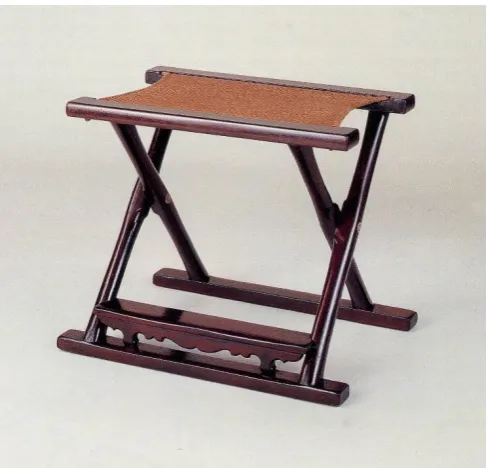
Folding Stool
Zitan
17th/18th century
Width 59cm, depth 39cm, height 48cm
The folding stool eventually became a popular form of portable seating furniture. Even today in China, men and women can be seen relaxing on small folding stools by the side of street, or while fishing along a canal. Nevertheless, the folding stool’s earlier function as a seat of honor is still reflected in the dignified, luxurious appearance of this stool, constructed from precious zitan.7
Stools are really common in Taiwan. We could often see the elderly sitting on the stools and chatting
on the side of the street with each other. Furthermore, the wedding banquets at the side of the road
are an original and unique part of Taiwan's culinary culture. These types of wedding banquets are set
[image:10.595.54.298.71.305.2]up under large tents, right alongside the busy streets. People are seated on stools around the dining
tables and enjoy local delicacies. Those scenes and experiences are truly special and fun memories
for me as everyone was having fun and indulging themselves in the atmosphere. Therefore, I wanted
to make the stools to pair with the dining table to complete the full imagery from my memory.
7
10 III. Critical Analysis
The first piece- Heading back, Return, Memory
回
HuiChosen character and analysis
This chosen character came from my homesickness and anticipation to go back to my country and be
reunited with my family. In our tradition, the Chinese New Year is a major festival for a family
reunion, and its precious memories are always exclusive and unforgettable. On the last day of the
lunar calendar, the night preceding Chinese New Year's Eve is an occasion for Chinese families to
gather together for the annual reunion dinner. This is also the inspiration for choosing the Hui
character to further develop the design of a dining table representing the tradition of this festival.
Meanwhile, this experience brings me back to the memory of being with my family as well.
Work Description
Apart from the meaning of the character, I was drawn to different perspectives of this character. It is
not just the lines of the character itself as a flat surface, but when seen from various angles, many
new and interesting compositions come to life. From the top view of the table, the bigger outer
square is the table top layer. It lined up with the inner square which is the bottom layer and the
location of the feet of the table. The design attempted to transform the character from two
dimensions to three dimensions, and included hierarchy and vitality to the work. Furthermore, the
Square Table with iconic arm braces also serves as my inspiration with the Chinese character graphic.
The clear and transparent glass table top was chosen instead of wood to create a simple and bright
feeling through the whole piece. Also, wooden-framed glass could make people easily focus on the
11
Hui回, White Oak, Glass, 36"x 36"x 30"
The second piece- Neutral, Independent, Standing, Rising, Establishing
立
LiChosen character and analysis
For the second piece, the chosen character ”立” (Li) means independence and establishment.
Therefore, it ccould be further elaborated as a person's uniqueness and individuality. After graduating
12
now I am in the middle of a foreign city pursuing my studies. This process is a transformation for me,
and an important stage that fosters me to become who I am. In Asia, the lives of most high school
students are focused on study and exams. When entering the university, learning how to get along
with others and gaining a better understanding of oneself is necessary. This is a period to build our
image, to have attitudes in facing every obstacle, to be responsible for ourselves and to think
independently.
Work Description
The inspiration I gained from the chosen character was further developed into the creation of two
stools, which pair with the dining table. These two stools could represent different people in the
family and memories of times when each of us experienced some sort of transformation. During the
process of growing up, we had to balance the bond of dependence on family and independence of
self growing. Therefore, the challenge is how to maintain the intimate relationship with your family
and also uphold autonomy and individuality (two forces that create a balance while connecting one’s
family and holding one’s sense of self). That is, people don’t overly depend on their families to gain
the sense of security, nor will they escape from their families so that they might lose their
individuality.
I took the strokes of the character as the stool's front view. Not only did I refer to the traditional
Chinese folding stool, but also used straight lines and curve as my language to create the simple and
symbolic looking structure. In the meantime, it could be pragmatic as well. Moreover, in accordance
with the structure and design from the dining table, I also added curved lines to the structure in order
to support the seat.
13
The third piece- Never, Future, Branch, Uncertainty, Incompletion
未
WeiChosen character and analysis
Last, but not least, I chose the character ”未” which means “never” and “the future”. The main
reason for choosing this character was because of my relationship with my grandfather. In fact, the
word “grandfather” is a vague and unfamiliar word to me. Since he passed away before I was born, I
have never seen or had any interaction with him. However, the consanguinity still connects us
together. As an Asian family, the connection with our grandfather is emphasized. Ancestor
worshipping ceremonies and stories told by my grandmother are the only two ways for me to create a
vague imagination and connection with him. Thus, I designed this piece based on the ceremony,
representing the shrine and the way of appearance for worshiping my grandfather and the ancestor of
my family. From the things he left more than a quarter of a century ago, I chose the clothes rack and
the coat as a symbol to depict his portrait. Presenting in an amiable way instead of a solemn
ceremony, I hoped the audience could understand the piece in the simplest and most direct way, as it
is usable furniture as well as had cultural significance.
Work Description
The character is symmetrical when looking at it directly, but I wanted to design this piece in a
different and unexpected way. I also made the character transform from two dimensions to three
dimensions, and also with a 45-degree angle to get the character. Therefore, I made the middle pillar
as the core pillar and designed the rest of the parts around it. This made the piece more diverse and
playful.
As for the function, I took three main rituals for worshipping Chinese ancestors: lightening incense,
offering flowers and reading scripture. I took these three elements as the function into the character.
As for the lines and curves, since I wanted to create a piece that would not occupy too much space, a
real mock-up needed to be made in order to see every different aspect, its usability, and balance.
Meanwhile, I still followed the design language from the previous work, which was to compose with
14
Wei未, White Oak, Walnut, 30"x 28"x 75"
IV. Conclusion
I thought of this work not as an ending, but rather a beginning. The process of making these pieces
gave me a new perspective to view my life. Reflecting the past from my memories, I was able to
capture the most profound moments and represent them as unique furniture. From the start of the
thesis, I thought what made my work special and different is the particularity of language. Language
has also had an important impact on my growth and thinking. I have been focusing on thinking about
the relationship with my family since I first thought of going back to reunite with them. During the
process of making my thesis work, I have come to cherish more of what I have gained from the past,
from holiday customs, to the sense of connection with my hometown. I was satisfied with the work I
made this year, as well as having the opportunity to express this emotion. This series of work
precisely expressed my story and shared my culture with others by the unique interpretation and
15
experience. When it came to the practicality and functionality of real furniture, this was a challenge.
The design process was a love-hate relationship for me. I was motivated by the moments when ideas
appeared, or drawings are developed, but meanwhile I still need to think about utility and function.
This process had lots of back and forth. Through discussions with teachers and peers, I could
discover the parts I was lacking of and kept trying and testing. I thought the last piece “未Wei” is
good representative of this.
Looking back from the first year till now, from a person who knew nothing about building furniture
to where I am now, I am confident that I can overcome a lot of challenges, both in my work, and the
challenges that life will bring. I learned a lot from these three years from instructors and peers, not
only with regard to school work, but also my life. Lastly as I said before, this is just a start. I have
other ideas relating to this character series that I've been thinking about this year. I will keep working
16
Hanzi, Kanji, Hanja: graphic & logo design with contemporary Chinese characters/ edited and produced by
Victionary, 2015 April
Ban Kôjin, Kanji Kanji,East Publications, Tokyo, 1972
Nagel Encyclopedia-Guide, Nagel Publishers; First English Edition , China, 1968
An, Shuanhu, China Media Report Overseas, Vol. 7 Issue 4, 2011 October
Beyond the Screen: Chinese Furniture of the 16th and 17th Centuries, Museum of Fine Arts Boston, 1996
Wang, Shixiang; Evarts Curtis, Masterpieces from the Museum of Classical Chinese Furniture,
17
19
20