The Efficacy of Previewing and Providing Background
Knowledge on EFL Reading Comprehension
Zhaonua Shen
Thesis submitted as partial requirement for the degree of Master of Arts of the Australian National University
Except where otherwise indicated this
thesis is my own work
Acknowledgements
During the process of completing this thesis, many people have helped
me and encouraged me. First of all, sincere gratitude is extended to my
supervisor, Dr. Louise Jansen. Without her systematic guidance, insightful
comments, continuing encouragement and kind patience, I could not possibly
have written this thesis. My deepest gratitude is also extended to Dr. Tony
Liddicoat who helped me to spell out my ideas more clearly at an early stage
which has been essential to this study.
My gratitude is extended to the staff in the Academic Skills and Learning
Centre of the ANU who always offered helpful advice on my thesis; I would
particularly like to express my heartfelt thanks to Dr. Gail Craswell who read
everything I wrote in its earlier and later drafts and helped me search the English
language for the exact expression.
Over this year, I have discussed aspects of this thesis with my friends.
Some not only influenced my thinking but also took the time to comment
verbally or in writing, on various bits and pieces. My warm thanks go to Safari
Arsyad, Mark Pinster, Fuchun Huang, Xi Liu and Xiaobing Wu.
Special thanks is certainly due to my colleagues Xiliang Gou, Jiangun
Abstract
Research by Anderson (1977) Steffensen, Joag-Dev and Anderson
(1979), Carrell (1987), Kang (1992) has shown that because of differences in
culture or expertise, EFL students experience comprehension difficulty.
However, when provided with prereading activities, their comprehension
maximizes considerably (Carrell 1983, Taglieber 1988, Chen and Graves 1995).
Research has shown that both providing background knowledge and previewing
are effective for both LI and L2 readers. (Pearson, Hansen and Gordon 1979,
Birkmire 1985, Grabe 1991, Graves and Cooke 1980, Graves, Cooke and
Laberge 1983, Chen and Graves 1995).
further demonstrate that
The.
I
ortest v eseo v cbCKeva
C i r o w e s L l ^ 5 ) - f u r t h e r d e m o n s t r a t e s t h < x t p r e W e w o . V x ^ ? s s i ^ ^ j c o
of
an American short
I III »1 I ■ liW il ini il yj ifJ iW rail iSUper'cy -to prov/i'olMj background (enable in
MQiyi
comprehension of O'n AweWccm Snort
•
However, no
line
whether preview and background knowledge differ in their effectiveness for
improving comprehension in other text types. Also, so far, no research has been
done on the longer-term effect of prereading activities. It is expected that
information rehearsal will enrich preview and background knowledge and these
t
K'S Mrucljy > o\)lnic|q baUols or\ cWry c*»\t>l Q
yo^ &s0 ^ ^ 3 Amis Ci3
t oe x m v r i ^ t i / o h e t h e r p r e v i e w r n g t s s u p e r i o r - t - «
kY\ovv\ed^
' f o r (A t e x t t u p e o t h e r t h e n i r t A i r r V v ' t ' i v e , , v 2 9 t « € X f t w ? r t g , v u h e t t e r
iV\f o f *>\ o-t1 on GVrSCM 6rtVt cf \ pfS-e-e PvdmA ft C t I 1/111 ■£ S So -f-<3
This study, which builds on Chen and Graves (1995) is informed by the ^ Gh cv n c 6
_ __________ , _ ^Jie e f f ic ^ c i
following three research questions: 1) Is previewing superior to background
° i p r e i / t ' e i A j
knowledge for a text type other than narrative ? 2) Does information rehearsal b p c i c.enrich prereading activities so as to enhance the efficacy of preview and
t o ex^mi background knowledge? 3) Is the facilitative effect o f schemata on reading
comprehension increased when schemata are enriched? -f&ci W tw h V e e f f e c t of
S c h e m a t a oh y e o c f tc i
Comprehension ift ere 0^ * 0*
In this study, I used randomized experimental, control groups and.
rich I
immediate and delayed post test design. The immediate post test was conductedimmediately after the groups received the prereading activities and the reading of
the first text. The second test in which none of the groups (A, B & C) received
the prereading activities, was administered 2 weeks after the immediate post test
to measure if information rehearsal contributes to the longer term efficacy of
preview and background knowledge. Data were ananlysed using the SPSS
Eackage o f statistical procedures .
in This s t u d y , i S n < m -£ n g i;sh S o p h o i W e a t t e n d , ' ^ ^ c p k *
? \ n i / e r r i t y in mpdrtiftnoi Chin^. W e r t r a n d o m l y
f t <s>anedt o o r e of
The results show first that in the short term, background knowledge is i -Tl v.
Condi id on5 '
more effective than preview in improving EFL comprehension of documentaryreao l t h e narrative. However, in the longer term, it’s previewing rather than providing tv .jo c^oSen
(doc U rg e n t A background knowledge that promotes EFL reading comprehension. Second,
information rehearsal do have an effect on the efficacy of previewing and Before the» f i r s t V e e nH t background knowledge.
inft r/n c\f I o
y\
p f e s ^ r t r ^ d re e x d d e t a i l e d in f o r n n ^ f ? ° n C o n d i t i o n , t h e r e Vo
iaj o s <xol m i n i s t o Ted 2
C o m p reh en sio n t e s t , m t h e p r e v ie w c o n d itio n ,
About the Content of upCorrinj
vJ^s
£» s • Iii ' “he. h ^ tc ^ y o w n d !<■■, o v .le d g e c o r u h tio r i ,
^bout the. C o n t e n t
vJo^s
gii/en. In the c°ntTo|
Table of Contents
Acknowledgements...ii
Abstract...iv
Table of Contents...vii
List of Tables...x
List of Figures...xi
Introduction... 1
Chapter 1 Review of the Literature
... 6
1.1 Introduction...6
1.2 A Brief History of Models of Reading...7
1.2.1 Reading as a Bottom-up Process... 7
1.2.2 The Psycholinguistic Model of Reading... 8
1.2.3 The Bottom-up and Top-down Model of Reading...9
1.2.4 The Schema-Theoretical Model of Reading... 10
1.3 Schema Theory... 11
1.3.1 The Function of Schemata in the Process of Reading
Comprehension... 13
1.3.1.1 Ideational Scaffolding... 13
1.3.1.2 Default Values... 15
1.3.1.3 Allocation of Attention... 15
1.3.1.4 Orderly Searches of Memory...16
1.3.1.5 Summary... 17
1.4 The Rationale of Prereading Activities and Information Rehearsal...17
1.4.1 The Rationale of Background Knowledge...18
1.4.2 The Rationale for Using Previewing... 20
1.4.3 The Role of Information Rehearsal... 21
Chapter 2 Review of Empirical Studies... 23
2.1 Introduction...23
2.2 Studies on Providing Prereading Activities which Facilitate ESL Readers’
Comprehension...23
2.3 Research on Prereading Activities and LI and L2 Readers...26
2.3.1 Research on Background Knowledge in LI and L2... 27
2.3.2 Review of Preview Research in LI and L2 Readers...28
Chapter 3 Methodology of the Study 31
3.1 Introduction... 31
3.2 Research Design...31
3.2.1 Hypotheses and Subhypotheses... 34
3.3 Instrument... 37
3.3.1 Reading Selection... 37
3.3.2 Two Prereading Treatments... 38
3.3.2.1 The Preview Treatment... 39
3.3.2.2 The Background Knowledge Treatment...41
3.3.3 Testing... 42
3.3.3.1 The Construction of Comprehension Questions... 42
3.3.3.2 The Reliability of the Test Results in the Two Tests... 45
3.3.3.3 The Construction of Reading Comprehension Questions... 46
3.3.3.3.1 Advantages and Disadvantages of Multiple Choice and True or False Questions...46
3.3.3.3.2 Standards for Constructing Multiple Choice and True or False Questions... 47
3.4 Data Collection... 47
3.4.1 Selection of Participants...47
3.4.2 Procedures of Data Collection... 48
3.5 Data Analysis... 50
3.5.1 Scoring... 50
3.5.2 Choosing Statistics... 51
Chapter 4 Results and Interpretation... 52
4.1 Introduction... 52
4.2.Results...52
4.2.1 Research Hypothesis 1...52
4.2.2 Research Hypothesis 2 ...55
4.2.3 Research Hypothesis 3 ...58
4.3 Discussion... 64
4.3.1 Interpreting the Results of Hypothesis 1... 64
4.3.2 Interpreting the Results of Hypothesis 2 ... 67
4.3.3 Interpreting the Results of Hypothesis 3 ... 70
Chapter 5 Future Research and Implications... 74
5.1 Introduction... 74
5.2 Suggestions for Future Research... 74
5.3 Implications and Applications for EFL Reading Classrooms... 77
5.3.1 Materials Selection and Reading Programs... 77
5.3.2 Key Vocabulary Instruction... 79
5.3.3 Prereading Activities... 81
5.4 Concluding Statements... 82
References...84
Appendix A: Preview For Experimental Group A ... 96
Background Knowledge Passage for Experimental Group B Appendix B: Text One and Test One...101
Text Two and Test Two Appendix C: Three Groups of Ten Words and Phrases...116
Appendix D: Instructions to the Teachers in China for Conducting Prereading Activities...117
List of Tables
Table 3.1 Research Design...32
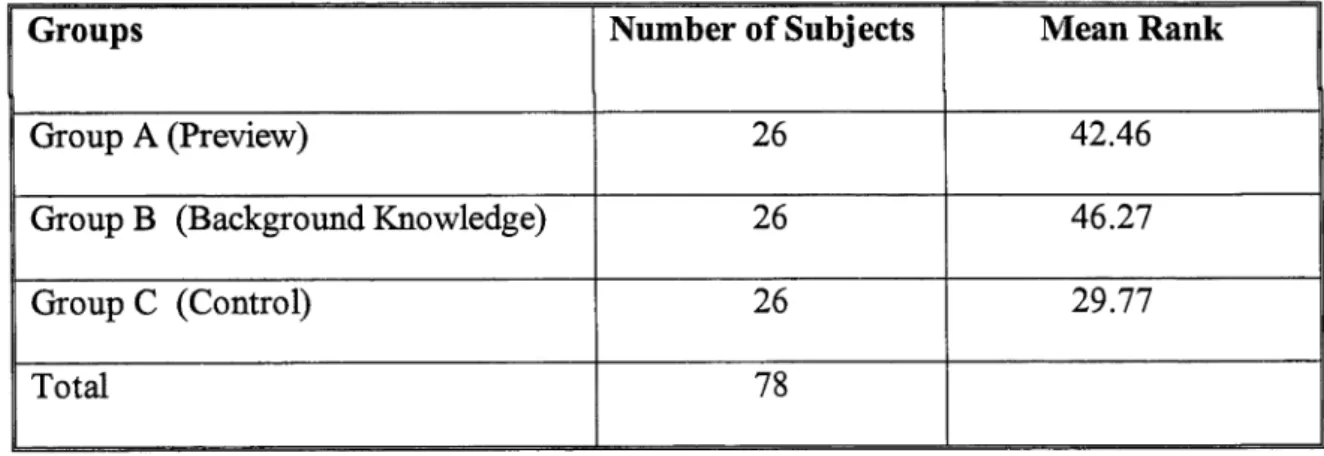
Table 4.1 The Mean Ranks of The Three Groups ( A, B & C) in Test 1... 54
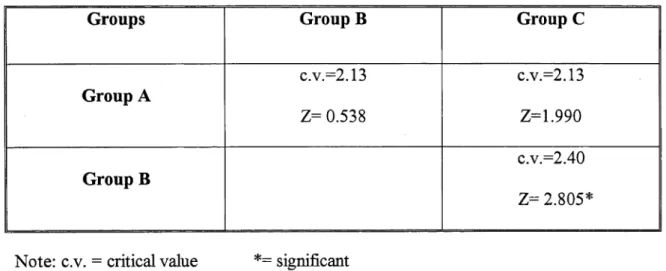
Table 4.2 Ryan Procedure: Comparison of Critical Values and Z Values of
the Three Groups in Test 1...55
Table 4.3 The Mean Ranks of the Three Groups ( A, B & C ) in Test 2 ... 57
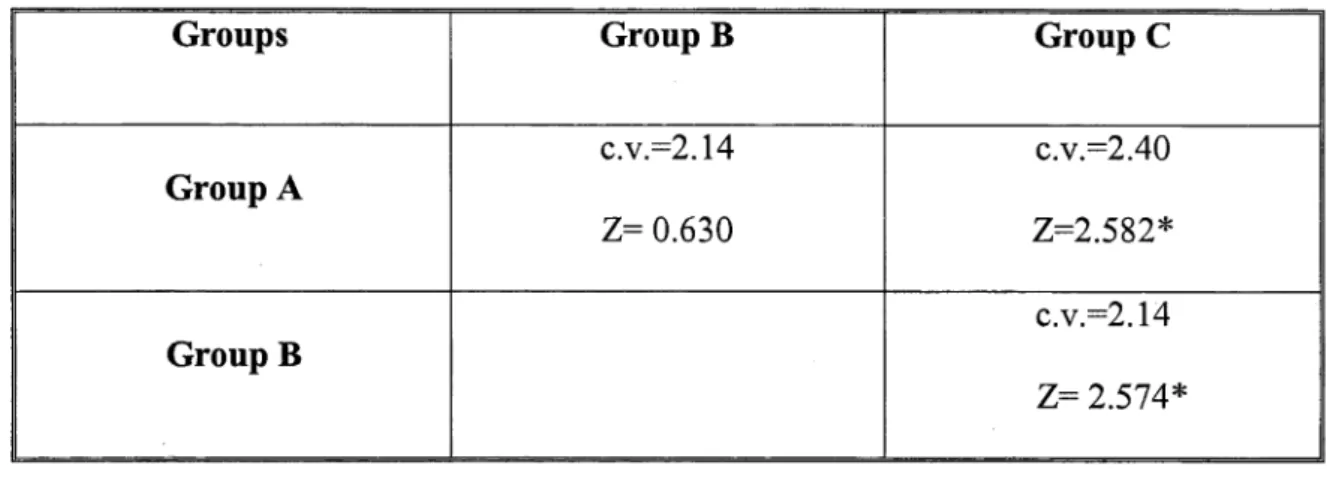
Table 4.4 Ryan Procedure: Comparison of Critical Values and Z Values
of the Three Groups in Test 2...58
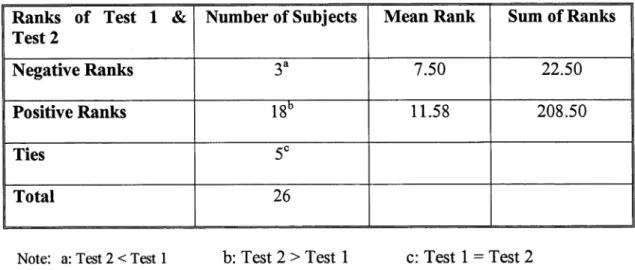
Table 4.5 Comparison of the Students' Performance in Group A (Preview) in
Test 1 and Test 2 ... 59
Table 4.6 Comparison of the Students' Performance in Group B ( Background
Knowledge) in Test 1 and Test 2... 61
Table 4.7 Comparison of the Students' Performance in Group C in Test 1 and
List of Figures
Figure 1.1 A Possible Representation of the Chinese Candy-Buying Schema... 12
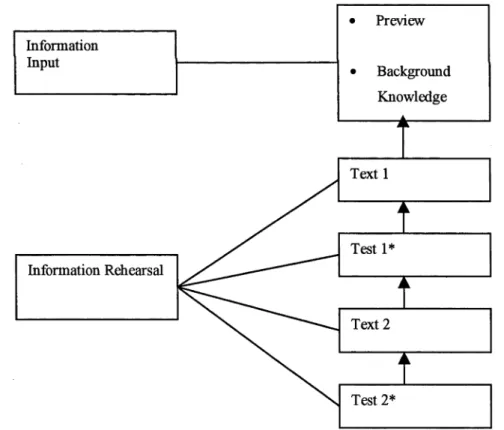
Figure 3.1 Four Information Rehearsal Processes Provide Access Routes to
Information Input... 33
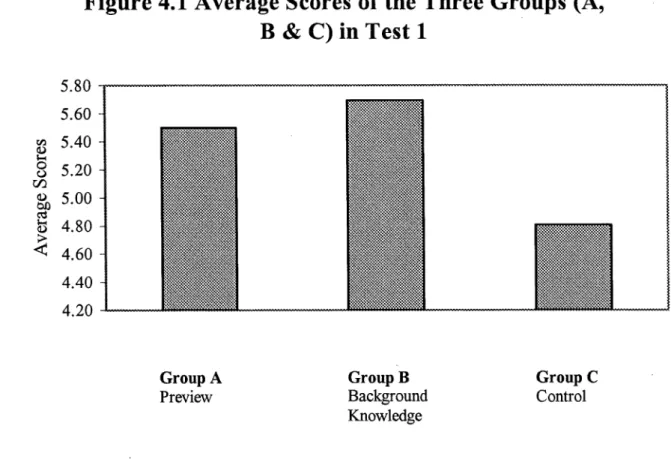
Figure 4.1 Average Scores of the Three Groups (A, B & C) in Test 1... 53
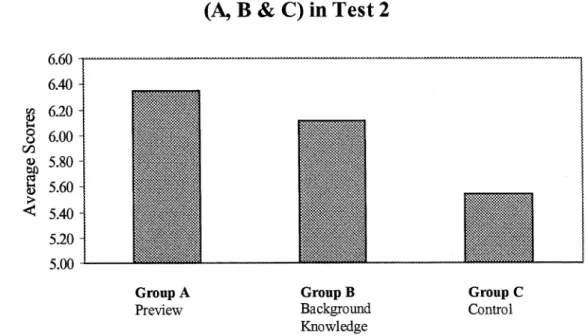
Figure 4.2 Average Scores of the Three Groups (A, B & C) in Test 2 ... 56
Figure 4.3 Average Scores of Group A ( Preview ) in Test 1 and Test 2 ... 60
INTRODUCTION
Students o f English as a foreign language experience considerable difficulty in
comprehending English texts. One reason for this is that texts sometimes contain
unfamiliar concepts or culture-specific elements (Tagliber, Johnson & Yarbrough,
1988). According to Fillmore (1997:45), writers generally assume a level o f prior
knowledge and cultural and real world experience when they write, depending on the
background o f the readers o f their texts. It is difficult though for readers, especially for
English Second language/ English Foreign Language readers, to comprehend materials
that presuppose cultural background knowledge, and experiences that they do not
already have. The following empirical research will give you a glimpse o f the
difficulties that ESL readers at different proficiency levels encounter when they are
reading materials which require cultural schemata or expertise.
The research between the 1970s and 1990s on differences in culture or expertise
reviewed here usually involves two groups o f readers who read two passages on two
topics, each o f which is familiar to one group but unfamiliar to the other. These studies
have reported strong effects o f background knowledge on reading comprehension.
Anderson et al. (1977) used two passages of about 145 words each. Each
passage could be given at least two distinct interpretations. One passage could be
interpreted as being about either a convict planning his escape or a wrestler trying to
break the hold o f an opponent. The other passage could be interpreted as being about
passages were given to subjects from the physical education department and to subjects
from the music department. The results indicated that the interpretation which people
give to a message is influenced by their backgrounds. In discussing the implications of
schema theory, Anderson et al. (1977: 378) state: "It may turn out that many problems
in reading comprehension are traceable to deficits in knowledge rather than deficits in
linguistic skill."Thus, it appeal's that the readers may not have the schemata needed to
comprehend passages or they may have relevant schemata but do not know how to use
them in comprehension.
A study by Steffensen, Joag-Dev and Anderson (1979) did not use language
specifically as a variable, since the participants were American native English speakers
and Indians (natives o f India) whose English proficiency was very high. However, the
study addressed the issue o f cultural differences in background knowledge and how this
knowledge assists or interferes with comprehension. The researchers presented separate
letters about an American and an Indian wedding to university students whose native
culture was either American or Indian. They had the students read descriptions o f the
weddings. Since wedding customs differ in America and India, members o f both groups
read the descriptions from the other culture more slowly than the one from their own.
They not only remembered more details o f the weddings in their own culture and
remembered them more accurately, they were also able to draw correct inferences from
the description o f the weddings in their own culture. This suggests that readers make
use o f a wedding schema that is specific to their culture in interpreting the meaning o f a
Participants also often drew incorrect inferences from the description of the
wedding from the other culture, based on the wedding schema in their own culture. For
example, the description of the American wedding included a mention that the bride
wore her grandmother’s wedding gown. An Indian participant reported, in the recall
protocol, that the dress was unfortunately, old and out of fashion, a comment which
would fit the Indian view that it is important for the bride’s family to show their
economic status by providing a new, fashionable wedding sari for the bride to wear.
American readers, in contrast, emphasized the aspect of family tradition involved in the
bride wearing her grandmother’s dress, which fits with the schema for an American
wedding.
In addition, recall protocols were often vague in areas where the readers did not
have schemata. For example, the text on the Indian wedding contained details about the
gifts exchanged by the families. Indian respondents not only tended to remember what
the gifts were, they commented on the significance of the gifts. In contrast, recalls by
Americans o f the gifts exchanged were vague and did not include any information about
the significance o f the gifts.
This study is an indication that, even in the native language or a strong second
language, a reader’s knowledge o f the schematic background o f a text greatly aids
comprehension. In addition, lack o f an appropriate schema for a text hampers accurate
Johnson’s (1981) study investigated the effects o f text complexity and cultural
background on comprehension. She found that for second language readers, cultural
background had a greater effect on their ability to understand the text than did semantic
and syntactic complexity. Johnson had American participants and intermediate and
advanced Iranian participants read simplified or unsimplified versions o f two passages,
one based on American folklore and one on Iranian folklore. For Iranians, she found an
interaction between cultural background and language complexity for the total number
o f events recalled. Like the Iranians, Americans produced more inferences from the
culturally familiar story than the unfamiliar one.
The results o f this study indicate firstly that Iranian second language readers
make use o f domain-related schemata in their text comprehension, and secondly that
schemata are more important than language complexity in making inferences from the
text.
Carrell’s (1987) study involved 28 Muslim Arabs and 24 Catholic Hispanic ESL
students o f high-intermediate proficiency enrolled in an English program at a mid-
western university in America. Each student read two texts, one with Muslim-oriented
content and the other with Catholic-oriented content. After reading each text, the
subjects answered a series o f multiple-choice comprehension questions and were asked
to recall the text in writing. Analysis o f the recall protocols and scores on
comprehension and recall suggested that participants better comprehended and
Oed
iajW il\e r e U - K ° n t;p s are c^pm j th e d o ts U r o e K ö r .U M 1, ^owjalsfe; 4 S m ith , (^ o ) . There a re tw o, broacj -t-upes
of Schemed"^
C
Carrell
EiVterhold
[Qgl)'-
Content Cctamnt*
and (formal
$chemeeh>\. C on te nt sckem<atA,
wI
aapK Coirtaiflgeneral or SpecYf; c •ih'formpcfton on a. glren top^c, feme
't/Hfoujh reah Infe.
e t p t e n e t s .
formed secern
o4
aContain
i ^ r m ^ t . o r o.bouf
hoaj rh e to ric Ps o n g a n ^ e d and 6ome
^ rt?rh
d re Rnouvj|-e d ^ of d iffe r e n t "text -tape_r m d g e rye s,
Top do^on re fe rs t o th e m aking °f f feol I c/t i<>r\s about the
r rt bc0ed on
u/ori'd Rfto^yledge Schemata then c h e e k y
'' ^ te x t
C onfirm ation .
t ßoffo^- up refers T° tbe
decoolmcj of moliVi o^ua|
LUtt? C 6-^. p/donernest ftophemexy e/jorols) anol bculd1
' ^
textual ^e^h.Vg -from the smallest umts t* th e largest,
v
odd then rn o d I'fij mg
p re e x irt'n g background (iYwwIedjg
c u rre n t
pre cTct.'ons on basir ^f- Inform ation
An interesting study was earned out by Kang (1992). Kang’s study examined
how second language readers filter information from second language texts through
culture specific background knowledge. Korean graduate students with advanced
English profiency read stories and answered questions. A think-aloud protocol assessing
their understanding and inferences indicated an effect of culture specific schemata and
inferences upon text comprehension.
Although all the variables and factors surrounding the issues o f how culture
shapes background knowledge and influences reading are not fully understood, there is
agreement in these studies that background knowledge is important, and that content
schemata play an integral role in reading comprehension.
Overall, ESL readers appeared to have a higher level o f comprehension when
the content was familiar to them. Given this, second language readers who do not
possess the content schemata that writers of teaching materials of western countries
generally assume will experience comprehension frustration and difficulties.
The p^rpoS£ of -this «SVno/tj
T k ; s s t u c l ^
i a
KU b e a f i r s t
^
r e h e £ \ r s < x | i n t e r n e t s u A 'th b a c k g r o u n d
IpiiouMledge on E fL
Comprehension.
Y C S ^ r c hb^.s
Ipeen c
(K/r\id
ovArt b j
cUeva
Q r w e s UR°( S)
Pefmition of fcey Jeynas
1
o c K e f n o c t ^ C - t h e s f n g l e f o r m
15
S c h e m a ) «.ire p r e v ^ u c l y
^ c c j a i r e o i
l e d g e S t r u c t u r e s , r r a o l e u p ° i ‘
or u p l a c e h o l d e r s w C A n d e r s o n , R e y n o l d ^ S c h c d ^ r t &
Qoetz: (477). Sehe wort
include. informc\t<kn ubour
1
REVIEW OF THE LITERATURE
1.1 Introduction
As discussed previously, empirical studies substantiate that lack o f or
inability to make use o f cultural and expertise schemata can be sources o f problems in
ESL/ EFL reading comprehension. It is obvious that schemata hold much promise for
our understanding, especially as it occurs in a second or foreign language and culture.
Therefore, this chapter discusses different views of the reading process, schemata and
what specific functions schemata may serve, and the rationale behind the prereading
activities and information rehearsal.
First, I will describe how models o f the reading process have evolved recently
from passive, to active, to interactive. The interactive model o f reading includes the
psycholinguistic model o f reading, top-down and bottom-up model o f reading and
schema-theoretical model of reading. I then introduce schemata and illustrate the way in
which schemata function in reading comprehension. Finally, I describe the rationale
supporting two prereading activities—providing background knowledge and previewing
1.2 A Brief History of Models of Reading
As far back as 1932, Bartlett (cited in Carrell & Eisterhold 1983) is credited with
first proposing the concept o f schemata. He arrived at the concept from studies of
memory he conducted in which subjects read a story from an unfamiliar culture. Their
memory o f the story changed over time to fit the schemata of their own culture. He
suggested that memory takes the form of schemata which provide a mental framework
for understanding and remembering information. Yet, it was not until three decades
later that wider interest in Bartlett’s theories developed.
Since the 1970s, there has been a revival o f interest among psycholinguists and
scholars in Bartlett’s schema theory. One area in which schema theory has stimulated a
great deal o f interest is in the area o f reading. In the following section, I will explore
how models o f the reading processes have evolved recently from passive to active, to
interactive. What is meant by bottom-up and top-down processing? What are the
different senses in which the term ‘interactive’ is used to describe the ESL reading
process?
1.2.1 Reading as a Bottom-up Process
The models o f LaBerge and Samuels (1974) propose that reading is a process of
building symbols into words, words into sentences, and sentences into overall meaning
(1974: 34). The model reflects traditional attitudes toward reading, which are referred to
C^e p.q)
as a bottom-up process because the reader begins with the lowest level, features of
symbols, from which the symbols are identified (Gough 1972, cited in David and
Rivers 1964, LaBerge & Samuels 1974), second language reading is "a process of
building up a meaning for a text from the smallest units at the "bottom" (letters and
words) to large units at the "top" (phrases, clauses, intersentential linkages)" (Can-ell
1988a: 2). However, many studies (e.g. Stevens and Rumelhart 1975, Schank 1973)
show that lower level processes (identification o f words and letters) are influenced by
higher level processes (knowledge about the context) (Stanovich 1980: 34).
1.2.2 The Psycholinguistic Model o f Reading
Goodman’s psycholinguistic model o f reading (1970) was among the first to
spark the recent view o f reading as an interaction among different levels o f processing,
rather than a bottom-up process. It introduced the idea that reading, far from being
passive, is an active process, with emphasis on both, active and process. Goodman has
described reading as a "psycholinguistic guessing game," in which the "reader
reconstructs... a message which has been encoded by a writer as a graphic display." In
this model, the reader does not need to (and the efficient reader does not) use all o f the
textual cues. (Goodman, 1970: 111) The more able the reader is to make correct
predictions, the less confirming through the text is necessary (Goodman, 1970: 113).
According to Goodman, what happens "behind the eye" is as important as what is on the
printed page (Goodman, 1970: 113)
Smith (1971) has been another strong and influential proponent o f the
psycholinguistic model o f reading. He has emphasized the role o f what he refers to as
non-visual information. Smith characterizes the role o f non-visual information as
coming up in the text based on syntactic, semantic, and background information (Smith
1971: 65-67).
Although both Goodman and Smith do emphasize that what happens "behind the
eye" and non-visual information is as important as what is printed on the page, they do
not deal with schema theory directly (Carrell 1988a : 2-3).
According to Carrell and Eisterhold (1988:74), it was Coady who elaborated on
the psycholinguistic model o f reading (Coady 1979 cited in Carrell and Eisterhold). He
suggested a model in which the ESL reader’s background knowledge interacts with
conceptual abilities and process strategies to produce comprehension (Carrell and
Eisterhold 1988: 74). Coady emphasizes the role o f background knowledge in reading
comprehension.
7.2.3 The Bottom-up and Top-down Model o f Reading
Beginning with Rumelhart (1977), researchers have proposed interactive
models o f reading, arguing that lower-level and higher-level processes work together
interactively as parts of the reading process (Grabe 1988: 58).
Rumelhart’s interactive-activation model (1977) and Stanovich’s interactive-
compensatory model (1980) view reading as interactive, a combination o f top-down and
bottom-up processing. Top-down processing refers to the making o f predictions about
the text based on background and expectation then checking the text for confirmation.
Bottom-up processing refers to the decoding o f individual units (e.g. phonemes,
and then modifying preexisting background knowledge and current predictions on the
basis of information encountered in the text (Carrell 1988b : 101) . According to these
interactive models, the interactive processes o f reading, which allow processing at one
level (e.g. word perception) to interact with processing at another level (e. g. semantic
knowledge), are superior to either strictly bottom-up, decoding or strictly top-down,
predicting (Samuels and Kamil 1988: 27-31).
1.2.4 The Schema-Theoretical Model o f Reading
Anderson and Pearson (1988) introduced another type o f interactive model of
reading, namely a schema-theoretical model. They show how reading comprehension
involves the interaction between old and new information. They focus on “how the
reader’s schemata, or knowledge already stored in memory function in the process o f
interpreting new information and allowing it to enter and become a pail o f the
knowledge store” (1988: 37).
The schema-theoretical model of reading, along with the psycho linguistic and
interactive models o f reading, is an effective counterweight to bottom-up models of
reading. As Anderson (1984) has pointed out, schema theory has challenged our
thinking about issues such as how information in a text is assimilated, how inferences
are made, and how a text is remembered. The following sections will address schema
theory specifically and illustrate the way in which schemata function in providing
ideational scaffolding, default values, retrieving information in memory and allocating
1.3 Schema Theory
According to Anderson, Reynolds, Schallert, and Goetz (1977), schemata are
previously acquired knowledge structures, made up o f "slots" or "placeholders".
Schemata include information about constraints on what can fill a particular slot,
including default values to be used if the slot is not filled (Anderson, 1978), and what
the relationships are among the slots (Graesser, Woll, Kowalski, & Smith, 1980).
Schemata tell us what is essential, expected and possible in a certain situation (Van
Dijk, 1977). Schemata are arranged hierarchically from the most general to the most
specific information (Anderson, 1978).
There are two broad types o f schemata (Carrell & Eisterhold 1983): content
schemata and formal schemata. Content schemata, which contain general or specific
information on a given topic, come through real-life experiences. Formal schemata
contain information about how rhetoric is organized and come from the knowledge of
different text types and genres. The latter is not o f concern in this study, which focuses
only on the role o f content schemata in reading comprehension.
Although definition o f a schema is not consistent and may refer to a variety o f
different constructs, the various definitions have several points in common (see
Rumelhart & Ortony, 1977). Rumelhart and Ortony define a schema simply, as a
general knowledge structure used for understanding. Recently, Medin and Ross (1992)
clarified Rumelhart and Ortony’s ideas on schema in some detail:
facts are related. This structure is part of what allows a schema to be used for inferring. Fourth, a schema is used in comprehension. The structure of the schema is such that it includes how the knowledge is related in this type of situation, but it does not include information about any exact situation (Medin and Ross, 1992: 346-347).
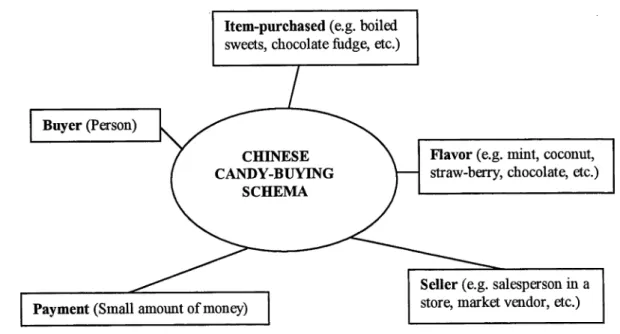
Figure 1.1 provides an illustrative example o f a schema for candy buying in
China. Although such a schema would contain all the knowledge about candy buying,
the figure presents only a simplified version. A schema is viewed as consisting o f a
frame that includes slots for particular information (Anderson and Pearson 1988: 43).
So, a candy-buying frame would have slots for the buyer, what kind o f candy was
purchased (e.g., both the form and the flavor), the seller, and the amount paid.
Understanding this typical candy buying situation "consists of filling in these slots"
(Anderson and Pearson 1988: 34). Although the schema for candy-buying would
include knowledge that someone buys some type o f candy, the schema is general and
would not contain the particular person or particular candy, as indicated below:
Figure 1.1: A Possible Representation of the Chinese Candy-Buying
Schema
CHINESE CANDY-BUYING
SCHEMA
Buyer (Person)
Payment (Small amount of money)
Flavor (e.g. mint, coconut,
straw-berry, chocolate, etc.)
Seller (e.g. salesperson in a
store, market vendor, etc.)
Item-purchased (e.g. boiled
1.3.1 The Functions o f Schemata in the Process o f Reading Comprehension
For the purpose o f my study, I am interested in the use o f content schemata in
the process o f reading comprehension. Schema theory holds that no text, either spoken
or written, carries meaning by itself; rather a text only provides directions for readers as
to how they should construct meaning from their own schema (Anderson, 1984:248).
Comprehension involves filling in a schema’s slots with particular information and
making inferences based on the information that is given and on information from the
schema (see Anderson & Pichert 1978). In the following sections, we will see various
ways in which schemata may function in achieving comprehension. They provide
"ideational scaffolding", make default inferences, allocate attention and retrieve
information from memory.
1.3.1.1 "Ideational Scaffolding"
A schema embodies a structural organization o f the information it represents. If
most text information fits into the slots within the schema, the text is readily
comprehended with little mental effort (Anderson, Spiro & Anderson 1978). In this
sense, the schema is a "scaffold" in aiding comprehension. I again use "the Chinese
candy-buying schema" to show how the ideational scaffolding functions to fill in the
slots with particular information when comprehension actually happens, and provide a
relevant text based on my diary.
about 160 bags. Each bag had boiled sweets, chocolate fudge etc. in a variety o f flavors, such as mint, coconut, chocolate. When she went through the checkout, the sales girl said that she hoped that "Double Happinesses’ would sweeten up her wedding and also her life.
The following analysis shows that most o f the information in the diary generally
fits in the candy-buying schema and provides readers with confidence to comprehend
the diary.
As mentioned above, the frame has at least five slots in a reader’s schema about
buying candy. When a reader reads the diary, the five slots in his/her schema about
buying candy can be "instantiated" (Anderson & Pearson 1988:42) with particular
information. For example, <the buyer> slot is filled by Huahua. Boiled sweets and
chocolate fudge are consistent with the <item-purchased>. ‘Double Happinesses’ is
obviously a well-known name of a candy for weddings in China. The mint, coconut and
chocolate fit with the slot <flavor>. The slot <payment> can be instantiated with $ 5.00.
When a schema is activated and used to interpret the diary, the slots are "
instantiated" for particular information, as shown above. In addition to filling in the
slots with particular' information, the slots contain restrictions about what information
can fill them (Anderson 1978). For example, in the candy-buying schema, it is not
permissible to have the<buyer> slot filled by "mint" or to have the candy flavor filled
by "Huahua."
From the above example, we can see how a schema functions in providing
ideational scaffolding for understanding the diary passage by understanding appropriate
slots and filling in the slots with the details o f the particular information. Since most of
can easily draw the conclusion that the diary entry is probably about candy-buying
rather than an advertisement for ‘Double Happinesses’.
1,3.1.2 Default Values
A schema also contains default values for each slot (Minsky 1975). If a text fails
to mention some piece of information, the reader fills the slot with a value that he/she
knows to be typical in the slot (Minsky 1975). For example, if a reader reads, when she
went through the checkout, the salesgirl said that she hoped that ‘Double Happinesses ’
would sweeten up her wedding and also her life. A reader can assume that she paid for
the candy (a default value) rather than stole it. The writer does not mention the
procedure o f paying money at the checkout, but a reader can infer that there was a
procedure o f paying money involved. In this way, a reader's schema can provide the
basis for making inferences that go beyond the literally stated information to complete
the meaning of the text.
1.3.1.3 Allocation o f Attention.
Schemata used in selective attention have been defined as guiding readers’
deliberate decisions and actions designed to focus cognitive resources on certain kinds
o f information in a text in order to comprehend and remember them (Wilson &
Anderson 1986:35)
According to Mayer (1989: 46), meaningful learning depends on three basic
processes: selecting, organizing, and integrating information. The first process,
attention on the information on learners' understanding o f a target passage. The second
process, organizing, involves arranging the units o f selected information into a coherent
mental structure. Mayer (1989: 47) refers to this step as "building internal connections"
or constructing logical relations between ideas in the text. The third process, integrating,
involves connecting the coherently organized information to existing cognitive
structures. This process is also referred to as "building external connections" because it
entails linking information from the text to information that is external to the text but
internal to the reader (Mayer, 1989: 46). The more elaborate and rich the internal and
external connections between units of information, the more available and accessible
the information is for later use (Prawat, 1989: 6-7).
1.3.1.4 Orderly Searches o f Memory
In addition to the important role that schemata play in providing ideational
scaffolding, default value and guiding readers for allocating cognitive resources, "
schemata are assumed to be the guiding forces behind remembering as well" (Rumelhart
1980: 49). A schema has slots for certain types o f information. When the text contains
certain types o f omission, a schema can guide readers to seek the information that needs
to be recalled to function as orderly searches of memory while they are reading
(Anderson & Pichert 1978).
The following personal example illustrates how a schema functions in retrieving
information. Some time ago, I attempted to find an article which I had already read in
the library. I needed to instigate a search. However, in this case, the search was not
random. It was guided by schemata that represented the layout o f the library. Knowing
to find it. Note that the location of this journal was not my goal in the memory search
for the article. When I found the journal, I used my knowledge of its structure to guide
me to the appropriate location of that particular article in the journal. This example
illustrates the search paths through memory while trying to recollect information after a
long delay.
1.3.1.5 Summary
As discussed previously, the analysis o f "my diary" given earlier illustrates
generally how the two functions o f schema are supposed to operate. With the help of
ideational scaffolding, a reader can have confidence in comprehending the text with
little mental effort. With the help o f default value, a reader can comprehend questions
after the text is read, even when the required information is not presented as input
explicitly in the text. In this way, in providing ideational scaffolding and default value, a
schema can be used as a solution to the problems of inferencing in comprehension.
M ayer’s (1989) three basic processes of learning indicate that readers can select the
important information relevant to the text. The analysis o f "search paths o f an article"
illustrates how schemata function in retrieval o f information.
1.4 The Rationale of Prereading Activities and Information Rehearsal
Given the role of schemata in helping readers to comprehend and remember
what they have read, then the question is: "can we bridge the gap between the text
content and the reader’s lack of schemata by providing prereading activities'?" The
empirical research in the following chapter provides an affirmative answer to this
sections engage this question. My discussion focuses on the rationale o f two prereading
activities—providing background knowledge and previewing in both LI and L2 reading.
In addition, according to Craik and Lockhart (1972), information rehearsal is considered
important in substantial long-term memory o f previously acquired knowledge. Thus, the
value o f using information rehearsal will also be discussed.
1.4.1 The Rationale o f Background Knowledge
According to Chun and Plass (1997: 68), schema theory for L2 reading has
been investigated extensively and appears to be a very useful notion for describing how
prior knowledge is integrated in memory and used in higher-level comprehension
processes (1997: 68). The theory provides a strong rationale for providing background
knowledge. Background Knowledge is used to aid comprehension and is supported by
two cognitive theories; e.g. advance organizers and Langer’s Prep ( Pre Reading Plan)
and some additional conclusions based on empirical research.
1. Advance organizers (Ausubel 1960) emphasize the relationship between
existing cognitive structures and new learning. There are two kinds o f advance
organizers. Expository organizers provide a basic concept "at the highest level of
abstraction" (Ausubel 1960: 252), that is the scaffolding (as discussed earlier p.13)
which enables learners to relate new knowledge to what they already know, thus
assimilating new information. Comparative organizers are used most with relatively
familiar material. They are designed to discriminate between old and new concepts in
order to prevent any confusion which may be caused by similarity. These two kinds o f
advance organizers may be presented as a prereading activity in various ways
Organizers may include: a 200-500 word prose passage, a graphic presentation, a
thematic organizer in the form o f a picture, or a slide-verbal presentation. Advance
organizers provide students with a framework for understanding new material. The
background knowledge is not written at a higher level o f abstraction than the new
materials and this provides students with an organizational framework for
comprehending a text.
2. Another applicable theory which lends support to the use o f background
knowledge is Langer’s (1980) PreP (Pre Reading Plan). In the PreP, teachers create a
condition that allows students to draw upon what they already know about a topic, and
group discussion encourages students to reflect upon the appropriateness o f their ideas
in relation to a specific reading task. In this view, from background knowledge readers
can select key words strongly associated with conceptual and culture-specific
knowledge that is central to the understanding o f the text to be read.
3. Pearson, Hansen, and Gordon (1979) generalize based on their findings (see
empirical studies in Chapter Two) that students who have better developed background
knowledge for a particular topic will understand and remember more than those with
weaker background knowledge. Hayes and Tierney (1982) found that presenting
background information related to the topic helped readers learn from the text regardless
o f how that background information was presented on how specific or general it was.
Taglieber et al. (1988) note that providing background knowledge is a device for bridging
the gap between the text’s content and the reader’s schemata. Their conclusion is
significant for reading materials containing "culture-specific elements which can not be
notion o f comprehension as a process of integrating new information with preexisting
schemata (Chen & Grave 1995: 665).
1.4.2 The Rationale for Using Previewing
Providing a preview as a prereading activity recognizes the different
background knowledge that will influence how students read and learn from a text.
Previewing can promote students’ engagement and interest to anticipate the text.
Previewing is used to aid comprehension and is supported by two theoretical concepts
which account for facilitating effects o f previewing: e.g. compensatory effects o f top-
down strategies, and Mayer’s ‘aids’ (1989) for text comprehension and some additional
arguments based on empirical research.
1. Stanovich’s (1980) interactive-compensatory model (see the discussion in this
Chapter P. 9) lends support to the value of previewing. According to this model, reading
is an interactive process in which readers may also try to compensate for deficiencies at
one level, e.g., word recognition, by relying more on a source at a lower or higher, e.g.,
contextual knowledge (Stanovich, 1980: 32). Therefore, providing readers with top-
down semantic and structural information they may not acquire from their bottom-up
processing o f the text is important.
2. Another applicable theoretical construct is Mayer’s (1989) ‘aids’ for text
comprehension. According to Mayer (1989: 46), an ‘aid’ for text comprehension is
intended to support the reader’s building of internal connections among the units o f the
information presented, for example, organizing the presented information into a
previews can help readers create and remember an interpretation of a text by providing
them with a summary related to the target text before they read.
3. Additional arguments have been made for the use o f previewing by Graves et
al. (1983), McCormick (1989), Dole et al. (1991) and Chen and Graves (1995). Graves
et al. (1983) note that previews can give readers a brief description o f the story’s theme
which helps them to understand characters, setting and point o f view. McCormick
(1989) argues that previews aid students in their reading by providing a purpose-setting
question or directions for reading. Dole et al. (1991) maintain that previews can
motivate students to make connections between topics to be read and their own
experience. They also argue that a preview is helpful because it can focus students’
attention on only global information. Chen and Graves (1995) note that preview can
help students build their knowledge about a story before they read it. Complicated
settings, events, or characters can lead to a difficult reading for students. Therefore, the
story preview can give readers this information in a framework to understand the
characters and events at the text level and beyond.
1.4.3 The Role o f Information Rehearsal
Among the four functions o f the schemata in reading comprehension stated
earlier (pp.13-17), the function of retrieval o f information is determined by the level at
which information is rehearsed (Craik and Lockhart 1972). According to Craik and
Lockhart (1972: 679), deep, semantic rehearsal is associated with higher retention of
information input. Retention is viewed as a function o f the extent to which the
information input then, could be said to depend on the richness with which they are
elaborated. (McDaniel 1984: 47)
Information Rehearsal has been identified as the central mechanism by which
information is transferred from a transient short-term store to a more permanent long
term memory and also has been formally defined simply in terms of repetition (Waugh
& Norman 1968; Atkinson & Shiffrin, 1968;). More recently, theorists have broadened
the scope o f the term "rehearsal" to "encompass more than just rote repetition" (Dark &
Loftus 1976: 480). "Rehearsal can be applied as a label to any active processing that
keeps information available in consciousness such that the information can be
accurately recalled at any time during which it is being rehearsed." (Dark & Loftus
1976:480)
The power of rehearsal, characterized in this way, has been demonstrated in
several studies on delayed comprehension (Bransford and Johnson 1972; Gemsbacher
1990). These studies indicate that allowing overt repetition leads to better performance
on a delayed comprehension test than does preventing rehearsal. Thus, there is support
for the concept o f information rehearsal as a mechanism that results in transfer o f
2
REVIEW OF EMPIRICAL STUDIES
2.1 Introduction
The rationale behind prereading activities has been discussed prevously.
Prereading activities are used to help readers, particularly ESL readers, to build up their
store o f culture and background knowledge. This chapter reviews empirical research
providing insight into how prereading activities enable ESL readers to minimize reading
difficulties and maximize comprehension. Towards the end of this chapter, I outline the
puipose o f my research based on the latest research o f Chen and Graves (1995) and
similar research.
2.2 Studies on Providing Prereading Activities which Facilitate ESL Readers’
Comprehension.
Research between the 1980s and 1990s on prereading activities usually
involved examining the readers’ knowledge by either providing or not providing a
background picture, a title, or a perspective for subjects when a text required culture-
Hudson (1982) looked at the effects o f different prereading exercises intended to
activate schemata on reading performance o f beginning, intermediate and advanced
students, primarily Iranians. In one condition, students were shown pictures related to
the text, which they discussed. Afterwards, students privately generated predictions
about the content o f the text. In a second condition, students were given a list of
vocabulary words and definitions. Both o f these groups answered questions about the
content o f the text. In a third condition, students read the text, answered questions about
it, read the text again, and answered the same questions again. Scores were significantly
higher for the first condition for beginning and intermediate students. There was no
difference for advanced students. Hudson inteipreted this to indicate that advanced
readers were able to activate schemata without help, but at the lower levels, some help
in activating schemata was necessary. This study indicates that prereading exercises are
o f some use to beginning and intermediate students.
CarrelTs study (1983) investigated three components o f background knowledge
using three groups o f subjects from different cultural backgrounds: a group of
undergraduate students who were native speakers o f English, a group o f EFL students
and a group of ESL students both o f different backgrounds. The three separate
components o f background knowledge tested were: context (the presence o f a title and a
picture page preceding the passage); transparency (the presence o f concrete lexical
items within the text which provide textual cues to the content area o f the text); and
familiarity (the presence within the reader o f prior knowledge or experience o f the
content o f the text). Subjects were assigned to one o f the four conditions: context-
transparent, context-opaque, no context-transparent and no context-opaque. Each
subject was asked to read and recall two passages which occurred in two versions: one
was affected by all three components whereas that was not the case for non-native
readers. Carrell concluded that native speakers make use o f contextual cues to do top-
down processing, and that, at least in short term memory, novel information is more
memorable. The non-native speakers in CarrelTs study, on the other hand, were not
particularly proficient at either top-down or bottom-up processing. This brings up a
problem in doing schema research with non-native speakers. The results indicate that
second language readers have not made use of schemata that they have, or that they
have activated an inappropriate schema.
Taglieber et al. (1988) had a group of EFL Brazilian students read four different
reading passages and answer an 8-item open-ended test and a 10-item multiple choice
test. All subjects received all four treatments which consisted o f three different
prereading activities: pictorial context, vocabulary pre-teaching and pre-questioning.
There was also a control condition in which there was no prereading activity. As was
hypothesized, subjects’ comprehension scores were found to be higher when the reading
was preceded by one o f the prereading activities than when it was not. In addition,
vocabulary preteaching was found to be less effective than the two other prereading
activities.
Chen and Graves (1995) investigated the effects o f previewing and providing
background knowledge necessary for Taiwanese college students’ comprehension of
American short stories, and at the same time investigated the effects o f attitude
questionnaires. In this study, 243 non-English major freshmen were randomly assigned
to one o f four treatment groups and read two short stories. Before reading each story,
one group listened to a 200-word preview, a second group listened to a 200-word
and background knowledge presentation. The fourth group read each story without any
prereading assistance. Results showed stronger positive effects o f providing preview
and combined treatments and weaker positive effects of the background knowledge
treatments. Students’ responses to a semantic differential and an open-ended attitude
question showed that they responded positively to all experimental treatments.
In short, it is by pre-reading activities that readers, particularly ESL readers
build up their store o f cultural and background knowledge. Perhaps this is how most
ESL learners eventually master English, and also come to have the kind o f cultural
background and schemata (Rumelhart, 1980) that writers assume readers have to
interpret their writings.
2.3 Research on Prereading Activities and LI and L2 Readers
Research on LI reading comprehension suggests that prereading activities can
be used to provide necessary background knowledge for particular reading tasks (Dole,
Valencia, Greer, & Wardrop, 1991). Prereading activities may help students process
reading tasks with more meaningful anticipation and cognitive readiness than had the
prereading preparation not occurred (Langer 1980: 151).
For L2 students, Carrell (1983) suggests that teachers can use prereading
activities such as text previewing, pre-teaching unfamiliar vocabulary, and providing
prereading questions. And also the results o f Chen and Graves (1995) make a strong
argument that providing preview and background knowledge both have a positive effect
In order to be able to build on Chen and Graves’ (1995) research, my further
discussion will focus on the two prereading activities—providing background
knowledge and previewing used in both LI and L2 research. First, I will review
research on background knowledge in LI and L2, and then preview in LI and L2.
2.3. J Research on Background Knowledge in LI and L2
Pichert and Anderson (1977) had readers pretend they were either burglars or
homebuyers before reading about what two boys did at one o f the boys’ homes while
skipping school. This study found that when reading the text, readers focused more on
the information relevant to their assigned roles. For example, pretend burglars were
more likely to learn that three 10-speed bikes were locked in the garage, and that there
were collections o f coins and paintings. Pretend homebuyers were more likely to learn
about the wall to wall carpeting and spiral staircase. Anderson and Pichert (1978)
carried this research further by asking readers to switch perspectives after their first
attempt to recall. Subjects were able to recall previously unrecalled information
important to their new perspective, but unimportant to their old perspective. Anderson,
Pichert, and Shirey (1983) replicated these findings and discovered there was still an
effect for the perspective shift even when the task was carried out two weeks after the
initial reading. Anderson et al. (1983) concluded that a schema influences learning and
memory when activated before reading, and retrieval when accessed after reading.
Birkmire (1985) had music and engineering students read three passages, one
about canaries, one about music, and one about engineering. For both groups of
subjects, the canary passage contained highly familiar' information. For the music
the engineering passage was unfamiliar; the opposite was true for the engineering
students. Birkmire found the music students spent less time in comprehending the
passages on music and the canary than the passage on engineering; the opposite was
true for the engineering students. This finding suggests that when prior knowledge is
consistent with the target text, comprehension is easier.
Pearson, Hansen and Gordon (1979) tested the comprehension o f second grade
children with high and low knowledge on a passage about spiders. The children differed
on spider knowledge but not on IQ and achievement test scores. Both explicit and
implicit questions were asked to assess comprehension. The high-knowledge group
performed significantly better overall, mainly due to their ability to answer the implicit
questions. This finding suggests that comprehension requiring integration o f text and
world knowledge may be especially facilitated by strong knowledge o f domain content.
Johnson (1982) compared ESL students’ recall on a reading passage on
Halloween. ESL students at the university level from 23 countries read a passage on the
topic o f Halloween. Before they read the passage, Johnson involved them in a
Halloween celebration. Results o f recall protocols suggested that the subjects’
experience o f the Halloween celebration prepared them for comprehension o f the more
unfamiliar information about Halloween in the passage.
2.3.2 Review o f Preview Research in L I and L2 Readers
Previewing is another prereading activity used to provide introductory
information about the content o f an upcoming text. Almost 20 years ago, Graves
provide students with essential background information that they needed to understand
new materials. Two separate experiments (Graves & Cooke, 1980; Graves, Cooke &
LaBerge, 1983) involving upper elementary, junior high, and senior high school
students yielded significant results for both high and low skilled readers as measured by
explicit and implicit multiple-choice questions, story recall, or short answer
comprehension questions. Although these narrative previews involved more than
general knowledge, their results suggest that increasing a student’s knowledge may be
an important step toward improved comprehension. The effects o f previewing
expository texts were further investigated by McCormick (1989) and Dole et al. (1991).
The results o f these studies show that previews can be effective with narrative as well as
expository texts, and with easier as well as more difficult material.
The studies reviewed above all investigated the effect o f previews on LI
readers’ comprehension o f English. Raman (1990 cited in Chen and Graves 1995)
investigated the effects of previewing for difficult short stories on Malaysia University
first year students’ comprehension. The results show students who received the preview
treatment comprehended significantly better than the control group who did not receive
preview.
Over five years later, the effects of previewing an American short story were
further investigated by Chen and Graves (1995) with Taiwanese college students. The
results by Chen and Grave showed that previewing is the more effective treatment
compared to providing background knowledge, and the combined treatment, thus,
2.4 The Research Questions
Previous research suggests that providing both previewing and background
knowledge is effective for both LI and L2 readers. The latest research o f Chen and
Graves ( 1995) shows that previewing was significantly superior to background
knowledge in helping Taiwanese College students’ understanding o f an American short
story. However, no comparable research has been carried out to examine whether
preview and background knowledge differ in their effectiveness for promoting
comprehension in other text types. Also, so far, no research has been done on the long
term effect o f prereading activities. It is expected that information rehearsal will enrich
preview and background knowledge and in turn contribute to delayed effect o f preview
and background knowledge. Therefore, this study will be a first attempt to investigate
how information rehearsal interacts with preview and background knowledge on EFL
reading comprehension. Specifically, my research questions are:
1. Is previewing superior to background knowledge for a text type other than narrative ?
2. Does information rehearsal enrich prereading activities so as to enhance the efficacy
o f preview and background knowledge?
3. Is the facilitative effect o f schemata on reading comprehension increased when
3
METHODOLOGY OF THE STUDY
3.1 Introduction
This chapter outlines the research design and methods which guided this study.
The research methods presented in the chapter are divided into three parts. In the first
part, the instrument is discussed, which includes reading selection, treatment and
testing. In the second pail, I discuss data collection, including selection o f participants,
and the procedure o f data collection. In the third pail, the approach to data analysis is
discussed, including scoring and choosing statistics.
3.2 Research Design
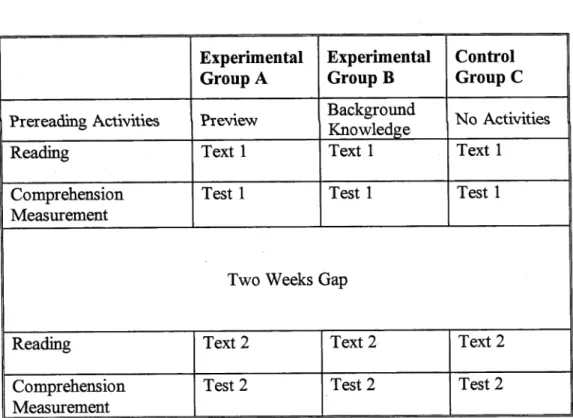
In this study, I used randomized experimental, control groups and immediate
and delayed post test design as set out schematically in Table 3.1.
By "randomized experimental, control" groups, I mean I randomly selected and
grouped 26 students from each of three intact classes into 3 groups (A, B & C). Groups
A and B were experimental groups; Group C was a control group. The two experimental
groups received prereading treatments before the first test, (experimental group A