Title page
Article Title:
A virtual reality collaborative planning simulator and its method for three machines in a fully mechanized coal-mining faceAuthors:
XIE Jiachenga,YANG Zhaojiana,WANG Xuewena,Zeng Quanrenb,LI Juanlia,LI Boa Author affiliations:a. College of Mechanical Engineering, Key Laboratory of Fully Mechanized Coal Mining Equipment, Taiyuan University of Technology, Shanxi 030024,China;
b. Department of Design, Manufacture and Engineering Management, University of Strathclyde, Glasgow, UK
Corresponding author name:
YANG Zhao-jianAffiliation:
College of Mechanical Engineering, Key Laboratory of Fully Mechanized Coal Mining Equipment, Taiyuan
University of Technology, Shanxi 030024,China
Detailed permanent address:
No.216 mailbox, HuYu Campus, Taiyuan University of Technology, No.18, Xin KuangYuan Road, TaiYuan, ShanXi
Province, P. R. China
Email address
:
[email protected];[email protected]Telephone number:
86-15333014310;86-03516010414Acknowledgements
This work is supported by Shanxi Postgraduate Education Innovation Project(No. 2017BY046), Shanxi Scholarship
Council of China(No.2016-043), Program for the Outstanding Innovative Teams of Higher Learning Institutions of
Shanxi (No.2014), Shanxi Province Scholars Scientific and Technological Activities Preferred Funding Project
A virtual reality collaborative planning simulator and its method for three machines
in a fully mechanized coal-mining face
Abstract: The existing automatic control program and its parameters for three machines in a fully mechanized coalmining face are static and simplex and are therefore inadequate for satisfying the complex and dynamic environment of underground coal mines. To overcome this problem, a collaborative mathematical model is
established that includes the effects of a dynamic environment. A virtual reality collaborative planning simulator with methods for the three machines is also proposed based on a multi-agent system (MAS). According to the
dynamic characteristics of the environment, equipment and technologies, a fully mechanized Unity3D simulator (FMUnitySim) is designed in terms of multiple factors and multiple dimensions. The factors affecting the coordinated operation of the three machines are analyzed and modeled. The communication modes, coordination,
and redundant sensing process among multiple agents, which include the shearer agent and the scraper conveyor agent, are also investigated in detail. Using this system, the key parameters of the three machines can be planned and
adjusted online to design and distinctly observe the corresponding collaborative simulations of coordinated operation with multiple perspectives and in real time. Tests of different maximum shearer haulage speeds for regular or reverse transporting coal are designed; their key parameters, including the average shearer haulage speed, average follower
distance, and average scraper conveyor load, are planned and simulated using FMUnitySim. The optimal parameter combination is obtained by analyzing and comparing the simulation results. The proposed FMUnitySim offers an
effective means and theoretical basis for the rapid planning and safe automatic production of a fully mechanized coalmining face.
Keywords: Three machines in a fully mechanized coal-mining face; Virtual planning; Collaborative mathematical model; Multi-agent system; Parameter matching; Unity3D
List of symbols
Aarea Maximum cross-sectional area to
transport coal for the scraper conveyor
A(t) Cross-sectional area to transport coal
for the scraper conveyor at moment t
normal
B Critical value of the roof broken degree
) (i
Bzj Corresponding roof broken degree of
hydraulic support No. i
Ddrum Drum diameter of the shearer
Dfollow Follower distance
Dzbc Middle trough width of the scraper
conveyor
f1 Running resistance coefficient of the
scraper chain
f2 Running resistance coefficient of coal
)) ( (S t
f r Cutting height of the rear drum at the
position of Sr(t)
Hc Machine height of the shearer
Hdown Length of the retracting columns
Hrise Length of the rising columns
Hu(i) Corresponding mine height of middle
trough No. i
) (m
Hzj Height of hydraulic support No. m
Imotor Virtual electric current of the virtual shearer
J Cutting depth of the shearer
Kg Capacity decline coefficient of the
scarper conveyor due to poor operating conditions
L Length of the working face (m)
l Distance of the cutting position and
unloading position
Lgbj Running distance of the shearer from
moment t1 to moment t2
LJiTou Distance from the front drum to the unloading point of the shearer
LJiShen Distance from the left drum hinge point to the right drum hinge point for the
shearer
Lwan Distance from the start point of the
Ly Length of the shearer rocker arm
) (t
mfront Cutting amount of the front drum from
the beginning to moment t
) (t
mInsfront Instantaneous coal cutting amount of
the front drum at moment t
) (t
mInsrear Instantaneous coal cutting amount of
the rear drum at moment t
(t
mInstransport Instantaneous amount of shipped coal
) (t
mrear Coal cutting amount of the rear drum
from the beginning to moment t
mtotaltransport Total cutting amount of the shearer
from the beginning to moment t
msudd Mutation load of the scraper conveyor caused by the collapse of the coal wall
N Serial number of the advancing
hydraulic support
broken
n Influence parameter of the broken roof
condition
n Influence parameter of the equipment
working condition
hy
n Influence parameter of the action mode
press
n Influence parameter of the mine
pressure
Nmotor Motor load of the scraper conveyor
normal
P Critical value of the roof pressure for
the hydraulic support
) (i
Pzj Corresponding roof pressure value of
hydraulic support No. i
permit
Q Maximum permitted power of
transporting coal
q0 Scraper chain weight per meter (kg/m)
)
(
t
q
Mine stream amount of the currentmiddle trough per meter )
(t
Q Total load of the scraper conveyor from
the beginning to moment t )
(t
QIns Scraper conveyor load at moment t
S (t) Shearer fuselage position at moment t
Sf(t) Front drum position at moment t
Sr(t) Rear drum position at moment t
) (m
Szj Position of hydraulic support No. m
) (m
Stuiyi Elongation length of the advancing
units for hydraulic support No. m
l r
S Action area of the columns
l d
S Action area of the advancing units
)
(m
state State of hydraulic support No. m
t0 Running start moment of the shearer
t1 Moment when the front drum begins to
cut coal
t2 Moment when the scraper conveyor
begins to transport coal shipped out
t3 Moment when the rear drum begins to
cut coal
move norm
t Action time of the hydraulic support
Vo Relative speed from Vc to Vg
Vg Scraper conveyor chain speed
Vc Shearer haulage speed
Vy Advancing speed of the hydraulic
support
YiJiaFa-ngShi
Current advancing mode of the hydraulic support
X(i) Corresponding X coordinate of middle
trough No. i
η Transmission mechanism efficiency of
the scraper conveyor
β Dip degree of the coal seam (degrees)
) (t S
Relative angle of the front drum to the
fuselage at the position of S (t)
) (t S r
Relative angle of the rear drum to the
fuselage at the position of S (t)
Density of solid coal
Density of bulk coal
Divisor of (Sr(t)- Sr(t3))/Dzbc
Remainder of (Sr(t)- Sr(t3)) %Dzbc)
(m
Flap angle of hydraulic support No. m
1. Introduction
With the advent of "Industrial 4.0" and "Internet Plus", fully mechanized mining equipment has
developed from the traditional manual control stage to the electro-hydraulic control stage with hydraulic
support and finally to the intelligent collaborative control stage[1]. In certain well-conditioned coal mines, fully mechanized mining equipment with
intelligent collaborative control has been shown to reduce the labor intensity of coal miners and to
improve the efficiency of coal production[2]. However, because of the static and simplex nature of
soild
ispersion d
setting parameters in the existing collaborative control program of the three machines, intelligent
collaborative control, which is prone to unknown problems, cannot adapt to the complex environment and become the main production mode of coal mining
[3].
To improve this situation, the three machines
must be adaptive to the dynamic environment and have a “life form”, which includes abilities such as self-perception, self-decision and self-adaptation.
Based on this concept, several scholars have introduced the idea of "mining robots", which is
considered the mainstream research direction for unmanned coal mining [4-5]. With the introduction of a multi-agent system (MAS) to the field of three
machines in a fully mechanized coalmining face, Fan established the three-machine task planning model
and simulated a three-machine operation with the Generalized Partial Global Planning(GPGP) theory. However, Fan did not achieve the expected results
because of the singularity of the model and his assumptions of an ideal environment [6].A complex
and reliable mathematical model that can portray real-life situations is the basis of simulation and planning. However, the current main stream planning
and simulation process is too abstract for general engineering personnel to implement. If the simulation
process is visualized and the whole planning process is displayed in a more realistic manner, then the software’s versatility and digital design ability will be
greatly improved.
Virtual reality (VR) technology has been rapidly
developing in recent years and, if combined with planning technology, shows great potential for visualizing the entire planning process. Widely used
VR software for planning include OpenGL, Unreal, and Unity3D. These software programs are used to
construct 3D simulation environments, such as OpenSim [7], V-REP [8], Delta3D [9], USARDim [10] and Gazebo [11]. Among them, Unity3D has received
particular attention because of its advantages in visual interface, multi-platform release, and shielding of its
underlying code. With Unity3D, WonsilLee [12] created a simulation of a room with Internet of Things
(IoT), where virtual sensors were added to simulate the interaction between people and the indoor
environment. The MAS theory was used in another
application of Unity3D. Christian Hu [13] established a 3D visualization environment of an airplane cabin
that simulates and visualizes the passengers’ behavior awareness and path. By establishing a real-time 3D
multi-aircraft path planning and simulation system
[14-15], a proposal was put forward to couple the
virtual environment with actual sensors, such as
radars. This simulation system can visually control the aircraft and verify the algorithm of path planning.
Xu Z. et al. [16] and Cha et al. [17] established a VR fire training simulator. Mancal et al. [18] established an accident simulation to train process-industry
operators in a virtual environment. These VR planning simulators have achieved very good results
and have contributed to the development of many industries.
VR technology has been widely used in the coal
mining field because of its intuitive, immersive and interactive features, and has led to many research
advancements [19]. Tichon et al. [20-22] applied VR to miners in safety training and effectively improved their safety level. Kerridge, Kizil, and Bruzzone et
al.[23-25] built a VR framework that can evaluate and analyze the underground risks of mining. Using a
head mounted display (HMD) and other means of interaction, Foster Pet al.[26,27,30] conducted an training operation simulation for underground miners
in an interactive and immersive environment, where the simulated continuous mining machine and drilling
machine could be operated to train remotely. Stothard[28-29] designed a VR coal industry training simulator that allows miners to experience the
consequences of decision-making errors and learn from their mistakes. Based on a computer VR
simulator, Stothard[40] also developed a mining classification method, and simulated the process with a short example. Based on VR and AR technology,
Zhang [31] obtained dynamic images that were a fusion of real images and a virtual scene of the fully
the complete simulation data, Akkoyun [32-33] established an interactive mining and engineering
visualization environment for teaching that demonstrated an open pit of magnesite. Zhang et al. [34-35,38-39] established a series of virtual mining
models that included shearer, scraper conveyor and hydraulic support, and simulated the entire kinematics
process and technique of fully mechanized coal mining face. By using fuzzy logic, neural networks and the 3D finite element method, Torano [36]
simulated the longwall mining roof behavior and realized the 3D display of the longwall mining face
with VRML language. Sun [37] established a digital information shearer platform that simulated the shearer movements of coal cutting, the adjustments of
roller height, and the rotation of drum. Wan et al. [43-45] also studied from the point of coal and rock
caving, monitoring respectively. Li[41-42] built a simple GUI interactive interface to simulate the process of fully mechanized coalmining face. On the
basis of these virtual simulations, virtual monitoring appeared gradually and combined with the actual
parameters in real time[46-48].In regard to its application in the mining field, VR technology has already achieved many successful results.
As mentioned above, the VR simulations in the mining field focused on aspects including safety
training, operation process simulation, kinematics simulation, and visualization of the underground scene. It has been used mainly in the training and
teaching fields and does not have as much prevalence in the industrial field. Therefore, the application level
of VR technology in the mining industry is still relatively low, as there is no real industrial application. VR planning has not yet been applied in the mining
industry. The following five points illustrate the reasons that limit this development.
(1) Due to the static and simplex nature of the simulation parameters, complex and dynamic scenes include the effects from many various factors cannot
be simulated within a single simulator;
(2) There is no mathematical model for
supporting, as the existing simulators can show only the process;
(3) The datum in the simulation process cannot be exported, so the simulator cannot provide in-depth
analysis and decision-making skills;
(4) There is some lacking analysis in the information interaction between equipment and
equipment as well as the information interaction between equipment and the environment;
(5) The virtual simulation parameters do not correspond to real parameters;
Therefore, the existing mining virtual simulation
leads to many defects and cannot provide support for industrial applications such as planning and design,
scheme argumentation, decision support, and other aspects of comprehensive management.
In Industrial 4.0, SIEMENS first proposed the
so-called digital win model, in which all elements in the actual production process are digitalized, and all
involved production processes can be simulated and
analyzed within this digital level. This model can
predict the events that are likely to occur in the actual
production process and help avoid unnecessary investment losses before production begins. However,
the application of VR technology remains relatively rare in coal-mining equipment, and a large gap remains to be filled in genuinely promoting the
development of coalmining equipment.
A fully mechanized coal-mining face is the most
critical link in the coal industry. Therefore, based on the above analysis, this paper will establish a VR simulator that can solve the problem of the fully
mechanized coalmining face and carry out visual planning details. This advancement will help with
decision making in the conceptual design, design selection and actual operation stages of the mining project. After analyzing the application and
development of fully mechanized coalmining equipment and VR technology in detail, a fully
mechanized Unity3D simulator (FMUnitySim), which can plan and adjust the three machines’ key parameters online, is proposed in terms of
mathematics and artificial intelligence. The remainder of this paper is organized as follows. Section 2
mathematical model of three machines and collaborative planning model based on an MAS,
respectively. Section 5 discusses the method and technology realization in Unity3D. The simulation system and parameter matching experiments are
tested and analyzed in section 6. Section 7 concludes this study.
2. Framework of FMUnitySim
2.1 Overall framework
Based on the established collaborative mathematical model of three machines in a dynamic environment and the MAS theory, FMUnitySim (Fig.
1) defines the virtual behaviors of three machines and their interactions with the virtual environment using
C# script in Unity3D, thereby enabling the visualization of the entire planning process and enabling all relevant process data to be acquired and
analyzed.
Figure 1 to be inserted here.
2.2 Collaborative mathematical model of three machines
The entire coordination process of the three
machines is in accordance with the shearer location and relevant regulations. The hydraulic supports in
different areas will take diverse but coordinated actions: those in the front of the shearer flap out, whereas those at the rear of the shearer slide in front
of the support, which constitutes the support of the suspended roof and coal wall after coal cutting. After
the sliding advance of the support, the hydraulic supports will push the scraper conveyor close to the coal wall side and load the falling coal to be shipped
out. The overall goal of coordinating these three machines is to (1) automatically move the coalmining
equipment, (2) avoid any interference between the shearer and hydraulic support, (3) maintain and guarantee the suitable running posture and
straightness of the scraper conveyor, (4) effectively manage the coal wall and roof of the coalmining face,
and (5) ensure that the hydraulic support strength attain the initially specified value.
To achieve these goals, the three machines must
work in close coordination and achieve effective interaction with the underground environment. Fig. 2
shows the influencing factors in the three machines for different geological conditions at the coalmining face.
(i) The coordinated operation of the three machines requires the ability of comprehensive
organization, with which the information from the ever-changing underground environment, mutative equipment conditions, supplier devices, running
speed of shearer, and scraper conveyor load can be accordingly synthesized, optimized, and controlled.
(ii) The coordinated operation of three machines requires adaptation and optimization capabilities with which the shearer haulage speed and numbers and
parameters of the advancing mode can be automatically adjusted according to various
production scenarios and roof conditions.
Figure 2 to be inserted here.
2.3 Collaborative planning model based on an MAS
As the core of multi-agent analysis, coordination
and cooperation enable the knowledge, expectations, intentions, planning, and actions to collaborate with one another. In other words, the coordination in an
MAS is a process in which all agents interact with one another to achieve a common goal in a
compatible and harmonic manner and avoid deadlocks or mutual locks among the agents.
Therefore, in this study, the shearer, scraper
conveyor, grouped hydraulic supports, hydraulic system and underground environment are taken as an
agent; they swap and sense information with one another, which affects and controls their behaviors. The interactions among all agents of the three
machines and the environment used to effectively cut and transport coal are shown in Fig. 3.
Figure 3 to be inserted here.
2.4 VR planning method
In the VR environment of Unity3D, virtual
(1) With the control of CmjAgent.cs, the virtual shearer can realize coordinated motion between the
rocker arm and vertical steering cylinders, control the shearer haulage speed and direction, and simulate the movement of the real shearer.
(2) With the control of GbjAgent.cs, the virtual scraper conveyor can be adaptively laid on the virtual
floor with the ability to push itself to the coal wall side and virtually transport and detect the ship capacity of coal.
(3) With the control of YyzjAgent.cs, the hydraulic support can perform movement, such as
setting the legs, retracting the legs, advancing the support, and pushing the conveyor.
(4) Under the control of YyxtAgent.cs, the
hydraulic system can provide hydraulic oil for hydraulic supports according to different conditions.
(5) With the control of EnvAgent.cs, the virtual environment can construct the virtual roof and floor from XML data, which are assigned by the users, to
stimulate the mine pressure and broken roof.
3. Collaborative mathematical model of the three
machines
3.1 Coupling of the shearer haulage speed and scraper conveyor load
With differences in the shearer haulage speed and location, the scraper conveyor typically changes
its chain speed to maintain its rated load. Therefore, an accurate coupling analysis must be conducted, and
the shearer haulage speed must be calculated for the scraper conveyor load.
3.1.1 Instantaneous withstanding maximum load
The following research results can be obtained from reference [49]:
The maximum permitted coal transporting amount is calculated as
β) β ( v η η βf Lv q N Q g g motor permit sin cos 102 ) 102 cos 2 -* 0.83
( 0 1
(3.1)
For the SGZ768/630-type scraper conveyor, the
sectional area to transport coal is calculated according to reference [49] as
Aarea=0.48 m2.
The amount of coal stream per meter in the
middle trough is calculated as
area g area area g g A v K . t Q A A v K . t Q v K . t Q t A 0 0 0 6 3 ) ( 6 3 ) ( 6 3 ) ( ) ( (3.2)
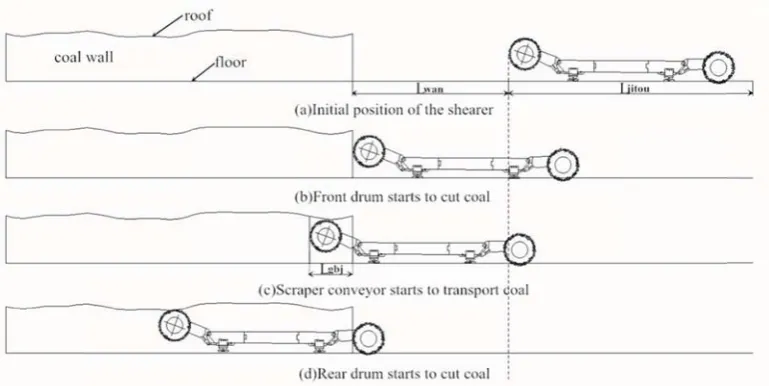
3.1.2 Analysis of cutting with the coal-transporting process
For a shearer that cuts coal from its head to its tail, if the roof is assumed to be undulating and the floor is assumed to be flat, then the transporting coal
process is as shown in Fig. 4.
Figure 4 to be inserted here.
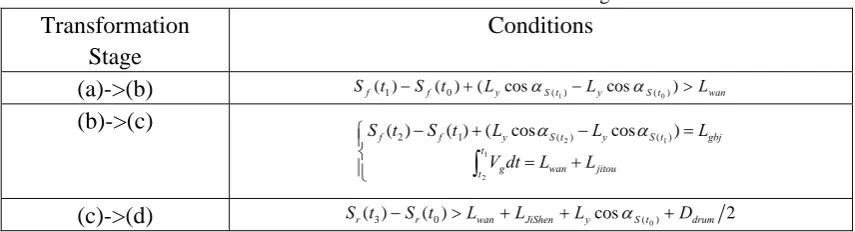
The conversion conditions of four phases must satisfy the conditions shown in Table 1.
Table 1 to be inserted here.
3.1.3 Calculation of the coal cutting amount
We assume that a good coal-rock recognition
device is installed in the shearer or that the operators can clearly distinguish the interface between coal and rock; then, the cutting amount of the front drum can
be approximated as the full diameter of the front drum, and the cutting amount of the rear drum can be
calculated according to the cutting trajectory of the front drum, as shown in Fig. 5.
Figure 5 to be inserted here.
As shown in Fig. 5, the definition of the coal seam curve is a series of feature points of cutting
height per length of the middle trough in the X coordinates. Thus, the feature points of the cutting
height of the rear drum are (X(i), Hu(i)-Ddrum).
Define
= (Sr(t)-Sr(t3))/Dzbc and the remainder
= (Sr(t)-Sr(t3))%Dzbc.Because the coal seam height changes slowly, the cutting line that connects two adjacent cutting points can be considered a straight line. Accordingly,
the cutting area of two adjacent cutting points can be considered a trapezoid.
The coal cutting amount of the front drum and rear drum can be calculated as shown in Equations (3.3) and (3.4), respectively.
soild
1) cos cos )* * *
( ) ( (
1
L D J
L t S t S
mfront f f y t y t drum
soild 1 1 * * ) 2 / * )) ) ( ( * 2 )) ( ) 1 ( ( ( 2 / * ) * 2 ) 1 ( ) ( ( ( J D h D h h D D i h i h m drum u zbc u u zbc drum u i u rear
(3.4)The instantaneous coal cutting amount of the front and rear drums is calculated as shown in
Equations (3.5) and (3.6) respectively.
soild
* * * )
(t V D J
mInsfront c drum (3.5)
soild * * )) ( ( * )
(t V f s t J
mInsrear c r (3.6)
The instantaneous amount of shipped coal is
calculated as
ispersion g
transport
Ins t q t v
m ( ) ( )* *
d (3.7)The total amount of shipped coal from moment
t2 to moment t is calculated as
t t i transport Ins transporttotal m i
m
2
)
( (3.8)
The instantaneous load of the scraper conveyor is calculated as
permit transport
total rear
front t m t m t Q
m t
Q() () () () (3.9)
If Q(t) reaches the maximum allowed value
permit
Q
, the scraper conveyor load at moment t must satisfy the following condition:
0 ) ( ) ( ) ( )
(t m t m t m t
QIns Ins front Ins rear Ins transport (3.10)
3.1.4 Coupling of the scraper conveyor load with the underground environment
In the hydraulic support process, the coal wall
may suddenly collapse depending on the shearer location and running speed.
Whether collapse occurs mainly depends on the follower distance and mining height, and the common regulation is as follows: a higher mining height and
greater follower distance correspond to a higher probability of coal wall collapse.
If this phenomenon occurs, the scraper conveyor load will change suddenly.
After this phenomenon occurs, it will not occur
again within 50 m.
In this paper, assuming a scope of 50 m, if the
follower distance is greater than 10 times Dzbc, the
probability of collapse is calculated as follows:
zbc follow zbc follow D D D D p f * 10 0 * 10 1 ) ( (3.11)
where Dfollow is the follower distance. The mutation
load of the scraper conveyor is calculated as
msudd=(-1)f(p)*Random.Range(0.75,1)*2.5t (3.12) Considering the sudden collapse of the coal wall,
the instantaneous load of the scraper conveyor is calculated as permit sudd transport total rear
front t m t m t m Q
m t
Q() () () ()
(3.13)
3.2 Coupling of the shearer haulage speed and
adjustment of the front drum height with the underground environment
Facing an undulating virtual roof, the virtual
shearer can adjust the height of the front drum and adaptively plan according to its capacity.
Whenever the shearer runs along the length of
the middle trough, the shearer will acquire the next roof height in advance and make a comparison with
the current drum height. The shearer decides which action to take next according to the comparison result and ability of the hydraulic system.
When the shearer is operating at moment t, the rotate angle of the front drum is calculated as
) 2 / ) ( arcsin( ) ( y drum c u t S L D H i
H
(3.14)
Due to the control strategy of the shearer or
detected error of the coal seam height, the front drum is likely higher than the interface between coal and
rock, and the front drum begins to cut the rock. In an abnormal electric current condition, the virtual shearer must reduce the height of the front drum.
The decision condition to determine whether the current is abnormal is as follows:
ui drum
c i
y H D H
L sin /2
(3.15)
3.3 Coupling of the following control of hydraulic supports and the shearer haulage speed
3.3.1 Matching the advancing mode
The most important factor of the three-machine coordination is the matching of shearer haulage speed
If Vc<Vy, the hydraulic support can follow the shearer action in a sequential advancing mode, where
the phenomena of support loss and inadequate advancing do not appear. Before the shearer location triggers the next group action, the current group has
completed advancing the action.
If 2Vy>Vc>Vy, the hydraulic support cannot
regularly follow the shearer action in a sequential advancing mode and must switch to the cross-grouping advancing mode under the premise of
a favorable roof condition. The hydraulic supports can continue running in order only by the
cross-grouping advancing mode.
In the course of shearer running, the swarm hydraulic supports automatically switch the
advancing mode according to the detected shearer haulage speed and follower distance in real time.
YiJiaFangShi, which is a static variable defined in FMUnitySim, is used to mark the current
advancing mode. N, which is a static variable defined
in FMUnitySim, is used to mark the number of hydraulic supports, which conduct advancing action.
If the value of YiJiaFangShi is equal to one, the current advancing mode is the sequential advancing
mode, and the value of N is unique. If the value of
YiJiaFangShi is equal to two, the current advancing mode is the cross-grouping advancing mode, and N is
a smaller number.
3.3.2 State mark of the hydraulic support using
the finite-state machine
Hydraulic support has six states, which are denoted as 1-6, as shown in Table 2.
Table 2 to be inserted here.
The hydraulic support must detect the distance between its position and the position of the front
drum or rear drum. If the distance satisfies the rules shown below, the hydraulic support will take the
corresponding actions.
(1) Rule 1: if the distance from its position to the
position of the rear drum is less than two times Dzbc,
the hydraulic support begins to successively retract the columns, advance the support and rise the
columns.
(2) Rule 2: if the distance from its position to the
position of the rear drum is within 10-15 m, the hydraulic support begins pushing the conveyor.
(3) Rule 3: If the distance from its position to the
position of the front drum is less than two times Dzbc,
the hydraulic support begins to flap out.
3.3.3 Realization of the sequential advancing mode
If the value of YiJiaFangShi is equal to one, the
current advancing mode is the sequential advancing mode. The conditional relation is as follows:
) 5 ) ( ( ) * ) 10 7 ( ) ( ) ( ( 6 ) 0 ) ( ) ( ( ) 4 ) ( ( 5 ) ) ( ( ) 3 ) ( ( 4 ) ) ( ) ( ( ) 2 ) ( ( 3 ) 5 ) 1 ( ( ) * ) 6 2 ( ) ( ) ( ( 2 * 2 ) ( ) ( 1 ) ( z state D z S t S z H z H z state J z S z state H z H z H z state z state D z S t S D t S z S z state zbc zj r zj u tuiyi down zj u zbc zj r zbc f zj (3.16) 3.3.4 Realization of the cross-grouping advancing
mode
If the value of YiJiaFangShi is equal to two, the current advancing mode is the cross-grouping
advancing mode. Suppose that hydraulic supports No.
z and No. z+2 maintain the cross-grouping advancing
mode; then, hydraulic support No. z is calculated as
shown I Equation (16), and hydraulic support No.
z+2 must be synchronized with hydraulic support No.
z. The conditional relation is shown below.
) 5 ) 2 ( ( ) * ) 10 7 ( ) ( ) ( ( 6 ) 0 ) 2 ( ) 2 ( ( ) 5 ) ( ( 5 ) ) 2 ( ( ) 4 ) ( ( 4 ) ) 2 ( ) 2 ( ( ) 3 ) ( ( 3 2 ) ( 2 * 2 ) ( ) ( 1 ) 2 ( z state D z S i S z H z H z state J z S z state H z H z H z state z state D t S z S z state zbc zj r zj u tuiyi down zj u zbc f zj (3.17)
3.3.5 Switching of the advancing mode
If the follower distance is greater than 11 times
Dzbc, the shearer must decelerate. While waiting for
the previous hydraulic support to finish advancing, the advancing mode switches from the sequential
advancing mode to the cross-grouping advancing mode.
If the follower distance is less than 3 times Dzbc,
the shearer must accelerate. Similarly, under the premise of waiting for the previous hydraulic support
sequential advancing mode.
3.4 Coupling of the following control of hydraulic
supports with the condition of the roof and floor
When the underground environment is in a good condition, the advancing action of hydraulic supports
must match the difference of the shearer haulage speed and location, which follow rules 1-3 in section 3.3.2. For a working face with a broken roof, the
advancing mode of the support with pressure is recommended to prevent the roof from falling. The
column retracting speed for the working face with a large mine pressure is slower than that under normal conditions because the relieving the pressure requires
a long period of time.
With the continuous operation of three machines,
the action speed of the swarm hydraulic cylinders gradually decreases because of the filter plug or other problems, which makes the original control
parameters unsuitable. These problems may occur at any time in any hydraulic support; thus, the action
quality cannot be effectively controlled.
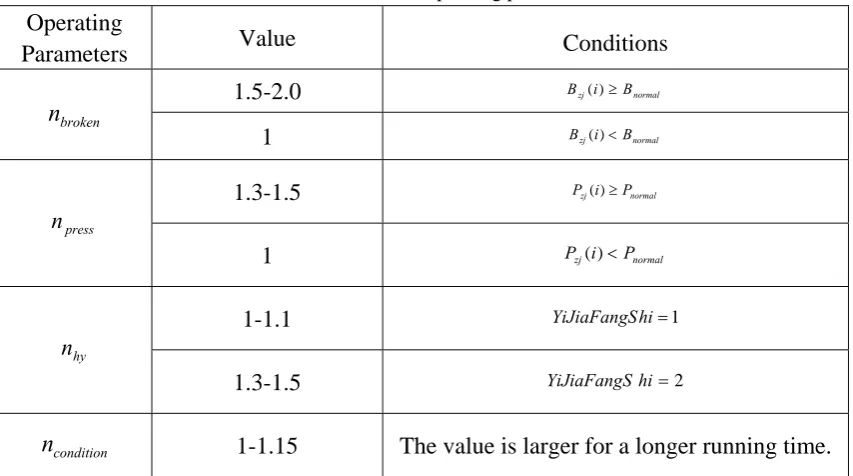
The action time of the advancing supports can be calculated as )) ( * )( ( ) ( t r l d down l r rise condition hy press broken move norm S J S H S H n n n n t (3.18) The values of the operating parameters are shown in Table 3.
Table 3 to be inserted here.
3.5 Coupling of the shape of the scraper conveyor and advancing units of the hydraulic supports
When the shearer runs in the feeding process, the scraper convey will form an s-shaped bending section.
When the shearer runs in the normal cutting process, the straightness of every middle trough must be
detected in real time.
We assume that the roof is flat and that each hydraulic support maintains the normal attitude, i.e.,
it does not appear askew, and no inclination occurs in the support advancing process. Therefore, the
s-shaped and straightness of the scraper conveyor depend on the elongation of the advancing units for the corresponding hydraulic supports.
3.6 Delay or data loss
In the process of interacting with other machines,
each machine may encounter delay or data loss. The interaction of the three machines is as follows: the shearer occupies the lead position in the
three-machine movement, and the scraper conveyor and group hydraulic supports are auxiliary.
The shearer may obtain the number of hydraulic supports, which delays advancing support and results in a greater distance at the empty top. The shearer
may also obtain the scraper conveyor’s single load overrun, which causes a short-time overrun of the
scraper conveyor. Conversely, this effect decreases the efficiency of the coal mining process.
By obtaining the shearer’s location in real time,
the advancing action of a single hydraulic support is continuous. However, the hydraulic supports in front
of the shearer may retract the supporting plate farther backward than is normal, which causes a risk of interference.
Those behind the shearer will struggle more than normal while advancing support. This widens
the empty distance and increases the collapse risk of the roof coal wall.
The definition of the reliability of data
transmission is the probability that the communication system does not appear data
transmission delay or loss. In this paper, the value of this parameter is 95% .
4. Collaborative planning model based on an
MAS
4.1 Model of the shearer agent
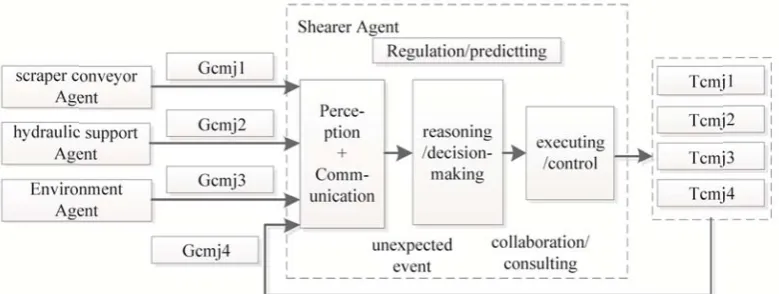
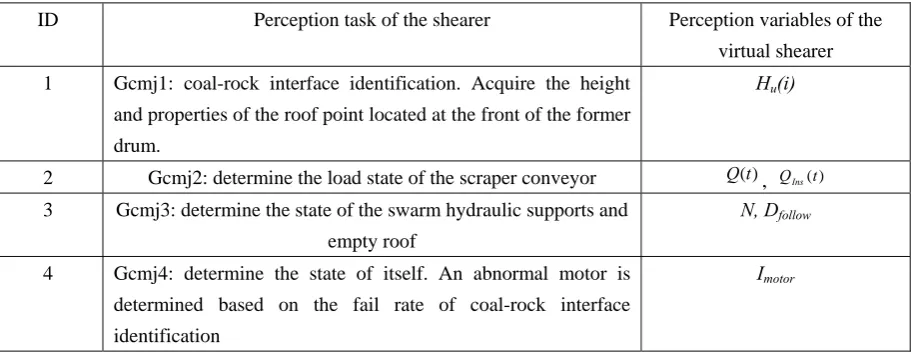
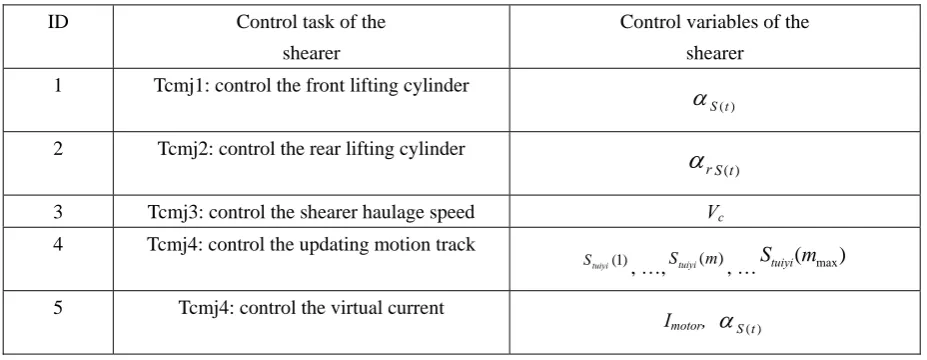
An agent model of the shearer is shown in Fig. 6. The perception and communication module is used to
interact with other agents (Table 4); then, the logical information processing module is used to reason, decide and transfer results to the execution and
control module (Table 5), which manipulates the virtual shearer to take specific actions.
Figure 6 to be inserted here. Table 4 to be inserted here. Table 5 to be inserted here.
the shearer
The shearer haulage speed should be coupled
with the conditions of the roof, scraper conveyor and hydraulic supports.
Coupled with the hydraulic supports, the virtual
shearer must take corresponding actions when is facing the minimum and maximum distance of empty
roof.
Coupled with the scraper conveyor load, if the scraper conveyor load is greater than the permitted
maximum load, the instantaneous cutting amount of coal is not greater than the instantaneous transport
amount of shipped coal.
Coupled with the roof plate, if the coal-rock interface identification is regularly working, a shearer
should be in the normal condition. In contrast, when abnormal turning of the virtual electric current of
motors occurs, the shearer must decelerate and decrease the height of the front drum by adjusting the front lifting cylinder.
4.2 Model of the scraper conveyor agent
The scraper conveyor has two functions: the shape, as shown in section 3.5, and the load, as shown
in section 3.1. The corresponding relationship between the perception task of the scraper conveyor
and the perception variables of the virtual scraper conveyor is shown in Table 6, and the corresponding relationship between the control task of the scraper
conveyor and the virtual control variable of the scraper conveyor (GbjAgent.cs) is shown in Table 7.
Table 6 to be inserted here. Table 7 to be inserted here.
Logic information processing module of the scraper conveyor
If the scraper conveyor load is greater than the
maximum permitting load, the instantaneous amount of coal cut by the front and rear drums and the instantaneous amount of shipped coal must be
detected online. If the former is greater than the latter, the shearer haulage speed must decelerate.
4.3 Model of the hydraulic support agent
There are currently over 100 hydraulic supports in the actual underground working face. Each
hydraulic support must communicate with other agents and have the appropriate behavior for the
current underground environment, as shown in Fig. 7.
Figure 7 to be inserted here.
The corresponding relationship between the
perception task of the hydraulic support and the perception variables of the virtual hydraulic support is
shown in Table 8, and the corresponding relationship between the control task of the hydraulic support and the control variable of the virtual hydraulic support
(YyzjAgent.cs) is shown in Table 9.
Table 8 to be inserted here.
Table 9 to be inserted here.
Logic information processing module of the
hydraulic support
Hydraulic support (i) must detect the distance between its position and the front drum or rear drum.
If the distance satisfies rules 1, 2 and 3, hydraulic support (i) performs the corresponding actions.
In the support advancing process, it is necessary
to couple the roof trajectory, mine pressure, hydraulic system and surrounding hydraulic supports, as
discussed in section 3.3.2. The action of pushing the conveyor and advancing the support must be coupled with the shape of the scraper conveyor.
4.4 Model of the hydraulic system agent
The hydraulic system is mainly affected by the action mode and amount of swarm hydraulic supports.
The corresponding relationship between the perception task of the hydraulic system and the
perception variables of the virtual hydraulic system is shown in Table 10, and the corresponding relationship between the control task of the hydraulic system and
the virtual control variable of the hydraulic system (YyxtAgent.cs) is shown in Table 11.
Table 10 to be inserted here. Table 11 to be inserted here.
4.5 Model of the underground environment agent
As shown in Fig. 8, the agent of the underground environment can simulate the change in the
collapse of the coal wall and broken roof caused by the empty roof distance and periodic mine pressure in
the geology condition.
Figure 8 to be inserted here.
The corresponding relationship between the
perception task of the environment and the perception variables of the virtual environment is shown in Table
12, and the corresponding relationship between the control task of the environment and the virtual control variable of the environment (EnvAgent.cs) is shown
in Table 13.
Table 12 to be inserted here.
Table 13 to be inserted here.
5. VR planning method
To visually observe the entire simulation state, Unity3D must be integrated with a collaborative
planning model based on MAS theory. Several common issues must be addressed, as discussed below.
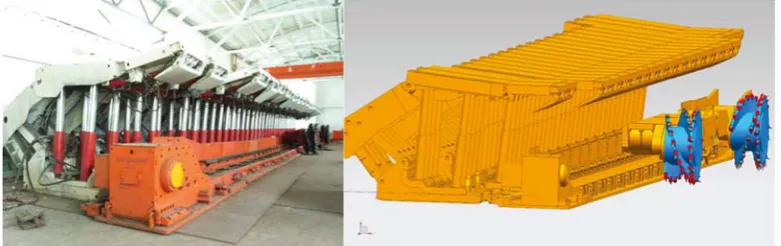
5.1 3D model of the three machines
According to the scene mapping and a full set of drawings, the 3D model of the three machines is
obtained and repaired in the UG(Unigraphics NX). Considering the capacity and pressure of the software
and hardware, the external dimensions should be precisely modeled, and the internal transmission structures are ignored, as shown in Fig. 9.
Figure 9 to be inserted here.
The 3D model is imported into 3DMAX in stl
format and converted into fbx format, which can access Unity3D. In this manner, virtual models that are consistent with the physical model are established
in Unity3D.
5.2 Model of the underground environment
The underground environment includes the intellectual input of various types of variables, such as the roof height, mine pressure and broken degree.
In this paper, to plan in a convenient manner, the floor is ideally flat, and the roof height is described
with 100 points of the cutting height of the front drum, which are collected using the actual underground coal wall.
The mine pressure and broken conditions are generated in the virtual scene according to the setting
result that the users input into the GUI module.
5.3 GUI interface
The GUT interface can set up different initial
conditions by entering different planning parameters. It is mainly divided into six modules.
(1) The module of geological terrain parameters
is a general overview of the underground geological environment, which includes the dip angle of the coal
seam, degree of broken roof, and mine pressure regulation.
(2) The module of the roof and floor parameters is responsible for the roof and floor parameters, which determine the generation of the virtual roof and
floor in FMUnitySim.
(3) The module of the coal cutting method and
process parameters includes the selection of coal cutting methods and three rules between the shearer and hydraulic supports.
(4) The module of the shearer parameters contains the movement and performance parameters,
such as the scope and acceleration of the shearer haulage speed, scope of the permitted follower distance, and virtual current of the motor.
(5) The module of the scraper conveyor parameters includes the movement and performance
parameters, such as the scope of the chain speed, power of the motor, detection of straightness, and collapse probability of the coal wall.
(6) The module of the hydraulic support parameters and hydraulic system includes the
movement and performance parameters, such as the total amount, pressure and form of the hydraulic system.
6. Experiment and discussion
The experimental planning conditions in this paper are set as follows:
(1) The roof is assumed to be undulating, and the
floor is assumed to be flat.
(2) The planning process belongs to the coal
of the end beveling feeding bidirectional coal cutting method.
(3) The uploading point of the scraper conveyor is assumed to be in its head section, and the direction of coal transport is assumed to be from high to low.
6.1 Design of the simulation experiment
Unity3D can be released on a PC platform or Web platform.
First, after the PC platform program is run, the "end of the oblique cut feed two-way coal cutting
process" is selected as the mining method. Second, the specific values of rules 1, 2 and 3 are set as 3, 7 and 2, respectively, and the scope of the safety
follower distance is set as 2-8. Third, the matched parameters of the three machines are moderately set,
such as the action parameters of the hydraulic support and scope of the shearer haulage speed. Finally, stable coal-rock is selected in the geological terrain
parameters, where the cross-grouping advancing mode is permitted.
When the simulation begins, the virtual shearer takes the following series of actions: lifting the left drum, descending the right drum and running toward
the scraper conveyor tail section.
Because Vc is greater than Vy, when the shearer
location begins to trigger the advancing action of
hydraulic support No. n as rule 1 in section 3.3.2,
hydraulic support No. n+1 cannot begin to move until
hydraulic support No. n completes its advancing
action. When Vy<Vc<2Vy, the cross-grouping
advancing mode is triggered. In this process, the hydraulic support catches up with the shearer quickly. The scene in that moment is illustrated in Fig. 10.
Figure 10 to be inserted here.
When the follower distance is greater than a
certain limit, the shearer automatically begins to decelerate and the hydraulic support begins to catch up with the shearer until the follower distance is
smaller than the safe follower distance.
Simultaneously, Vc increases.
With the program running, the generation and transmission of an s-shaped bending section caused by the action of gradually pushing the conveyor can
be easily observed, as shown in Fig. 11.
Figure 11 to be inserted here. Figure 12 to be inserted here.
Fig. 12 shows the planning relationship among
Vc, Dfollow and Q(t).
Point A: Along the running length of Lwan, the
shearer begins to cut coal with the front drum.
Meanwhile, Vc increases from 0 to 10.2 m/min, and
the advancing action of hydraulic support No. 1 has been triggered.
Point B: Vc will approach 20 m/min, which is the
maximum value that the users can preset.
Point C: at this moment, Q(t) changes suddenly,
which results in an increase of 2 tons. This change
occurs because if Dfollow is ten times greater than Dzbc,
the coal wall suddenly collapses. Meanwhile, the
advancing mode switches from sequential to cross-grouping.
Point D: When Dfollow reaches the maximum,
which is equivalent to 12.8 times Dzbc, the empty roof
may fall. At this time, the shearer must rapidly
decelerate to make the hydraulic support quickly advance and gradually catch up to the shearer.
Point E: Q(t) appears to decrease, and Vc is
11.63 m/min, which precisely matches QIns(t) .
Simultaneously, Dfollow is less than the minimum safe
follower distance, whose value is 3 times Dzbc.
Interference may occur between the shearer and
hydraulic supports; thus, Vc increases again to match
) (t
Q . Before reaching a balance, the entire process
has fluctuated five times.
Point F: Vc increases again until Q(t) has
reached the maximum load.
Point F-G: After Q(t) reaches the maximum
load, Vc slightly decreases again.
Point G –H: A similar process is performed.
Point H: Q(t) fluctuates in a small range until
it reaches a stable state, where the sum of mInsfront(t)
and m (t)
rear
Ins is equivalent to mInstransport(t).
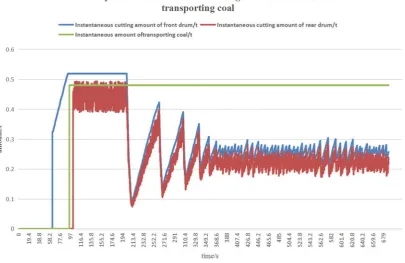
Fig. 13 shows the relationship among
) (t
mInsfront , mInsrear(t) and scraper mInstransport(t).
First, the front drum begins to cut coal; then, the scraper conveyor transports the shipped coal. Finally, the rear drum begins to cut coal, which must be calculated using the trapezoidal method in section 3.1.3.
) (t
) (t
q remains constant. Finally, a stable state at which
) (t
mInsfront and mInsrear(t) are equivalent to
) (t
mInstransport occurs.
Figure 13 to be inserted here.
6.2 Matching of the optimal parameter
Experiments were performed to determine the best matching parameter in different experimental
schemes (Table 14), where key planning parameters, such as the shearer haulage speed, follower distance,
and scraper conveyor load, were set in different conditions and combined.
Table 14 to be inserted here.
The optimal parameters were mainly determined by the indicator of the time-velocity, safety efficiency
(average follower distance), and average quality of coal production.
According to the above scheme, experiments
were performed 10 times in every condition, and the average results of each group are shown in Table 15.
Table 15 to be inserted here.
The simulation results show the following: (1) Compared with group 1, group 2 indicates
that when collapse of the coal wall is considered, the safety efficiency is decreased and the other properties
remain largely unchanged;
(2) A comparison of groups 2-5 indicates that to match the advancing speed of the hydraulic support,
if the maximum shearer haulage speed is greater than the matching speed, a greater maximum shearer
haulage speed corresponds to a greater average shearer haulage speed, lower security efficiency and a greater scraper conveyor load.
However, when the maximum shearer haulage speed increases, the average shearer haulage speed
does not increase significantly, but the safety factor increases considerably. Hence, the shearer haulage speed should be selected to match the advancing
speed of the hydraulic support and should not be larger because the short-term efficiency increases.
The comparison of groups 5 and 6 indicates that the average shearer haulage speed and coal cutting efficiency decrease considerably when the maximum
shearer haulage speed is smaller than the matching speed. Only the safety factor improves slightly; thus,
the maximum shearer haulage speed should not be less than the matching speed of the advancing speed
of the hydraulic support.
(3) A comparison of groups 2 and 7 shows that when the direction of coal transportation is reversed,
the average shearer haulage speed decreases, and the corresponding safety factor improves considerably.
Thus, in this condition, the shearer haulage speed should be appropriately improved.
7. Conclusion and prospects
From the AI and VR perspectives, a VR
collaborative planning simulator with its method for three machines in a fully mechanized coalmining face is developed with Unity3D based on the collaborative
mathematical model and MAS. The main conclusions of this study are as follows:
(1) The proposed FMUnitySim can expand the application field of VR technology, not merely in industrial teaching and training. In particular, the
application of VR in a fully mechanized mine face is a novel attempt of this study. With this application,
the entire production process can be controlled and examined at the early stage of the project, and the type of selection design can be integrated with
technique planning.
(2) The proposed FMUnitySim can considerably
improve the digital design level of fully mechanized mining equipment. The equipment can be used to control the relationship between the entire system and
a given part, and the operation details and strategy can be planned. With this VR simulation, various
problems can be predicted, modified and optimized, thus reducing costs and increasing efficiency.
(3) Diversity and specialization in the design
project are achieved for different environments and user requirements. The proposed FMUnitySim can
provide a clearly visualized plan of the operational status of three machines in a fully mechanized coalmining face. It can also simulate the dynamic
supporting relationship, attitude and performance of the three machines in terms of different working
intelligentization and unmanned management of three machines in a fully mechanized mining face.
(4) By providing a broad vision for intelligentization and unmanned management, the proposed FMUnitySim can digitize and virtualize the
entire process of fully mechanized coal mining. Then, FMUnitySim can solve the existing problems in fully
mechanized coalmining equipment from the global system perspective and can accurately predict the possible development of the coalmining process.
FMUnitySim makes a technological preparation for the digital model based on the virtual working face
and an authentic image of the working face based on automation technology.
In this study, there are many complex constraints
between the underground environment and the three machines, which consist of many unknown possible
events. It is difficult to express the mathematical formula for so many unknown factors. Therefore, the collaborative mathematical model needs to further
describe the complex underground environment. In addition, this study simulated only the fully
mechanized coalmining face, which is part of the mining industry. In the future, this industry could also apply the VR planning technique to other production
aspects of the mining industry, such as digging, belt transportation, and mine hoisting. This paper has
provided the theoretical support and technical support to advance the mining industry with new technology and information.
Future work will focus on integrating and incorporating FMUnitySim into the actual control
system of the three machines to improve the efficiency. Future research goals include establishing an online planning system by reading the real-time
information sensed from the three machines and better controlling the running of the three machines.
References
1.Wang, J.H.; Wang, Y.H.; Fu, J.H.: Crucial
technology research and demonstration of digital
mines. J China Coal Soc.41(6), 1323-1331 (2016)
2.Ge,S.R.: Key Technology of Intelligent Coal
Mining Equipment. Coal Sci. Techno. 42(9),7-11
(2014)
3.Niu, J.F.: Key Study on automatic and intelligent
following control system of hydraulic powered support in fully-mechanized coal mining face.
Coal Sci. Techno. 43(12), 85-91(2015)
4.Wang, C.; Tu, S.; Chen, M.: Optimal Selection of a
Longwall Mining Method for a Thin Coal Seam
Working Face. Arab J. Sci. Eng. 41(9),1-11 (2016)
5.Wang, J.H.; Huang, L.T.; Li, S.B.: Development of
intelligent technology and equipment in fully-mechanized coal mining face, J China Coal
Soc. 39(8),1418-1423 (2014).
6. Fan, Q.G.; Li, Wei.: Study on Equipment Positioning and Task Coordination for Three Machines Controlling on the Mechanized Mining Face. China J. Mech. Eng. 9, 73-73 (2015)
7.Opensim, J.: A 3D Simulator for autonomous
robots. http://opensimulator.sourceforge.net/ (2008). Accessed 14, April 2017
8. Freese, M.; Singh, S.; Ozaki, F.: Virtual robot experimentation platform v-rep: a versatile 3D robot simulator. In Simulation, Modeling, and Programming for Autonomous Robots, pp.51–62. Springer, Berlin Heidelberg (2010)
9.Mcdowell, P.; Darken, R.; Sullivan, J.: Delta3D: A
Complete Open Source Game and Simulation Engine for Building Military Training Systems. J.
Defense Model. Simulat. 3(3),143-154 (2006)
10.Lewis, M.; Wang, J.; Hughes, S.: USARSim:
Simulation for the study of human-robot
interaction. J. Cognitive Eng. Decis. Making, 1(1),
98–120 (2007)
11.Koenig, N.; Howard, A.: Design and use
paradigms for gazebo, an open-source multi-robot simulator. In IEEE/RSJ International Conference on Intelligent Robots and Systems,28 September -2,October, no.3: 2149–2154.Sendai (2004)
12.Lee, W.; Cho, S.; Chu, P.: Automatic agent
generation for IoT-based smart house simulator.
Neurocomputing, 209, 14–24 (2016).
13.Becker-Asano.; Christian.: A Multi-agent System
based on Unity 4 for Virtual Perception and Wayfinding. Transportation Res. Procedia. 2:452-455 (2014)
14.Meng, Wei.; ROSUnitySim: Development and
Experimentation of a Real-time Simulator for
Multi-UAV Local Planning. Simulat. 92(10),
002562-002567 (2016)
15.Meng, Wei.: ROS+unity: An efficient
16.Xu, Z.; Lu, X.Z.; Guan, H.: A virtual reality based fire training simulator with smoke hazard
assessment capacity. Adv Eng. Softw.68(2),1-8
(2014)
17.Cha, M.; Han, S.; Lee, J.: A virtual reality based
fire training simulator integrated with fire
dynamics data. Fire Safety J. 50(3),12–24 (2012)
18.Manca, D.; Brambilla, S.; Colombo, S.: Bridging
between Virtual Reality and accident simulation for training of process-industry operators. Adv.
Eng. Softw. 55(1),1-9 (2013)
19.Kizil, M.S.: Virtual reality applications in
Australian minerals industry. J. S. Afr. I. Min.
Metall. 31, 569-574 (2013)
20.Tichon, J.; Burgess,limerick. R.: A review of
Virtual Reality as a medium for safety related training in Mining. J. Health Safety Res. Pract.
3(1),33-40 (2011)
21.Perez, P.; Pedram, S.; Dowcet, B.: Impact of
virtual training on safety and productivity in the
mining industry. Conference: MODSIM 2013,
Adelaid (2013)
22.Pedram, S.; Perez, P.; Dowsett, B.: Assessing The
Impact Of Virtual Reality-Based Training On
Health And Safety Issues In The Mining Industry. ISNGI2013 - International Symposium for Next Generation Infrastructure. (2013)
23.Pedram, S.; Perez, P; Palmisano, S.: Evaluating
the influence of virtual reality-based training on
workers' competencies in the mining industry. In A. G. Bruzzone, F. De Felice, M. Massei, Y. Merkuryev, A. Solis & G. Zacharewicz (Eds.),
13th International Conference on Modeling and Applied Simulation, MAS 2014 (pp. 60-64). Red
Hook, New York, United States: Curran (2014).
24.Pedram, S., Perez, P.; Palmisano, S.: Evaluating
360-Virtual Reality for Mining Industry’s Safety
Training, International Conference on Human-Computer Interaction. Springer, Cham,
pp.555-561 (2017)
25.Kerridge, A.P.; Kizil, M.S.; Howarth, D.F.: Use of
virtual reality in mining education. The AusIMM
Young Leader's Conference. The Australasian Institute of Mining and Metallurgy, pp.1-5 (2003)
26.Grabowski, A.: Jankowski, J.: Virtual
Reality-based pilot training for underground coal
miners. J. Safety Sci.72,310-314 (2015)
27.Foster, P.; Burton, A.: Virtual reality in improving
mining ergonomics. J. S. Afr. I. Min. Metall.
104(2), 129-133 (2004)
28.Stothard, P.; Laurence, D.: Application of a
large-screen immersive visualization system to
demonstrate sustainable mining practices
principles. Trans. I. Min Metall. 23,199-206
(2014)
29.Stothard, P.: The feasibility of applying virtual
reality simulation to the coal mining operations.
Australas. I Min. Metall. Publ. Ser. 5,175-183
(2003)
30.Foster, P.J., Burton, A.: Modelling potential
sightline improvements to underground mining vehicles using virtual reality. Trans. I. Min.
Metall.115,85-90 (2013)
31.Zhang, S.X.: Augmented Reality on Longwall
Face for Unmanned Mining. Appl. Mech.
Materials. 40-41(6), 388-391(2010)
32.Akkoyun, O.; Careddu, N.: Mine simulation for
educational purposes: A case study. Comput. Appl.
Eng. Educ.23(2),286-293 (2015)
33.Kijonka, M.; Kodym, O.; Coal industry
technologies simulation with virtual reality utilization. Proceedings of the 13th International
Carpathian Control Conference (ICCC), High Tatras, IEEE, 278-283 (2012)
34.Zhang, X.; An, W.; Li, J.: Design and Application
of Virtual Reality System in Fully Mechanized
Mining Face. Procedia Eng. 26(4),2165-2172
(2011)
35.Wan, L.R.; Gao, L.; Liu, Z.H.: The Application of
Virtual Reality Technology in Mechanized Mining
Face. Adv. Intell. Syst. Comput. 181,1055-1061
(2013)
36.Torano, J.; Diego, I.; Menéndez, M.: A finite
element method (FEM) – Fuzzy logic (Soft
Computing) – virtual reality model approach in a coalface longwall mining simulation. Automat.
Constr. 17(4),413-424(2008)
37.Sun, H.B.; Tan, C.; Yao, X.G.: Research on
Three-Dimension Scene Modeling Technology of
3DVR Platform for Shearer. J. China Univ. Min.
38.Xie, J.C.; Yang, Z.J.; Wang, X.W.: Design and Key Technologies of Virtual Assembly and
Simulation of Mining, Driving and Transporting
Equipment System. J. Syst. Simulat. 27(4),
794-802 (2015)
39.Li, A.L.; Zheng, X.W.; Wang, W.: Virtual Motion
Simulation of Hydraulic Support Based on Unity
3D.First International Conference on Information Sciences, Machinery, Materials and Energy. Atlantis Press (2015)
40.Stothard, P.; Squelch, A.; Stone, R.: Taxonomy of
interactive computer-based visualization systems
and content for the mining industry – part 2. International Future Mining Conference and Exhibition. OAI, vol.124, no.2, 201-210 (2015)
41.Li, W.N.: Fully Mechanized Three-Machine
Linkage Process Simulation Based on Virtual
Reality Technology. Dissertation Xi`an:Xi`an
University of Science and Technology (2014)
42.Xu, X.Z.; Meng, X.R.; He, Y.R.: Research on
virtual simulation of full mechanized mining face production based on three-dimensional
visualization and virtual simulation. J. Safety Sci. Technol. 1,26-32 (2014)
43.Wan, L.R.; Gao, L.; Liu, Z.H.: The Application of
Virtual Reality Technology in Mechanized Mining
Face. Adv. Intell. Syst. Comput. 181,1055-1061
(2013)
44.Tang S S, Wei C K. Design of Monitoring System
for Hydraulic Support Based on LabVIEW. J.
Adv. Mater. Res. 989-994, 2758-2760 (2014)
45.Lo, J.Z.; Chen, H.Z.; Sui, G.: Study on
Simulation System of Fully Mechanized Mining Face Based on Virtual Reality. J. Syst. Simula.
19(18),4164-4167 (2007)
46.Li, H.; Chen, K.; Zhang, X.: Disign of monitoring
and control system based on virtual reality
technology on fully-mechanized coal mining face,
Ind. Min. Autom. 42(4),15-18 (2016)
47.Liang, S.; Chen, Y.; Zheng, X.: Study of
monitoring system of hydraulic support movement state based on virtual reality.
International Conference on Mechatronic Sciences, Electric Engineering and Computer. pp.3434-3437
(2013)
48.Yan, H.F.; Su, F.X.; Chen, Z.H.; A study on the
remote monitoring system of hydraulic support based on 3DVR. Audio Language and Image Processing (ICALIP), 2010 International
Conference on. IEEE, pp.912-915 (2010)
49.Wand, Y.: Design Manual for continuous
Figuures
Fig. 2. Influencing fac
Fig. 1 Overa
ctors for three
all framework
e-machine coo
k of FMUnity
ordination wi ySim
[image:18.595.130.491.393.598.2]Fig. 3 Intteraction amoong the agents
Fig. 4 T
Fig. 5 Cu
s of three mac
Transport pro
utting curve o
chines and th
ocess analysis
of the rear dru
he undergroun
s
um
[image:19.595.187.434.592.740.2]F
[image:20.595.121.502.326.494.2]Fig. 6 A
Fig. 7. Agent
Fig. 8 Age
Agent model
t model of the
ent model of t
l of a shearer
e hydraulic su
the environm upport
[image:20.595.122.511.571.723.2]Fig. 10 Mutu
Fig.
ual perception
Fig. 11
9 Model rep
n between the
S-shaped ben
pair results
e shearer and
nding section
d hydraulic su
n
[image:21.595.147.479.285.440.2] [image:21.595.166.451.501.719.2]Fig. 12 Plan
Fig. 13 Rela
t C
nning relation
of the sc
ationship amo
oal cutting am
nship among S
craper convey
ong Cutting a
mount of the
Shearer haula
yor from the b
amount of the
rear drum fro
age speed, Fo
beginning to m
e front drum f
om the beginn
ollower distan
moment t
from the begi
ning to mome
nce and Total
inning to mom
ent t
load
[image:22.595.128.534.431.694.2]Tables
Table 1 Conversion conditions for the four stages
Transformation
Stage
Conditions
(a)->(b)
Sf(t1)Sf(t0)(LycosS(t1)LycosS(t0))Lwan(b)->(c)
wan jitout
t g
gbj t S y t S y f f
L L dt V
L L
L t S t S
1
2
1
2 cos )
cos ( ) ( )
(2 1 ( ) ( )
Table 2 Corresponding state numbers of the hydraulic support