
Co-Synthesis of Energy-Efficient Multi-Mode Embedded Systems
with Consideration of Mode Execution Probabilities
Marcus T. Schmitz1,2, Bashir M. Al-Hashimi1, Petru Eles2 1Electronic Systems Design Group
Department of Electronics and Computer Science University of Southampton, Southampton, UK
2Department of Computer and Information Science Linköping University
S-581 83 Linköping, Sweden {g-marsc, petel}@ida.liu.se
Final version: 19 March 2004
Abstract
In this paper, we present a novel co-design methodology for the synthesis of energy-efficient embedded systems. In particular we concentrate on distributed
em-bedded systems that accommodate several different applications within a single de-vice, i.e., multi-mode embedded systems. Based on the key observation that
opera-tional modes are executed with different probabilities, i.e., the system spends uneven amounts of time in the different modes, we develop a new co-design technique that
exploits this property to significantly reduce energy dissipation. The energy savings
are achieved through a suitable synthesis process that yields better hardware resource sharing opportunities for both cost and energy reduction. We conduct several
exper-iments, including a realistic smart phone example that demonstrate the effectiveness of our approach. Reductions in power consumption of up to 64% are reported.
1
Introduction
Over the last several years, the popularity of portable applications has explosively increased.
Mil-lions of people use battery-powered mobile phones, digital cameras, MP3 players, and personal
digital assistants (PDAs). To perform major parts of the system’s functionality, these mass
prod-ucts rely, to a great extent, on sophisticated embedded computing systems with high performance
and low power dissipation. One key characteristic of many current and emerging embedded
For instance, modern mobile phones often integrate not solely the functionality required for
com-munication purpose (e.g., voice coding and protocol handling), but additionally integrate
appli-cations like digital cameras, games, and complex multimedia functions (MP3 players and video
decoders) into the same single device. Throughout this article, such embedded systems are referred
to as multi-mode embedded systems. This paper introduces a novel co-synthesis methodology
par-ticular suitable for the design of energy-efficient multi-mode embedded systems. Starting from
a specification model that captures both mode interaction and functionality, the developed
co-synthesis technique maps the application under consideration of mode execution probabilities to
a heterogeneous, distributed architecture with the aim to reduce the energy consumption through
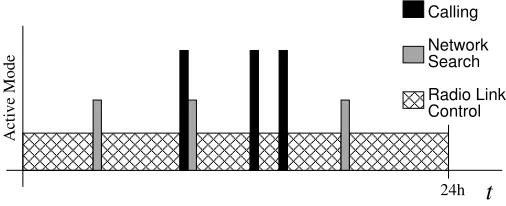
an appropriate resource sharing between tasks. Mode execution probabilities refer to the
activa-tion time of operaactiva-tional modes that are user typical. Consider for instance the typical activaactiva-tion
[image:2.612.190.443.274.377.2]Calling Network Search Control Radio Link
t
24h Active ModeFigure 1: Typical Activation Profile of a Mobile Phone
profile of a mobile phone, which is shown in Figure 1. According to this profile, the phone stays
most of the time in aRadio Link Controlmode, in order to maintain network connectivity. While
theNetwork Search mode and theCalling mode are only active for small periods of the overall
time. The main principle by which the proposed co-synthesis process achieves energy-efficiency
is an implementation trade-off between the different operational modes. In general, modes with
high execution probability should be implemented more energy efficient (e.g., by moving more
tasks to hardware) than modes with a low execution probability. Nonetheless, the implementation
of modes is heavily interrelated, due to the fact that different modes share the same resources
(architecture). For example, mapping an critical task of a highly active mode into
energy-efficient hardware might prohibit to implement a timing-critical task into hardware due to the
restricted hardware area (see motivational example in Section 4). Clearly, a well balanced
imple-mentation of the operational modes is vital for a good system design. In addition, the co-synthesis
approach further reduces the energy dissipation by adapting the system performance to the
par-ticular needs of the active mode, using dynamic voltage scaling (DVS) as well as component
shutdown. That is, instead of wasting energy through over-performance, the computational power
is adapted according to the individual performance requirements of each mode and each task.
order to allow the scaling of hardware processing elements that are capable of executing tasks in
parallel, however, which rely on a single scalable supply voltage source.
The remainder of this paper is organized as follows. Section 2 introduces relevant previous
work. Preliminaries, outlining a new multi-mode specification and an architectural model, are
given in Section 3. Motivational examples exemplify the need for a suitable multi-mode synthesis
approach in Section 4. The problem at hand is formulated in Section 5. Section 6 describes
our multi-mode co-synthesis approach, and Section 7 presents experimental results. Finally, in
Section 8 we draw some conclusions.
2
Previous Work
In the last decade, numerous methodologies for the design of low power consuming embedded
systems have been proposed, including approaches that leverage power management techniques,
such as dynamic power management (DPM) and dynamic voltage scaling (DVS). Nevertheless, a
crucial feature of many modern embedded systems is their capability to execute several different
applications (multi-modes), which are integrated into a single device.
Approaches for the schedulability analysis of systems with several modes of operations can be
found in the real-time research community [31, 26]. However, these approaches solely concentrate
on scheduling aspects (i.e., they investigate if the mode change events fulfil the imposed timing
constraints) and do not address implementation aspects. Three recent approaches have addressed
various problems involved in the design of multi-mode embedded systems [21, 25, 32]. Shin et al.
[32] proposed a schedulability-driven performance analysis technique for real-time multi-mode
systems. They show that it is possible, through a sophisticated performance estimation, to identify
timing-critical tasks, which are active in different operational modes. This identification allows to
improve the execution times of the most crucial tasks, in order to achieve system schedulabilitly.
In their work, the optimization of the identified tasks is up to the designer. For example, reductions
in the execution times can be made by handcrafted code tuning and outsourcing of core routines
into hardware. Kalavade and Subrahmanyam [21] have introduced a hardware/software
partition-ing approach for systems that perform multiple functions. Their technique classifies tasks, found
within similar applications, into groups of task types. The implementation of frequently
appear-ing task types is biased towards hardware. This can be intuitively justified by the fact that costly
hardware implementations are shared across a set of applications, hence, exploiting the allocated
hardware more cost effective. Oh and Ha [25] address the problem in a slightly different way.
Their co-synthesis framework for multi-mode systems is based on a combined scheduling and
mapping technique for heterogeneous multiprocessor systems (HMP [24]). Taking a processor
(PEs) such that the schedulability constraint is satisfied and the system cost is minimized. The
main principle behind all three approaches is to consider the possibility of resource sharing, i.e.,
computational tasks of the same type, which can be found in different modes, utilize the same
implementations. Thereby, multiple hardware implementations of the same task type are avoided,
which, in turn, reduces the hardware cost. Other noticeable approaches are the works by Chung
et al. [11] and Yang et al. [34]. In [11], energy efficiency is achieved by leveraging information
regarding the execution time variations, which is supplied to the mobile terminal by the contents
provider. That is, the performance of the mobile terminal can be influenced directly by the
con-tents provider, in accordance to the processing requirements of the sent content. The approach
presented in [34] uses a two-phase scheduling method. In the first stage, which is performed
off-line (during design time), a Pareto-optimal set of schedules is generated. These schedule provide
different execution time/energy trade-offs. During run-time, a run-time scheduler selects points
along the Pareto set, in order to account for the dynamic behavior of the application. As opposed
to these approaches, the work presented in this paper addresses the design of low energy
consum-ing multi-mode systems that exhibit variations in the mode activation profile; hence, it differs in
several aspects from the previous works. To the authors’ knowledge, there has been no prior work
investigating the co-design problem of energy minimization taking into account mode execution
probabilities. This paper makes the following contributions:
(a) The consideration of mode execution probabilities and their effect on the energy-efficiency
of multi-mode embedded systems is analysed and demonstrated.
(b) A co-design methodology for the design of energy-efficient multi-mode systems is
pre-sented. The proposed co-synthesis maps and schedules a system specification that captures
both mode interaction and mode functionality onto a distributed heterogeneous architecture.
Four mutation strategies are introduced that aid the genetic algorithm-based optimization
process in finding solutions of high quality by pushing the search into promising design
space regions.
(c) Dynamic voltage scaling is investigated in the context of multi-mode embedded systems. A
transformation-based approach is used to tackle the problem of DVS on processing elements
that execute different tasks in parallel, but offer only a single scalable supply voltage source.
3
Preliminaries
This section introduces the functional specification model (Section 3.1) and the architectural model
GSM codec + RLC Ψ1=0.74
Ψ2=0.01
Ψ3=0.02
Ψ4=0.02
Ψ5=0.1
Ψ6=0.01
Ψ7=0.01
Ψ0=0.09
Radio Link Control decode Photo =0.025s HD deQ IDCT Tr. color coeff. 256 256 256 256 RLC =0.015s θ
θ =0.025s
φ
(b) Task Graph of a single Mode
Search
Network RadioLink Control Take
Photo Photo decode
Search + NeworkPhoto
+ RLC + RLC MP3 play MP3 play + Nework Search Network found Network found Network found Network lost Show
Photo ShowPhoto
Incoming Call User request /
Terminate Call audio Play audio Play Terminate Terminate audio audio
Terminate TerminatePhoto
Photo Photo Photo taken taken Take Photo Take Photo decode INIT
(a) Operational Modes
Network lost
Network lost tmax= 30ms tmax= 30ms
tmax= 30ms
4,7
1,2
[image:5.612.110.553.61.268.2]5,6
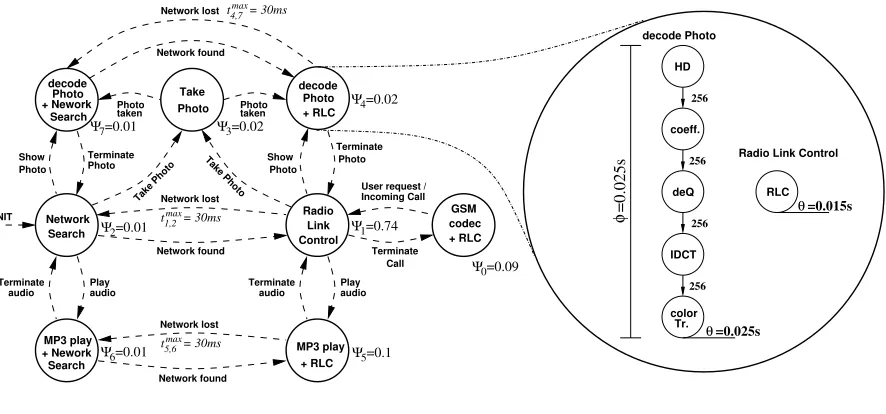
Figure 2: Relation between OMSM and individual task graph specifications
3.1 Functional Specification of Multi-Mode Systems
The abstract specification model used for multi-mode embedded systems consists of two parts.
In précis, it is based on a combination of finite state machines and task graphs, capturing both
the interaction between different operational modes as well as the functionality of each individual
mode. Structurally, each node in the finite state machine represents an operational mode and
further contains the task graphs which are active during this mode. The following two sections
introduce this model, which is henceforth referred to as operational mode state machine (OMSM).
A similar abstract model was mentioned in [17]. However, here this model is extended towards
system-level design and includes transition time limits as well as mode execution probabilities.
The following introduces this model, using the smart phone example shown in Figure 2.
Top-level Finite State Machine
In this work, it is considered that an application is given as a directed cyclic graphϒ(Ω,Θ), which
represents a finite state machine. Within this top-level model, each node O∈Ωrefers to an
op-erational mode and each edge T ∈Θspecifies a possible transition between two different modes.
If the system undergoes a change from mode Ox to mode Oy, where x6=y, the transition time
tTmax associated with the transition edge T = (Ox,Oy)has to be met. For instance, as indicated in
Figure 2(a), upon losing the network connection the system needs to activate theNetwork Search
mode within 30ms. Such transition overheads can originate from the reconfiguration of FPGAs
as well as from loading the application software of the particular mode into the local PE memory.
exemplify the proposed model consider Figure 2(a). This figure shows the operational mode state
machine for a smart phone example with eight different modes. A possible activation scenario
could look like this: When switched on, the phone initialises intoNetwork Searchmode. The
sys-tem stays in this mode until a suitable network has been found. Upon finding a network the phone
undergoes a mode change toRadio Link Control (RLC). In this mode it maintains the connection to
the network by handling cell hand-overs, radio link failure responses, and adaptive RF power
con-trol. An incoming phone call necessitates to switch the system intoGSM codec + RLCmode. This
mode is responsible for speech encoding and decoding, while simultaneously maintaining network
connectivity. Similarly, the remaining modes have different functionalities and are activated upon
mode change events. Such events originate upon user requests (e.g. MP3-player activation) or are
initiated by the system itself (e.g. loss of network connection necessitates to switch the system
into network search mode). Furthermore, based on the key observation that many multi-mode
systems spend their operational time unevenly in each of the modes, an execution probabilityΨO
is associated with each operational mode O, i.e., it is known what percentage of the operational
time the device spends in each mode. For instance, in accordance to Figure 2, the smart-phone
stays 74% of this operational time inRadio Link Control (RLC)mode, 9% inGSM codec + RLC
mode, and 1% inNetwork Searchmode. The remaining 16% of the operation time are associated
with the remaining modes. In practice the mode probabilities vary from user to user, depending
on the personal usage behavior. Nevertheless, it is possible to derive an average activation profile
based on statistical information collected from several different users. Taking this information
into account will prove to be important when designing systems with a prolonged battery lifetime.
It is interesting to note that different operational modes do not necessarily correspond to
differ-ent functionalities of the system. For example, alternative modes can be used to model the same
functionality under different working conditions (such as different workloads). For instance, in
order to account for variations in the wireless channel quality, we could exchange the GSM voice
transcoder mode O0in Figure 2(a) with three transcoder schemes, each responsible for the coding
at a different signal-to-interference ratio (SIR) on the channel. During run-time the appropriate
transcoder scheme would be selectively activated, depending on the actual channel quality.
Functional Specification of Individual Modes
The functional specification of each operational mode O∈Ωin the top-level finite state machine
is expressed by a task graph GOS(
T
,C
). This relation is shown in Figure 2. Each nodeτ∈T
O ina task graph represents a task, i.e., a fragment of functionality that needs to be executed without
preemption. The level of granularity is coarse, i.e., tasks refer to functions such as Huffman
de-coder, de-quantizer, FFT, IDCT, etc. Therefore, each task is further associated with a task type
MEM
MEM ASIC
Interface
DVS−Contr.
CPU
Interface
DSP
BUS
SW C1: FFT
C2: HD C3: IDCT C4: Color Trans.
C5: DeQ C6: STP C7: LTP HW
Interface C5
C6 C7
C2
C4
DVS−Contr.
C1
C3 Interface
[image:7.612.234.405.61.200.2]FPGA Cores
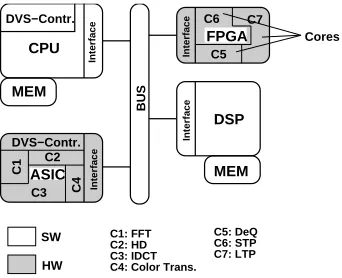
Figure 3: Distributed Architectural Model
setsΓO⊆Γof different modes O∈Ωcan intersect, i.e., tasks of same type are executed in
dif-ferent modes. Such modes can share the same hardware resource (inter-mode sharing). Resource
sharing is also possible for multiple tasks of identical type that are found in a single mode
(intra-mode sharing); however, due to task communalities among different (intra-modes, the chances to share
resources are increased. Further, tasks might be annotated with deadlines θτ (withτ∈
T
O) bywhich the execution has to be finished, in order to guarantee correct functioning. Similarly, the
whole task graph has to be successively repeated according to a periodφO. Edgesγ∈
C
in the taskgraph refer to precedence constraints and data dependencies between the computational tasks, i.e.,
if two tasks,τiandτj, are connected via an edge, then taskτimust be finished and transfer data to
taskτj, beforeτjcan be executed. A feasible implementation of a certain mode O needs to respect
all task deadlinesθ, task graph periodφ, and precedence relations.
3.2 Architectural Model and System Implementation
The proposed system-level synthesis approach targets distributed architectures that possibly
con-sist of several heterogeneous processing elements (PEs), such as general-purpose processors (GPPs),
application-specific instruction set processors (ASIPs), ASICs, and FPGAs. These components are
connected through an infrastructure of communication links (CLs). A directed graph GA(
P
,L
)captures such an architecture, where nodesπ∈
P
and edgesλ∈L
denote PEs and CLs,respec-tively. Figure 3 shows an architecture example. Since each task might have multiple
implemen-tation alternatives, it can be potentially mapped onto several different PEs that are capable of
performing this type of task. Tasks mapped to software-programmable components (i.e., GPP or
ASIP) are placed into local memory. However, if a task is mapped to a hardware component (i.e.,
ASIC or FPGA), a core for this task type needs to be allocated. A feasible solution needs to obey
the imposed area constraints, i.e., only a restricted number of cores can be implemented on
hard-ware components. The subdivision of hardhard-ware components (ASICs and FPGAs) into hardhard-ware
time. Tasks assigned to GPPs or ASIPs (software tasks) need to be sequenced, whilst the tasks
mapped onto FPGAs and ASICs (hardware tasks) can be performed in parallel if the necessary
resources (cores) are not already engaged. However, contention between two or more tasks
as-signed to the same hardware core requires a sequential execution order, similar to software tasks.
Cores implemented on FPGAs can be dynamically reconfigured during a mode change, involving
a time overhead, which needs to respect the imposed maximal mode transition times tTmax. Further,
PEs might feature dynamic voltage scaling to enable a trade-off between power consumption and
performance that can be exploited during run-time. The relation between the dynamic power
dis-sipation Pdynand the circuit delay d (inverse proportional to performance) can be expressed using
the following two equations [7, 10].
Pdyn=Ce f f·Vdd2 ·f and d∝1/f =k·
Vdd
(Vdd−Vt)α
where Ce f f is the effectively switched capacitance, Vdddenotes the circuit supply voltage, f
repre-sents the clock frequency, k andαare a circuit dependent constants, and Vt denotes the threshold
voltage. As we can see from these equations, by varying the circuit supply voltage Vdd, it is
pos-sible to trade off between power consumption and performance. In reality, DVS processors are
often restricted to run at discrete voltage levels [5, 6]. Therefore, a set
Vπ
specifies the availablediscrete voltages of DVS-PEπ. For such PEs a voltage schedule needs to be derived, in addition
to a timing schedule. To implement a multi-mode application captured as OMSM, the tasks and
communications of all operational modes need to be mapped onto the architecture, and a valid
schedule for these activitiesε∈
A
, whereA
=T
∪C
, needs to be constructed. As mentionedabove, for tasks mapped to DVS-enabled components an energy reducing voltage schedule has to
be determined. According to these aspects, an implementation candidate can be expressed through
four functions, which need to be derived for each operational mode O∈Ω:
Task mapping: MτO:
T
→P
Communication mapping: MγO:
C
→L
Timing schedule: SOε :
A
→R+0Voltage schedule: VτO:
T
DV S→Vπ
where MτOand MOγ denote task and communication mapping, respectively, assigning tasks to PEs
and communications to CLs. Activity start times are specified by the scheduling function SO
ε, while
VτOdefines the voltage schedule for all tasksτ∈
T
DV Smapped to DVS-PEs, whereVπ
is the set ofthe possible discrete supply voltages of PEπ. Clearly, the mappings as well as the corresponding
Ψ =0.11 Ψ =0.92
η1=A
η2=B
η3=C
η4=D
O1 O2
τ3 τ2 τ1 η 6=F η 5=E τ4 6
τ5 τ
(a) Application specified by two interacting modes
τ1 τ2 τ3 τ4 τ5 τ6 O2
O1
τ1 τ2 τ3 τ4 τ5 τ6 O2 O1 τ1 τ2 τ3 A B C D E F τ4 τ6 τ5
(b) Optimised without mode consideration τ1 τ4 τ2 τ3 τ6 τ5 A C B D E F
(c) Optimised with mode consideration
area=60
PE1
Mapping
String (PE): MappingString (PE):
area=60
PE1
PE2 PE2
1 1 1 1 2 2 1 1 2 1 2 1
CL1
CL1
[image:9.612.133.462.58.229.2]Mode: Mode:
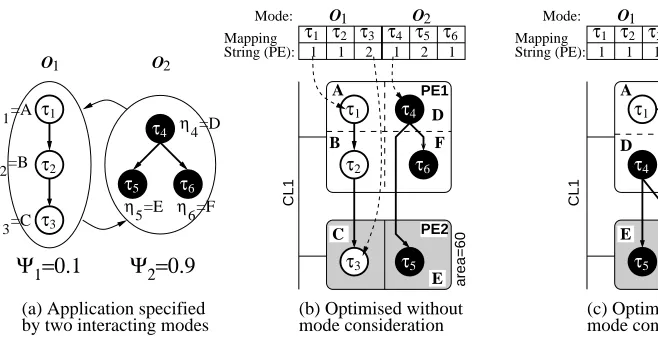
Figure 4: Mode execution probabilities
Oy, the execution of activities found in mode Ox are finished, and the activities of mode Oy are
activated.
4
Motivational Examples
The aim of this section is to motivate the key ideas behind the new multi-mode co-synthesis, that is,
the consideration of mode execution probabilities and multiple task type implementations. First,
the influence of mapping in the context of multi-mode embedded systems with different mode
execution probabilities is demonstrated. Second, it is illustrated that multiple task implementations
can help to reduce the energy dissipation of multi-mode embedded systems.
Example: Mode Execution Probabilities
For simplicity, timing and communication issues are neglected in the following example.
Con-sider the application shown in Figure 4(a), which consists of two operational modes, O1 and
O2, each specified by a task graph with three tasks. The system spends 10% of its operational
time in mode O1 and the remaining 90% in mode O2, i.e., the execution probabilities are given
by Ψ1 =0.1 and Ψ2 =0.9. The specification needs to be mapped onto a target architecture
built of one general-purpose processor (PE1) and one ASIC (PE2), linked by a bus (CL1).
De-pending on the task mapping to either of the components, the execution properties of each task
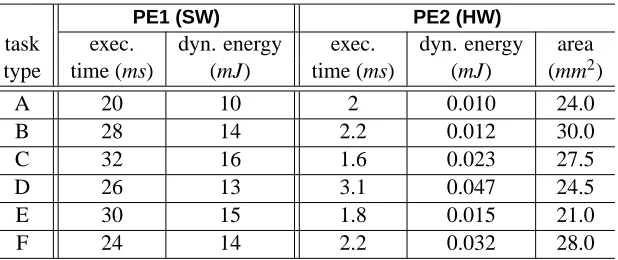
are shown in Table 1. In general, hardware implementations of tasks achieve a higher
perfor-mance and are more energy efficient [8]. It can be observed that all tasks are of different type,
therefore, if a task is mapped to HW, a suitable core needs to be allocated explicitly for that
task. Hence, in this particular example, no hardware sharing is considered. Each allocated
core uses area on the hardware component that offers 60mm2, i.e., at most 2 cores can be
PE1 (SW) PE2 (HW)
task exec. dyn. energy exec. dyn. energy area
type time (ms) (mJ) time (ms) (mJ) (mm2)
A 20 10 2 0.010 24.0
B 28 14 2.2 0.012 30.0
C 32 16 1.6 0.023 27.5
D 26 13 3.1 0.047 24.5
E 30 15 1.8 0.015 21.0
[image:10.612.167.476.61.191.2]F 24 14 2.2 0.032 28.0
Table 1: Task execution and implementation properties
that although the two modes execute mutually exclusive, the task types implemented in
hard-ware (HW cores) cannot be changed during run-time, since their implementation is static
(non-reconfigurable ASIC); as opposed to software-programmable components. Consider the mapping
shown in Figure 4(b) in which the highest energy consuming tasks (τ3andτ5, when implemented
in software) are executed using a more energy-efficient hardware implementation. According to
the task energy dissipations given in Table 1, the energy dissipation during modes O1 and O2
are E1=10mJ+14mJ+0.023mJ=24.023mJ and E2=13mJ+0.015mJ+14mJ=27.015mJ.
Neglecting the mode execution probabilities by assuming that both modes are active for even
amounts of time (50% mode 01 and 50% mode O2) energy consumption can be calculated as
Ee =0.5·24.023mJ+0.5·27.015mJ=25.519mJ. Nevertheless, taking the real behavior into
account, mode O1 is active for 10% of the operational time, i.e., its energy dissipation can then
be calculated as Er1=0.1·24.023mJ=2.4023mJ. Similarly, mode O2 is active 90% of the
op-erational time, hence, its energy is given by Er2=0.9·27.015mJ=24.3135mJ. Thus, the real
energy dissipation results in Er=Er1+Er2=26.7158mJ. Now consider an alternative mapping,
shown in Figure 4(c), for the same task graphs. In this configuration tasksτ5andτ6, i.e., the most
energy dissipating tasks of the highly active mode O2, use energy-efficient hardware
implementa-tions on PE2, while taskτ3of the less active model O1is shifted into the software-programmable
processor (PE1). According to this solution, the energy consumptions of modes O1 and O2 are
given by E1=10mJ+14mJ+16mJ=40mJ and E2=13mJ+0.015mJ+0.032mJ=13.047mJ.
Considering the even execution of each mode (neglecting the execution probabilities), the energy
consumption can be calculated as 0.5·40mJ+0.5·13.047mJ=26.524mJ. Note that this value is
higher than the corresponding energy of the first mapping (Ee=25.519mJ). Thus, a co-synthesis
approach that neglects the mode execution probabilities would optimize the system towards the
first mapping. However, in real-life the modes are active for different amount of time and hence
the real energy dissipation is given by Er=0.1·40mJ+0.9·13.047mJ=15.7423mJ. This is
41% lower compared to the first mapping (Er=26.7158mJ) shown in Figure 4(b), which is not
τ1
τ2
τ3
τ1 τ2 τ3 τ4 τ5 τ6
O2
O1
η=D 5 η6=E
η=A 1 η=B 2 η=C 3
O1 O2
τ3
τ2
τ1
η=A 4
τ1 τ2 τ3 τ4 τ5 τ6
O2 O1 τ2 τ3 A D E B
τ5 τ6
τ4
C
τ4
τ5 τ6
(a) Application with resource sharing possibility
(b) Resource sharing, but no shut−down possible
A D E
B
τ1
A
τ5 τ6
τ4
C (c) No resource sharing, but component shut−down
Mapping Mapping
String (PE): String (PE):
PE1
PE2 PE2
PE1
2 1 2 2 1 1 2 1 2 1 1 1
CL1 CL1
[image:11.612.129.506.58.241.2]Mode: Mode:
Figure 5: Multiple task type implementations
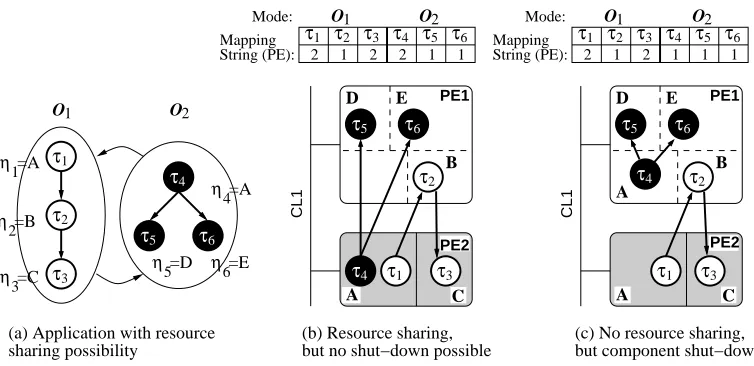
to switch off PE2 and CL1 during mode O1, since all tasks of this mode are assigned to PE1. This
results in a significant reduction of the static power, additionally increasing the energy savings.
Example: Multiple Task Type Implementations
An important characteristic of multi-mode systems is that tasks of the same type might be found
in different modes, i.e., resources can be shared among the different modes in a time-multiplexed
fashion. To increase the possibility of component shutdown, it might be necessary to implement
the same task type multiple times, however, on different components. The following example,
shown in Figure 5, clarifies this aspect. Here tasks τ1 and τ4 are of type A (see Figure 5(a)),
allowing resource sharing between these tasks. The sharing is possible without contention due to
the mutual exclusive execution of these tasks (only one mode is active at a given time). In the first
mapping, given in Figure 5(b), both tasks utilize the same HW core. However, implementing task
τ4in software (additional task type A on PE1), as shown in Figure 5(c), allows to shut down PE2
and CL1 during the execution of mode O2. Hence, multiple implementations of task types can
help to reduce power dissipation.
These two examples have demonstrated that it is essential to guide the synthesis process by:
(a) an energy model that takes into account the mode execution probability as well as (b) allowing
multiple task implementations.
5
Problem Formulation
The goal of our co-synthesis approach is an energy-efficient implementation of application ϒ,
which modeled as OMSM, such that timing and area constraints are satisfied. This involves the
under the consideration of static and dynamic power as well as mode execution probabilities.
Al-though static power consumption is often neglected in system-level design approaches, since until
recently dynamic power has been the dominating power dissipation, emerging sub-micron
tech-nologies with reduced threshold voltage levels show increased leakage currents that are becoming
comparable to the dynamic currents [9]. In multi-mode systems this static power consumption can
have a significant impact on the overall energy efficiency. The reasons for this are the different
per-formance requirements of the various operational modes. For instance, the minimal perper-formance
requirements of the hardware architecture are imposed by the most computational intensive mode,
i.e., the minimal allocated architecture has to provide enough computational power to execute this
performance critical mode. However, the allocated architecture might be far more powerful than
actually needed for the execution of modes with low performance requirements. Furthermore,
low performance modes, such as the standby-mode of mobile phones (i.e., Radio Link Control),
often account for the greatest portion of the system time. During such circumstances, the static
energy dissipation of unnecessarily switched-on PEs and CLs can outweigh the dynamic energy
consumption caused by tasks of a "lightweight" mode. Thus, switching-off the unneeded
compo-nents becomes an important aspect particularly in multi-mode embedded systems. In accordance,
an accurate estimation of the average power consumption of an implementation alternative should
consider both static and dynamic power, and further the mode execution probabilities. The average
power consumption ¯p can be expressed using the following equation:
¯
p=
∑
O∈Ω
(POstat+POdyn)·ΨO (1)
where POstat, POdyn, andΨOrefer to the static power dissipation, the dynamic power dissipation, and
the execution probability of mode O, respectively. The static and dynamic power consumptions
are given as:
POstat=
∑
ξ∈KO
Pstat(ξ) (2)
and
POdyn=
∑
ε∈AO
Edyn(ε)
!
· 1
hpO
(3)
where Pstat(ξ)refers to the static power consumption of a componentξ, which is found in the set
of all active components
K
O⊆(P
∪L
)of mode O. Please note that this static power consumptionalso includes the additional power required for the DC/DC converter of voltage-scalable
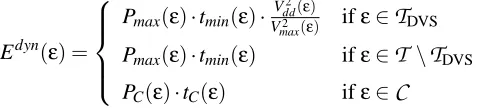
respect to the type of activities, the dynamic energy consumption Edyn(ε)can be calculated as:
Edyn(ε) =
Pmax(ε)·tmin(ε)·
V2
dd(ε)
V2
max(ε) ifε∈
T
DVSPmax(ε)·tmin(ε) ifε∈
T
\T
DVSPC(ε)·tC(ε) ifε∈
C
(4)
where Pmaxis the dynamic power consumption and tminthe execution time of tasks when executed
at nominal supply voltage Vmax. Tasksτ∈
T
DVSmapped to DVS-PEs can execute at a scaled supplyvoltage Vdd, resulting in a reduced energy consumption. Further, communications consume power
PCover a time tC. If the DVS-enabled processors are restricted to a limited set of discrete voltages,
the continuous selected supply voltage Vdd is split into its two neighboring discrete voltages Vlow
and Vhigh. The corresponding execution times in each voltage are calculated as given in [28]. The
mode execution probabilities used in Equation (1) are either based on approximations or statistical
information collected from several real users. In the case that statistical information is available
from a set of different users U , the average execution probabilities ΨO of a single operational
mode O∈Ωcan be calculated.
The co-synthesis goal is to find a task mapping MτO, a communication mapping MγO, a starting
time schedule SεO, as well as a voltage schedule VτOfor each operational mode O, such that the total
average power ¯p, given in Equation (1), is minimized and the deadlines are satisfied. Furthermore,
a feasible implementation candidate needs to fulfill the following requirements:
(a) The mapping of tasks MOτ does not violate area constraints in terms of memory and hardware
area, i.e.,(∑η∈Γπaη)≤amaxπ , ∀π∈
P
; whereΓπis the set of all task types implemented onPEπ, and aη and amaxπ refer to the area used by task type ηand the available area on PE
π, respectively. Please note that for DVS-enabled HW, amaxπ represents the available area including the area overhead required for the DC/DC converter.
(b) The timing schedule SOε and the voltage schedule VτO, based on task and communication
mapping, do not exceed any task deadlinesθτor task graph repetition periodsφO, therefore,
tS(τ) +texe(τ)≤min(θτ,φ), ∀τ∈
T
; where tS(τ) and texerefer to task start time and taskexecution time (potentially based on voltage scaling).
(c) The system reconfiguration time tT between mode changes does not exceed the imposed
maximal mode transition times tTmax. Hence, tT ≤tTmax, ∀T ∈Θneeds to be respected for
all mode transitions.
[image:13.612.197.449.94.149.2]6
Co-Synthesis of Energy-Efficient Multi-Mode Systems
Power, Performance, Cost Evaluation
01010100101 01010001001 00100101000 01001000101 01010001001 ProbabilitiesExecution
Task & Comm. execution estimation/ profiling Allocation
Architecture
SYSTEM−LEVEL CO−SYNTHESIS
Communication Mapping
Schedulingand
Inner Loop
Outer Loop
User Driven
Dynamic Voltage Scaling and Core Allocationand Task Mapping
(OMSM) Specification
Component Shutdown
New Product Integration Hardware
Components ApplicationSoftware
Library Technology
Step 1
Step 2
Step 3
Step 4
[image:14.612.214.423.62.354.2]Step 5
Figure 6: Multi-Mode Embedded Systems Design Flow
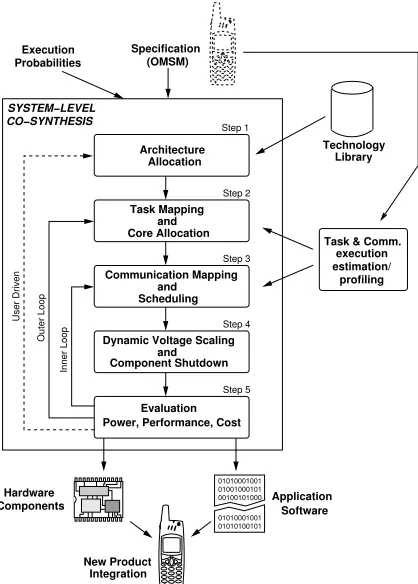
design flow is primarily based on two nested optimization loops. The outer loop optimizes task
mapping and core allocation, while the inner loop is responsible for the combined optimization of
communication mapping and scheduling. Although we concentrate in this paper on task mapping
and core allocation, we will outline briefly this overall design flow. As we can observe from
Figure 6, an initial system specification has to be translated into the final hardware and software
implementations. In our approach the specification includes information regarding the execution
probabilities. Along the design flow we can identify five major synthesis steps:
(1) An adequate target architecture needs to be allocated, i.e., it is necessary to determine the
quantity and the types of the different interconnected components (processing elements and
communication links). Available components are specified in the technology library.
(2) The tasks of the system specification and the require communications have to be uniquely
mapped among the allocated components. Based on the component to which a tasks has
been mapped its execution properties are determined, based on previously established
ex-ecution estimations and profiling. Furthermore, hardware cores are allocated based on the
available hardware area and the application parallelism.
(3) According to the task mapping, the communications are mapped onto the allocated
deadline, while, at the same time, achieve a good slack distribution in order to reduce
en-ergy via DVS.
(4) Dynamic voltage scaling and components shutdown possibilities are exploited to reduced
the system energy consumption.
(5) The system implementation candidates, specified by the synthesis steps 1–4, are evaluated
in terms of power consumption, performance (deadline satisfaction), cost (architecture and
hardware area). This step is used to provide feedback to the previous synthesis steps in order
to refine the design.
For more information we refer the interested reader to [30, 28, 29]. A major goal of this
de-sign flow, is to support the system dede-signer with a methodology that aids to find suitable target
architectures for a given system specification.
In this paper we concentrate on the task mapping and core allocation step, since the scheduling
and communication mapping can be carried with standard single mode techniques (e.g., [18, 29]).
This is due to the fact that the modes are executing mutually exclusive. Thus, here we present
new techniques and algorithms for task mapping, hardware core allocation, and dynamic voltage
scaling that suit the particular problems of multi-mode embedded systems. However, since these
approaches are targeted towards the exploitation of mode execution probabilities, we first discuss
how such probabilities can be obtained in practice.
6.1 Estimation of Mode Execution Probabilities
As we have demonstrated in the motivational example of Section 4, the consideration of mode
execution probabilities during design time can help to significantly reduce the energy consumption
of the embedded system. Certainly, to achieve a good design it is necessary that the execution
probabilities (estimations) used during design time reflect the real usage probabilities (in-field)
accurately. In the following, we outline how to obtain adequate execution probabilities using two
different design scenarios:
(a) The new design is an upgrade of an existing product which is connected to a service provider
(e.g. a new version of a mobile phone). For such product types it is possible to use
informa-tion regarding the activainforma-tion profile that has been collected on the provider side during the
operation of the previous product generation. For instance, the cellular network base
sta-tions can record the activation profile of the mobile terminals (e.g. phones) regarding radio
link control and calling mode, directly in-field. This information could then be evaluated
(b) The product is a completely new design. In this situation, it is common practice to evaluate
the market acceptance before the final product is introduced using a limited number of
pro-totypes that are distributed among a set of evaluation users. During this evaluation phase, the
prototypes can gather information regarding the activation profile. This information could
then be used during the final design of the product to optimize the energy consumption. Of
course, it is also possible to use application-specific insight of the designer to estimate the
execution probabilities. As we will show in the experiments given in Section 7.1, even if the
estimated execution probabilities do not reflect the user activation with absolute accuracy,
but are sufficiently close to the real values, energy savings can be still achieved.
6.2 Multi-Mode Co-Synthesis Algorithm
The task mapping approach, which simultaneously determines Mτ for all modes of application
ϒ, is driven by a genetic algorithm (GA). GAs optimize a population of individuals over several generations by imitating and applying the principles of natural selection. That is, the GA
iter-atively evolves new populations by mating (crossover) the fittest individuals (highest quality) of
the current population pool until a certain convergence criterion is met. In addition to mating,
mutation, i.e., the random change of genes in the genome (string), provides the opportunity to
push the optimization into unexplored search space regions. GA-driven task mapping approaches
have already been shown to provide a powerful tool in derive mappings for single modes systems
[16, 28]. Here we enhance such approaches towards multi-mode aspects. These enhancements
include the consideration of resource sharing, component shutdown, and mode transition issues.
As opposed to the single mode task mapping strings, such strings for multi-mode specifications
combine the mapping strings of each operational mode into one larger task mapping string, as
shown in Figure 7. Within this string each number represents the PE to which the corresponding
task is assigned. This encoding enables the usage of a genetic algorithm to optimize the placement
of tasks across the processing elements that form the distributed architecture. Please note that this
representation supports the implementation of multiple task types. For instance, if two tasks of
the same type are mapped onto different PEs, these tasks are implemented on both PEs. Thereby,
the possibility of multiple task implementations is mainly inherited into the genetic mapping
algo-rithm which is guided by a cost function that accounts for the multiple task implementations, i.e.,
the GA trades off between the savings in static power consumption against the increase dynamic
power.
The goal of the co-synthesis is to find a mapping of tasks that minimizes the total power
consumption and obeys the performance constraints. Figure 8 outlines the pseudo-code of our
co-synthesis algorithm. Starting from an initial random population of multi-mode task mapping
PE0 A B C D E F τ4 τ6 τ5 PE1 CL0 τ1 τ2 τ3 PE0 A B C D E F PE1 CL0
η4=D
τ1 τ2 τ3 τ4 τ5 τ6 η1=A
η2=B
η3=C τ3
Multi−Mode Task Mapping String η5=E
τ4
6
τ5 τ
PE Mode2 Mode1 0 1 0 0 1 0
η6=F τ2
[image:17.612.192.446.61.258.2]τ1
Figure 7: Task mapping string for multi-mode systems
Algorithm: MULTI-MODE-SYN
Input: - OMSM (finite state machine + task graphs), Technology
Library, Allocated Architecture
Output:- Outer loop: Core Allocation, Task Mapping
- Inner loop: Communication Mapping, Scheduling, Scaled Voltages
01: Pop=CreateInitialPopulation // randomly
02:while(NoConvergence(Pop))
03: forallmap∈Pop
04: mob=ComputeMobilities(map) // ASAP & ALAP
05: cores=ImplementHWcores(map,mob)
06: ap=CalcAreaPenalty(map,cores)
07: PstatPE=CalcStaticPowerPE
08: trp=CalcTransitionPenalty(cores)
09: forallmode∈Ω
10: CommMapping_Scheduling(mode) // inner loop
11: tp(mode)=CalcTimingPenalty(mode)
12: Pdyn(mode)=CalcDynPower(mode) // incl. DVS
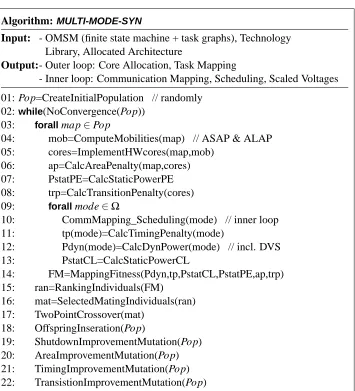
13: PstatCL=CalcStaticPowerCL 14: FM=MappingFitness(Pdyn,tp,PstatCL,PstatPE,ap,trp) 15: ran=RankingIndividuals(FM) 16: mat=SelectedMatingIndividuals(ran) 17: TwoPointCrossover(mat) 18: OffspringInseration(Pop) 19: ShutdownImprovementMutation(Pop) 20: AreaImprovementMutation(Pop) 21: TimingImprovementMutation(Pop) 22: TransistionImprovementMutation(Pop)
[image:17.612.144.499.286.677.2]criterion is based on the diversity in the current population and the number of elapsed iterations
without producing any improved individual. To judge the quality of mapping candidates, i.e., the
fitness which guides the genetic algorithm, it is necessary to estimate important design objectives,
including static and dynamic power dissipation, area usage, and timing behavior (lines 03–13).
The following explains each of the required estimations. The hardware area depends on the
allo-cated cores on each hardware component (ASIC or FPGA). Of course, for each task type mapped
to hardware at least one core of this type needs to be allocated. However, if too many cores are
placed onto a single ASIC or FPGA, the available area is exceeded and an area penalty is
intro-duced (line 6). On the other hand, if multiple tasks of the same type are mapped to the same
hardware component and the hardware area is not violated, it is possible to implement cores
mul-tiple times (if helpful for the energy reduction). In the proposed approach, additional cores (line 5)
are allocated for parallel tasks with low mobility (line 4), therefore, the chance to exploit
applica-tion parallelism is increased. The mobility of a tasks is the difference between its earliest possible
start time and its latest possible start time [33]. Clearly, from an energy point of view this is also
preferable, especially in the presence of DVS, where a decreased execution time results in more
slack that can be exploited. Section 6.3 describes the core allocation in more detail. At this point
it is possible to compute the static power consumption of the implementation (line 7), taking into
account component shutdown between different modes. Components can be shut down during
the execution of a certain mode whenever no tasks belonging to that mode are mapped onto these
components, i.e., the component is vacant (for instance, PE0 during execution of mode O2in
Fig-ure 5). Another important aspect is the reconfigurability of FPGAs which allows to exchange the
implemented cores to suit the active mode. However, this reconfiguration during a mode change
takes time, hence, a transition penalty is introduced if the maximal transition times are exceeded
(line 8). Having determined the cores to be implemented (line 5), it is now also possible to
sched-ule each mode of the application and to derive a feasible communication mapping (line 10). Since
the modes are mutually exclusive, it is possible to employ a communication mapping and
schedul-ing optimization for a sschedul-ingle mode system. In our approach we utilize the technique described
in [28] for this step. If timing constraints are violated by the found schedule, a timing penalty is
introduced (line 11). Furthermore, based on the communication mapping and scheduling, the
dy-namic power consumption of the application can be computed, taking into account DVS (line 12)
if voltage-scalable components are present. Similarly to the shutdown of PEs, it is also possible to
switch off a CL when no communications are mapped to that link (line 13), therefore, further
re-ducing the static power consumption of the system. Based upon all estimated power consumptions
and penalties, a fitness is calculated (line 14) as,
FM=p¯·t p·(1+wA·
∑
π∈Pv
(aUπ−amaxπ )/(amaxπ ·0.01))·(wR·
∏
T∈Θv
where the average power dissipation ¯p is given by Equation (1) and t p introduces a timing penalty
if the schedule exceeds task deadlines or the repetition period. Further, an area penalty is applied
for all PEs with area violation
P
v by relating used area aUπ and area constraint amaxπ . Similarly, atransition time penalty is applied for all transitionsΘv that exceed their maximal transition time
limit, i.e., transition time tT exceeds the maximal allowed transition time tTmax. Both area and
transition penalty are weighted (wA and wR), which allows to adjust the aggressiveness of the
penalty. Having assigned a fitness to all individuals of the population, they are ranked using linear
scaling (line 15). A tournament selection scheme is used to pick individuals (line 16) for mating
(line 17). The produced offsprings are inserted into the population (line 18).
In order to improve the performance of the genetic algorithm, we apply four genetic mutation
strategies that add problem specific knowledge into the optimization process (lines 19–22). This
is achieved by introducing a small number of mutated individuals into the current population
whenever the optimization process occurs to be trapped. These newly injected solution candidates
provide the potential to turn into high quality solution by mating with other solution. The mutation
strategies are introduced next.
Shutdown Improvement: To increase the chances of component shutdown, which leads to a
reduction of static power consumption, the genetic task mapping algorithm employs a
sim-ple yet effective strategy during the optimization. Out of the current population randomly
picked individuals (probability 2% was found to lead to good results) are modified as
fol-lows. A single mode Ox and a non-essential PE πa are selected. Non-essential PEs are
considered to be PEs that implement task types that have alternative implementations on
other PEs, hence, they are not fundamental for a feasible solution. Our goal is to switch
off PE πa during the execution of mode Ox. Therefore, all tasks of mode Ox which are
mapped toπaare randomly re-mapped to the remaining PEs (
P
\πa), hence, PEπacan beshut down during mode Ox. Of course, only feasible mappings are allowed, i.e., tasks are
always mapped randomly to the PEs that are capable of executing this kind of task type.
Area Improvement: To avoid convergence towards area infeasible solutions, a second strategy
is employed. If only infeasible area mappings have been produced for a certain number of
generations, the search is pushed away from this region by randomly re-mapping hardware
tasks onto software-programmable PEs.
Timing Improvement: In contrast to the area improvement strategy, if a certain amount of
tim-ing infeasible solutions have been produced, software tasks are randomly mapped to faster
hardware implementations. Thereby, the chance to find timing feasible implementations is
Transition Improvement: Cores implemented in FPGAs can be dynamically reconfigured.
How-ever, this involves a time overhead. If this overhead exceeds the imposed transition time
limits, the mapping is infeasible. Hence, after generating for a certain number of
genera-tions solely solugenera-tions that violate the transition times, tasks are randomly re-mapped away
from the FPGAs that cause the violations.
Although some of the produced genomes (strings) might be infeasible in terms of area and
timing behavior, all these strategies have been found to improve the search process significantly by
introducing individuals that evolve into high quality solutions. For instance, running the synthesis
process (on examples of moderate size) without the shutdown improvement strategy often results
in implementations which do not exploit this energy reduction possibility.
6.3 Hardware Core Allocation
For tasks mapped to ASICs and FPGAs it is necessary to allocate hardware cores that are capable
of executing the task types. This is a trivial job as long as only tasks of different types are mapped
to the same hardware component, i.e., when a single core for each task needs to be allocated.
Nev-ertheless, if tasks of the same typeηare assigned to the same PE more than once, it is necessary to
make a decision upon how many core of typeηneed to be implemented. This is important because
hardware cores are able to execute tasks in parallel, i.e., the right quantitative choice of cores can
efficiently help to exploit application parallelism, hence, improve the timing behavior as well as
energy dissipation. In the proposed co-synthesis, the following approach is employed during the
schedule optimization. Initially, each task type assigned to hardware is implemented only once,
even if multiple tasks of this type are mapped onto the same PE. This ensures that all hardware
tasks have at least one executable core implementation. If the hardware area constraints are not
violated through the initial allocation, additional cores are implemented as follows. The tasks are
analysed to identify possibly parallel executing task, taking into account task dependencies. These
tasks are then ordered according to their mobility. Clearly, tasks with low mobility are more likely
to improve the timing behavior and therefore should be the preferred choice when implementing
additional hardware cores. Accordingly, cores for task with low mobility are implemented as long
as the area constraints of the hardware components are not violated. Note that this strategy
poten-tially improves the dynamic energy dissipation, since it is probable to result in more slack time,
which, in turn, can be exploited through DVS.
6.4 Dynamic Voltage Scaling for Multiple Parallel Executing Tasks
Dynamic voltage scaling is a powerful technique to reduce energy consumption by exploiting
voltage of PEs. The applicability of DVS to embedded distributed systems was demonstrated
in [18, 22, 27]. However, these works concentrate on dynamically changing the performance of
software PEs only, while parallel execution of tasks on hardware resources has been neglected.
Nevertheless, in the context of energy-efficient multi-mode systems, where performance
require-ments of each operational mode can vary significantly, DVS needs to be considered carefully.
Consider, for instance, an inverse discrete cosine transformation (IDCT) algorithm implemented
in fast hardware which is used during two modes: MP3 decoding and JPEG image decoding.
Clearly, the JPEG decoder should restore images as quickly as possible, i.e., the IDCT hardware
is required to execute at maximal supply voltage (equivalent to peak performance). On the other
hand, the MP3 decoder works at a fixed repetition rate of 25ms for which the hardware
imple-mentation operates faster than necessary, i.e, the IDCT performance can be reduced such that this
repetition rate is adequately met. By using DVS it is possible to adapt the execution speed to suit
both needs and to reduce the energy consumption to a minimum. Here we consider that
hard-ware components might employ DVS. However, due to the area and power overhead involved in
additional DVS circuitry (DC/DC-converter [23, 15]) it is assumed that all cores allocated to the
same hardware component are fed by a single voltage supply, i.e., dynamically scaling the supply
voltage simultaneously affects the performance of all cores on that hardware component.
The new technique presented here enables an efficient usage of existing DVS approaches
[18, 22, 27] to handle the case of dynamic voltage scaling on hardware components that
exe-cute tasks in parallel. To cope with this problem, the potentially parallel executing tasks on a
single voltage-scalable hardware resource are transformed into an equivalent set of sequentially
executing tasks, taking into account the dynamic power dissipation on each core. Note that this is
done to calculate the scaled supply voltages only, i.e., this virtual transformation does not affect
the real implementation. In this section we highlight solely our transformational-based approach,
while we refer the interested reader to [18, 22, 27], where different voltage scaling techniques are
described in detail.
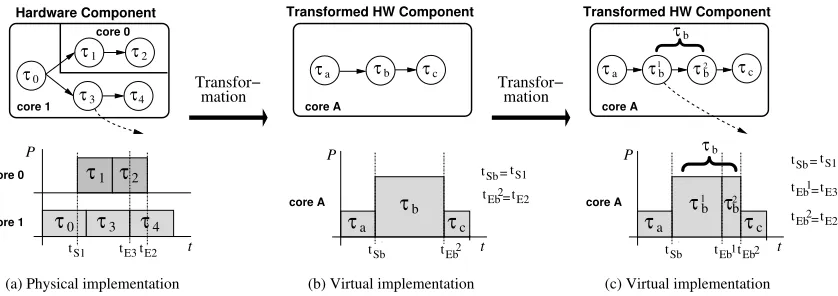
The following example illustratively outlines the proposed transformation approach. Figure 9
shows the transformation of five hardware tasks, executing on two cores (both cores are
imple-mented within the same hardware component), to four sequential tasks on a single core. The given
schedules do not only reveal the activation times of the individual tasks, but further indicate their
power dissipation over time (given by the height of the tasks). Such a power annotated schedule
is referred to as power-profile. The main advantage of the shown transformation lies within the
fact that it results in sequentially executing tasks on a single components, which is equivalent to
the behavior of software tasks. Hence, a voltage scaling technique for software processors can be
applied after the transformation, in order to exploit system idle times. Such a technique has been
τ1 τ2
τ0
τ3 τ4
τ1 τ2
τ0 τ3 τ4 tE2
tS1 tE3
mation Transfor−
mation
Transfor− τa τb τc
τa τc
τb
τb
tSb tEbtEb τb τb τb tSb tEb tS1 tE3 tE2 = = = tEb 1 2 core A
Transformed HW Component
P t core A 2 2 1 1 2 1
}
}
(c) Virtual implementation
τa τc tSb tEb
τb τc
τa
τb
tSb=tS1 core 0 Hardware Component core 1 P t core 0 core 1
(a) Physical implementation
core A
Transformed HW Component
P
t
core A
(b) Virtual implementation
=
tEb2 tE2
[image:22.612.111.530.62.210.2]2
Figure 9: DVS Transformation for HW cores considering inter-PE communication
(a) A single power profile is derived by adding the power profiles of both hardware cores and
by splitting this power profile into individual tasks whenever the power values change. In
Figure 9(b) these points are tSb(the start time of taskτ1) and tEb2 (the end time of taskτ2).
The power dissipation of tasksτaandτcare equivalent to the power of core 1, while taskτb
dissipates a power which is the sum of the power consumptions on core 0 and core 1.
(b) Further, for each outside data dependency (indicated as dashed arrow in Figure 9), the virtual
power profile is split and additional tasks are introduced. For the given example, task τ3
communicates to an outside task. Since the execution of this task lies within the virtual task
τb, taskτb is split intoτ1b andτ2b. In this way the outside communication can be correctly included. Tasks with deadlines are handled in a similar fashion, in order to avoid that tasks
are extended beyond their timing constraints.
7
Experimental Results
Based on the techniques and algorithms presented in this work, a multi-mode synthesis approach
has been implemented on a Pentium III/1.2GHz Linux PC. In order to evaluate its capability to
produce high quality solutions in terms of energy consumption, timing behavior, and hardware area
requirements, a set of experiments has been carried out on 15 automatically generated multi-mode
examples (mul1–mul151) and one real-life benchmark example (smart-phone)2. All reported results were obtained by running the optimization processes 40 times and averaging the outcomes.
The average power dissipations as well as the energy consumptions have been calculated according
to Equation (1) to (4).
1These examples were generate with the publicly available tool TGFF [12].
2The used benchmarks, including the realistic smart phone example, can be found at:
7.1 Automatically Generated Examples
Each of the 15 generated examples (mul1–mul15) is specified by 3 to 5 operational modes, each consisting of 8 to 32 tasks (required execution cycles vary between 500–350000). The used target
architectures contain 2 to 4 heterogeneous PEs (clock frequencies are given in the range from
25 to 50MHz), some of which are DVS enabled. These PEs are interconnected through 1 to 3
communication links. The active power consumption of programmable processors was randomly
chosen between 5mW and 500mW, depending on the executed task. The power dissipation of
hardware components are selected to be 1 to 2 orders of magnitude lower. Further, the static
power dissipation was set to be 5 to 15% of the maximal active power. The execution probabilities
of individual modes were randomly chosen and vary between 1% and 85%. Timing constraints
have been assigned in the form of individual task deadlines as well as repetition periods to the
modes (hyper-periods). The timing constraints were varied between 15ms and 500ms, such that
schedulable implementations with up to 50% deadline slack could be found.
To illustrate the importance of taking mode execution probabilities into account during the
synthesis process, an execution probability neglecting approach is compared with the proposed
synthesis technique, which considers the mode probabilities. The first two sets of experiments
demonstrate the energy savings achievable through the consideration of mode execution
probabil-ities, either with or without the exploration of DVS. The third set examines the influence of the
actual activation profile on the energy savings.
Comparisons excluding Dynamic Voltage Scaling
To highlight the influence of mode execution probabilities on the achievable energy saving,
con-sider Table 2 which shows the multi-mode co-synthesis results for the 15 automatically generated
benchmarks. The first three columns give the benchmark names, the hyper-period (repetition
pe-riod) of each mode, and the mode execution probabilities. The fourth and the fifth column present
the dissipated average power and optimization time for the execution probability neglecting
syn-thesis approach. Note that the execution probabilities are neglected during the synsyn-thesis only,
while the computed power dissipations at the end of the synthesis incorporate the execution
prob-abilities, in order to ensure a meaningful comparison. The sixth and the seventh column show
the same for the proposed approach, which considers the execution probabilities throughout the
synthesis process. Take, for instance, examplemul6. When ignoring the execution probabilities
during the optimization, an average power dissipation of 1.677mW is achieved. However,
op-timizing the same benchmark example under the consideration that modes execute with uneven
probabilities (e.g., 15:10:10:65 — i.e., mode 1 is active for 15%, mode 2 is active of 10%, and
w/o probabilities with probabilities
Example Hyper- Mode Average CPU Average CPU Reduction
(No. of period Execution power time power time
modes) (ms) Probabilities (mW ) (s) (mW ) (s) (%)
mul1 (4) 70,60,90,20 5:10:75:10 8.131 20.7 7.529 24.7 7.29
mul2 (4) 50,70,40,80 10:5:80:5 3.404 15.5 2.771 18.2 18.61
mul3 (5) 20,24,60,40,30 7:3:80:5:5 10.923 23.4 10.430 23.0 4.17
mul4 (5) 60,30,70,40,50 1:4:5:40:50 7.975 21.0 6.726 25.2 15.50
mul5 (4) 20,60,60,40 7:13:35:45 5.186 18.4 4.668 22.1 10.01
mul6 (4) 65,40,40,100 15:10:10:65 1.677 20.6 1.301 19.9 22.46
mul7 (4) 200,160,190,100 5:5:5:85 3.306 11.6 1.250 21.4 62.18
mul8 (4) 400,70,40,80 75:5:15:5 1.565 32.1 1.329 28.0 15.06
mul9 (4) 40,40,100,40 7:3:80:10 3.081 6.0 1.901 5.8 38.28
mul10 (5) 500,70,500,80,70 45:5:40:5:5 1.105 28.3 0.941 32.1 14.83
mul11 (3) 100,120,200 80:10:10 2.199 9.3 1.304 16.6 40.70
mul12 (4) 80,80,90,150 15:10:50:25 7.006 25.4 5.975 34.2 14.69
mul13 (3) 80,60,100 5:15:80 4.090 15.8 2.816 15.8 31.04
mul14 (5) 60,30,60,100,190 5:5:10:10:70 8.195 28.6 6.466 33.0 21.13
[image:24.612.107.532.63.301.2]mul15 (5) 220,150,60,250,200 5:10:75:7:3 2.188 41.5 1.222 55.4 44.16
Table 2: Considering mode execution probabilities (excluding DVS)
1.301mW . This is a significant reduction of 22.46%. Furthermore, it can be observed that the
proposed technique was able to reduce the energy consumption of all examples with up to 62.18%
(mul7). Note that these reductions are achieved without any modification of the underlying hard-ware architectures, i.e., the system costs are not increased. It is also important to note that the
achieved energy reductions are solely introduced by taking the mode execution probabilities into
account during the co-synthesis process, i.e., both compared approaches allow the same resource
sharing and rely on the same scheduling technique. When comparing the optimization times for
both approaches, it can be observed that the proposed technique shows a slightly increased CPU
time for most examples, which is mainly due to the more complex design space structure.
Comparisons including Dynamic Voltage Scaling
The next experiments were conducted to see how the proposed technique compares to DVS and
if further savings can be achieved by taking the mode probabilities and DVS simultaneously into
account. Table 3 reports on the findings. The DVS technique that was used here is based on
PV-DVS[27], which has been extended to enable the consideration of DVS not only for software
processors, but also for parallel executing cores on hardware PEs (see Section 6.4). As in the first
experiments, two approaches are compared here. The first approach disregards the mode execution
probabilities during optimization, while the second takes them into account throughout the
co-synthesis. Similar to Table 2, the second and the third column of Table 3 show the results without
consideration of execution probabilities, whilst the fourth and the fifth column present the results
![(Z) 2 Benzylidenebenzo[d]thiazolo[3,2 a]imidazol 3(2H) one](data:image/gif;base64,R0lGODlhAQABAIAAAP///wAAACH5BAEAAAAALAAAAAABAAEAAAICRAEAOw==)