
Cognitive task analysis: current use and practice in the UK Armed Forces and elsewhere
117
0
0
Full text
(2) HFIDTC/WP2.3.1/1 Version 1/ 23 January 2005. Contents 1. Introduction ................................................................................................ 1. 1.1. Origins of Cognitive Task Analysis ..................................................................................... 1. 1.2. Scope of Report .................................................................................................................. 3. 1.3. Outlines of Report Sections ................................................................................................ 3. 2. CTA: Definition or Description .................................................................... 5. 2.1. Defining Cognitive Task Analysis (CTA) ............................................................................. 5. 2.2. The Application of CTA ....................................................................................................... 6. 3. CTA Methods and Approaches .................................................................. 9. 3.1. Classification of CTA Methods ............................................................................................ 9. 3.2. A Taxonomy of CTA Methods ........................................................................................... 11 3.2.1 Selection of Methods for the Final CTA Taxonomy ................................................. 12 3.2.2 Method Descriptions ............................................................................................... 15 3.2.3 Taxonomy Limitations .............................................................................................. 18. 3.3. CTA Approaches ............................................................................................................... 19 3.3.1 Approach Descriptions ............................................................................................. 21 3.3.2 Product Development Lifecycle ............................................................................... 25 3.3.3 Cognitive Work Analysis ......................................................................................... 26 3.3.2 Could CWA become a major approach to CTA? ..................................................... 28. 3.4. The Terminology Problem Revisited................................................................................. 29. 3.5. Section 3 Conclusions....................................................................................................... 30. 4. CTA usage – Military and Elsewhere ....................................................... 32. 4.1. Section 4 Structure............................................................................................................ 32. 4.2. Current Practice Relevant to the UK Armed Forces ......................................................... 32 4.2.1 Royal Navy Task Analysis Practice. ........................................................................ 32 4.2.2 Army Task Analysis Practice .................................................................................. 39 4.2.3 Royal Air Force Practice ......................................................................................... 39 4.2.4 Interservice comparisons........................................................................................ 41 4.2.5 Potential military requirement for CTA.................................................................... 42. ii.
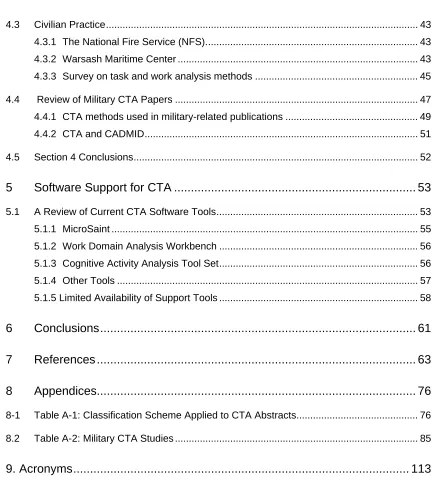
(3) HFIDTC/WP2.3.1/1 Version 1/ 23 January 2005. 4.3. Civilian Practice................................................................................................................. 43 4.3.1 The National Fire Service (NFS)............................................................................. 43 4.3.2 Warsash Maritime Center ....................................................................................... 43 4.3.3 Survey on task and work analysis methods ........................................................... 45. 4.4. Review of Military CTA Papers ........................................................................................ 47 4.4.1 CTA methods used in military-related publications ................................................ 49 4.4.2 CTA and CADMID................................................................................................... 51. 4.5. Section 4 Conclusions....................................................................................................... 52. 5. Software Support for CTA ........................................................................ 53. 5.1. A Review of Current CTA Software Tools......................................................................... 53 5.1.1 MicroSaint ............................................................................................................... 55 5.1.2 Work Domain Analysis Workbench ........................................................................ 56 5.1.3 Cognitive Activity Analysis Tool Set........................................................................ 56 5.1.4 Other Tools ............................................................................................................. 57 5.1.5 Limited Availability of Support Tools ........................................................................ 58. 6. Conclusions.............................................................................................. 61. 7. References ............................................................................................... 63. 8. Appendices............................................................................................... 76. 8-1. Table A-1: Classification Scheme Applied to CTA Abstracts............................................ 76. 8.2. Table A-2: Military CTA Studies ........................................................................................ 85. 9. Acronyms.................................................................................................... 113. iii.
(4) HFIDTC/WP2.3.1/1 Version 1/ 23 January 2005. Abstract This report is concerned with Cognitive Task Analysis (CTA). It covers the origins, growth, and diversity of CTA as an activity, current practice in the UK Armed Forces and civilian operations, reviews an extensive range of archive material and draws a number of conclusions as to the best practice. It reveals that there is no consistent use of CTA in the Armed Forces. Recommendations are made as to how CTA techniques could be implemented so as to benefit UK MoD with regard to both training and procurement.. iv.
(5) HFIDTC/WP2.3.1/1 Version 1/ 23 January 2005. 1 Introduction 1.1 Origins of Cognitive Task Analysis Cognitive Task Analysis (CTA) can be defined as any method of Task Analysis (TA) that investigates the task requirements associated with the use and handling of knowledge. These task requirements and activities may or may not be observable, thus differentiating CTA from many traditional forms of TA, but they are all associated with the maintenance of the work aim and the achievement of mission goals. The development of CTA practice will be discussed later in this report with regard to its usage both in the military and elsewhere. Firstly, it is necessary to consider the purpose of CTA and the way in which the term came into use. Whilst the need for CTA will become apparent it will be seen that there is a general lack of a clear understanding in the workplace as to the specific meaning or forms of CTA. While such commentators as Schraagen (2000) have traced the development process for CTA back to the 1950s, and even before, it can be argued that the expression “Cognitive Task Analysis” started to come into general use in the 1980s. In this decade, many areas, both of psychology and systems work, began to use the prefix “Cognitive”. Thus, as well as Cognitive Psychology, there was Cognitive Social Psychology, Cognitive Developmental Psychology, Cognitive Systems Engineering, Cognitive Ergonomics, and some of the therapeutic techniques also acquired the “Cognitive” prefix. In the area of work, this can be seen as an acceptance of the worker as having a cognitive input into the performance of his/her task, and of the effects of inappropriate cognitive inputs or processes on that performance. From the “Taylorism” of the early 1900s, and through the “Hawthorne Studies” of the late 1920s and 1930s (Roethlisberger and Dixon, 1939), organizations have sought to improve the efficiency of their operations. “…use of complex and tightly coupled technological systems in the workplace is rapidly increasing, as companies seek to make performance and efficiency gains and edge out the competition” (Rasmussen, 1999). Traditionally, the same methods of Task Analysis (TA) have been used for all types of jobs and activities. In the 1950s, the focus of the psychological study of work began to move away from manual to mental activities, as for the first time the number of white-collar workers exceeded blue-collar workers (Schraagen, 2000). It was necessary for psychologists to develop new techniques to match this shift; whilst traditional Task Analysis (TA) outputs were sufficient when a step-by-step description of observable behaviour was sought, they were. 1.
(6) HFIDTC/WP2.3.1/1 Version 1/ 23 January 2005. generally inadequate when studying the cognitive processes involved in mental tasks. Different approaches to the problem of studying cognition at work were taken over the next 30 years, with varying degrees of success. These approaches included computational modelling, hierarchical task analysis, expert-novice performance and system design (Schraagen, Chipman and Shalin, 2000). It should be noted that only a decade ago, Merkelbach and Schraagen (1994) identified 20 approaches to CTA; just 6 years later, Schraagen could refer to over 100 (Schraagen, 2000). However, many of the approaches deemed to be CTA had been previously termed as task analysis or knowledge elicitation methods and had changed little since their conception. In military tactical work, the tasks performed can be predominately nonprocedural being strongly influenced by environmental artefacts. Also, technology is initiating change in the nature of many areas of work from the physical to the cognitive. Thus, many modern systems function at the limits of their operators, in terms of the demands placed upon their cognitive resources. Moreover, the consequences of operator error when using such systems can be disastrous. System designers require an understanding of the role of mental processes and cognition in the performance of work activities, in order to allocate tasks, develop interventions and training procedures, and evaluate operator competence and performance. Cascio (1995) noted a change in the consideration of work from task-based to a more process-based approach. As more and more jobs are involved in management, supervision, and trouble shooting with systems, so cognitive approaches to the understanding of work become more appropriate to identify the tactics and strategies needed for effective performance. Additionally, the consideration of teamwork both within and between teams has become more important as technology has allowed improved and faster communication worldwide. Furthermore, many researchers are involved in the study of competency as an important contributor to performance, whether related to the individual or the team (Cannon-Bowers, Tannenbaum, Salas, and Volpe, 1995). The study and understanding of competencies shares a common ground with the traditional analysis of Knowledge, Skills, and Abilities (KSA). However the understanding of competence involves a consideration of a greater range of skills than traditional KSAs afford. Thus, whilst the knowledge component is similar, there is a need to also focus on other relevant areas, such as Attitudes, as contributors to performance. Many separate research efforts have led to the development of a number of TA techniques, that aim to assist Human Factors (HF) practitioners in the analysis and description of the cognitive processes required during the performance of work. These numerous and diverse techniques are referred to collectively as TA methods, or by the TA or CTA acronym. However, it will be seen later in this report that the terms used vary in their specificity.. 2.
(7) HFIDTC/WP2.3.1/1 Version 1/ 23 January 2005. 1.2 Scope of Report This report provides an introduction to the group of research techniques that have been associated with both TA and CTA; it gives an overview of many of the methods and approaches that are in use in both military and civilian TA and CTA research; it also summarises the supporting software that is currently in use and highlights the requirement for a new generation of software support tools. This report does not go into great detail about the history of CTA development, nor does it examine any single method in great detail. For one more detailed account of the origins of CTA, readers are referred to Schraagen et al., (2000). Further reading on particular methods, approaches and software tools will be referenced in the relevant sections of this report.. 1.3 Outlines of Report Sections Section 1 – The Introduction. Section 1 introduces CTA, outlines the scope of the report, and gives a high level outline of its different sections. Section 2 - CTA Definition and Description. Section 2 addresses the nature of CTA, its areas of application, critiques that might be placed on its application, and the approach taken by the report on the consideration of CTA. Section 3 – CTA methods and Approaches. Section 3 argues classifications for CTA methods and establishes a taxonomy on methods based on a library search. Limitations in classification and the argued taxonomy are presented. The section also discusses various approaches to CTA and introduces the Cognitive Work Analysis Framework that arguably includes the application of several specific CTA methods. The section also discussed the problem of the uses of terminology and acronyms. Section 4 – CTA Usage: Military and Elsewhere. Section 4 addresses the foundation question of this report, namely what usage of CTA is made by the UK Military? Current practice relevant to the UK armed forces is addressed considering all three military services. Civilian practice with CTA is then considered. The section ends with a review of military related CTA published papers. Section 5 – Software Support for CTA. This section considers many of the tools that are used in support of CTA. Section 6 – Conclusions. Section 6 is the conclusion of the report and considers the discussions contained in all the previous sections. Section 7 – References. Section 7 contains the references cited in the main text of the report.. 3.
(8) HFIDTC/WP2.3.1/1 Version 1/ 23 January 2005. Section 8 – Appendices. Section 8 contains 2 tables covering: 1) the classification scheme applied to CTA abstracts; 2) A listing citing some military CTA Studies. Section 9 – Acronyms. Section 9 contains a short list of acronyms used.. 4.
(9) HFIDTC/WP2.3.1/1 Version 1/ 23 January 2005. 2 CTA: Definition or Description 2.1 Defining Cognitive Task Analysis (CTA) As mentioned in Section 1.1, traditional TA techniques are used to analyse observable manual work activities that can be governed by sequence, or procedures, or both. “Task analysis involves the study of what an operator (or team of operators) is required to do to achieve a system goal. The primary purpose of task analysis is to compare the demands of the system on the operator with the capabilities of the operator, and if necessary, to alter those demands, thereby reducing error and achieving successful performance.” [Kirwan and Ainsworth, 1992, p15] The CTA intention must be to go further in its coverage than traditional forms of TA, in that it should aim to describe the knowledge, knowledge usage, thought processes and goal structures within the individual or team that lie behind the task performance observed (Schraagen, et al, 2000). Furthermore, any consideration on the skilled use of knowledge and information must also address the environmental affects and organisational factors on task performance. In addition, CTA should consider the influences on task performance arising from the situation and context of work, awareness skills, and task-associated information requirements and cues. Thus, CTA may be used to address the performance of non-procedural innovative tasks that are driven by environmental artifacts including hard-to-anticipate hazards. “CTA propels us further, providing a means to examine the cognition that underlies the behaviours identified using traditional task analysis techniques. The focus of CTA is on difficult decisions, judgments, and perceptual skills, elements that cannot be seen as overt behaviors, but play an important role in many tasks. Cognitive Task Analysis is the description of the cognitive skills needed to perform a task proficiently.” [Militello and Klein, 1997, p2) Indeed, CTA should attempt to consider cognitive behaviours that cannot be determined by traditional forms and methods of TA. CTA will normally include a description of the actions carried out by the operator (both observable behaviours and internal activities, e.g. decision making), combined with details of the knowledge states they require to perform the role successfully (Jonassen, Tessmer and Hannum, 1999). CTA outputs are typically used to inform the design of procedures and processes, the design of new technology and systems, levels of automation within a system, the development of training procedures and interventions, and the evaluation of individual and team performance within complex systems.. 5.
(10) HFIDTC/WP2.3.1/1 Version 1/ 23 January 2005. It can be seen from the above that the term CTA can mean a range of methods and activities, and that will vary from one commentator to another (as indeed does conventional TA).. 2.2 The Application of CTA “Because CTA techniques have been developed independently in research throughout the world, there is considerable variety in approach, emphasis, and resource requirements.” [Militello and Klein, 1997, p2] Flanagan (1954) first probed the decisions and actions taken by pilots in near accidents using the Critical Incident Technique (CIT). However, as is noted in Section 1, the term ‘Cognitive Task Analysis’ did not appear until the early 1980’s when it began to be used in research texts to describe approaches to the understanding of the cognitive activities required of man-machine systems (Woods and Hollnagel, 1987; Hollnagel, 2003). Multiple strategies for the study of cognition at work have been adopted (see Section 1.1), leading to the development of a great many research methods, approaches and software applications that offer some potential for all or part of a CTA 1. The CTA Resource website (an online community of CTA practitioners) has a published list of over 100 methods which have been used in CTA research, ranging from passive observation of individuals at work to structured interview techniques and the production of computer models and simulations. These methods also differ in terms of the data they use, the nature of their outputs and the kinds of activities that they are suited to studying, which has meant that CTA has purportedly been carried out in support of a number of research activities: “CTA has been successful across a variety of domains, including system design, training design, interface design, accident investigation, and consumer research.” [Militello and Klein, 1997, p2] In addition, this range of techniques has meant that CTA has been used to study a number of very different work environments, including (but by no means limited to) aviation, the emergency services, nuclear power plant operation, air traffic control, command and control, military operations, naval maintenance and even white-water rafting (Chin, Sanderson and Watson 1999; Klein, 2000; O’Hare and O’Brien; 2000; Shaafstal and Schraagen 2000). It is also treated (somewhat in parallel) as an essential component in Software Engineering, Human Computer Interaction, and Knowledge Engineering (see, for example, Preece 1994). Note that many supposed CTA techniques (more accurately described as Knowledge Elicitation techniques) are also used for traditional task analysis.. 1. www.ctaresource.com. 6.
(11) HFIDTC/WP2.3.1/1 Version 1/ 23 January 2005. A form of CTA that is often ignored in the consideration of CTA techniques is the range of Knowledge, Skills, and Attitudes (KSA) analyses in regular use [for example, sometimes Abilities rather than Attitudes are considered]. KSA is used to assist the selection and training of personnel and is specified by JSP502. However, outside the prescribed use in JSP502 it is also applied in both the military and civilian domains in many countries. The reason that KSA can be considered to be CTA is explicit by its title.. 2.3 Issues with TA and CTA Research and Practice A number of concerns exist regarding the use of both TA and CTA in terms of the appropriateness of the research being undertaken, the associated costs, the application of the results and the perception of the domain amongst host organisations: Is it Appropriate? For practitioners who are new to TA or CTA the abundance of techniques can be bewildering – it is not obvious what types of activities are suitable for examination with TA or CTA, which methods should be chosen or the types of outputs that they generate. Furthermore, there is little guidance available to practitioners regarding the selection and use of TA or CTA methods (Schraagen et al, 2000). Several of the TA techniques covered by Kirwan and Ainsworth are still valid (and still in use), and it may be that the problem lies with an incorrect use of the word “Cognitive”. Is it Beneficial? This diversity of methods has led to confusion as to what TA or CTA actually refers to, what it should involve and how the results are to be applied (Potter et al, 2000). This lack of established approaches to CTA means that potential customers (not directly confined to the military) may not understand the benefits of CTA, what CTA can (and cannot) do and what constitutes ‘good’ CTA research. This criticism can also be levelled in part against TA. Is it Economical? Both TA and CTA techniques can be time consuming and labour intensive, in terms of the collection, evaluation and analysis of data (Hoffman, 2003), as can traditional techniques. They have also been criticised for being overly reliant on specialists, such as professional researchers, designers and subject matter experts, whose availability is often limited (Seamster, Redding and Kaempf, 2000). Taken together, these factors mean that regardless of the approaches taken to TA, research can have a large financial cost and a slow turnaround. A subsequent lack of understanding of how to apply analysis results (Potter et al, 2000) may mean that the potential benefits of TA and CTA research are not being realized and/or that TA and CTA are portrayed badly in cost-benefit analyses, and/or that the subject analysis is rejected out of hand. Remembering that CTA encompasses the use of some more recently developed techniques for the analysis of tasks, but also shares many techniques with TA. CTA’s general. 7.
(12) HFIDTC/WP2.3.1/1 Version 1/ 23 January 2005. worth is arguable more difficult to prove than that of traditional TA as the concepts are newer.. 2.4 Approach Taken in this Report Despite the wide variety of methods, approaches, support tools and domains of research which can be found in the CTA literature, it is possible to gain an overview of CTA research and to have an understanding of some of the more significant CTA methods and approaches. This can be achieved because some CTA methods and approaches are far more widely used in published research and practice than others, and because these methods can be classified according to the types of work they are deemed suitable for, or have been used on, and the ways in which they are used. This should not be interpreted as making any judgement on their practical use. Furthermore, some CTA techniques, such as KSA, are not commonly referred to as belonging to CTA. This report summarizes a majority of types of available CTA methods in the form of a classification system. The most heavily used CTA methods (as in the most frequently cited) have then been examined in more detail, along with approaches to CTA (which combine multiple methods). The application of CTA methods within military contexts is then reviewed, along with existing support software for CTA.. 8.
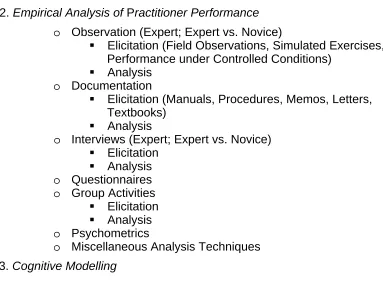
(13) HFIDTC/WP2.3.1/1 Version 1/ 23 January 2005. 3 CTA Methods and Approaches 3.1 Classification of CTA Methods Figure 3-1 represents a Cognitive Task Analysis classification structure. The aim here is to define a scheme that can be applied to CTA methods in order to classify them according to the type of data they use and the research aims they support. The classification scheme is adapted from four sources (Cooke, 1994; Roth, Patterson and Mumaw, 2002; Roth, 2002; CTA Resource Website). Some of the sources (e.g. Cooke, 1994) go into greater detail as to how to group and define CTA methods than has been used here. This classification is also somewhat subjective; some of the methods could arguably fit into different or multiple sub-categories. Moreover, the classification is strongly USA based. However, it does give an overview of the different method types available and, when populated with CTA methods, will show the purpose for which a method has been designed. 1. Goal-Means Decomposition 2. Empirical Analysis of Practitioner Performance o Observation (Expert; Expert vs. Novice) Elicitation (Field Observations, Simulated Exercises, Performance under Controlled Conditions) Analysis o Documentation Elicitation (Manuals, Procedures, Memos, Letters, Textbooks) Analysis o Interviews (Expert; Expert vs. Novice) Elicitation Analysis o Questionnaires o Group Activities Elicitation Analysis o Psychometrics o Miscellaneous Analysis Techniques 3. Cognitive Modelling Figure 3-1: CTA Method Classification An alternative (and simpler) classification would be on predominant use. This high level classification has equivalence to the classification of Figure 3-1:. 9.
(14) HFIDTC/WP2.3.1/1 Version 1/ 23 January 2005. 1. Goals-means analysis. 2. Knowledge Elicitation (KE). 3. Cognitive and mental process modelling. The selection of a CTA method depends on the aims and objectives of the study, the nature of the task(s) to be studied, their context, and the time and financial constraints on the research (Hoffman, 2003). The practitioner should also consider the particular context and application of the analysis. To consider the simplified CTA classification structure of Figure 3-1: Goal-Means, Empirical Analysis and Cognitive Modelling. The goal-means strategy focuses on the overall goals that need to be reached to successfully complete the task, followed by an analysis of the work domain in terms of the means by which these goals may be achieved, the task cues required, the task conditions, and the environment in which they are performed (Roth et al., 2002; Roth and Mumaw, 2002). The resulting hierarchy of activities is an idealised version of the task, which does not necessarily reflect the way that users perform the task. Here CTA has some similarities to Hierarchical Task Analysis (HTA), HTA initially devised to assist the determination of training, apart from the flexibility of the consideration of goals, means, and task outcomes that CTA can afford. A Goal-means decomposition provides a description of the main cognitive processing demands placed upon the role in question and the information required to complete the task. CTA is most effective when there is a good understanding of the goals, sub-goals and means by which they may be achieved within the domain in question (Roth et al., 2002). Empirical elicitation and analysis techniques aim to establish how tasks are actually performed and assist in capturing the knowledge and strategies that are required in order to perform the task well (Roth et al., 2002). Many techniques are available, including observation in the working environment or simulations, structured and unstructured interviews, comparison of expert vs. novice performance, Concept Mapping, Repertory Grids, Verbal Protocol Analysis (Roth et al., 2002; Hoffman, 2003). These techniques are an effective approach to CTA when little is known about the task or the domain in question (Roth et al., 2002). The third strategy for CTA involves the development of cognitive models (often computer-based) that can be used to simulate the cognitive activities required during the task under analysis (Roth et al., 2002). Such models have been successfully applied both in the exploration of existing working environments and in the prediction of the effects of proposed changes to work environment tasks (Hoffman, 2003). Task Analytic Simulation is a widely adopted approach (i.e. Micro-SAINT and its extension with appendages such as with IPME, CREWCUT), or Stella (e.g. Jaber, 1999). There are strong advantages in using dynamic modelling techniques to analyse tasks as the static representation of the dynamics of work, as offered by most TA and CTA techniques, has obvious limitations.. 10.
(15) HFIDTC/WP2.3.1/1 Version 1/ 23 January 2005. 3.2 A Taxonomy of CTA Methods Ninety eight separate methods were identified from the list published on the CTA Resource website; this list was used as the basis for the final taxonomy of methods. In Appendix 1, Table 1 - the classification structure from Section 3.1 has been populated with these 98 methods. A search of the Ergonomics Information Analysis Centre (EIAC) database (which holds over 170,000 Ergonomics and Human Factors abstracts) was carried out, yielding 595 publicly available CTA related abstracts. These abstracts were then searched for references to each of the 98 CTA methods. The results of these searches are listed in table 1, in the columns ‘Number of References’, ‘First Mention’, ‘Latest Mention’ and ‘Percentage of CTA abstracts’. There are 3 additional columns – “Military References”, “CTA Approach” and Software Tools”. It is acknowledged that the use of CTA is not necessarily solely under the ownership of Ergonomics/Human Factors (HF). However, the coverage of the EIAC was considered to be sufficient for the purposes of this paper. Military References The 595 CTA abstracts were searched for military (or military-related) references. Where a CTA method is mentioned in a military-related CTA paper, the paper number is listed (the military-related CTA papers are summarised in Appendix 2, Table 2). Military-related applications of CTA are discussed in Section 4. CTA Approach If a method can be used in combination with other methods as part of an established approach to CTA then this is shown. Specific CTA Approaches will be covered in more detail later in this section. Software Tools The CTA abstracts were also searched for mentions of software support tools. Where a tool was mentioned that supports a particular method, the name of the tool is shown. Software support for CTA will be discussed in Section 5. The analysis carried out for this report has concentrated on publicly available, HF related, journals. There may well be references to CTA methods in journals concerned with other domains (e.g. Cognitive Psychology, Computer Science, Cognitive Engineering, Training, or Artificial Intelligence), or in restricted military publications. However, note that EIAC abstracts do refer to some of the journals in these latter domains. Since, however, a separate set of searches on the Internet (incorporating CTA or Cognitive Task Analysis in the search terms) failed to find many of the methods mentioned in this paper, the approach is considered to be useful for the purposes of this paper. The EIAC database was used, rather than military sources as these papers are unrestricted – the analysis of restricted military research would severely limit the distribution of this report. Additionally, as will be shown in Section 4, military-related research is only a small part of all CTA work (though in the case of KSA this is burgeoning), and therefore. 11.
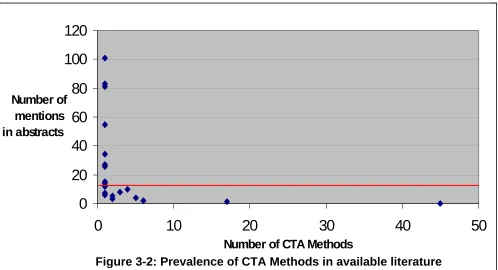
(16) HFIDTC/WP2.3.1/1 Version 1/ 23 January 2005. concentrating only on military research would have been another constraint on this review. A reference to a method was found if the method name or similar term was mentioned either in the Title, Abstract or Classification Term(s) sections of the abstract. Method references may not have been found, despite having been used in the research, if they were not mentioned in any of these sections, or if the authors did not use a recognisable or specific method name. This comment is also applicable to the separate Internet searches mentioned above.. 3.2.1 Selection of Methods for the Final CTA Taxonomy For the final CTA Taxonomy to be of a practical size, it was decided to select a shortlist of methods to be further examined, based on their prevalence in the CTA literature. An assumption made is that the more commonly reported methods are of more value to researchers and practitioners than those methods that have received only a small number of mentions. Figure 3.2 shows the number of CTA Methods (as shown on the x-axis) against the number of references in the 595 CTA Abstracts (as shown on the y-axis). From this, it can be seen that 45 of the CTA Methods are not mentioned in any of the 595 CTA Abstracts, whilst 1 CTA Method is mentioned 101 times in the abstracts. It is realised that the definition of what is CTA varied widely within the considered abstracts.. 120 100 80. Number of mentions 60 in abstracts .. 40 20 0 0. 10. 20. 30. 40. 50. Number of CTA Methods Figure 3-2: Prevalence of CTA Methods in available literature The Taxonomy needs to be representative of the CTA methods that are in use, without becoming too unwieldy. In order to do this, a cut-off point of a minimum of 10 mentions (or 1.68% of total abstracts) per method in the CTA Abstracts was chosen for practical reasons (indicated by the red line on Figure 3.2). That left 14. 12.
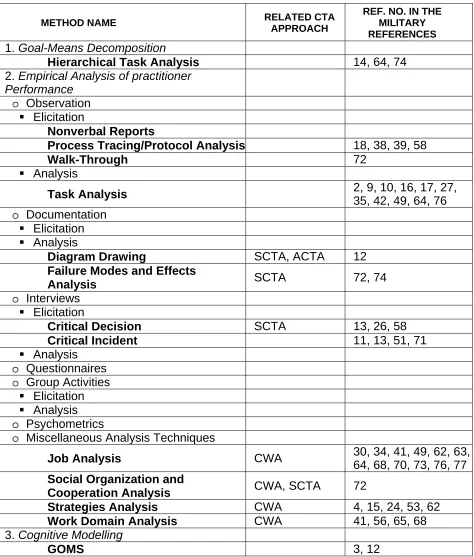
(17) HFIDTC/WP2.3.1/1 Version 1/ 23 January 2005. methods (14.58% of the total) in the taxonomy, that between them represent over 80% of the method references in the abstracts (488 mentions). The final taxonomy of CTA methods is shown in Table 3-1, below. Where a method has a related CTA Approach or is mentioned in a military-related CTA paper, this has been shown in the appropriate column. CTA Approaches, and Military–related CTA researches are discussed in Section 3.3 and Chapter 4 respectively. It can be seen that – as with the term CTA itself – several of these methods have a circular definition, or have been labelled as a CTA method for reasons not related to either the research or the analysis, or both. Many methods classed as CTA are in fact extensions of traditional task analysis methods. In many cases these latter extensions are thinly argued to encompass aspects of cognitive. As an example, Hierarchical Task Analysis (HTA) is considered by several researchers to be a CTA method. As mentioned in a previous report (HFI-DTC 2.2.1/1) one of the originators of HTA has (privately) considered CTA to be part of HTA. To a certain extent this opinion must be valid as all human work implies some degree of cognition. Many views are not compatible, and are indicative of the lack of an accepted definition of the remit or purpose of CTA.. 13.
(18) HFIDTC/WP2.3.1/1 Version 1/ 23 January 2005. METHOD NAME. RELATED CTA APPROACH. 1. Goal-Means Decomposition Hierarchical Task Analysis 2. Empirical Analysis of practitioner Performance o Observation Elicitation Nonverbal Reports Process Tracing/Protocol Analysis Walk-Through Analysis. 14, 64, 74. 18, 38, 39, 58 72 2, 9, 10, 16, 17, 27, 35, 42, 49, 64, 76. Task Analysis o Documentation Elicitation Analysis Diagram Drawing Failure Modes and Effects Analysis o Interviews Elicitation Critical Decision Critical Incident Analysis o Questionnaires o Group Activities Elicitation Analysis o Psychometrics o Miscellaneous Analysis Techniques Job Analysis Social Organization and Cooperation Analysis Strategies Analysis Work Domain Analysis 3. Cognitive Modelling GOMS. REF. NO. IN THE MILITARY REFERENCES. SCTA, ACTA. 12. SCTA. 72, 74. SCTA. 13, 26, 58 11, 13, 51, 71. CWA. 30, 34, 41, 49, 62, 63, 64, 68, 70, 73, 76, 77. CWA, SCTA. 72. CWA CWA. 4, 15, 24, 53, 62 41, 56, 65, 68 3, 12. Table 3.1: CTA Method Classification. 14.
(19) HFIDTC/WP2.3.1/1 Version 1/ 23 January 2005. 3.2.2 Method Descriptions Following, are brief descriptions of (or comments on) the CTA methods included in the taxonomy. Whilst some of the methods in the taxonomy are not used to directly analyse cognitive activity (e.g. Task Analysis) they have all nevertheless been reported as used as part of CTA research. Moreover, many methods known to be commonly used by researchers into cognition are not covered by the taxonomy i.e. Repertory Grid. Hierarchical Task Analysis (HTA) HTA involves breaking down the task under analysis into a hierarchy of goals, operations and plans: • Goals – The unobservable objective associated with the task in question. • Operations – The observable behaviours or activities that the operator has to perform in order to accomplish the goal of the task in question. • Plans – The unobservable decisions and preparation made on behalf of the operator. See also the report HFI-DTC WP 2.2.1/1, and also the two views that HTA encompasses CTA, and that CTA encompasses HTA. HTA was initially devised to assist the definition of training on fully specified or developed systems. However, it has been used to effect over a wide range of domains, most notable with relation to sequential and procedural task architectures. For example, for TA in support of Safety Cases and Human Reliability Analysis for the Nuclear Industry both civilian and military. Nonverbal Reports These can be held to comprise any recorded data, the value of which is directly related to the design of the collection method. Process tracing/Protocol Analysis This can be seen as an analysis of the procedures used to accomplish a complex task, and as having strong connections to the domains of Business Process Re-engineering, and Systems Engineering. Verbal Protocol Analysis is a well-used technique used to elicit task knowledge through the analysis of subject’s speech when asked to verbalise on their work performance. Walk-Through Walkthrough analysis is a very simple procedure used by designers whereby experienced system operators perform a walkthrough or demonstration of a task or set of tasks using the system under analysis. A walkthrough involves an operator walking through a scenario, performing (or pretending to perform) the actions that would occur, explaining the function of each control and display used. The walkthrough is also verbalised and the analyst(s) can stop. 15.
(20) HFIDTC/WP2.3.1/1 Version 1/ 23 January 2005. the scenario and ask questions at any point. As “Cognitive Walkthrough” it is also to be found in several reviews of Software Engineering methods. Task Analysis Task analysis is a generic term used to refer to any method or technique used for the analysis of tasks. Diagram Drawing It is not surprising that “Diagram Drawing” emerges as a method, if the comment about keywords in the preceding paragraph is considered. Many of the tools and methods available for Business Process Re-engineering, training development, and Systems Engineering (Vista and Extend, for example; or SSM and UML) are reliant on constructing some form of drawing or chart as part of the methodology. Drawings are a method of depiction or description, and require some prior knowledge before they can be constructed – and this in turn will usually have required some prior analysis. A form of diagram drawing originating in the training domain is Concept Mapping. Failure Modes and Effects Analysis (FMEA) This is effectively an advanced form of risk analysis approach. It considers: Steps in a process Failure modes (WHAT could go wrong) Failure causes (WHY would it happen) Failure effects (What would be the consequences) A tool for FMEA is available for Healthcare professionals from the Institute of Healthcare Improvement in Boston, MA; and a related measure derives a Risk Priority Number. Several other FMEA tools have also been developed. Critical Decision The Critical Decision Method involves the use of observation, semi-structured interviews and cognitive probes in order to elicit information regarding the cognitive aspects of expert decision-making. CDM outputs provide knowledge engineering for expert system development, the identification of training requirements, the development of training materials and the evaluation of task performance and the impact of expert systems (Klein, Calderwood and MacGregor 1989). The technique is a development of the Critical Incident Technique (Flanagan 1954) and was developed in order to study naturalistic decision-making strategies of experienced personnel. CDM has been applied in a number of domains involving complex and dynamic systems, including fire fighting, military, paramedic activity (Klein, Calderwood and MacGregor 1989) and white water rafting (O’Hare et al 2000).. 16.
(21) HFIDTC/WP2.3.1/1 Version 1/ 23 January 2005. Critical Incident Critical Incident Technique (CIT) (Flanagan, 1954) is an interview technique that is used to collect specific data regarding non-routine incidents or events and associated operator decisions and actions made. The technique was first used to analyse aircraft incidents that almost led to accidents and has since been used extensively and also developed in the form of the Critical Decision Method (CDM) (Klein, 2003). CIT involves using interview techniques to facilitate operator recall of critical events or incidents, including what actions and decisions were made by themselves and colleagues and why they made them. CIT can be used to highlight vulnerable system features or poorly designed system features and processes. Examples of the CIT probes used by Flanagan (1954) include; “Describe what led up to the situation?”, “Exactly what did the person do or not do that was especially effective or ineffective?”, “What was the outcome or result of this action?”, “Why was this action effective or what more effective action might have been expected?”. It can be seen that this bears directly on cognitive processes. Job Analysis Job Analysis is a process to establish and document the 'job relatedness' of employment procedures such as training, selection, compensation, and performance appraisal. Some researchers consider Job Analysis is improved by CTA or is an extension to CTA (Gordon and Gill, 1997; Reynolds and Brannick, 2000; Reynolds and Neville, 2002). Social Organization and Cooperation Analysis Vicente considers this to be a part of Cognitive Work Analysis. Section 3.3.3.. See also. Strategies Analysis Again, Vicente considers this to be a part of Cognitive Work Analysis. See also section 3.3.3. Work Domain Analysis The work domain analysis technique is used to better understand the task or work environment that is involved in a CTA effort. A work domain analysis involves describing the work environment in terms of system goals and objectives, artefacts, tangible characteristics of the work domain and also individual and group roles within the work domain (Chin, Sanderson and Watson 2000). Note, however, that Goals-Means Task Analysis (GMTA) (Hollnagel, 1993) and HTA (Stanton, 2004) can also address many of the issues and their implications related to these areas. GOMS GOMS (Goals, Operators, Methods and Selection Rules) was developed as a Human-Computer Interface tool, but some believe that it is best considered as a Software Engineering approach. It is based on an information processing theory, and interprets all cognitive activities in terms of searching a problem. 17.
(22) HFIDTC/WP2.3.1/1 Version 1/ 23 January 2005. space. The GOMS technique is used to provide a description of human performance in terms of the user’s goals, operators, methods and selection rules. GOMS first attempts to define the user’s goals, decompose these goals into sub-goals and then demonstrate how the goals are achieved with the other components through user interaction. GOMS can be used to provide a description of how a user performs a task, to predict performance times and to predict human learning. The GOMS techniques are based upon the assumption that the user’s interaction with a computer is similar to solving problems. Problems are broken down into sub-problems, and these subproblems are broken down further. The four basic components of human interaction are used within the GOMS technique are Goals, Operators, Methods and Selection Rules (Card, Moran and Newell, 1983).. 3.2.3 Taxonomy Limitations This short-listed taxonomy seeks to reduce the extensive array of CTA methods down to those that seem to be most traditionally used in HF research. It also illustrates what type of research each method is best suited to (Goal-Means, Empirical Analysis, Cognitive Modelling) and the way in which the method is to be used. This provides a structured overview of CTA methods for those new to the field. However, this taxonomy does not address all of the problems associated with CTA research. Whilst the methods listed in Table 3 are those that appear most widely used in CTA research (as determined on a quantitative basis), each one still has limited applicability in terms of the type of task, the application domain or technology that it may be applied to (Barnard and May, 2000; Schraagen et al, 2000). The result of this is that practitioners must either become adept in the use of several different techniques, or severely limit their scope in terms of work environments that they are able to study. All HF methods, when used in isolation, are of limited value – usually good practice suggests that several methods must be combined to produce an accurate picture of the cognitive demands of a role: “…they should be viewed as complementary rather than as alternative methods. In practice, a mix of analytical and empirical techniques are required for a thorough cognitive task analysis...” [Roth, Patterson and Mumaw, 2002 p16] It should be noted that, in general, HF methods can be divided into those methods used in a predictive manner, those applied during the actual performance of work, and those applied retrospectively. The prevalence of the multi-method approach is illustrated by the fact that 25.6% of the Military papers analysed in this report mention two or more CTA methods in their abstract. There are however methodological and theoretical concerns that continue to exist with multi-method research: •. Practitioners may not know how to combine output from different methods in order to generate meaningful results, possibly with the result that the research is flawed, without the practitioner realising this.. 18.
(23) HFIDTC/WP2.3.1/1 Version 1/ 23 January 2005. •. Combining methods with multiple theoretical bases may result in contradictory results and an inability to draw coherent conclusions, as well as limiting the research value of the work.. Having said this, it should be noted that practitioners are usually concerned with the delivery of some findings (product) that will benefit their client organisation – not with abstract research. Due to the large number of CTA methods relative to the amount of CTA research that had been conducted, it is difficult to validate the methods in terms of the applications to which they are suited and the conclusions, which can safely be drawn from their results. When methods and tools are combined on an ad-hoc basis it becomes increasingly difficult to validate that the output of such a combination has any value – even when the product can be seen to be of value. Note the truth of this statement to the use of most HF related methods and techniques.. 3.3 CTA Approaches A solution to the problems associated with the combining of CTA methods is the provision of a framework or toolkit of CTA techniques that the HF practitioner can use in the examination of the cognitive components of the task under analysis. The concept of a toolkit or framework is an established one and has in the past been used in other psychological fields such as the prediction of human error (Kirwan 1998a, 1998b) and the dynamic modelling and measurement of mental workload (MacLeod and Helyer, 1993; MacLeod, Farkin and Helyer, 1994). Several approaches to Cognitive Task Analysis have been developed, which combine knowledge elicitation and analysis techniques to produce a coherent, multi-method research technique. Five CTA Approaches have been identified and their prevalence in the 595 CTA abstracts is summarised in Table 3.2, below. Approach. Cognitive Work Analysis (CWA). No. of Refs 32. First mention. Latest mention. % CTA refs. Military References. Software Tools. 1990. 2003. 5.38. 30, 34, 41, 49, 53, 60, 63, 65, 68, 70, 73, 77 6, 20, 26. CAATS. Cognitive Function Model (CFM). 5. 1989. 2001. 0.84. Applied Cognitive Task Analysis (ACTA). 3. 1997. 2000. 0.50. Goal Directed Task Analysis (GDTA). 2. 2002. 2002. 0.34. WDAW. 64, 66. 19.
(24) HFIDTC/WP2.3.1/1 Version 1/ 23 January 2005. Approach. Skill-Based CTA Framework (SCTA). No. of Refs 1. First mention. Latest mention. % CTA refs. 2000. 2000. 0.17. Military References. Software Tools. Table 3.2: Prevalence of CTA Approaches in the EIAC CTA abstracts. It should be noted that the table above also indicates that those papers identified from the EIAC database do not – in turn - identify some of the approaches currently in use by practitioners, such as Repertory Grid Technique, GMTA, KSA analysis, or Concept Mapping. The adoption of an established multi-method approach to the analysis of cognitive tasks would address many of the concerns regarding CTA research that have been highlighted in this report (c.f. Sections 2.3 and 3.2.6): 1. The absence of a universally accepted CTA technique and the limited applicability of individual methods. It would not be possible for any single CTA technique to achieve universal acceptance, as all CTA techniques are designed for fairly specific analyses and have limitations. However, multi-method approaches to CTA are versatile enough to be applied across a variety of situations and environments and some of the CTA components of Cognitive Work Analysis in particular, are already widely used in civilian and military CTA research (see SOARs April and June 2002). 2. The lengthy training requirements associated with CTA techniques. The choice of one established approach to CTA would also mean that practitioners would not need to study a multitude of methods in order to be able to undertake analyses of a number of different roles, thus reducing their training time and increasing the scope of work that they are able to undertake. However, a requisite understanding of the method would still have to be complete. The possibility that a single technique may well provide the solution to a single problem should not be overlooked. 3. A shortage of adequately qualified/experienced personnel. The adoption of one multi-method CTA approach may also mean that nonspecialised personnel could be trained in some of the data collection and analysis methods, rather than in 100s of different methods. This would help to reduce the demand on the limited number of qualified practitioners. Note that the same comment could be made to justify the adoption of existing wellestablished methods of analysis such as HTA or Repertory Grids. 4. Poor interpretation of CTA outputs.. 20.
(25) HFIDTC/WP2.3.1/1 Version 1/ 23 January 2005. The use of an established approach should mean that the type of output produced by the analysis is expected and practitioners can be trained to interpret them. This reduces the risk of misinterpretation that is associated with the selection of different techniques for each CTA or any HF method. This should also allow customers to develop some understanding of what the research will involve and what kinds of output they should receive. Note that many practitioners argue that HTA is a Task Analysis technique where the use of a single method can be successful. Nevertheless prior to the accomplishment of HTA there has to be some form of knowledge elicitation performed to discover tasks and their properties. 5. The theoretical problems of combining CTA or any HF method Selecting an established CTA Approach grounds the study in a coherent theoretical framework, which should remove the risk of practitioners trying to combine results from incompatible methods or draw unfounded conclusions from their studies. The frequent use of the same approach across a number of situations also allows for a thorough evaluation of its effectiveness and applicability, giving it further credibility.. 3.3.1 Approach Descriptions These are brief descriptions of the 5 CTA approaches as identified in Table 3.2. Applied Cognitive Task Analysis (ACTA) ACTA is a proprietary method generated by Klein Associates. No tools are available to the general public, but a training CD is available from Klein Associates for US$45. Applied Cognitive Task Analysis (ACTA) uses specific interview techniques in order to determine the cognitive skills and demands associated with a particular task or scenario. The output of ACTA is typically used to aid system design. ACTA was developed as part of a Navy Personnel Research and Development Center funded project as a solution to the inaccessibility and difficulty associated with using existing cognitive task analysis type methods (Militello and Hutton 2000). The overall goal of the project was to develop and evaluate techniques that would allow system designers to extract the critical cognitive elements of a particular task. The ACTA procedure consists of the following components: Task diagram interview. The task diagram interview is used to provide an overview of the task under analysis. The task diagram interview also allows the analyst to identify any cognitive aspects of the task that require further analysis. Knowledge audit. The knowledge audit allows the analyst to determine the expertise required for each part of the task. During the knowledge audit interview, the analyst probes Subject Matter Experts (SMEs) for specific examples of expertise that were employed during task performance.. 21.
(26) HFIDTC/WP2.3.1/1 Version 1/ 23 January 2005. Simulation Interview. The simulation interview allows the analyst to probe specific cognitive aspects of the task under analysis. The analyst probes SMEs using specific probes that are designed to elicit information regarding the decisions made and the associated actions and information requirements. Cognitive Demands Table. Once the task diagram, knowledge audit and simulation interviews are complete, the cognitive demands table is used to group and sort the data. The ACTA probes are presented below: Basic Probes. Examples. Past and Future. Is there a time when you walked into the middle of a situation and knew exactly how things got there and where they were headed?. Big Picture. Can you give me an example of what is important about the big picture for this task? What are the major elements you have to know and keep track of?. Noticing. Have you had experiences where part of a situation just ‘popped’ out at you; where you noticed things going on that others didn’t catch? What is an example?. Job Smarts. When you do this task, are there ways of working smart or accomplishing more with less – that you have found especially useful?. Opportunities/Impr ovising. Can you think of an example when you have improvised in this task or noticed an opportunity to do something better?. Self-Monitoring. Can you think of a time when you realised that you would need to change the way you were performing in order to get the job done?. Optional Probes. Examples. Anomalies. Can you describe an instance when you spotted a deviation from the norm, or knew something was amiss?. Equipment difficulties. Have there been times when the equipment pointed in one direction but your own judgement told you to do something else? Or when you had to rely on experience to avoid being led astray by the equipment?. 22.
(27) HFIDTC/WP2.3.1/1 Version 1/ 23 January 2005. Simulation interview probes As the (job you are investigating) in this scenario, what actions, if any, would you take at this point in time? What do you think is going on here? What is your assessment of the situation at this point in time? What pieces of information led you to this situation assessment and these actions? What errors would an inexperienced person be likely to make in this situation?. Table 3.3 ACTA probes (Source: Militello and Hutton 2000) A more detailed description of the ACTA approach is provided in the CTA review carried out as part of Work Packages 1.3.2 and 1.3.3. Cognitive Function Model (CFM) This is a computer-based approach developed by the Klein Corporation and Aptima Inc as a way to guide an analyst in choosing which tasks or functions to pursue using CTA. It is claimed to be linked closely with Systems Engineering (see, for example: Chrenka, Hutton, Klinger and Anastasi, 2001) but, since it can only be applied by the Klein Corporation, no independent assessment is possible. Cognitive Work Analysis (CWA) Cognitive Work Analysis (CWA) can be argued to include forms of CTA within its framework. Developed by Rasmussen, Pejtersen and Goodstein (1994) of the Risø National Laboratory in Denmark, CWA is a work-centered, rather than usercentered conceptual framework for the analysis of cognition at work. It is a framework that is used to model and analyse decision-making in complex environments. A CWA involves five main stages. These are work domain analysis, activity analysis, strategies analysis, socio-organisational analysis and worker competencies analysis. The work domain analysis involves describing the work environment under analysis in terms of system goals and objectives, artefacts, tangible characteristics of the work domain and also individual and group roles within the work domain (Chin, Sanderson and Watson 2000). The activity analysis component involves identifying the tasks that need to be performed in the work domain under analysis. Strategies analysis involves identifying the mental strategies that the system personnel may use during task performance in the domain under analysis. Social organisation analysis involves identifying exactly how the work is distributed amongst the actors and artefacts in the domain under. 23.
(28) HFIDTC/WP2.3.1/1 Version 1/ 23 January 2005. analysis. Finally, worker competencies analysis involves the identification of the competencies that the agents involved are required to possess in order to perform the task(s) in the work domain. The worker competencies are simply classified using Rasmussen’s Skill, Rule, and Knowledge (SRK) framework. The CWA is an exhaustive procedure that uses a number of different methods, including an abstraction-hierarchy, decision ladders, flowcharts and the SRK classification. A more detailed description of this Approach is provided in the CTA review carried out as part of Work Packages 1.3.2 and 1.3.3. Goal Directed Task Analysis (GDTA) GDTA is also considered to be part of Human-Centered Design, Cognitive Engineering, and Systems Engineering. It should be noted that the US think-tank Mitre Corporation consider GDTA as being particularly appropriate for Concept Definition (or the C in CADMID) and for establishing the information needed to maintain Situation Awareness. It is also considered of value during requirements definition. (Mitre, 2004). Skill-Based CTA Framework (SCTA) SCTA is a framework for conducting CTA based on the assumption that simpler cognitive skills form the basis for more advanced skills, and which attempts to identify the hierarchy of skills needed to operate in a domain. This hierarchy, starting at the most complex skill type, includes: Strategies, Decision-Making Skills, Representational Skills, Procedural Skills, and Automated Skills. A different CTA technique is used for each skill type (Redding, 1992). 3.3.1.1. Conclusion to Section 3.3.1. According to this literature review, Cognitive Work Analysis is by far the most widely used of these approaches, having been referenced in 32 (5.4%) of the CTA abstracts, compared with 5 references (0.8%) for the next most widely mentioned Approach – Cognitive Function Modelling. Cognitive Work Analysis is also the most widely adopted CTA Approach in Military research, with 12 references in the military-related CTA abstracts (15.4%), compared to 3 mentions (3.8%) for Cognitive Function Modelling. Many treat the meanings of task and work as synonomous. However, CWA is a work-centered rather than individual user-centered conceptual framework that may explain the small percentage of references mentioning the approach. CWA is concerned with the analysis of the many forms of cognition affecting work and that implies focus on a high level consideration of the work domain rather than on a pure consideration of the specific individual or team’s tasks within that domain. Therefore CWA may be argued to include CTA rather than be a form of CTA.. 24.
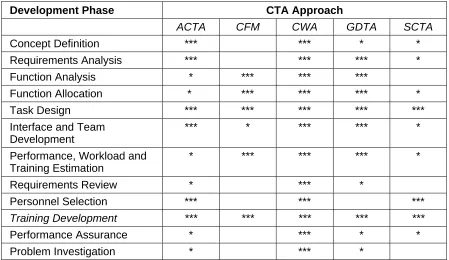
(29) HFIDTC/WP2.3.1/1 Version 1/ 23 January 2005. 3.3.2 Product Development Lifecycle HF work is required throughout the lifecycle of a system or product, to ensure that the technology accounts for the requirements and the limitations of the operator(s): “To ensure a system is as effective and reliable as possible (i.e. that it is operable and maintainable), the human element must be considered in parallel with the equipment at all stages in the ‘system life cycle’. This consideration of the human element (i.e. explicitly via the task analysis process), should be undertaken as an integral part of the system life cycle, making use of the different task analyses techniques at appropriate stages of design or operation.” [Kirwan and Ainsworth, 1992, p15] Although Kirwan and Ainsworth are discussing Task Analysis as it was some 14 years ago, their comments are equally applicable to knowledge elicitation for CTA. It is important that any CTA Approach used is versatile enough to be applied across the development lifecycle, to support the HF work at each stage. Table 3.3 below shows the applicability of each of the 5 CTA Approaches identified earlier to the stages of the system development life cycle. It can be seen that the Cognitive Work Analysis (CWA) framework is versatile enough to be appropriate in a number of different situations, parts arguably having high applicability to all of the stages of system development.. 25.
(30) HFIDTC/WP2.3.1/1 Version 1/ 23 January 2005. Development Phase. CTA Approach ACTA. CFM. CWA. GDTA. SCTA. Concept Definition. ***. ***. *. *. Requirements Analysis. ***. ***. ***. *. Function Analysis. *. ***. ***. ***. Function Allocation. *. ***. ***. ***. *. Task Design. ***. ***. ***. ***. ***. Interface and Team Development. ***. *. ***. ***. *. Performance, Workload and Training Estimation. *. ***. ***. ***. *. Requirements Review. *. ***. *. Personnel Selection. ***. ***. Training Development. ***. ***. ***. ***. ***. *** *. Performance Assurance. *. ***. *. Problem Investigation. *. ***. *. Table 3.4: The fit between CTA Approaches and system development phases. (Taken from Bonaceto and Burns, 2003). 3 stars indicate high applicability, 1 star indicates medium applicability and no stars low/no applicability.. 3.3.3 Cognitive Work Analysis As identified above, CWA appears to be the most widely reported, and potentially the most applicable, of the CTA or CTA associated approaches examined in this report’s main literature research. Therefore, CWA will be given a more detailed review than that of the description in Section 3.3.2. Conceptualised by Rasmussen, Pejtersen and Goodstein (1994) of the Risø National Laboratory in Denmark, CWA is a work-centered, rather than usercentered conceptual framework for the analysis of cognition at work (Vicente, 1999; Fidel and Pejtersen, 2004 and 2005). This means that it is the work domain itself that is of main interest, rather than the actions of individual actors working within it (Fidel and Pejtersen, 2004). CWA is primarily concerned with the goals that guide the work being undertaken and examines the constraints and conditions that restrict and shape the way in which these goals may be achieved, rather than choosing to concentrate solely on the actions and activities of actors in the work environment (Sanderson et al., 1999). From this analysis of the current system in place, in terms of work goals and the constraints relating to them, it is then possible to develop recommendations for improvements to the work environment, which can be used as design requirements during development (Fidel and Pejtersen, 2004).. 26.
(31) HFIDTC/WP2.3.1/1 Version 1/ 23 January 2005. In order to perform CWA, a multi-method approach is required (Fidel and Pejtersen, 2004). This is because there are several CWA dimensions, which constrain the way work activities may be carried out, and each of these has a corresponding level of analysis within CWA (Sanderson et al., 1999). Figure 3-3 shows one set of dimensions that would need to have corresponding methods and analysis applied as part of CWA performance:. Figure 3-3: The Dimensions of CWA (Taken from Fidel and Pejtersen, 2004, p7) Vicente (1999) describes five phases of CWA, which analyse the dimensions shown in Figure 3-1. These phases are summarised below: Work Domain Analysis Work Domain Analysis is the study of the structure and functioning of the work domain itself, in terms of organisation goals, the means of their achievement, the constraints operating upon the organisation, the types of activities it undertakes and the tools it uses in this work (Sanderson et al., 1999; Fidel and Pejtersen, 2004; Woods and Hollnagel, 1987). Control Task Analysis This phase of analysis examines the tasks that need to be carried out in order to achieve the goals of the organisation and identifies the constraints that act upon them (Fidel and Pejtersen, 2004).. 27.
(32) HFIDTC/WP2.3.1/1 Version 1/ 23 January 2005. Strategies Analysis Strategies Analysis examines the possible strategies that could be adopted for each task and decision (Fidel and Pejtersen, 2004) Social Organization and Cooperation Analysis This is the analysis of the social and organizational factors that affect work roles, such as the prevalent management style, culture and communication structures within the organisation (Sanderson et al., 1999; Fidel and Pejtersen, 2004) Worker Competencies Analysis This phase of analysis concentrates on identifying the cognitive abilities of the workers performing the tasks in question (Sanderson et al., 1999) The various outputs from the different phases of analysis may be combined to produce a comprehensive yet clear picture of the work being carried out: “Being a holistic approach it examines simultaneously several dimensions: the environmental, organizational, social, activities, and individual… It provides concepts and templates to facilitate an analysis of complex phenomena, without reducing their complexity.” [Fidel and Pejtersen, 2004, p 2] A complete CWA, taking all relevant influences and constraints into account should enable the CWA practitioner to produce recommendations for changes that will improve performance of the work in question. These proposals can affect all of the dimensions previously discussed, thereby enabling the redesign of not just specific roles, but of entire work environments, leading to more effective system changes and improvements.. 3.3.2 Could CWA become a major approach to CTA? It can be seen from Table 3.4 that CWA could well be suited to the full range of system development activities. Note the argued differences between the remits of CWA and CTA given in Section 3.3.1.1. Within proposed CWA frameworks, there are currently no formal agreements on what techniques and methods should be used as part of the analysis. This is a current major weakness in the approach, but could equally be seen as strength, since it means that the practitioner is free to choose the most appropriate tool for the environment or domain in question. It is realised that this latter statement may appear contrary to the critique of TA and CTA given in Section 2.3. However, in order to address the problems with CTA research raised in Sections 2.3 and 3.2.6 of this report, it is suggested that there is a need to come to an agreement as to what methods should and should not be included within the approach. This would not mean that researchers would. 28.
(33) HFIDTC/WP2.3.1/1 Version 1/ 23 January 2005. be limited to just one method for each phase of analysis, but that a restricted group of the most appropriate methods for each phase of CWA should be agreed. This needs to happen if the advantages of adopting a single CWA approach highlighted in Section 3.3 are to be realised and may happen if CWA is to become a major CTA approach to be adopted within military or civilian research. Note, however, that practitioners may well choose to employ a different set of methods to make up their own analysis tool-set, and this most probably will be determined on an empirical basis. A further problem is that there are CTA and other techniques that have not been identified by this (Section 3.3) particular research approach; this is due in part to the somewhat vague terminology in use within the CTA community, and in part to the restrictions implicit in the use of the EIAC database. The method known as Goals Means Task Analysis (or GMTA) was mentioned in the HFI-DTC report on HTA, and is also worthy of consideration as is an established CTA approach (see Hollnagel, 1993; Hollnagel and Woods, 1987). Any analysis method or approach must have at least one goal (and perhaps a structure of goals), and thus both GMTA and the hard/soft goal modelling approach of Donzelli (Donzelli and Moulding, 1999, Donzelli and Marazza, 2000) should also be considered. Regardless of the CTA methods to be considered, it should be accepted that the inclusion of such methods in CWA should increase CTA efficacy through the increased understanding of work promised by CWA.. 3.4 The Terminology Problem Revisited It has already been shown that several of the CTA approaches use methods drawn from the same pool of resources, and that an approach can be regarded as independent of CTA by one and integral to CTA by another. The problems of any literature search in this area have also been brought out. As one example, the omission from the search of GMTA (Goals Means Task Analysis). GMTA was developed at the Risö Laboratory and research conducted for the European Space Agency about two years prior to the development of the prototype Cognitive Activity Analysis Toolset (CAATS – ESA Final Report 3535S). Subsequently CAATS was integrated into a larger GMTA based toolset termed CADETS. GMTA has been used for many applications (for example see SOARs, Hollnagel, 1993, CORAS project - http://coras.sourceforge.net). Forms of GMTA have also been used in practice on several projects including the UK Airborne Standoff Radar (ASTOR), Apache Ground System (GSS), and Nimrod MRA4 Tactical Command and Control (TCSS). Moreover, the search also failed to identify the KSA (Knowledge Skills Attitudes) approach – or indeed any of the KSA variants – yet KSA is mandated in the official guide to Training Needs Analysis (TNA as in JSP502) and KSA as Knowledge, Skills and Aptitudes (i.e. also as KSA) is considered within a USA Data Item Description (DID) (Instructional Performance Requirements Document, DI-ALSS-81518A).. 29.
(34) HFIDTC/WP2.3.1/1 Version 1/ 23 January 2005. To discuss CTA or TA in any general terms may be to overlook the arguments as to whether CTA is part of HTA (or the reverse). Sufficient to say that TA is of course the generic – of which the others are part. Much of the research cited stresses that the methods used must be selected for the work in hand, and it has been shown here that few methods are universally applicable, but that some have a much broader theoretical base than others. It may well be that addressing a specific domain would have produced a different set of methods – possibly resulting in a different categorisation. One example may serve here, that of Application Domain Modelling (or ADM). As propounded by Hone and Moulding (1998, 2000) this approach features two Training Needs Analysis (TNA) stages, separated by a HTA, and followed by a CTA (and there are other stages at the beginning and end). Note, however that ADM was proposed solely for the development of training simulations (it was referred to as the Training Process Development Framework); and references to this approach will normally be found only by using “Simulation” or “Validation and Verification” as keywords; this same comment must also apply to Donzelli and Moulding (1999). The CTA method suggested within ADM was a variation of the KSA approach and it will be seen later that even something as apparently simple as this does not have an accepted basis for use. It will be seen that the Royal Navy have a simplified view of “skills”, and also that the KSA analysis required in JSP502 is not always considered to have a firm basis.. 3.5 Section 3 Conclusions In this section many of the issues associated with CTA research have been addressed: • Through the analysis of published CTA research, it has been shown that the majority of these studies have been based on only a few of the great many methods available. • Through the classification system and taxonomy of short-listed methods, it has been shown that it is possible to gain a rapid appreciation of some of the types of CTA techniques available, their prevalence in published literature and the kinds of tasks that they are suited to. • An argument has been presented that CTA research often needs to involve the use of multiple methods in order to create a thorough and accurate understanding of the work environment and that this is not without its own problems. The adoption of one of several multi-method approaches to CTA may address many of the practical and theoretical problems associated with CTA and the use of multiple methods. • It has been suggested that, of the multi-method approaches to CTA identified in this report, CWA is worthy of adoption as a standard encompassing approach to CTA, due to its adaptability.. 30.
(35) HFIDTC/WP2.3.1/1 Version 1/ 23 January 2005. • It has also been shown that some techniques have not been brought out by the approach of this paper, and it may well be necessary to start from the domain requirement and move to the analysis approach, in order to determine the most suitable form of analysis.. 31.
Figure
+7




Related documents
(STEVENS-JOHNSON SYNDROME): Resulting in Blindness in a Patient Treated SEVERE ERYTHEMA MULTIFORME OF THE PLURIORIFICIAL
The coarse droplets measurement technique described in this paper can be used above the resolution limit of the objective and camera.. Under this limit the light scattering
The M06 Suite of Density Functionals for Main Group Thermochemistry, Thermochemical Kinetics, Noncovalent Interactions, Excited States, and Transition Elements: Two New Functionals
In depth profiling, high sputter currents at lower beam energy, extremely stable ion sources, optimized secondary ion yields and high repetition rates are necessary,
To be exact, Fagin’s algorithm will not need random accesses for all the objects, but as k objects have already been seen in all atomic output streams, their aggregated values
The aim of this RCT was to compare the outcome of partial fixed prostheses supported by 5 mm-long implants (Rescue implant with internal connection, MegaGen Implant Co.,
To over- come the problem, according to [10–13] dielectric lens loading is intro- duced in this paper to reduce the phase error at the aperture, which helps improve antennas’
