2010
An Interpretable Reasoning Network for Multi-Relation Question
Answering
Mantong Zhou Minlie Huang∗ Xiaoyan Zhu
State Key Lab. of Intelligent Technology and Systems, National Lab. for Information Science and Technology,
Dept. of Computer Science and Technology, Tsinghua University, Beijing, PR China
[email protected], [email protected],
Abstract
Multi-relation Question Answering is a challenging task, due to the requirement of elaborated analysis on questions and reasoning over multiple fact triples in knowledge base. In this paper, we present a novel model calledInterpretable Reasoning Networkthat employs an interpretable, hop-by-hop reasoning process for question answering. The model dynamically decides which part of an input question should be analyzed at each hop; predicts a relation that corresponds to the current parsed results; utilizes the predicted relation to update the question representation and the state of the reasoning process; and then drives the next-hop reasoning. Experiments show that our model yields state-of-the-art results on two datasets. More interestingly, the model can offer traceable and observable intermediate predictions for reasoning analysis and failure diagnosis, thereby allowing manual manipulation in predicting the final answer.
1 Introduction
Open-domain Question Answering (QA) has always been a hot topic in AI and this task has recently been facilitated by large-scale Knowledge Bases (KBs) such as Freebase (Bollacker et al., 2008). However, due to the variety and complexity of language and knowledge, open-domain question answering over knowledge bases (KBQA) is still a challenging task.
Question answering over knowledge bases falls into two types, namely single-relation QA and multi-relation QA, as argued by Yin et al. (2016). Single-multi-relation questions, such as “How old is Obama?”, can be answered by finding one fact triple in KB, and this task has been widely studied (Bordes et al., 2015; Xu et al., 2016; Savenkov and Agichtein, 2017). In comparison, reasoning over multiple fact triples is required to answer multi-relation questions such as“Name a soccer player who plays at forward position at the club Borussia Dortmund.”where more than one entity and relation are mentioned. Compared to single-relation QA, multi-relation QA is yet to be addressed.
Previous studies on QA over knowledge bases can be roughly categorized into two lines: semantic parsing and embedding-based models. Semantic parsing models (Yih et al., 2014; Yih et al., 2016) obtain competitive performance at the cost of hand-crafted features and manual annotations, but lack the ability to generalize to other domains. In contrast, embedding-based models (Bordes et al., 2014b; Hao et al., 2017; Yavuz et al., 2017) can be trained end-to-end with weak supervision, but existing methods are not adequate to handle multi-relation QA due to the lack of reasoning ability.
Recent reasoning models (Miller et al., 2016; Wang et al., 2017) mainly concentrate on Reading Comprehension (RC) which requires to answer questions according to a given document. However, transferring existing RC methods to KBQA is not trivial. For one reason, the focus of reasoning in RC is usually on understanding the document rather than parsing questions. For another reason, existing rea-soning networks are usually designed in a black-box style, making the models less interpretable. While in multi-relation question answering, we believe that an interpretable reasoning process is essential.
In this paper, we propose a novel Interpretable Reasoning Network (IRN) to equip QA systems with the reasoning ability to answer multi-relation questions. Our central idea is to design an interpretable
∗
*Corresponding author: Minlie Huang ([email protected]).
reasoning process for a complex question: the reasoning module decides which part of an input question should be analyzed at each hop, and predicted a KB relation that corresponds to the current parsed results. The predicted relation will be used to update the question representation as well as the state of the reasoning module, and helps the model to make the next-hop reasoning. At each hop, an entity will be predicted based on the current state of the reasoning module.
Different from previous models, our model is interpretable in that the predicted relation and entity at each hop aretraceable and observable. At each hop our model has a specific aim to find an appro-priate relation based on the iterative analysis of a question, and intermediate output at each hop can be interpreted by the corresponding linked entity. In this manner, IRN offers the ability of visualizinga com-plete reasoning pathfor a complex question, which facilitates reasoning analysis and failure diagnosis, thereby allowing manual manipulation in answer prediction as detailed in our experiments.
The contributions of this paper are in two folds:
1. We design an Interpretable Reasoning Network which can make reasoning on multi-relation ques-tions with multiple triples in KB. Results show that our model obtains state-of-the-art performance.
2. Our model is more interpretable than existing reasoning networks in that the intermediate entities and relations predicted by the hop-by-hop reasoning process construct traceable reasoning paths to clearly reveal how the answer is derived.
2 Related Works
Recent works on QA can be roughly classified into two types: one is semantic-parsing-based and the other is embedding-based. Semantic parsing approaches map questions to logical form queries (Pasupat and Liang, 2015; Yih et al., 2016; Abujabal et al., 2017). These systems are effective but at the cost of heavy data annotation and pattern/grammar engineering. What’s more, parsing systems are often constrained on a specific domain and broken down when executing logical queries on incomplete KBs.
Our work follows the line of Embedding-based models (Bordes et al., 2014b; Dong et al., 2015; Xu et al., 2016; Hao et al., 2017; Yavuz et al., 2017) which are recently introduced into the QA community where questions and KB entities are represented by distributed vectors, and QA is formulated as a prob-lem of matching between vectors of questions and answer entities. These models need less grammars as well as annotated data, and are more flexible to deal with incomplete KBs. To make better matching, sub-graphs of an entity in KB (Bordes et al., 2014a), answer aspects (Dong et al., 2015; Hao et al., 2017) and external contexts (Xu et al., 2016) can be used to enrich the representation of an answer entity. Though these methods are successful to handle simple questions, answering multi-relation questions or other complex questions is far from solved, since such a task requires reasoning or other elaborated processes. Our work is also related to recent reasoning models which focus on Reading Comprehension where memory modules are designed to comprehend documents. State-of-the-art memory-based Reading Com-prehension models (Sukhbaatar et al., 2015; Kumar et al., 2015; Shen et al., 2016; Wang et al., 2017; Celikyilmaz et al., 2017) make interactions between a question and the corresponding document in a multi-hop manner during reasoning. MemNN (Weston et al., 2015), KVMemN2N (Miller et al., 2016) and EviNet (Savenkov and Agichtein, 2017) transferred the reading comprehension framework to QA where a set of triples is treated as a document and a similar reasoning process can be applied. However, reading comprehension makes reasoning over documents instead of parsing the questions.
3 Interpretable Reasoning Network
3.1 Task Definition
Our goal is to offer an interpretable reasoning network to answer multi-relation questions. Given a question q and its topic entity or subjectes which can be annotated by some NER tools, the task is to
find an entityain KB as the answer.
In this work, we consider two typical categories of multi-relation questions, a path question (Guu et al., 2015) and a conjunctive question (Zhang et al., 2016), while the former is our major focus.
A path questioncontains only one topic entity (subjectes) and its answer (objecta) can be found by
walking down an answer path consisting of a few relations and the corresponding intermediate entities. We define ananswer pathas a sequence of entities and relations in KB which starts from the subject and ends with the answer like es
r1
−→e1
r2
−→...−→rn a. Relations (ri) are observable (in various natural
language forms) in the question, however, the intermediate entities (e1· · ·eH) are not. For example,
for question “How old is Obama’s daughter?”, the subject is Barack Obamaand the answer path is
Barack Obama−−−−−−→Malia ObamaChildren −−→18Age . Note that since there are 1-to-many relations1, the range of the intermediate entities can be large, resulting in more than one answer path for a question.
A conjunctive questionis a question that contains more than one subject entity and the answer can be obtained by the intersection of results from multiple path queries. For instance, the question “Name a soccer player who plays at forward position at the club Borussia Dortmund.” has a possible an-swer as the intersection of results from two path queries2 F ORW ARD plays position−1
−−−−−−−−−−−→ M arco Reusand
Borussia Dortmund plays in club
−1
−−−−−−−−−−→ M arco Reus. The details for dealing with conjunctive questions are shown in Fig 2.
3.2 Overview
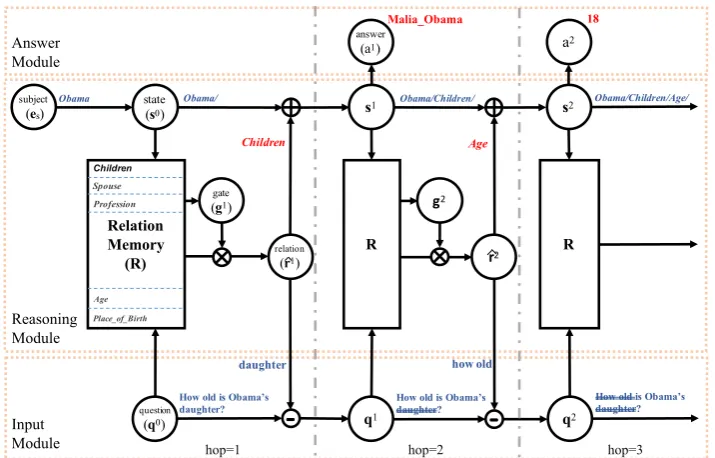
The reasoning network has three modules: input module, reasoning module, and answer module. The input module encodes the question into a distributed representation and updates the representation hop-by-hop according to the inference results of the reasoning module. The reasoning module initializes its state by the topic entity of a question and predicts a relation on which the model should focus at the current hop, conditioned on the present question and reasoning state. The predicted relation is utilized to update the state vector and the question representation hop-by-hop. The answer module predicts an entity conditioned on the state of the reasoning module.
The process can be illustrated by the example as shown in Figure 1. For question“How old is Obama’s daughter?”, the subject entity Barack Obamais utilized to initialize the state vector. IRN predicts the first relation “Children”at the first hop. The “Children”relation is added to the state vector to encode the updated parsing result, and the corresponding natural language form of this relation in the question (here is “daughter”) is subtracted from the question to avoid repeatedly analyzing the relation-relevant word “daughter”. This procedure is repeated until the Terminalrelation is predicted.
3.3 Input Module
The input module encodes a question to a vector representation and updates the representation of the question at each hop of the reasoning process: the predicted relation will be subtracted from the current representation to compel the reasoning process to attend to other words that should be analyzed.
Formally, the questionX =x1, x2, ..., xncan be initialized by the sum of the word embeddings and
updated by subtracting the relation predicted by the reasoning module at the previous hop:
q0 =
n
X
i=1
xi (1)
qh = qh−1−Mrqrˆh (2)
1
For instance, relationChildrenis one-to-many, where a person may have more than one child.
subject
Figure 1: Interpretable Reasoning Network. At each hop IRN computes the probability of selecting the next relation asgh
and obtains a predicted relationrˆh. The predicted relationrˆhis used to update the questionqhand the stateshwith different projections. The state is initialized by subject ass0 =e
s. The answer path (Obama
Children
−−−−−−→M alia Obama−−→Age 18) is composed of the predicted relations and entities (in red).
whereMrqis a matrix projecting the KB relation space to the natural language question space,qh−1is
the question representation at hoph−1, andrˆhdefined by Eq. 4 is the predicted relation at hoph. The intuition of such update is that the already analysed part of the question should not be parsed again.
Representing a question as a bag of words might be too simple. However, this method works well in our setting. Future work would consider other sophisticated encoders such as CNN or LSTM.
3.4 Reasoning Module
The reasoning module aims to attend to a particular part of the question at each hop, predict an associated relation in knowledge base, and then update its state.
The reasoning module takes as input the previous state vector (sh−1) and the previous question vector (qh−1), and then predicts a relation (rˆh) based on the analysis at the current hop. Once the predicted relation (rˆh) is obtained, the relation will be used to update the next question representation (qh) and the
state of the reasoning module (sh). In this manner, the reasoning network is traceable and interpretable. The process can be formally described by the following equations3:
gjh=P(rh=rj|qh−1,sh−1) = softmax((Mrqrj)Tqh−1+ (Mrsrj)Tsh−1) (3)
where rj is the embedding of a relation in KB and all the relation embeddings are stored in a static
memoryR, andshis the state of the reasoning module at hoph.gjhis the probability of selecting thejth
relation in KB andMrsis the projection matrix mapping rfrom the relation space to the state space.
Mrqis the same projection matrix used in Eq. 2 to maprfrom the relation space to the question space.
We initialize the state vector with the topic entity (subject) s0 = e
s. IRN will learn to enrich the
state representation hop by hop, for instance, at the first hop s1 ≈ es+r1, and at the second hop s2≈es+r1+r2, intuitively. In this manner, the state vector encodes historical information.
In order to signify when the reasoning process should stop, we augment the relation set with the
Terminalrelation. Once the reasoning module predicts the Terminalrelation, the reasoning process will stop, and the final answer will be the output when the last non-terminal relation is added to the states.
3.5 Answer Module
The answer module chooses the corresponding entity from KB at each hop (denoted asah). At the last hop, the selected entity is chosen as the final answer, while at the intermediate hops, the predictions of these entities can be inspected to help reasoning analysis and failure diagnosis.
More formally, an entity at each hop can be predicted as follows:
eh =Msesh (6)
ohj =P(ah =ej|sh) = softmax(eTjeh) (7)
Mseis used to transfer from the state space (sh) to the entity space (eh) to bridge the representation
gap between the two spaces.ejis the embedding vector of thejthentity in KB.
3.6 Loss Function
We adopt cross entropy to define the loss function. The first loss term is defined on the intermediate prediction of relations, while the second term on the prediction of entities.
The loss on one instance is defined as follows:
L=X
h
Cr(h) +λCa(h) (8)
Cr(h) =− nr
X
j=1
[ˆghj lngjh], Ca(h) =− ne
X
i=1
[ˆohi lnohi]
wherenr/neis the number of relations/entities in KB respectively,ˆgh is the gold distribution (one-hot)
over relations at hoph,ghis the predicted distribution defined by Eq. 3,oˆis the gold distribution over entities, which is also one-hot representation, andois defined by Eq. 7.λis a hyper parameter to balance the two terms.
Note that the training data is in the form of (q, < es, r1, e1, ..., a >), which indicates that the model can incorporate supervision not only from the final answer (referred to as IRN-weak), but also from the intermediate relations and entities along the answer path (referred to as IRN).
3.7 Multitask Training for KB Representation
In order to incorporate more constraints from KB4, we learn the embeddings of entities and relations as well as the space transition matrix with a multitask training schema. For a given fact triple in KB,
(es, r, eo), the representations of the entities and the relation apply the following constraint:
Mse(es+r) =eo (9)
wherees, r,eo are embeddings of the subject (or head) entity, relation, and the object (or tail) entity.
This idea is inspired by TransE (Bordes et al., 2013), but we adoptMse(see Eq. 6) as a transfer matrix
to bridge the representation gap between the state space (herees+r = s) and the entity space (here
eo=e).
The parameters are updated with a multi-task training schema. We first learn the KB embeddingse/r and the transformation matrixMseto fit Eq. 9 with several epoches. This is the task of KB embedding
training. Then, we update all the parameters of IRN under supervision from the QA task with one epoch, which is the task of QA training. We run the two tasks iteratively.
With the help of the auxiliary KB embedding training, IRN not only utilizes the additional information from KB to make better inferences, but also has an ability to deal with incomplete answer paths. For example, even if the connection between Barack Obamaand Malia Obamais not present in KB, our model can still make correct prediction thanks toMse(eBarack Obama+rChildren)≈eM alia Obama.
3.8 Dealing with Conjunctive Questions
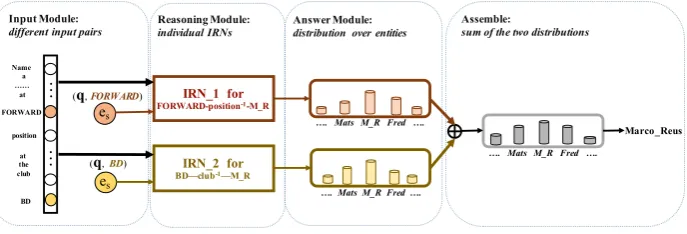
IRN is not limited to only path questions. For a conjunctive question that contains more than one topic entity, the answer can be found by executing multiple IRNs with the same parameters in parallel and then obtaining the intersection of individual results.
Reasoning Module:
Figure 2: An assembly of two IRNs to handle a conjunctive question with two subjects. Different IRNs take as input the same question but different subjects and output the distribution over the candidate answers. The final answer is selected after summing the two distributions.
This process is exemplified by Figure 2. The input question “Name a soccer player who plays at forward position at the club Borussia Dortmund”has two subject entities,“FORWARD”and “Borus-sia Dortmund(BD)”. One IRN (IRN 1) takes the original question and“FORWARD”as input, and then predicts possible objects for path query“FORWARDplays position
−1
−−−−−−−−−−−→?(Marco Reus)”.5 The output is a
distribu-tion over entities. Similarly, another IRN (IRN 2) tackles the path query“BDplays in club −1
−−−−−−−−−−→?(Marco Reus)”
where the input is the same question but another subject entity“Borussia Dortmund(BD)”. After sum-ming the two output distributions, the answer“Marco Reus”is chosen with the largest probability.
4 Data Preparation
We prepared two KBQA datasets to evaluate our Interpretable Reasoning Network: one is PathQuestion6, constructed by ourselves, and the other is WorldCup2014, adopted from (Zhang et al., 2016).
4.1 PathQuestion
We adopted two subsets of Freebase (Bollacker et al., 2008) as Knowledge Bases to construct the PathQuestion (PQ) and the PathQuestion-Large (PQL) datasets. We extracted paths between two en-tities which span two hops (es
r1 denoted by -3H) and then generated natural language questions with templates. To make the gener-ated questions analogical to real-world questions, we included paraphrasing templates and synonyms for relations by searching the Internet and two real-world datasets, WebQuestions (Berant et al., 2013) and WikiAnswers (Fader et al., 2013). In this way, the syntactic structure and surface wording of the generated questions have been greatly enriched.
PQL is more challenging than PQ in that PQL utilizes larger KB and provides less training instances. The statistics are shown in Table 1 and more details are described in the Appendix 6.
4.2 WorldCup2014
We also evaluated our model on the WorldCup2014 (WC2014) dataset constructed by (Zhang et al., 2016). The dataset contains single-relation questions (denoted by WC-1H), two-hop path questions (WC-2H), and conjunctive questions (WC-C). WC-M is the mixture of WC-1H and WC-2H. The statistics of
WorldCup2014are listed in Table 1.
5
The question mark indicates the entity to be predicted and the entity in bracket is the expected answer.
Dataset #Entity #Relation #Question Exemplar Question
PQ-2H / 3H 2,215 14 1,908 / 5,198 What does the son of princess Sophia’s mom do for a living? PQL-2H / 3H 5,035 364 1,594 / 1,031 What is the notable type of Jody Harris’s profession? WC-1H / 2H / M / C 1,127 6 6,482 / 1,472 / 7,954 / 2,208 Name a player who plays at Forward position from Mexico?
Table 1: Statistics and exemplar questions of PathQuestion (PQ), PathQuestion-Large (PQL) and WorldCup2014 (WC).
5 Experiment and Evaluation
5.1 Implementation Details
ADAM optimizer (Kingma and Ba, 2015) was used for parameter optimization. The dimension of all the embeddings (words in question, entities and relations in KB) was set asdx = de = dr = 50. The
hyper-parameterλ(see Eq. 8) is set to1. We partitioned the entire dataset into the train/valid/test subset with a proportion of8 : 1 : 1and set the batch size as50.
5.2 Performance of Question Answering
In this section, we evaluated the performance of multi-relation question answering onPathQuestionand WorldCup2014respectively. To further show that IRN is able to handle more challenging datasets, we evaluated the model with two configurations:
Incomplete KB To simulate the real KBs which are often far from complete, we removed half of the triples (entities and relations are retained but the connections between entities were removed) from the KB of the PQ-2H dataset.
Unseen KB To simulate a real QA scenario where out-of-vocabulary(OOV) words is one of the major challenges, we removed questions whose answer path includes relation “Cause of Death”, “Gender”
or“Profession” from the PQ-2H training set. The models need to cope with questions related to these three OOV relations during the test.
Several baselines are included here:
Embed(Bordes et al., 2014b) deals with factoid QA over KB by matching a question with an answer in the embedding spaces.
Subgraph(Bordes et al., 2014a) improves theEmbed model by enriching the representation of an an-swer entity with the entity’s subgraph.
Seq2Seq(Sutskever et al., 2014) is a simplified seq2seq semantic parsing model, which adopts an LSTM to encode the input question sequence and another LSTM to decode the answer path.
MemN2N(Sukhbaatar et al., 2015) is an end-to-end memory network that can be used for reading com-prehension and question answering. The memory units consist of the related triples in a local subgraph of the corresponding answer path, where the settings are the same as (Bordes et al., 2015).
KVMemN2N(Miller et al., 2016) improves the MemN2N for KBQA as it divides the memory into two parts: the key memory stores the head entity and relation while the value memory stores the tail entity. IRN-weakis our model that employs only supervision from the final answer entity rather than the com-plete answer path. This can be implemented by simply ignoring the loss from the intermediate hops except the final entity in Eq. 8.
The performance is measured by accuracy7: correct if a predicted entity is in the answer set of input question. Since there are many 1-to-many relations in Freebase and WC2014, a question may have several possible answer paths, resulting in multiple answers. For example, given the question“How old
is Obama’s daughter?”, the original path can be“Barack Obama−−−−−→Children Malia Obama−−→Age18” or
“Barack Obama−−−−−→Children Sasha Obama−−→Age 14”, thus the answer can be either“18”or“14”. For this question, either answer is correct.
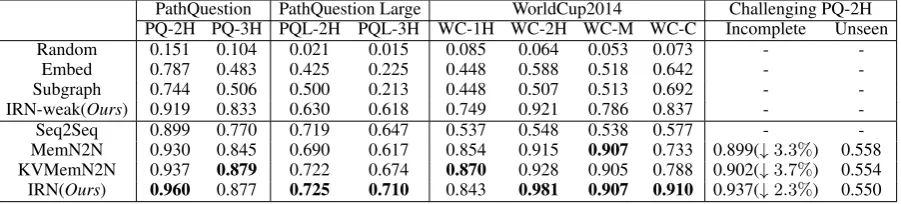
The results in Table 2 demonstrate that our system outperforms the baselines on single-relation ques-tions (WC-1H), 2-hop-relation quesques-tions (PQ-2H/PQL-2H/WC-2H) as well as 3-hop-relation quesques-tions (PQ-3H/PQL-3H). Furthermore, assembled IRNs obtain strong performance when dealing with conjunc-tive questions in WC-C .
PathQuestion PathQuestion Large WorldCup2014 Challenging PQ-2H PQ-2H PQ-3H PQL-2H PQL-3H WC-1H WC-2H WC-M WC-C Incomplete Unseen Random 0.151 0.104 0.021 0.015 0.085 0.064 0.053 0.073 -
-Embed 0.787 0.483 0.425 0.225 0.448 0.588 0.518 0.642 - -Subgraph 0.744 0.506 0.500 0.213 0.448 0.507 0.513 0.692 - -IRN-weak(Ours) 0.919 0.833 0.630 0.618 0.749 0.921 0.786 0.837 - -Seq2Seq 0.899 0.770 0.719 0.647 0.537 0.548 0.538 0.577 - -MemN2N 0.930 0.845 0.690 0.617 0.854 0.915 0.907 0.733 0.899(↓3.3%) 0.558 KVMemN2N 0.937 0.879 0.722 0.674 0.870 0.928 0.905 0.788 0.902(↓3.7%) 0.554
IRN(Ours) 0.960 0.877 0.725 0.710 0.843 0.981 0.907 0.910 0.937(↓2.3%) 0.550
Table 2: Accuracy on different QA datasets. WC-C is for conjunctive questions while other datasets for path questions. Challenging PQ-2H are two more difficult configurations of PQ-2H. The models in the second block utilize the answer path information but those in the first block do not.
We have further observations as follows:
•IRN-weakoutperformsEmbed andSubgraph, indicating that multi-hop reasoning indeed helps to an-swer complex questions even when our model is trained end-to-end in the same configuration of weak supervision8.
•TheSeq2Seqbaseline performs worse thanIRN. Though they are both interpretable,IRNis more pow-erful when dealing with complicated KBs and questions.
•IRNis better thanMemN2NandKVMemN2Non most of the datasets, and both models are much better than other baselines using the path information. Note that the memory in(KV)MemN2Nconsists of fact triples which are distilled from KB using answer path. In this sense,(KV)MemN2Nindirectly employs strong supervision from answer path. In contrast,IRN has a better (or easier) mechanism to supervise the reasoning process thanks to its interpretable framework.
•The highest accuracy on PQL-2H/3H reveals thatIRNperforms better when faced with larger datasets. IRN deals with relations and entities separately, where the number of entities and relations is much less than that of triples. However,(KV)MemN2Nhas to handle much more triples in its memory.
•IRNis more robust than the baselines (↓3.7%vs. ↓2.3%) when dealing with incomplete KB, which is probably because auxiliary KB embedding training facilitates the prediction of missing triples. While the baselines are more sensitive to the incomplete information stored in the memory units.
•BothIRN and the baselines degrade remarkably (0.9→0.5) in the unseen setting because wrong dis-tributed representations are influential in embedding-based QA models. In addition, the size of the training set is much smaller than that of the original PQ-2H, which also leads to worse performance.
•IRNis more interpretable compared with(KV)MemN2N, attributed to the structure ofIRN. The rela-tion/entity predicted at each hop is a part of the answer path. The intermediate outputs offer the possibil-ity to trace the complete reasoning process, diagnose failures, and manipulate answer prediction through intermediate interactions (see Section 5.3).
5.3 Interpretable Path Reasoning
In this section, we demonstrated how IRN is interpretable by both quantitative and qualitative analysis. For the quantitative analysis, we can measure how it performs during the reasoning process by inves-tigating the prediction accuracy of intermediate relations and entities. In this task, we collected all the relations and entities with largest probabilities (see Eq. 3 and Eq. 7) at each hop{r1, a1, r2, .., aH}and compared these intermediate outputs with the ground truth{r1, e1, r2, .., a}. As for KVMemN2N, we also fetched an entity at each hop by an answer distribution, similar to that at the final hop.
According to the structure of IRN, the relation/entity predicted at each hop constitutes an answer path. Results9in Table 3 indicate that IRN can predict intermediate entities more accurately than final answers, due to the cascading errors in the consecutive prediction.
Though KVMemN2N (KVM) predicts the exact answers well, it lacks interpretability. On the one hand, KVM can not predict relations to trace the answer path. On the other hand, the hops in KVM all
8
Only supervision from question-answer pairs, but without answer path information from KB.
9Note here that only if an output matches the labeled entity exactly, the prediction will be judged as correct.Thus, the
r1 e1 r2 e2 r3 a
IRN KVM IRN KVM IRN KVM IRN KVM IRN KVM IRN KVM
PQ-2H 1.000 NA 0.957 0.016 1.000 NA NA NA NA NA 0.934 0.916 PQL-2H 0.968 NA 0.722 0.083 0.836 NA NA NA NA NA 0.673 0.676 WC-2H 1.000 NA 0.531 0.000 1.000 NA NA NA NA NA 0.528 0.382 PQ-3H 1.000 NA 0.883 0.003 1.000 NA 0.772 0.001 1.000 NA 0.738 0.774 PQL-3H 0.808 NA 0.721 0.019 0.702 NA 0.721 0.007 0.683 NA 0.608 0.600
Table 3: Accuracy at different hops along the answer path from IRN and KVMemN2N (KVM).riindicates the relation at
hopi,eiindicates the entity at hopi.aindicates the final answer. NA means not applicable.
aim at finding the answer entity rather than the intermediate entities along the answer path.
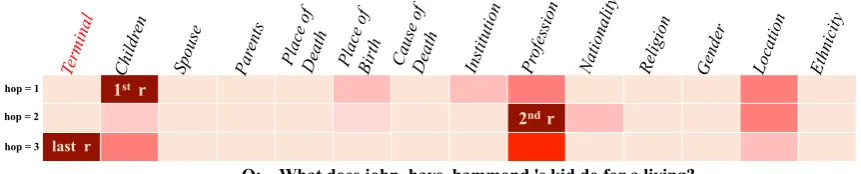
To illustrate how our model parses a question and predicts relations hop-by-hop, we studied the dis-tributions over all the relations (gh, see Eq. 3) and chose an example from PathQuestion as shown in Figure 3. It is clear that IRN is able to derive the relations in correct order. For question “What does john hays hammond’s kid do for a living?”, IRN first detects relationChildren(the corresponding word/phrase in the question is kid) and thenProfession (what does..do). When detecting theTerminal
relation, IRN will stop the analysis process.
1st r
2nd r last r
hop = 1
hop = 2
hop = 3
Q: What does john_hays_hammond 's kid do for a living?
hop = 1
hop = 2
hop = 3
hop = 4
Q: Why Ptolemy_xiii_Theos_Philopator 's couple 's daughter died ?
Figure 3: The predicted relations at each hop. Each row represents a probability distribution over relations. Darker color indicates larger probability. The terminal relation is highlighted in red.
Our model can map relations in KB to words in question. We sampled some relations in KB and pro-jected them to the question space byrq=Mrqr(see Eq. 2). We then obtained words whose embeddings
are most close torq measured by cosine similaritycos(rq,xi). The result in Table 4 indicates that IRN
can establish reasonable mapping between KB relation and natural language, such as linkingProfession
to words likeworking, profession, andoccupation. Besides mapping to single words, relation in KB can be associated with some complicate templates, such asProfession →“what does ... do”.
Relation Similar words in natural language questions Profession profession, do, working, occupation Insititution institution, organization, work, where
Religion faith, religion, what, belief Cause of Death died, killed, how, death
Place of Birth hometown, born, city, birthplace
Table 4:Most similar words in questions for some exemplar relations.
The above analysis demonstrates that our model is interpretable. Specifically, IRN has merits at:
•Providing a traceable reasoning path for question answering. With the aid of these intermediate entities and relations, we can obtain not only the final answer but also the complete path that infers the answer.
•Facilitating failure diagnosis. For instance, IRN fails to answer the question “Where did the child of Joseph P Kennedy Sr die ?”. The true answer path should be “Joseph P Kennedy Sr
Children
−−−−−−→Patricia kennedy Lawford −−−−−−−−−−→New York County”P lace of Death . However, the middle entity decided by IRN is“Rosemary Kennedy”who is also a child of“Joseph P Kennedy Sr”, but her death is not included in KB.
accuracy in Table 5 implies that we can improve the final prediction by correcting intermediate predictions.
Dataset PQ-2H PQ-3H PQL-2H PQL-3H
Acc 0.980 (↑2.0%) 0.900 (↑2.3%) 0.755 (↑3.0%) 0.744 (↑3.4%)
Table 5:Accuracy when the intermediate predictions are replaced by ground truth.
6 Conclusion
We present a novel Interpretable Reasoning Network which is able to make reasoning hop-by-hop and then answer multi-relation questions. Our model is interpretable in that the intermediate predictions of entities and relations are traceable and the complete reasoning path is observable. This property enables our model to facilitate reasoning analysis, failure diagnosis, and manual manipulation in answer prediction. Results on two QA datasets demonstrate the effectiveness of the model on multi-relation question answering.
As future work, there is much room for complex question answering. For instance, answering “How old is Obama’s younger daughter?”needs to handle arithmetic operation. Furthermore, multi-constraint questions will also be considered in this framework.
Acknowledgements
This work was partly supported by the National Science Foundation of China under grant No.61272227/61332007 and the National Basic Research Program (973 Program) under grant No. 2013CB329403.
References
Abdalghani Abujabal, Rishiraj Saha Roy, Mohamed Yahya, and Gerhard Weikum. 2017. Quint: Interpretable question answering over knowledge bases. In Proceedings of the 2017 Conference on Empirical Methods in
Natural Language Processing: System Demonstrations, pages 61–66. Association for Computational
Linguis-tics.
Jacob Andreas, Marcus Rohrbach, Trevor Darrell, and Klein Dan. 2015. Neural module networks. In IEEE
Conference on Computer Vision and Pattern Recognition, pages 39–48.
Jacob Andreas, Marcus Rohrbach, Trevor Darrell, and Dan Klein. 2016. Learning to compose neural networks for question answering.NAACL, pages 1545–1554.
J. Berant, A. Chou, R. Frostig, and P. Liang. 2013. Semantic parsing on freebase from question-answer pairs.
Empirical Methods in Natural Language Processing, pages 1533–1544.
Kurt Bollacker, Colin Evans, Praveen Paritosh, Tim Sturge, and Jamie Taylor. 2008. Freebase: A collabora-tively created graph database for structuring human knowledge. InACM SIGMOD International Conference on
Management of Data, SIGMOD 2008, Vancouver, Bc, Canada, June, pages 1247–1250.
Antoine Bordes, Nicolas Usunier, Alberto Garcia-Duran, Jason Weston, and Oksana Yakhnenko. 2013. Translat-ing embeddTranslat-ings for modelTranslat-ing multi-relational data. InAnnual Conference on Neural Information Processing
Systems, pages 2787–2795.
Antoine Bordes, Sumit Chopra, and Jason Weston. 2014a. Question answering with subgraph embeddings.
Em-pirical Methods in Natural Language Processing, pages 615–620.
Antoine Bordes, Jason Weston, and Nicolas Usunier. 2014b. Open question answering with weakly supervised embedding models. In Proceedings of ECML-PKDD, pages 165–180.
Antoine Bordes, Nicolas Usunier, Sumit Chopra, and Jason Weston. 2015. Large-scale simple question answering with memory networks. CoRR, abs/1506.02075.
Li Dong, Furu Wei, Ming Zhou, and Ke Xu. 2015. Question answering over freebase with multi-column convolu-tional neural networks. InMeeting of the Association for Computational Linguistics and the International Joint
Conference on Natural Language Processing, pages 260–269.
Anthony Fader, Luke Zettlemoyer, and Oren Etzioni. 2013. Paraphrase-driven learning for open question answer-ing. InMeeting of the Association for Computational Linguistics, pages 1608–1618.
Kelvin Guu, John Miller, and Percy Liang. 2015. Traversing knowledge graphs in vector space. Empirical
Methods in Natural Language Processing, pages 318–327.
Yanchao Hao, Yuanzhe Zhang, Kang Liu, Shizhu He, Zhanyi Liu, Hua Wu, and Jun Zhao. 2017. An end-to-end model for question answering over knowledge base with cross-attention combining global knowledge. In
Proceedings of the 55th Annual Meeting of the Association for Computational Linguistics (Volume 1: Long Papers), pages 221–231. Association for Computational Linguistics.
Diederik Kingma and Jimmy Ba. 2015. Adam: A method for stochastic optimization. international conference on learning representations.
Ankit Kumar, Ozan Irsoy, Peter Ondruska, Mohit Iyyer, James Bradbury, Ishaan Gulrajani, and Richard Socher. 2015. Ask me anything: Dynamic memory networks for natural language processing. International Conference
on Machine Learning, pages 1378–1387.
Alexander Miller, Adam Fisch, Jesse Dodge, Amir-Hossein Karimi, Antoine Bordes, and Jason Weston. 2016. Key-value memory networks for directly reading documents. InEmpirical Methods in Natural Language Pro-cessing, pages 1400–1409.
Lili Mou, Zhengdong Lu, Hang Li, and Zhi Jin. 2017. Coupling distributed and symbolic execution for natural language queries. InProceedings of the 34th International Conference on Machine Learning, Sydney, NSW, Australia, 6-11 August, pages 2518–2526.
Arvind Neelakantan, Quoc V Le, and Ilya Sutskever. 2015. Neural programmer: Inducing latent programs with gradient descent. International Conference on Learning Representations.
Arvind Neelakantan, Quoc V Le, and Ilya Sutskever. 2016. Neural programmer: Inducing latent programs with gradient descent. international conference on learning representations.
Panupong Pasupat and Percy Liang. 2015. Compositional semantic parsing on semi-structured tables. Association
for Computational Linguistics, pages 1470–1480.
Denis Savenkov and Eugene Agichtein. 2017. Evinets: Neural networks for combining evidence signals for factoid question answering. InProceedings of the 55th Annual Meeting of the Association for Computational Linguistics (Volume 2: Short Papers), pages 299–304. Association for Computational Linguistics.
Yelong Shen, Po-Sen Huang, Jianfeng Gao, and Weizhu Chen. 2016. Reasonet: Learning to stop reading in machine comprehension. SIGKDD, pages 1047–1055.
R. Socher, D. Chen, C. D. Manning, and A. Y. Ng. 2013. Reasoning with neural tensor networks for knowledge base completion. InInternational Conference on Intelligent Control & Information Processing, pages 926–934.
Sainbayar Sukhbaatar, Arthur Szlam, Jason Weston, and Rob Fergus. 2015. End-to-end memory networks.
An-nual Conference on Neural Information Processing Systems, pages 2440–2448.
Ilya Sutskever, Oriol Vinyals, and Quoc V Le. 2014. Sequence to sequence learning with neural networks.Annual
Conference on Neural Information Processing Systems, 4:3104–3112.
Wenhui Wang, Nan Yang, Furu Wei, Baobao Chang, and Ming Zhou. 2017. Gated self-matching networks for reading comprehension and question answering. In Proceedings of the 55th Annual Meeting of the
Associa-tion for ComputaAssocia-tional Linguistics (Volume 1: Long Papers), pages 189–198. Association for Computational
Linguistics.
Jason Weston, Sumit Chopra, and Antoine Bordes. 2015. Memory networks.International Conference on Learn-ing Representations.
Kun Xu, Siva Reddy, Yansong Feng, Songfang Huang, and Dongyan Zhao. 2016. Question answering on freebase via relation extraction and textual evidence. InProceedings of the 54th Annual Meeting of the Association for
Semih Yavuz, Izzeddin Gur, Yu Su, and Xifeng Yan. 2017. Recovering question answering errors via query revision. InProceedings of the 2017 Conference on Empirical Methods in Natural Language Processing, pages 903–909. Association for Computational Linguistics.
Wen-tau Yih, Xiaodong He, and Christopher Meek. 2014. Semantic parsing for single-relation question answer-ing. InProceedings of Association for Computational Linguistics, pages 643–648.
Wen Tau Yih, Matthew Richardson, Chris Meek, Ming Wei Chang, and Jina Suh. 2016. The value of seman-tic parse labeling for knowledge base question answering. InMeeting of the Association for Computational Linguistics, pages 201–206.
Pengcheng Yin, Zhengdong Lu, Hang Li, and Ben Kao. 2015. Neural enquirer: Learning to query tables with natural language. Association for Computational Linguistics, pages 2308–2314.
Wenpeng Yin, Mo Yu, Bing Xiang, Bowen Zhou, and Hinrich Schtze. 2016. Simple question answering by attentive convolutional neural network. International Conference on Computational Linguistics, pages 1746– 1756.
Liwen Zhang, John Winn, and Ryota Tomioka. 2016. Gaussian attention model and its application to knowledge base embedding and question answering. CoRR, abs/1611.02266.
Appendix A. PathQuestion Construction and Question Templates
We constructed a synthesis dataset by generating questions with templates. The knowledge base for PathQuestion has more than 60,000 triples which are adopted from FB13 (Socher et al., 2013) with 13 re-lations and thousands of entities. As for PathQuestion-Large, we adopted another more complex subset of Freebase (Bollacker et al., 2008). First, we extracted all the paths with two hops (< es, r1, e1, r2, a >), or three hops (< es, r1, e1, r2, e2, r3, a >) among these triples. Second, we crafted templates to gen-erate natural language questions from these paths. Last, we collected question and answer path pairs
(q, < es, r1, e1, ..., a >)to construct thePathQuestion (PQ)dataset.
We crafted templates to transfer an answer path extracted from KB to natural language questions. To make the generated questions analogical to real-world questions, those templates are firstly written manually, and then enriched by replacing synonyms. Besides, we searched for different syntactical struc-tures and paraphrases in real-world datasets including WebQuestions (Berant et al., 2013) and WikiAn-swers (Fader et al., 2013) as well as on the Internet. In this manner, the templates have been greatly diversified and are much closer to real questions.
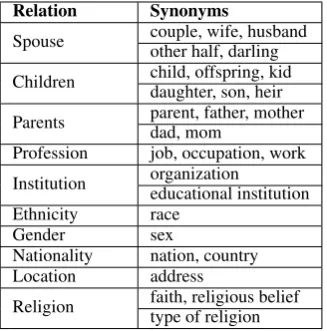
Synonyms used in templates for PathQuestion are shown in Table 6 and templates for 2-hop paths (PQ-2H) are shown in Table 7. The datasets are available athttps://github.com/zmtkeke/IRN.
Relation Synonyms
Spouse couple, wife, husband other half, darling
Children child, offspring, kid daughter, son, heir
Parents parent, father, mother dad, mom
Profession job, occupation, work
Institution organization
educational institution Ethnicity race
Gender sex
Nationality nation, country Location address
Religion faith, religious belief type of religion
Path Pattern Question-templates
Universal
“What is ther2ofes’sr1?”
“What is thees’sr1’sr2?”
“What is ther2ofr1ofes?”
“Ther2ofes’sr1?”
“Thees’sr1’sr2?”
“Ther2ofr1ofes?”
Ask about a person “Who is ther2ofes’sr1?”
“What is the name of ther2ofes’sr1?”
r2=r1=Parents/ “Who is the grand-r1ofes?”
r2=r1=Children “What is the name of the grand-r1ofes?”
r2=Ethnicity
“Whatr2ises’sr1”
“What ises’sr1’sr2like?”
“What ises’sr1’sr2about?”
r2=Institution
“Where doeses’sr1work?”
“Where doeses’sr1work for?”
“Whichr2doeses’sr1work for?”
r2=Nationality “Which nationality ises’sr1?”
“Where doeses’sr1come from?”
r2=Religion
“Whatr2doeses’sr1follow?”
“Whatr2ises’sr1?”
“Whatr2doeses’sr1have?”
“Whatr2ises’sr1practice?”
r2=Gender “Whatr2ises’sr1?”
“Ises’sr1a man or a woman?”
r2=Location
“Where ises’sr1living?”
“Where ises’sr1staying?”
“Please tell mees’sr1present address.”
r2=Profession
“What doeses’sr1do?”
“What ises’sr1working on?”
”What ises’sr1?”
“What line of business ises’sr1in?”
“What doeses’sr1do for a living?”
r2=Cause of Death
“Whyes’sr1died?”
“Howesdied?”
“What’s the reason ofes’sr1’s death?”
“What caused the death ofes’sr1?”
”What killed thees’sr1?”
“What made thees’sr1dead?”
“What dides’sr1die from?”
r2=Place of Death
“Where dides’sr1die?”
“Where did ther1ofesdie?”
“What city dides’sr1die?”
r2=Place of Birth
“Where dides’sr1born?”
“What city dides’sr1born?”
“What is the hometown ofes’sr1?”
“What ises’sr1’s birthplace?”