Turbo-Detected Unequal Protection MPEG-4 Audio Transceiver
Using Convolutional Codes, Trellis Coded Modulation and Space-Time Trellis Coding
N. S. Othman, S. X. Ng and L. Hanzo
School of ECS, University of Southampton, SO17 1BJ, UK.
Tel: +44-23-8059 3125, Fax: +44-23-8059 4508
Email:
{
nso01r,sxn,lh
}
@ecs.soton.ac.uk, http://www-mobile.ecs.soton.ac.uk
Abstract – A jointly optimised turbo transceiver ca-pable of providing unequal error protection is proposed for employment in an MPEG-4 aided audio transceiver. The transceiver advocated consists of Space-Time Trellis Coding (STTC), Trellis Coded Modulation (TCM) and two different-rate Non-Systematic Convolutional codes (NSCs) used for unequal error protection. A benchmarker sche-me combining STTC and a single-class protection NSC is used for comparison with the proposed scheme. The au-dio performance of the both schemes is evaluated when communicating over uncorrelated Rayleigh fading chan-nels. It was found that the proposed unequal protection turbo-transceiver scheme requires about two dBs lower trans-mit power than the single-class turbo benchmarker scheme in the context of the MPEG-4 audio transceiver, when aim-ing for an effective throughput of 2 bits/symbol, while ex-hibiting a similar decoding complexity.
1. MOTIVATION AND BACKGROUND
The MPEG-4 standard [1, 2] defines a comprehensive multi-media content representation scheme that is capable of sup-porting numerous applications - such as streaming multime-dia signals over the internet/intranet, content-based storage and retrieval, digital multimedia broadcast or mobile communica-tions. The audio-related section of the MPEG-4 standard [3] defines audio codecs covering a wide variety applications -ranging from narrowband low-rate speech to high quality mul-tichannel audio, and from natural sound to synthesized sound effects as a benefit of its object-based approach used for repre-senting the audio signals.
The MPEG-4 General Audio (GA) encoder is capable of compressing arbitrary natural audio signals. One of the key components of the MPEG-4 GA encoder is the Time/Frequency (T/F) compression scheme constituted by the Advanced Audio Coding (AAC) and Transform based Weighted Vector Quan-tization (TwinVQ), which is capable of operating at bitrates ranging from 6 kbit/s to broadcast quality audio at 64 kbit/s [1].
The financial support of the EPSRC, Swindon UK and the EU under the auspices of the PHOENIX, NEWCOM and NEXWAY projects is gratefully acknowledged.
The MPEG-4 T/F codec is based on the MPEG-2 AAC standard, extended by a number of additional functionalities, such as Perceptual Noise Substitution (PNS) and Long Term Prediction (LTP) for enhancing the achievable compression per-formance, and combined with the TwinVQ for operation at ex-tremely low bit rates. Another important feature of this codec is its robustness against transmission errors in error-prone prop-agation channels [4]. The error resilience of the MPEG-4 T/F codec is mainly attributed to the so-called Virtual Codebook tool (VCB11), Reversible Variable Length Coding tool (RVLC) and Huffman Codeword Reordering tool (HCR) [4, 5], which facilitate the integration of the MPEG-4 T/F codec into wire-less systems.
In this study the MPEG-4 audio codec was incorporated in a sophisticated unequal-protection turbo transceiver using joint coding and modulation as inner coding, twin-class convolu-tional outer coding as well as space time coding based spatial diversity. Specifically, maximal minimum distance Non-Sys-tematic Convolutional codes (NSCs) [10, p. 331] having two different code-rates were used as outer encoders for providing unequal audio protection. On one hand, Trellis Coded Modula-tion (TCM) [6–8] constitutes a bandwidth-efficient joint chan-nel coding and modulation scheme, which was originally de-signed for transmission over Additive White Gaussian Noise (AWGN) channels. On the other hand, Space-Time Trellis Coding (STTC) [7, 9] employing multiple transmit and re-ceive antennas is capable of providing spatial diversity gain. When the spatial diversity order is sufficiently high, the chan-nel’s Rayleigh fading envelope is transformed to a Gaussian-like near-constant envelope. Hence, the benefits of a TCM scheme designed for AWGN channels will be efficiently ex-ploited, when TCM is concatenated with STTC.
We will demonstrate that significant iteration gains are at-tained with the aid of the proposed turbo transceiver. The paper is structured as follows. In Section 2 we describe the MPEG-4 audio codec, while in Section 3 the architecture of the turbo transceiver is described. We elaborate further by characterising the achievable system performance in Section 4 and conclude in Section 5.
Encoder NSC Encoder NSC
TCM
Encoder
STTC
Encoder
Fading
Channels
Iterative
Decoder
MPEG−4
Decoder Audio MPEG−4
Encoder Audio
s
b1
b2
u1
u2
c
xNt
x1
.
.
.
yNr
y1
.
.
.
ˆb1ˆb2
[image:2.595.57.568.60.136.2]ˆs
Figure 1: Block diagram of the serially concatenated STTC-TCM-2NSC assisted MPEG-4 audio scheme. The notationss,ˆs,bi,
ˆbi,ui,c,xj andyk denote the vector of the audio source symbol, the estimate of the audio source symbol, the class-iaudio bits, the estimates of the class-iaudio bits, the encoded bits of class-iNSC encoders, the TCM coded symbols, the STTC coded symbols for transmitterjand the received symbols at receiverk, respectively. Furthermore,NtandNrdenote the number of transmitters and receivers, respectively. The symbol-based channel interleaver between the STTC and TCM schemes as well as the two bit-based interleavers at the output of NSC encoders are not shown for simplicity. The iterative decoder seen at the right is detailed in Figure 2.
2. AUDIO SYSTEM OVERVIEW
As mentioned above, the MPEG-4 AAC is based on time/frequency audio coding, which provides redundancy reduction by exploit-ing the correlation between subsequent audio samples of the input signal. Furthermore, the codec uses perceptual modelling of the human auditory system for masking the quantisation dis-tortion of the encoded audio signals by allowing more distor-tion in those frequency bands, where the signal exhibits higher energy peaks and vice versa [4, 5].
The MPEG-4 AAC is capable of providing an attractive au-dio quality versus bitrate performance, yielding high-fidelity audio reconstruction for bit rates in excess of 32 kbit/s per channel. In the proposed wireless system the MPEG-4 AAC is used for encoding the stereo audio file at a bit rate of 48 kbit/s. The audio input signal was sampled at 44.1 kHz and hence results in an audio framelength of 23.22 ms, which cor-responds to 1024 audio input samples. The compressed au-dio information is formatted into a packetized bitstream, which conveyed one audio frame. In our system, the average trans-mission frame size is approximately 1116 bits per frame. The audio Segmental Signal to Noise Ratio (SegSNR) of this con-figuration was found to beS0= 16.28dB, which gives a trans-parent audio quality.
It is well recognised that in highly compressed audio bit-streams a low bit error ratio (BER) may lead to perceptually unacceptable distortion. In order to prevent the complete loss of transmitted audio frames owing to catastrophic error prop-agation, the most sensitive bits have to be well protected from channel errors. Hence, in the advocated system Unequal Error Protection (UEP) is employed, where the compressed audio bitstream was partitioned into two sensitivity classes. More explicitly, an audio bit, which resulted in a SegSNR degrada-tion above 16 dB upon its corrupdegrada-tion was classified into pro-tection class-1. A range of different audio files were used in our work and the results provided are related to a 60 seconds long excerpt of Mozart’s ”Clarinet Concerto (2nd movement -Adagio)”. From the bit sensitivity studies using this audio file as the source, we found that approximately 50% of the total
number of MPEG-4 encoded bits falls into class-1.
At the receiver, the output of the turbo transceiver is de-coded using the MPEG-4 AAC decoder. During the decoding process, the erroneously received audio frames were dropped and replaced by the previous error-free audio frame for the sake of avoiding an even more dramatic error-infested audio-quality degradation [11, 12].
3. THE TURBO TRANSCEIVER
The block diagram of the serially concatenated STTC-TCM-2NSC turbo scheme using a STTC, a TCM and two different-rate NSCs as its constituent codes is depicted in Figure 1. Since the number of class-1 audio bits is approximately the same as that of the class-2 audio bits and there are approximately 1116 bits per audio frame, we protect the 558-bit class-1 audio se-quence using a rate-R1 NSC encoder and the 558-bit class-2 sequence using a rate-R2NSC encoder. Let us denote the turbo scheme as STTC-TCM-2NSC-1 when the NSC coding rates of
R1=k1/n1= 1/2andR2=k2/n2= 3/4are used.
Further-more, when the NSC coding rates ofR1= 2/3andR2= 3/4 are used, we denote the turbo scheme as STTC-TCM-2NSC-2. The code memory of the class-1 and class-2 NSC encoders is
L1= 3andL2= 3, respectively. The class-1 and class-2 NSC coded bit sequences are interleaved by two separate bit inter-leavers, before they are fed to the rate-R3 = 3/4 TCM [6– 8] scheme having a code memory of L3 = 3. Code termi-nation was employed for the NSCs, TCM [6–8] and STTC codecs [7, 9]. The TCM symbol sequence is then symbol-interleaved and fed to the STTC encoder. We invoke a 16-state STTC scheme having a code memory ofL4 = 4andNt= 2 transmit antennas, employingM = 16-level Quadrature Am-plitude Modulation (16QAM) [8]. The STTC employingNt=
2requires one 16QAM-based termination symbol. The over-all coding rate is given byRs1 = 1116/2520 ≈0.4429and
(3) NSC
(3a) MAP
Decoder
(3b) MAP
Decoder (1)
TCM
MAP
Decoder (2)
MAP
Decoder STTC
= = =
π−1 b1
πb2 Ω
Ψ
πs
π−1 s P1
a(c) =Pi2(c)
y
P1
p(c) =Pe1(c) +Pi2(c) P2
a(c) =Pe1(c) Pp2(c) =Pi2(c) +Pe1(c) P2
p(u) =Pi2(u) +Pe3(u)
Ψ−1 π−1
b2
πb1
L3
a(u) =L2i(u)
L3a a(u)
L3b a(u)
L3a
p(u) =L3ea(u) +L3aa(u) L3a
p(u)
L3b p(u)
L3a p(b1)
L3b p(b2)
L3b
p(u) =L3eb(u) +L3ab(u)
Ω−1
L2
p(u) =L2i(u) +L3e(u)
P2
a(u) =Pe3(u) L3e(u) 2m+1
2m
[image:3.595.58.566.57.194.2]Bit LLR
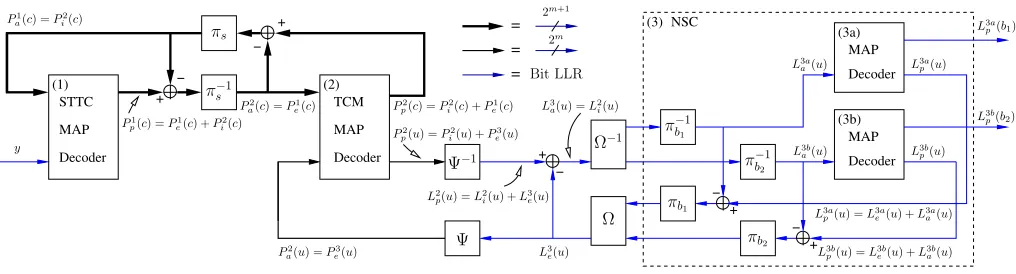
Figure 2: Block diagram of the STTC-TCM-2NSC turbo detection scheme seen at the right of Figure 1. The notationsπ(s,bi) andπ−(s,b1
i) denote the interleaver and deinterleaver, while the subscripts denotes the symbol-based interleaver of TCM and the subscriptbidenotes the bit-based interleaver for class-iNSC. Furthermore,ΨandΨ−1denote LLR-to-symbol probability and symbol probability-to-LLR conversion, whileΩandΩ−1denote the parallel-to-serial and serial-to-parallel converter, re-spectively. The notationmdenotes the number of information bits per TCM coded symbol. The thickness of the connecting lines indicates the number of non-binary symbol probabilities spanning from a single LLR per bit to2mand2m+1 probabili-ties [13] cIEE, 2004, Ng, Chung and Hanzo.
(BPS) andlog2(M)Rs2≈2.07BPS, respectively.
At the receiver, we employNr = 2receive antennas and the received signals are fed to the iterative decoders for the sake of estimating the audio bit sequences in both 1 and class-2, as seen in Figure 1. The STTC-TCM-2NSC scheme’s turbo decoder structure is illustrated in Figure 2, where there are four constituent decoders, each labelled with a round-bracketed in-dex. The Maximum A-Posteriori (MAP) algorithm [7] oper-ating in the logarithmic-domain are employed by the STTC, TCM and the two NSC decoders, respectively. The notations
P(.)andL(.)in Figure 2 denote the logarithmic-domain sym-bol probabilities and the Logarithmic-Likelihood Ratio (LLR) of the bit probabilities, respectively. The notationsc,u and
bi in the round brackets (.) in Figure 2 denote TCM coded
symbols, TCM information symbols and the class-iaudio bits, respectively. The specific nature of the probabilities and LLRs is represented by the subscripts a, p, e andi, which denote
a priori,a posteriori,extrinsicandintrinsicinformation,
respectively. The probabilities and LLRs associated with one of the four constituent decoders having a label of{1,2,3a,3b} are differentiated by the identical superscripts of{1,2,3a,3b}. Note that the superscript 3 is used for representing the two NSC decoders of3aand3b. The iterative turbo-detection scheme shown in Figure 2 enables an efficient information exchange between STTC, TCM and NSCs constituent codes for the sake of achieving spatial diversity gain, coding gain, unequal error proctection and a near-channel-capacity performance. The in-formation exchange mechanism between each constituent de-coders is detailed in [13].
For the sake of benchmarking the scheme advocated, we created a powerful benchmark scheme by replacing the TCM and NSC encoders of Figure 1 by a single NSC codec hav-ing a codhav-ing rate ofR0 =k0/n0 = 1/2and a code memory ofL0 = 6. We will refer to this benchmarker scheme as the
STTC-NSC arrangement. All audio bits are equally protected in the benchmarker scheme by a single NSC encoder and a STTC encoder. A bit-based channel interleaver is inserted be-tween the NSC encoder and STTC encoder. Taking into ac-count the bits required for code termination, the number of output bits of the NSC encoder is(1116 +k0L0)/R0= 2244, which corresponds to 561 16QAM symbols. Again, a 16-state STTC scheme havingNt= 2transmit antennas is employed. After code termination, we have 561 + 1 = 562 16QAM symbols or 4(562) = 2248 bits in a transmission frame at each transmit antenna. The overall coding rate is given by
R = 1116/2248 ≈ 0.4964 and the effective throughput is
log2(16)R ≈ 1.99BPS, both of which are very close to the corresponding values of the STTC-TCM-2NSC-2 scheme. A decoding iteration of the STTC-NSC benchmarker scheme is comprised of a STTC decoding and a NSC decoding step.
We will quantify the decoding complexity of the proposed STTC-TCM-2NSC scheme and that of the benchmarker scheme using the number of decoding trellis states. The total number of decoding trellis states per iteration for the proposed scheme employing 2 NSC decoders having a code memory ofL1 =
L2 = 3, TCM havingL3 = 3and STTC havingL4 = 4, is
given byS = 2L1 + 2L2 + 2L3 + 2L4 = 40. By contrast,
the total number of decoding trellis states per iteration for the benchmarker scheme having a code memory ofL0 = 6and STTC having L4 = 4, is given byS = 2L0 + 2L4 = 80.
4. SIMULATION RESULTS
In this section we evaluate the performance of the proposed MPEG-4 based audio telephone schemes using both the Bit Error Ratio (BER) and the Segmental Signal to Noise Ratio (SegSNR).
ber12-a.gle
0 1 2 3 4 5 6
Eb/N0(dB)
10-6 10-5 10-4 10-3 10-2 10-1 100
BER
STTC-TCM-2NSC-1
class 2 class 1
[image:4.595.322.565.57.228.2]6 iter 4 iter 2 iter 1 iter
Figure 3: BER versus Eb/N0 performance of the 16QAM-based STTC-TCM-2NSC-1 assisted MPEG-4 audio scheme, when communicating over uncorrelated Rayleigh fading chan-nels. The effective throughput was1.77 BPS.
ber12-b.gle
0 1 2 3 4 5 6
Eb/N0(dB)
10-6 10-5 10-4 10-3 10-2 10-1 100
BER
STTC-TCM-2NSC-2
class 2 class 1
[image:4.595.57.302.142.312.2]6 iter 4 iter 2 iter 1 iter
Figure 4: BER versus Eb/N0 performance of the 16QAM-based STTC-TCM-2NSC-2 assisted MPEG-4 audio scheme, when communicating over uncorrelated Rayleigh fading chan-nels. The effective throughput was2.07 BPS.
Figures 3 and 4 depict the BER versus Signal to Noise Ra-tio (SNR) per bit, namelyEb/N0, performance of the 16QAM-based STTC-TCM-2NSC-1 and STTC-TCM-2NSC-2 schemes, respectively, when communicating over uncorrelated Rayleigh fading channels. As we can observe from Figures 3 and 4, the gap between the BER performance of the class-1 and class-2 audio bits is wider for STTC-TCM-2NSC-1 compared to the STTC-TCM-2NSC-2 scheme. More explicitly, the class-1
au-segsnr-s12.gle
0 1 2 3 4 5 6
Eb/N0(dB)
4 6 8 10 12 14 16 18
SegSNR
STTC-TCM-2NSC-2 STTC-TCM-2NSC-1
6 iter 4 iter 2 iter 1 iter
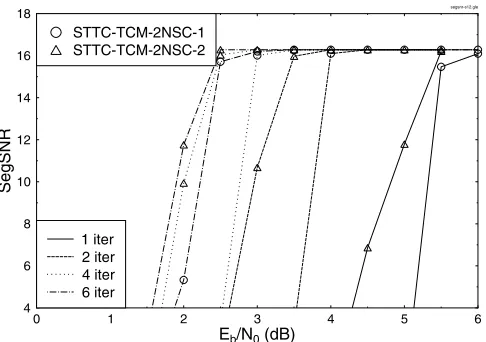
Figure 5: Average SegSNR versus Eb/N0 performance of the 16QAM-based STTC-TCM-2NSC assisted MPEG-4 audio scheme, when communicating over uncorrelated Rayleigh fad-ing channels. The effective throughput of STTC-TCM-2NSC-1 and STTC-TCM-2NSC-2 was 1.77 and2.07 BPS, respec-tively.
segsnr-bench.gle
0 1 2 3 4 5 6
Eb/N0(dB)
4 6 8 10 12 14 16 18
SegSNR
STTC-NSC
[image:4.595.321.564.320.488.2]4 iter 3 iter 2 iter 1 iter
Figure 6: Average SegSNR versus Eb/N0 performance of the 16QAM-based STTC-NSC assisted MPEG-4 audio bench-marker scheme, when communicating over uncorrelated Ray-leigh fading channels. The effective throughput was1.99 BPS.
dio bits of STTC-TCM-2NSC-1 have a higher protection at the cost of a lower throughput compared to the STTC-TCM-2NSC-2 scheme. However, the BER performance of the class-2 audio bits of the STTC-TCM-class-2NSC-1 arrangement is ap-proximately 0.5 dB poorer than that of STTC-TCM-2NSC-2 at BER=10−5.
[image:4.595.56.302.379.549.2]STTC-TCM-2NSC-1 requiresEb/N0= 3 dB, when having an audio SegSNR in excess of 16 dB after the fourth turbo iteration. Hence the audio SegSNR performance of STTC-TCM-2NSC-1 is 0.5 dB poorer than that of STTC-TCM-2NSC-2 after the fourth iteration. Note that the BER of the 1 and class-2 audio bits for the corresponding values ofEb/N0, SegSNR and iteration index is less than10−7 and10−4, respectively, for the two different turbo schemes. After the sixth iteration, the SegSNR performance of both turbo schemes becomes quite similar since the corresponding BER is low. These results demonstrate that the MPEG-4 audio decoder requires a very low BER for both class-1 and class-2 audio bits, when aiming for a SegSNR above 16 dB. In this context it is worth mention-ing that Recursive Systematic Convolutional codes (RSCs) [6, 7, 10] are capable of achieving a higher iteration gain, but suf-fer from an error floor. Owing to this reason the SegSNR per-formance of the schemes employing RSCs instead of NSCs was found to be poorer. The SegSNR results of the turbo schemes employing RSCs instead of NSCs as the outer code were not shown here for reasons of space economy.
Figure 6 portrays the SegSNR versusEb/N0performance of the STTC-NSC audio benchmarker scheme, when commu-nicating over uncorrelated Rayleigh fading channels. Note that if we reduce the code memory of the NSC constituent code of the STTC-NSC benchmarker arrangement fromL0=6 to 3, the achievable performance becomes poorer, as expected. If we increasedL0from 6 to 7 (or higher), the decoding complex-ity would increase significantly, while the attainable best pos-sible performance is only marginally increased. Hence, the STTC-NSC scheme having L0=6 constitutes a good bench-marker scheme in terms of its performance versus complex-ity tradeoffs. It is shown in Figures 5 and 6 that the first iteration based performance of the STTC-NSC benchmarker scheme is better than that of the proposed STTC-TCM-2NSC arrangements. However, at the same decoding complexity of 160 (240) trellis decoding states STTC-TCM-2NSC-2 having 4 (6) iterations performs approximately 2 (1.5) dB better than the STTC-NSC arrangement having 2 (3) iterations.
It is worth mentioning that other joint coding and modula-tion schemes directly designed for fading channels, such as for example Bit Interleaved Coded Modulation (BICM) [7, 8, 14] were outperformed by the TCM-based scheme, since the STTC arrangement rendered the error statistics more Gaussian-like [15].
5. CONCLUSIONS
In conclusion, a jointly optimised audio source-coding, outer unequal protection NSC channel-coding, inner TCM and spa-tial diversity aided STTC turbo transceiver was proposed for employment in a MPEG-4 wireless audio transceiver. With the aid of two different-rate NSCs the audio bits were protected differently according to their error sensitivity. The employ-ment of TCM improved the bandwidth efficiency of the sys-tem and by utilising STTC spatial diversity was attained. The
performance of the proposed STTC-TCM-2NSC scheme was enhanced with the advent of an efficient iterative joint decod-ing structure. The MPEG-4 audio decoder was found to re-quire a very low BER for both classes of audio bits in order to attain a perceptually pleasing, artefact-free audio quality. The proposed twin-class STTC-TCM-2NSC scheme performs ap-proximately 2 dB better in terms of the required Eb/N0 than the single-class STTC-NSC audio benchmarker.
6. REFERENCES
[1] R. Koenen , “MPEG-4 Overview,” in ISO/IEC JTC1/SC29/WG11 N4668, version 21-Jeju Version, ISO/IEC, (http://www.chiariglione.org/mpeg/standards/mpeg-4/mpeg-4.htm), March 2002.
[2] R. Koenen, “MPEG-4 Multimedia for Our Time,” vol. 36, pp. 26–33, February 1999.
[3] ISO/IEC JTC1/SC29/WG11 N2503, “Information Technology-Very Low Bitrate Audio-Visual Coding,” inISO/IEC 14496-3. Final Draft In-ternational Standard. Part 3: Audio, 1998.
[4] J. Herre, and B. Grill, “Overview of MPEG-4 Audio and its Applications in Mobile Communications,” vol. 1, pp. 11–20, August 2000.
[5] F. Pereira and T. Ebrahimi ,The MPEG-4 Book. New Jersey, USA: Prentice Hall PTR IMSC Press, 2002.
[6] G. Ungerb¨ock, “Channel Coding with Multilevel/Phase Signals,”IEEE Transactions on Information Theory, vol. 28, pp. 55–67, January 1982. [7] L. Hanzo, T. H. Liew and B. L. Yeap,Turbo Coding, Turbo Equalisation
and Space Time Coding for Transmission over Wireless channels. New York, USA: John Wiley IEEE Press, 2002.
[8] L. Hanzo, S. X. Ng, W. T. Webb and T. Keller,Quadrature Amplitude Modulation: From Basics to Adaptive Trellis-Coded, Turbo-Equalised and Space-Time Coded OFDM, CDMA and MC-CDMA Systems. New York, USA: John Wiley IEEE Press, 2004.
[9] V. Tarokh, N. Seshadri and A. R. Calderbank, “Space-time Codes for High Rate Wireless Communication: Performance analysis and code construction,”IEEE Transactions on Information Theory, vol. 44, pp. 744–765, March 1998.
[10] S. Lin and D. J. Costello, Jr,Error Control Coding: Fundamentals and Applications. Inc. Englewood Cliffs, New Jersey 07632: Prentice-Hall, 1983.
[11] L. Hanzo, P.J. Cherriman and J. Street,Wireless Video Communications: Second to Third Generation Systems and Beyond. NJ, USA : IEEE Press., 2001.
[12] L. Hanzo, F.C.A. Somerville, and J.P. Woodard,Voice Compression and Communications: Principles and Applications for Fixed and Wireless Channels. Chichester, UK: John Wiley-IEEE Press, 2001.
[13] S. X. Ng, J. Y. Chung and L. Hanzo, “Turbo-Detected Unequal Protec-tion MPEG-4 Wireless Video Telephony using Trellis Coded ModulaProtec-tion and Space-Time Trellis Coding,” inIEE International Conference on 3G Mobile Communication Technologies (3G 2004), (London, UK), 18 - 20 October 2004.
[14] E. Zehavi, “8-PSK trellis codes for a Rayleigh fading channel,”IEEE Transactions on Communications, vol. 40, pp. 873–883, May 1992. [15] S. X. Ng, J. Y. Chung and L. Hanzo, “Integrated wireless multimedia