ePrints Soton
Copyright © and Moral Rights for this thesis are retained by the author and/or other
copyright owners. A copy can be downloaded for personal non-commercial
research or study, without prior permission or charge. This thesis cannot be
reproduced or quoted extensively from without first obtaining permission in writing
from the copyright holder/s. The content must not be changed in any way or sold
commercially in any format or medium without the formal permission of the
copyright holders.
When referring to this work, full bibliographic details including the author, title,
awarding institution and date of the thesis must be given e.g.
AUTHOR (year of submission) "Full thesis title", University of Southampton, name
of the University School or Department, PhD Thesis, pagination
Distributed Mechanisms for Multi-Agent
Systems: Analysis and Design
by
Rajdeep K. Dash
A thesis submitted for the degree of Doctor of Philosophy
Faculty of Engineering, Science and Mathematics School of Electronics and Computer Science
Intelligence, Agents, Multimedia Group
There is an increasing need for multi-agent systems to operate under decentralised control regimes that support openness (individual components can enter and leave at will) and enable components representing distinct stakeholders with different aims and objectives to interact ef-fectively. To this end, this thesis explores issues associated with using techniques from Game Theory and Mechanism Design to organise and analyse such systems. In particular, emphasis is given to distributed mechanisms in which there is distributed allocation (no single centre de-termines the allocation of the resources or the tasks) and distributed information (agents require information privately known by other agents in order to determine their own valuation or cost). Such mechanisms are important because, in comparison to their centralised counterparts, they are robust to a single-point failure, the computational burden can be potentially shared amongst many agents, and there is a reduction in bottlenecks since not all communication need pass through a single point. As a result, distributed mechanisms are better suited to many types of multi-agent application.
To provide a grounding for the mechanisms we develop, the thesis contains a running example of a multi-sensor network scenario. In these systems, distributed allocation mechanisms are de-sirable since they are robust and reduce bottlenecks in the communication system. Furthermore, we show that distributed information naturally arises by deriving an information-theoretic val-uation function. This scenario also gives rise to two additional requirements that are addressed within this thesis: (i) constrained capacity, whereby suppliers can only provide a limited amount of goods or services at any given time and (ii) uncertainty in task completion, whereby sensors potentially fail after they have been assigned tasks.
Specifically, we focus on the Vickrey-Clarke-Groves (VCG) mechanisms and investigate ways of extending it so as to address the requirements that arise within distributed setting in general and sensor networks. In particular, we choose the VCG as our point of departure since it is a mechanism that is efficient, individually rational and incentive compatible. Unfortunately, it is brittle in the sense that it does not conserve these desirable properties when considering the requirements that we outlined above. Therefore, we develop novel mechanisms that do.
our case, we need to modify their format in order to deal with the requirement of constrained capacity. In both of these mechanisms, we study the system’s loss in efficiency that ensues from distributing the allocation and find that it is 1e in the simultaneous auction case and upto35%in the continuous double auction case.
List of Figures viii
List of Tables ix
Nomenclature x
Acknowledgements xii
1 Introduction 1
1.1 Background . . . 3
1.1.1 Economic Foundations . . . 3
1.1.2 Computational Challenges . . . 6
1.1.3 Distribution Challenges . . . 7
1.2 Running Scenario . . . 10
1.2.1 Market-Based Task Allocation in Sensor Networks . . . 11
1.3 Research Contributions . . . 14
1.4 Thesis Structure . . . 19
2 Mechanism Design 21 2.1 Mechanisms . . . 21
2.2 Solution Concepts . . . 24
2.3 Implementation of Social Choice Functions . . . 26
2.4 Important Impossibility and Possibility Theorems . . . 27
2.4.1 Direct Mechanisms . . . 28
2.5 Summary . . . 32
I Distributed Allocation Mechanisms 33 3 A Mechanism Employing Simultaneous Auctions 36 3.1 Introduction . . . 37
3.2 Distributed Allocation within the MSN Scenario . . . 38
3.3 Related Work . . . 39
3.4 Bidding in Multiple Vickrey Auctions . . . 40
3.4.1 The Auctions . . . 41
3.4.2 Global and Local Bidders . . . 41
3.5 A Single Global Bidder . . . 42
3.5.1 The Global Bidder’s Expected Utility . . . 43
3.5.2 Participation in Multiple Auctions . . . 44
3.5.3 The Optimal Global Bid . . . 45
3.5.3.1 Reducing the Search Space . . . 45
3.5.3.2 Empirical Evaluation . . . 47
3.6 Multiple Global Bidders . . . 48
3.6.1 The Setting . . . 49
3.6.2 The Results . . . 50
3.7 Market Efficiency . . . 51
3.7.1 Local Bidders Only . . . 52
3.7.2 With Global Bidders . . . 56
3.8 Summary . . . 57
4 Mechanisms with Constrained Capacity Suppliers 59 4.1 Introduction . . . 60
4.2 Constrained Capacity Suppliers within the MSN Scenario . . . 62
4.3 Related Work . . . 64
4.4 The Allocation Problem . . . 66
4.5 The Centralised Mechanism . . . 67
4.5.1 The Transfer Scheme . . . 68
4.5.2 The Penalty Scheme . . . 70
4.5.3 The Equivalent One-Stage Mechanism . . . 71
4.5.4 Properties of the Mechanism . . . 72
4.6 The Decentralised Mechanism . . . 76
4.6.1 The Mechanism . . . 77
4.6.2 The ZI2 Strategy . . . 79
4.6.3 Empirical Evaluation . . . 81
4.7 Summary . . . 85
II Distributed Information Mechanisms 87 5 Mechanisms for Interdependent Valuations 90 5.1 Introduction . . . 91
5.2 Interdependent Valuations within the MSN Scenario . . . 93
5.3 Related Work . . . 93
5.4 An Information-Theoretic Valuation Function . . . 95
5.5 Assumptions in Mechanisms with Interdependent Valuations . . . 97
5.6 A Mechanism for Single Goods . . . 98
5.7 A Mechanism for Multiple Goods . . . 99
5.7.1 Example of Interdependent Valuations . . . 102
5.8 Properties of the Mechanism . . . 104
5.8.1 Economic Properties . . . 105
5.8.2 Computational Properties . . . 108
5.9 Summary . . . 109
6 Mechanisms with Uncertainty in Task Completion 111 6.1 Introduction . . . 112
6.3 Related Work . . . 115
6.4 The Allocation Problem . . . 115
6.5 Trust Model Requirements . . . 119
6.5.1 Augmenting the Task Allocation Scenario . . . 120
6.5.2 Failure of the VCG Solution . . . 122
6.6 The Trust-Based Mechanism . . . 123
6.6.1 Properties of the Mechanism . . . 124
6.7 Instances of Trust-Based Mechanism . . . 125
6.7.1 Self-POS Reports Only . . . 126
6.7.2 Efficiency Independent Scenario . . . 126
6.8 Implementing the Trust-Based Mechanism . . . 126
6.8.1 The Optimisation Model . . . 127
6.8.2 Preprocessing Bids and Allocations . . . 131
6.9 Experimental Evaluation . . . 134
6.10 Summary . . . 136
7 Conclusions 138 7.1 Summary . . . 138
7.2 Future Work . . . 142
1.1 An overview of a MSN showing the physical components of a sensor node, the decisions faced by an agents controlling a node, and common problems
encoun-tered within the network. . . 12
1.2 Positioning of work done in this thesis in relation to challenges involved in CMD and DMD. . . 16
I.1 The challenges addressed and the design perspective of part I of the thesis . . . 34
3.1 Multisensor scenario showing highlighting the distributed mechanism require-ment addressed within this chapter. . . 39
3.2 The optimal bid fractionsx=b/vand corresponding expected utility forNl= 5, static local bidders, and varyingM. . . 48
3.3 Best response strategy for 2 auctions and 3 global bidders without local bidders (a), and with 10 local bidders (b), averaged over 10 iterations and 20 runs with different initial conditions. The measurements are taken after an initialisation period of 10 iterations. The error-bars indicate the standard deviation. . . 50
3.4 Four states for a market consisting of two distributed sellers each selling a single homogeneous good and three buyers each interested in a single good. The other four states are mirror images. . . 52
3.5 Expected efficiency of distributed market (singly-endowed sellers and single-object buyers) of homogeneous goods with upto 15 sellers and 25 buyers and buyers’ valuations drawn from a uniform distribution. . . 54
3.6 Average efficiency for different market settings as shown in the legend. The error-bars indicate the standard deviation over the 10 runs. . . 56
4.1 Figure of the MSN scenario highlighting the constrained capacity of suppliers and the centralised and decentralised mechanism considered within this chapter. 63 4.2 Pseudo-code representing the dynamic programming solution to find the opti-mum centralised solution in pseudo-polynomial time. . . 75
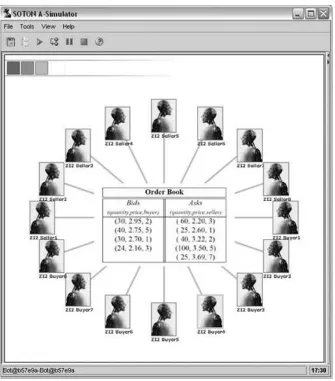
4.3 Panel (a) shows the demand and supply (curves) of the order book, with the shaded region representing allocations. Panel (b) points out the clearable bids and asks in the order book (shaded area in panel (a)). . . . 79
4.4 The multi-unit CDA simulator . . . 81
4.5 Optimal and CDA production cost . . . 82
4.6 Average market efficiency . . . 82
4.7 The sellers’ total profit given different demands (for market A with 3 buyers and 3 sellers and market B with 15 buyers and 15 sellers. . . 84
4.8 Performance of decentralised mechanism in different markets with different number of buyers and sellers. . . 85
II.1 The challenges addressed and the design perspective of part II of the thesis. . . 88
5.1 Figure of the MSN scenario highlighting the interdependent valuation of buyers considered within this chapter . . . 94 5.2 Figure showing a MSN detecting a target which falls in the region of interest of
two sensors and region of observation of three sensors. . . 95 5.3 Figure demonstrating how payments are calculated in Krishna’s mechanism for
single good and interdependent valuations. . . 100 5.4 Valuations of1,2andIfor each bundle asθ1is increased . . . 103
5.5 Modified valuations of 1,2 andI for allocations(AB,∅) and (A,B) as θ1 is
increased . . . 105
6.1 Figure of MSN scenario highlighting faulty sensors which are considered within this chapter . . . 114 6.2 Graphical depiction of the allocation problem studied with this chapter. . . 116 6.3 Task allocation model without uncertainty in task completion. . . 118 6.4 Trust-based task allocation model. The dotted lines represent the modifications
2.1 Table showing possibility and impossibility results. The first three columns
show the SCFs that can/cannot be achieved in tandem . . . 31
4.1 A set of three producers bidding to satisfy a demand of 200 units. . . 69
4.2 Multi-unit CDA Order Book - before clearing . . . 78
4.3 Multi-unit CDA Order Book - after clearing . . . 79
4.4 A set of three buyers with different demands. . . 82
5.1 Valuations of the players with each allocation . . . 102
6.1 A set of four agents in which agent 4 has proposed a task. . . 122
[image:10.595.127.525.215.364.2]Calligraphic Symbols
K Set of possible allocations. I Set of (buyer) agents. J Set of (seller) agents.
M Mechanism specifying how an allocation should be determined.
Greek Symbols
b
θi Agenti’s reported type.
Γ Game Form.
Θi Set of types for agenti.
θi Type of (or independent signal observed by) agenti.θi ∈Θi.
Roman Symbols
ci(.) Cost of agentiof performing tasks specified in (.) .
Eθ−i[.] Expectation of[.]given the types of all other agents.
f(.) Probability density function of (.).
F(.) Cumulative density function of (.).
g(.) Outcome function.
i Index of one agent in the set of agentsI −i The set of agentsI \i.
j Index of one agent in the set of agentsJ −j The set of agentsJ \j.
b
K∗ Implemented efficient allocation given reported typesθbi. May not correspond to efficient
allocation if agents lie.
K A particular allocation.
K∗ Efficient allocation, i.e. the one which maximises the sum of utility of all agents.
ki Allocation to agenti
M Number of sellers in an auction.
N Number of buyers in an auction.
ri Overall transfer to agenti
scf(.) Social choice function describing a particular desiderata.
si Strategyihas selected to use.
Si Strategy space of agenti.
ui Utility of agenti.
CDA Continuous Double Auction
CMD Computational Mechanism Design
DMD Distributed Mechanism Design
MD Mechanism Design
MSN Multi-Sensor Network
MAS Multi-Agent System
VCG Vickrey-Clarke-Groves
ZI zero-intelligence
POS Probability of Success
LP Linear Programming
DP Dynamic Programming
I would first like to express my heartfelt gratitude to my supervisor Professor Nick Jennings. His help, insight, encouragement and patience have been greatly helped to steer me into the right direction. The discussions we had were always helpful and taught me the essential skills of research. His rapid and efficient turnover of papers has always amazed me. The dreaded “why?”s that peppered initial versions of a paper resulted in more grounded research and have sharpened my inquisitiveness. Work iteratively became stronger, better explained and more coherent at each review process.
I would also like to acknowledge the people without whose help and advice this thesis would not have been possible. Jusso Val¨ımaki and Robin Mason at University of Southampton introduced me to microeconomics and game theory. Their lectures were so clear that even coming from a background of electronic engineering, I soon managed to get a grasp of these theories. David Parkes at Harvard University provided me with a lot of insight during my visit into the world of computational mechanism design. I also had interesting discussions on sensor networks with Andy Wright at BAE systems. These led to much of the motivation behind the research carried out within this thesis.
During the course of this thesis, I have had the pleasure of collaborating with number of out-standing individuals who each contributed in making this research possible. Enrico Gerding and David Yuen worked with me on research in the simultaneous auction environment. Krish-nen Vytelingum, Minghua He and Adam Sykulski collaborated with me on a number of papers linked with the continuous double auction protocol, as well as on strategy design. Viet Dung Dang, Alex Rogers, Steve Reece, Iead Rezek and Paritosh Padhy worked on sensor-related pa-pers with me. Alex Rogers also collaborated on research in interdependent mechanism design, as well as in market mechanisms for constrained capacity suppliers. Esther David contributed to the latter research as well. Gopal Ramchurn, Juan Antonio Rodriguez, Andrea Giovannucci and Bastian Blankenburg worked with me on trust-based scenarios.
I also gratefully acknowledge the financial support of the Overseas Research Studentship and the BAE studentship. This meant that I was not hampered by financial constraints and instead could dedicate my time to research. Also, the AAMAS scholarships (2004,2005 and 2006) and EUMAS scholarship (2004) enabled me to attend these very relevant conferences.
During my time as a PhD student, I have been able to interact within a number of social cir-cles within which I have met many friends. These friends have ensured that my time within Southampton has been a very enjoyable experience. I would like especially mention the IAM group, the LCU and the SCR as the three most important circles.
Last, but not least, I would like to thank my family who have provided me with unstinting support during the course of my thesis.
Introduction
There is an increasing need for computer systems that operate a decentralised control regime, that are open (individual components can enter and leave at will) and that contain a number of components representing distinct stakeholders with different aims and objectives. Relevant examples include grid computing [Foster and Kesselman, 1999], the semantic web [Berners-Lee, 1999], pervasive computing [Huang et al., 1999], e-commerce [Wellman, 2004], mobile computing [Radrinath et al., 1993] and peer-to-peer systems [Shneidman and Parkes, 2003]. For these complex systems, it has been argued that agent-based approaches, with their emphasis on autonomous actions and flexible interactions, are a natural computational model [Jennings, 2001]. In such Multi-Agent Systems (MASs), there are two fundamental design issues that need to be addressed. First, there is a need to specify the protocols that govern the interactions. These cover issues such as how the actions of the agents translate into an outcome, what range of actions are available to the participants, and whether the interactions occur over a series of steps or are one-shot. Second, given the prevailing protocol, there is a need to define the strategy (mapping from state history to action) for each agent.
Now, in some cases, a designer may be able to impose both the protocol and the strategy of each agent. In such settings, the agents can cooperate to find a good system-wide solution [Padhy et al., 2006; Jennings and Bussmann, 2003; Pynadath and Tambe, 2003; Shoham and Tennen-holtz, 1992]. This cooperation amongst agents can be structured using a variety of planning, dis-tributed constraint optimisation, coalition formation and scheduling algorithms that have been proposed [Lesser and Corkill, 1981; Durfee and Lesser, 1989; Boutilier, 1999; Ramamritham et al., 1989; Yokoo et al., 1998; Dang et al., 2006]. However, such methods fail in systems where the agents represent distinct stakeholders whose aim is to maximise their own profit in the sys-tem (e.g. in Grid computing where the agents represent different end users and in e-commerce scenarios where the agents represent the buyers and sellers). They fail because in such cases they present the opportunity for the agents to gain an advantage by misreporting their position (either their needs or their resources). For example, an agent might over-report its need for memory capacity on a computational grid so that when the distributed constraint optimisation process is carried out, it gets allocated more memory than its share in an efficient allocation.
Another example is in peer-to-peer systems where the case of free-riding (i.e. where agents under-state their available resource so as not to be asked to contribute to the system) has been well documented [Adar and Huberman, 2000]. In both of these cases and many others besides, the safest assumption to make is that if agents can act so as to get more benefit, then they will do so. Thus, by default, agents should be assumed to be self-interested, rational problem solvers.
Stated in this way, it is obvious that microeconomics [MasColell et al., 1995] — the study of the decision-making behaviour of self-interested agents as they interact with their environment — should be able to provide useful insights into the design process for systems that operate a decentralised control regime. Specifically, a clear parallel emerges between the self-interested agents that are trying to find their best strategy in large, open, distributed computer systems and the economic model of rational beings trying to maximise their gain from a market. In particular, there are two points of focus from which a designer needs to carry out a non-cooperative strategic analysis. In the first one, the designer of a system can only impose the protocol (and has no control over what strategies the agents adopt) and designs it so as to ensure that certain properties are guaranteed within the desired protocol. In the second one, the designer of a participating agent is faced with a particular system having a pre-specified protocol and designs the strategy of an agent such that it maximises its utility (or profit) in the system.
In dealing with these constraints, the first part of this thesis analyses and designs markets in which the allocation is not determined centrally by a controlling agent. In the second part of the thesis, mechanisms which deal with distributed information are designed. In both parts, we are also concerned with developing protocols that are resilient to the deficiencies of the individual agents (such as their limited capacity to perform tasks and provide resources as well as their propensity to fail). Specifically, this thesis addresses the following requirements:
Requirement 1. Distributed Allocation: The allocation of tasks and resources within the
system should be carried out without the use of a central controller.
Requirement 2. Limited Capacity: The protocol should be able to deal with the situation
whereby individual agents being limited in the number of tasks they can carry out.
Requirement 3. Distributed (Interdependent) Information: The protocol should
incor-porate the fact that agents may form their preferences over the allocations based on private signals observed by other agents.
Requirement 4. Uncertainty in Task Completion: The protocol should be robust to the
fact that certain agents may fail to successfully carry out the tasks assigned to them.
It should be noted that whilst these requirements are inspired from a MSN scenario, the analyses and solutions we present are broadly applicable to open MASs in general. To this end, we now provide a background in order to position the challenges that this thesis has addressed in the broad set of challenges that MAS designers encounter when designing and analysing distributed mechanisms.
1.1
Background
In this section, we provide a more detailed description of the problems that this thesis seeks to address. Specifically, we will provide an overview of the economic foundations of this en-deavour and then detail the challenges that become more imperative in a MAS (as opposed to traditional economic settings). We then give a broad overview of the MSN scenario which is em-ployed as a running example throughout this thesis. In so doing, we provide the background for our work by positioning it on the canvas of challenges that need to be addressed when designing MASs and, more specifically, MSNs with selfish agents.
1.1.1 Economic Foundations
1. Theory of Competitive Equilibrium [MasColell et al., 1995]. This studies the equilibrium conditions (conditions characterising the stable state) that arise when a large number of agents compete with each other in a given environment. Here, each agent is assumed to be rational in that it tries to maximise its utility (a measure of the “goodness” the agent derives from the outcome), based on its information about the environment.
2. Game Theory [Osborne and Rubinstein, 1994]. This studies the behaviour of agents in in-teractive decision problems where the actions of one agent affect both the selected actions of another and the resulting equilibrium.
The main difference between these two theories is in how the agent models its environment before making a decision. The former assumes that each agent is interested only in some envi-ronmental parameters (such as prices and availability of resources), whereas in the latter each agent additionally takes into account the behaviour of other agents and how they may influence these parameters. Thus in game theory, the behaviour of other agents is incorporated into an agent’s decision making process1. Though we investigate both these approaches in this thesis, the work described herein focuses mainly on the latter. This is because it is a more principled way of achieving desirable properties in a MAS (in that it relies on mathematical models to prove certain properties, rather than experimental evaluation). Furthermore, as we discuss in chapter 2, designing systems using game-theoretic approaches gives us the necessary condi-tions for designing systems where there might not be a central controller. In particular, we use game theory to design multi-agent systems that address the last three requirements listed above (limited capacity, interdependent information and uncertainty in task completion). However, one important shortcoming of designing systems using game theory is that the resultant sys-tem is almost invariably centralised2. On the other hand, approaches adopting the competitive equilibrium tend to ascribe very little power to a centre or have no centre at all. Thus, these approaches can shed light on how to design systems using game theoretic techniques, but which have distributed allocation mechanisms.
To date, both of these approaches have been investigated in MASs. Wellman’s seminal work on Market Oriented Programming [Wellman, 1993] was based on the competitive equilibrium ap-proach and has subsequently been extended to numerous applications [Clearwater, 1996; Kraus, 2001]. In this work, the main point of focus has been the design of agent strategies for rela-tively complex market institutions in which the agents are assumed to be selfish but not strictly rational (as defined in Chapter 2)3. In particular, strategies have been developed using various above mentioned heuristics for these specific settings [He et al., 2006; Vytelingum et al., 2004;
1
In very large systems the two theories yield similar models and answers since a single agent then has little effect on the whole environment (especially if the environment is nearing equilibrium).
2
One could argue that this shortcoming is a result of researchers using the revelation principle (discussed in chapter 2) too literally, rather than of game theory in itself. However, the fact is that most systems designed using game theory involve a centre.
3
Airiau and Sen, 2003; Byde et al., 2000; Yarom et al., 2004]. In this context, one of the simplest and most commonly studied institutions is the CDA in which traders submit offers to buy (bid) and offers to sell (ask) at any time during the trading period and in which the market clears4 continuously [Friedman and Rust, 1992]. As a result, certain of the global properties of such institutions, such as speed of convergence of the market towards the equilibrium and the prox-imity of experimental and theoretical equilibria5, rely on the particular strategies that the agents adopt. In fact, in [Vytelingum et al., 2004] we design a strategy which performs better than current strategies in both a local (profit-maximising) and global context. However, in this thesis, since we concentrate on the baseline performance of protocols, we employ the methodology advocated by [Gode and Sunder, 1993] and apply it to the CDA protocol we design in chapter 4 (thereby simultaneously addressing requirements 1 and 2).
Game theory has also been heavily used to analyse and design strategies in various markets [Engelbrecht-Wiggans and Weber, 1979; Szentes and Rosenthal, 2003; Fatima et al., 2005]. Such game-theoretic approaches to the design of strategies (which we use in chapter 3 for a distributed marketplace) differ from the heuristic approaches in that they yield predictable equi-librium strategies under the assumption that the agents are rational. As a result, the design of protocols for predictable systems (i.e. systems in which certain global properties can be guaran-teed) within MASs has been mainly based on Game Theory [Parkes, 2001; Zlotkin and Rosen-schein, 1996; Sarne and Kraus, 2005; Sandholm, 2003; Wurman et al., 2001]. Furthermore, this approach models the interactions between agents mathematically, resulting in a more principled way of building protocols whereby the properties of the protocol can be proven or disproven the-oretically rather than empirically. In particular, the techniques used are drawn from Mechanism Design (MD) which is the area of micro-economics concerned with how to design systems, using tools developed by game theory analysis (e.g. Nash Equilibrium, Dominant Strategy, Bayesian-Nash equilibrium), such that certain system-wide properties (e.g. efficiency, stability, fairness) emerge from the interaction of the constituent components. Here the mechanism is viewed as the whole system; consisting of the set of agents with their utility functions, their action sets and the protocol. In contrast to Market Oriented Programming, agents in this case will always adopt one strategy since they are incentivised to do so as a result of the design of the protocol6. In the MAS context, MD has been mostly used for the design of auction protocols for the allocation of resources and tasks and in this thesis we study how to design mechanisms under the constraints imposed by MASs (chapters 4, 5 and 6). However, we will first discuss the broad range of challenges that arise in designing MASs using MD (sections 1.1.2 and 1.1.3), before focusing on the specific challenges we address in this thesis.
4
The market clears as soon as a bid exceeds an ask.
5
The theoretical equilibrium is the one achieved as the number of agents in the market tends to infinity.
6The adoption of one strategy is the objective of the design of the mechanism. In certain protocols, agents may
1.1.2 Computational Challenges
As a result of the assumptions made in traditional MD, its application in MASs is not straight-forward. In traditional MD, for example, agents are assumed to be rational and no consideration is given to how computationally hard it is to select the appropriate strategy, the centre is as-sumed to be able to compute the outcome of the protocol once the agents have transmitted their strategies to it, the agents are assumed to undertake and successfully complete tasks assigned to them, communication between the agents and the system is generally assumed to be free and faultless, and the system is assumed to know the number of agents that are present [Dash et al., 2003; Parkes, 2001; Rubinstein, 2002; Conitzer and Sandholm, 2002; Dash et al., 2004; Glazer and Rubinstein, 1998]. However these assumptions are problematic in computational settings because in addition to the issues that we highlighted in the previous section, the following chal-lenges are also present:
1. The mechanism will not be able to compute the outcome if this is an intractable problem (e.g. computing the allocation in certain types of sealed bid auctions is what prevented their application in FCC spectrum auctions [Klemperer, 2002]).
2. The agents themselves do not have the unbounded computational power required for cal-culating their preferences for all possible outcomes as is required, in general, to produce an optimal strategy.
3. Communication is not necessarily cost-free and may also be prone to errors.
4. The set of agents may vary with time due to the open nature of the system.
5. The presence of money, a common denominator by which every good can be valued, is an important component in traditional MD. However, in many MASs, such a common num´eraire does not exist naturally and in many cases has to found or constructed.
The field that seeks to address some of these limitations and, thereby, apply MD techniques to computational problems is called Computational Mechanism Design (CMD). It could be argued that a new field is not required since we can decompose the problem of using MD in a MAS into its economic part (MD) and its computational part (MAS) and then attack the problem in a modular fashion. However this approach fails to recognise that at each stage of the design process both economic and computational principles need to be addressed. In fact, in many cases, principles from one of the areas can help to solve a problem in the other. For example, one could make finding an undesirable equilibrium strategy (economic problem) so intractable (computational solution) that no agent would be able or wish to do so. Similarly, one could make optimal strategies tractable (computational problem) by designing mechanisms that have a simple, truth-revealing equilibrium (economic solution).
limited computational resources [Parkes, 2001; Sandholm, 2003; Nisan and Ronen, 1999]7. As a result, there is an inherent assumption in most existing work in this area that the agents have a direct line of communication with this centre and can play their strategies or reveal their types simultaneously. Furthermore, it has been assumed that each agent forms its valuation based solely on information that is privately observed by it. However these assumptions do not always hold in distributed open systems and hence there is a strong need to move from CMD into the realms of Distributed Mechanism Design (DMD). To this end, the next section details the additional challenges involved in moving from CMD to DMD.
1.1.3 Distribution Challenges
DMD is concerned with the design of large-scale distributed systems consisting of multiple autonomous, selfish and rational agents in which there is no centre imposing an outcome and in which both the information or communication protocol are distributed over the agents. Thus, DMD is still concerned with the computational problems outlined in the previous section, but it differs in that there is no centre that decides on the outcome and the information an agent uses to make its choices is distributed. Such distributed mechanisms have a number of advantages over their centralised counterparts including:
Tractability. A distributed mechanism allows the burden of computation to be transferred from
a central node in the mechanism to the numerous constituent agents that go to make up the system. This is akin to transforming the problem into a distributed optimisation task that exploits the computational resources of many agents.
Robustness. In a centralised mechanism, the communication channels linking the centre are
critical for the system and failure may incapacitate the operation of the entire system. However in a decentralised setting, failure of these channels will not incapacitate the mechanism, though it may lead to a sub-optimal solution.
Trustworthiness. The issue of trustworthiness in the centre is an ever-present problem in a
centralised mechanism. This is, we believe, a factor that has limited the use of Inter-net auctions since the agents have to trust that the auctioneer will not manipulate the mechanism for its own profit. In a distributed mechanism, since there is no central agent computing the outcome, there can be a higher degree of trust in the mechanism once the incentive issues to do with agents are addressed. However, the problem of trust between agents assumes greater importance in this context than in the centralised mechanism since now each agent depends on each other to carry out the mechanism.
Reduction of Bottlenecks. In distributed mechanisms there is no longer a single point through
which all communication has to pass. Thus, there is no longer such an obvious and large bottleneck.
7
However, these advantages come at a price. At one extreme, it may be possible to dispense with MD altogether and simply ask about the “price of anarchy” [Papadimitriou, 2001; Roughgarden, 2002] or the economic cost of just implementing distributed solutions with no carefully designed mechanism. In many cases, we believe that this cost will be too high and the challenge for the community remains in designing distributed mechanisms that retain the normative goals of MD. To this end, we explain the three core challenges in DMD [Dash et al., 2003]:
1. Distribution of allocation: In traditional MD, there is a centre that computes and en-forces the outcomes. However, in DMD, we aim to study mechanisms in which such a centre does not exist. Such a constraint may arise naturally due to the computational struc-ture of a system (as discussed above) or may be imposed by the system designer seeking the advantages of a distributed mechanism. For example, in current P2P networks, such as Gnutella and KaZaa, free-riding is a well-documented problem. In response, a num-ber of studies have considered the economics of tit-for-tat where agents can only receive resources to the degree that they contribute them [Lai et al., 2003]. However, such a tit-for-tat approach is blind to the heterogeneity of local agents, that will likely differ in their computational resources and data content and quality. To this end, a classical approach in which the allocation is not computed by a central agent has been to implement mar-kets akin to the CDA. However, such mechanisms rely on multiple trades before a stable allocation is determined. Furthermore, the assumption of direct lines of communication to a central information repository is still present (i.e. agents know which current items are available and at what price they are trading). As a result, there is a heavy commu-nication load in such mechanisms. Another approach in this context is to implement a mechanism using distributed algorithms, whilst addressing the additional incentive con-siderations that occur when the same agents (with the set of agents being greater than two) that are implementing the mechanism are also strategic and self-interested [Shneid-man and Parkes, 2003; Parkes and Shneid[Shneid-man, 2004]. However, whilst the computational burden has been removed from the centre in this approach, the centre is still required in order to enforce the mechanism. Finally, another line of research has investigated the use of distributed auctions held simultaneously by a number of sellers in order to allocate goods [Engelbrecht-Wiggans and Weber, 1979; Krishna and Rosenthal, 1996; Gerding et al., 2006a,b; Greenwald et al., 2001; Airiau and Sen, 2003; Preist et al., 2001]. In this case, whilst there is no centre either computing or enforcing the mechanism, the strategic decisions made by the agents need to be studied and the equilibrium is not guaranteed to be efficient.
by other agents, resulting in interdependent valuations8. For example, in grid computing, an agent estimating the cost of performing a particular task would base its estimate on which resources it will require in order to complete the task. These resources will typ-ically be distributed over the grid with a number of agents having access to them. As a result, it will have to base its cost estimate on the signals observed by other agents, thereby resulting in interdependent valuations. Thus an agent might require x seconds on a micro-processor (to which it has direct access and can observe) and y bytes of memory (which another agent monitors) to complete a task. Another example is in P2P systems, where very often the value of a particular download to an agent might depend on how much the other agents value that download. This is especially true for downloads of systems that require a network to work, such as online games and chat engines where there has to be a sufficient number of users for the download to be worthwhile or when downloading files that appeal to a large base of users such as popular songs and movie clips.
3. Distribution of communication system: In DMD we can no longer assume direct lines of communication and hence need to rely on the agents themselves routing information for other agents. For example, in an inter-domain routing problem, each of the nodes routing traffic can be considered as an agent in a MAS. Hence, since these agents can lie about the cost incurred in passing messages in their routes, a DMD approach is required to provide agents with incentives to reveal truthful information and support the selection of the short-est path for the routing of messages. However this efficient outcome should be computed without overburdening the network with messages just to find it! Research in this area has developed mechanisms that have been tailored to specific topologies [Feigenbaum et al., 2002, 2001]. This, in turn, may point to adopting a design methodology similar to that in traditional MD, where solutions and mechanisms are developed for restricted topologies (as opposed to specific utility functions and trading environments in MD).
In summary, in this section, we have provided a list of the key challenges that exist when de-signing MASs using MD. However, as stated earlier, we shall concentrate in this thesis on four specific requirements that need to be addressed. Requirements 2 and 4 concentrate on challenges that fall under CMD, while requirements 1 and 3 address the first two challenges of DMD. We note here that we will not be addressing the challenges of distributed communication since we feel that it has been already been researched quite extensively [Shneidman and Parkes, 2003; Feigenbaum et al., 2002, 2001; Monderer and Tennenholtz, 1999; Bachrach and Rosenschein, 2005; Anderegg and Eidenbenz, 2003]. We next provide an overview of the MSN scenario, from which these requirements have been inspired.
8This problem is documented in purely economic settings as well (such as wildcatters bidding for a strip of
1.2
Running Scenario
Multi-Sensor Networks (MSNs) are networks of small sensor nodes where each node typically consists of a micro-controller, a radio front-end, a power supply and one or more sensors for sensing the physical environment [Akyildiz et al., 2002; Padhy et al., 2006; Deshpande et al., 2004; Rao et al., 1991; Culler et al., 2004]. As such, they require a decentralised control regime (pertaining to both the way that the sensors perform their tasks and where information is distrib-uted amongst the sensors) and are potentially open systems with distinct stakeholders. Hence, they provide a compelling area for the application of MAS since they are open, dynamic systems in which there are numerous points at which decisions and actions have to be carried out. Specif-ically, each agent (residing in the micro-controller) takes decisions on the following aspects (as shown in figure 1.1):
1. Task Scheduling: The agent decides the timing and nature of the sensing tasks that the sensor node should carry out.
2. Resource Allocation: The agent decides on the apportionment of the limited resource (e.g. power, bandwidth and/or computational resource) between the different tasks it may be required to carry out.
3. Communication Protocol: The agent decides the sources from which to receive data, the data it will transmit and the sinks to which to transmit data.
perspective any further within this thesis since we believe that the groundwork for individual selfish sensors should first be laid before investigating such hierarchical systems.
In more detail, figure 1.1 shows a typical sensor network with the physical and agent-based representation of each sensor node. The sensors within this MSN have three possible capabili-ties, namely to sense the temperature and pressure of the environment, as well as visually track targets. Each sensor has a schedule of sensing tasks during which they gather data from the environment. They then send and receive data from each other using the bandwidth constrained communication links. In this thesis, we study how these types of MSNs can be managed using the economic mechanisms we develop. In particular, the requirements that have been outlined above are all reflected within the MSN depicted in figure 1.1 in the following way:
1. Within a MSN, sensors can be tasked by other sensors to sense various signals from the environment against a payment. Now, a trusted centre may not exist in such scenarios leading to sensors holding simultaneous auctions for their services. This scenario, from which requirement 1 is inspired, in studied in greater detail in chapter 3.
2. Sensors are typically constrained by the amount of power and/or bandwidth which is available to them. This leads to the sensor being able to carry out only a few of the total tasks that are demanded. As a result, we incorporate such sensors with limited capacity (requirement 2) into the design of the mechanism in chapter 4.
3. The value for the particular data gathered by a sensor can depend on the data which has been gathered by other sensors. This is especially true when sensors fuse information and results in the interdependent valuation model (requirement 3) considered in chapter 5.
4. A sensor may not always report a true value due to a variety of reasons including faults, maliciousness or noisy communication channels. Thus requirement 4 is inspired from such a failure-prone environment and is dealt with in chapter 6.
Having thus provided the scenario for this thesis, we now briefly cover some of the related research in the area of market-based task allocation within sensor networks. The specifics of the related work on each of the above issues are dealt with in the corresponding chapter.
1.2.1 Market-Based Task Allocation in Sensor Networks
Task allocation within sensor networks has traditionally been analysed under the assumption that the sensors will work towards the global objective of the MSN. This has been due to the fact that most of these MSNs are owned by a single stakeholder and has thus resulted in the adoption of cooperative approaches [Padhy et al., 2006; Lesser et al., 2003; Clearwater, 1996].
FIGURE1.1: An overview of a MSN showing the physical components of a sensor node, the decisions faced by an agents controlling a node, and common problems encountered within the
in order to achieve a distributed control regime (e.g. [Gerkey and Mataric, 2002a; Sadagopan and Krishnamachari, 2004; Rogers et al., 2005]), whilst [Dash et al., 2005] consider sensors that are selfish due to their distinct ownerships. We consider each of these main items of related work in turn.
In more detail, Gerkey and Mataric [2002a] develop the MURDOCH protocol, which is loosely based on a multiple auction model, for task allocation amongst a system of robots (which is a collection of sensors and actuators). More specifically, in one particular instance of this protocol, the following correspondence with auctions would hold: the item being auctioned would be a task, the auctioneer would be the robot requesting the task, and the bid is a fitness measure which other idle robots provide. However, since they are operating within a cooperative environment no payments are made in the system. Rather, selfishness and the auction protocol are used as a means of carrying out a distributed allocation mechanism. The concept of selfishness is further investigated in [Sadagopan and Krishnamachari, 2004] where they study how the routing of data from sensors to a certain destination in the MSN. They construct a game whereby despite the selfish actions of the agents, an optimal load-balanced data gathering tree results in the network. However, the concept of selfishness is selectively applied since the agents higher up in the data gathering tree have to commit to providing bandwidth for transmission of data until they are saturated. These agents are thus providing a service for no apparent gain. Rogers et al. [2005] correct this by designing a protocol in which parent nodes in the networks are incentivised to forward data by the payments provided by the child nodes. These payments are conditioned on the power that a sensor expends when forwarding data and the resulting protocol has a close to optimal performance. However, the designed payment protocol is based on the assumption of an inverse square power law governing the power expenditure (and hence is not generalisable to cases where this law is not obeyed) and is not robust to selfishness since it does not contain a way of guaranteeing that the parent node will conform to the protocol once it has been paid (such as in [Blankenburg et al., 2005]). The selfishness-related drawbacks of the systems discussed here are not major if the whole system is owned by a single stakeholder who can program each sensor to behave as it wishes. This is because the sensors will then conform to the designed protocol and selfishness is used as a means to achieve a decentralised allocation scheme. However, it also implies that these systems would fail if they were adopted in a context where the sensors are owned by different stakeholders and thus are selfish by nature rather than by design. This is because such sensors will be designed by each individual stakeholder that can take advantage of these drawbacks for their selfish gain, which will, in turn lead to a degradation of system performance.
Having thus explained the context of the research conducted within this thesis, we now detail the specific research contributions.
1.3
Research Contributions
The research reported in this thesis stems from our analysis and design of distributed allocation and distributed information mechanisms. This research thus provides the following insights into these two crucial aspects of distributed mechanisms:
• Distributed Allocation: Distributed allocation mechanisms require no centre to compute
and enforce the overall allocation. In this context, we study two such mechanisms: simul-taneous auctions (in Chapter 3) and the CDA (in Chapter 4). In both cases, we find that the efficiency of the distributed mechanism implemented is less than the full efficiency that can be achieved with centralised mechanism. Thus, we can infer that there is a cost of distributing a mechanism in that we can no longer achieve full efficiency. Nevertheless, we find that this cost is not overly prohibitive and in certain scenarios may be justified in order to gain the advantages of distributed mechanisms. Furthermore, the implementation of distributed allocation mechanisms for scenarios involving multiple goods and complex utility functions is not straightforward and thereby requires a significant design effort.
• Distributed Information: Distributed information mechanisms pertain to those
situa-tions where the agents require distributed information in order to formulate their pref-erences over outcomes. In such cases, we find that traditional mechanisms cannot in-centivise the agents to choose strategies that lead to desirable outcomes. Therefore, we design novel efficient mechanisms (in Chapters 5 and 6) to deal with such distributed information.
Furthermore, in studying the computational properties of the centralised mechanisms we de-sign in Chapters 4, 5 and 6, we find that often the computation of the solution is hard. This results from the fact that such mechanisms require the exact computation of solutions in order to guarantee their economic properties. Nevertheless, we reduce the computational load on the centre in each of these mechanisms by designing appropriate algorithms that exploit the problem structure.
1. Distributed Allocation. In Chapter 3, we develop for the first time the optimal strategy of a buyer wishing to acquire a single unit in a simultaneous auction market consisting of a number of sellers each auctioning off a single identical item. This allows us to analyse the equilibrium behaviour when the buyers in the market are of three types: (i) global (such buyers can bid in all auctions), (ii) dynamic local (such buyers can only bid at one auction, but can randomly choose which auction to participate in) and (iii) static local (such buyers can only bid in one predetermined auction). We also prove that the lower bound on the efficiency of such markets is1−1e. Furthermore, in Chapter 4, we develop a novel clearing scheme (employing a distributed allocation mechanism based on the CDA) so as to deal with constrained capacity suppliers. We empirically show that the efficiency of such a mechanism is fairly high (around 83%), even when employing very basic bidding and selling strategies9.
2. Limited Capacity. We develop two new mechanisms for the case of multiple suppliers with limited capacities competing to satisfy a demand. The first mechanism is centralised and ensures the desirable properties of incentive compatibility, efficiency, individual ra-tionality and robustness via the introduction of a novel penalty scheme. We provide an algorithm that computes the allocation in pseudo-polynomial time. The second mecha-nism is the distributed mechamecha-nism mentioned above and is based on the CDA protocol. This mechanism requires the design of a novel clearing scheme in order to address the issue of constrained capacities. Furthermore, this mechanism is fair in that it allows an approximately equal sharing of profits between buyers and sellers.
3. Distributed (Interdependent) Information. We show for the first time how to derive utility functions for a MSN scenario from information theory using a distributed infor-mation filter (which is a distributed way of measuring the inforinfor-mation gain that a mea-surement provides). Furthermore, we develop a novel mechanism for the allocation of multiple goods (tasks) in the case when agents form their valuations from observations made by other agents (i.e. interdependent valuations). This mechanism is proven to be incentive compatible, efficient and individual rational.
4. Uncertainty in Task Completion. We develop a novel mechanism that accounts for the case in which an assigned allocation may not always be completed to the pre-specified level. Furthermore, different agents have different views about whether an allocation has been completed successfully. Thus, each agent has a measure of how well the other agents are likely to perform a particular task (which we term as trust). Hence, for the first time, we incorporate trust within the design of a mechanism. We then go on to study the economic properties of the mechanism and evaluate its performance against other closely-related mechanisms. We finally implement our mechanism using both linear and dynamic programming techniques that reduces the complexity of computing the optimal allocations and payments.
9
Mechanism Employing Simultaneous Auctions
(Chapter 3)
Distributed Allocation
(Part I)
Distributed Information (Part II) Design of
Protocol Strategy Design
and Analysis
Computational Mechanism Design
Mechanism for Interdependent Valuations (Chapter 5)
Mechanism with Uncertainty in Task Allocation (Chapter 6)
Mechanisms with Constrained Capacity
Suppliers(Chapter 4)
Design Perspective Design Challenge
FIGURE1.2: Positioning of work done in this thesis in relation to challenges involved in CMD and DMD.
To summarise, the work described in this thesis addresses a number of issues that arise when using MD for the design of MASs. In effect, our aim is to apply the theoretical work developed herein to MSN scenarios and simultaneously design distributed systems that address the chal-lenges that have been outlined in the previous sections. This is illustrated diagrammatically by figure 1.2 which shows how the various strands of our work (which are detailed in the different chapters) are positioned according to whether they deal with distributed allocation or distributed information.
The work carried out in relation to this thesis has resulted in the publication of the following papers which are reported within this thesis:
• R. K. Dash, D. C. Parkes and N. R. Jennings (2003) “Computational Mechanism Design:
A Call to Arms” IEEE Intelligent Systems 18 (6) 40-47. (Chapters 1 and 2)
• E. H. Gerding, R. K. Dash, D. C. K. Yuen and N. R. Jennings (2006). Optimal Bidding
Strategies for Simultaneous Vickrey Auctions with Perfect Substitutes, Proc. of the 8th
Int. Workshop on Game Theoretic and Decision Theoretic Agents, (AAMAS 06), 10-17. (Chapter 3)
• R. K. Dash, P. Vytelingum, A. Rogers, E. David and N. R. Jennings (2006) Market-based
task allocation mechanisms for limited capacity suppliers IEEE Trans on SMC (Part A).
• R. K. Dash, A. Rogers, S. Reece, S. Roberts, and N. R. Jennings (2005) Constrained
bandwidth allocation in multi-sensor information fusion: a mechanism design approach
Proc. 8th Int. Conf. on Information Fusion, Philadelphia, USA. (Chapter 5)
• R. K. Dash, A. Rogers and N. R. Jennings (2004) “A mechanism for multiple goods and
interdependent valuations” Proc. 6th Int. Workshop on Agent-Mediated E-Commerce,
New York, USA, 197-210. (Chapter 5)
• A. Rogers, R. K. Dash, S. Reece, S. Roberts, and N. R. Jennings (2006) Computational
Mechanism Design for MultiSensor Information Fusion Proc. 5th Int. Conf. on
Au-tonomous Agents and Multi-Agent Systems (AAMAS 06), Hakodate, Japan. (Demo Pa-per)(Chapter 5)
• A. Rogers, R. K. Dash, N. R. Jennings, S. Reece and S. Roberts (2006) Computational
mechanism design for information fusion within sensor networks Proc. 9th Int. Conf. on
Information Fusion (Fusion 06), Florence, Italy. (Chapter 5)
• R. K. Dash, S. D. Ramchurn, and N. R. Jennings (2004) ”Trust-based mechanism design” Proc. 3rd Int. Conf. on Autonomous Agents and Multi-Agent Systems (AAMAS04), New York, USA 748-755. (Chapter 6)
Furthermore, this work has also spawned a number of publications that are not been reported here (since they do not fit perfectly into the context of this thesis). Nevertheless, these papers relate to this thesis in the following ways:
• V. D. Dang, R. K. Dash, A. Rogers and N. R. Jennings (2006) Overlapping coalition formation for task distribution in multi-sensor networks Proc. 21st National Conference on AI (AAAI), Boston, USA.
This paper investigates the use of cooperative coalition formation with sensor networks when sensors can belong to more than one coalition. It is related to the MSN scenario considered in this thesis and builds upon the use of an information theoretic base for utility functions (as in Chapter 5). However, in this paper, the sensors are cooperative and the focus is on devising algorithms that allow such a computationally complex task to be achieved.
• E. Gerding, A. Rogers, R. K. Dash and N. R. Jennings (2006) Competing Sellers in Online
Markets: Reserve Prices, Shill Bidding, and Auction Fees Proc. 5th Int. Conf. on
Au-tonomous Agents and Multi-Agent Systems (AAMAS 06), Hakodate, Japan, 1208-1210.
• P. Padhy, R. K. Dash, K. Martinez and N. R. Jennings (2006) A utility-based sensing and
communication model for a glacial sensor network Proc. 5th Int. Conf. on Autonomous
Agents and Multi-Agent Systems (AAMAS 06), Hakodate, Japan, 1353-1360.
This paper investigates the use of utility functions within a MSN in order to maximise the data gathered by the sensors, whilst minimising the power consumed. It is related to the MSN scenario considered in this thesis though differs crucially in that it operates within a cooperative rather than a selfish context.
• P. Vytelingum, R. K. Dash, M. He, and N. R. Jennings (2005) A framework for designing strategies for trading agents Proc. Int Workshop on Trading Agent Design and Analysis, IJCAI 05, Edinburgh, Scotland, 7-13.
• P. Vytelingum, R. K. Dash, M. He, A. Sykulski and N. R. Jennings (2006) Trading strate-gies for markets: A design framework and its application Lecture Notes in Artificial In-telligence
These papers propose a framework for designing strategies for trading agents that takes into consideration the various signals that these agents receive whilst trading. It has then been applied in order to design a strategy for the the trading agent competition [Wellman et al., 2004]. This research is related to Chapters 3 and 4, in that it concentrates on the design of strategies, though the technique employed has a heuristic base rather than the game-theoretic one used in Chapter 3.
• P. Vytelingum, R.K. Dash, E. David and N. R. Jennings (2004) ”A risk-based bidding strategy for continuous double auctions” Proc. 16th European Conference on Artificial Intelligence (ECAI 04), Valencia, Spain, 79-83.
This paper investigates the use of risk with a bidding strategy for the CDA by changing the degree of aggressiveness of the strategy in relation to its value/cost and its prediction of the equilibrium price. The resultant strategy outperforms current strategies that have been proposed for the CDA and improves market efficiency. It is thus related to the research carried out in Chapter 4 on the CDA mechanism.
• B. Blankenburg, R. K. Dash, S. D. Ramchurn, M. Klusch, and N. R. Jennings (2005) Trusted kernel-based coalition formation Proc. 4th Int Joint Conf on Autonomous Agents and Multi-Agent Systems (AAMAS 05), Utrecht, Netherlands.
This paper considers task allocation with uncertainty in task completion when using a cooperative game theoretic approach. As such, it is related to Chapter 6, though the solution concepts employed are based on coalitional games rather than MD.
• I. Rezek, S. J. Roberts, A. Rogers, R. K. Dash and N. R. Jennings (2005) Unifying learning in games and graphical models Proc. 8th Int. Conf. on Information Fusion, Philadelphia, USA.
within this thesis, namely game theory and views the field from a probabilistic point of view.
1.4
Thesis Structure
This section outlines the structure of the thesis giving a summary of the work presented in each chapter.
Chapter 2 discusses the theories relevant to our work, by reviewing the economic principles behind mechanism design. We discuss the possibility and impossibility results that relate to the different game theoretic equilibria, thereby outlining the implementable social choice functions (i.e functions that specify what the desirable system-wide properties are).
Chapters 3 and 4 consider the case of distributed allocation in which there is no trusted centre that collects all the bids and performs the required calculation for an allocation. However, they differ in the distributed protocol which they implement. Chapter 3 considers the case where there is no coordination mechanism available to the buyers and sellers. In contrast, Chapter 4 compares the CDA protocol (in which there is an indirect coordination mechanism in the form of the billboard posting current bids and asks) to a canonical centralised protocol (the Vickrey-Clarke-Groves Mechanism).
In Chapter 3, we first discuss a scenario in which buyer-sensors have to bid for tasks to be performed by seller-sensors. The scenario leads to a model whereby multiple sellers are selling identical items simultaneously, whereas buyers have to choose the bids they place at each of the sellers. We study the optimal strategies that the global bidders should employ when faced with different combinations of local and global bidders. In so doing, we prove that the global bidder should always place non-zero bids in all available auctions, irrespective of a local bidder’s valuation distribution. We then study the computational problem of finding the optimal strategy and prove that, for non-decreasing valuation distributions, the problem of finding the optimal bids reduces to two dimensions. These results hold both in the case where the number of local bidders is known ( i.e. static local bidders) and when this number is determined by a Poisson distribution (i.e. dynamic local bidders). In addition, by combining analytical and simulation results, we demonstrate that similar results hold in the case of several global bidders, provided that the market consists of both global and local bidders. Finally, we address the efficiency of the overall market, and show that information about the number of local bidders is an important determinant for the way in which a global bidder affects efficiency.
application of a penalty scheme is sufficient to ensure desirable economic properties of the mechanism. We also study the computational complexity of finding the best allocation using this protocol. We then analyse the CDA where both sellers and buyers participate in a market and thus the items that needs to be allocated are distributed over all agents in the systems, but every agent knows which items are being allocated and the status of the market. We study the economic properties of our modified CDA protocol by using very simple strategies and show that the performance of this protocol is satisfactory when compared to the centralised protocol.
In Chapters 5 and 6, we study another form of distribution, namely the distribution of infor-mation (which can be characterised as the interdependence of valuations). Chapter 5 develops a general mechanism for the case when there are multiple items in the market and the valua-tions of a buyer depend on its own observation, as well as signals observed by other buyers in the system. To this end, in Chapter 6, we look at a particular form of interdependent signals, namely trust, and develop a mechanism that incentivises the agents to report truthfully about their observed trust measure.
More specifically, in Chapter 5, we argue that interdependent valuations are common in MASs and then go on to develop a general mechanism that has desirable economic properties. We study its computational properties and show that the mechanism adds a computational load only on the centre (as compared to classic mechanisms). We also investigate an application for this mechanism which concerns a multi-sensor target detection scenario in which multiple individually-owned sensors are monitoring a particular area with each sensor having a particular accuracy of measurement. We model this as a MAS and propose a valuation function based around Information Theory that calculates the value each sensor has for information gained by other sensors.
In Chapter 6 we design a mechanism in which the uncertainty in the completion of a task is taken into account. We first investigate the case when each agent can report on its own uncer-tainty. We then analyse the more general case where each agent can report on other agents’ uncertainties. Thus, we cannot hope to achieve a strong equilibrium (like in Chapter 5) and in-stead opt for a weaker equilibrium condition (ex-ante Nash equilibrium). We analyse the prop-erties of this mechanism and benchmark it against other comparable mechanisms. We study the computational properties of our mechanism and implement it using both linear and dynamic programming techniques that reduce the amount of computation required for finding the optimal allocations and payments by reducing the size of the search space and reusing past solutions.
Mechanism Design
Mechanism Design (MD) is the area of micro-economics concerned with how to design systems, using tools developed by game theory analysis, such that certain system-wide properties emerge from the interaction of the constituent components. As such it provides the basis on which a large part of this thesis rests. We therefore provide in this section a brief mathematical outline of the rich and important body of research to which MD has given rise (see [Jackson, 2000; Os-borne and Rubinstein, 1994; MasColell et al., 1995; Krishna, 2002; Klemperer, 2002] for more comprehensive reviews.). This chapter thus presents traditional MD, which has concerned itself with how to satisfy certain economic criteria (such as efficiently allocating resources, maximis-ing revenues or havmaximis-ing a fair system) given the settmaximis-ing of selfish agents in interactive decision making. The newer challenges within mechanism design, namely computational and distribu-tion challenges have been reviewed in Chapter 1 and the related work specific to each chapter is discussed more extensively in each of the chapters.
In more detail, we will first present a basic model of a mechanism in Section 2.1 and explain how different solution concepts may arise in mechanisms in Section 2.2. We then present some of the social choice functions that traditional MD has concerned itself with in Section 2.3. We explain what can and what cannot be achieved in Section 2.4. Within this section, we present an important mechanism, namely the Vickrey-Clarke-Groves (VCG) mechanism, which we refer to extensively within this thesis.
2.1
Mechanisms
A mechanism (or game form) Γ = (I,Θ, S, g(.))consists of a set of agents I = {1. . . , I}
that each have a strategy set Si. Each agent chooses its strategysi ∈ Si from its particular
strategy set given the private information contained in its typesθi ∈Θiand an outcome function, g :S1× · · · ×SI → O, which sets the outcome. The way that each agent chooses its strategy
depends on how we model that agent. For example, it is commonly assumed that agents choose
their strategy so as to achieve their best outcome. The “goodness” of the outcome o ∈ O is measured by a utility function [Varian, 1999] that gives a numerical value to each outcome (higher being better) withui : O ×Θi → ℜ. Thus the assumption of each agent looking for
its best outcome, also known as the rationality assumption [Rubinstein, 2002], can be stated in terms of the utility function as:
Assumption 2.1. Rationality Assumption. An agent is termed rational if it chooses its best
strategy,s∗i
s∗i = arg max
si∈Σi
E[ui(g(s1, . . . , sI))] (2.1)
whereE[.]is the expectation operator.
Given this setting, the mechanism is then designed so as to satisfy certain criteria which are encompassed in the social choice function (SCF)scf : Θ1× · · · ×ΘI → O. We hence have scf(θ)being the outcome that satisfies the particular criteria set by the designer. Since the aim of the mechanism is to achievescf(θ), we can restate the objective of the designer as being:
g(s1, . . . , sI) =scf(θ) (2.2)
We say that a mechanismΓimplementsscf(θ)whenever equation 2.2 is satisfied. The central question in MD asks which set of desiderata (or which scf(θ)) can and cannot be achieved under a certain solution concept (which is a state that can be predicted to occur given a certain mechanism). This question is partially answered in terms of results, termed possibility and
impossibility theories, which are discussed in greater detail in section 2.4 (after a discussion on
the solution concepts and desirable desiderata set). One obvious way of trying to achievescf(θ)
is to ask the agents to report their types truthfully such thatsi =θiand then setg(.) =scf(.).
Such mechanisms, in which Si = Θi, are called direct mechanisms (a.k.a direct revelation
mechanisms):
Definition 2.1. Direct Mechanism. A direct mechanism is one in which the strategy space,Si,
available to each agent is reporting its typeΘi.
However, a straightforward implementation of a direct mechanism does not guarantee that the agents would communicate the true values,θ. In order for this to happen, we need to build into the mechanism the incentives for the agents to reveal their types truthfully. If any agentifinds thatui(g(ˆθi, θ−i))≥ui(g(θi, θ−i))where the reported typeθˆi 6=θi, then it has an incentive to
reportθˆi. Hence, we requireui(g(ˆθi, θ−i)) < ui(g(θi, θ−i))for alli ∈ I to ensure that each
agent reports its true type. Mechanisms in which this occurs are called incentive compatible mechanisms:
Definition 2.2. Incentive Compatible Mechanism. In an incentive compatible mechanism,

![Figure 3.5 shows the expected efficiency that occurs when the number of buyers is varied from� 1to 25 and the number of sellers is varied from 3 to 15 and the buyers’ valuations are drawn fromthe uniform distribution U[0, 1]](https://thumb-us.123doks.com/thumbv2/123dok_us/8500138.347260/68.595.218.414.238.313/figure-expected-efciency-sellers-valuations-fromthe-uniform-distribution.webp)