An Application of Sinc Sum Function in Hilbert
Transformer
Yunlong Wang
Department of Electronic Information Engineering, Huaiyin Institute of Technology, Huaian, China
Email: [email protected]
Received January 16, 2013; revised February 18, 2013; accepted February 27,2013
Copyright © 2013 Yunlong Wang. This is an open access article distributed under the Creative Commons Attribution License, which permits unrestricted use, distribution, and reproduction in any medium, provided the original work is properly cited.
ABSTRACT
An application of the sinc sum function in Hilbert transformer (HT) is studied. The expression of the frequency re- sponse of HT is expressed with sinc sum functions. Some properties of sub-amplitude response of HT are proved by using the properties of the sinc sum function. A general HT formula is obtained theoretically and it contains a general window function. As an example three new window functions are obtained. Different from the existing window func- tions obtained from lowpass filters, these window functions are obtained directly from HT. Comparisons show that new windows are better than the Hanning, Hamming, Blackman and Kaiser windows in terms of HT performances.
Keywords: Sinc Sum; Fourier Transform; Hilbert Transformer; FIR Filter
1. Introduction
Hilbert transformer (HT) is widely used in engineering, such as damage diagnosis of rotors [1], electroencepha- lography analysis [2], detection in speech [3], extraction of modal characteristics [4], upmixing stereo signals [5], and vibration analysis [6]. Hilbert-Huang transform is a technique developed in recent years. One of its main parts is HT [4,7]. Reference [8] gives more application examples of HT. About the design method of HT, we can find some methods [9-13], but window method is one of the most frequently used methods [2-4]. The reason is that window method is the simplest one of them and sev- eral windows have good performances. The well-known fixed windows are the Hanning, Hamming, Blackman windows and the most frequently used adjustable win- dow is the Kaiser window. These windows are obtained according to the performances of lowpass filters. Conse- quently, windows with good performances can not easily be obtained because for finding satisfied windows three performances of passband, stopband and transition width of lowpass filters must be given attention to simultane- ously. In the study of FIR filter design, a new function is defined as sinc sum function [14] by the author. The function has been used in the design of FIR filters, such as lowpass filters [14] and differentiators [15,16]. Further study shows that it can be used in the design of FIR HT.
The definition of the sinc sum function is as follows [14]. For the positive finite integer and the real indepen- dent variable
L
x, the expression
L1 sin n Lxn L S x
n
(1)is called sinc sum function.
Some properties of the sinc sum function are proved as follows:
(i) Global symmetry: S
x S x
and S
0 0; (ii) Stair shape: S x
2Lπ
S x
2π;(iii) Local symmetry: πS x
S
2Lπx
π and
π π S L ;(iv) Local extrema certainty: Let
π 1, 2, , 1
x k L k
. Then (a) has a local maximum value if is an odd number; (b)
π S k
π S k has a local minimum value if k is an even number;(v) Oscillation regularity: If x increases from 0 to , then
π
L S x
π
oscillates with decaying magnitude above or below alternatively along with the increase of x;
(vi) Extreme value stability: Let be large enough. Then the extreme value and some sub-extreme values of
L
S x are almost unchangeable along with the change of
2. New HT Expression
2.1. Truncated Ideal HT HT formula in frequency domain is
, π 0e
,0 π
j j
H
j
(2)
Corresponding HT formula in time domain is
1
1π
n d
h n
n
(3) We truncate it as follows:
1
1
π
n T
h n T n
n
N
1
(4) where N2L and
1, ,0.5, 1, 2, , 1
N
n L L T n
n L L L
(5)
The frequency response of h nT
is
1
1 1
e
1 1
e e
π
1 1 sin
π
1 1 sin
π
sin π
1 sin 1
π π
j T
n L
j n j n
T N
n n L
n L
N n L
n L
n L
L L
n L n L
H
h n T n
n
j n T n
n
j n
n
n
j n
n n
(6)
In the third step Euler formula is used. Let πv
L
. Then it becomes
1 1
1 e
π
π
π sin
sin
π
jv T
L L
n L n L
H j
L v
v n
n L
L
n n
(7)
This is a new form of frequency response of the truncated HT. Let
1 1
0
π
π sin
sin
1 π
π
L L
n L n L
L v
vn n
L L
Z v
n n
(8)
Theorem 1 Z v0
of (8) has following properties:(i) Z0
v Z0
v and Z0
0 0;(ii) Z v0
2L
Z0
v ;(iii) Z v L0
Z v0
; (iv) Z L v0
Z v0
;(v) Z v0
has a local maximum value if v is anodd number and has a local minimum value if is an even number on the interval ;
v
0 v L (vi) Z v0
0 v
oscillates in the vicinity of 1 on the in- terval L.
Proof. According to (1), (8) becomes
0
1
π π
π
Z v S v S L v π (9) where S v
π and S L v
π are two sinc sum functions.Substituting v for in (9) we get v
0
1 π π
π
Z v S v S L v π (10) By property (ii) of the sinc sum function we get
0
1
π π 2 π 2π π π
1 π π π
π
Z v
S v S L v L
S v S L v
(11)
By property (i) of the sinc sum function we get
0
1
π π
π
1 π π
π
Z v
S v S L v
S v S L v
π
π
(12)
From (2.8) and (2.11) we get
0 0
Z v Z v (13) Substituting v0 in both sides yields Z0
0 0.Part (i) of the proof is complete. Substituting v L for in (9) we get v
0 2
1 2 π 2 π π
π
1
2 π π 2 π π
π
Z v L
S v L S L v L
S v L S L v L
(14)
By property (ii) of the sinc sum function and (2.8),
0 2 0
Z v L Z v (15) Part (ii) of the proof is complete.
0
1
π π
π
1 π π π
π
Z v L
S v L S L v L
S v L S v
π
(16)
By property (ii) of the sinc sum function we get
0
1 π 2 π 2π π
π
1
π π π π
Z v L
S v L L S v
S v L S v
π
0
(17)
By property (i) of the sinc sum function and (2.8),
0
Z v L Z v (18) Part (iii) of the proof is complete.
Substituting L v for in (9) we immediately get v
0 0
Z v Z L v (19) Part (iv) of the proof is complete.
By the property (iv) of the sinc sum function, S v
πhas a local maximum value if is an odd number and has a local minimum value if is an even number. The local extreme points of
v v
v
πS L relates to the parity of L. For L even, S v
π and S L v
π have extrema of the same kind. In this case, Z v0
, S v
πand have extrema of the same kind at any extreme point of
. For odd,π
S L v
πS v L S v
π and have extrema of different kinds at each extreme point. But by property (v) of the sinc sum func- tion we always have
πS L v
π π
πS v S L v π on the interval 0
2
L v
. Then we know that Z v0
and
πS v have extrema of the same kind at any extreme point of on the interval. According to (iv) of this theorem the conclusion is still true on the interval
π
S v
2
L v L
. Therefore, Z v0
has a local maximum value if is an odd number and has a local minimum value if is an even number on the intervalv
v 0 v L,
no matter how L is odd or even. Part (v) of the proof is complete.
By property (v) of the sinc sum function, S v
π πand
are both oscillates in the vicinity of on
the interval . Then from (9) we easily know that
πS L v
0
0
v L
Z v oscillates in the vicinity of 1 on the interval. The proof is complete.
From Theorem 2.1 we can see that Z v0
2L
is sym- metrical about , odd symmetrical about both
and v , and periodic with period . 0.5
v
L L
0
v
In addition, Z v0
oscillates with decaying ampli-tude in the vicinity of 1 both from to 0.5 and from to 0. . Because the proof is too complexity, we do not prove it in the paper.
0
v L
L 5L
2.2. New HT Formula For 2M L 1
e
we construct an expression as fol- lows:
0
M jv
K K
K
H j W
Z v (20)where W W0, 1, ,WM are undetermined weights and
1
1
1
1
π
1, 2, ,
L
n L
L
n L
L
n L
L
n L
Z v
π
sin 1
2
sin
π
π
sin 1
2π
sin
π
K
v K n L n
L v K
L n
v K n L n
L v K
L n
K M
π
π n
n
(21)
Theorem 2 ZK
v of (21) has following properties:(i) ZK
v ZK
v and ZK
0 0;(ii) ZK
v2L
ZK
v ; (iii) ZK
v L
ZK
v ;(iv) ZK
L v
ZK
v ;(v) ZK
v has a local maximum value if v K is an odd number and has a local minimum value if v K is an even number on the interval K v L K;(vi) ZK
v oscillates in the vicinity of 1 on theinterval K v L K
0 v
and in the vicinity of 0 on both the interval K and the interval L K v L.
1
π π
2π
1
π π
2π
1, 2, ,
K Z v
S v K S L v K
S v K S L v K
K M
π
π
(22)
where S v K
π,S L
v K
π,S v K
π
and S L
v K
π are four sinc sum functions.For convenience, let
1
1 π π ,
π
1, 2, ,
K
Z v
S v K S L v K
K M
π (23)
and
2
1
π π ,
π
1, 2, ,
K
Z v
S v K S L v K
K M
π
(24)
Then (22) becomes
0.5 1
2
K K K
Z v Z v Z v (25) Comparing (23) and (24) with (9), respectively, we get
1 0
K
Z v Z v K (26) and
2 0
K
Z v Z v K (27) Then (25) becomes
0.5 0
0
K
Z v Z v K Z v K (28) Substituting v for in (28) we get v
0.5 0
0
K
Z v Z v K Z v K
By Theorem 2.1 (i) we get
0 0
0 0
0.5 0.5
K
Z v Z v K Z v K
Z v K Z v K
Comparing it with (2.27), we get
K K
Z v Z v (29) Substituting v0 in both sides yields ZK
0 0. Part (i) of the proof is complete.Substituting v2L for in (28) we get v
0 0
2
0.5 2 2
K
Z v L
Z v L K Z v L K
By Theorem 2.1 (ii) we get
2
0.5 0
0
K
Z v L Z v K Z v K
Comparing it with (2.27), we get
2
K K
Z v L Z v (30) Part (ii) of the proof is complete.
Substituting v L for in (28) we get v
0.5 0
0
K
Z v L Z v L K Z v L K
By Theorem 2.1 (iii) we get
0 0
0 0
0.5 0.5
K
Z v L Z v K Z v K
Z v K Z v K
Comparing it with (2.27), we get
K K
Z v L Z v (31) Part (iii) of the proof is complete.
Substituting v L for in (28) we get v
0.5 0
0
K
Z L v Z L v K Z L v K
By Theorem 2.1 (iv) we get
0.5 0
0
K
Z L v Z v K Z v K
Comparing it with (2.27), we get
K K
Z L v Z v (32) Part (iv) of the proof is complete.
By Theorem 2.1 we know from (26) that ZK1
v has a local maximum value if is an odd number and has a local minimum value if is an even number on the intervalv K
v K
K v L K , and we know from (27) that ZK2
v has a local maximum value if v K is anodd number and has a local minimum value if v K is an even number on the interval K v L K. There- fore, ZK1
v and ZK2
v have local extrema of the same kind at each extreme point on the intervalK v L K . Then from (25) we know that any common extreme point of ZK1
v
and ZK2
v is theextreme point of ZK
v on the interval. Thus ZK
vhas a local maximum value if is an odd number and has a local minimum value if is an even number on the interval.
v K
vK
Part (v) of the proof is complete.
By Theorem 2.1 (i) and (v), we know from (26) that
1
K
Z v oscillates in the vicinity of 1 on the interval
K v L K
v
and in the vicinity of −1 on the interval
L K K
and that K1
v K 0; we knowfrom (27) that
Z v
2
K
the vicinity of 1 on the interval K v L K
0 v K and in
the vicinity of 0 on the interval . By Theorem 2 (iv) we know that ZK
vL K v oscillates in the vicinity of
0 on the interval L. The proof is complete.
From Theorem 2.2 we can see that ZK
v is sym- metrical about v , odd symmetrical both aboutand about , and periodic with period . 0.5L
L
v
0
v 2L
Comparing (2.7) with (2.20), we know that Z v0
isa special case of ZK
v with K0. We call each
K
Z v sub-amplitude response of HT. Replacing K by K1 in (2.21), we get
1 1 1 K L K L
1 π π
1 π π
v K v K
1 1 2π 1 , 2π 0,1, , K Z v S v S v K M π π S S (33)By property (iv) of the sinc sum function, we easily know that ZK1 v and ZK
vK
L K
always have extrema of different kinds at each integer point v except
and , 1,L
v K K 1 on the interval .
0 v L
A plot of Z v Z v0
, 1
and Z v2
for L16 areillustrated in Figure 1. We can see that the above analysis is identical with the figure.
By πv L
, (21) becomes
1 1 1 1 π 1 2π π n π 1 2π π n K L n L L n L L n L L n L Z K n L sin 1 si sin 1 si n n n K n L n K n L n K n L n
(34) [image:5.595.60.543.71.746.2]Using triangular identity, we have
Figure 1. Z Z0, 1 and Z2 for L = 16 on [−16 16].
1 1 1 1 1 11 sin π
2π
1 1
1 sin π
2π
1 1
1 sin cos π
π 1 1 1 π sin cos π K n L n L n L n L n L n L n L N n L Z K n n L K n n L n Kn n L
n Kn T
n L
nUsing Euler formula, we get
1
1 cos π
en
j n
K N
n
Z j Kn T n
n L
(35)By πv L
, (2.19) becomes
0
ej M K K K
H j W Z
(36) Substituting (2.34) in (2.35), we get
0
e
1 1 π
cos e j n M j n K N n K H
W Kn T n
n L
(37)Corresponding impulse response is
0 1 1 π cos π n M K N Kh n W Kn T n
L n
(38)or
0
π 2
cos , is odd
π
0, is even
L
K N
K
W Kn T n n
h n L n
n
(39)of all W ZK K can make the maximum deviation of
H v decreased because their changes in opposite di- rections can counteract mostly. Then we can obtain HT formulas with good performances. According to the property (vi) of the sinc sum function, H v
L
is almost unchangeable along with the change of if it is large enough. Thus can be arbitrary under this condition. In general, can be considered large enough.
L
30
L
Equation (38) contains a window function as follows:
0
π
cos
M K K
w n W Kn
L
(40)Now the weight WK is the widow constant.
For convenience, let
0
M K K K
H v W Z
v (41) It is the amplitude of (2.19).3. Examples of Obtaining HT Formulas
We choose M 4
(correspondingly, through 4). Then (41) becomes
0
K
2 2
0 0 1 1
3 3 4 4
H v W Z v W Z v v
W Z v W Z v
W Z
0 1
(42)
We can select 5 points of . In general, it is better to select the local extreme points of 2 5
v
, , , ,
Z v v
2 2
v v denote the 5 points, respectively. Then from (42) we get 5 equations as follows:
1
0 0 1 1 1 1 1
3 3 1 4 4 1
H v W
2 0
Z v W Z v v
v W Z v
W Z
2 2W Z (43)
0 2 1 1 2 2
3 3 2 4 4 2
H v W Z v W Z v v
v W Z v
W Z
2 2 3
W Z
0
3 3
(44)
3
0 3 1 1 3
3 4 4 3
H v W
W Z
4 0
Z v W Z v
v W Z v
W Z v
2 2(45)
0 4 1 1 4
4 4 4 4
4
3 3
H v W
5Z v W Z v
v W Z v
W Z v
2 2 5
W Z (46)
0 5 1 1 5
5 4 4 5 0
3 3
H v W
W Z
Z v W Z v
v W Z v
W Z v
3 3,
v v
63
(47)
Solving the simultaneous equations, we can obtain through W .
0 4
Now we choose 1 2 4 , and
5 as above five points and let . Substituting
them in (8) and (21), respectively, we get W
5
v
0 1
1, 2, 4
v v
L
0 5
-Z v Z v , Z v1
1 -Z v1
5 , Z v2
1 -Z v2
5 ,
3 1 - 3
5
Z v Z v , and Z v4
1 -Z v4
5 , in turn. We do notlist theses values here.
1 , 1 ,H v H v , and H v
5 are selected with 3cases listed in Table 1. They are selected based on the consideration that the resulting windows can easily be compared with the Hanning, Hamming and Blackman windows in terms of HT performances, respectively.
Solving (3.2) we get 0 through W4 listed in table 3.1, too. Then from (39) we obtain HT formula as follows:
W
4
0
π 2
cos , is odd
π
0, is even
K N
K
W Kn T n n
h n L n
n
(48)Corresponding window is
0 1 23 4
π 2π
cos cos
3π 4π
cos cos
w n W W n W n
L L
W n W n
L L
(49)
For L127, we get corresponding maximum pass- band ripple of each HT. In Table 1, Ap is the maximum passband ripple and is from the following relation- ship:
π
l
N
(50) where l is the lower cutoff frequency of magnitude responses.
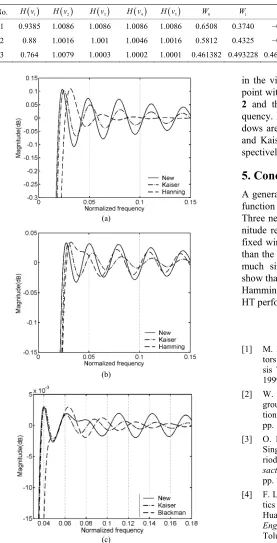
It is obvious that for finding good window constants we only need to take into account two performances of maximum passband ripple and transition width in the magnitude response of HT.
If maximum passband ripple and lower cutoff fre- quency as two specifications are known, we can easily design HTs. The first step is to select a window from table 3.1. Then the corresponding is obtained from the table. The next step is to compute according to (50) and further . The last step is to compute HT coefficients according to (48).
N L
4. Compared with Other Windows
Table 1. Three cases of H v
1 through H v
5 , W0 through W4 and HT performances.No. H v 1 H v 2 H v 3 H v 4 H v 5 W0 W1 W2 W3 W4 Ap (dB) α 1 0.9385 1.0086 1.0086 1.0086 1.0086 0.6508 0.3740 −0.0330 0.0093 −0.0011 0.109 0.754 2 0.88 1.0016 1.001 1.0046 1.0016 0.5812 0.4325 −0.0194 0.0082 −0.0026 0.034 0.958 3 0.764 1.0079 1.0003 1.0002 1.0001 0.461382 0.493228 0.460071e−1 −0.395644e−3 −0.221528e−3 2.97e−3 1.48
in the vicinity of 0 dB from some local extrema to the point with the normalized frequency being 0.5 in Figure 2 and the whole curve is symmetrical about the fre- quency. From the figure we can see that these new win- dows are better than the Hanning, Hamming, Blackman and Kaiser windows in terms of HT performances, re- spectively.
5. Conclusion
A general HT formula is deduced by using the sinc sum function and it contains a general window function. Three new windows are obtained directly from the mag- nitude responses of HT. These new windows belong to fixed window. They are two or three cosine terms more than the Hanning, Hamming and Blackman windows but much simpler than the Kaiser window. Comparisons show that these new windows are better than the Hanning, Hamming, Blackman and Kaiser windows in terms of HT performances.
(a)
REFERENCES
[1] M. Feldman and S. Seibold, “Damage Diagnosis of Ro- tors: Application of Hilbert Transform and Multihypothe- sis Testing,” Journal of Vibration and Control, Vol. 5, 1999, pp. 421-442. doi:10.1177/107754639900500305
(b)
[2] W. J. Freeman, “Origin, Structure, and Role of Back- ground EEG Activity. Part 3. Neural Frame Classifica- tion,” Clinical Neurophysiology, Vol. 116, No. 5, 2005, pp. 1118-1129. doi:10.1016/j.clinph.2004.12.023
[3] O. Deshmukh, C. Y. Espy-Wilson, A. Salomon and J. Singh, “Use of Temporal Information: Detection of Pe- riodicity, Aperiodicity, and Pitch in Speech,” IEEE Tran- sactions on Speech Audio Process, Vol. 13, No. 5, 2005, pp. 776-786. doi:10.1109/TSA.2005.851910
[4] F. L. Zarraga, “On-Line Extraction of Modal Characteris- tics from Power System Measurements Based on Hilbert- Huang Analysis,” International Conference on Electrical Engineering, Computing Science and Automatic Control, Toluca, 10-13 January 2009, pp. 1-6.
(c)
[5] C. J. Chun, Y. H. Lee, Y. G. Kim, H. K. Kim and C. S. Cho, “A Real-Time Audio Upmixing Method from Stereo to 7.1-Channel Audio,” Communication and Networking —Communications in Computer and Information Science, Vol. 120, 2010, pp. 162-171.
Figure 2. Comparison between new windows with other windows in terms of HT performances for L = 63, respec- tively. (a) Magnitude response obtained by using new win- dow (No. 1), Kaiser window (β = 3:83) and Hanning window; (b) Magnitude response obtained by using new window (No. 2), Kaiser window (β = 4:98) and Hamming window; (c) Magnitude response obtained by using new window (No. 3), Kaiser window (β = 7:5) and Blackman window.
[7] N. E. Huang, “Introduction to Hilbert-Huang Transform and Its Related Mathematical Problems,” In: N. E. Huang and S. S. P. Shen, Eds., Hilbert-Huang Transform and Its Applications, World Scientific, Singapore City, 2005, pp. 1-26.
[8] H. Luo, X. Fang and B. Ertas, “Hilbert Transform and Its Engineering Applications,” AIAA Journal, Vol. 47, 2009, pp. 923-932.
[9] H. W. Schüler and P. Steffen, “Halfband Filters and Hil- bert Transformers,” Circuits, Systems and Signal Proc- essing, Vol. 17, No. 2, 1998, pp. 137-164.
doi:10.1007/BF01202851
[10] A. Hossen, “A New Fast Approximate Hilbert Transform with Different Applications,” IIUM Engineering Journal, Vol. 2, No. 2, 2001, pp. 21-27.
[11] S. W. A. Bergen and A. Antoniou, “Design of Nonrecur- sive Digital Filters Using the Ultraspherical Window Func- tion,” EURASIP Journal on Applied Signal Processing, Vol. 12, 2005, pp. 1910-1922.
doi:10.1155/ASP.2005.1910
[12] H. Olkkonen, P. Pesola and J. T. Olkkonen, “Computa- tion of Hilbert Transform via Discrete Cosine Trans-
form,” Journal of Signal and Information Processing, Vol. 1, No. 1, 2010, pp. 18-23. doi:10.4236/jsip.2010.11002
[13] J. T. Olkkonen and H. Olkkonen, “Complex Hilbert Trans- form Filter,” Journal of Signal and Information Process-ing, Vol. 2, No. 2, 2011, pp. 112-116.
doi:10.4236/jsip.2011.22015
[14] W. Yunlong, “Sinc Sum Function and Its Application on FIR Filter Design,” Acta Applicandae Mathematicae, Vol. 110, No. 3, 2010, pp. 1037-1056.
doi:10.1007/s10440-009-9492-7
[15] Y. Wang, “An Effective Approach to Finding Differenti- ator Window Functions Based on Sinc Sum Function,” Circuits, Systems and Signal Processing, Vol. 31, No. 5, 2012, pp. 1809-1828. doi:10.1007/s00034-012-9399-9
[16] Y. Wang, “New Window Functions for the Design of Narrowband Lowpass Differentiators,” Circuits, Systems and Signal Processing, 2012.
doi:10.1007/s00034-012-9536-5
![Figure 1. Z,Z01 and Z2 for L = 16 on [−16 16].](https://thumb-us.123doks.com/thumbv2/123dok_us/7768513.716063/5.595.60.543.71.746/figure-z-and-z-for-on.webp)