Verifying the Contract Net Protocol: A Case
Study in Interaction Protocol and Agent
Communication Language Semantics
Shamimabi Paurobally
University of Southampton
Southampton SO17 1BJ, UK.
Jim Cunningham
Imperial College
London SW7 2BZ, UK.
Nicholas R. Jennings
University of Southampton
Southampton SO17 1BJ, UK.
May 14, 2004
Abstract
Multi-agent conversations are built upon two components: agent communication languages (ACLs) that specify the individual messages that can be exchanged and interaction protocols (IPs) that specify the sequences in which these message can be arranged. Although informative, the semantic definition proposed for the most standard ACL (FIPA 1997) is complicated and contentious, while published IPs tend to be ambiguous, incomplete, and unverified with respect to message seman-tics. As a case study to clarify and help rectify these problems, we have investi-gated verification of the contract net protocol when its messages are presumed to be expressed in FIPA ACL. In order to help both informal comprehension and formal verification we separate several concerns. We suggest a revised and simpler core semantics for many of the FIPA ACL speech acts, using the same belief-intention style of logic, although the underlying ideas are not dependent on this detail. An extended form of propositional dynamic logic and statecharts is used to express IPs. States are interpreted using mutual beliefs and intention, and properties such as termination and consistency of joint beliefs are shown.
1
Introduction
KQML [3], FIPA ACL [4]) specifies the individual communicative acts (CAs), typi-cally as classes of asynchronous messages modelled on the Theories of Speech Acts enunciated by Austin [1] and Searle [12] . The 1997 semantic specification for FIPA ACL is expressed using a logic of belief and intention and derived from work associ-ated with Sadek [11]. This specification is informative has been criticised on various grounds [10] [6], not least that it is unverifiable [16]. Relatedly, an IP (for example the contract net protocol (CNP) [15] or an English auction protocol) specifies message sequences that can lead towards a goal state. However to date, may of the published specifications for these protocols suffer from ambiguities and incompleteness [8]. This lack of precision can arise from the inherent inexpressiveness of diagrammatic rep-resentations such as Petri-nets [7] and AUML [4], or from the level of abstraction chosen when using informal language or formal logic. Such representations can never-theless be informative and helpful for comprehension. Commitment-based semantics have been used for modeling multi-agent interactions [17]. However this work remains focussed on the creation, fulfilment and discharge of an agreement, tends to be cen-tralised, through for example an instituion, and discourages interactions whose goals are to share experience and model their environment. The legal issues also are often not considered.
internal to an agent. Treating intention in a similar way is also a useful ideal for suc-cinct reasoning about a goal state without getting into more temporal reasoning. The durability of the Belief-Desire-Intention paradigm for practical deliberative agents also provides a heuristic justification for this sort of reasoning.
The remainder of this paper is structured in the following way. In the next section we provide an informal summary of the separate issues in simplifying reasoning about the FIPA ACL. Section 3 critically analyses a representation of the CNP in Petri nets and those aspects of the specification that cannot be captured with in this approach. Section 4 develops a novel formal representation of the CNP in extended PDL and extended statecharts. In section 5, we discuss the axioms and assumptions of the belief logics and ACL. Sections 6 and 7, respectively, summarize our use of communicative acts and interpret the states in the CNP. In section 8, we validate our approach by proving desirable properties of the CNP in our framework. Section 9 presents our conclusions and future work.
2
Issues in Reasoning about the FIPA ACL
As defined in FIPA-ACL 1997 there is a feasibility pre-condition (FP) and a rational effect (RE) associated with each CA. The FP conjoins a sincerity condition (SC), with a typically more complex Gricean condition (GC) to preclude a redundant message. The RE expresses the condition that the sender may use in planning the communicative act. The FIPA inform, (or KQML tell) is the basic CA. As a message it has parameter for senders, receiverrand propositional contentφ. The SC isBsφand the RE isBrφ The GC expresses the belief that the sender does not believe the receiver believesφ, or is uncertain about it.
The obvious criticism is that the Gricean condition introduces inessential complex-ity, even if the term “inform” is inappropriate without it, but there are deeper issues. The semantic conditions as expressed are sender oriented, and there is no overt associa-tion between the semantic condiassocia-tions and the occurrence of the message itself, after all, sincerity and non-redundancy are social conditions, not mechanical. Although these concerns have been pointed out in [13], [16] we take a new step in removing much of their impact by re-expressing the semantics in the belief-intention logic itself.
The key step is not obvious and indeed exploits an obvious ”hack” in the logic, which is to avoid the detailed expression of temporality or causation by using the spe-cial propositiondone(a, act), for any agentaand action act. Using PDL notation, we expressdone(a, act) as done(a.act). Now the propositions Is done(s.m) and
Brdone(s.m)respectively can express that the sender agentsintends thatmbe sent, and receiver agentrbelieves thatm has been sent bys. These are the tightest pre-and post-conditions we can express in the logic, pre-and suggest the following PDL axiom schema for such messages, assuming there is a sender s and a receiver r:
Isdone(s.m)↔[s.m]Brdone(s.m)
believes that the message transport post-condition entails the message RE
(Brdone(s.m)→BrREm), and that the pre-conditionIsdone(s.m)is itself a primi-tive plan by which the sender can attain the RE. The FIPA semantics do not assume the sender to intend the RE, but one can take the view that the FP should be strenghened to entailIsdone(s.m).
Indeed, each agent can access a common ontology of messages and infer from the receipt of a message what it means, and this may vary with any other environmental context that is available. We will simply drop the GC part of the FP, on the grounds that it is really a social protocol for human communication which need not be presumed in the context of any other interaction protocol, but retain the SC part as simpler FIPA-like pre-condition, and allow the FIPA RE as a trustworthiness assumption (see section 5.2).
It turns out that the remaining FIPA-ACL messages that we use can be re-expressed as special cases of the inform act in context. This was known when the standard was prepared, but in some cases obscured and made erroneous by the inessential complexity we have sought to remove. For example a propose message, sent by a potential CNP contractor to the manager is an inform with the propositional content that if the sender believes that the receiver intends that the action be done by the sender, then the sender (will) intend this (too). So a sincere accept or reject requires belief by the manager in the propositional content of such a proposal, and becomes an inform message with content expressing the manager’s intention, so that the contractor can discharge the conditional ”promise”. Given these issues in the semantics of ACLs, there also exist issue in the current representations of IPs.
3
Issues in Representing IPs
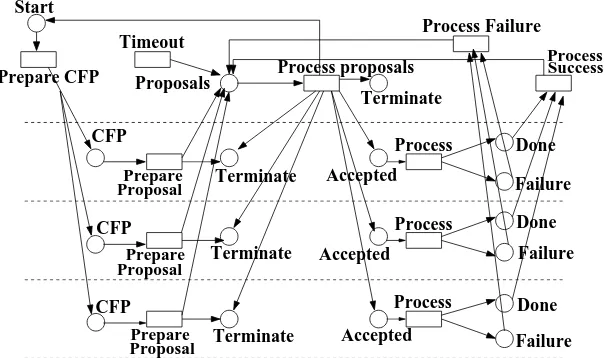
To illustrate the required expressiveness of a specification language for realistic IPs, we consider the CNP since this is probably the most widely used protocol in the field. Figure 1, from [7], presents the CNP as a “Coloured” Petri Net. The interaction is started by a manager issuing a call for proposals (cfp). Potential contractors respond with proposals, which the manager either rejects or accepts. Accepted proposals can be either cancelled by the manager or executed by the proposer, who later informs the manager of success or failure of their execution. The manager may also re-select other proposals or issue a new cfp.
However figure 1 is both ambiguous and incomplete:
• A manager has no means of deciding whether the overall contract net process has succeeded or failed. For example, if out of n proposals, m are done and p fail, the state of the overall process is undefined.
CFP
CFP
Terminate Prepare CFP
Timeout
CFP
Process Success
Start
ProposalPrepare
Prepare Proposal
Prepare
Proposal Terminate
Terminate Terminate Proposals
Process Failure
Process
Process
Process
Accepted Accepted
Accepted Process proposals
Done
Failure
Done
Failure
Done
[image:5.612.153.456.125.304.2]Failure
Figure 1: Contract Net conversation with three contractors in Coloured Petri Net
• Even if roles are used, as in AUML [4], there is no binding of an action to an agent’s identity. Thus the manager should only send acceptance messages to those contractors who proposed, and only those proposers should inform the manager of the result of their execution.
• A deadlock will occur if all contractors refuse to bid or if the manager does not issue a new call. This is because for termination or for issuing a revised call, at least one contractor has to send a proposal to the current call.
• Alternative actions cannot be distinguished. For example, instead of the manager being able to both accept and reject each proposal, as in figure 1, it should either accept or reject each proposal.
There are also other aspects missing in the CNP representation. It is not shown that different contractors have different beliefs depending on what they sent and received. Thus, since proposals are not broadcasted, a contractor will not know who else other than itself has sent a proposal, whilst the manager knows all proposers. In turn, the manager has to ensure that it accepts or rejects only those agents which sent a proposal in the first place. Thus, there is a shared belief between a contractor and the manager, (e.g. whether that contractor has sent a proposal or whether its proposal has been accepted). In the same protocol, some states are public, some are private to an agent, while yet others are mutually believed. Sometimes, the private states of an agent have to be expressed; for example, the state when the manager is deliberating a proposal is needed in order to show that: i) there is a specific set of contractors whose proposals a manager has chosen to accept and another distinct set whose proposals are rejected; and
ii) contractors wait for the manager to finish its deliberation. These required features
Table 1: Semantics of Extended PDL
M, w|=p iffw∈V(p), p∈P ROP
M, w|= [γ]A iff∀w1(wRγw1impliesM, w1|=A)
M, w|=A(X) iffM, w|=AandX ∈Ag group M |= (γ1::γ2) iffRγ1 ⊆Rγ2
M, w|=none of(S) iff∀A(A∈SimpliesM, w6|=A)
M, w|=one of(S) iff∃A1∀A2((A1 ∈SandM, w|=A1)
and(A2∈SandM, w|=A2))
impliesA1 ↔A2)
RAg group.γ⊆Rγ
RA?={(w, w) :M, w|=A}
Rγ?={(w1, w2) : (w1, w2)∈Rγ}
4
A Formal Representation for Interaction Protocols
Here we show how to represent IPs formally in extended PDL and graphically in ex-tended statecharts. First, however we specify our extensions to PDL.
4.1
Extended PDL
We extend PDL to enable us to reason about the effect of processes on interaction states (refer to [8] for more details and a complete axiomatisation). Specifically, let A denote a formula andγdenote a process. In general, a formula may be in multi-modal logic, including beliefs, desires and intentions, as well as actions. The formula[γ]Ahas the intended meaning: A holds after executing processγ. (The formula[γ]Ais also the weakest precondition forγto terminate with A). The syntax of the extended logic is defined below, whereAdenotes one agent or a set of agents and the term States denotes set of formulae.
Formulae: A ::=p| ⊥ |A1→A2|[γ]A|BAA|IAA|A(A)|γ1::γ2 |none of(States)|one of(States)
Processes: γ ::=$|γ1;γ2|γ1∪γ2|γ∗|A?|null|abort| A .γ|γ?
The complex process (γ1;γ2) denotes the sub-processγ1followed byγ2, the
pro-cess (γ1∪γ2) either γ1 or γ2 non-deterministically, whileγ∗ denotes zero or more
An agent or a group of agents, A, may execute atomic actions or complex pro-cesses,γ. So the termA.γcan be read asAexecutes processγ, as for example in
r:retailer.display means retailer r executes the display process, but the agent role may
be omitted. Using set notation, we can denote a joint process between two parties as {r,c}.shopping. The formulaA(A)allows stateAto have an agent or a group,A, as parameters. The semantics ofM, w |= (γ1 :: γ2)states that all the worlds obtained
through execution of processγ1are elements of the set of worlds possible through
per-formingγ2. For example,
EbayAuction::EnglishAuction means that all the rules in the English auction apply to
the Ebay auction.
4.2
CNP in Extended PDL and Statecharts
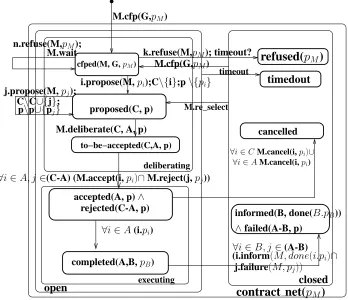
Figure 2 shows the CNP in an extended form of statecharts and each state is fully defined in figure 4. The process[X\Y]means the process of replacing occurences of
X with Y in the resulting state.
timedout
timeoutopen
executingclosed
M.re_select
to−be−accepted(C,A, p)
deliberating
M.cfp(G,pM)
k.refuse(M,pM); timeout?
M.cfp(G,pM)
n.refuse(M,pM);
cancelled
refused(
p
M)
i.propose(M,pi);C\{i};p\{pi}
M.wait
j.propose(M,pj);
C\C∪{j}; p\p∪{pj}
∀i∈A, j ∈(C-A) (M.accept(i,pi)∩M.reject(j,pj))
∀i∈AM.cancel(i,pi)
∀i∈B, j∈(A-B) (i.inform(M, done(i.pi)∩
j.failure(M, pj))
contract net(
p
M)
∧failed(A-B, p)
informed(B, done(B.pB))
cfped(M, G,pM)
∀i∈CM.cancel(i,pi)∪
∀i∈A(i.pi)
completed(A,B,pB)
rejected(C-A, p) accepted(A, p)∧
proposed(C, p)
[image:7.612.136.484.329.629.2]M.deliberate(C, A, p)
¬contract net↔[G.contract net process]closed (1) contract net↔one-of ({open , closed}) (2) closed↔one-of({(failed∧informed), timedout, cancelled, refused}) (3) open↔one-of({deliberating, executing}) (4) deliberating↔one-of({cfped, proposed, to-be-accepted}) (5) executing↔one-of({(accepted∧rejected), completed}) (6)
¬contract net↔[M:manager.cfp(G ,pM)]cfped(M,G,pM) (7)
Figure 3: Theory of CNP’s diagram structure in extended PDL
cfped(M,G,pM)↔(
[n:contractor.refuse(M,pM); M.wait]cfped(M,G,pM)
∨[n:contractor.refuse(M,pM); timeout?] refused(pM)
∨[i:contractor.propose(M,pi);C\ {i}; p\ {pi}]
(proposed(C, p)∧∀i(i∈C↔BMdone(i.propose(M.pi))) ) (8) proposed(C, p)↔[M:manager.deliberate(C,A, p)]
(to-be-accepted(C,A, p)∧∀i∈A,∀j6∈A(BM(i∈A)∧BM(i6∈A)))
∨[j:contractor.propose(M,pj);C\C∪ {j};p\p∪ {pj}] (9) to-be-accepted(C,A,p)↔[∀i∈A,∀j∈(C−A)(M:manager.accept(i, pi)∩M:manager.reject(j, pj)]
(accepted(A, p)∧∀i∈A(Bi(accepted(i, pi))))
∧(rejected(C-A, p)∧∀j∈(C−A).Bj(rejected(j, pj))) (10) accepted(A, p)↔[∀i∈A(i.pi)] (completed(A,B,p)∧(∀i∈B(Bisucceeded(pi))
∨∀j∈(A−B)Bj¬succeeded(pj))∨) [∀i∈A(M:manager.cancel(i, pi)∪
∀i∈C(M:manager.cancel(i, pi)]cancelled (11) completed(A,B, p)↔[∀i∈B,∀j∈(A−B)[i.inform(M, done(i.pi))∩j.failure(M,pj]
(informed(B, done(B.pB))∧failed(A-B, p)) (12)
open↔[timeout] timedout (13)
closed↔[M:manager.cfp(G,pM)]cfped(M,G,pM)∨[M:manager.re reselect]proposed(C, p) (14)
Figure 4: Definition of the states of the CNP in extended PDL
Figures 3 and 4 provide a corresponding logical theory of the protocol in extended PDL. Axioms (1)-(7) in figure 3 specify the relation between the states as given in the CNP diagram in figure 2. Axioms (8)-(14) both define the states and state transitions of the CNP. In more detail, axiom (1) defines that a group of agents G adheres to the CNP in a process instance called contract net process. Double implication in the action-condition rules allows an agent to infer the history of an interaction. Axioms (2)-(6) define the relations between parent and sub-states, as seen in the hierarchy of figure 2. There are 5 other axioms (not shown here) for ensuring when a parent state is false, none of its sub-states are true.
proposal, leading to proposed(C, p) where C is the set of proposers and p the set of proposals, each associated to its proposer. Further proposals from other proposers are added to the sets C and p. The expression∀i(i ∈ C ↔BMi.done(i.propose(M,pi))) means that the manager’s beliefs include the identity of all proposers in C (Axiom 8).
Then the contractor deliberates to record those proposals it will accept as set A. The condition∀i∈A, j6∈A(BM(i∈A))∧(BM(i6∈A))ensures that the manager’s beliefs include accepted and rejected proposers (axiom 9). The manager concurrently sends an accept message to all chosen proposers in A, and rejections to those in
(C-A) (axiom 10). The manager can also cancel the cfp or reject all proposals through a cancel message.
The action∀i ∈ A(i.pi)and the state completed(A,B,p) express the fact that all accepted contractors in A execute their proposals and if successful are implicitly part of the set B. Each contractor privately believes whether it has succeeded or not in its execution (axiom 11). Finally, the contract net process terminates after all contractors in B have informed the manager of success, and the rest in (A-B) of failure (axiom 12). In an open state, a timeout can occur at any point (axiom 13), while from the closed state the manager can re-issue a call for proposal (axiom 14).
5
Beliefs and Intentions in a Group
Given the formal representation of the CNP in extended PDL, we now give meaning to the actions and states in the protocol in terms of the beliefs and intentions of the group. To do this, we use the modal operators for beliefs and intentions [2] [14]. Specifically, an axiomatic system for belief may be defined in terms of axioms for consistency and introspection [2]. We assume that each agent in a group has such a system of beliefs. The formulaBiαis read as agent i believesα,Iiαis read as agent i intends to doα, and
EGαis read as everyone in a group of agents, G, believesα, whereαitself may express an agent’s beliefs and intentions. The joint beliefs (Bi1α1∧. . . Binαn) of a group are the sentences that are consequences of the union of the individual beliefs of the agents. We also re-use a modified version of the FIPA SL done operator [4]. Here, done(i.a) (done(i,a) in FIPA SL) means that agent i has performed action a. Pre-conditions p for doing a can be expressed as part of a (e.g. p?;a).
As mentioned in section 2, we ignore the Gricean condition involving uncertain beliefs. We also specify intention axioms and other axioms for sincerity and trust that hold in our environment. These axioms are independent of the ACL and the protocol, but apply to reasoning about an interacting group of agents. Thus, although the seman-tics or the ACLs may differ, these core axioms should nevertheless hold in all agent interactions.
5.1
Belief and Intention Axioms
axiom for belief, we have axioms for intentions and beliefs about intentions. Like pos-itive introspection for belief and knowledge, we assume an agent’s iterated intentions collapse to a single intention (A1):IiIiα↔Iiα.
Axiom (A2) states that an agent i is aware of its intentions and, intends what it believes it wants to intend:BiIiα↔Iiα.
We can have a stronger system where an agent is aware of what it does not intend to do, which is some kind of negative introspection (A3):¬Iiα→Bi¬Iiα.
An agent is rational, that is it does not intend what it believes it does not intend (A4):Bi¬Iiα→ ¬Iiα.
Intentions for negative intentions also collapse to not intendingα(A5):
Ii¬Iiα→ ¬Iiα.
An agent has control over its beliefs. If it intends to believeα, then it intends it (A6):IiBiα→Iiα.This also impliesIiBi¬α→Ii¬α.
From axioms (A1) and (A2), we obtain the following axiom, which can be further simplified to:Iiα(A7):BiIiBiIiα↔BiIiα.
Definitions for common intentions may be formulated in the same way as common knowledge and common beliefs. Axioms (A1) to (A6), except for axiom (A3) hold in our framework, whereαcan itself include belief and intention modalities.
5.2
Assumptions
In this section, we formulate the axioms holding in our model. These are the foun-dations of our reasoning and proofs and combined infer a sincere and trustworthy be-haviour, and that messages are successfully delivered. All of these assumptions are implicit in FIPA ACL. Although they may seem to require an ideal environment, our goal in this paper is to provide a simple and well-founded semantics that work in such a social context. Untrustworthy environments and relaxing these are avenues for future work. Let s (sender) and r (receiver) represent two different agents interacting with one another.
Sincerity Axioms:IsBrBsα→Bsα.
IsBrIsα→Isα.
Agents are sincere and the sender does not intend the receiver to believe what it does not believe itself.
Trust Axiom:BrIsBrα→Brα.
This states that if r believes that agent s sent a message to agent r thatαholds, then r believesα. Receivers trust the sender. Ifαis a proposition or a belief formula, then r also believes s believesα; that is,BrIsBsα→Brα∧BrBsα(Trust Axiom 2).
Cooperative Axiom:BrIsIrα→(IrBsIrα∨IrBs¬Irα).
The agents are co-operative. Thus on receiving a message, an agent replies, even if it is a refusal or a rejection.
Similar to the FP and RE of a CA, there are preconditions and postconditions when sending a message, that are independent of the meaning of the CA. Our precondi-tion states that a sender intends for the message to be sent. For example, the CA
s.inform(r,p) means that the sender s informs the receiver r that p holds. The FIPA
the sender’s beliefs will hold. Let done(m) denote a sent message m containing a CA. Let FP(m) denote the FP of the CA and RE(m) denote the RE of the CA being sent. The axioms that apply to message exchange are:
Transport Precondition:Isdone(m). Before sending a message, sender s intends to send it.
Transport Postcondition:Brdone(m). The receiver received the message.
Message Sending:Isdone(m)→F P(m).
Message Receipt:Brdone(m)→RE(m).
If the sender intends to send a message m, then the FP of the message (its commu-nicative act) should hold and likewise for the receiver to believe the RE of the message on receiving it. Given the above system for beliefs and intentions, we specify the se-mantics of the speech-acts and states in the CNP in terms of the intentions of a message sender and the receiver’s beliefs.
6
The Semantics of CNP Actions
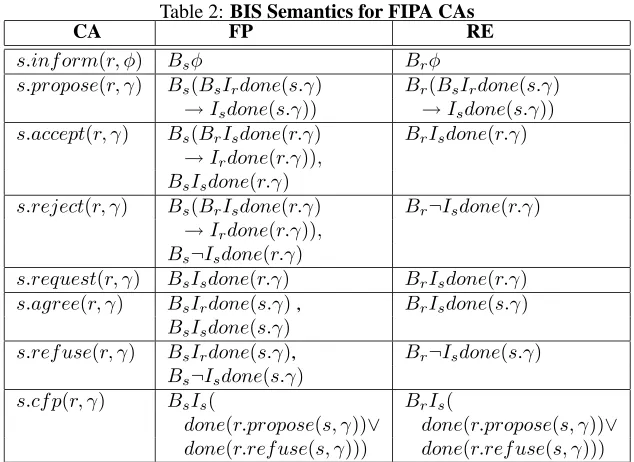
[image:11.612.147.464.392.623.2]We analyse the semantics of the most commonly used CAs, as given by FIPA in the SL language, and discuss the incorrectness of these semantics with respect to the intended meaning of the CA. As a remedy, we provide a simpler and more intuitive semantics for the CAs in table 2. Let s and r denote the sender and receiver respectively.
Table 2: BIS Semantics for FIPA CAs
CA FP RE
s.inf orm(r, φ) Bsφ Brφ
s.propose(r, γ) Bs(BsIrdone(s.γ) Br(BsIrdone(s.γ) →Isdone(s.γ)) →Isdone(s.γ))
s.accept(r, γ) Bs(BrIsdone(r.γ) BrIsdone(r.γ) →Irdone(r.γ)),
BsIsdone(r.γ)
s.reject(r, γ) Bs(BrIsdone(r.γ) Br¬Isdone(r.γ) →Irdone(r.γ)),
Bs¬Isdone(r.γ)
s.request(r, γ) BsIsdone(r.γ) BrIsdone(r.γ)
s.agree(r, γ) BsIrdone(s.γ), BrIsdone(s.γ)
BsIsdone(s.γ)
s.ref use(r, γ) BsIrdone(s.γ), Br¬Isdone(s.γ)
Bs¬Isdone(s.γ)
s.cf p(r, γ) BsIs( BrIs(
done(r.propose(s, γ))∨ done(r.propose(s, γ))∨
6.1
Speech Acts Semantics in BIS Semantics
Henceforth, we refer to the SL semantics as “FIPA semantics” and we refer to our pro-posed revised semantics as “BIS” (Belief Intention Semantics) semantics. As in FIPA SL, we give the preconditions (FP) and postconditions (RE) holding, respectively, be-fore sending and after receiving a CA. In general, the FP of a CA includes the intention of the sender for conveying that CA and the RE of a CA includes the receiver’s beliefs. To be compatible with the way FIPA semantics are expressed, using axiom (A2), we prefix the intentions of a sender with its beliefs about those intentions, (e.g. BiIiBjα instead ofIiBjα). Table 2 presents our BIS semantics for most of the FIPA CAs. We discuss below the semantics of some of the salient CAs.
6.1.1 s.inform(r,φ).
s informs r thatφholds.
Fipa FP:Bsφ∧ ¬Bs(Bifrφ∨U ifrφ)
inform RE:Brφ
BIS FP:Bsφ
inform RE:Brφ
In the FIPA semantics, the FP includes the fact that the sender believesφand the RE that the receiver believesφ. As mentioned in section 5.2,Bsφis not strong enough since we need to represent the intention of s to send the message. We could express this asBsIsBrφ, the sender intends the receiver to believeφ. By the sincerity and the trust axioms, in the BIS semantics (as shown in table 2), the FP and RE respectively simplify toBsφandBrφ.
6.1.2 s.propose(r,γ).
s proposes r for s itself to doγ.
Fipa FP:Bsα∧ ¬Bs(Bifrα∨U ifrα)
propose RE:Brα where,
α=Irdone(< s, γ >)→Isdone(< r, γ >) BIS FP:Bs(BsIrdone(s.γ)→Isdone(s.γ))
propose RE:Br(BsIrdone(s.γ)→Isdone(s.γ))
In the FIPA semantics FP, the sender s believes that if r intends s to doγ, then s will intend it. However, s may not know what r intends and therefore cannot consequently infer that it should intend to doγ. For s to be aware that r intendsdone(s.γ), it must have received an accept to its proposal. As such, the FIPA semantics specifies s adopts an intention by being privy to the individual beliefs of r. In our BIS semantics, both the FP and the RE specify that s (the proposer) believes that r intendsdone(s.γ), for
6.1.3 s.accept(r,γ).
s sends an accept proposal to r.
Fipa FP:Bsα∧ ¬Bs(Bifrα∨U ifrα)
accept RE:Brα, whereα=Isdone(< r, γ >). BIS FP:Bs(BrIsdone(r.γ)→Irdone(r.γ)),
accept BsIsdone(r.γ) RE:BrIsdone(r.γ)
The FIPA semantics for accepting a proposal do not consider the context of sending an accept. As FP, s believes that it intends r to doγ. There is no notion in either the FP or in the RE, that s is accepting a proposal that r must have sent. These FP and RE could also hold in other speech-acts such as tell and does not distinguish an accept-proposal from them. In our BIS semantics, we also include that both sender and receiver are aware that r sent a proposal previously and it is up to s to accept it. Our FP and RE also specify the context of the CA, this being an acceptance, there was a proposal before. The other part is the choice of the sender to intend the receiver to doγ.
The same remarks as for accept-proposal apply to the FIPA semantics for
reject-proposal. The BIS semantics for reject can be found in table 2
6.1.4 s.cfp(r,γ).
s sends a call for proposal to r to doγ. In the FIPA semantics, the FP for a call for proposal includes that both sender and receiver intend for the receiver to perform the request. However, these intentions are premature given that r has yet to propose and s to accept for r to doγ. It does not leave the possibility for refusal or rejection. The rest of the semantics for cfp is so complicated that its meaning is unclear.
In our semantics, a call for proposal from s to r is equivalent to a request from
s to r for r to make a proposal to s. Thus s.cfp(r, γ) is equivalent to s.request(r, r.propose(s,γ)).
Using our BIS semantics for s.request(r,γ), as shown in table 2, we can specify a
call for proposal by s as having FPBsIs(done(r.propose(s, γ))∨done(r.ref use(s, γ))). This means that s intends that r either sends a proposal or refuses to doγ(because may be r cannot doγ). In turn, the RE of a call for proposal is that r believes s intends r to make a proposal or to refuse.
6.1.5 s.refuse(r,γ).
s sends a refusal to r for r to doγ. Again for the refusal CA, the FIPA semantics are obscure. For example, the FP given by the FIPA semantics is:
Bs¬F easible(< s, γ >)∧Bs(BrF easible(< s, γ >)∨
UrF easible(< s, act >))∧Bsα∧ ¬Bs(Bifrα∨U ifrα) whereα=β∧ ¬done(< i, γ >)∧ ¬Isdone(< s, γ >).
intend to do so. The RE is that the receiver then believes that the sender does not intend
γ.
6.2
Internal Actions
There are two internal actions in the CNP protocol — M.deliberate(C,A,p) from a
pro-posed state and i.p from an accepted state. The process i.p expresses that agent i
executes p and it semantics are given in terms of the semantics for extended PDL. In the processM.deliberate(C, A, Act), the set C contains those agents which sent a proposal, A contains the set of agents whose proposals M will accept and Act is the set of proposals subscripted with their corresponding proposer. A manager internally per-forms theM.deliberate(C, A, Act)process to select which proposals to accept. The semantics can be found in table 3. The precondition requires that M believes that the set
C contains those agents which sent a proposal. The postcondition specifies that after a deliberate action, the set A contains the contractors whose proposals M will accept and
the set (C-A), those who will be sent rejections.
7
The Semantics of CNP States
The interaction states of an IP specify the beliefs of an agent or group of agents. Given this, the interaction states in the CNP can be grouped into three types: public, shared and individual. Public states are believed by all the agents, shared states are mutually believed by a particular subset of the group, and individual states are the beliefs of one agent that others are unaware of. Internal actions are assumed to succeed. In the CNP, statesiis equivalent todone(ai). For example, the state cfped(M, G, p) can be written as done(M.cpf(G,p)) and likewise for the other states. For the sake of readability, in figure 2 we prefer to name a state as the past tense of an action leading to it, instead of a parameterised done. Let a group of contractors be denoted by G and the manager by
M. LetEGαbe read as everyone in a group of agents, G, believesα. We specify below the semantics of the interaction states of the CNP, which together with the semantics of the processes in the CNP, constitute the semantics of the protocol.
7.1
Public States
The public states in the CNP are cfped, timedout, open and closed (see figure 2). These states are believed by the manager and all the contractors in G. The semantics of the state cfped(M, G, p) is that everyone in the group GM, (whereGM =G∪ {M}) be-lieves done(M.cpf(G,p)). That is:
EGM∀i∈ G(done(M.request(i, i.propose(M, p)))).This entails that everyone be-lieves the FP and RE of a call for proposal:
EGMIs(done(r.propose(s, p))∨done(r.ref use(s, p))).
7.2
Shared States
In the CNP, these shared states are mutually believed by the manager and a contractor. For example, only the manager and a contractor sending a proposal believe and mutu-ally believe that this particular contractor has sent the manager a proposal. The shared states of the CNP are proposed, accepted, rejected, cancelled, refused, informed and
failed (see figure 2). Their semantics are given in terms of the beliefs of the manager
and a contractor. We explain the semantics of the proposed and accepted states. The semantics of the other shared states are given in figure 3.
7.2.1 proposed(C,p).
Can be re-written as∀i ∈ C(done(i.propose(M, pi)). The beliefs between M and each i in C are given below. The FP and RE of the propose CA are:
BM(BiIMdone(i.pi)→Iidone(i.pi))and
Bi(BiIMdone(i.pi)→Iidone(i.pi))leading to the shared belief between i and M: ∀i∈C(E{M,i}(BiIMdone(i.pi)→Iidone(i.pi))).
7.2.2 accepted(A, p).
Every contractor i in the set A has been sent an acceptance message from M. This can be re-written as∀i∈A(done(M.accept(i, pi)).
From the FP and RE effect of accept CA, we have∀i∈A:
E{M,i}(BiIMdone(i.pi)→Iidone(i.pi)),i and M believe i previously sent a proposal to M.
E{M,i}IMdone(i.pi)holds i.e. both i and M believe M has accepted i’s proposal, leading to the beliefE{M,i}Iidone(i.pi), both believe that i has adopted the intention to doγ.
7.3
Individual States
There are two individual states in the CNP process, to-be-accepted and completed, as the private state of the manager and a contractor respectively (see figure 2). The state to-be-accepted(C,A, Act) expresses the private belief of M that it will send an acceptance to all contractors in C. The following holds in the manager’s beliefs for the
to-be-accepted(C,A, Act) state:
• BM∀i ∈C(BiIMdone(i.pi)→ Iidone(i.pi)), M believes that all agents in C sent it a proposal.
• BM∀i ∈ A(IMdone(i.pi)∧IMBiIMdone(i.pi)). By axioms (A6) and (A1), this is equivalent toBM∀i ∈ A(IMdone(i.pi))M intends that all agents in A execute their proposal and M intends to let them know about its acceptance. • BM∀i ∈ (C −A)(¬IMdone(i.pi)∧IMBi¬IMdone(i.pi)), likewise for the
8
Proving Properties of the CNP
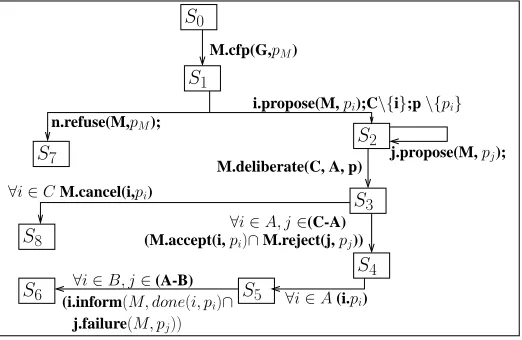
We validate our semantics for the CNP and its CAs by proving useful properties of the protocol. We do this by reasoning about the possible paths in the CNP. To this end, figure 5 shows an interpretation of the CNP from its start with a call for proposal to its completion with refusals, cancellations or informs. Figure 5 is derived from the CNP statechart in figure 2 and includes all possible paths in the execution of the CNP (apart from timeout). Let us refer to the statessiin figure 2 as interaction states, and to the statesSi in figure 5 as execution states. An execution state,Si, represents the beliefs of the manager and the contractors, given by the RE of the action leading toSi, the FP of the next action, and the group beliefs in the interaction statesi. The pathS0
toS6is the longest execution path in the CNP, and the beliefs holding at these states
are given in table 3. For example, the action cfp leads to stateS1in figure 5, and thus
in table 3, the stateS1gives the RE of cfp, the group’s beliefs of the cfped state, and
the FP of the next action propose. In table 3, letGM = G∪ {M}. Letαi denote
BiIMdone(i.p)→Iidone(i.p)and letαjdenoteBjIMdone(j.p)→Ijdone(j.p).
S0
S1
S2
S3
S4
S7
S8
S5
S6
M.cfp(G,pM)
n.refuse(M,pM);
i.propose(M,pi);C\{i};p\{pi}
∀i∈CM.cancel(i,pi)
j.propose(M,pj); M.deliberate(C, A, p)
(M.accept(i,pi)∩M.reject(j,pj))
∀i∈A, j∈(C-A)
∀i∈A(i.pi) j.failure(M, pj))
(i.inform(M, done(i, pi)∩
[image:16.612.176.437.327.497.2]∀i∈B, j∈(A-B)
Figure 5: Flowchart showing CNP Interpretation
8.1
Termination
We prove that any interpretation of the CNP will terminate.
Theorem 1. In a CNP between a manager M and a group of contractors G, the
for-mula (cf ped(M, G, pM)→[P athsALL]closed) holds, where the processP athsALL
expresses all complete paths of execution in our framework.
Proof. We prove that the closed state is eventually reached from the cfped interaction
Table 3: Execution Paths from StateS0toS6
S0 F Pcf p ∀i∈G(BMIM(done(i.propose(M, p))∨done(i.ref use(M, p))))
S1
REcf p ∀i∈G(BiIM(done(i.propose(M, p))∨done(i.ref use(M, p))))
Statecf ped ∀i∈G(EGMIM(done(i.propose(M, p))∨done(i.ref use(M, p))))
F Ppropose Biαi
S2
REpropose BMαi
Stateproposed ∀i∈C(E{M,i}αi)
P redeliberate ∀i∈C(BMαi)
S3
P ostdeliberate A⊆C∧ ∀i∈A(BMIMBiIMdonei),
∀j∈(C−A)(BMIMBj¬IMdonej)
to-be-accepted ∀i∈C(BMαi),∀i∈A(BM(IMdonei∧IMBiIMdonei)),
∀j∈(C−A)(BM(¬IMdone(j, pj)∧IMBj¬IMdonej))
F PM.accept(i,pi) BMαi, BMIMdone(i.pi)
F PM.reject(j,pj) BMαj, BM¬IMdone(j.pj)
S4
REM.accept(i,pi) BiIMdone(i.pi) REM.reject(j,pj) Bj¬IMdone(j.pj)
Stateaccepted E{M,i}αi,∀i∈A(E{M,i}IMdone(i.pi))
Staterejected ∀j∈(C-A)(E{M,j}αj∧E{M,j}¬IMdonej, E{M,j}¬Ijdonej)
P rei.p Beliefs of accepted state
S5
P ost∀i∈A(i.p) Beliefs of completed state
Statecompleted ∀i∈B(Bi(done(i.pi)∧IiBMdonei)
∀j∈(A-B)∧Bj(¬donej∧ ¬Ijdonej∧IjBM¬donej))
F Pi.inf orm Bidone(i.pi)
F Pj.f ailure(M,pj) Bj¬Ijdonej
S6
REi.inf orm BMdone(i.pi)
REj.f ailure(M,pj) BM(¬done(j.pj)∧ ¬Ijdonej) Stateinf ormed ∀i∈B(E{M,i}done(i.pi))
Statef ailed ∀j∈(A−B)(E{M,j}(¬donej∧ ¬Ijdonej))
followed by the processρi+1. Let the notations in table 3 be used (e.g. forαi). Proving termination for all processes inP athsALL implies proving that all paths in figure 5 terminate. Thus, we prove that all actions in the paths in figure 5 are feasible in their source state (i.e, the FP of all processesρi+1may hold after actionρiand in interaction statesi). The premise is that the CNP has been started with a call for proposals. The
REcf p(RE of cpf) holds, stating that contractors should either reply with a refusal or a proposal. But this is what is required by the CNP to trigger the next state, so the process proceeds to the state proposed or refused, since theREcf prenders it possible. Since refused is a sub-state of closed, all paths from refuse terminate. So using table 3, we now prove that the paths following a propose action terminate. That is, for all actionsρi, after execution stateS1, theF Pρi+1is possible from the interaction statesi
and theREρi. This can be seen in table 3 where the pre-condition of deliberate holds from theREpropose.
The FP of the action∀i ∈ A(M.accept(i, pi))holds since the state to-be-accepted includes the belief∀i∈C(BMαi)and∀i∈A(BMIMdonei).
From table 3 it can be seen that the FP of both accept and reject can be derived from the state completed, leading to the sub-states of closed.
Corollary 1. After a call for proposal, the FP of all actions may hold from the FP and
RE of the previous action. That is,F Pρi+1fromF Pρiand theREρi
We can also show there are no deadlocks in the CNP interpretation. The corollary holds because when proving theorem 1, we provedF Pρi+1is possible from the
inter-action statesiand theREρi. From our semantics, interaction statesiis itself defined from the FP and RE of the actionρileading to it.
8.2
A Failed or Succeeded CNP
We can also show that a CNP always terminates with the beliefs of whether the CNP process has satisfied the goal of the interaction:
Theorem 2. The interpretation of the CNP terminates with either the shared belief
between a manager and a contractor i of eitherdoneior¬donei, or the group beliefs
of¬done.
Proof. By theorem 1, a CNP interpretation always terminates.¬doneobviously holds in the timedout state. Terminal states are refused, timedout, cancelled and (informed ∧failed). Section 7 and table 3 both show that¬done holds in states refused and
cancelled. It can also be seen that in the accepted and rejected states,E{M,i}donei andE{M,j}¬donej respectively hold. Thus, all accepted contractors i believedonei and all rejected contractors j believe¬donej, while the manager appropriately believes
doneiand¬donej.
8.3
Consistent Joint Beliefs in a Group
Consistent joint belief aboutµin group G entails that everyone in G believesµand no-one believes¬µ. Below we show that for public and shared states, there are some beliefs that are consistent between the agents in the group (for public states) or sub-group (for shared states). Thus, there is a state of affairs which every agent in the group (or sub-group) believes.
Theorem 3. In the CNP interpretation, for all public and shared states, there are some
consistent joint beliefs in, respectively, the group or sub-group. That is, for all states public to G, and states shared betweenGsub:
∃µ(EGµ∧(¬∃i∈G(Bi¬µ)))∧ ∃β(EGsubβ∧(¬∃i∈Gsub(Bi¬β)))
Proof. In the public cfped state, it can be seen that:
∀i∈G(EGMIM(done(i.propose(M, p))∨done(i.ref use(M, p)))).
Regarding shared states in the CNP, they have been formulated in table 3 in such a way to show the joint beliefs between the manager and each contractor i. For example,∀i∈
9
Conclusions and Future Work
We believe there is a lack of consensus on a suitable ACL for agent interaction because of the bewildering array of approaches to formalising an ACL’s semantics. Likewise, there is a similarly strong need for formal specification and verification of interaction protocols and their semantics. To highlight these needs and in attempting to satisfy them, this paper uses the contract net protocol as a non-trivial case study. In our frame-work, we formulate axioms for reasoning about an agent’s beliefs about its intentions and present a simplified and revised semantics for the FIPA communicative acts that appear in the contract net protocol. We accompany these ACL semantics with those of the states and internal actions in the contract net protocol in order to obtain (for the first time) a complete semantics for that protocol. In so doing, we can prove proper-ties when interpreting the protocol such as termination and consistency in joint beliefs. Even though the case study has raised several issues about ACL and IP semantics, it is still incomplete and we intend that future work analyses other interesting open issues. Future work includes relaxing the assumptions detailed in section 5.2 and analysing properties such as liveness, completeness, complexity and decidability. A denotational semantics for the speech-acts can be specified in addition to the given BDI semantics and these semantics may be combined with our previous work [9] in modeling agent interactions in imperfect communication environments for an analysis of the perfor-mance of agent interactions in realistic environments.
References
[1] J. L. Austin. How to Do Things with Words. Oxford University Press, 1962.
[2] R. Fagin, J. Halpern, Y. Moses, and M. Vardi. Reasoning about Knowledge. MIT Press, 1995. [3] Y. Finin, T.and Labrou and J. Mayfield. KQML as an agent communication language. In Software
Agents, Jeff Bradshaw (Ed), pages 267–273, 1995.
[4] Foundation for Intelligent Physical Agents, http://www.fipa.org. FIPA Agent Communication
Lan-guage Specification.
[5] R. Goldblatt. Logics of Time and Computation. CSLI, 1987.
[6] F. Guerin and J. Pitt. Agent communication frameworks and verification. In AAMAS 2002 Workshop
on Agent Communication Languages, Bologna, LNCS volume 2650, 2002.
[7] M. Nowostawski, M. Purvis, and S. Cranefield. A layered approach for modelling agent conversations. In Proc. 2nd Int. Work. on Infrastructure for Agents, MAS, and Scalable MAS,, 2001.
[8] S. Paurobally. Rational Agents and the Processes and States of Negotiation. PhD thesis, Imperial College, 2002.
[9] S. Paurobally, R. Cunningham, and N. R. Jennings. Ensuring consistency in joint beliefs of interacting agents. In Proc. AAMAS, pages 662–669, 2003.
[10] J. Pitt and A. Mamdani. Communication protocols in mas. In Work. on Specifying and Implementing
Conversation Policies, pages 39–48, 1999.
[11] D. Sadek. A study in the logic of intentions. In 3rd Conf. on Principles of Knowledge Representation
and Reasoning, pages 462–473, 1992.
[12] J. R. Searle. Speech acts: An essay in the philosophy of language. Cambridge University Press, 1969. [13] M. Singh. Agent communication languages: Rethinking the principles. IEEE Computer, 31(12):40–47,
[14] I. Smith, P. Cohen, J. Bradshaw, Greaves M., and H. Holmack. Designing conversation policies using joint intention theory. In ICMAS, pages 269–276, 1998.
[15] R. G. Smith. The contract net protocol: High-level communication and control in a distributed problem solver. IEEE Transactions on Computers, C-29(12):1104–1113, 1981.
[16] M. Wooldridge. Semantic issues in the verification of agent communication languages. Journal of
Autonomous Agents and MAS, 3(1):9–31, 2000.