EVALUATION OF THE BENEFITS OF NATURAL ECOSYSTEM PRESERVATION WITH SPECIAL REFERENCE TO EXISTENCE VALUES
By
JEFFREY WILLIAM BENNETT
undertaken j o i n t l y w i t h my s u p e r v i s o r Mr. Ben Smit h, and where o t h e r w i s e acknowledged, t h i s t h e s i s i s e n t i r e l y t he r e s u l t o f my own r e se a r c h .
ACKNOWLEDGEMENTS
Gr a t e f ul acknowledgement i s ext ended t o my s u p e r v i s o r , Mr. Ben Smith f o r h i s h e l p f u l comments and s u g g e s t i o n s and f o r h i s c o n t r i b u t i o n t o our j o i n t st udy o f t h e U t i l i t y Val uat i on Method. My former s u p e r v i s o r , Mr. A l i s t a i r Ulph, i s a l s o acknowledged f o r h i s a s s i s t a n c e in t he i n i t i a l f o r mu l a t i o n of t h i s r e s e a r c h p r o j e c t and h i s c o nt i nue d s uppor t a f t e r r e t u r n i n g t o t h e U.K. in December 1978.
I wish t o thank t he A u s t r a l i a n Nat i onal Parks and Wi l d l i f e Se r v i c e and t he Cent re f o r Resource and Envi ronmental St u d i e s f o r t h e i r p r o v i s i o n of f i n a n c i a l s u p p o r t . In p a r t i c u l a r , Ms Pamela Me r r i l l wa s most h e l p f u l in a r r a n g i n g t he ANPWS fundi ng and
P r o f e s s o r Frank Fenner, P r o f e s s o r Geoff Ta y l o r , s u c c e s s i v e D i r e c t o r s of CRES, and P r o f e s s o r S t u a r t H a r r i s , Head of t he CRES Resources Programme, pr ovi ded encouragement t h r o u g h o u t t he d u r a t i o n o f t h i s p r o j e c t .
The Survey Research C e n t r e , ANU, c a r r i e d o u t t he survey of Canberra r e s i d e n t s which pr ovi ded t he d a t a a n a l y s e d in P a r t II o f t h i s t h e s i s . My t hanks ar e e x t e n d e d , in p a r t i c u l a r , t o
Mr. Roger Jones and Ms Er i c a F i s h e r o f t he SRC f o r t h e i r u n f a i l i n g c o - o p e r a t i o n and i n t e r e s t .
I am g r a t e f u l t o Dr. B i l l Donnelly of CRES, Dr. Adrian Pagan of t h e Department o f S t a t i s t i c s , Fa c u l t y of Economics, ANU and
V
The services o f several CRES s t a f f members - Ms Kathy Fisher, Ms Sue Salmon and Mr. Ian Reynolds - were much appreciated during the evening on which the s t r a t e g ic bias experiment was undertaken. Other members o f CRES must also be thanked f o r t h e i r comments and suggestions, and f o r providing a well-balanced atmosphere f o r research endeavour.
Ms Monica F o l l e t t , my t y p i s t , has displayed remarkable
patience and t e n a c i t y , as well as s k i l l , in producing t h i s document - fo r t h i s e f f o r t I am most g r a t e f u l .
F i n a l l y , the unselfish support given to me by my w i fe , Jane, during the past four years must be acknowledged, f o r without i t , there would be no the s is . Admittedly, f o r the l a s t two o f those years, she has been able to r e ly on our son James to provide
ABSTRACT
Thi s t h e s i s i s aimed a t f u r t h e r i n g t he e f f e c t i v e n e s s o f b e n e f i t - c o s t a n a l y s e s o f p r e s e r v e d n a t u r a l ecosyst em p r o v i s i o n , b y c o n s i d e r i n g t he e v a l u a t i o n of t he b e n e f i t s which a r i s e from t h i s t ype o f l and use.
P a r t I c o n s i d e r s t he t h e o r e t i c a l a s p e c t s o f measuri ng t he f u l l range o f p r e s e r v a t i o n b e n e f i t s . An a n a l y s i s o f t he we l f a r e
change measures r e v e a l s t h a t in most cas e s t he p r a c t i c a b l e Ma r s h a l l i a n consumer' s s u r p l u s meas ur e, based on t h e o r d i n a r y demand curve f o r t he good under c o n s i d e r a t i o n , i s t h e o r e t i c a l l y a d e q u a t e . However, i t i s
concl uded t h a t when a b e n e f i t i s not ma r ke t ed, and hence when an
o r d i n a r y demand curve i s not d i r e c t l y o b s e r v a b l e , a common c i r c ums t anc e in t he p r e s e r v a t i o n c a s e , two a l t e r n a t i v e b e n e f i t measures can be pursued: t he Ma r s h a l l i a n consumer ' s s u r p l u s , d e r i v e d from t he market f o r a
r e l a t e d good, and t he Hi cksi an income e q u i v a l e n t measure. A revi ew of t he v a l u a t i o n t e c h n i q u e s which ar e based on t h e s e a l t e n a t i v e meas ur es , r e v e a l s t h a t under s p e c i f i c c o n d i t i o n s t he r e l a t e d market t e c h n i q u e s a r e capa bl e o f p r o v i d i n g a c c u r a t e measurements and have been wi del y used, but t h a t t he a c c e pt anc e o f t he income e q u i v a l e n t or h y p o t h e t i c a l v a l u a t i o n t e c h n i q u e s , has been hampered by t he
s u s p e c t e d p r e s enc e of s e v e r a l t ypes o f b i a s , n o t a b l y " s t r a t e g i c b i a s " . A number of s t u d i e s ar e revi ewed which q u e s t i o n t he s e v e r i t y of
v i i
in achieving this ideal are found to be such that the best available alternative is the use of a Smith Auction Process,over a sub-sample of respondents providing hypothetical valuations,to indicate the extent of strategic bias in the main sample. Given this background, techniques appropriate to the tasks of measuring individual and grouped preservation benefits are suggested. It becomes clear that the
main problem in measuring the benefits of natural ecosystem preservation is the assertion of existence demand: not only has confusion arisen regarding i t s exact definition, but l i t t l e has been done to establish i ts magnitude.
Part II considers the problems of measuring existence values, by addressing the task of assessing the value, held by a sample of Canberra residents, of the knowledge of existence of a particular preserved natural ecosystem, Nadgee Nature Reserve»using the technique recommended in
Part I for such an exercise - the direct questioning method used in conjunction with a Smith Auction Process sub-sample experiment to establish the extent of strategic behaviour present in the main sample
responses. Two issues are addressed concurrently: is the measurement methodology capable of producing useful results, and i f so, what is
the magnitude of the existence benefits of Nadgee? Following a description of the benefits which are to be measured, and a general overview of
Nadgee, the questionnaire designed to implement the direct questioning, "willingness to pay" approach, is detailed. Special features of the questionnaire include its provision of information to minimize
"hypothetical bias", i ts use of optional modes of payment to reduce the possibility of "payment mode bias",and i t s use of a context for
benefits the area provides. The role of the Survey Research Centre, ANU, in carrying out the sampling and surveying of the Canberra population is then reported, and as an introduction to the main presentation of results, some characteristics of the sample, are provided together with an analysis of the representativeness of the sample. Five assumptions are made for the analysis of the distribution of bids: only existence benefits are measured ; existence benefits are always "goods"; there is no hypothetical bias, payment mode bias or strategic bias. Linder these assumptions, the willingness to pay
bids can be treated as equivalent surpluses resulting from the continued provision of Nadgee's existence benefits. The bids are found to have a large range with a lumpy distribution. The modal
score is zero (25% of respondents) and the population mean is estimated to lie approximately between $20 and $30. The effects on willingness to pay of changing information provision and the level of species rarity are found to be insignificant, but differences across the distribution of bids made by the respondents choosing the alternative payment modes are detected. Various hypotheses to explain these two results are formulated, but none can be substantiated. Two analyses are undertaken to explain the magnitude of respondents' willingness to pay: the f i r s t considers the distinctions between respondents who indicated a positive willingness to pay and those who hypothetically bid zero, using
crosstabulation and discriminant analyses; and the second examines only those respondents who offered positive bids using crosstabulation and multiple regression analyses. Young, wealthy people who
support conservation and read books on nature study are found to be more +o
i x
additional taxes to finance the preservation proposal. The a b i l i t y of the discriminant and regression analyses
No.
ACKNOWLEDGEMENTS iv
ABSTRACT vi
INTRODUCTION xxi
I . , MARKET FAILURES xxvi
1.1 Ecosystem R a r i t y xxvii
1.2 J o i n t n e s s and N o n - E x c l u d a b i l i t y X X V a
1.3 I r r e v e r s i bi 1 i t y xxxiv
1.4 M e r i t xxxviii
1.5 C o n c l u s i o n s xl
I I . . PUBLIC PROVISION xli
I I . l W e l f a r e Economics and t he L i m i t a t i o n s o f BCA xlii I I . 2 BCA and t h e T h eo r y o f t h e Second Bes t xlv 11.3 P r a c t i c a l L i m i t a t i o n s xlvi
I I . 4 C o n c l u s i o n s xl-ix
I l l , . THESIS OUTLINE li
PART I
CHAPTER 1: THE THEORY OF MEASURING BENEFITS
1 ,.1 INTRODUCTION 2
1 ..2 CONSUMER'S SURPLUS AND COMPENSATING VARIATION 4 1..3 THE BENEFIT MEASURES OF QUANTITY CHANGES 9
1 .4 PROPERTY RIGHTS IMPLICATIONS 13
1 .5 PRACTICABILITY OF ALTERNATIVE MEASURES 24
1.6 CONCLUSIONS 28
CHAPTER 2: MEASURING NON-MARKETED BENEFITS
2.1 INTRODUCTION 31
2 .2 NON-MONETARY MEASUREMENT TECHNIQUES 33
2 . 3 THE OPPORTUNITY COST CRITERION 35
2 . 4 VALUATION THROUGH RELATED MARKETS 39
2 . 4 . 1 The T heor y 39
2 . 4 . 2 The P r a c t i c e 44
2 .5 INCOME EQUIVALENT VALUATION 49
2 . 5 . 1 V a l u a t i o n by U t i l i t y A n a l y s i s 50 2 . 5 . 2 The P r i o r i t y E v a l u a t o r T e c hn iq ue (PET) 61 2 . 5 . 3 The I t e r a t i v e B i d d i n g Method (IBM) 72 2 . 5 . 4 D i r e c t Q u e s t i o n i n g 88
No. CHAPTER 3: STRATEGIC BIAS
3.1 INTRODUCTION 94
3 . 2 THE REALI TI ES OF STRATEGIC BEHAVIOUR 97
3 . 3 DEMAND REVEALING PROCESS: THEORY 105 3 . 3 . 1 The C l a r k e Tax Mec hani sm (CTM) 105 3 . 3 . 2 The G r ov e s and L e d y a r d Me c h a n i sm (GLM) 112
3 . 3 . 3 C o n c l u s i o n s 116
3 . 4 DEMAND REVEALING PROCESSES: PRACTICE 117 3 . 4 . 1 The S c h e r r and Babb E x p e r i m e n t 118 3 . 4 . 2 B l o m q u i s t ' s Du Page R i v e r S t u d y 121
3 . 4 . 3 The S m i t h E x p e r i m e n t s 122
3 . 4 . 4 C o n c l u s i o n s 129
3 . 5 CONCLUSIONS 130
CHAPTER 4 : MEASURING THE BENEFITS OF NATURAL ECOSYSTEM PRESERVATION
4. 1 INTRODUCTION 134
4 . 2 BENEFIT INTERRELATIONSHIPS 137
4 . 3 PRODUCTION BENEFITS 139
4 . 4 RECREATION BENEFITS 140
4 . 5 HEALTH BENEFITS 142
4 . 6 EDUCATIONAL BENEFITS 144
4 . 7 AESTHETIC BENEFITS 146
4 . 8 GENE-POOL MAINTENANCE BENEFITS 148
4 . 9 S C I EN T I F I C RESEARCH BENEFITS 150
4 . 1 0 EXISTENCE BENEFITS 151
4. 1 1 CONCLUSIONS 155
APPENDIX TO CHAPTER 4 : OPTION VALUE 159
x i
No. PART II
INTRODUCTION TO PART II 173
CHAPTER 5 : THE BENEFITS OF NATURAL ECOSYSTEM PRESERVATION:
NADGEE NATURE RESERVE
5.1 INTRODUCTION 178
5.2 PRODUCTION BENEFITS 180
5.3 RECREATION BENEFITS 181
5.4 HEALTH BENEFITS 183
5.5 EDUCATIONAL BENEFITS 184
5.6 AESTHETIC BENEFITS 186
5.7 SCIENTIFIC RESEARCH BENEFITS 187
5.8 GENE-POOL MAINTENANCE BENEFITS 194
5.9 EXISTENCE BENEFITS 194
5.10 CONCLUSIONS 198
CHAPTER 6 : THE QUESTIONNAIRE
6.1 INTRODUCTION 199
6.2 WILLINGNESS TO PAY ESTIMATION 203
6.2.1 Isolating Existence Benefits 203
6.2.2 Context Familiarity 205
6.2.3 Hypothetical Bias 210
6.2.4 Payment Mode Bias 211
6.2.5 Strategic Bias 212
6.3 STRATEGIC BEHAVIOUR DETECTION 213
6.4 THE EFFECT OF INFORMATION 217
6.5 PREFERENCES AND ATTITUDES 218
6.6 SOCIO-ECONOMIC CHARACTERISTICS 222
xiii
CHAPTER 7: THE SURVEY AND THE SAMPLE
No.
7.1 INTRODUCTION 224
7. 2 THE MECHANICS OF SAMPLING AND SURVEYING 225
7 . 2 . 1 Sample S e l e c t i o n 225
7 . 2 . 2 Su rv ey P ro ce d u re 226
7 . 2 . 3 Data Coding and A n a l y s i s 228
7 . 3 SAMPLE REPRESENTATIVENESS 228
7 . 3 . 1 S o c i o - E c o n o m i c C h a r a c t e r i s t i c s o f t h e Sample 229 7 . 3 . 2 Comparison w i t h t h e Canber r a P o p u l a t i o n 230 7 . 3 . 3 Comparison w i t h t h e A u s t r a l i a n P o p u l a t i o n 232
7 . 4 SAMPLE CHARACTERISTICS 235
7 . 4 . 1 S t a t e d O p i n i o n s 235 7 . 4 . 2 B e h a v i o u r a l C h a r a c t e r i s t i c s 240
7 .5 CONCLUSIONS 243
CHAPTER 8: EVALUATION OF EXISTENCE BENEFITS
8.1 INTRODUCTION 245
8 . 2 THE DISTRIBUTION OF BIDS 250
8 . 2 . 1 The Raw Data 250
8 . 2 . 2 The T r a n s f o r m e d D i s t r i b u t i o n 257
8 . 3 THE EFFECT OF INFORMATION 262
8 . 3 . 1 Group R e p r e s e n t a t i v e n e s s
8 . 3 . 2 T e s t i n g f o r D i f f e r e n c e s between Groups'
263
W i l l i n g n e s s t o Pay D i s t r i b u t i o n s 264 8 . 3 . 3 P o s s i b l e E x p l a n a t i o n s 274
8 . 4 THE DISTRIBUTION OF BIDS REVISITED 276
8 . 5 PAYMENT MODE DIFFERENCES 281
8 . 5 . 1 C r o s s t a b u l a t i o n A n a l y s i s 282 8 . 5 . 2 t - T e s t A n a l y s i s 282 8 . 5 . 3 P o s s i b l e E x p l a n a t i o n s 285
CHAPTER 9: EXPLANATION OF EXISTENCE BENEFITS
9.1 INTRODUCTION 296
9 . 2 PREPAREDNESS TO PAY 297
9 . 2 . 1 C r o s s t a b u l a t i o n A n a l y s i s 298
9 . 2 . 2 T e s t i n g f o r S p u r i o u s R e l a t i o n s h i p s 302
9 . 2 . 3 D i s c r i m i n a n t A n a l y s i s 307
9 . 2 . 4 Co n c l u s i o n s 312
9 . 3 BID MAGNITUDES 315
9 . 3 . 1 C r o s s t a b u l a t i o n A n a l y s i s 315 9 . 3 . 2 T e s t i n g f o r S p u r i o u s R e l a t i o n s h i p s 319 9 . 3 . 3 M u l t i p l e R e g r e s s i o n A n a l y s i s 321
9 . 3 . 3 . 1 The Linear Relationship 321
9 . 3 . 3 . 2 Logarithmic Transformations 332
9 . 3 . 3 . 3 Per-Household-Member Analysis 341 9 . 3 . 4 C o n c l u s i o n s 348
9 . 4 CONCLUSIONS 351
CHAPTER 1 0 : STRATEGIC BEHAVIOUR IN THE DIRECT QUESTIONING
VALUATION PROCESS
10.1 INTRODUCTION 356
10.2 THE QUESTIONNAIRE ANALYSIS 358
10.2.1 The D i s t r i b u t i o n o f Bi ds 358 10.2. 2 " O u t l i e r " C h a r a c t e r i s t i c s 360
1 0 . 2 . 3 Payment Mode Choice 362
1 0 . 2 . 4 A t t i t u d e s and A c t i o n s 363
1 0 . 2 . 5 C o n c l u s i o n s 371
10. 3 THE EXPERIMENT 372
1 0. 3. 1 I n t r o d u c t i o n 372
1 0 . 3 . 2 The Ex p e r i me n t Sample 375
1 0 . 3 . 3 The Expe r i me nt 377
1 0 . 3 . 4 The R e s u l t s 382
1 0 . 3 . 4 . 1 Bids and Behaviour Types 382
1 0 . 3 . 4 . 2 Relationships between Respondents’
Behaviour Types and th eir
Characteristics 390
1 0 .4 SUMMARY AND CONCLUSIONS x v
No. 397
SUMMARY AND CONCLUSIONS: PART I I 403
BIBLIOGRAPHY
APPENDIX I : COMPLETE QUESTIONNAIRE
APPENDIX I I : RESPONDENTS' CHARACTERISTICS
APPENDIX I I I : ANALYSIS OF DIFFERENCES BETWEEN ATTITUDES TO THE FIVE PURPOSES OF NATIONAL PARKS AND NATURE RESERVES
APPENDIX IV : CROSSTABULATION ANALYSIS OF RESPONDENTS' CHARACTERISTICS ACROSS GROUP ALLOCATION
APPENDIX V : PAYMENT MODE RELATIONSHIPS
APPENDIX V I : CROSSTABULATION ANALYSIS OF PREPAREDNESS TO PAY
APPENDIX V I I : AN ANALYSIS OF WILLINGNESS TO PAY USING LWTP AS THE DEPENDENT VARIABLE
N
APPENDIX V I I I : EXPERIMENT DOCUMENTS
APPENDIX I X : EXPERIMENT SAMPLE COMPARISON
APPENDIX X : EXPERIMENT DIALOGUE
TABLES
No.
1.1 Hicksian Welfare Measures 19
2.1 Ramsey Model Decision Matrix 51
2.2 Ramsey Model Decision Matrix f or Subsequent
U t i l i t y Curves 54
2.3 Ramsey Model Decision Matrix for Deriving the
U t i l i t y Curve for X given Yj 57
4.A.1 Option Price Decision Matrix 163
5.1 Nadgee V i s i t a t i o n , 1965-1970. 183
7.1 Comparison of Sample Age-Sex Di st ri buti on with the
Canberra Population 231
7.2 Comparison of Canberra Age-Sex Di st ri but i on with the
Australian Population 233
7.3 Comparison of Canberra Income Di st r i but i on with the
Australian Population 234
7.4 Definitions of Conservation 237
7.5 Reasons for Negative At t it ude to Conservation 238
7.6 Comparison of Respondents' At t it udes to the Five Major
Purposes of National Parks and Nature Reserves 239
7.7 The Di st ri buti on of Respondents Using Natural Reserves
by Purpose 242
8.1 Willingness to Pay, Group 1 251
8.2 Reasons for Zero Contribution, Group 1 254
8.3 Transformed Willingness to Pay, Group 1, in Detail 260
8.4 Differences in Socio-Economic Cha r ac t e r i s t i c s Across
Groups 263
8.5 Group 1 Transformed Willingness to Pay 265
8.6 Group 2 Transformed Willingness to Pay 266
8.7 Group 3 Transformed Willingness to Pay 266
xvii
No.
8.9 Differences in Bid D i s t r i b u t i o n Across Groups 267
8.10 t-Test between Groups' 1 and 2 Means 271
8.11 Analysis o f Variance across Groups' 1, 2 and 3 Means 272
8.12 t-Test between Groups' 2 and 3 Means 272
8.13 t-Test between Groups' 3 and 4 Means 273
8.14 Willingness to Pay, A ll Groups 278
8.15 Reasons f o r Zero C on tribution, A ll Groups 279 8.16 Transformed Willingness to Pay, A ll Groups 279 8.17 Crosstabulation of Transformed Willingness to Pay
by Payment Mode 283
8.18 t-Test between Payment Mode Means 284
8.19 Reasons f o r Payment Mode Choice 289
9.1 Relationships between Preparedness to Pay and
Respondents' Cha racte ristics 299
9.2 X2 S t a t i s t i c s of Controlled Crosstabulations between
Preparedness to Pay and Preferences/Attitudes 303 9.3 Respondent C ha racteristics across Preparedness to Pay
Groups 308
9.4 Relationships between Positive Bids and Respondents'
Characteristies 316
9.5 S t a t i s t i c s o f Crosstabulations between Bids and Reading Preferences, Controlled by Household Income 320
9.6 Variable L i s t : Regression Analysis 323
9.7 t-Tests on Willingness to Pay Means, across Dummy
Variable Groups 324
9.8 Correlation S t a t i s t i c s with WTP: Continuous Variables 325 9.9 Tests f o r Mult i c o l 1i n e a r i t y : Linear Case 325 9.10 Detection of Spurious Relationships between Independent
Variables and Willingness to Pay 327
9.11 t-Tests on Log Willingness to Pay Means, across
Dummy Variable Groups 333
9.12 Correlation S t a t i s t i c s with LWTP: Continuous
9.13 Detection of Spurious Relationships between
Independent Variables and LWTP 335
9.14 t-Tests on L/WTPx Means across Dummy Variable v N '
Groups 343
9.15 Correlation S t a t i s t i c s with L^WTP^: Continuous
Variables ^ 344
9.16 Tests f o r Mult i c o l 1i n e a r i t y : per-Household-Member
Case 345
10.1 Frequency of Char act er is ti cs o f Respondents
Bidding Greater than on Equal to $250 360 10.2 Respondents' A tt i tu d e s to the Existence Benefits of
Nadgee Nature Reserve 364
10.3 Respondents' Preparedness to Pay f o r the Existence
Benefits of Nadgee Nature Reserve 364
10.4 Respondents' Stated A tt i t u d e Toward Conservation 366 10.5 Total Subscriptions made by Respondents to Conservation
Organizations in the Previous Twelve Months 367 10.6 Respondents' Reasons f o r not having Subscribed to
Conservation Organizations 368
10.7 Respondents' Stated A tt it u d e s toward Nageee's
Existence Benefits 369
10.8 Differences in Socio-Economic Cha racte ristics Between
Experiment P a rti ci p an ts and Non-Participants 376
10.9 Respondents' Bids 383
x v x
FIGURES
No.
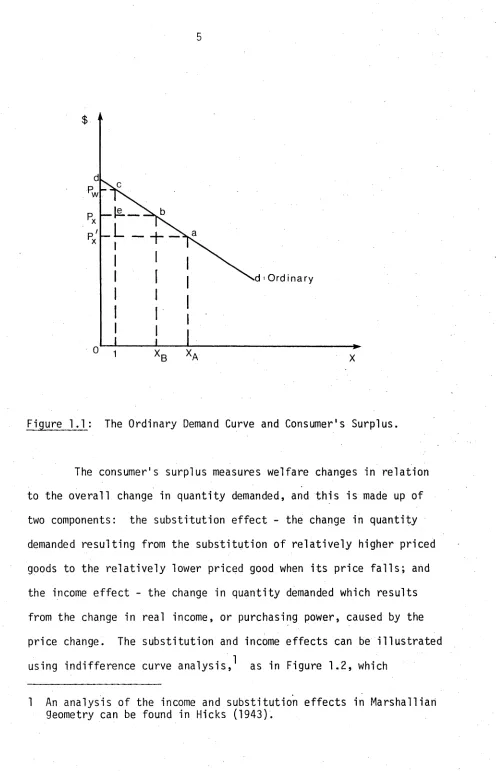
1.1 The Ordinary Demand Curve and Consumer's Surplus 5 1.2 Sub st it ut io n and Income E ff e c ts , the Compensated
Demand Curve and the Compensated Variation fo r
a Price Fall 6
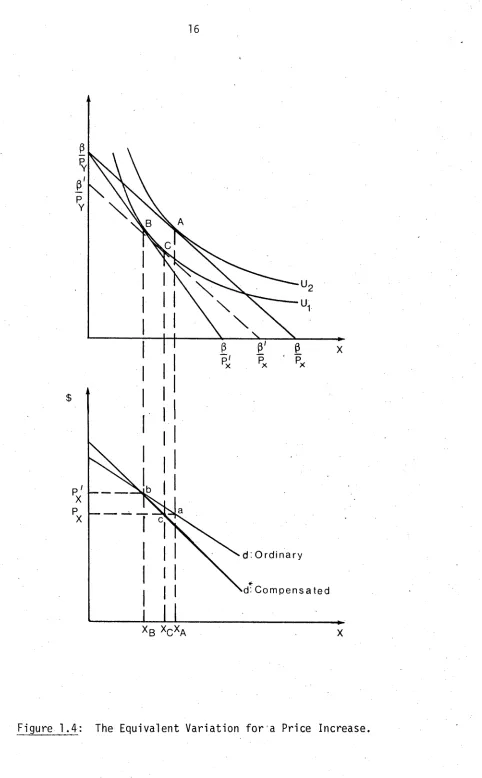
1.3 Compensated Surplus f o r an Increase in Quantity 11 1.4 The Equivalent Var iation f o r a Price Increase 16 1.5 A Comparison o f the Hicksian Measures and Consumer's 20
Surplus
2.1 Total U t i l i t y f o r Good X 53
2.2 The Sinden Derivation o f a U t i l i t y Curve f o r X given
Xg from the U t i l i t y Curve f o r X given 54
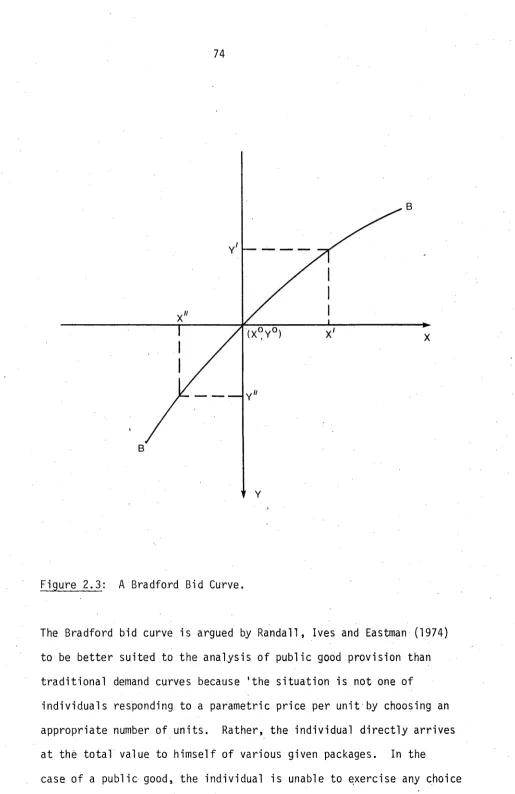
2.3 A Bradford Bid Curve 74
2.4 The Equivalent Surplus o f a Quantity Fall 76
3.1 The Clarke Tax Mechanism 107
4.A.1 A Positive Option Value 162
5.1 Nadgee Nature Reserve 179
8.1 Willingness to Pay, Group 1 252
8.2 Transformed Willingness to Pay, Group 1 (Absolute
Frequency) 259
8.3 Group 1 Transformed Willingness to Pay (Relative
Frequency) 268
8.4 Group 2 Transformed Willingness to Pay (Relative
Frequency) 268
8.5 Group 3 Transformed Willingness to Pay (Relative
Frequency) 269
8.6 Group 4 Transformed Willingness to Pay (Relative
Frequency) 269
8.8 A l l Groups Transformed Willingness to Pay
(Relative Frequency) 280
9.1 Normalized Discriminant Scores: Yes, Prepared to 311 Pay
9.2 Normalized Discriminant Scores: No, Not Prepared
to Pay 311
9.3 Plot o f Standardized Residuals against Standardized Predicted Willingness to Pay: Linear Regression
Form 331
9.4 Plot o f Standardized Residuals against Standardized
Predicted LWTP: Log-Linear Regression Form 337 9.5 ( i ) The Relationship between LHHINC and LWTP (grouped)
( i i ) Four Residuals Points from the 2.3 LWTP group
and t h e i r Relationship with Predicted LWTP 340 9.6 Plot o f Standardized Residuals against Standardized
Predicted L/WTP>,: Per-Household-Member Form 347 1 N '
xxi
INTRODUCTION
This thesis is concerned with the analysis of the provision
of preserved natural ecosystems - areas of land or water which have
been largely undisturbed by people,or which have been managed by
people so that the effects of any past human presence on the area
have been removed or substantially reduced.^ Preserved natural
ecosystems provide a-wide range of benefits for the community. Production
benefits are derived from a preserved natural ecosytem when either an input to the production process of a marketed good, such as silt-
free water run-off used by a farmer to water his stock, or a marketed
good itself, such as migratory fish, is derived from the area.
Recreation benefits are enjoyed by those participating in both active and passive use of natural areas,and include a range of activities
from skiing and surfing through to picnicing and wilderness exploration.
Health benefits are derived usually through recreation in terms of physical well-being, but mental well-being also may be improved by
the whole range of participatory uses. Similarly, aesthetic benefits
are enjoyed by users and passers-by who delight in the natural
beauty of a preserved area, but the same type of benefit may also be
1 Often, preserved natural areas are provided in association with developed facilities such as access roads, picnic sites and camping amenities - the comp!ementary relationship between preserved areas and associated facilities is
enjoyed by readers of books and pamphlets devoted to photographic representation of the area. These same readers and participatory users may enjoy e d u c a tio n a l b e n e f i t s from learning about the
natural ecosystem. Closely related to this type of benefit are the s c i e n t i f i c b e n e f i t s which may be gained by carrying out research
in areas largely untouched by people,to determine the effects of human inhabitance ,and to learn how to improve the environment which is
inhabited by people. Natural areas also provide people with g en e-p o o l m a in ten a n ce b e n e f i t s : by storing genetic material, such areas
provide a reservoir from which people can draw to help satisfy future demands. Finally, people can benefit from the knowledge that natural ecosystems, and the individual species which make up those ecosystems,
survive in a natural state - these benefits are known as e x is te n c e b e n e f i t s.
As an alternative to preservation, natural areas can be developed to produce timber, agricultural products, home s it e s , etc. However, the amount of natural ecosystem is clearly f i n i t e , whereas the aggregated wants of the community for such areas are both varied and insatiable. In other words, the stock of natural ecosystems available would never be able to create sufficient benefits to satisfy all the demands placed upon i t . This is one way of
stating the problem of s c a r c i t y : because of scarcity, competition between the infinite wants for, and hence uses of, natural ecosystems develops and b i t t e r conflict is often the outward manifestation of this competition. For instance, in October 1979 groups of
environmentalists (i . e . individuals with a high preference for preservation benefits) attempted to prevent bulldozers from clearing logging
x x ^ ^ t
In another c o n f l i c t , supporters of the preservation of the s o u th west Tasmanian wilderness marched in s t r e e t r a l l i e s in June 1980, while supporters o f the Tasmanian H y d r o - E l e c t r i c i t y Commission, the organization planning to generate e l e c t r i c i t y by damming several w il d and scenic r i v e r s in the area, attempted to shout down t h e i r op po si tio n' s speakers.
U l ti m a te l y , a choice between a l t e r n a t i v e uses, and th a t implies a choice between the s a t i s f a c t i o n o f competing wants, must be
made, and v i t a l to such a choice is the underlying approach, or ra ti o n in g device, on which the decision is based. In the Australian economy, the most common r a ti o n i n g devices are pr ic e s , determined by the i n te r a c ti o n of market and p o l i t i c a l forces: where governments consider tha t the operation o f market forces alone does not provide an a l l o c a t i o n o f resources which s a t i s f i e s t h e i r goals, inte rv en tio n
in the market, through price c o n tr o l s , ta x a t i o n , sub si diz ati on , e n try l i m i t a t i o n s e t c . , or a programme of public provision, may be
used to ensure a more suitable a l l o c a t i o n . In the case o f the
a l l o c a t i o n o f natural ecosystems between preservation and development a l t e r n a t i v e s , i t is clear from the actions o f State and Federal
Governments in A u s tr a li a ,th a t i nt e rv en ti on ,to the extent of public provision of areas o f preserved natural ecosystem,has been considered necessary.
To implement a p o lic y o f public p r ov is io n, governments face the problem of determining the "appropriate" level o f p r o v i s i o n .
2
viewpoint of society as a whole. However, while the costs of providing a preserved natural area can generally be ascertained from market information, many of the benefits of provision are more di f f i cul t to quantify in comparable units.
It is the purpose of this thesis to further the effectiveness of benefit-cost analyses of preserved natural ecosystem provision by considering the evaluation of the benefits which arise from this type of land use. Two major aims are addressed:
(i) the consideration of the theoretical aspects of measuring the value which the community places on the benefits of preserving areas of natural ecosystems; and,
(i i ) the application of the relevant theory to the measurement of one of those benefits - the existence benefits of a particular area of preserved natural ecosystem, Nadgee Nature Reserve, on the far South Coast of New South Wales.
2 Benefit-cost analysis is based on a specific definition of what is "appropriate": the Hicks-Kaldor hypothetical
compensation cr i t eri on, which accepts changes in resource allocation as being desirable if at least one person can be made better-off without making anyone worse-off after the payment of costless lump sum compensation. This criterion is essentially a practical version of the Pareto efficiency criterion and i t is important to recognise that the
achievement of Pareto efficiency does not imply any satisfaction of distribution goals - every different distribution of resources between individuals in society yields a unique allocation which
X X V
The purpose of this Introduction is to provide a setting for the main body of the thesis by considering two broad issues: f i r s t , the failure of markets to provide "appropriate" levels of preserved natural areas; and secondly, the su it a b il ity of benefit-cost analysis as an analytical tool used by governments in the process of assessing
3
the "appropriate" level of public provision. It is important to consider the characteristics of the benefits of preserved natural areas which would cause the failure of a hypothetical market for
such areas, in order to understand the reasons why government provision, and hence benefit measurement, is undertaken. In addition, the
close relationship that exists between benefit-cost analysis and the market process - ju st as the market will fail to provide
appropriate valuations of non-marketed benefits of preservation, so will the benefit-cost analyst have problems in determining the
magnitude of the same benefits - enables a consideration of the causes of market failure to provide information useful to the formulation and assessment of techniques designed to value non-marketed benefits for a benefit-cost analysis. While Section 1 of this Introduction indicates that the extent of market failure is considerable, the second issue, the caveats associated with the use of benefit-
cost analysis, considered in Section 2 , places the thesis in perspective by enabling a comparison of the problems of public provision with
those created by a reliance on market forces.
Despite the essentially non-analytical character of this
I n t r o d u c t i o n ^ is concluded that the results of benefit-cost analyses
of public provision of preserved natural areas can given pragmatic
guidance for governments deciding levels of supply, given the
assumption that all the benefits and costs of the proposals being
considered are measured accurately: i t is the fulfi llm en t of this
condition which is the major concern of the main body of the thesis.
The final task of the Introduction therefore is to provide an
outline of how this concern is addressed, with specific reference
to the dual aims of the thesis.
I . MARKET FAILURES
There are four basic characteristics of the benefits of natural
ecosystem preservation which create problems for the operation of
hypothetical markets for such areas: r a r i t y , jointness and non
excludability, i r r e v e r s i b i l i t y and merit.^ This section considers how
these characteristics create market failur e and the extent to which
the operation of a market will distort the allocation of natural
ecosystems away from Pareto efficiency: the allocation from which
no person can be made b e tte r-o ff without adversely affecting other
people.
xxv
a
1.1 Ecosystem Rarity
' Many natural ecosystems possessfeatures which e f f e c t i v e l y d i f f e r e n t i a t e those areas from t h e i r surrounding d i s t r i c t s : the r a r i t y o f the ecosystem i t s e l f , a species inh abi ti ng the ecosystem, or perhaps a geological feature contained w i th i n the area. However, the r a r i t y c h a r a c t e r i s t i c is a f a c t o r which may contribute to the under-supply of preserved natural areas: as T is d el l (1972) points out, the ' i n d i v i d u a l who owns a natural feature and has no competitors in the immediate neighbourhood . . . has a monopoly which may arise from the d i f f e r e n t i a t i o n of his product as well as from spatial e f f e c t s ' (p. 155). The e f f e c t o f monopoly ownership of preserved natural areas is a contraction o f supply away from the Pareto
e f f i c i e n t level of provision which equates supply and demand, to the 5 6
level which equates supply and marginal revenue. *
1.2 Jointness and Non-Excludability
Many o f the benefits of preserved natural areas embody the pu blic good c h a r a c t e r i s t i c s of joint nes s and n o n - e x c l u d a b i l i ty .^
5 In t h i s context, the level o f provision refers to both the a v a i l a b i l i t y o f access to preserved natural areas and the qu ant ity o f areas to which access is granted.
6 This r e s u l t is not true when the monopolist is able to practice pe rfect price d i s c r i m i n a t i o n , as is noted by T is d e ll (1972). 7 Samuelson (1954), (1955), (1958) recognized the d i s t i n c t i o n between pr iv a te and public goods - the public good ' d i f f e r s from a priv at e consumption good in th a t each man's consumption o f i t . . . is related to the t o t a l . . . by a condition o f eq u a li ty
rather than summation' ( p . 350 (1955)) and proved tha t Pareto e f f i c i e n c y was achieved when the summation of a l l i n d iv i d u a l s ' marginal rates
Jointness i s an extension o f the case o f decreasing costs in tha t once the j o i n t good is provided the marginal cost o f allowing f u r t h e r use of the good is close t o , o r equal t o , z e ro , and non e x c l u d a b i l i t y is an extreme case of the neo-classical d e f i n i t i o n
o
of external ( dis)economies in th a t once the non-excludable good is p r o v i d e d , i t is impossible to prevent be n e f ic ia ri e s from using
the good. To examine the occurrence o f joi ntness and n o n -e x c l u d a b i l i ty , and hence to determine the pos iti on on the "continuum" of goods
types which e xi s ts between the polar cases o f pure priv at e and pure public goods, each category of preservation be ne fi t w i l l be
considered.
Generally, the production benefits of natural ecosystem preservation are priv at e goods because they are defined in terms
of p r i v a t e l y marketed products. For instance, the commercially caught f i s h which were spawned in an area o f preserved natural ecosystem cannot be eaten more than once and i t is possible to exclude a po ten tia l consumer who has not paid f o r the meal.
Recreation benefits are often j o i n t in supply - th a t i s , an area of preserved natural ecosystem is av aila ble to additional recreational users at zero marginal cost • However the jointness c h a r a c t e r i s t i c may not be applicable at a l l levels o f recreational use - f o r instance, an ad dit ion al s k i e r on the slopes may reduce the benefits o f established skiers because of increased queueing
8 Buchanan and Stubblebine (1962) define an external (d is) economy or e x t e r n a l i t y as being present when 'the u t i l i t y o f an i nd iv id ua l is dependent on a c t i v i t i e s . . . th a t are
X X zx
times on f a c i l i t i e s and increased danger of co llision s, thus creating a situation where congestion causes non-zero marginal costs. Areas of preserved natural ecosystem may be non-excludable to recreational users, or at least i t may be too expensive to prevent non-paying
use5re la tive to the revenue which would be gained from policing entry. For example, many preserved natural areas frequented by bushwalkers have extensive boundaries with any number of easy access points, and even though i t may be possible,physically, to build a boundary fence and employ s u ffic ie n t rangers to patrol for non-paying users, the expense would be p ro h ib itiv e , thus e ffe c tiv e ly creating a non excludable good. However, exclud ab ility may be possible and feasible for s p a tia lly compact recreation areas, p a rtic u la rly i f the recreation is car based and there are only a small number of roads entering the area - th is is the case fo r boating at Kurringai National Park, near Sydney, and snow skiing at Kosciusko National Park.
Health benefits are usually enjoyed in association with recreation benefits and so the occurrence of the public good
characteristics within health benefits can be regarded as the same as that which has been described fo r recreation benefits. A similar pattern of occurrence for jointness and non-excludability could also be expected fo r educational and aesthetic benefits which are enjoyed by individuals who v i s i t the preserved natural area. However both the aesthetic and educational benefits of a natural ecosystem can be enjoyed by non-participatory users: publications
featuring preserved natural ecosystems provide readers with information on nature in addition to allowing the enjoyment of beautiful
use material based on natural areas; and, people passing-by a preserved natural area or neighbouring residents may enjoy the scenic beauty of an adjacent park. The benefits enjoyed by people reading books on preserved natural areas must be considered to be private,as i t is the book which is the relevant good rather than the goods which i t is portraying - the marginal cost of supplying the information contained in the book is the cost of producing an extra book, and despite the p o s s ib ility of book borrowing and photocopying,the material is essentially excludable. The case of educational benefits,derived by the non-user student,is similar to the book example in that i t is the education rather than the ecosystem i t s e l f which is relevant, but here, the education is not a private good because even though i t is excludable i t is jo in t in supply. F ina lly, the non-visiting aesthetic beneficiary enjoys a good which is jo in t in supply and is non-excludable when viewing a natural area from outside it s boundaries.
The occurrence of the public good characterisecs in gene - pool maintenance and s c ie n tific research benefits depends on the type of good which is derived eventually from these two uses of preserved natural ecosystems . When the genes stored in
a natural area are used by scientists to develop a cure for cancer, the resultant good is essentially private,but when natural ecosystem
research develops a more effective method of bushfly control, then
9 As is the case fo r recreational benefits, non-excludability may depend on the expense of erecting a s u ffic ie n tly high fence
(and roof, for those fly in g overhead) to exclude non-payers. I t may be noted that the property values of residences
surrounding a park are higher, but this premium is not a method of price exclusion but rather an internalisation into the
x x x i
the decrease in bushfly population which results is jo in t and non excludable. In both cases however, the informational aspects of the research may have public good characteristics:
even i f the cancer cure was patented, the information provided by the discovery which is both jo in t and non-excludable,may be s u ffic ie n t to enable the discovery of substitute cures, thus circumventing the patent.
The existence benefits of preserved’ natural ecosystems have strong public good characteristics: once an area is preserved, the knowledge thatthe p a rticular ecosystem, or species within that ecosystem,is preserved,is available at zero marginal c o s t , ^ and i t is almost impossible to prevent the transmission of the information on the existence of the area or species.
This b rie f review of the occurrence of jointness and non excludability in the benefits of preserving natural areas has shown clearly that a range of goods between the polar cases of pure private and pure public goods resu lt from the preservation of natural
ecosystems. Those benefits which do have public good characteristics can be grouped into two broad categories: those which exhibit
jointness but which can be price excluded (recreation,
health, participatory aesthetic,and participatory and teacher- based education benefits );and, those which exhibit both jointness and non exclud ab ility ("passer-by" aesthetic, and existence
benefits).^ To consider the effect on the level of provision of preserved natural areas of these characteristics, two groups- joint/excludable and joint/non-excludable - will be examined separately.
The market situation for a good which is joint in supply but excludable was analysed by Samuelson (1954). He argued that the optimal provision price set, consisting of prices equal to each individual's marginal valuation for the total quantity of the joint good provided, would not be achieved by market forces because an individual with a high marginal valuation for the joint good would turn to alternative low cost suppliers when asked to pay a
relatively high price. The resulting allocation of resources would be an underprovision of preserved natural areas offering joi nt but
12
excludable benefits.
The divergence from optimality is lessened somewhat when
production is carried out by a perfectly discriminating monopolist - if i t is assumed that the monopolist has full information on all
11 The classification of scient i fi c research and gene-pool maintenance benefits depends on the characteristics of the good which is derived and the type of information which
is associated with the good.
x x x i i i
users' marginal valuations to enable the correct setting of prices, and the abi l i t y to prevent retrading of the joint good, then optimal
13
provision will result. However, the practical problem of
determining consumers' preferences in the large numbers case - where individuals perceive that their actions have a minimal effect on the level of output, the incentive is for them to state their preferences for the joint good, when questioned by the monopolist, as zero, in the hope that they will be able to use the good without paying^ -will result, in general, in the monopolist under-providing preserved
15 natural ecosystems yielding joint/excludable goods.
One final point must be made concerning the optimality of private provision of joint supply goods in terms of the optimality of consumption. Consumption optimality occurs when only those
individuals whose marginal value is below the marginal cost are excluded from using the good,and in the case of joint goods,this
implies that no one with a positive marginal value should be excluded Clearly, any form of provision of preserved natural ecosystems is sub
13 See Head (1974) pp. 79-80 for a more detailed consideration of monopolistic provision of a joint ly supplied good.
14 If all consumers adopt this "free-riding" behaviour, zero output will result.
15 Coase (1974) uses lighthouses in seventeenth
optimal for the consumer if positive prices are charged: under provision is again the result.
The second category of benefits of preserved natural
ecosystems to be considered in terms of the optimality of private provision ,are the benefits which are both joint in supply and non excludable. The addition of the problem of non-excludability to the situation of a jointly supplied good,leads to a far more severe level of underprovision of preserved natural ecosystems: producers can no longer collect fees for the use of such areas,and any previously accepted set of optimal prices cannot be used to create production efficiency. The incentive for production is eliminated and i t would be expected that a zero level of provision of preserved natural areas,which provide only joint/non-excludable benefits ,would result from the operation of market forces alone.
It appears therefore, that private provision of
the joint ly supplied,but excludable benefits of natural ecosystem preservation will result in a sub-optimal, but positive supply
of such areas. However, there seems l i t t l e possibility of preserved natural areas being supplied by the open market i f they provide only joint and non-excludable benefits. Clearly, most preserved natural areas provide a mixture of most, i f not all of the benefits of preservation ,so as a general conclusion i t can be expected that the community will be under-suppl ied with such areas i f reliance is placed only on market forces.
I .3 ir re versi bi1ity
X X X V
of preserved natural areas by market forces is irreversib i1ity - once a natural ecosystem is developed, i t may be either impossible or prohibitively expensive to return all the area to its preserved natural state, whereas i f preservation is undertaken, i t remains possible for the development to take place at any time in the
future. An example of ir re v e rsib il ity is the case of a development project which causes the extinction of an animal species - an
action which can not be reversed. The characteristic of ir re versi bi1ity is not a problem to the optimal provision of preserved natural
ecosystems by private enterprise under conditions of certainty, so long as the private investor uses a sufficiently long time period of project appraisal,or includes in the decision calculus all asset values at the end of the project appraisal period i f this
16 period is based on the development projects lif e span.
However, when uncertainty is introduced, the optimality of the private provision of preserved natural ecosystem becomes less clear, with two main issues being raised: f i r s t » will private investors account correctly for the incidence of risk - that is, will the correct interest rate be used for private investment decisions involving natural ecosystems ; and secondly, will private investors account correctly for the uncertainty involved in future events - that is, is the use of the expected value technique applicable to decisions involving natural ecosystems?
A private investor faced with the choice of developing or
16 Long time horizons or the inclusion of terminal asset
preserving an area of natural ecosystem will incorporate any risk component into the decision making framework by adding a premium to the discount rate used to calculate the net present values of the streams of net earnings to be gained from each alternative. Tisdell (1972) notes that 'the addition of the premium increases the probability that the present discounted value of the plan for . . .
(development) . . . exceeds that for . . . (preservation)' (p. 159) because the benefits of preservation generally occur further into the future. Using the Arrow and Lind r e s u l t , ^ Tisdell argues that the appropriate discount rate for the evaluation of natural ecosystem allocations is the risk-free rate,and hence that private
investors, who use the risk-inclusive rate, may underprovide preserved natural a r e a s . ^
The second issue concerning the characteristic of
ir re v ersibi 1ity under uncertainty,is the acceptability of the use
17 Arrow and Lind (1970) show that the risk associated with government provision is extremely small because any losses incurred could be spread across the whole tax base.
18 The severity of under-provisicn may be moderated by the
public-good characteristics of the benefits of preservation: Fisher (1973) points out that the conditions underlying the Arrow and Lind (1970) result do not hold for public
goods because the risk associated with the loss of the benefits to the community is the same risk of loss to each individual. Ulph (1979) suggests that the Arrow and Lind result is
X X X V i i
of expected values to re fle c t the value of the benefits/costs which
accrue to an investment involving natural ecosystems. A private
investor considering the development/preservation choice would m ultiply each revenue and cost by the probability of it s occurrence before incorporating i t into the decision calculus - this process
is regarded by some economists as being inadequate because
of the fa ilu re to add an "option value" premium to the benefits of preservation. Option value was introduced by Weisbrod (1964) to describe the difference between the price a person was w illin g to pay to ensure the continued a v a ila b ility of a good which is subject to irreversible ity,and the expected value of actual use. Both Weisbrod and Cicchetti and Freeman (1971) argued that option value would be positive because of the need for a risk premium to be applied to an irre ve rsib le outcome when i t is assumed that society is made up of predominantly risk averse individuals. However,
Henry (1974b) proved that option value can take any sign and hence that the use of expected values, although almost certainly inaccurate fo r the in d iv id u a l,may be accurate for a community made up of a large number of people. To dispute this conclusion would
19 require empirical analysis of a type not yet undertaken.
While the concept of "option value" has been found to provide no reason for the mi sal location of resources by private entrepreneurs i t led to a more complete analysis of irreversible decisions overtime under uncertainty,and in pa rticu la r, to the
20 21 concept of "quasi-option value" or the " i r r e v e r s i b i 1i t y e f f e c t " . I f the i r r e v e r s i b l e development option is chosen, the opportunity to be ne fit from new information which indicates tha t the preservation option has become the preferred o p t i o n , i s l o s t because the
opportunity to reverse the past decision is l o s t : the re s u lt a n t bias toward development must be counteracted by the
addition of a quasi-option value premium to the benefits o f preservation. However Ulph (1979) demonstrates th a t even the quasi-option value
may be taken int o account by pr ivate owners o f natural ecosystems: while 'a simple comparison o f the choice between development and preservation using expected net benefits as a c r i t e r i o n neglects (the quasi-option value) aspect and so creates a bias in favour of development', Ulph (1979) suggests th a t 'w i t h any decision under uncertainty (the p r iv a te owner) should always consider not j u s t the immediate decision but also decisions about whether to obtain ad ditional information' (p. 67).
The f a i l u r e s of a hypothetical market may l e a d ,t h e r e fo r e ,t o an un der -provisionof preserved natural areas,not because o f the use
by pr ivate investors o f expected values to account f o r the uncertainty of future outcomes ,but rather by t h e i r incorporation of a premium f o r r i s k in the discount rate used to cal culate the present value o f investment projects,when i t is Pareto e f f i c i e n t to use a ri s k l e s s rate.
I .4 Merit
A number of the benefits o f preserved natural ecosystems are argued to possess the c h a r a c t e r i s t i c s o f a "m e ri t good": th a t i s , 20 A name coined by Arrow and Fisher (1974).
x x x i x
the aggregate of the revealed preferences for preserved natural ecosystems of the individuals comprising society does not represent the preference of society as a whole fo r such areas. Two reasons
are advanced by Head (1974) for the c la s s ific a tio n of a good as a -"merit good": a lack of information concerning the good, resulting
in individuals revealing preferences which are not indicative of th e ir true demand; and, the " ir r a t io n a lit y " of minors, again resulting in an inaccurate revelation of true preferences. Boyden and Harris (1978) argue, by implication, that the health benefits of preserved natural areas are not widely known, and th is ju s t if ie s the intervention of governments to ensure adequate provision. Sim ilarly, Costin
and Marples (1971) and Dasmann (1975) stress the ecological concept that people and nature are so closely interrelated that any
substantial deterioration in the v i a b i l i t y of the gene-pool w ill
cause the eventual downfall of the human species, with the implication that, because most people are unaware of th is in te rrelatio nsh ip,
the gene-pool maintenance benefits of preservation must be viewed 22 23
as merit goods. *
22 Even i f the whole community is perfectly informed regarding the relationship between man and nature, the jointness and non-excludability character!*sties of the gene-pool in this respect would almost certa inly result in sub-optimal provision of preserved natural areas.
23 A somewhat d iffe re n t argument is advanced by Godfrey-Smith
(1980),who suggests that society should consider the preferences of plant and animal species in addition to human preferences when deciding between preservation and development options. The d i f f i c u l t y of achieving such a policy is obvious but i t
The divergence from Pareto efficiency which is caused by the merit good aspects of the preservation of n a t u r a l areas
is d i f f i c u l t to assesses i t is dependent primarily on the amount of
i n f o r m a t i o n a v a i l a b l e t o ,and used by individuals. Perhaps a more acceptable method of overcoming the sub-optimality of provision of preserved areas due to merit good aspects is for governments to intervene in the provision of information regarding the benefits of preservation.
1.5 Conclusions
The characteristics of the benefits of preserved natural
ecosystems - r a r i t y , jointness and non-excludability, i r r e v e r s i b i l i t y and merit - a l l contribute to the fa il ur e of a hypothetical market to achieve a Pareto e f f i c i e n t level of provision of such areas:
s p e c if ic a ll y , u n d e r - p r o v i s i o n would result from the operation of market forces alone. The extent of u n d e r -p r ov i si o n has been shown to be
dependent on the mix of benefit characteristics provided by each
diffe rent area: while areas providing benefits which are rare, j o i n t , meritorious and irreversible but price excludable may be operated
by private enterprise ( p a rti c u la rly i f price discrimination can be practiced) at levels which are not substantially different from Pareto e f f i c i e n t levels, areas involving non-excludable benefits w i l l be s i g n i fi c a n tl y under-supplied, i f indeed they are supplied at a l l , by private operators.
x l i
the resource i t is clear that government action has the potential to provide such improvements, particularly when non-excludable
benefits are involved. It is the purpose of the next section of the Introduction to consider the ability of governments to maximize their potential for the achievement of Pareto improvements in the supply of preserved natural areas.
II. PUBLIC PROVISION
Governments have two basic options to consider as methods for attempting to improve the market allocation of preserved natural ecosystems - the payment of a subsidy to owners of natural ecosystems who decide to preserve their area,or the purchasing and operation of areas suitable for incorporation into a network of National Parks and Nature Reserves. Because the payment of a subsidy implies that
25
the private owner will continue to charge an entry fee, a situation 24
24 Scott (1979) argues that the short term of office facing most governments creates a situation in which the benefits accruing to future generations are not incorporated adequately into the decision framework and concludes that private enterprise can
provide optimal levels of goods such as preserved natural ecosystems i f the property rights for such areas are established so that
residents close to a preserved area operate i t commercially. Clearly this argument ignores the inability of the residents group to charge for the non-excludable benefits provided. Dolan (1971) believes that governments will over-supply wilderness areas because of the strength of preservation lobby groups and suggests that optimal provision can be achieved by allowing all National Parks to be auctioned so that conservation organisations could purchase them. While i t is not clear that preservation lobby
groups in Australia have a political advantage over their development counterparts, Dolan's auction suggestion also ignores the occurrence of non-excludable benefits.
which is sub-optimal in consumption when the good is joint in
production, the option providing the maximum opportunity for Pareto
improvement is public provision. The most extensively used economic
technique for determining the level of provision which the government
should attempt to achieve, is benefit-cost analysis (BCA), a process
which weighs the advantages and disadvantages of a change in resource
allocation, considered from the viewpoint of society as a whole.
This section of the Introduction considers the ability of BCA to
provide governments with information sufficient to ensure an
allocation of natural ecosystems which is a Pareto improvement over
private provision,by analysing the problems which confront BCA: the
problems associated with the transformation of theoretical welfare
economic considerations into the practical context of BCA; the use
of BCA, which is a partial equilibrium technique, in a general
equilibrium context; and finally, the practical implementation of
BCA.
11.1 Welfare Economics and the Limitations of BCA
A change in resource allocation is Pareto efficient if and only
if at least one individual is made better-off without making any other
individuals worse off. Clearly, the Pareto criterion is excessively
restrictive in a real world context where almost any change in resource
allocation will result in a net cost to some people. While the
Xllll
appl icat ion of the Pareto c r i t e r i o n could be achieved i f costless
lump-sum compensation payments were made by the bene fi ci ar ie s
of a resource a ll o ca ti o n change to those who bear the costs, the
p o s s i b i l i t y of such costless comepens'ations being paid is small
and the problem of pr act ical appl icat ion remains. BCA overcomes
the problem by using the Kaldor-Hicks concept of hypothetical
compensation: a change in resource a l lo ca ti on s a t i s f i e s the
Kaldor-Hicks c r i t e r i o n i f the be ne f ic i ar ie s of the change can compensate
those bearing the costs (with the compensation being in the form
of a "batch" of goods) even though the compensation payments are
not necessarily made. The be ne f it - cos t analyst i nt er pr et s the
Kaldor-Hicks c r i t e r i o n as r equiring the measured benefits to. society of
the a l l o ca t i on change to be greater than the associated measured
costs.
The use of the hypothetical compensation c r i t e r i o n as a
pract ical version of the Pareto c r i t e r i o n produces fundamental
weaknesses in the t he or et ic al oase of BCA. F i r s t , Scitovsky noted
t hat i t was possible f or an e x - a n te analysis of a resource
al lo cat i on change to indicate that a change from a l t e r n a t i v e A to
a l t e r n a t i v e B s a t i s f i e d the Kaldor-Hicks c r i t e r i o n and f o r an
e x - p o s t analysis to indicate that B was superior to A by the same
c r i t e r i o n . Secondly, Boadway (1974) showed that the method used
in BCA to determine whether benefits exceed costs ( that the absolute
value of the positive compensating v a r i at i on in income to gainers
27 The Scitovsky "reversal paradox" is outlined by Dasgupta and Pearce (1974) pp. 59-60 - they note t ha t the explanation of the paradox l i e s in ' the change in income d i s t r i b u t i o n between
be g r e a t e r t han t he a b s o l u t e val ue o f t h e n e g a t i v e compensat i ng v a r i a t i o n s in income t o t h e l o s e r s ) pr o v i d e s a n e c e s s a r y b u t n o t s u f f i c i e n t c o n d i t i o n f o r t h e s a t i s f a c t i o n o f t h e Kal dor-Hi cks
29
c r i t e r i o n . BCA, because o f i t s r e l i a n c e on t h e Kal dor-Hi cks c r i t e r i o n vi a t h e compensat i ng v a r i a t i o n measurement t e c h n i q u e , i s weakened c o n s i d e r a b l y as a means by which governments can r e c o g n i z e
28 The use of t h e compensat i ng v a r i a t i o n in income i s c o n s i d e r e d in d e t a i l by Chapt er 1 o f t h i s t h e s i s .
29 Boadway's argument i s c l a r i f i e d and g e n e r a l i s e d by Smith and Stephen (1975) who p r e s e n t t he f o l l o wi n g diagram as a cas e in which a p o s i t i v e n e t compensat i ng v a r i a t i o n
(CV) i s c a l c u l a t e d when t h e r e i s an ambiguous movement between community i n d i f f e r e n c e c ur ves (CIC-j t o CIC2) -
i . e . i t i s not p o s s i b l e t o s t a t e t h a t t h e movement
r e p r e s e n t s an improvement or a d e t e r i o r a t i o n in community well bei ng.
CIC2 good Y